Showing posts with label 2003. Show all posts

Wednesday, May 6, 2026

Second Look - Devil May Cry 2

Note: This review contains spoilers for Devil May Cry 2

Near the end of the production of the original Devil May Cry (DMC1), Capcom struck while the iron was hot and greenlit a sequel. Unfortunately, this sequel faced a very troubled production under its original director, who remains anonymous to this day. When Capcom assigned the second director, Hideaki Itsuno, to the project, he was shocked by the lack of any real progress, which amounted to almost nothing aside from the Stinger animation. With only a few months left, he built pretty much the entire rest of the game from scratch. The end result, Devil May Cry 2 (DMC2), released on the PS2 in 2003 to poor reviews, though it still established some series conventions and had high sales numbers. The game’s development disaster also motivated the team to improve their work, with most staying on for future entries. In fact, near the end of development, Itsuno successfully convinced Capcom to let him direct Devil May Cry 3: Dante’s Awakening from scratch because he didn’t want to be forever known as “the guy who directed DMC2.”

In the years since its release, DMC2 has gained a reputation as the worst game in the series, even more so than the controversial reboot, DmC: Devil May Cry (DmC). It really is. However, I’ve also felt unsatisfied with my coverage of the game in the past, both in my review of the original PS2 version and the other when talking about the Devil May Cry HD Collection as a whole. Since I re-reviewed DMC1 in the context of its origin as Resident Evil 4, I decided that even though DMC2 is certainly the worst game in the series, it deserved a better and more in-depth look. As with my re-review of DMC1, this re-review is based on DMC2 as presented in HD Collection.

Wednesday, December 3, 2025

Sonic Heroes (Xbox)

Note: This review contains spoilers for Sonic Adventure 2 and Sonic Heroes.

Following the release of Sonic Adventure 2 (SA2), the previously unthinkable happened when Sega went third-party and started developing titles for non-Sega consoles and handhelds, including Sonic Advance, which officially ended the long-standing rivalry with Nintendo. When Sega showed interest in developing a multi-platform Sonic game, Sonic Team USA landed on a team-based concept to take advantage of the capabilities of newer hardware. Since the new title, Sonic Heroes (Heroes), would celebrate the series’ twelfth anniversary, they also decided that they would create a standalone experience closer to the Genesis games instead of a third Adventure entry, both due to the number of numbered sequels hitting the market and out of a desire for accessibility. The final game would launch in 2003 to mixed reception, but still sold very well and led to the development of 2005’s Shadow the Hedgehog.

Unlike some of the other Sonic games I’ve reviewed recently, I actually have more of a personal history with this one. When it first came out, it was one of the first Sonic console games I owned, so I played it obsessively, yet I couldn’t ever finish the game. At some point, I didn’t have my PS2 copy anymore, though an original Xbox that I bought still had a copy in the disc drive, so I ended up playing that copy for the purpose of this review (the disc had seen better days, but the data layer still looked fine). Fortunately, the disc held up well as I finally completed Heroes over twenty years later and concluded that it’s built around a neat idea with a tedious and frustrating execution.

Saturday, August 9, 2025

Freaky Friday (2003)


While Disney is no stranger to adaptations, the novel Freaky Friday by Mary Rodgers is one that the company has made into a franchise with multiple unique adaptations for each generation since 1976. Perhaps the most well-known of these is the third adaptation of Freaky Friday from 2003, starring Jamie Lee Curtis and Lindsay Lohan, which was also the one that was advertised to me as a kid. Though I had always had the curiosity about it in the back of my head, I didn’t watch it in earnest until the announcement of a 2025 sequel to it, dubbed Freakier Friday. After streaming the movie through Disney+, I not only enjoyed it more than I expected, I also thought it mostly aged surprisingly well.

Saturday, March 1, 2025

Daredevil (+ Director's Cut)

Note: This review contains spoilers for Daredevil.

In a post-MCU world, it can be difficult to remember a time when Marvel had licensed their properties to other studios in the 2000s, even more so the films that didn’t reach the same notoriety as some of Fox’s thirteen X-Men films or Sam Raimi’s Spider-Man trilogy at Sony. One of these films was Daredevil, starring Ben Affleck and released by Fox in 2003. Although it received mixed reviews from critics, it still saw some success at the box office, earning $178 million against a budget of $78 million, and spawned the Elektra spinoff film, itself a box office bomb. Based on the reviews at the time, as well as negative word of mouth and Ben Affleck earning a Golden Raspberry Award for Worst Actor, I went in expecting a cinematic trainwreck on par with other duds like Batman & Robin or Fant4stic. Instead, I saw a film that, while flawed in execution, represented a bold step forward for grounded cinematic takes on comic book superheroes.

Saturday, December 21, 2024

Tokyo Godfathers


Note: This review contains spoilers for Tokyo Godfathers

Satoshi Kon, arguably one of Japan’s greatest anime film directors, was an absolute master of his craft, taking full advantage of hand-drawn animation by seamlessly blending fantasy and reality in ways that only that medium can. However, even though he had primarily directed dramas and psychological thrillers, in the case of Paranoia Agent even tackling various societal issues, his third feature, 2003’s Tokyo Godfathers, stands out from the rest of catalogue. Not only does it downplay the blending of fantasy and reality, it’s actually his most grounded work and, taking inspiration from the 1948 film 3 Godfathers, is more sentimental and uplifting. Despite this contrast with other works, however, Satoshi Kon never lost his unique touch and made a film worthy of adding to a Christmas rotation.

Thursday, July 4, 2024

X2


Note: This review contains spoilers for X-Men

Like many other superhero films, both past and future, 2000’s X-Men proved so successful that Fox immediately commissioned a sequel, X2 (also marketed as X2: X-Men United). While the production didn’t proceed without its own hiccups, including budget cuts, rewrites and on-set disputes, Director Bryan Singer’s concept of a more personal angle and having a human villain persisted throughout the writing process, with the initial outline based on Chris Claremont’s X-Men: God Loves, Man Kills graphic novel (which we haven’t read at the time of this writing). When X2 finally released in 2003, it received rave reviews, with critics considering it a rare time when a sequel surpassed the original (although this sentiment wasn’t universal). As a modern viewer experiencing the full X-Men film series for the first time, I found myself agreeing with the critics of the time and thought the film actually aged pretty well and felt like a breath of fresh air from other superhero films from recent memory.

Monday, December 18, 2023

Tron 2.0: Killer App (Xbox)

Note: This review contains spoilers for Tron and Tron 2.0

Back in 2010, Disney released Tron: Legacy, the official sequel to the 1982 film Tron, which had gained a cult following at the time. While most modern Tron fans would know of Legacy (often erroneously labeled a reboot) and maybe its spinoff media, including the criminally underrated Tron: Uprising, few today may remember that Tron once had a different official sequel, a video game appropriately titled Tron 2.0, as far back as 2003. Monolith Productions, perhaps best known now for F.E.A.R. and the Middle-earth games, developed the original PC version of Tron 2.0, which would receive two mobile versions (subtitled Light Cycles and Discs of Tron) developed by Lavastorm Analytics, an Xbox port (subtitled Killer App) developed by Climax LA (who would later develop Silent Hill: Origins and Silent Hill: Shattered Memories) and a Game Boy Advance prequel (also subtitled Killer App) developed by Digital Eclipse. All versions of the game received mixed to positive reviews from critics, though the game unfortunately didn’t sell very well and the publisher, Buena Vista Games, dropped support for the game two years later.

My own memories of Tron 2.0 date back to around the year of release, or maybe a little later, when I saw a boxed copy on a retail shelf and never picked it up despite liking the original Tron. Even after I got into Tron: Legacy (Legacy) and its related media, I still had that memory in the back of my mind and found myself growing more curious about what could have been. This year, I finally sated my curiosity through the Xbox port (henceforth referred to as Killer App for the purpose of this review) in time for not only the thirteenth anniversary of this blog, but also, coincidentally, the twentieth anniversary of the game itself. While the Xbox Killer App version has some technical issues, likely brought on by the porting process, I found myself having a fun time and curious about what could have been for the franchise if it had continued in this direction.

Saturday, December 2, 2023

Elf


As time goes on, more Christmas films are considered classics of their genre or, depending on who you ask, staples of the season. One of these is Elf, a 2003 comedy directed by Jon Favreau and starring Will Ferrell. Back when I was only eleven, I saw the film during its original theatrical run and although I had enjoyed it, I never saw it again for one reason or another. Years later, I would see the film referenced more and more to the point where I thought I would give it another try, both to experience it with essentially fresh eyes and see if it was worthy of the praise others had given it. Twenty years after its initial release, I feel it’s safe to say that not only did it hold up pretty well on its own merits, it was actually better than I had remembered.

Friday, October 7, 2022

Silent Hill 3


In the years since their original release, the Silent Hill games, particularly the entries developed by Team Silent, have maintained a reputation as some of the scariest horror games ever created. Unfortunately, general neglect from Konami, the series’ publisher and IP holder, following the infamous delisting of P.T. has caused a scarcity of the Team Silent entries and increased the monetary barrier of entry for fans of the console releases who either don’t want to deal with emulation or don’t have access to a PS3. This hit 2003’s Silent Hill 3 (SH3) particularly hard, considering it never received a digital rerelease, unlike Silent Hill (SH1) and Silent Hill 4: The Room, and outside of Silent Hill HD Collection only had a console release on the PS2. As such, without a cheaper Xbox copy to fall back on, secondhand North American copies easily go for over $100, even floating around $200 if you also want the soundtrack that it originally came with.

Since I was unfortunate enough to get into the series late, I was one of those who ended up paying about $180 for a complete PS2 copy in good condition and even then, I wondered how long it would take for buyer’s remorse to sink in. As such, I did everything possible to get the most value out of my copy, including playing on multiple difficulties, viewing every ending and obtaining or viewing just about every secret I could. After all of that, did the game hold up to its reputation as one of the best and scariest games in the series? Yes. Is it worth paying the unnecessarily high price point to experience it? No.

Saturday, July 23, 2022

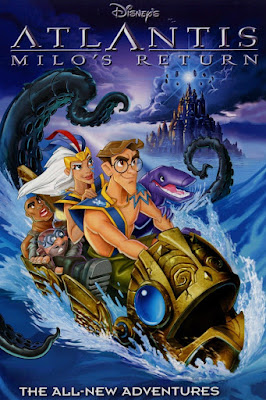
Atlantis: Milo's Return


Note: This review contains spoilers for Atlantis: The Lost Empire.

Of all the IPs Disney owns, one of the most overlooked is Atlantis, which revolves around the lost city of Atlantis. Though the original 2001 film, Atlantis: The Lost Empire, has managed a cult following within the last twenty years, it didn’t do as well at the box office as Disney had anticipated. As such, any further plans for a franchise were scrapped, including a TV series called Team Atlantis. Before Team Atlantis’ cancellation, however, three episodes were produced. Not wanting the effort to go to waste, these episodes were combined into a DTV feature, Atlantis: Milo’s Return, with some new animation tying the episodes together. Gauging critical reception is difficult, though Milo’s Return is typically viewed as a subpar effort in comparison to The Lost Empire. Looking as it now, it’s hard not to see why, but the rare window into what could have been makes it more interesting.

Wednesday, May 18, 2022

Kao the Kangaroo: Round 2 (PC)


Among the more obscure mascot platformers, Kao the Kangaroo from Polish developer Tate Interactive (now Tate Multimedia) was one that had slipped under my radar. So much, in fact, I was not fully aware of it until the second game, Kao the Kangaroo: Round 2, was released on Steam in 2019, when it was offered for free for 24 hours to promote a new Kao game in development. Since I knew it was the second game in the series, I tried looking into playing the first game, only to find that it was both hard to find and expensive second-hand. With this in mind, I opted to skip straight to the second game in order to see what exactly Kao the Kangaroo was. For a game originally released on sixth-generation consoles, I thought it held up really well, though not without issue.

Wednesday, February 16, 2022

Vexx (Xbox)


Acclaim Studios Austin, aka Iguana Software, is perhaps best known for developing the Turok franchise, though one of their last games was an obscure platforming game in 2003 by the name of Vexx. My interest in this game came from stumbling upon mentions of it online, and my curiosity took over from there. Since then, I had deliberated on whether to actually try it, even after learning of its difficulty, only to commit to taking the plunge when I found a complete physical Xbox copy of the game in the wild. Despite the difficulty level and some technical issues that became very apparent as I continued playing, I don’t regret my time with the game and even agree with the idea that it deserves more attention.

Tuesday, December 7, 2021

EyeToy: Groove


After EyeToy: Play showed off the power of the EyeToy, London Studio followed it up with a rhythm game known as EyeToy: Groove, the second game released overall specifically for the peripheral. I admit I did not have this game when it first came out, however I did become curious when, along with other EyeToy games, I found it for very cheap used at Amoeba as a way to get more mileage out of the accessory since I still owned one. While I am satisfied knowing how it worked as an early attempt at a motion control rhythm game, I couldn’t help but feel a little let down after seeing what EyeToy: Play had to offer.

Monday, December 6, 2021

EyeToy: Play


Of the various peripherals released for the PS2, one of its most experimental and overlooked is perhaps the EyeToy, originally released in 2003. At the time it came out, it was an early serious attempt at motion control gaming, where it didn’t require a traditional controller and instead relied on using your body through the EyeToy camera. If you're unfamiliar with the EyeToy and this description sounds familiar, its modern day equivalent is the Xbox Kinect peripheral, released in 2010. While there were a good number of games during its lifespan that were specifically designed for the EyeToy, only eight of them ever made it to North America.

The EyeToy was originally packed with a game known as EyeToy: Play, a collection of minigames designed to show off the capabilities of the peripheral. Aside from its later sequel EyeToy: Play 2, this was the only EyeToy game I had at the time and so I have some nostalgia for this particular game. After revisiting the game for review purposes, I found that the fun factor was still there.

Monday, November 8, 2021

Prince of Persia: The Sands of Time (Game)


If there’s one series that has unfortunately faded into obscurity, it’s Ubisoft’s Prince of Persia, created by Jordan Mechner. Despite the prestige brought on by the Sands of Time trilogy, Ubisoft’s focus shifted to other endeavors, like Assassin’s Creed, and the general public stopped talking about it. With a remake of the first game, The Sands of Time, in the works, I finally played the original release, which has a reputation as one of the best games ever made, plus a script written by Jordan Mechner himself. Fortunately, this game lives up to its reputation and combines story and gameplay in ways that I wished more games had attempted.

Saturday, July 3, 2021

Holes


Of the many (many) films I had watched growing up, I have distinct memories associated with Holes. Around the time I had watched Holes during its initial theatrical run, I was reading the original novel by Louis Sachar, who also wrote the adaptation, and had actually finished reading the book in the theater right before the lights dimmed. Though I don’t remember every detail from the book, many elements of the film stuck with me for eighteen years, which ultimately led me to rewatch the film. To my surprise, Holes held up really well and stands out as an example of great storytelling that anyone can get into.

Thursday, May 6, 2021

Second Look - Star Wars: Clone Wars (2003)


Note: This review contains spoilers for Star Wars: Clone Wars (2003) and the Star Wars Prequel Trilogy.

In the time between the releases of Star Wars Episode II: Attack of the Clones and Star Wars Episode III: Revenge of the Sith, a series of animated shorts was produced to help bridge the gap between them, under the title of Star Wars: Clone Wars, directed by Genndy Tartakovsky of Samurai Jack fame. The series was originally two Seasons of 10 episodes each, each lasting 3-5 minutes, however positive reception led George Lucas to commission a third Season consisting of five episodes lasting 12-15 minutes, with the intent of providing a direct lead-in to Revenge of the Sith. The series was later compiled into two hour-long features spread across two DVD volumes, the first compiling Chapters 1-20 and the second Chapters 21-25, however this would later be superseded by the 2008 series Star Wars: The Clone Wars, and even declared part of the non-canon Legends continuity by Disney following their purchase of Lucasfilm.

Having grown up watching Samurai Jack when this series first came out, and being caught up in the Prequel Trilogy hype at the time, I made sure to catch every episode as they came on, even the very short ones, and the strong animation and character writing never failed to disappoint. I even got the two DVDs as they came out, which has since made it much easier to re-watch the series over the years even without the context of the trilogy it was based on. Despite this series being officially designated non-canon material, I choose to pretend it still is for reasons that will become evident. While going through a re-evaluation of the Prequel Trilogy, however, I decided it would be good idea to revisit this series again in between Episode II and Episode III. While my general positive opinion of the series hasn’t changed much, I must admit I got a lot more out of it with the full context of the Prequel Trilogy’s events.

Wednesday, January 27, 2021

Bombastic

After the release of Devil Dice, developer Shift would produce a handful of other titles related to it, however only one of them, Bombastic (XI Go in Japan), would see a release outside Japan. Between these two games, I actually ended up playing Bombastic first, which I picked up for cheap from a GameStop back when they still sold PS2 games. I enjoyed my time with it, however I spent most of my time with it on one mode and gave up when the final boss proved to be too difficult for me. Upon finally getting to play Devil Dice, I decided to revisit Bombastic and actually explore its other offerings, finding myself enjoying it just as I did back then.

Friday, September 4, 2020

Tony Hawk's Underground (PS2)


Note: This review contains spoilers for Tony Hawk's Underground

Tony Hawk’s Pro Skater 4 set a precedent for later games in the series to go more open-world, however the next entry, Tony Hawk’s Underground, takes this a few steps further. Rather than playing as one of many professional skaters, this time the game is about you, the player, trying to become a professional skater, even introducing a story mode to the series. Though times have changed since the game’s release in 2003, their first attempt at a story-driven Pro Skater game was handled surprisingly well and still somewhat resonates to this day despite some mechanical flaws.

Thursday, October 31, 2019

SpongeBob SquarePants: Battle for Bikini Bottom (PS2)


When SpongeBob SquarePants: Battle for Bikini Bottom, based on the long-running SpongeBob SquarePants cartoon on Nickelodeon, was first released in 2003, I did not actually own any of the home consoles it was initially released on, and so had to settle with experiencing the PC version, which was presented as a point-and-click game. If memory serves, it was generally serviceable, however for years I had been wanting to see what the console version was like, even after finally getting a PS2 as a gift just as the PS3 was around the corner. After finally getting a PS2 copy of the game a few months ago, I was just planning on playing it after playing through the Spy Fox trilogy when a remake was announced by THQ Nordic for later this year, entitled SpongeBob SquarePants: Battle for Bikini Bottom – Rehydrated, which promises a Crash Bandicoot-style graphical upgrade and the inclusion of a number of cut content from the original release, making me anticipate playing the original even more to see what it was like. After getting the experience I always wanted, I found the game had held up surprisingly well, even with some minor setbacks.