Showing posts with label Genndy Tartakovsky. Show all posts

Thursday, May 6, 2021

Second Look - Star Wars: Clone Wars (2003)


Note: This review contains spoilers for Star Wars: Clone Wars (2003) and the Star Wars Prequel Trilogy.

In the time between the releases of Star Wars Episode II: Attack of the Clones and Star Wars Episode III: Revenge of the Sith, a series of animated shorts was produced to help bridge the gap between them, under the title of Star Wars: Clone Wars, directed by Genndy Tartakovsky of Samurai Jack fame. The series was originally two Seasons of 10 episodes each, each lasting 3-5 minutes, however positive reception led George Lucas to commission a third Season consisting of five episodes lasting 12-15 minutes, with the intent of providing a direct lead-in to Revenge of the Sith. The series was later compiled into two hour-long features spread across two DVD volumes, the first compiling Chapters 1-20 and the second Chapters 21-25, however this would later be superseded by the 2008 series Star Wars: The Clone Wars, and even declared part of the non-canon Legends continuity by Disney following their purchase of Lucasfilm.

Having grown up watching Samurai Jack when this series first came out, and being caught up in the Prequel Trilogy hype at the time, I made sure to catch every episode as they came on, even the very short ones, and the strong animation and character writing never failed to disappoint. I even got the two DVDs as they came out, which has since made it much easier to re-watch the series over the years even without the context of the trilogy it was based on. Despite this series being officially designated non-canon material, I choose to pretend it still is for reasons that will become evident. While going through a re-evaluation of the Prequel Trilogy, however, I decided it would be good idea to revisit this series again in between Episode II and Episode III. While my general positive opinion of the series hasn’t changed much, I must admit I got a lot more out of it with the full context of the Prequel Trilogy’s events.

Sunday, September 22, 2019

Genndy Tartakovsky's Primal - Tales of Savagery


Genndy Tartakovsky has made a name for himself in the animation industry, best known for works such as Dexter’s Laboratory, Samurai Jack and Star Wars: Clone Wars (2003) (and, to a lesser extent, Symbionic Titan), along with directing the Hotel Transylvania series of films (of which I have seen the first). As a fan of his work, including [adult swim]’s Samurai Jack Season 5, I was excited to see what he’d do when his next [as] series Primal was announced, for which a selling point was a complete lack of dialogue, a step up from Samurai Jack’s more conservative use of dialogue. With Primal’s air date drawing nearer, I stumbled upon a limited theatrical screening of the series at the Downtown Independent LA (still going as of this writing) that would take place prior to the TV premiere, and so I took advantage of the opportunity to see what the show would be like. After taking the chance, I walked away highly impressed with what Tartakovsky had accomplished.

Saturday, December 5, 2015

Stubs - Star Wars: Clone Wars (2003)


Star Wars: Clone Wars (2003) Starring the voices of: Mat Lucas, James Arnold Taylor, Tom Kane, Grey DeLisle, Anthony Daniels, Corey Burton, Andre Sogliuzzo, Richard McGonagle, Nick Jameson. Directed by Genndy Tartakovsky. Written by Bryan Andrews, Mark Andrews, Darrick Bachman, Paul Rudish, and Genndy Tartakovsky. Based on characters created by George Lucas. Color U.S.A. Animated, Science Fiction. Run times: 69 and 64 minutes.

Following the conclusion of his Samurai Jack series, Genndy Tartakovsky was approached by LucasFilms to produce one-minute segments about the Clone Wars, an event mentioned in the Star Wars mythology. Tartakovsky agreed as long as the segments could be 3 to 5 minutes and pitched the idea as having “a Band of Brothers-feel to it—where it's episodes of different battles and strategies during the Clone Wars.” Lucas, who would serve as Executive Producer, apparently gave Tartakovsky all the major events during the Clone Wars.

Released between Star Wars Episode II: Attack of the Clones (2002) and Star Wars Episode III: Revenge of the Sith (2005), Star Wars: Clone Wars appeared on Cartoon Network. Season one consisted of ten 3 minute long episodes and ran for 10 days over 2 weeks, between November 3 and November 20, 2003. A second season of ten additional 3 minute series ran the following spring from March 26 to April 8, 2004. These two seasons would be cut into a feature length (69 minutes) story line and released on DVD on March 22, 2005.

Taking place after Attack of the Clones, the story deals with the actual Clone Wars, which is really only hinted at, in the feature films. Jedi Knight Obi-Wan Kenobi (James Arnold Taylor) is assigned to lead an assault on the home planet of the Intergalactic Banking Clan, financial backers of the Confederacy of Independent Systems, which wish to break away from the Galactic Republic.

Obi-Wan leading troops into battle.

Over his objections, Obi-Wan’s apprentice, Anakin Skywalker (Mat Lucas), is appointed to lead the space forces at the instance of Supreme Chancellor Palpatine (Nick Jameson), the secret alter ego of Sith Lord Darth Sidious.

Chancellor Palpatine is also Darth Sidious, the Sith Lord.

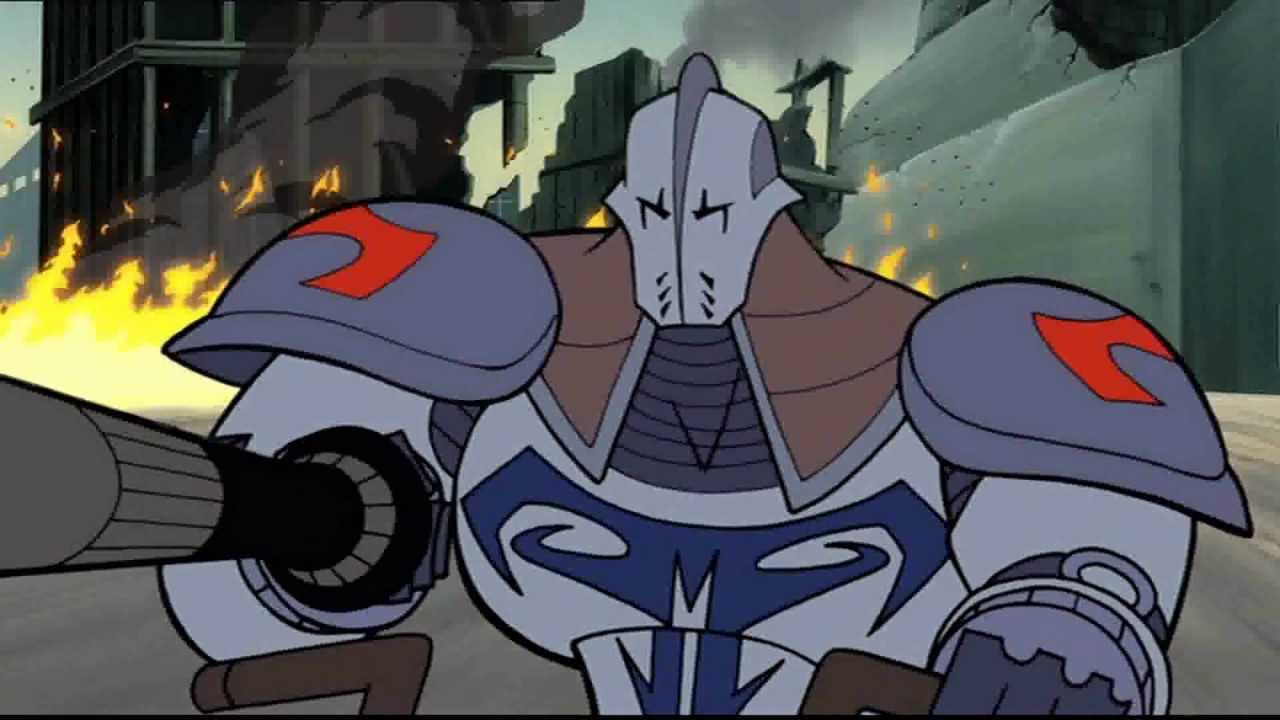
On the ground on Muunilinst, Republic troops face an assault by ARC (Advanced Recon Commando) Captain Fordo (André Sogliuzzo), who leads clone troopers.

Captain Fordo leads clone troopers against the Army of the Republic.

Separatist leader Count Dooku (Corey Burton), meanwhile, takes the Dark Jedi Asajj Ventress (Grey DeLisle) as his apprentice and sends her to eliminate Anakin.

Count Dooku with his apprentice Asajj Ventress.

She manages to draw Anakin’s attention in the middle of a battle in space and he pursues Ventress to planet Yavin 4, where they engage in a lightsaber duel. Anakin manages to defeat her, but only by tapping into fear and anger, the well-known path to the Force’s dark side.

Anakin takes on Ventress.

In addition to the main story, there are various other battles featured, including familiar characters, like Jedi Master Mace Windu (T.C. Carson) who faces an army of droids unarmed on Dantooine, Master Yoda (Tom Kane) with Padmé Amidala (uncredited) in tow travels to the ice world of Ilum to save two other Jedi Knights; the up ‘til then unknown Kit Fisto (Richard McGonagle), an amphibious Jedi, who leads an aquatic regiment against clone troopers in the water world of Mon Calamari; and the soon to be prominent General Grievous (John DiMaggio) who likes nothing more than to take lightsabers off of vanquished Jedi.

General Grievous showing himself to be a Jedi's worst nightmare.

Even though the series was originally conceived as 20 episodes, its success led to a third season. Instead of 3 minute long episodes, each lasted 12 minutes, but there were only 5 episodes airing on consecutive days from March 21 to March 25, 2005. Like Seasons 1 and 2, this season was also edited together into a 64 minute feature, released as Star Wars: Clone Wars: Volume Two on December 6, 2005.

This volume picks up where Volume 1 ended. It’s two years later, after Anakin’s victory over Ventress and Obi-Wan’s victory on Muunilinst. But Grievous has been winning on behalf of the Confederacy and the Republic is in need of more Jedi Knights. After some discussion, the Jedi Council, headed by Yoda, decides to make Anakin a Jedi.

Grievous, now with four arms, has been leading victories for the Confederacy.

Anakin, meanwhile, has been sneaking around to be with Padmé Amidala, who by now is his wife. Jedi Knights are not supposed to have emotional attachments, let alone wives, but not all the rules apply when you’re the chosen one.


Amidala and Anakin sneak around to be together.

Three years later, Anakin has proven himself to be quite the Jedi. He’s helped Obi-Wan to capture a fortress and rescued other Jedi from bigger droids.

Anakin and Obi-Wan are assigned to find Grievous on the planet Nelvaan, but instead end up liberating a group of Nelvaanians who had been enslaved and mutated by the Techno Union.

Meanwhile, the Confederacy of Independent Systems attacks the city of Coruscant to which masters Yoda, Windu, Shaak Ti (DeLisle) and others are called upon to defend. However, during the attack, General Grievous and his army of droids manage to sneak into the city and kidnap Palpatine for his Master, Dooku.

Yoda can't stop Grievous from kidnapping Palpatine.

Anakin and Obi-Wan set out to rescue the Chancellor, which leads directly into the beginning of Revenge of the Sith, the third of the pre-sequel films.

The visual style of the series is very reminiscent of Samurai Jack and that works surprisingly well telling this story. Episodes rely less on dialogue and more on action; another similarity to Samurai Jack. Battle scenes, which can get drawn out too much in movies, are succinct here.

The voice-acting is spot on. It had been a while since I had seen the films and was surprised to learn that none of the actors from the feature films were actually voicing the characters. And unless you watch the credits, you would probably not know it either.

For some reason, the events of this series are not considered canon to the overall Star Wars universe. My guess is that it was superseded by Star Wars: The Clone Wars (2008), which, despite a poorly received feature film debut, Star Wars: The Clone Wars (2008), ran for 121 episodes. I have never seen the newer series or its feature film and have no real plans to do so.

Tartakovsky’s version of the Clone Wars story is perfect for someone like me. I didn’t want to devote too much time to what is basically a side-story, but he manages to make it very entertaining and must-watch television, so much so I wish there was a fourth season. If you have a chance to watch either or both of these volumes, I would highly recommend that you do. These do not disappoint.

Next up: Star Wars (1977).

Sunday, January 4, 2015

Hotel Transylvania


Hotel Transylvania is an interesting film in terms of its history. Over the course of its production, taking place across several years before its final 2012 release, the project went through a few directors until finally Genndy Tartakovsky, the sixth and final director, would be brought in to finish it. Since I knew of Tartakovsky through Samurai Jack, Dexter’s Laboratory and the Star Wars: Clone Wars cartoon from 2003, I became somewhat curious about Hotel Transylvania, although Adam Sandler receiving top billing also had me a little worried (I think he can be really funny, but relies too much on appealing to the lowest common denominator). Still, I wouldn’t really have a chance to see it until after Christmas in 2014 (which I must now refer to as “last year”) to find out if it was actually any good. In some ways the movie was better than I thought it would be, but there are still some setbacks.

Over 100 years ago, Count Dracula (Adam Sandler) created Hotel Transylvania, a hotel deep within the dark forest of Transylvania where monsters can find refuge from hostile humans. In the present day, it is the 118th birthday of Dracula’s daughter, Mavis (Selena Gomez), and he wishes to make it her best birthday ever while at the same time discouraging her from interacting with the outside world. His plan is going smoothly until a 21-year-old human drifter named Jonathan (Andy Samberg) manages to wander inside. Dracula manages to keep the other monsters from noticing, but the situation worsens when Mavis and Jonathan, in disguise, begin to have feelings for each other. Now Dracula must try to prevent the two from falling in love while doing whatever he can to prevent the hotel’s residents from finding out that Jonathan is a human, which could jeopardize the future of the hotel.

Jonathan's arrival puts a wrench in Dracula's plans.

The story is paced pretty well and doesn’t waste much time developing itself. Dracula’s conflicts as a father and keeping Jonathan’s identity a secret are intertwined and drive the story forward in a way that feels meaningful, but the rest of the movie doesn’t feel as well done. The monster’s fear of the humans is ever-present, but only comes up from the hotel residents every once in a while until the third act, when it really feels important. Additionally, there’s really only one character, Quasimodo, who can be considered a villain, but his scenes don’t really amount to anything and he might as well have been cut from the movie. I feel like this may have been an artifact from earlier versions of the movie, one which Tartakovsky probably couldn’t iron out. On another note, it’s rather interesting how this movie features what is essentially a gathering of all the Universal movie monsters, even weaving in a lot of the mythology from their classic films, yet this occurs in a movie made by Sony.

Another artifact, or rather what can be seen as the stamp of Adam Sandler, is the unnecessary amount of crude humor, especially in the first act. I feel they could easily have cut out these instances, most of which involve bodily functions, and not really affect the flow of the movie at all. Apart from this type of humor, there are some genuine moments of hilarity to be found, though I didn’t really laugh out loud the whole time. These moments are also balanced with more dramatic or touching moments, though I didn’t really feel completely invested on an emotional level. I understood what Mavis and Jonathan were going through when trying to develop a relationship, but I personally wasn’t engaged.

Jonathan (left) and Mavis (right) have good chemistry, but it wasn't too engaging.

What’s really good about this movie is the highly expressive animation. Though created in CG, it has the feeling of traditional animation, specifically of the more cartoonish variety, with classic squash and stretch animation. The art style doesn’t feel like the more recognizable Disney/Pixar or Dreamworks styles, but rather that of Genndy Tartakovsky translated to three dimensions while still appearing to have weight. This art style also allows for plenty of detail to appear in the characters and backgrounds, so if one were to look for something new, they might find it.

It can be difficult to discuss the minutia of voice acting, but for this film I think everyone did a good job. Adam Sandler gives a rather good performance as Dracula, especially since he doesn’t really sound like himself when speaking and demonstrates a good emotional range. Similarly, Andy Samberg is able to show range in his voice, particularly since the character of Jonathan matches his style of humor more closely. I also thought Selena Gomez did well as Mavis, enough to show some promise as a future voice actor by conveying a teenager’s behavior rather well. The supporting cast, which includes Kevin James, Steve Buschemi and CeeLo Green among others, also give decent performances that help to round off the rest of the characters. One may also find the score of Mark Mothersbaugh to be fitting for each scene it appears in, though the appearance of other original and popular songs can be enough to drown it out.

Hotel Transylvania is surprisingly well done considering that it went through six directors to be completed, but the long production is also evident in the finished product. The story is well-paced and solidly written, but I couldn’t find myself invested too heavily in what went on and there are some artifacts in the form of half-baked plot elements and unnecessary crude humor. However, the animation is very good and the voice acting is rather decent. I’d say this is a movie that’s great for families to watch, as well as fans of Genndy Tartakovski. Since the inevitable sequel is on the way, I may check it out, but I’m not really sure I’d check back in immediately.

Monday, March 17, 2014

Samurai Jack: The Premiere Movie


A few months ago, IDW began releasing comics based on various Cartoon Network properties they had acquired licenses for. One of these was for Samurai Jack, serving as a continuation of the popular animated series by Genndy Tartakovsky. As the first story arc of the comic has concluded at the time of this writing, I really like it so far and will continue to read it. However, what prompted this review was a Samurai Jack special issue IDW put out which reprinted a 2002 special that was essentially a comic adaptation of the show’s premiere movie. This got us interested in re-watching the movie, if only to see how close the comic adaptation was, and it turns out that the comic was very close in replicating the events of the movie. During this recent viewing of the movie though, I also remembered just how good a cartoon Samurai Jack really was.

The comic that inspired this viewing of the movie.

In Feudal Japan, a powerful demon wizard named Aku (Mako Iwamatsu) is awakened from his prison by the passing of a solar eclipse. As an act of revenge, he assaults the palace, capturing The Emperor (Keone Young), who had first imprisoned him years ago with a magic sword. As a contingency plan, The Emperor has his son (Phil LaMarr) leave the palace and travel around the world to hone his skills as a Samurai. When he returns years later, Aku has enslaved the empire and is giving particularly harsh treatment to The Emperor (now voiced by Sab Shimono). After the samurai rescues his father, he confronts Aku in his lair, nearly winning a fierce battle with the demon wizard. However, right before he can inflict the final blow, Aku opens a portal in time, sending the samurai into the far future, where Aku rules the earth with an iron fist. While trying to figure out exactly what has happened in the millennia since his displacement in time, the samurai adopts the name Jack and sets out on a quest to return to his own time and vanquish the evil Aku.

Samurai Jack’s premiere movie, as it is the first three episodes strung together, is mostly a means of setting up the series that would follow, but it does a very good job of doing so. We are introduced not only to the main conflict between the two main characters, Jack and Aku, but we are given a good demonstration of their abilities and personalities. The way this story is told though is very interesting, as there are long stretches without any dialogue, allowing the visuals to speak for themselves. This is most apparent during Jack’s extended training montage as well as the long fight sequences. Though this does make Samurai Jack a more visual affair, it is a very nice touch that you wouldn’t normally see in other cartoons from the same genre. There’s also an interesting mix of eastern and western storytelling elements, as we see heavy influences from Japanese mythology in the past before transitioning to the future, the first setting seen in this timeframe being something one would see in a dystopian sci-fi flick. This blending of styles is what helps set Samurai Jack apart, as it sets up the classic Good vs. Evil struggle but with the twist of a temporally displaced samurai who upholds his own code of honor. While it starts off pretty seriously, it also manages to throw in a fair amount of comedy to set up the tone of the rest of the series nicely. Dialogue is also very natural, revealing smaller details about the world through throwaway dialogue rather than a big exposition dump.

Another notable trait of Samurai Jack is the animation, namely the outlineless art style. Much like how there are no outlines in real life, not a single thing in Samurai Jack has an outline, which gives it a very iconic style that none have tried to replicate. This distinct visual flare is very good at drawing the viewer in, aided by the very fluid motions, particularly when martial arts are on display.

Apart from the fantastic musical score, there is also incredible voice acting. Phil LaMarr, known for such roles as Static from Static Shock and Vamp from Metal Gear Solid 2 and 4, has a very strong performance as Jack. Jack’s stoic personality comes across very clearly and his reactions feel very natural, even if he is able to take his new setting surprisingly well. The character’s deep voice isn’t off-putting and, in fact, is very fitting because there can still be a lot of compassion behind what he says and, in some cases, is very warm in its delivery. The late great Mako Iwamatsu, who received an Academy Award nomination for Best Supporting Actor in The Sand Pebbles and is otherwise well-known as Uncle Iroh from Avatar: The Last Airbender among other roles, also nails it as the evil demon wizard Aku. At times Aku sounds genuinely threatening, but his hammy and over-the-top voice also adds an element of comedy as a great balance of different extremes. Aku is a villain that everyone would like to see defeated, especially during the series to follow, and Mako’s voice is perfect for his personality.

The evil demon wizard Aku.

In the end, Samurai Jack: The Premiere Movie can only really be seen as the start of a much larger work, but it is a very good one. The characters and motivations are all introduced very well and we get a good taste of what the rest of the series would bring. Fantastic voice acting, plus a good attention to animation and quietness, helps strengthen the film and elevates it to great heights. Fans who watched the series already have an idea of how good this movie is, but if you’ve never seen Samurai Jack and are curious to see what it’s like, then The Premiere Movie is the best possible place to start.