Showing posts with label 2004. Show all posts

Wednesday, November 2, 2022

The Nightmare Before Christmas: Oogie's Revenge


As far as action games go, the Devil May Cry series is easily one of the best. While certainly challenging for the most part, the games are rewarding to finish and have had a lasting influence on the genre in games like the Bayonetta series. I can even recall a period of time where licensed games copied either God of War or Devil May Cry, though usually not as good. Few games inspired by Devil May Cry, however, have the distinct honor of being made by Capcom themselves. In this case, it’s The Nightmare Before Christmas: Oogie’s Revenge, a 2004 sequel to the original 1993 stop motion film. While not a perfect game, what truly makes this licensed game stand out is not only its strong use of the license, but also its seeming influence on later Devil May Cry games, as it predates Devil May Cry 3 by one year.

Friday, October 14, 2022

Silent Hill 4: The Room (Xbox)


During development on Silent Hill 3 (SH3), Team Silent also worked its successor, Silent Hill 4: The Room (SH4), with the philosophy of change and shaking up the established formula. While the general reception from critics to the new direction was by no means negative, SH4 was and still is a divisive entry, especially since development of the series was handed off to western developers afterwards. Looking online, you’ll find just as many people, from 2004 to now, who enjoyed the game in spite of its faults as you will those who don’t think very highly of it, both for justifiable reasons. As such, I knew what I was getting myself into when I got to this point in my deep dive of the series, but otherwise went in without any knowledge of the major twists and turns.

Of course, price is also a factor and, interestingly, SH4 is one of the more accessible and affordable Team Silent games, with a digital PS2 copy available on the Japanese PSN store on PS3 and a modern rerelease of the original PC port on GOG that’s Windows 10 compatible. Not wanting to go through the hassle of having a Japanese PSN account for the former or downloading patches to restore content apparently cut from the latter, however, I still ended up paying about $70 for a complete physical Xbox copy, if only because it was easier to find and cheaper than a complete original PS2 copy. With all of this in mind, I still found myself landing somewhere in the middle in terms of how I felt. While I found the game an interesting and often engaging change of pace, some development decisions do add some unnecessary tedium and I’m not sure that buying a physical copy of the game would be worth the cost for most people nowadays.

Saturday, February 5, 2022

Lemony Snicket's A Series of Unfortunate Events


Note: This review contains spoilers for Lemony Snicket’s A Series of Unfortunate Events.

Running alongside the original run of the Harry Potter book series was a series of 13 books written by Lemony Snicket (pseudonym for Daniel Handler) known as A Series of Unfortunate Events, which chronicles the story of the Baudelaire children Violet, Klaus and Sunny as they try to escape the evil Count Olaf, who is chasing after their family fortune. As a child, I grew up reading these books and I remember enjoying them, so I was excited when a film adaptation based on the first three books in the series (The Bad Beginning, The Reptile Room, The Wide Window), dubbed Lemony Snicket’s A Series of Unfortunate Events, was announced for a 2004 release. I liked the movie when it came out in spite of some noticeable changes to the story, though in the years since I have not seen it again that much, and I always thought it was a shame that it never got a sequel, which I discovered during research was due to corporate shakeups on Paramount’s end at the time. Well over a decade later, after deciding to revisit the movie, I found that the movie holds up pretty well and some of it hit me a lot harder as an adult than it did back when I first watched it.

Saturday, December 18, 2021

Grand Theft Auto: San Andreas (PS2)


2004 was a big year for gaming, with several heavy hitters like Metal Gear Solid 3: Snake Eater and Half-Life 2 releasing to critical acclaim and a lasting legacy. If there’s one game that I distinctly remember from this time period, however, it’s Grand Theft Auto: San Andreas (San Andreas), Rockstar’s fifth entry in the Grand Theft Auto (GTA) series. Even though I wouldn’t have been able to play the game at the time, I remember that everyone talked about the game, including a number of students in real life, and how great it was, with additional praise from gaming news sources. I also remembered the “Hot Coffee” controversy and how it made the news at the time, along with the recall and rerelease of the game. Eventually, I heard enough hype that I actively sought out a copy, but couldn’t find a single one in any GameStop that I looked at (back when I actually bought all of my games at GameStop). Fortunately, the game was rereleased under the Greatest Hits label and I got a complete copy that way.


Sometime later and about eleven years ago, I tried to play San Andreas, but for whatever reason only completed three missions (or about an hour of gameplay) before I got epically sidetracked by other games, including Grand Theft Auto V (GTA V), the only GTA game I had played to completion. Since then, I wanted to try playing San Andreas again, but that interest didn’t fully reignite until I saw footage of the botched Grand Theft Auto: The Trilogy – The Definitive Edition, glorified console ports of mobile ports of console games. With San Andreas now relevant again, I passionately played the original PS2 version over two weeks, with an in-game time of 24:07 and completing the main story with an overall percentage of 63.10%. With that goal finally accomplished, I can confidently say that despite its rough edges, San Andreas is still a game worth playing and has definitely earned its reputation.

Monday, December 13, 2021

EyeToy: Play 2


Months after the US release of EyeToy: AntiGrav came EyeToy: Play 2, the sixth of eight EyeToy games to be released in the US and a sequel to the original EyeToy: Play. Much like the original EyeToy: Play, this was one game that could be found bundled with the camera itself, however, like with some games in my EyeToy collection, I found it cheap at Amoeba without the camera, which I fortunately still had from the first game. Since I still enjoyed the original game, I expected the similar experience out of the sequel, however I strangely found myself getting bored more than I did excited.

Friday, December 10, 2021

EyeToy: AntiGrav


Following Sega Superstars came EyeToy: AntiGrav, the fifth EyeToy game to be released in the US. Developed by Harmonix of Rock Band fame, this was also the first (at least in the US) to be designed for a more hardcore demographic rather than the casual focus of earlier EyeToy titles. Of the games released for the peripheral beyond EyeToy: Play, this is one I vividly recall seeing ads for on TV when it first came out, and was one I found cheap at a local games reseller when I was on my initial hunt for more EyeToy content. After finally getting to play it, I found the experience worth it, even if it was a little more difficult for me.

Thursday, December 9, 2021

Sega Superstars


Within weeks of Nicktoons Movin’, Sega released their own contribution to the EyeToy peripheral, Sega Superstars, the only other EyeToy game made by a third party to be released in the US. Much like Nicktoons Movin’, this was a game I had to actively seek out when trying to complete my EyeToy collection, resorting to eBay as I could not find it in a physical store. After getting to play Sega Superstars, I found it to be a vast improvement over Nicktoons Movin’ in just about every way, to where this is what that game should have been.

Wednesday, December 8, 2021

Nicktoons Movin'


Though more EyeToy games were released following EyeToy: Groove, not many of them were released in the US, where instead the third game to be released for the peripheral was Nicktoons Movin’. Based on various Nickelodeon shows, it became the first EyeToy game in the US to not be developed by London Studio as well as the first to be based on a licensed property. In an effort to complete my EyeToy collection, I found this one for cheap at a local game store, not knowing what to expect going in. Once I played it, however, I walked away a bit disappointed for reasons beyond its content.

Tuesday, November 9, 2021

Prince of Persia: Warrior Within


One year after the success of The Sands of Time had revitalized the Prince of Persia brand, Ubisoft released a sequel, Warrior Within. While it did receive generally positive reception, it notably had no involvement from Jordan Mechner, who didn’t like the darker direction the studio had taken the game compared to The Sands of Time. After finally playing Warrior Within for myself, I can see why.

Wednesday, April 14, 2021

Hitman: Contracts (Xbox)


After the release of Hitman 2: Silent Assassin, IO Interactive started work on what would become Hitman: Blood Money. During development, however, they realized they wouldn’t be able to get that game out in time to please their investors. With less than a year left to deliver a game, and with the knowledge that only about 10% of Silent Assassin players had actually played the PC-exclusive Codename 47, a small skeleton crew began work on a “Hitman 2.5” that would both buy IOI two more years to develop Blood Money and allow console players an opportunity to experience some of the Codename 47 levels alongside some original content. The result was Hitman: Contracts, which launched in 2004 to general acclaim, though criticized for its similarities to Silent Assassin. Considering the troubled development, which included a nine-month crunch period and all-nighters in freezing cold, Contracts actually turned out pretty well, though its status as essentially a filler arc is nevertheless evident in the final design.

Monday, September 7, 2020

Tony Hawk's Underground 2 (PS2)


Following the success of Tony Hawk’s Underground in 2003, a sequel was released in 2004, simply titled Tony Hawk’s Underground 2, which saw a much wilder take on skating culture. This was actually my first exposure to the Pro Skater series as a whole, even if I wasn’t the one playing it, and so this is the entry I am most familiar with. As a result, I will admit to having a small bias towards this game, and so would rank the game higher if I were to place it on a tier list, however I felt that it was not to the point that it would interfere with writing an impartial review. After going through the game again, while it has its issues and is generally a lot more crass, it still stands as one of my favorite entries in the series for its sheer fun factor.

Saturday, May 30, 2020

Scooby-Doo 2: Monsters Unleashed


After a viewing of Scooby-Doo (2002), we noticed that the sequel, Scooby-Doo 2: Monsters Unleashed, was also available for free streaming and decided we may as well give it a watch. Like the previous film, I remember seeing ads for it at the time, but nine-year-old me had no interest. Watching it now, we noticed immediate improvements over the original and I think I might’ve liked it as a kid, but it’s still not a great film.

Saturday, March 30, 2019

Stubs - Sky Captain and the World of Tomorrow


Sky Captain and the World of Tomorrow (2004) Starring: Gwyneth Paltrow, Jude Law, Angelina Jolie, Giovanni Ribisi, Michael Gambon. Directed by Kerry Conran. Screenplay by Kerry Conran. Produced by Jon Avnet, Sadie Frost, Jude Law, Marsha Oglesby Run Time: 106 minutes. USA Science Fiction, Action Adventure

Few movies create new ways of production. Such a case was Sky Captain and the World of Tomorrow, known as the first major motion picture to be shot completely on a blue screen with computer-generated backgrounds (with the exception of the two sets built due to time and budget constraints). Films such as Sin City (2005), 300 (2006), and The Spirit (2008) were all influenced by Sky Captain. But being first does not always mean best. For all its inventiveness, Sky Captain borrows heavily from other stories and in the end is rather boring, which is practically the worst thing you can say about a movie.

Saturday, May 19, 2018

Shrek 2 - Could Use A Little Change


Three years after the success of the Academy Award-winning Shrek (2001), Dreamworks released the inevitable sequel, Shrek 2 in 2004. I had seen this in the theater when it first came out and loved it at the time, though I would later become burnt out on it due to overexposure. Having seen it again years later, shortly after re-watching the original Shrek, it seems to have held up well in some areas and aged poorly in others.

While on their honeymoon, Shrek (Mike Myers) and Fiona (Cameron Diaz), accompanied by Donkey (Eddie Murphy), are summoned to the kingdom of Far Far Away to celebrate their marriage with a royal ball. Upon arrival, however, things immediately get off to a rocky start when Fiona’s parents, King Harold (John Cleese) and Queen Lilian (Julie Andrews), have differing feelings about their daughter marrying an ogre. At the same time, Prince Charming (Rupert Everett), originally meant to marry Fiona, had arrived too late to rescue her from the dragon. As a result, he becomes part of a somewhat complex revenge scheme to make sure that he’s the one wed to Fiona instead of Shrek.

King Harold and Queen Lilian are surprised
to see that Fiona has married an ogre.

By comparison to the original film, Shrek 2 has a more complex and comparatively original plot with a larger cast of characters, more interesting villains and subplots which all contribute to the main plot. A major twist that comes near the end of the movie, and also contributes to the ultimate failure of the villain, is also set up with a surprising amount of foreshadowing and changes how the viewer looks at certain scenes. As the film explores life beyond the initial happy ending, its lesson is ultimately that you can be yourself and still make a relationship work, even a marriage. While rather simple, it’s pulled off rather effectively. Some of the humor in Shrek 2 is also still genuinely funny, though the cruder jokes seem to only exist to reinforce just how different Shrek was from its competition.

As befitting an animated sequel, the actual animation is a real improvement and has aged far better than the original Shrek. The character models are generally more detailed and the hair and liquid physics are comparatively closer to the real world. There’s also more detail in the backgrounds, along with improved lighting and a greater variety of locations.

With all of that said, however, it seems that Dreamworks truly did take a wrong lesson from the success of Shrek. Where the original had a rather minimal use of pop culture jokes and anachronistic references in its obviously medieval setting, Shrek 2 is absolutely filled to the brim with such references, so many, in fact, that it’s at times distracting. While some of the pop culture references predate the movie, including Alien (1979), The Seven Year Itch (1955) and Flashdance (1983), others were very contemporary at the time, including Spider-Man (2002), Lord of the Rings: The Fellowship of the Ring (2001) and The Mask of Zorro (1998). Other pop culture references, however, either come out of left field, such as the O.J. Simpson murder case of all things, or feel incredibly forced, such as one throwaway reference to Garfield’s catchphrase, “I hate Mondays.”

The anachronisms, as well, are far more numerous and harder to ignore. The most noticeable ones involve Far Far Away, as its modeled after Los Angeles and Southern California in general. The kingdom has its own equivalent to the Hollywood Sign and there are fairy tale versions of several real-world businesses, including, but not limited to, Starbucks, Burger King, Gap, Old Navy, Bob’s Big Boy and Tower Records (now defunct in the US). A particular anachronism that stretches the setting further relates to the original Shrek as well. In the first movie, the Magic Mirror could be controlled similarly to a recording, but still fit within the setting. In Shrek 2, however, television just straight-up exists, including a scene where a handful of side characters watch the show Knights (itself a parody of the show Cops) and another where Joan Rivers plays an announcer at the royal ball as though it were a live broadcast.

Notably, the home video release (not viewed for this review) contains yet another reference, an extended parody of American Idol called Far Far Away Idol which not only loosely follows the format of the show, but also literally includes Simon Cowell voicing an animated version of himself as a judge. There was even a way for viewers to vote on a winner of the competition (the official winner was Doris). Since American Idol was new at the time, it only made sense that Shrek 2 would want to reference it, but nowadays it only contributes to the “Early 2000s” vibe that permeates the film.

The home video release features an extended American Idol
parody in which Shrek (Mike Myers), Fiona (Cameron Diaz)
and Simon Cowell (Simon Cowell) are judges.

On that note, as with Shrek, Shrek 2 includes a good number of licensed songs. However, the ones performed in the movie are predominantly covers, including one for “Funkytown” by Lipps Inc. and two (yes, two) for “Holding Out for a Hero” by Bonnie Tyler. However, it does include some original material, including “Accidentally in Love” by Counting Crows, which would receive Academy Award and Golden Globe nominations for Best Original Song, as well as a Grammy nomination for Best Song Written for a Motion Picture, Television or Other Visual Media.

While Shrek 2 has arguably had less of a lasting impact on internet culture compared to the original Shrek, its presence as a pop culture powerhouse for the time cannot go unstated. Due to how well it stood out compared to its contemporaries, Shrek 2 was highly successful at the box office, making about $920 million against a budget of $150 million. As Dreamworks’ most successful film to date, it was the highest-grossing animated film of all time until Toy Story 3 (2010), the highest-grossing animated film in the US until Finding Dory (2016) and was the highest-grossing film of 2004. It was even nominated for an Academy Award for Best Animated Feature but lost to The Incredibles (2004).

The most lasting part of this film’s legacy, however, is the introduction of Puss in Boots (Antonio Banderas). His popularity eventually led to a spin-off film, Puss in Boots (2011) and the Netflix series The Adventures of Puss in Boots, which lasted for 78 episodes across six seasons between 2015 and 2018.


Shrek 2 introduces the popular Puss in Boots (Antonio Banderas).

While Shrek 2 improves on its predecessor in terms of story, character and humor, the higher concentration of pop culture nods and anachronistic elements are nearly a distraction. It’s easy to see why the movie was such a juggernaut on release, but now it’s a little harder to see where the movie truly shines without consciously peeling back the outer layer of dated references that haven’t aged as well as they could’ve. After 14 years, Shrek 2 is still an enjoyable film that’s worth viewing today, partly due to its historical significance, although the original Shrek gets a slight edge for its balance of story and references.

Saturday, March 17, 2018

Yu-Gi-Oh! The Movie (Remastered)


Back in 2004, Yu-Gi-Oh! The Movie (aka Yu-Gi-Oh! The Movie: Pyramid of Light), first released in the US as a critical and commercial failure, mainly because it was impenetrable for non-fans. However, when I first saw the movie as a kid, I didn’t really care and was able to enjoy it (although it did spoil the outcome of the Battle City Arc of the anime, which hadn’t finished airing yet in the US). Over the years I have found that, mainly out of nostalgia, I can’t find it within me to not like the original Yu-Gi-Oh!, but my opinion of this movie would wane over time. In a surprising move, 4K Media, the remnants of 4Kids Entertainment after Konami absorbed them, decided to remaster the movie and distribute it for a limited run through Fathom Events. When the opportunity struck, I bought a ticket to see the extent of the remaster and for a brief nostalgia trip. Now that I’ve seen it again, the remastered picture did little to distract from the inherent flaws of the movie.

5000 years ago, the Pharaoh had defeated and sealed away Anubis (Scottie Ray), the Egyptian lord of the dead. Five millennia later, Yugi Muto had completed the Millennium Puzzle at the same time that Anubis’ tomb was discovered in an archeological dig, releasing Anubis’ spirit, which seeks revenge on the Pharaoh. In the present, Yugi has just won the Battle City tournament and gained possession of the most powerful cards in all of Duel Monsters, the three Egyptian God Cards: Obelisk the Tormentor, Slifer the Sky Dragon and The Winged Dragon of Ra. At the same time that Yugi evades a horde of duelists attempting to claim the God Cards for themselves, Seto Kaiba (Eric Stuart) tries repeatedly to come up with a strategy to defeat Yugi, but to no avail. He decides to confront the game’s creator, Maximillion Pegasus (Darren Dunstan), about a possible card made to counteract the God Cards. However, Kaiba doesn’t know that his actions are only helping Anubis with gaining his revenge.

Anubis (Scottie Ray) wants his revenge on the Pharaoh.

The story and plot for the movie have a pretty rough execution. The idea of the Pyramid of Light as an eighth Millennium Item as well as the presence of another ancient evil can come off as fanfiction, which is never a compliment, and Anubis himself has almost no personality and is motivated entirely by an ancient grudge. The main bulk of the movie is a duel between Yami (Dan Green) and Kaiba, which goes on for quite a while. Once Kaiba activates Pyramid of Light, which unwittingly sets Anubis’ plan into motion, the spirits of Yugi, Joey Wheeler (Wayne Grayson) and Tristan Taylor (Greg Abbey) are sucked into the Millennium Puzzle, where they encounter the spirit of Anubis and his army of the undead. These scenes, interspersed within the Yugi vs Kaiba duel, can prove more interesting, if only because they provide the occasional break from the rest of the action.

That said, the dialogue is pretty decent and there are some occasional moments of laugh-out-loud humor. This includes some subtle moments, including Pegasus being served a red wine spritzer after swearing off white wine spritzers, and some of the jabs that characters take at each other. Other moments, like Joey making a couple movie references, are funny if only because of how cheesy/dumb they are.

One notable element of the dialogue is that when 4Kids had originally dubbed this movie, they had made the bold decision to keep any and all allusions and references to death and dying rather than change any instance to mentioning the Shadow Realm (as they had done in their dub of the anime). While this doesn’t mean much now, it was rather surprising back in 2004.

The quality of the animation is sort of hit and miss. It’s generally a higher quality than Studio Gallop used when animating the show, but after 14 years it also feels like a relic of the 2000s. Though the character models are good for the time, there are some moments where it went noticeably a little off-model. Nothing too jarring, but noticeable enough that it didn’t help the movie age that well over 14 years.

Something about this movie that’s particularly notable is that until 2017’s Yu-Gi-Oh! The Dark Side of Dimensions, this was the only instance where cards depicted in the English version used translated English text instead of the altered format used in the anime. While this was rather surprising and impressive at the time, especially since they also tried to recreate card rarities, there are some noticeable errors with card layouts (such as flipped or mirrored cards). One that’s particularly noticeable is that when Yami activates the card Double Spell, the card shown instead is Diffusion Wave-Motion (fixed in the Japanese version; see below).


As for the remaster, it’s essentially the same movie but the picture has a much-needed touch-up for modern screens. The look of the remaster is generally very impressive, giving it crisper visuals which help the movie age a little better, though in some zoomed-in shots the quality dips somewhat. It would’ve been nice if they also took the opportunity to correct the errors in the English card text and art, though I understand that wasn’t really the point of the remaster.

The voice acting is pretty good for when it came out, especially Dan Green as Yugi/Yami and Eric Stuart as Seto Kaiba. Looking back on it now, though, it’s obvious that by the time The Dark Side of Dimensions had come out, the actors had greatly improved in their roles since.

As for the soundtrack, the actual score is fitting and has a similar style to the anime. One original song that plays during a scene of Kaiba flying the Blue-Eyes White Dragon Jet is a little cheesy, but still kinda works. However, a number of snippets of other songs play over the credits, which seemed to be for the sole purpose of promoting the soundtrack with the promise of original songs (including one performed by The Black-Eyed Peas for some reason).

At the time the movie first came out in the US, theaters gave away one of four special cards (in a unique one-card booster pack) with each ticket sold and retail stores sold an eight-card Exclusive Pack as a tie-in. DVD copies of the film also came with two cards from the theater-exclusive Movie Pack with the option to send in for the other two. As an additional bit of small trivia, Blue-Eyes Shining Dragon saw a TCG release through this pack two years before the card required to summon it, Blue-Eyes Ultimate Dragon, would. Another tie-in was the Yu-Gi-Oh! The Movie Ani-Manga (basically a screencap comic) which came bundled with Slifer the Sky Dragon’s original TCG printing; the screencaps in the Ani-Manga only highlight many of the animation errors.

Original theatrical release poster.

For this special re-release of the movie, viewers were also given an exclusive look at the first English dub episode of the new Yu-Gi-Oh! series, Yu-Gi-Oh! VRAINS. I’m not sure how much I can say except that, without having seen the Japanese version, it feels like 4K Media is giving more respect to the source material with great voice acting and good dialogue, including a funny reference to the idea that some people think a hotdog is a sandwich. I’ll note here that my screening of the movie had low attendance anyway, likely since it was a Monday night, but everyone else had left before and during the VRAINS preview, so I enjoyed what had become a private screening.

A Japanese poster for Yu-Gi-Oh! VRAINS. L-R (clockwise):
Yusaku Fujiki, Firewall Dragon, Decode Talker, Yusaku Fujiki (as Playmaker), Ai.

After 14 years, I can conclude that Yu-Gi-Oh! The Movie hasn’t really aged well. The remastered visuals are impressive and I wouldn’t mind getting it on home video if they offered it. However, the story is still pretty rough and Anubis, though designed by Kazuki Takahashi himself, is a rather flat villain without much going for him. The climactic duel also goes for a large amount of the 89-minute runtime, so that’s something to keep in mind. It’s also very difficult to recommend to anyone who isn’t already a Yu-Gi-Oh! fan, since it requires the viewer to already be pretty familiar with the source material. While fun as a nostalgic trip back to the original series, it’s a pretty rough movie overall, though for some that may be part of its charm.

Friday, December 8, 2017

TY the Tasmanian Tiger 2: Bush Rescue


Following the success of the original TY the Tasmanian Tiger, Krome Studios developed a sequel, released in 2004, known as TY the Tasmanian Tiger 2: Bush Rescue. Among other changes, this release sees a somewhat drastic change in general gameplay, as platformers of its kind were wont to do. Continuing our look at this series, let us take a look at TY the Tasmanian Tiger 2: Bush Rescue.

Following the events of the original game, Boss Cass’ subordinate, Fluffy, is attempting to break him out of prison, however TY tries (and fails) to stop her. Sometime after this, Boss Cass has formed his own sovereign nation, Cassopolis, solely as a means to gain diplomatic immunity and get away with whatever he wants. In response to this, a group known as Bush Rescue is formed, with TY put at the center, to help those in need within Southern Rivers and protect them from Boss Cass. Meanwhile, with the aid of an old koala named Karlos, Boss Cass has been developing an army of Uber Frills in order to take over Southern Rivers.

The primary gameplay is similar to the previous game, primarily TY’s moveset and the presence of platforming, except now the levels take place in a more open world. Outside the starting town of Burramudgee, you move around the various missions in Southern Rivers via driving the Bush Rescue jeep (a minimap, like in TY 1 and 3, is provided to help you find your way). These missions can vary in terms of design and objectives, and somewhere deeper in the map is an area big enough to almost be an entire other hubworld.


The Bush Rescue jeep in action. (Finding usable screenshots remains
somewhat difficult.)

Burramudgee also has shops where you can purchase new Rangs and other abilities and story items, using Opals and other collectibles as currency. When you get past a certain point in the game, a new shop opens up on the map where you can purchase more powerful Rangs from Sly, a former enemy thylacine, which more resemble the Rangs from TY 1 to override the Rangs you can purchase in Burramudgee. (Protip: The Doomerang is the one you want for most situations.)

Being a game from 2004, the graphics are an improvement over the original TY game, including those of the pre-rendered cutscenes. There’s also sort of a minor art style change compared to the previous game, though it doesn’t deviate too much to be jarring. As with the previous game, it’s possible to see Australian wildlife running about, which can make one wonder how they could do that without sacrificing too much processing power. Also like the previous game, there is some good sound design, especially in the background music (at least one track even had me thinking of Ratchet & Clank of all things); the voice actors, however, are different from those in the previous game, making it a little jarring after you’ve gotten used to the previous cast. In spite of this, you do get used to the new cast after a while and they do a decent job putting their own spin on the voices without overall straying too far from how they sounded previously. There’s still the issue of a lack of subtitles in cutscenes, so you’d have to make do when playing.

One addition to the game is the optional kart racing missions (because there was a point where kart racing games were all the rage), which can provide a fun distraction to increase replayability. These minigames can be accessed from within the open world, however you can also access them from the main menu if you so choose, thus turning it into a potential party game akin to Mario Kart.


You also get to pilot a Bunyip at certain points in the game.

TY the Tasmanian Tiger 2: Bush Rescue is a graphical improvement over the previous TY game, and the added gameplay variety and more open world gives something new for players to explore. The change in voice actors can be a bit jarring, however one can get used to it after several minutes of play. This is a game I would recommend to fans of the original TY game and its ilk, however I would still suggest newcomers start with TY 1 for the sake of the story. As with TY 1, this game can be purchased and played via Steam for those unable to acquire/play the game for sixth-generation home consoles.

Saturday, September 12, 2015

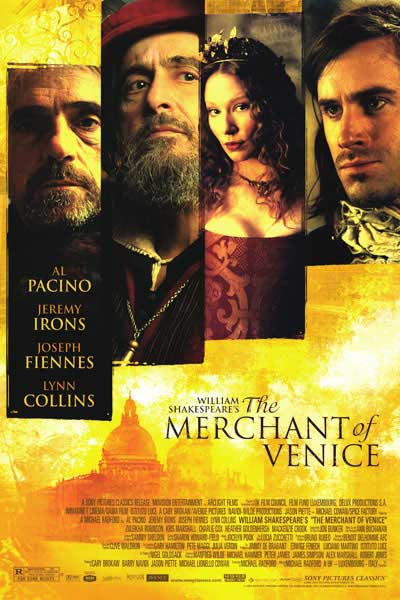
Stubs - The Merchant of Venice


The Merchant of Venice (2004) Starring: Al Pacino, Jeremy Irons, Joseph Fiennes, Lynn Collins, Zuleikha Robinson. Directed by Michael Radford.  Screenplay by Michael Radford. Based on the play The Merchant of Venice by William Shakespeare (London, ca. 1596-97, published 1600). Produced by Cary Brokaw, Barry Navidi, Jason Piette, Michael Lionello Cowan. Run Time: 127 minutes. Great Britain, Italy, Luxembourg, and United States. Color. Comedy, Drama

William Shakespeare has been the source, either directly or indirectly, for many films. It seems that whenever Hollywood can’t think of something new or doesn’t have a sure-fire sequel in its back pocket, they will turn to Shakespeare’s work. Since the French made a version of Hamlet in 1900 starring Sarah Bernhardt, Shakespeare’s plays have been made into 410 feature-length films and television productions, making him far and away the most filmed author in any language.

As an example, The Merchant of Venice has been made several times, including versions British film versions in 1916 and 1922; British television versions in 1947, 1955, 1972, 1973, 1980, 1996, 2001; a Canadian TV adaptation in 1976, a New Zealand film in 2002 and the version we’ll be reviewing made in 2004 and starring Al Pacino and Jeremy Irons. This is not only the first time Hollywood has attempted to make a movie from this particular play, it is the first film version made in the sound era.

Why has this play lagged behind others of Shakespeare’s works to make it to the big screen? No doubt it is the perceived anti-Semitic message of the play. It will come as no surprise that Jews have not been treated well in Europe and the same was very true back in Elizabethan England, when this play was written. At the time, Jews were often depicted on screen as caricatures with hooked noses and red wigs and usually depicted as usuries, people that loan money with interest.

In The Merchant of Venice, Shylock (Al Pacino) is not only portrayed as an avaricious money-lender, but also as sadistic and vengeful; not that he didn’t have reasons for disliking his treatment by Venetian society and at the hands of Antonio (Jeremy Irons), the Merchant, in particular. In Venice, Jews were forced to live in a Ghetto at night, could not marry out of their faith, had to wear red hats when milling with the Christians and were generally treated little better than rats. Adding insult to injury, the first interaction we’re shown between Shylock and Antonio is Antonio spitting in Shylock’s face.


Antonio (Jeremy Irons) is the Merchant of Venice.

Antonio is an ambitious merchant with four trade ships in route to four different destinations. With his money tied up, he has to use his credit to subsidize his good friend Bassanio’s (Joseph Fiennes) pursuit of Portia of Belmont (Lynn Collins). It is Bassanio who finds Shylock and names Antonio as the loan’s guarantor.

While Shylock is reluctant at first to make the loan, he does agree to give Bassanio the 3,000 ducats he requires, but will do so at no interest. However, there is one catch. If Antonio is unable to repay the loan amount by a specified date, Shylock can take from Antonio one pound of his flesh. Feeling assured that his fortunes and cash flow will improve upon his ships return to Venice, Antonio agrees to Shylock’s terms. With the money he needs, Bassanio and his friend, Gratiano (Kris Marshall), set out for Belmont.


Shylock (Al Pacino) makes the loan, but there is one catch.

Portia, whose now deceased father has left her a fortune, must also deal with one other of her father’s stipulations from his will, how suitor will win her hand. Based on his interpretation of a slogan about each of three caskets, one gold, one silver and one lead, each suitor will have the opportunity to choose the casket containing a portraiture of Portia. If the suitor chooses correctly, he will win Portia’s hand in marriage and the wealth that comes with her.


One of Portia's (Lynn Collins) suitors is the Prince of Morocco (David Harewood).

A fair maiden, Portia has several suitors. The first is the Prince of Morocco (David Harewood) who chooses the gold casket. The second suitor, the frumpy and older Prince of Aragon (Antonio Gil), chooses the silver one. Both are wrong. When Bassanio arrives he correctly chooses the lead casket and wins Portia’s hand. Gratiano falls in love with Portia’s handmaid, Nerissa (Heather Goldenhersh), and they plan to marry as well.


Bassanio (Joseph Fiennes) chooses the right casket.

Meanwhile, back in Venice, all of Antonio’s ships are stranded and when it comes time to pay back Shylock, he doesn’t have the money. Some of Shylock’s anger towards Antonio is really towards Christians in general after his daughter, Jessica (Zuleikha Robinson), has eloped with Lorenzo (Charlie Cox) and taken with her a substantial amount of his fortune.


Shylock's daughter, Jessica (Zuleikha Robinson), elopes and takes some of his money with her.

When a letter reaches Bassanio notifying him of Antonio’s troubles, he and Gratiano plan to return to Venice, but not before each is married. As a sign of their union, Portia gives Bassanio a ring as a symbol of their love and swore him not to remove it, sell it or give it away. Nerissa does the same with Gratiano. Portia also gives Bassanio 6,000 Ducats to repay Antonio’s debt to Shylock. Portia and Nerissa then leave to seek advice from her cousin, Bellario, a lawyer.

In the court of the Duke of Venice (Anton Rodgers), final resolution of Antonio’s debt is being discussed. Shylock is there, waiting to take his literal pound of flesh. While the Duke wants to save Antonio, he doesn’t think he can interfere with a contract. Shylock refuses Bassanio’s offer of 6,000 ducats to settle the debt, but Shylock is adamant that he is due the pound of flesh stipulated in the loan contract.


Shylock wants his pound of flesh from Antonio.

Helpless to do anything, the Duke allows the issue to be settled by a new arrival, a man (actually Portia in disguise) who claims to be Balthazar, a doctor of the law. With him is his court clerk, who is Nerissa in disguise. As reference, Balthazar has a letter from Bellario.

Balthazar (Lynn Collins), a doctor of law, comes to Antonio's legal aid.

Balthazar asks for Shylock to show mercy, but Shylock will have none of it. Shylock is allowed to take his pound of flesh, but is warned that if any blood should spill then Shylock will be charged and lose his lands and goods under Venetian law. She further tells him the same will be true if he takes anything other than an exact pound, which Shylock has brought his own scale to measure. Anything above or below that amount will result in similar punishment for Shylock.

Feeling defeated, Shylock decides to take the offer of payment, but now Portia tells him that he has already forfeited that in open court and cannot change his mind now. She then cites a Venetian law in which Shylock as a Jew, and therefore considered an alien, has attempted to take the life of a Venetian citizen. As such he has forfeited his fortune, half to the government and half to Antonio and that his life now lies in the balance up to the discretion of the Duke.

The Duke immediately pardons Shylock and Antonio offers his half for Shylock to use for the rest of his life, provided that it be left on his death to Jessica and Lorenzo. The Duke will forgive the government’s share as well, as long as Shylock converts to Christianity and leaves his entire estate to Jessica and Lorenzo. Shylock accepts his status, but it is obvious that it causes him real distress.

Neither Bassanio nor Gratiano recognize their wives, even when they speak with them. Bassanio offers to pay Balthazar (Portia) for his help. While she originally rebuffs the offer, she does ask for Bassanio’s gloves and for the ring. He gives her his gloves, but doesn’t want to part with ring until Antonio talks him into it. Gratiano likewise parts with his ring, which he also promised Nerissa never to remove, giving it to the court clerk for their part in resolving the debt.


The two couples, Portia and Bassanio; Gratiano (Kris Marshall) and Nerissa (Heather Goldenhersh).

Back at Belmont, Portia and Nerissa make a show of asking their husbands about their missing rings and have they’ve broken their vows before revealing that they were the lawyer and clerk in disguise. In the end, Antonio is informed that three of his ships were not stranded after all and have returned.

Despite the dramatic moments, the humiliation of Shylock and threats of mutilation, the play is considered a Comedy. And while it has moments of whimsy and romance, it is obvious that the definition of comedy has been changed since this play was first performed in and about 1598.

This film was not a success either at the boxoffice or with critics. On a budget of about $30 million, it only made a little over $21 million worldwide. Critics gave generally positive but not overwhelming reviews.

The acting is for the most part very good throughout and the three male leads: Al Pacino, Jeremy Irons and Joseph Fiennes are all to be applauded for their work. Nothing against Fiennes, but it’s hard to imagine better actors than Pacino and Irons. But of those two, Pacino is dominant. Pacino, who came to prominence playing Michael in The Godfather (1972), brings a lot of humanity to the villain character. He is a very three-dimensional character and while Pacino is capable of chewing the scenery, he is somewhat restrained here.


Al Pacino's Shylock is the most commanding performance in the film.

While Shylock is not The Merchant of Venice, Antonio is, the film’s most dramatic moments are when he’s in front of the camera and he frankly outshines Irons. While he’s good, Irons’ Antonio seems to take a backseat to Pacino’s Shylock, especially in the scenes they have together. Irons is a good actor in his own right, but doesn’t have the same presence Pacino commands.

As good as Pacino and Irons are, to me the break out performance comes from Lynn Collins, who played Portia. I am far from being the first reviewer to be impressed by her in this role. Collins, who had performed Shakespeare on stage prior, is excellent in the role. While it is obvious that she’s a woman playing a man in the scene in the court of the Duke of Venice, she is still fascinating to watch, both in and out of drag.


Lynn Collins was a stand out in the film playing Portia and Balthazar.

Speaking of being out of clothes, there is nudity in this film, something I doubt there was in the original staged versions of the film. The nudity, which is mostly confined to unconfined breasts, has a place and is perhaps historically accurate, as most of it occurs in scenes taking place in brothels. While it’s not just nudity for the sake of nudity, there are still 15 shots (someone else’s count) of bare breasts, which might not be what you’d expect with your Shakespeare. (Insert your own pound of flesh joke here.)

This was my first exposure to The Merchant of Venice in any form, having never seen this on stage or having read the play. I understand from reading that there are some changes between play and film, but that’s to be expected whenever a play is adapted, even one of Shakespeare’s. They are different media after all. I particularly liked using the actual canals of Venice for some of the backdrops. Seeing it performed where the play takes place adds to the story-telling in ways the playwright could have only imagined.

While this is not my favorite Shakespeare play, this adaptation of The Merchant of Venice is a good addition to the catalog of his plays put to film. There are other versions of the play out there to watch, most notably a 1973 television version starring Laurence Olivier, but it’s hard to imagine one as vital and alive as this one.

Saturday, June 7, 2014

Stubs – Second Opinion: The Incredibles (2004)


The Incredibles (2004) Starring the voice of: Craig T. Nelson, Holly Hunter, Sarah Vowell, Spencer Fox, Jason Lee, Samuel L. Jackson, Elizabeth Peña and Brad Bird. Directed by Brad Bird. Screenplay by Brad Bird. Produced by John Walker Run Time: 115 minutes. U.S.  Color, Animated, Comedy, Action

By 2004, Pixar Animation Studios was considered to be on the leading edge of animation. They had burst on the scene in 1995 with Toy Story and had followed up every few years with A Bug’s Life (1998), Toy Story 2 (1999), Monsters, Inc. (2001), Finding Nemo (2003). All had been directed by original members of the Pixar team and all had been incredibly successful. During the same period, Brad Bird had moved from animator to writer/director with The Iron Giant (1999), a great film that flopped at the box office due in part to the lack of marketing by Warner Bros., which was gun shy after the boxoffice failure of Quest for Camelot (1998). But the film impressed John Lasseter, head of Pixar and an old friend of Bird’s.

If you think live-action features have a long lead time, they are nothing compared with animated films. Bird pitched the idea of The Incredibles to Lasseter in March 2000. Pixar signed Bird to a multifilm contract in May of that year. There were a lot of firsts in this film for Pixar: the director was not one of their own, there was only one writer on the project, Bird, and all the main characters were humans.

The Incredibles (previously reviewed on Trophy Unlocked here), in a family friendly way, covers many of the same themes that Alan Moore and Dave Gibbons covered in the 1986 Watchmen comics, itself made into a movie in 2009. Society has become disillusioned with superheroes and tired of picking up the huge financial tabs super heroes leave in their wake. While Moore and Gibbons set their tale in a dystopian world, The Incredibles live amongst us in Middle America.

When the film opens, superheroes are in their prime. Mr. Incredible (Craig T. Nelson) is on his way to an important engagement, but has the time to get involved in a police pursuit, taking a few minutes to rescue a cat from a tree. Once again he helps out tracking down a purse thief and, with the help of Elastigirl (Holly Hunter), subdues the criminal. There is obviously an attraction between the two superheroes, but Elastigirl tells him that she has an engagement later.

A young and single, Mr. Incredible (Craig T.Nelson)

But one more stop on his way; Mr. Incredible foils a suicide attempt by intercepting the jumper on his way down and crashing him in through some windows in a bank tower. There, Incredible foils a bank robbery attempt by Bomb Voyage (Dominque Louis). But fanboy Buddy Pine (Jason Lee), self-proclaimed Incrediboy, who wants to be Incredible’s sidekick, interferes. This allows Bomb Voyage to escape, while Incredible removes a bomb from Incrediboy’s cape. The bomb goes off on the elevated track of a commuter train and while Incredible stops the train, passengers are injured.
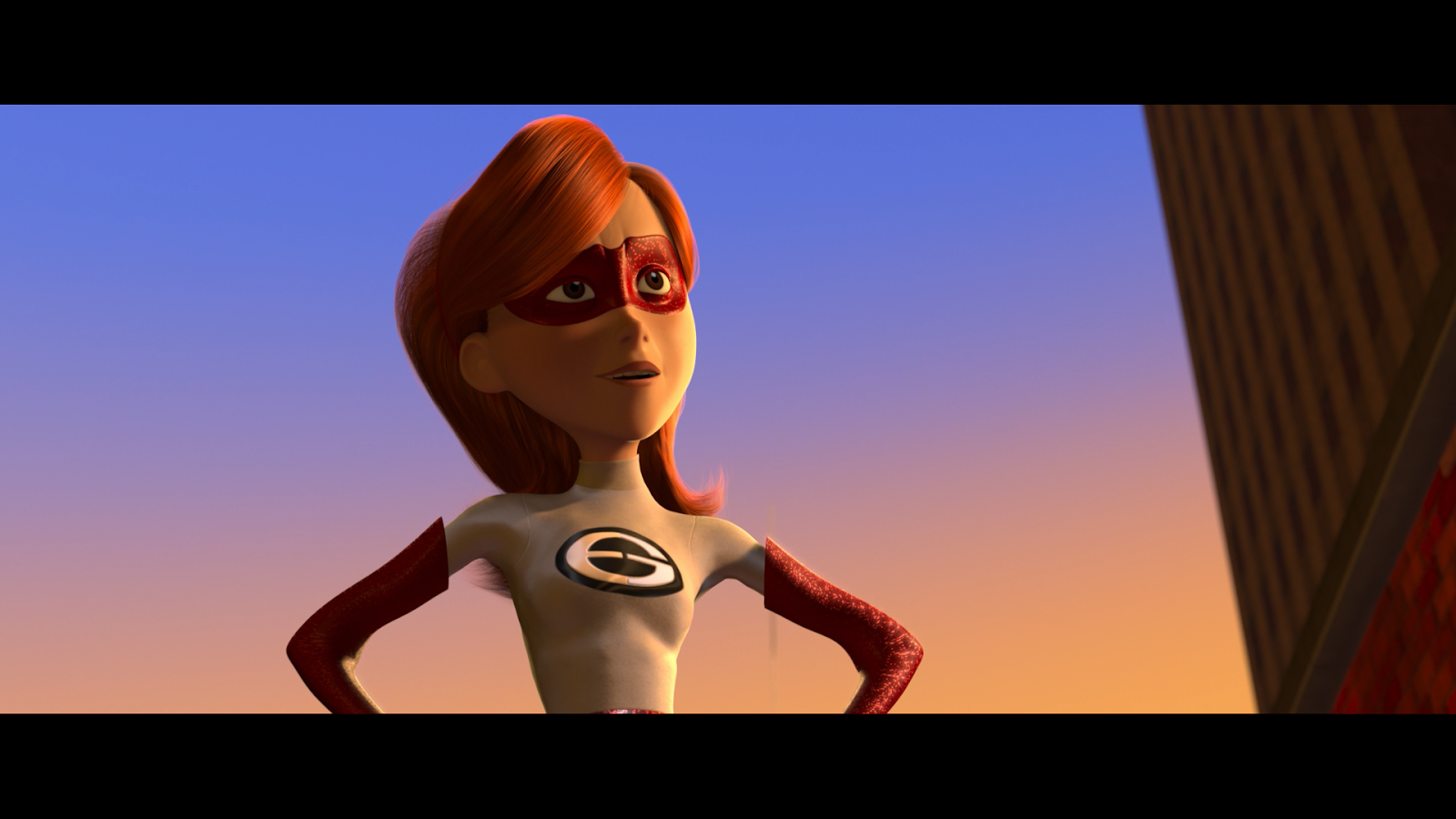
Mr. Incredible has a date to keep with Elastigirl (Holly Hunter).

Still on an adrenaline rush, Incredible arrives at his destination, a church, where he married Elastigirl with his best friend, and co-crime fighter, Frozone (Samuel L. Jackson) standing with him as his best man. But their future together isn’t all that rosy. The lawsuits that follow, from the suicide victim denied his effort and the injured passengers, not to mention the collateral damage done to the bank building and commuter train, lead the government to relocate the Incredibles.
Fifteen years after relocation, Bob and Helen Parr, formerly Mr. Incredible and Elastigirl, live in the suburbs with their three children Violet (Sarah Vowell), Dash (Spencer Fox), and baby Jack-Jack as a suburban family. Bob works as a claims agent at Insuricare, an insurance company, working for Gilbert Huph (Wallace Shawn), a job which he finds very unsatisfying.

After fifteen years in exile, Bob Parr works for Gilbert Huph (Wallace Shawn) at Insuricare.
Longing for the glory days, Bob meets up regularly with Lucius Best (aka Frozone) and they spend the night listening to the police radio and perform vigilante work, all while Helen thinks they are bowling. One night, under the watchful eye of a woman called Mirage (Elizabeth Pena), the two get involved in a burning building, rescuing several tenants, but accidentally break into a bank as part of the escape. They manage to elude the police, but Helen is not happy with Bob’s behavior.

Mr. Incredible longs for his Glory Days.
When Bob loses his temper with Mr. Huph and throws him through several walls when he won’t let him interfere with a mugging in progress, he is fired. His government handler, Rick Dicker (Bud Luckey), warns Bob about such outbursts and offers, for old time’s sake, to relocate the Parr family once again, but Bob turns down the offer.

Returning home, Bob finds a Mission: Impossible-style message from Mirage, who needs him to be Mr. Incredible again and help with a mission to destroy a malfunctioning robot called the Omnidroid, promising a substantial reward. Arriving on Nomanisan Island, Bob is able to defeat the robot by tricking it into ripping out its own power source.

Mirage (Elizabeth Pena) elicits Mr. Incredible's help with a project.
Bob is rejuvenated by being able to use his powers freely, improving his attitude and relationship with his family, and he begins rigorous training while waiting for more work from Mirage. Discovering a tear in his Mr. Incredible suit, Bob visits superhero costume designer, turned fashion mogul, Edna Mode (Brad Bird) for repairs. Edna decides to make him and his whole family new suits, unbeknownst to Helen and the children. She rejects Mr. Incredible’s desire for a suit, recounting all the supers who have been killed by accidents with their capes.

Mr. Incredible brings his suit to Edna Mode (Brad Bird) for
repairs. She makes him and his family all new outfits.

Leaving for Nomanisan once again, Bob discovers that Mirage is working for Buddy, now identifying himself as the super-villain Syndrome. Buddy, after being shunned by Mr. Incredible, took to weapons design, which has made him incredibly rich, but there are some weapons he has kept for himself, including the Omnidroid, which Syndrome has been perfecting at the expense of former Supers. Syndrome plans to release and then defeat the Omnidroid in Metroville, the Parr family’s hometown. Using controls he’s built into his own suit, Syndrome can manipulate the robot and become a hero himself. Then he plans to retire and sell his inventions so that everyone will become super, meaning that nobody really is.

Annoying Incrediboy grows up to be Syndrome (Jason Lee)

Meanwhile, Helen visits Edna, who shows her the new suits she’s gleefully designed. Edna tells Helen what Bob has been up to, making it sound like he’s having an affair with Mirage. She encourages Helen to find Bob, using a homing beacon built into his suit and go fight for him. The activation of the beacon gives Bob’s presence away and he is captured.

Syndrome captures Mr. Incredible.

Helen borrows a jet and heads for Nomanisan, but on the way she finds out Violet and Dash have stowed away wearing their own costumes, leaving Jack-Jack in the care of a teenage babysitter Kari McKeen (Bret Parker).
Syndrome picks up Helen’s radio transmissions and despite Helen’s plea that there are children onboard, sends missiles with destroy the jet. But Helen, along with the children, survives and makes it to the island, following the jet trails from the short range missiles, but Bob thinks they are dead.

Helen rescues Violet (Sarah Vowell) and Dash (Spencer Fox) by turning herself into a raft.

Leaving the children in a cave, Helen proceeds to the base to find Bob, discovering Syndrome's intentions to send the Omnidroid to Metroville in a rocket. Mirage, who is distraught when Syndrome acts indifferent to Incredible’s threat to kill her, releases Bob and informs him that his family is alive. Just when Bob hugs Mirage in celebration, Helen appears. Her suspicions realized, Bob has to convince her there’s nothing going on. The two end up racing after the children when alarms go off when they are spotted by security. Dash and Violet use their powers (Dash’s speed and Violet’s invisibility and force field capabilities) to escape their captors and are joined by their happy parents. But their freedom is short-lived when the whole family is captured by Syndrome; his plan is initiated.

The Incredible strike their iconic pose before being captured.

Violet manages to escape, but the family needs Mirage's help as well to get off the island. Using a security van, a rocket booster and Elastigirl’s stretchiness, they pursue Syndrome and the Omnidroid to Metroville. But the Omnidroid proves to be too intelligent for Syndrome and knocks the remote controls out of his grasp, knocking him unconscious and rampaging through the city.

Syndrome's Omnidroid about to wreck havoc on Metroville.

The Parrs and Lucius team up to fight the robot, but are losing until they use Syndrome's remote control and one of the Omnidroid’s detached pincers to blow a hole through the Omnidroid, the only thing strong enough to break inside, tearing out its power source and destroying it.

Lucius, aka Frozone, (Samuel L. Jackson) teams up with the Incredibles to stop the Omnidroid.

On their return home, the Parrs find Syndrome has taken over watching Jack-Jack from Kari, much to the teenager’s relief. But Syndrome intends to raise Jack-Jack as his own sidekick to seek revenge on the family. As Syndrome attempts to escape to his waiting jet, Jack-Jack, whom the family thought had no super powers of his own, shows that he has several, including turning into fire and becoming a lead weight. Syndrome drops the baby and Helen is thrown by Bob to intercept. Syndrome tries to escape in his jet, but Bob throws his own car at the jet, knocking Syndrome into the jet’s intake which catches his own cape in the blades of the engine, which sucks him in. The jet explodes and destroys the Parr's house, but Violet's force field shields the family.

Baby Jack-Jack, who no one thinks has any powers, becomes a handful for babysitter Kari.

Three months later, the Parrs have readjusted to normal life. Dash is allowed to participate in sports as long as he holds back. Violet has come out of her shell long enough to attract the attention of Tony Rydinger (Michael Bird), a popular boy at school, who asks her out. All seems right with the world, that is until a new villain called the Underminer (John Ratzenberger) tunnels up and invades the city. The family dons their superhero masks and prepares to face this new threat.

It wouldn't be a Pixar film without a vocal appearance by John
Ratzenberger, here appearing as a new villain, the Underminer.

The Incredibles would go onto win the Academy Award for Best Animated Feature and earn over $600 million at the worldwide boxoffice. Bird would take over the direction of Ratatouille (2007) and again win the Best Animated Feature Oscar. While the budget was 50% higher, Ratatouille, like The Incredibles would also earn more than $600 million worldwide. Bird would move on to live action films, directing Mission: Impossible – Ghost Protocol (2011). He is currently working on Tomorrowland, co-written and co-produced with Damon Lindelof, and is expecting a release next year. And there are plans in the works for an Incredibles sequel.

It’s difficult for me to comment on the acting in an animated film. While the voice is very important, there are no screen captures, so much of the physical acting is animated. However, all the voices seem to hit the right notes so to speak.

The animation is typically amazing Pixar rendering. At this time the studio was setting the animation bar very high with not only incredible CGI, but amazing story-telling as well. That has arguably dropped off since, as Pixar, like all the studios, seems to rely on sequels: Toy Story 3 (2010), Cars 2 (2011) and Monsters University (2013) as they ramp up their output at the expense of invention. Their films seem to still do well at the box office, but the bloom of infallibility, which the studio once had, is off the rose by now.

Having recently watched The Incredibles again, I can tell you that it still holds up very well after ten years. It is still a lot of fun to watch and is definitely one of those family films that people over 10 can really enjoy. While I worry about Disney/Pixar going back to the well again, The Incredibles 2 is in pre-production, the magic is definitely present here and The Incredibles lives up to its name.