Showing posts with label Nintendo. Show all posts

Wednesday, May 20, 2026

Super Mario Galaxy 2 (Wii)

Sequels seem inevitable after a successful game release, especially for a series as popular as Super Mario. What makes Super Mario Galaxy 2 (Galaxy 2) stand out, however, is that it was originally intended as an updated version of the original Super Mario Galaxy (Galaxy) called Super Mario Galaxy More, but there was enough new content that the development team turned it into a full sequel. When Galaxy 2 released for the Nintendo Wii in 2010, it garnered instant acclaim, with many considering it on par with or even better than the original and became one of the best-selling titles for the system (though it would still fall a few million units short of the original). Since I played the original Galaxy in anticipation of The Super Mario Galaxy Movie, I continued my journey with Galaxy 2, this time through the original Wii release via the Wii U’s backwards compatibility. While it did deserve the praise it had received, I felt more mixed about the presentation overall compared with its predecessor.

Saturday, April 11, 2026

The Super Mario Galaxy Movie


Note: This review contains spoilers for The Super Mario Bros. Movie.

The success of 2023’s The Super Mario Bros. Movie, grossing over $1 billion on a $100 million budget, would naturally justify a sequel, announced one year later and released in 2026. Despite animation studio Illumination’s track record for the inconsistent quality of their output, I still enjoyed The Super Mario Bros. Movie (in spite of its flaws) and felt growing hype as the sequel, The Super Mario Galaxy Movie, drew closer, enough that I finally played the original game that it was based on, Super Mario Galaxy. Although some skepticism and negative critic reviews popped up during the lead-in to the film’s release, I felt that I should see first-hand how it shaped up compared to the original. Unfortunately, for every enjoyable element, there is something that holds it back from greatness.

Wednesday, April 1, 2026

Super Mario Galaxy (Switch)


Back in 2007, Nintendo released Super Mario Galaxy (Galaxy), an early release for their explosively popular Wii system and the third 3D platformer in the Super Mario series. During its lifetime, it sold nearly 13 million copies on its original platform and continues receiving critical praise, even against other modern Mario titles. Although I had heard about the game for nearly two decades, including comparisons made against other games like Sonic Lost World, I got hyped enough for the release of a 2026 film adaptation, The Super Mario Galaxy Movie, that I decided I should finally play the game and express my thoughts on it as the first Mario game reviewed on this blog. Fortunately, I can confidently say that it lived up to the hype, though Mario’s journey through the stars wasn’t entirely a smooth one.

Before continuing, I want to firmly establish that this review is based on the Switch version of the game as presented in Super Mario 3D All-Stars (which I played through a physical copy) and played with a Switch Pro Controller (due to suspected JoyCon drift). As such, I will not make any comparisons with the original Wii release or the later Switch compilation re-release with Super Mario Galaxy 2.

The version used for this review.

Tuesday, March 17, 2026

Star Fox Command


Following the release of Star Fox: Assault (Assault) on the GameCube, a new Star Fox game, Star Fox Command (Command), was developed for Nintendo’s then-new DS system and released early in the system’s life cycle. Admittedly, I didn’t have much interest in this game at first, but I ended up investing in a physical copy, partly to fill the unsightly gap in my Star Fox collection after realizing it was the only game I didn’t own in any capacity and partly to complete my experience with the timeline started by Star Fox 64 (64). Rather notably, said timeline represents a more experimental era in Star Fox history, with each subsequent game after 64 attempting to bring something new to the table to stand out. In the case of Command, its most notable feature is its use of multiple endings, as well as a unique control scheme based around the DS touchscreen, making it stand out from even the radically different Star Fox Adventures (Adventures) and Assault. While these are interesting ideas in theory, the end result unfortunately falls a little short in practice.

Thursday, March 12, 2026

Star Fox: Assault

With the success of Star Fox Adventures (Adventures), Nintendo greenlit a sequel, Star Fox: Assault (Assault), this time developed by Namco rather than Rare, with the latter having been purchased by Microsoft. After I had originally played Adventures, I admittedly didn’t have much interest in the other Star Fox games, until I learned that Assault was a sequel and even contained elements from Adventures beyond Krystal becoming a mainstay, which led me to explore the franchise further and eventually receive Assault as a gift. Like the previous game, Assault was also developed for the GameCube, however I could not get my GameCube to properly read the disc, so I ended up playing it through the backwards-compatible Wii. After finally getting to play it, I found it an interesting follow-up to Adventures due to its different gameplay approach, and I also liked getting to see its characters and setting again, however briefly.

Tuesday, March 10, 2026

Star Fox 64 3D


Following the release of the original Star Fox on the SNES, with Star Fox 2 having been shelved despite being fully completed, the series was rebooted for the then-recent Nintendo 64 system in 1997, aptly named Star Fox 64. In 2011, as part of a series of 3DS remakes of older Nintendo titles, Star Fox 64 received one as Star Fox 64 3D, which aimed to be faithful to the original release while adding new content. I had become curious about playing Star Fox 64 after playing Star Fox Adventures, which was made as a sequel to it, to get a better hang on the story, but didn’t actively attempt to do so until the Nintendo 3DS eShop was shutting down, at which point I went for a physical copy of Star Fox 64 3D both for convenience and to get the best experience possible. After finally getting around to playing it, I can see why it’s considered a classic game in terms of gameplay and story.

Wednesday, March 4, 2026

Star Fox


After playing through Star Fox Adventures, I became interested in seeing what other Star Fox games were like, which quickly turned into a deep-dive that involved going back to the franchise’s 1993 roots with the original Star Fox (aka Starwing in Europe) on the SNES to see how it all began. Although I own a SNES and the game itself isn’t too difficult to find, I would end up playing the game through the SNES Classic, as it happened to be one of the included games and has a save state function that would make an otherwise difficult game easier for me to get through and play in chunks. While the game does still impress with the hardware limitations at the time, there are still areas where it didn’t age quite so well due to later entries improving upon what it set out to be.

Wednesday, April 19, 2023

The Super Mario Bros. Movie

Mario is a character who needs no introduction. Even if you’ve never played a video game before, chances are you recognize the Italian plumber, or at the very least heard of him or any of the literally hundreds of games he’s been in. He’s also no stranger to adaptations, with three dedicated TV series (The Super Mario Bros. Super Show!, The Adventures of Super Mario Bros. 3 and Super Mario World) and two films (the animated Super Mario Bros.: The Great Mission to Rescue Princess Peach! and the live-action Super Mario Bros.) under his belt. After a nearly 30-year absence from the silver screen, a second theatrical film, The Super Mario Bros. Movie, was announced with animation studio Illumination at the helm. Considering Illumination’s rather contentious output following Despicable Me, their first feature, their involvement invited some understandable skepticism that continued even during the first round of marketing. Mario fans can rest assured, however, knowing that in spite of the studio behind it, The Super Mario Bros. Movie, while not flawless, is indeed the film they’ve been waiting for.

Wednesday, July 29, 2020

Star Fox Adventures


Note: This review contains spoilers for Star Fox Adventures.

I admit I don’t have that much experience with the Star Fox series, and even then my only real exposure to it was the Switch version of Starlink: Battle for Atlas, which contained exclusive Star Fox content. However, I felt motivated to play Rare’s take on the series, Star Fox Adventures, in particular because the only thing I had heard about from it was the original character Krystal, and so wanted to see what else there was to this game and understand the character in that context. After finally getting the chance to play it, I found it overall decent, though flawed.

Saturday, December 28, 2019

Tetris 99


Over the last few years, the battle royale style of game has gotten increasingly popular, with arguably the best-known examples of this type of game being PlayerUnknown’s Battlegrounds and Fortnite Battle Royale. When Tetris 99 was announced and released earlier this year for the Nintendo Switch, I found the concept of the battle royale style crossed with a puzzle game such as Tetris to be intriguing, especially when it proved to be successful, however I was initially turned off a little by the lack of any offline capabilities and that playing it required subscribing to another service, that being Nintendo Switch Online. That said, I was more interested when a physical edition of the game was announced later in the year, as the cartridge not only came with the paid Big Block DLC that introduced offline functionality, it also included a voucher for a free year of Nintendo Switch Online. After getting a chance to play the game for a while, I can safely say this is a very interesting Tetris variant and one of the more unique versions to come out in the last few years along with Tetris Effect and Puyo Puyo Tetris.

Saturday, July 7, 2018

Bayonetta 2


Note: This review contains spoilers for Bayonetta.

Following the success of the original Bayonetta, a sequel was announced three years later in 2012, but this time exclusive to Nintendo’s Wii U console. The reason was later revealed to be that Nintendo was the only company willing to greenlight a sequel in the first place, hence the exclusivity. Since I didn’t own a Wii U at the time and didn’t want to get what I viewed as a DOA console solely to play one game, I didn’t end up playing it, not even with the incentive of first run copies including a Wii U port for the original Bayonetta. It wasn’t until the announcement of Bayonetta 3 as a Nintendo Switch exclusive that I finally caved and picked up the physical Switch port of Bayonetta 2, if only so I could actually keep up with the series. Now that I’ve finally played it, it feels like PlatinumGames managed to improve on the original in just about every way.

Only a few months after the events of the original game, Bayonetta is out Christmas shopping when she and Jeanna are attacked by a group of angels. All goes well until one of Bayonetta’s demons breaks free of her command and begins to attack her as well. Although she overpowers the demon, Jeanne’s soul is removed from her body and dragged down into Inferno. While Rodin does what he can to delay Jeanne’s death, he informs Bayonetta that she will need to travel to a sacred mountain named Fimbulventr, where she can enter the real Gates of Hell and retrieve her friend’s spirit. When she arrives in the town of Noatun to begin her journey to the mountain, she runs into a boy named Loki, who seeks the mountain for reasons he can’t remember and is being chased by a masked Lumen Sage.

Loki joins Bayonetta on her journey to Fimbulventr.

The story of Bayonetta 2 is better executed than in the first game, due largely in part to a more streamlined story that easier to follow. It also manages to expand on many of the concepts introduced in the previous game without betraying previously established lore or sacrificing the charm and personality of the original. Returning characters remain consistent to their characterizations and character growth from the original, while returning character Luka is also able to display a somewhat more mature side. At the same time, the plot threads which expanded on in later parts of the game manage to slot in the events of the story to fit in with and help explain the time travel elements from the first game.

While Bayonetta 2’s story is improved, I noticed that some of the story beats seem to echo ones from the previous game. In particular, Bayonetta once again travels with a child (in this case someone she believes is a child), with Loki filling the role in place of Cereza. The plot once again involves some sort of time travel aspect, as well as someone looking for the Eyes of the World, and the final boss is ultimately defeated in a similar fashion to Jubileus, though perhaps not as memorable in execution. I’m not saying these beats are bad to echo, in fact they are handled differently and very well in their own right, but it was noticeable after playing this game immediately after completing the original.

The idea that Bayonetta 2 is similar to, but greatly improves upon, the original also extends to the core gameplay. The mechanics of the game are largely unchanged, though each one has received an upgrade or some quality of life improvements. For one, Bayonetta begins with a god number of skills earned from the previous games, including the beast transformations. These transformations are expanded upon by including the addition of a Snake Within that allows for better maneuverability during underwater sections, itself a new feature to the game, and the transformations in general are incorporated more into the larger, more open level designs.

Bayonetta's new Snake Within form.

The magic system has received some noticeable improvements as well. Taking damage no longer drains the magic gauge and reaching a full gauge now gives the choice of either executing a Torture Attack or activating an Umbran Climax, which heavily increases the damage output of Bayonetta’s weapons. Each weapon is affected differently during an Umbran Climax, though it otherwise turns every attack into a Wicked Weave attack. Crafting is also handled differently, requiring the player to select a recipe book and then select a recipe to craft from instead of manually mixing all of the ingredients. As for other general quality of life improvements, they include, but are not limited to, the lack of instant death QTEs and a much larger window for remaining QTEs, a more forgiving window for activating Witch Time (in exchange for a slightly shorter duration) and item use no longer affecting the Chapter score.

While the enemies in Bayonetta 2 are a lot more varied than in the first, both in terms of the number of Angels and Infernals and their designs, the combat generally felt easier. Certain enemies still present a challenge, including some which return from the first game, but throughout my entire playthrough on Normal, I suffered far fewer resets than in the first. Basically, the game in general is more forgiving. However, the encounters with the Masked Lumen Sage, among others, also present themselves with a larger scale than their counterparts from the original, including having summons fighting each other in the background.

Bayonetta must now do battle with Infernals as well.

The default control scheme is a bit different from the original, mainly flipped functionality of the shoulder buttons, and takes some getting used to. While I was able to adjust, I was once again playing using the Joy-Cons in a separate Joy-Con Grip. Given the somewhat cramped layout of the controller and the shape of the L and R buttons, it was incredibly easy to accidentally switch weapon sets during combat and unintentionally activate Umbran Climax when I really wanted to use a Torture Attack. As before, this game also has a touchscreen control scheme, though I would advise against it. Control changes for special segments are easier to adjust for, since these segments are now a bit shorter than the would be in the original game.

As with Bayonetta, players can visit the Gates of Hell to buy various items, weapons and techniques for use in the game. Though Halos are still the primary currency, defeating Infernals and destroying related objects will also reward the player with Orbs of crystallized demon blood which count toward the total Halo count. Recommended buys for this game are similar to the original (Air Dodge, Stiletto, Break Dance, Bat Within and Crow Within), but the new Charge Bullet skill is also worth buying for its ability to increase damage output with bullets, as is the Mallet of Rewards for its ability to increase the number of Halos and items the player receives from performing Torture Attacks. Also available in the Switch version is amiibo support, which also provides a way for the player to obtain the Chain Chomp weapon, which is highly recommended for a weapon loadout alongside Salamandra; I used both in my B set when able. I’ll note here that my A set of weapons was simply the default Love Is Blue guns (their names are Prelude, Minuet, Toccata and Nocturne).

In terms of graphics, Bayonetta 2 seems more polished than its predecessor. The characters all received a general update to their appearance, all of which seemed to match the lighter direction of the sequel. What helps is that the game seems to generally have a brighter color palette that moves it a little more away from the Devil May Cry-inspired art direction of the previous game. With this brighter palette, it seems to emphasize the color blue a bit more as sort of a theme color.

I’ll mention here that while every character received a general update to their look, the most drastic were Bayonetta, who now has noticeably shorter hair, and Jeanne, who now has noticeably longer hair. I personally liked the new looks, and actually found Bayonetta’s new look more aesthetically pleasing, but those who preferred the original looks will be glad to know that the Bayonetta 1 costumes are unlockable within this game.

Bayonetta (L) and Jeanne (R) received more drastic redesigns than the rest of the cast.

As for any differences between the Wii U and Switch versions of the game, I can only go off of what I’ve been able to look up. Apart from the aforementioned amiibo support, I found graphical differences from the Wii U version rather negligible, perhaps a slight upgrade at best.

There’s a multiplayer mode called Tag Climax where two players play as one of the characters and fight groups of angels based on which unlockable Verse Cards are chosen. Each complete match uses six of these cards and players bet a certain number of Halos on each fight in an attempt to earn more; the difficulty of each fight is based on the number of Halos wagered. Players can fight alongside the CPU while waiting for someone else to play with, though this requires the second person to also own a Switch and have their own copy of the game, even if you’re playing locally. For this reason, I only tried out the CPU version and quickly concluded it would be better to play with another human being.

The music of Bayonetta 2 is also pretty good, especially with setting the mood of each segment of the game. As with the previous game, the most noticeable track is the main theme, in this case Tomorrow Is Mine, since it’s played during combat and also at the right moments within the story.

Bayonetta 2 is a good example of a sequel that’s able to improve on the original in all of the right ways. While a lot of the core gameplay is unchanged and the story follows some similar beats, the game manages to add a new layer of polish that elevates the Bayonetta series to new heights. Though the game feels easier this time around, save for trying to get Pure Platinum rankings, it still felt very much like Bayonetta. Fans of the original game are more than likely to enjoy this installment, especially in anticipation of Bayonetta 3, while Switch owners looking for a good action game should seriously take this game into consideration. Just make sure you find time to play the original as well.

Saturday, June 30, 2018

Bayonetta (Switch)


Back in 2010, Sega released Bayonetta, developed by PlatinumGames and directed by Hideki Kamiya of Devil May Cry and Viewtiful Joe fame, onto the PlayStation 3 and Xbox 360 in North America. At the time, I had, for a number of reasons, played the PS3 version of the game, widely considered the worst version of the game (Kamiya has since confirmed that it was because the game was designed with 360 hardware in mind). In 2014, a sequel, Bayonetta 2, launched exclusively on Nintendo’s Wii U alongside with an improved port of the original game. In 2017, a Bayonetta 3 was announced exclusively for the Nintendo Switch, along with Switch ports of the first two games for 2018. Since I didn’t want to permanently stay out of the loop, I finally caved and bought a Switch and later bought Bayonetta 2. However, I decided to play the original game again first, available through a download code, both for the story and because it had been eight years since I had last played it. In that time, I think the game has aged rather well, but its issues have become more noticeable as well.

Bayonetta is awoken after a 500-year slumber with no memory of herself or her past. She spends the next 20 years battling angels from Paradiso, one of the Trinity of Realities alongside Inferno and Purgatorio, until one day she finds herself wrapped up in a centuries-old conflict between the Umbra Witches and Lumen Sages over something called the Eyes of the World. As she chases these lost memories, she comes into contact with another Umbra Witch named Jeanne, a journalist named Luka and a child named Cereza. As she chases the meaning of the Eyes of the World, the pieces of her lost memory begin to fit together.

Jeanne, a recurring enemy throughout Bayonetta's journey.

The backstory of Bayonetta is rather fascinating and very consistent in its presentation and execution. Though out there in comparison to other games, the story is fairly easy to follow and is complex enough to keep the player invested until the end, when all of the preceding events make much more sense. What also helps keep the player invested are the contrasting personalities of each of the characters and how they play off each other. Even without knowing all of their backstories in full, their interactions also give a sense of familiarity that would have developed within 20 years. The only drawback might be that the full background of the world is located within collectible journals, which means that players should prepare to do some light reading.

The presentation of the cutscenes is also unique from other games. Though there are parts of cutscenes rendered the traditional way, some parts use static shots of the action rather than full motion, though some things like hair still have motion. It feels off at first, but after a while it feels like Platinum was going for a specific style with this approach and it does help it stand out from other games.

The easiest way to describe the gameplay of Bayonetta is that it’s like an evolved version of Devil May Cry. Combat is similar in that there are dedicated buttons for shooting, melee and jumping. However, this is where the similarities end. For one thing, Bayonetta can be equipped with two weapons, one on her hands and one on her feet; the default is a set of four guns called Scarborough Fair, with each individual gun named Parsley, Sage, Rosemary and Thyme. She can also be equipped with two sets of weapons, an A set and a B set, which the player can swap between on the fly; equippable weapons are unlocked by collecting Gold LPs and going to the shop. Additionally, the “Light Attack” button has her attack with her hands and “Heavy Attack” has her attack with her feet. Bayonetta also comes with a double jump which, along with unlockable beast transformations, allows her to gracefully move along the battlefield. Bayonetta can also use the enemy’s weapons against them, though the player will temporarily lose the ability to shoot. The player can also string together combos, which usually end in a Wicked Weave attack created from Bayonetta’s hair.
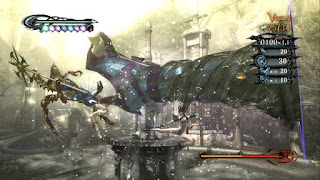
Combat in Bayonetta with a Wicked Weave attack.

I'll quickly mention that my personal setup while playing eventually fell into using Scarborough Fair in my A set and Shuraba and Odette in my B set. This allowed me to play the game will full power guns while also switching to a powerful and speedy weapon setup to help make certain fights easier.

An emphasis is also placed on dodging, since doing so at the right moment activates a mechanic called Witch Time. During Witch Time, time slows down, allowing Bayonetta to freely strike her enemies for the duration without worry. Witch Time is also used in some environmental puzzles in which the player must dodge a lightning blast to slow time and traverse certain terrain (ex. running water). Attacking enemies also builds up a magic gauge which, when full, allows Bayonetta to perform a Torture Attack which can heavily damage, if not outright kill, an enemy angel. However, taking damage beforehand will proportionally drain the magic gauge. Bayonetta can also craft and consume lollipops which provide a variety of abilities, including replenishing health and magic, creating a shield and multiplying her strength, but using these will also incur a score penalty at the end of a Chapter. Crafting ingredients can be obtained by destroying objects within the environment.

On the subject of scoring, Bayonetta, like Devil May Cry, features a ranking system that takes into account completion times, combo scores and penalties from retries and items uses. Each set of fights, or Verses, within each Chapter is scored on a scale from Stone to Pure Platinum, while each Chapter, rated on the same scale, averages the ratings from each Verse before applying score penalties; it is entirely possible to miss some Verses. Though the player can replay Chapters in an attempt to get a better score, the game itself can be pretty unforgiving as it goes on, even on Normal. I’ll admit that during my playthrough, I ended up using a lot of yellow (shield) and red (strength) lollipops to survive some of the harder battles.

While the combat is very fun and engaging, there are some general annoyances with the gameplay that are hard to ignore. During cutscenes and other in-game sequences, it is possible for quick-time events (QTEs) to pop up at the bottom of the screen. Unfortunately, failing a lot of these leads to instant death and a score penalty during a retry, not helped at all by the fact that the window to press the right button(s) is very slim. QTEs are also used during boss fights, where Bayonetta finished them off with a Climax attack which summons a demon from Inferno. In this case, the QTE determines how much of a score bonus you receive at the end of the Verse, but the timing window here is also pretty strict and it can take a moment to process which button you’re supposed to mash for each one.

Due to the game’s unforgiving nature, specific enemy pairings become increasingly unbearable no matter how you power up. Special mention goes to Grace and Glory and their later Gracious and Glorious counterparts, especially when the player has to survive multiple waves of them, as well as any team of at least three Joys.

In spite of the difficulty, the boss fights are highly interesting. This is the sort of game where enemies that are originally mid-bosses show up again as regular enemies and end bosses show up again in mini boss rushes. This isn’t really a bad thing, since it adds some extra challenge to the game, although the boss rushes can get kind of draining after a while, since they occur two or three times in the last few Chapters. What mitigates this somewhat is the creativity in their unique designs and strategies. The last three bosses are especially memorable, as they include some unique and highly cathartic sequences, though to elaborate would go into spoiler territory. However, I will admit here that during the Golem boss fights, I was able to cheese it by staying right next to it, dodging its attacks into Witch Time and holding down the fire button. Probably not the best way to enjoy the fight, but food for thought.

The Golem can change shape, but can also be easily cheesed.

The controls are mapped pretty intuitively and are highly responsive to the player’s button presses. However, I should address here that I did not play Bayonetta on a Pro Controller, as others may recommend, but rather with the Switch’s Joy-Cons. I tried playing them while attached to the unit, but it felt more comfortable to use a Joy-Con Grip to act as more of a traditional controller. Even then, however, I found the controller kind of cramped and the shape of the L and R buttons makes it rather easy to accidentally press them in the heat of battle. It didn’t affect me too much, but it’s certainly something to keep in mind. The Switch also has a touchscreen-friendly control scheme, but I wouldn’t really recommend it, since it depends heavily on player gestures.

There are also times when the game switches to different types of gameplay, necessitating a different button layout for the duration of the applicable Verse(s). These take a little getting used to, but for flying sections I would suggest inverting flying controls (in this case, the default is already inverted, where Up=Down and Down=Up).

During the course of the game, the player collects Halos by defeating enemies or destroying objects in the environment. These are exchanged at the Gates of Hell bar run by the demon Rodin. Halos can be exchanged for items, techniques, costumes, weapons, accessories and treasures. The game will highlight some “Hot” buys, or recommended purchases. Personally, I would highly recommend buying the techniques Air Dodge; Stiletto, a version of Devil May Cry’s Stinger attack; Break Dance; Bat Within, which eases up on dodge timing; and Crow Within, which grants temporary flight, as soon as possible, as they are very invaluable for movement and combat advantage.

Bayonetta (left) with Rodin (right), proprietor of the Gates of Hell.

Since Bayonetta and Devil May Cry were created by Hideki Kamiya, the comparisons are inevitable. They share some similarities in their visuals and atmosphere, but, as stated earlier, Bayonetta feels like an evolved version in terms of combat and the visuals themselves are also flashier, lending itself to its more upbeat tone. The sillier tone at times reminded me of a Suda51 game, which, considering I like Hideki Kamiya and Suda51, is actually pretty good.

The graphics of Bayonetta have aged quite well and are pretty good on the Switch, perhaps even improved from the original release, aided by a very steady framerate (especially when compared with the PS3 version). I’ll note here that Bayonetta’s design in this game is meant to strongly evoke sex appeal, mainly from her figure and costume design (her costume is actually her hair). While her sex appeal is subjective, her design is certainly iconic and really stands out, even eight years later.

I’ll note here that the Switch version of the game comes with a couple extras, mainly amiibo support and some extra Nintendo-themed costumes based on Princess Peach, Princess Daisy, Link and Samus. The Peach and Daisy costumes alter Bayonetta’s Wicked Weave attacks to summon Bowser from the Mario series while the latter two actually alter the gameplay. The Link costume changes the Shuraba weapon into the Master Sword and allows Bayonetta to parry attacks without the need of an accessory (specifically Moon of Mahaa-Kalaa), which can free up an extra accessory slot. The Samus costume not only allows Bayonetta to raise or lower a visor, but also enables her to fire a chargeable laser when shooting enemies.

Bayonetta in the Link costume.

The score for Bayonetta is absolutely fantastic, perfectly matching the tone of the game. Certain tracks are also very memorable, especially the main theme, Fly Me To The Moon, which plays at all the right moments. The music which plays during the various menus also becomes familiar with time and sets the right atmosphere.

Bayonetta is a game I would highly recommend. The story isn’t necessarily a literary masterwork, but its creative concepts and charming atmosphere are able to come together for a memorable experience. Though some aspects haven’t aged as well, including the instant death QTEs and certain encounters that are more difficult than they have any right to be, it’s still overall a very solid and enjoyable experience that’ll easily please action games fans, as well as those who enjoyed Devil May Cry and are looking for a great twist on the formula. For those looking for a game to add to their Switch library, Bayonetta should more than satisfy.

Friday, June 6, 2014

Tetris (Game Boy) - A Major Gaming Milestone


30 years ago today, a Russian programmer named Alexey Pajitnov created Tetris, a puzzle game whose popularity and status as a gaming icon persists to this day (fun fact: “Tetris” is a portmanteaux of the Greek number prefix “tetra-“, meaning “four”, and “tennis”, the favorite sport of Alexey Pajitnov). In celebration, it seemed appropriate to review something Tetris-related, and I thought what better game to discuss than the version released for Nintendo’s original Game Boy handheld in 1989 (which, according to an IGN interview, also happens to be Alexey Pajitnov’s favorite)? Now, retro games (for our purposes, anything from the first four console generations) are not usually reviewed on this blog unless it’s part of a special event (see: our Duke Nukem reviews), which this game fits the criteria for. Before typing this, I played a few games to figure out how to approach this game, and to complete the experience I played it on an original Game Boy device (which, incidentally, I never owned before my trip to the last WonderCon). So without further ado, let’s see how well this classic game still holds up.

Discussing the basic gameplay of Tetris, in which you control falling blocks, or tetrominos (called Tetriminos in modern releases), to clear lines in a matrix, would be useless, as it is so well-known and nearly everyone that’s played at least some version of the game has found something addictive in its simplicity (me included). However, I will discuss the different gameplay modes of the Game Boy version as well the minute differences that make it different from other iterations. Aside from the main game, labeled as Type A, there is also a Type B game which consists of trying to clear a set number of lines. The difficulty for either can be set by what level you wish to start from, while the difficulty for the Type B game can be further set by the High, or how high up you want any Junk Blocks (blocks that are placed on the board to impede your progress) to be on the screen (the 0 setting means zero Junk Blocks in this case). Before playing each game, you can also select from 3 different music tracks (labeled Type A, B, and C), or have the music off (which isn’t likely to be selected). The Type A music is the most famous among these, being a rendition of a Russian folk song called Korobeiniki, more commonly known stateside as the “Tetris Theme” (for those taking notes, the Type C track is Baroque musician Johann Sebtastian Bach’s French Suite No. 3 in B Minor, BWV 814: Menuet).

You're probably thinking about where that falling block should go.

One thing that should be noted about this version of Tetris is how it’s different on a technical level, graphics aside. While of course it doesn’t have some of the more modern gameplay elements such as Hold and Easy Spin due to when it was released, it does have a notable difference in the way gravity works in-game. In many of the more recent releases of the game, the tetrominos have a sort of gravity where, after a line is cleared, any lingering pieces from cleared portions of a block will fall down to fill empty spaces, which can end up clearing more lines in the process. As it is one of the earliest known releases of Tetris, the Game Boy version doesn’t have this kind of gravity, so any remaining portions of blocks stay where they are until they are cleared. Depending on one’s perspective, this can end up creating some additional tension as you try to manipulate incoming blocks to clear away more space for larger tetrominos (especially if you’re trying to get a Tetris with an I Block).

I may not have had any true nostalgia for this particular version, but Tetris for the Nintendo Game Boy is definitely a classic game and its simple concept has allowed it to stand up even to today. Many forms of Tetris are available for a wide variety of platforms, even on mobile phones and nearly every major console since its release; in fact, a brand new Tetris game, called Tetris Ultimate, is due for release later this year on next-gen consoles and PC. If you plan on playing this particular version and have not already, I would recommend doing so on a Game Boy Advance SP (or a compatible DS if you have one), since the system has a proper backlight that its older brethren lacked (proper lighting makes all the difference). However, no matter what version of the game you decide to play, you are still playing Tetris.

Saturday, August 11, 2012

Super Mario Bros. (Film) - A Major Bob-omb


Nintendo is perhaps one of the biggest names in the video game industry, alongside Sony, Microsoft, and others of their ilk. And when you think of Nintendo, chances are the first thing you think of is Mario (or Zelda). The plumber was first introduced in the early 80's, his popularity turning his franchise into the unstoppable gaming juggernaut it is today, each game having various degrees of success. The one game that is probably in the library of most NES owners, however, is Super Mario Bros., released in 1985. The game has remained a popular favorite to this day, and in 1993, a movie adaptation was released by Hollywood Pictures. Like another movie, however, this is one that I have heard bad things about to where I felt like I had to see it for myself, except this time I went in with some knowledge of and experience with the game on which it is based.

Mario Brothers Plumbing is a small business in New York, run by Italian-Americans Mario Mario (Bob Hoskins) and Luigi Mario (John Leguizamo), often competing with the much larger Scapelli Construction Company. After another failed attempt to beat Scapelli to a job, the Mario brothers' van breaks down. As Mario tries to fix it, Luigi meets a university student named Daisy (Samantha Mathis), who has been trying to excavate dinosaur fossils. At the same time, two idiots named Iggy (Fisher Stevens) and Spike (Richard Edson) have been tailing Daisy in an attempt to kidnap her. After a date with Daisy, Luigi is knocked out along with his brother Mario as they try to fix a major flooding problem, during which Daisy is taken by the aforementioned idiots. After recovering, the Mario brothers follow close behind and end up at a strange rock formation within a large pipe, which seems to act as a portal to another world. The brothers soon find themselves in a strange city covered in fungus run by Bowser King Koopa (Dennis Hopper) as they continue their quest to rescue Daisy.

Of course, the plot of this movie deviates from that of the game, which is to be expected, but at times it feels more like a completely different movie with Mario super-glued onto it. The concept of multiple dimensions is fine, as it gives the plot an excuse to shove in Mario references, but eventually it gets a little weird. You see, Koopa's plan is to kidnap Daisy in order to obtain a special rock around her neck that's actually the final piece of a meteor that made his dimension what it is which, when completed, will merge his dimension with ours so that he can become the ruler of both worlds, and Daisy is somehow the only one that can survive contact with the finished meteor along with anyone else she happens to be touching.

Since I bring up Mario references, this is something I need to expand upon. At many points throughout the movie, it feels like it's trying a little too hard to shove in things from the game, as if to try to remind you that that is what you are watching. For instance, Goombas and Yoshi make appearances, though the former does not resemble its game counterpart in any way and the latter only vaguely resembles his. To add to this King Koopa, like his Goomba minions, doesn't look like his namesake from the game (that is until very briefly at the final confrontation) and we never see the Mario brothers wearing anything like their iconic gear until about an hour into the movie. To give it credit though, some of the nods to the game are actually pretty clever. At one point we see the Banzai Bill enemy as an object used on special boots, as well as signs within the Koopa-run city for Thwomp and Hammer Brothers; you can also briefly see an electronic equivalent of the "?" box on a screen. Another clever one is Bob-omb, who is actually a plot point and appears as a small wind-up toy that explodes (and, alongside the Banzai Bill, it's the only thing that looks exactly like the game character).

As for the rest of the feature, I personally thought the acting was just okay. Throughout the story, the actors seem like they're at least trying to make something out of their parts, but nothing really stood out to me. On the same level, the music was also okay. Despite there being some big names attached to the soundtrack like Joe Satriani, Queen, and Megadeth, it's more likely that you will remember that Super Mario Bros. theme at the very beginning than anything else, if only because the movie itself is rather dull. On the other hand, the sets were actually pretty good and the special effects used were pretty decent for a movie from 1993. The visuals that were used make the setting somewhat believable, so I would give the film more technical credit than the acting.

My biggest complaint though has to go to the overall length and pacing of the product. Things often seem like they take forever to resolve and there seems to be a lot of padding. A case of this is an attempt at setting up a joke regarding King Koopa ordering a pizza, which goes absolutely nowhere. Scenes like this only serve to drag out the movie longer than necessary and made me more and more disinterested as it went on.

Overall, Super Mario Bros., like most video game movies out there, is not all that great to say the least, despite what the packaging may tell you. While the effects are good and some of the video game nods can be clever, the length and pacing of the movie makes for a rather boring experience. However, if you are looking for a bad movie that you can easily make fun of, give this movie a try. Otherwise, for hardcore Mario fans, a better experience is in another castle.