
Back in 2010, Sega released Bayonetta, developed by PlatinumGames and directed by Hideki Kamiya of Devil May Cry and Viewtiful Joe fame, onto the PlayStation 3 and Xbox 360 in North America. At the time, I had, for a number of reasons, played the PS3 version of the game, widely considered the worst version of the game (Kamiya has since confirmed that it was because the game was designed with 360 hardware in mind). In 2014, a sequel, Bayonetta 2, launched exclusively on Nintendo’s Wii U alongside with an improved port of the original game. In 2017, a Bayonetta 3 was announced exclusively for the Nintendo Switch, along with Switch ports of the first two games for 2018. Since I didn’t want to permanently stay out of the loop, I finally caved and bought a Switch and later bought Bayonetta 2. However, I decided to play the original game again first, available through a download code, both for the story and because it had been eight years since I had last played it. In that time, I think the game has aged rather well, but its issues have become more noticeable as well.
Bayonetta is awoken after a 500-year slumber with no memory of herself or her past. She spends the next 20 years battling angels from Paradiso, one of the Trinity of Realities alongside Inferno and Purgatorio, until one day she finds herself wrapped up in a centuries-old conflict between the Umbra Witches and Lumen Sages over something called the Eyes of the World. As she chases these lost memories, she comes into contact with another Umbra Witch named Jeanne, a journalist named Luka and a child named Cereza. As she chases the meaning of the Eyes of the World, the pieces of her lost memory begin to fit together.
 |
| Jeanne, a recurring enemy throughout Bayonetta's journey. |
The backstory of Bayonetta is rather fascinating and very consistent in its presentation and execution. Though out there in comparison to other games, the story is fairly easy to follow and is complex enough to keep the player invested until the end, when all of the preceding events make much more sense. What also helps keep the player invested are the contrasting personalities of each of the characters and how they play off each other. Even without knowing all of their backstories in full, their interactions also give a sense of familiarity that would have developed within 20 years. The only drawback might be that the full background of the world is located within collectible journals, which means that players should prepare to do some light reading.
The presentation of the cutscenes is also unique from other games. Though there are parts of cutscenes rendered the traditional way, some parts use static shots of the action rather than full motion, though some things like hair still have motion. It feels off at first, but after a while it feels like Platinum was going for a specific style with this approach and it does help it stand out from other games.
The easiest way to describe the gameplay of Bayonetta is that it’s like an evolved version of Devil May Cry. Combat is similar in that there are dedicated buttons for shooting, melee and jumping. However, this is where the similarities end. For one thing, Bayonetta can be equipped with two weapons, one on her hands and one on her feet; the default is a set of four guns called Scarborough Fair, with each individual gun named Parsley, Sage, Rosemary and Thyme. She can also be equipped with two sets of weapons, an A set and a B set, which the player can swap between on the fly; equippable weapons are unlocked by collecting Gold LPs and going to the shop. Additionally, the “Light Attack” button has her attack with her hands and “Heavy Attack” has her attack with her feet. Bayonetta also comes with a double jump which, along with unlockable beast transformations, allows her to gracefully move along the battlefield. Bayonetta can also use the enemy’s weapons against them, though the player will temporarily lose the ability to shoot. The player can also string together combos, which usually end in a Wicked Weave attack created from Bayonetta’s hair.
 |
| Combat in Bayonetta with a Wicked Weave attack. |
I'll quickly mention that my personal setup while playing eventually fell into using Scarborough Fair in my A set and Shuraba and Odette in my B set. This allowed me to play the game will full power guns while also switching to a powerful and speedy weapon setup to help make certain fights easier.
An emphasis is also placed on dodging, since doing so at the right moment activates a mechanic called Witch Time. During Witch Time, time slows down, allowing Bayonetta to freely strike her enemies for the duration without worry. Witch Time is also used in some environmental puzzles in which the player must dodge a lightning blast to slow time and traverse certain terrain (ex. running water). Attacking enemies also builds up a magic gauge which, when full, allows Bayonetta to perform a Torture Attack which can heavily damage, if not outright kill, an enemy angel. However, taking damage beforehand will proportionally drain the magic gauge. Bayonetta can also craft and consume lollipops which provide a variety of abilities, including replenishing health and magic, creating a shield and multiplying her strength, but using these will also incur a score penalty at the end of a Chapter. Crafting ingredients can be obtained by destroying objects within the environment.
On the subject of scoring, Bayonetta, like Devil May Cry, features a ranking system that takes into account completion times, combo scores and penalties from retries and items uses. Each set of fights, or Verses, within each Chapter is scored on a scale from Stone to Pure Platinum, while each Chapter, rated on the same scale, averages the ratings from each Verse before applying score penalties; it is entirely possible to miss some Verses. Though the player can replay Chapters in an attempt to get a better score, the game itself can be pretty unforgiving as it goes on, even on Normal. I’ll admit that during my playthrough, I ended up using a lot of yellow (shield) and red (strength) lollipops to survive some of the harder battles.
While the combat is very fun and engaging, there are some general annoyances with the gameplay that are hard to ignore. During cutscenes and other in-game sequences, it is possible for quick-time events (QTEs) to pop up at the bottom of the screen. Unfortunately, failing a lot of these leads to instant death and a score penalty during a retry, not helped at all by the fact that the window to press the right button(s) is very slim. QTEs are also used during boss fights, where Bayonetta finished them off with a Climax attack which summons a demon from Inferno. In this case, the QTE determines how much of a score bonus you receive at the end of the Verse, but the timing window here is also pretty strict and it can take a moment to process which button you’re supposed to mash for each one.
Due to the game’s unforgiving nature, specific enemy pairings become increasingly unbearable no matter how you power up. Special mention goes to Grace and Glory and their later Gracious and Glorious counterparts, especially when the player has to survive multiple waves of them, as well as any team of at least three Joys.
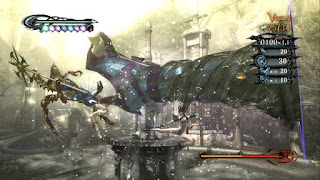
In spite of the difficulty, the boss fights are highly interesting. This is the sort of game where enemies that are originally mid-bosses show up again as regular enemies and end bosses show up again in mini boss rushes. This isn’t really a bad thing, since it adds some extra challenge to the game, although the boss rushes can get kind of draining after a while, since they occur two or three times in the last few Chapters. What mitigates this somewhat is the creativity in their unique designs and strategies. The last three bosses are especially memorable, as they include some unique and highly cathartic sequences, though to elaborate would go into spoiler territory. However, I will admit here that during the Golem boss fights, I was able to cheese it by staying right next to it, dodging its attacks into Witch Time and holding down the fire button. Probably not the best way to enjoy the fight, but food for thought.
 |
| The Golem can change shape, but can also be easily cheesed. |
The controls are mapped pretty intuitively and are highly responsive to the player’s button presses. However, I should address here that I did not play Bayonetta on a Pro Controller, as others may recommend, but rather with the Switch’s Joy-Cons. I tried playing them while attached to the unit, but it felt more comfortable to use a Joy-Con Grip to act as more of a traditional controller. Even then, however, I found the controller kind of cramped and the shape of the L and R buttons makes it rather easy to accidentally press them in the heat of battle. It didn’t affect me too much, but it’s certainly something to keep in mind. The Switch also has a touchscreen-friendly control scheme, but I wouldn’t really recommend it, since it depends heavily on player gestures.
There are also times when the game switches to different types of gameplay, necessitating a different button layout for the duration of the applicable Verse(s). These take a little getting used to, but for flying sections I would suggest inverting flying controls (in this case, the default is already inverted, where Up=Down and Down=Up).
During the course of the game, the player collects Halos by defeating enemies or destroying objects in the environment. These are exchanged at the Gates of Hell bar run by the demon Rodin. Halos can be exchanged for items, techniques, costumes, weapons, accessories and treasures. The game will highlight some “Hot” buys, or recommended purchases. Personally, I would highly recommend buying the techniques Air Dodge; Stiletto, a version of Devil May Cry’s Stinger attack; Break Dance; Bat Within, which eases up on dodge timing; and Crow Within, which grants temporary flight, as soon as possible, as they are very invaluable for movement and combat advantage.
 |
| Bayonetta (left) with Rodin (right), proprietor of the Gates of Hell. |
Since Bayonetta and Devil May Cry were created by Hideki Kamiya, the comparisons are inevitable. They share some similarities in their visuals and atmosphere, but, as stated earlier, Bayonetta feels like an evolved version in terms of combat and the visuals themselves are also flashier, lending itself to its more upbeat tone. The sillier tone at times reminded me of a Suda51 game, which, considering I like Hideki Kamiya and Suda51, is actually pretty good.
The graphics of Bayonetta have aged quite well and are pretty good on the Switch, perhaps even improved from the original release, aided by a very steady framerate (especially when compared with the PS3 version). I’ll note here that Bayonetta’s design in this game is meant to strongly evoke sex appeal, mainly from her figure and costume design (her costume is actually her hair). While her sex appeal is subjective, her design is certainly iconic and really stands out, even eight years later.
I’ll note here that the Switch version of the game comes with a couple extras, mainly amiibo support and some extra Nintendo-themed costumes based on Princess Peach, Princess Daisy, Link and Samus. The Peach and Daisy costumes alter Bayonetta’s Wicked Weave attacks to summon Bowser from the Mario series while the latter two actually alter the gameplay. The Link costume changes the Shuraba weapon into the Master Sword and allows Bayonetta to parry attacks without the need of an accessory (specifically Moon of Mahaa-Kalaa), which can free up an extra accessory slot. The Samus costume not only allows Bayonetta to raise or lower a visor, but also enables her to fire a chargeable laser when shooting enemies.
 |
| Bayonetta in the Link costume. |
The score for Bayonetta is absolutely fantastic, perfectly matching the tone of the game. Certain tracks are also very memorable, especially the main theme, Fly Me To The Moon, which plays at all the right moments. The music which plays during the various menus also becomes familiar with time and sets the right atmosphere.
Bayonetta is a game I would highly recommend. The story isn’t necessarily a literary masterwork, but its creative concepts and charming atmosphere are able to come together for a memorable experience. Though some aspects haven’t aged as well, including the instant death QTEs and certain encounters that are more difficult than they have any right to be, it’s still overall a very solid and enjoyable experience that’ll easily please action games fans, as well as those who enjoyed Devil May Cry and are looking for a great twist on the formula. For those looking for a game to add to their Switch library, Bayonetta should more than satisfy.

.png)


