Showing posts sorted by relevance for query The artist. Sort by date Show all posts

Saturday, November 21, 2015

Stubs – The Immigrant (1917)


The Immigrant (1917) Starring: Charlie Chaplin, Edna Purviance, Eric Campbell. Directed by Charlie Chaplin. Written by Charlie Chaplin, Vincent Bryan, Maverick Terrell. Produced by John Jasper. Run Time: 20 minutes. U.S. Black and White. Comedy, Silent

By the time Charlie Chaplin was 26, he was one of the most famous people in the world and arguably the biggest film star. Having started in film only three years earlier with Making a Living (1914) and Kid Auto Races at Venice (1914), he had gone from making $150 a week to an offer by the Mutual Film Corporation to make $670,000 a year in 1916. The films he made that first year include The Floorwalker, The Fireman, The Vagabond, One A.M., The Count, The Pawnshop, Behind the Screen and The Rink. But in 1917, Chaplin demanded more time and produced only four shorts in the next 10 months, including Easy Street, The Cure, The Immigrant and The Adventurer. Chaplin would later consider this to be the happiest period of his career.

Like many of Chaplin’s films at this time, he would start filming with only an idea and see what would develop from there. In this case, he started to make a movie set in an artist’s café. He quickly abandoned that idea and started to work on a film still set in a café, but about a man who had never been in a restaurant before, displaying poor table manners until he meets a girl played by Edna Purviance and shapes up almost immediately.

Realizing he needed more plot, he developed the idea of them both being immigrants and shot a sequence about arriving in America. He then reshot the café scenes to make it more consistent with the new plot line. Once filming was completed, Chaplin stayed awake for four straight days to edit the film for release on June 17, 1917.

The short has three acts. The film opens on board a steamer on its way to America. The opening sequence features several misadventures of an unnamed immigrant, the Tramp (Chaplin). We’re introduced to the backside of the Tramp as he is leaning far over the rail.


Our first view of the Tramp (Charlie Chaplin) in The Immigrants.

From the convulsions his body is going through, we assume he is having a bout of seasickness, but he’s not. He’s been trying to catch a fish, which he pulls on board, only to have it land next to a sleeping man on the deck.


The Tramp catches a fish off the side of the ship.

The Tramp tries eating in the mess, but the pitching of the ocean has the bowl of food sliding across the table to the Tramp and then to another unnamed immigrant. Each takes a bite of food when the bowl is in front of him. It is in this sequence that we’re first introduced to the unnamed immigrant portrayed by Edna Purviance. The Tramp notices her as soon as she enters the hall and offers up his seat at the table for her.


When Edna enters the room, the Tramp notices her right away.

Out on deck, the Tramp seems to win easily (and a little showy) at dice, ending up taking another immigrant’s money. The gambler (Tom Wilson) looks more like a reject from a western than a European, but he wants to try and win his money back. And when he sees an ailing woman (Kitty Bradbury) with an envelope of money around her neck, he is not above robbing her, so he does.

But he doesn’t want to play dice anymore, rather poker. The Tramp is nervous, especially since the man has a gun. The Tramp shuffles the cards after a fashion and two other shipmates join in. When the man with the gun can’t match the Tramp’s ante, the man sells his gun to the Tramp. And when the Tramp wins he uses the gun to ward off the angry gambler.


The Tramp is forced into a game of cars with gambler with a gun (Tom Wilson).

We find out that the money belonged to Edna’s mother and it is their life’s savings. The Tramp realizes perhaps that the money he’s won was taken from them and he slips some money into Edna’s coat pocket. Then he thinks about how much he’s giving and takes a few back; then reconsiders that amount.


Realizing the money he's won has been stolen, the Tramp returns some
of it to its rightful owner, Edna's mother. (Kitty Bradbury).

All the time he’s got his hand in and out of her pocket, he’s being observed by one of the ship’s officers (Frank J. Coleman), who accuses the Tramp of being a pickpocket. The official calls Edna over and tells him what he’s seen, but she knows there was no money in her pocket to steal. All is forgiven and a hint of blossoming romance is shown.

But the ship is about to land in America and after a panning shot across Lady Liberty, immigration officials board the boat and process everyone. Edna and her mother are the first off and even though the Tramp is processed right after them, we get the feeling they’ve been, perhaps forever, separated.


The Tramp, Edna Purviance and her mother all glimpse the Statue of Liberty as the ship arrives in New York City.

The second act picks up the Tramp’s story later when he is now broke and hungry. Outside a restaurant, he finds a coin on the street and goes inside to eat. He orders a plate of beans, which comes with a yard long piece of bread. While he’s eating he sees Edna who is now all alone. He has her join him and orders beans for her as well.

His burly waiter (Eric Campbell) patrols the restaurant floor like a vigilante. When a patron (John Rand) is short 10 cents on his bill, Campbell and the other waiters wail on him before forcibly ejecting him from the restaurant. It is about now that the Tramp realizes he has a hole in his pocket and the coin he was going to use to pay for dinner is gone. The Tramp is terrified of getting the same fate as the other patron.

When another patron pays for his dinner, the same coin the Tramp had found. He tries to be nonchalant about picking it up, but Campbell returns and stands on it. The Tramp makes many failed attempts at picking up the coin before retrieving it. However, when he pays the waiter, the coin turns out to be a fake.


The Waiter (Eric Campbell) demands payment from the Tramp.

The Tramp is saved when a visiting Artist (Henry Bergman) notices the couple and comes over to talk to them about posing for a painting he’s doing. The artist seems more interested in Edna and talks to her while the Tramp tries to figure out his next move. The artist offers to pay for their meal, but the Tramp makes a show of refusing the help. The artist offers again, but the Tramp again waves off the offer. This goes back and forth until the Artist withdraws the offer and the Tramp is once again on the hook.


A visiting Artist (Henry Bergman) provides the Tramp with a way to pay his restaurant tab.

The waiter returns and the Artist pays his bill. The change which the Artist meant as a tip, the Tramp notices, is enough to cover his meal. While the waiter is busying attending to another customer and the Artist is chatting to Edna, the Tramp slips the tip off the table and offers it to the waiter to settle his bill, tipping the waiter the much smaller change as a tip.

Outside the restaurant, the Artist thinks everything is settled, but the Tramp asks for a few dollars up front. It is raining heavily now and the Tramp escorts Edna over to the Marriage License office, where the Marriage Registrar (Tom Harrington) is waiting. The Tramp steals a kiss from Edna and apparently proposes marriage. The film ends with the two going into the office to start their new life together in their new country.


The Tramp steals a kiss from Edna as the two start out on their new life in America.


The film shows how far Chaplin had come as a filmmaker from his earliest slapstick Mack Sennett films. The Immigrant has a mixture of comedy and pathos that would characterize his best films including The Kid (1921) and City Lights (1931). We laugh at the antics of the filly and willy Tramp, but we see when he is down on his luck, too. There is nor a promise of a rosy future for the Tramp and Edna, but we're pretty sure they will get by somehow.

Edna Purviance had an entire career just appearing in Chaplin films. In 1915, She was working as a secretary in San Francisco when Chaplin was looking for a lead actress for his second film under his Essanay contract, A Night Out. Discovered at Tate’s Café by an associate of Chaplin’s, he gave her the part. Romantically involved with the director from 1915 to 1917, she would appear in 33 of his short films made under his Essanay, Mutual and First National contracts, including The Tramp (1915) and A Dog’s Life (1918).

She would also appear in The Kid and The Pilgrim (1923). In A Woman in Paris (1923), Edna was the lead and while Chaplin wrote, directed and produced the film, he did not appear in it. The film was not a commercial success and her career was virtually over. She would make another film with Chaplin, A Woman of the Sea, in 1926, but the film was not released and is now considered lost. Purviance is credited with appearing in a French film, Éducation de Prince (1927). Even though she stopped appearing in Chaplin films, she remained on his payroll until her death in 1958.

Eric Campbell, the hulking headwaiter with the severe devilish eyebrows had a similar film career. A fellow member of the Fred Karno act, Campbell moved to the U.S. in 1914. Chaplin saw him in a play in 1916 and asked him to move to Hollywood to join his cast of actors. Campbell appeared in 12 of the Mutual films for Chaplin. His first appearance was in The Floorwalker (1916) and he was prominently featured in Easy Street (1917). Like Chaplin, Campbell had impersonators, including Oliver Hardy. Campbell’s last film was Chaplin’s final Mutual film, The Adventurer. He would die in a car crash in 1917.

Chaplin, who had emigrated from England only four years earlier, never did become a U.S. citizen, even though he lived and worked here until 1952. Despite his support of the Liberty War Bond drives during World War I, Chaplin was accused of being a communist for publicly supporting opening a Second Front to aid the Soviets and various Soviet-American friendship groups during World War II.

Chaplin denied accusations that he was a communist, insisting he was instead a “peacemonger.” Subpoenaed to appear in front of the House Un-American Activities Committee, he was never called to testify. But anti-Chaplin feelings got so bad that when he left to premiere his film Limelight (1952) in London, Attorney General James P. McGranery revoked Chaplin’s permit to re-enter the U.S. Chaplin moved to Switzerland and severed all business connections with the U.S. when he sold his last shares in United Artists in 1955.

There is a lot to like in this short and I would definitely recommend it. One of the problems with films from this time period, at least for the modern viewer, can be the over-the-top makeup the actors wear, especially villains. The harsh eyebrows of Campbell’s waiter character seem to be in stride with the sometimes very absurd facial hair that one sees in comedies from the silent era. Men have beards that had to exist only in the movies. I’m not sure if that’s a hangover from vaudeville or a shorthand the audiences at the time understood. But it is worth getting past that and it shouldn’t affect your enjoyment of The Immigrant.

For reviews of other silent films, please see our silent film review hub here.

Thursday, December 29, 2011

The Artist - One of The Year's Best Films


THE ARTIST (2011) Starring: Jean Dujardin, Bérénice Bejo, John Goodman, James Cromwell, Missi Pyle, Penelope Ann Miller, Malcolm McDowell. Directed by Michel Hazanavicius. Written by Michel Hazanavicius. Produced by Thomas Langman. Run Time: 100 minutes. Black and White. France. Silent, Romantic, Comedy, Drama.

The silent era of filmmaking has been the subject of two extraordinary films in 2011: HUGO and THE ARTIST. Both deal with how the change in public tastes and expectations affect early filmmakers and stars. HUGO poignantly touches on the real life story of George Méliés. THE ARTIST on the other hand, tells a story reminiscent of WHAT PRICE HOLLYWOOD? (1932). In that film, Constance Bennett stars as Mary Evans, an aspiring actress who meets, falls in love with and who’s career eventually eclipses that of director Maximillan Carey (Lowell Sherman).

In Michel Hazanavicius’s brilliant film, set at the end of the silent movie era, aspiring actress Peppy Miller (Bérénice Bejo) turns a chance encounter with swashbuckling actor George Valentin (Jean Dujardin) into a career path. Valentin has just premiered his latest Kinograph film, The Russian Affair, to an excited audience. A mixture of Douglas Fairbanks and Gene Kelly, Valentin has an ego that is as big as the silver screen. The word ham comes to mind as he milks the applause of the audience for all its worth by dancing for them and playing with his dog co-star, before finally bringing out, and then quickly leading off, his female lead Constance (Missi Pyle). Outside the theater, the news photographers, what we now call paparazzi, take photo after photo of the star, when out of the crowd accidentally tumbles Peppy Miller. Swept up in the hoopla, she poses and preens for the camera, even landing a kiss on the always smiling actor’s cheek. The photo lands on the front page of Variety under the headline asking Who’s That Girl?

The photo and the story rub both Valentin’s wife Doris (Penelope Ann Miller) and his boss, Al Zimmer (John Goodman) the wrong way. Doris, who really never has much to do in this film other than be dissatisfied, doesn’t like seeing her husband kissing another woman and Zimmer doesn’t like the fact that the story pushed publicity for The Russian Affair off the front page. Meanwhile, Peppy is just happy to see her photo in print. She even brags to another one of the extras waiting to be cast (Malcolm McDowell) about it. And though she is cast, Zimmer recognizes her and fires her off the set, only to be overruled by Valentin who wants Peppy to stay. Rather than lose face, Zimmer leaves the set.

During a lull in filming, Peppy goes to Valentin’s dressing room and there is a bit of business with his trademark tux jacket that would be worthy of any silent comedy. When Valentin returns, he catches her in mid self-caress. Playing the part of mentor, Valentin suggests she use a drawn on beauty mark as a way of distinguishing herself from the other actresses. The beauty mark will not only become her trademark, but will also be the name of one of her first starring films, reminiscent of The It Girl for Clara Bow and Platinum Blonde for Jean Harlow. There is a smoldering attraction between the two, which gets derailed when Clifton (James Cromwell), Valentin’s faithful chauffer and manservant returns from a shopping trip to buy something for Valentin to give Doris.

Over the next two years, we see Peppy’s career ascend as she moves up the billing block, while Valentin stays a star making The German Affair. It is interesting that every time we see Valentin walking he is usually headed downstairs and Miller is always shown going up on the same set. Then, in 1929, everything changes in Hollywood with the coming of the talkies. As was the case for many silent stars, most notably John Gilbert, sound meant the end of their career. Valentin, who refuses to even attempt a talkie, is fired by Kinograph and ventures into forming his own production company, making and paying for his own jungle adventure film, Tears of Love. Meanwhile Peppy is one of the rising young stars at the studio and in Hollywood. Tears of Love are slated to open opposite Beauty Spot on October 25th. Only days before the release of his film, Valentin is also hit hard by the collapse of Wall Street. He is wiped out unless Tears of Love is a success. No one is surprised when it isn’t. Adding insult to injury, Doris decides to kick Valentin out that same night, giving him two weeks to move out his memorabilia.

Broke and down on his luck, Valentin becomes a drunk, pawning whatever he can to buy another bottle. Even though he hasn’t paid Clifton for over a year, the chauffer stands by his down on his luck boss, having to be fired before he leaves. Totally broke, Valentin sells everything he has, save his films, at auction. Everything is purchased by a mysterious man, who we quickly learn works for Peppy. By 1932, Valentin sits alone watching his old movies while he drinks himself into greater depression. Suddenly, feeling sorry for himself, he goes on a rant and decides in a whimsy to burn all his old films. Valentin is only saved when his dog runs for a policeman, in a scene out of every TV episode of Lassie. Before passing out from the smoke, Valentin grabs one reel of film back from the flames.

When Peppy learns of his plight, she rushes to his hospital bed, the canister of film that had to be pried from his hands nearby. When she looks at it, she sees it is from the first film she had made with him. Touched, she takes him home to convalesce. Trying to help him, she blackmails Zimmer into bringing Valentin back for another film with her. Clifton, who is now working for Miller, delivers the script to Valentin’s bed. But rather than take the hand out, the actor’s pride is too great. Discovering that Miller has all of his memorabilia stored in her house, he leaves with his dog back to his small apartment. He is intent on committing suicide. Again, this is reminiscent of the situation in What Price Hollywood? But in this case, Miller arrives in time. Driving like a mad woman through the streets of Hollywood, she has many near misses, but ultimately hits the tree in front of his apartment. The Bang the car makes stops Valentin who literally has the gun in his mouth at the time. Reunited with Miller, Valentin suddenly has a resurgence of vigor.

Having gone to the edge he lets Peppy pull him back from the precipice. But still he refuses to talk in films. Instead, she hits upon the idea of his dancing in the film, something she has seen him do on his own many times. In the last scene we see Zimmer watching them go through their routine. Valentin is back and Miller is by his side.

In much the same way The Wizard of Oz used color to distinguish Kansas from Oz, Hazanavicius uses sound. It is subtle throughout most of the movie. When Valentin dreams about not being able to talk at all, we hear the sounds of a drop of water, the laughter of extras, even a floating feather makes a whump when it finally lands. Everything makes noise, except Valentin. At the end of the film, we finally hear everyone talking, even Valentin. Like its star, the film finally moves into the realm of sound and we know there is no going back.

There are few things not to like about THE ARTIST. The casting for the most part is superb. Bejo especially looks like she could have been a flapper girl and early sound star. She is right for the era they are trying to pay homage to. I’m never surprised when John Goodman ends up in some offbeat film and his turn as movie mogul Zimmer seems to be based on cutthroat moguls like Louis B. Mayer. Goodman’s best scene is when he lets Valentin go as the studio gears up to make only sound films. Zimmer tells his star that the two of them belong to a different time, but as it turns out only one of them is going to stay.

I was surprised to see how many actors and actresses were willing to take such small parts in a small film. James Cromwell as Clifton and Penelope Ann Miller as Doris have little to do, though both characters they play are important to the plot. Malcolm McDowell has perhaps the skimpiest of parts. I’m not sure if he even warranted a title card when his unnamed character and Peppy interacted. Bit actors, like Joel Murray (best known as TV actor) and Bill Fagerbakke (perhaps best known as the voice of Patrick on Spongebob) both play policemen. My hat is off to all of the actors who participated in the film because they added to its atmosphere.

Speaking of bit parts, I would be remiss not to mention the Dog played by Uggie. This mutt can certainly do it all. Not only is he loyal to his down on his luck owner, but he is great for comic relief and is used for that throughout the film.

Despite this being a French film, it was shot in Los Angeles and locales, such as the Bradbury Building and the Orpheum Theater, are used to give THE ARTIST an appropriate period feel. Sad to say it took a French filmmaker to show interest in this fascinating time in Hollywood history, but perhaps because he was an outsider, Hazanavicius tried hard to get it right and he succeeded. I fear that a Hollywood film company might have shot the L.A. scenes somewhere else to save money.

There are few things that Hazanavicius uses as a convenience. For example, when Miller examines the reel that Valentin saved from the fire by holding it up to the light, it happens to be the outtakes of their first scene together. And while I’m no expert on the history of Variety, I don’t think it was ever such a gossip rag as to let a sidewalk kiss dominate the entire front page, the way it does in the movies. And I’m pretty sure that movie stars rarely actually owned the animals they used in the movies. But this is truly quibbling on my part and I know it.

THE ARTIST is the right film if you love Hollywood history, love films about films or just love a good story well told. As we come to the end of the year and to the official start of Awards season in tinsel town, THE ARTIST should be in the running for every award possible and should be at or near the top of everyone’s list of best films of the year.

Sunday, October 8, 2017

Stubs - Loving Vincent


Loving Vincent (2017) Starring Douglas Booth, Robert Gulaczyk, Jerome Flynn, Saoirse Ronan, Helen McCrory, Chris O'Dowd, John Sessions, Eleanor Tomlinson, Aidan Turner. Directed by Dorota Kobiela, Hugh Welchman. Screenplay by Dorota Kobiela, Hugh Welchman, Jacek Dehnel. Produced by Hugh Welchman, Ivan Mactaggart, Sean Bobbitt Run Time: 91 minutes. Polish/UK Color/BW Animated, Live Action, Biography

On July 27, 1890, at age 37, Vincent Van Gogh, a painter of little renown during his lifetime, shot himself in the chest with a 7mm Lefaucheux à broche revolver. There were no known witnesses, but the incident took place either in a cornfield or a barn. Mortally wounded, Van Gogh managed to make it back to his room, where he would die approximately 30 hours later. He would be visited by two doctors, Doctor Mazery and Doctor Gachet. While neither man was a surgeon, they made Van Gogh as comfortable as they could. Vincent's brother Theo came to visit, but before too long, Van Gogh grew weak and died.

These are the events that propel Loving Vincent, a new film with a very new technique. While originally shot as a live-action film, every frame has been painted over in oil in the impressionist style of Van Gogh.

From the film's website, showing the post-production of turning
 the live-action film into 65,000 oil painted frames.

A year after Van Gogh's death, the postmaster of Saint-Rémy, Joseph Roulin (Chris Dowd), discovers a letter that the late artist had sent to his brother and sends his son, Armand Roulin (Douglas Booth), to find Theo, not realizing the brother is also dead. Armand, who starts out grudgingly, turns into a detective as he researches the last weeks of the great artist's life.

While that might sound like an interesting endeavor on its own, it is the presentation that separates this film from anything else you have seen on the silver screen before. Armand's search takes you into the world of Van Gogh, which includes his work. We are treated to re-enactments of some of Van Gogh's more famous works, the subjects of which also include several of the main characters in this film. The colors are as vivid of Van Gogh's paintings, with black-and-white being used to simulate flashbacks detailing more about Van Gogh's life.

The actor Jerome Flynn playing Dr. Gachet, Van Gogh's painting
 of the doctor and his ultimate portrayal in the film.

A lot of experimental films are only about the experimental quality of their productions at the expense of film basics like story and acting. Thankfully, this film is both experimental without losing the basics that make it an interesting film. The story is intriguing. Even if you're not an art lover, Van Gogh's life and death have been made into movies before, probably the most memorable being Lust for Life (1956) starring Kirk Douglas. This film sort of works as a companion piece to that film, taking up the story when that one ends.

An example showing the film's transition from live action to oil painting.

The acting is also very good. More than voice work, the actors are actually the live models on which the painting is added. It's as if they were parts of a continuous painting that comes to life.  Douglas Booth, an actor I had never heard of before, gives a very strong performance as the son who becomes intrigued with an artist he doesn't really know. Other standouts include Eleanor Tomlinson as Adeline Ravoux, the daughter of the innkeeper where the artist died. Saoirse Ronan plays Marguerite Gachet, not only the subject of one of Van Gogh's paintings, but also a possible companion to the older artist. Jerome Flynn plays her father, Dr. Gachet, the last doctor Van Gogh sought treatment from after leaving the Hospital in Arles supposedly cured. Everyone feels that they had some hand in the artist's decision to commit suicide.

Douglas Booth gives a strong performance as Armand Roulin.

The sad news is that Loving Vincent is not an easy film to see. As with most art house films, it is not available in wide release. But the film is really worth seeking out. If you're not fortunate enough to see it in on a big screen, then you should be looking for it when it becomes available on home video or your favorite streaming service.

Monday, July 28, 2014

Report from the Front: San Diego Comic-Con 2014


Another Comic-Con has come and gone and while I don’t pretend to yet be an expert on the event, I’ve only gone eight times out of the last nine, we at Trophy Unlocked would like to share our experience for those who didn't go and compare ours to those who did.

I recently read someone describe Comic-Con as the child of Las Vegas and Disneyland that liked to read comics and watch movies. That’s not too far from the truth, without the gambling and the prostitution. It is an overwhelming sensory overload. There is too much to do and see and no way you can come close to doing it all.

I am not the first person to call Comic-Con Line-Con, and it is certainly that. I don’t know what it’s like for professionals, vendors or the press, but Joe Congoer spends an inordinate amount of time in the queue. And I’m not talking about the crazies who spend the night in line for Hall H or arrive at three in the morning to be first in line for the Hasbro exclusives.

There is a line for everything from picking up your badge, to getting in, for autographs, panels and just about everything else. Now don’t get me wrong, you can develop some very intense and short-lived relationships in a line. My personal favorite was the younger woman with a crush on one of the artists involved in The Hacktivist. While standing in line it was obvious that she had a crush and short of squealing, it was easy to sense her excitement. I held her place in line while sending her to see if she could get his autograph, but she quickly came back. I asked if she wanted a photograph with him and she said yes and even though I was ahead of her in line, I hung around to take their picture together. She thanked me and gave me and my wife a hug of gratitude. I really felt like I helped to make her day.


Welcome to San Diego Line-Con 2014.

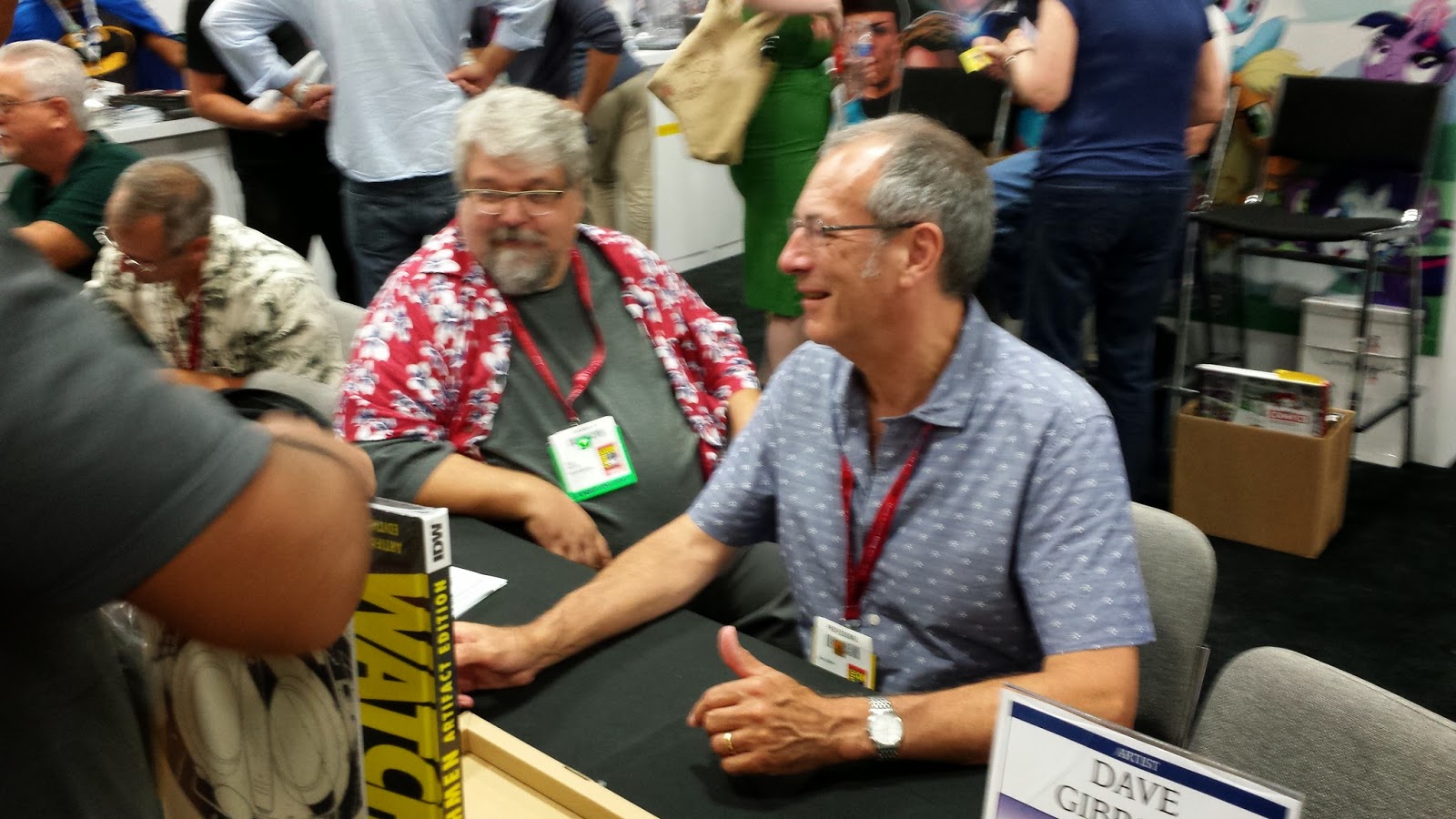
Like most Con goers, we plan and plan and plan, making spreadsheets and having discussions on what to take, who to see, what panels to try for and what off-site events we might be interested in. And plan as much as we do, sometimes you have to throw it out the window. Schedules change, artists and writers don’t show up on time and lines get capped. But there are also those moments when magic happens. As an example: Going by the Shout! booth on Saturday morning on our way to Toy Tokyo to buy a figurine of Zombie Kirk Hammett from Metallica, we noticed they were handing out free posters for “Weird Al” Yankovic’s UHF movie, a film we had recently reviewed here on the blog and a favorite of two of the writers. We were informed that there was going to be a signing that afternoon at 5, limited to 50 people with wristbands and just like that I’m going to meet “Weird Al” in person. But before that, my family met Kirk Hammett and in between I was able to meet Dave Gibbons, the artist behind Watchmen, and get him to sign my 12 issues of that ground-breaking comic book. Quite a day, but not the day we had anticipated or had planned out in our living room days before.

Kirk Hammett from Metallica was at Comic-Con signing zombie figurines.

Speaking of standing in line to meet someone, here’s a pet peeve: You’ve been standing in line for sometimes up to an hour to have a moment with someone, maybe it’s a geeky moment, but you’ve put in your time in line for a few moments of face time and someone the artist knows, or someone passing by the signing, will stick themselves into the midst. I had a least two occasions in Artists Alley when I got up to the front and someone who knew the artist would come over and start talking to them. “Have you seen so and so?” “You know it’s been a long time since we talked…” Not that I’m an attention hog, but I’m suddenly just standing there watching two old friends catch up rather than blurting out what I’d been practicing in line to say. It’s rude of that other person to just come up as if the artist wasn’t busy and start talking to them, taking away the time I’ve put in to see them, just because you’re old friends. This is not as bad though as the artist/actor/whatever who is not dedicated to the moment or the reason they’re there, especially when they’re charging for their time (Bruce Boxleitner), but gratefully we didn’t run into any of those this year.


And let's not forget The Aquabats! They were there, too.

Every artist, writer, editor and musician we spoke with were all very nice people. Tired and sometimes overwhelmed by the attention they’re receiving, but very nice and appreciative. You can tell the ones, like Hammett, Gibbons and Yankovic, who are used to the attention from those who are just starting to get it and it’s all so new to them.


One of the coolest exclusives was a Gumball comic book inside a SNES gaming cartridge from BOOM!

If you’re doing a booth signing, most will let you know about their other work they’ve done, which are usually at their fingertips for sale, but that’s part of the dance. And if you like their work, the least you can do is support them. You'd want the same in return, wouldn’t you?

And while you stand in line quite a bit, you also walk and walk, whether you’re going from Artists Alley to the IDW booth and back or just wandering up and down the aisles, you need a comfortable pair of shoes. Comic-Con (in reality the SD Fire Marshall) has a no loitering policy, so you have to keep moving and most walls have a no standing or sitting policy on them. Now I know how sharks feel.


Even the bathrooms seemed to have sponsors.

In the five days were down there, including Wednesday, in which we essentially drove most of the day and Sunday, which was a short day, the Walking Mate app on my phone shows I walked 50.9 miles or a little over 10 miles a day. Add to that I’m carrying a ten pound backpack most of that time and while your mileage may vary, that’s not a bad work out. (Still gained a couple of pounds, which doesn’t really seem quite fair.)


Dave Gibbons, the artist on Watchmen.

That will lead me to food, I guess. We usually bring ours in with us, which saves time and money. Believe it or not the lines are pretty long at the snack bars and they’re not cheap. Though that pizza looked and smelled a lot better than the fried chicken breast I ate on day three, which was about four days old at the time. In years past, we’d relied on the nearby Subway sandwich, which we’d bought the night before. Those got pretty old after a while, so we haven’t quite got the food bit nailed down. Hey, it’s only been eight times.

"Weird Al" speaks to one of the writers on Trophy Unlocked.

One of the improvements/upgrades we made as a family this year was getting smart phones. Part of the reason was to be able to check prices. Sale Items at the Con are oftentimes higher than they would be at say Amazon. But we also wanted to be able to better use the free provided Wi-Fi so as to better communicate with each other. This worked only so-so. I think there are still texts I’ve sent that haven’t been received, such as “Where are you?” and other missives that would have been nice to get more immediately than not. I had to sign in repeatedly to the ATT service because the phone and the ISP didn’t remember each other and who has to suffer? We do. Still you can always call as long as the person you’re reaching out to can hear the phone ring over the din. Someone pointed out that the hall is carpeted to deaden the sound; otherwise I can only imagine how loud it would be.

Another issue with smart phones is that the battery seems to run down very quickly. I would recommend taking a pre-charged charger with you in case your phone is down to 10% and you still have the evening ahead of you.

Clothing is another consideration. We all wore jean jackets, mostly for the pockets, but those get very hot and the last thing you want to be is sweaty. Jackets have their place, but it is not in the Con. We’re looking into cargo pants or some other wardrobe option.

One of the best reasons to go to Comic-Con are the panels, whether they are professional or for pleasure. We didn’t attend as many as we have in the past, but sometimes you have to decide if the panel is worth the time suck. And even for those that are worth it, there is a limit. We had to pass on one for Gravity Falls, because the line was impossibly long. If a show like that is popular then you really need to attend the panel prior and in that case the one before that, in order to get a seat. An hour wasn’t long enough and there was no guarantee of getting in.

The Penny Arcade booth at Comic-Con.

We barely got into one panel thrown by the Warner Archives: Trailers from Hell. Seems it was the panel before one on Mass Effect and the line was not really full of lovers of old films, but rather video gamers. We got in by the skin of our teeth and only as long as we promised we weren’t staying for the next panel (nothing against Mass Effect) and then in individual seats, which turned out to be one behind the other behind the other. But that’s the cool part about the Con, people get exposed to new things and I would imagine a few of those in attendance will check out the Warner Archives Instant streaming service now that they learned it exists. I know that’s how I became exposed to Watchmen; we were attending a panel, Watching the Watchmen so we could attend another panel afterwards. And yes, I told that to Dave Gibbons when I met him.

While everyone’s convention experience is quite different, I really had a good, but exhausting time. I was able to meet people I had only been communicating with through email and Facebook messaging (I won’t name names so they can maintain credible deniability that they know me).

After attending, it’s always a good idea to think about what you did that you don’t want to do again and what you still have on your plate to do. For the latter, it’s getting up at 4 am to get in line for Hasbro. There is something demoralizing when that’s not early enough. It really takes it out of you and when your day can go to 11 as ours did that night, it’s really exhausting and for what? No, we’re done trying to get that golden ticket (or red stamp if you want to be honest).

Things I’d still like to do: Well, there are so many things outside the convention center that I can never seem to get to. And the Con is only expanding out. There’s so much to do inside the Convention Center that getting outside seems nearly impossible. And, of course, there is Hall H. Every year you hear about everyone who lines up the night before and I’ve seen them. But I don’t want to be a part of that. And just about as often I hear that people walk into Hall H later in the day into panels that are not full. So I might just have to try that one afternoon.


Something else I didn't make it over to was the Fox salute to the Simpsons next to the Hilton.

After last year, I wasn’t sure I wanted to go again, but now I’m already looking forward to the next one.

Saturday, August 18, 2012

Stubs – Singin’ In The Rain


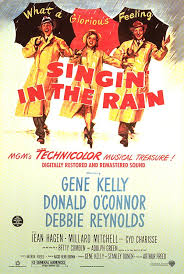
SINGIN’ IN THE RAIN (1952) Starring: Gene Kelly, Donald O’Connor, Debbie Reynolds. Directed by Gene Kelly and Stanley Donen. Screenplay by Betty Comden and Adolph Green. Produced by Arthur Freed. Run Time: 103. Color. U.S. Musical, Comedy.

Okay, it seems to me that I’m starting to let Turner Classic Movies determine the titles I write about for this blog. The film, celebrating its 60th anniversary is being shown in an encore presentation at movie theaters around the country next week. This isn’t the old revival type of release, either, but a digital cinema presentation, sort of akin to pay per view on a really big TV screen, but with only one start time to choose from. Some things are better left on film.

The first time I saw Singin’ in the Rain, I was in Junior college, taking an English course that was basically watching movies and writing a few papers on what we had seen. At the time, I was not a big fan of musicals (not that I’m a really huge fan now) and I thought the film was rather silly. I remember writing in my critique that I thought the lyric: “Moses supposes his toeses are roses” was exceptionally so.

Several years later, I’m more open to the musical genre on film and have already written praises of a few on this blog. It is time now to write appreciatively about Singin’ In The Rain. I’m not a fan, in that I’ll watch any musical, but if they’re good and star someone other than Barbara Streisand or Jeanette MacDonald, I might give it a go.

While thinking about what to write about this film, I’m struck by the similarities in the story between this film and last year’s Academy Award-winning The Artist. Both films deal with Hollywood’s transition from silent films to talkies and in particular the impact of the change on the leading man, who starts out as an action-adventure star and ends up as a song and dance man. In fact, Jean Dujardin, who played George Valentin, has acknowledged that Gene Kelly inspired his work. [It should be noted that both Dujardin’s Valentin and Kelly’s Don Lockwood are homages to silent swashbuckling star Douglas Fairbanks.] And whereas The Artist dealt with this transition by staying black and white and silent through 99% of the film, Singin’ In the Rain, depicts the change through vibrant Technicolor and music.

One of the differences though is that while The Artist seems to concentrate on the characters over the technology, Singin’ In The Rain actually provides a bit more of a history lesson, actually showing what went on behind the scenes with vocal coaching and microphone placement. And while I’m sure a true film historian might quibble with this, I think the film is fairly accurate with this portrayal.

The films opens, again like The Artist, at a Hollywood movie premiere. Lockwood and his film love interest Lina Lamont (Jean Hagen) are linked romantically by their studio’s, Monumental Pictures, publicity department. The problem is Lina believes her own publicity, despite Lockwood’s attempts to keep her at arm’s length.

One day, while to get away from his fans, Lockwood climbs into a car driven by Kathy Selden (Debbie Reynolds). Kathy, who claims to be a stage actress, holds Lockwood in disdain. At a party, R.F. Simpson (Millard Mitchell), the head of Monumental, shows a Vitaphone short demonstrating talking pictures. But no one in attendance is impressed or sees the writing on the wall. When a cake is wheeled out, Kathy, to Lockwood’s amusement, pops out. But Kathy doesn’t appreciate Lockwood’s teasing and throws real cake at him, but hits Lina instead. Later, Lockwood manages to find Kathy, who is working, oddly enough, as an extra on another Monumental production and they begin to fall in love.

But the winds of change are already blowing. Warner Bros.'s success with the Jazz Singer in 1927 turns Hollywood on its ear. R.F. makes the decision that talkies are the wave of the future and decides to turn Lockwood’s and Lamont’s latest film, The Dueling Cavalier, into a talkie. The problem is Lina’s voice, which is comical at best. The studio hires a diction coach, but they only get exasperated (and where we get “Moses supposes”). A test screening is also a disaster and when the sound gets out of synch, the results are unintentionally funny.

Don’s best friend, the multi-talented Cosmo Brown (Donald O’Connor) gets the idea to dub Lina’s voice with Kathy’s. Together they persuade R.F. to turn The Dueling Cavalier into a musical, The Dancing Cavalier, complete with a modern sequence, called Broadway Melody, which seems out of place from the get-go (if you asked me). Lina finally clues into the romance between Kathy and Lockwood and tries to break them up. She even becomes angrier when she finds out about her voice being dubbed and R.F.’s plans to give Kathy a screen credit and publicity push. Lina threatens to sue unless R.F. forces Kathy to remain anonymous. R.F. reluctantly capitulates.

While The Dancing Cavalier is a crowd-pleaser, the audience at the premiere clamor for Lina to sing live. R.F., Don, and Cosmo convince Lina to lip-synch to Kathy singing behind a curtain. When the audience applauds, R.F., Don, and Cosmo raise the curtain to show Kathy is really doing the singing. Lina is embarrassed and runs away. Kathy starts to do likewise, but Don announces to the crowd that Kathy is the real star of the film. The film ends with Kathy and Don kissing in front of a billboard for their next film, aptly named Singin’ In The Rain.

There are so many things great at work in this film that make it successful. To start off with, Gene Kelly is a tremendously talented dancer. He doesn’t have Fred Astaire’s finesse, but he makes up for it with athleticism. At the time of Singin’ In the Rain, Kelly had just come off starring in the Academy Award-winning An American in Paris, a musical inspired by George Gershwin’s music, especially the orchestral work from which the film got its name.

Kelly co-directed and co-choreographed the film with Stanley Donen. Donen had come to Hollywood to work for Kelly as an assistant choreographer. They had previously co-directed On The Town (1949) together. Despite their working relationship, the two did not end up as fast friends. Part of the problem was that Donen didn’t feel Kelly gave him the respect and credit he deserved and part of it was the fact the two men both married the same woman, dancer Jeanne Coyne.

Donen was a talented director on his own, included in his canon are Royal Wedding (1951), Funny Face (1955), Indiscreet (1958), Charade (1963), Two For the Road (1967), Bedazzled (1967) and Movie Movie (1978).

You wouldn’t know to look at her on the screen, but at the time she made Singin’ In The Rain, Debbie Reynolds was not a dancer. While she had been a gymnast, Kelly was upset with her lack of experience. Fred Astaire, who happened to be hanging around the studio, offered to help her with her dancing.

Reynolds is a little force of nature. She can sing and dance, as demonstrated in this film and many others; she could also act. In the epic Cinerama western How the West Was Won, Reynolds’ character Lilith Prescott is the thread that holds the film together. She has also proven to be a smart businesswoman, buying warehouses of movie costumes and props, which she has recently been selling for a profit. She is also the mother of Princess Leia, Carrie Fisher. She continues to act, appearing in Albert Brook’s Mother (1996) and has an appearance in One For the Money (2012).

Donald O’Connor began acting in films at the age of 12, appearing with Bing Crosby in Sing, You Sinners (1937). He worked at Universal in 1942, hitting it big with Mister Big (1943). After serving in the Army during World War II, O’Connor returned to Hollywood and got a unique co-star, Francis (1949), the talking mule.  He would make a Francis movie every year until 1955. He got an illness from Frances that prevented him from appearing again with Bing Crosby in White Christmas (1954), a part that would go to Danny Kaye. O’Connor is the comedy relief in Singin’ In The Rain and is perhaps best remembered for the dance number Make ‘Em Laugh from that film.

And what is a musical without songs? Singin’ In The Rain recycles many songs from previous MGM musical films, including the title track, which originally appeared in Hollywood Revue of 1929, itself an early talkie and only the second musical produced at the home of Hollywood musical’s MGM. “Fit as a Fiddle (And Ready For Love)” was originally in College Coach (1933); Going Hollywood (1933) provided “Temptation” and “Beautiful Girl”; “Good Morning” is from Babes in Arms (1939), and so on and so on. There are only two original songs; “Moses Supposes” and “Make ‘Em Laugh”, with the latter considered by many to plagiarized from Cole Porter’s “Be A Clown”.

But it is the production numbers that this film is best known for. Who can forget Kelly sloshing his way through a downpour in “Singin’ In The Rain”, O’Connor’s athletic dancing in “Make ‘Em Laugh” or Kelly, O’Connor, and Reynolds dancing their way through “Good Morning”. Reynolds danced so hard in the latter that her feet began to bleed. “Broadway Melody Ballet” always seems a little tacked on to me, but it is still a very impressive number featuring Cyd Charise, whom Kelly chose over Reynolds.

There is very little not to like about Singin’ In The Rain. If you’ve never seen it, you are in for a real treat. One of the last great MGM musicals, Singin’ In The Rain, is something to behold.

Sunday, June 22, 2014

Report From the Front: BotCon 2014


For Transformers fans, one major event to look forward to every year is BotCon, a Transformers convention officially endorsed by Hasbro and run in a joint effort with (currently) Fun Publications, who runs the Official Transformers Collectors’ Club. Unlike most conventions such as Comic-Con or WonderCon, BotCon is one that actively travels around the U.S. so as to reach every part of the U.S. fanbase, and so it won’t always be nearby, though it seems to go to Pasadena, CA every so often. Each year under the Fun Publications run has also had a different theme, often tying back into the original Transformers fiction given to Club Members; this year’s theme was Pirates vs. Knights, following a group of Decepticon Pirates as the Autobot Knights try to stop them from plundering the multiverse (the Transformers multiverse is important to the Collectors’ Club fiction).

My first time actually attending BotCon with my family was in 2011 when it was held in Pasadena and the theme was Transformers Animated, with special fiction canonically taking place after the events of the cartoon as an extension of it dubbed “Season 3.5” by the creators. I attended on a day that allowed for General Admission (BotCon lasts for four days, Thursday to Sunday, and getting into the first two days requires exorbitant amounts of cash) and even though I mainly spent my time on the show floor, I still had a good time since I got a taste of what BotCon was like. This year, the show came back to Pasadena, and so we decided to attend, but we did General Admission again on Saturday since we have yet to have the finances needed to attend the first two days. Interestingly, this year’s convention not only celebrated 30 years of Transformers, but also 20 years of BotCon, having started in 1994 in order to celebrate 10 years of the brand’s existence.

Since the convention center opened for General Admission at 10:00, we decided to show up early, getting there at around 9:00. As we waited in line, attendees who were 12 and under were being given a free toy, which seems to be a thing since that also happened during my first BotCon, specifically (for those who are interested) Animated Jackpot, a retool of Animated Jazz that features a different head sculpt and color scheme; comic programs were also being sold for $5 (the program for that year’s BotCon is at the back of a comic containing an original story which features every souvenir toy available at the show), so we bought one and I ended up reading through the whole comic before we got to the ticket booth. Interestingly, it wasn’t until we were in line that we were told that the $20 General Admission fee is cash only (it doesn’t say anything about that on the website), but everyone was told where the nearest ATM was so they could get more cash if they needed it. As we entered the convention, we also got our hands stamped in case we exited and wanted to go back in.


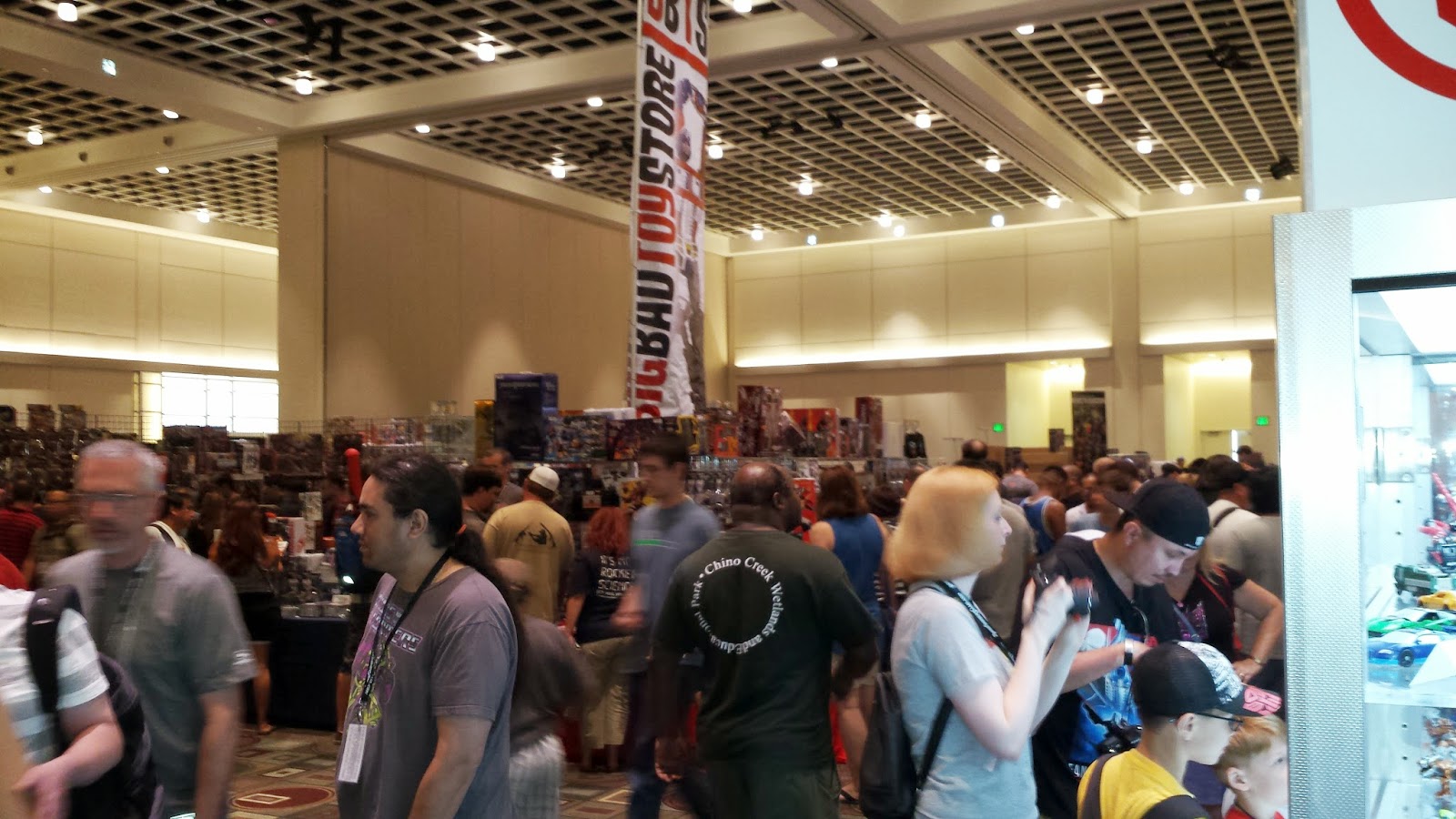
It may have been smaller than WonderCon, but BotCon still drew quite a crowd.

Since there were some exclusives to be found at that convention, mainly consisting of comic covers and prints (many of them My Little Pony-related), we decided that those would be our first priority since we thought they would run out early or might already have (given this was day 3 and the MLP fanbase tends to be rabid about this sort of thing, as we learned from Comic-Con). Surprisingly though, there were still plenty of the MLP-based exclusives available, and there were still a lot of them by the time we left. However, we decided to get these exclusives while we could, including a variant cover left over from the 2013 BotCon (we got the MLP covers and the MLP/Transformers print we were interested in mainly because they were BotCon-related; my enthusiasm for MLP has all but died down at this point). John Barber (a current writer and editor on IDW Publishing’s Transformers comics) also happened to be working at the IDW booth where we got a few of these exclusives, so we took his offer to sign the comics we bought that he wrote.

Following this, we decided to go around and get some more signatures from Transformers artists and writers who were at the convention (whilst dodging some cameras following a group of dedicated Transformers cosplayers). One of the artists, Sarah Stone (artist of the currently-running Windblade mini-series) was also with writer Mairghread Scott (who was also a writer on Transformers: Prime), whom I wasn’t expecting to see, and so I was able to compliment both of them on their work (other creators were complimented as I got their signatures). As I got signatures from colorist Josh Burcham, he was excited when I also got him to sign the latest issue of IDW’s Samurai Jack comic (which I coincidentally had on me on the way to the convention), commenting that it was a fun issue to work on. Another colorist I got signatures from, Thomas Deer, not only helped me get signatures from another Transformers artist, Matt Frank (who was a little occupied at the time, but still sounded excited to see one of the comics I brought for him to sign), but also expressed disappointment with not being able to do coloring work for the Beast Hunters comic (due to personal matters) since he enjoyed doing color work for the Rage of the Dinobots comic so much (this was prompted from Rage of the Dinobots being a comic I brought to get signed). Another interesting comment I got from another Transformers artist, Andrew Griffith, was when I had him sign the first issue of Foundation (a Dark of the Moon tie-in comic from a few years back), he made a comment about it being “a blast from the past” (a statement writer John Barber would repeat when he signed it later).


Colorist Thomas Deer in the foreground and artist Matt Frank in the background.

After getting some signatures (I did not name some of the creators I saw for the sake of space), we went over to the store by the entrance to get some souvenirs. While there are the usual shirts and hats available, the souvenirs also usually include a few packages consisting of two or three toys falling under a particular theme. Three toy packages fell under the Pirates vs. Knights theme, though another set was available, being a small Kre-O set of Kreons (mini-figures) based on previous BotCon exclusives (including the Generation 2 Breakdown toy from the original 1994 BotCon). There was also the opportunity to purchase Timelines Trans-Mutate, based on a character from the Beast Wars cartoon in an alternate universe, which came in a box with extra space intended for that year’s free toy for Collectors’ Club Members (as a Club Member myself, I found this very tempting, since this was done before with another pair of related toys). Ultimately, we ended up getting a couple of shirts and the Kre-O set, since they were the least expensive.

I then stopped by the Hasbro booth to get some pictures of the toys that were on display. Whenever Hasbro is at a convention, I make it a point to stop by their giant glass display so I get a good look at what toys are coming out or are already available. This time, the selection came from a large assortment of Age of Extinction toys, some of which were already out, which come in multiple sub-lines with varying size and degree of complexity, along with some Construct-Bots and Kre-O Transformers tie-in products; there were also a number of Rescue Bots toys on display (most of which leave me to wonder how/if they will make it into the Hub Network cartoon), alongside various other merchandise for Rescue Bots and Age of Extinction. There was also some display space reserved for the Generations toyline, which includes a number of toys that come with and/or are based on the recent IDW comics, one of which was Windblade, the first official toy created by the fanbase (through online votes) and one of the 30 exclusives for the Thrilling 30 celebration; some representation was also given to the Masterpiece toyline, a series of expensive toys aimed at adult collectors that aim to capture the characters as they appeared in the original ‘80s cartoon. One particular section of the display was reserved solely for the toys that will become available at San Diego Comic-Con (such room was required for a reason), both of which will be quite pricey to say the least.


The Autobot Crosshairs from the upcoming Age of Extinction film.
Toy available now!

Once I got enough pictures, we headed outside for lunch. While we were outside, we discussed our next course of action, after which we unloaded some stuff at the car and headed back to the convention. Our hand stamps were nearly faded away (mine was barely visible), and so they were generously re-stamped a few times.

After heading back in, we participated in a toy giveaway at the Hasbro booth, where they were giving small toys to attendees for free. They were giving away small Construct-Bots sets based on characters from the upcoming Age of Extinction film, and we walked away with a few copies of the Bumblebee and Drift toys (the latter written as “Autobot Drift” on the packaging due to trademark). We then decided to take a look around the vendors at the convention as I tried to look for a specific toy that was released only in Japan (plenty of vendors had some Japanese toys for sale, which gave me an idea of what some of the Japanese toys actually looked like along with their packaging). While I didn’t find the toy I was looking for, we did end up with a couple of Generations toys, a Transformers book, and a Deadpool comic (comics didn’t have nearly as much of a presence as the toys, which wasn’t all that surprising).

We then went around for a few final signatures. One of the creators I came across was writer James Roberts, who writes the More than Meets the Eye comic, one of my favorite Transformers comics from IDW. Alongside free signatures, he was also selling copies of two of his comic scripts (More than Meets the Eye #6 and #22 if you’re curious), which, while I didn’t get either, were rather tempting to buy. There was also a surprise set-up for voice actor Steve Blum, since he only expected to do an earlier, planned signing that day (that I didn’t end up lining up for), and so I had him sign my copy of the Fall of Cybertron game (which I had on me in preparation). After one final stop at the Hasbro booth for a few more pictures, we went home early and thought out how to prepare for a future Pasadena BotCon.


James Roberts, writer of the More than Meets the Eye comic, in the flesh.

I didn’t end up going to any panels scheduled that day (one of which, about upcoming Transformers products, will likely be at Comic-Con as well), but I still think I had a good time there. If I were to describe BotCon in a nutshell, I would say it’s like fan heaven and wallet nightmare at the same time. Some items for sale can be pretty tempting, but also pretty expensive, which may come down to a hard decision or two depending on how much you happen to have on you or how much you are willing to spend on toys and stuff. However, it’s also a good chance to meet some of the creators behind your favorite Transformers comics as well as an opportunity to get some unique exclusives and swag that you might not be able to get elsewhere.

Cosplayers are a given at any convention, and often it’s amazing to see how much effort people can put into their Transformers cosplay. There were plenty of people dressed up as Transformers: Prime or Generation 1 characters, and often they will have put a lot of effort into capturing painstaking detail from the character models, particularly the Prime cosplayers, as the character designs get very complex. Other parts of the franchise also had their share of cosplayers with varying obscurity, including a Windblade cosplayer and one dressed as the human character Mega from the Japanese Super-God Masterforce anime. Needless to say, even non-U.S. Transformers series are celebrated at this convention.


A rather impressive Prime Starscream cosplay.

The Hasbro booth also advertised a few Transformers games coming out, Transformers: Rise of the Dark Spark, Transformers: Age of Extinction – The Mobile Game, and Transformers Universe. However, Rise of the Dark Spark didn’t have much of a presence aside from advertising (perhaps Hasbro is really trying to avoid major Age of Extinction spoilers). I didn’t explore either of the other games any further, but of all these games, I am definitely looking forward to playing Rise of the Dark Spark in the future.

If you are a Transformers fan and wish to attend BotCon when it drops by your state, there are a couple of things you should be aware of. General Admission days cost $10-20 per person (age 4 and under is free), but the official website doesn’t tell you it has to be in cash, so be prepared with this fee in cash beforehand. Souvenirs can get pretty expensive as well, but you won’t know how expensive they can get until you’re there, so be prepared to also spend maybe at least around $100 on souvenir toys if they strike your fancy (apparel is always cheaper). The website will also not tell you what vendors you can expect to find (though you can definitely expect Hasbro, IDW Publishing, Shout! Factory, and Big Bad Toy Store to show up); usually the vendors are there selling Transformers toys and a few other things (that are not Transformers), but if you’re looking to peruse any of the vendors you’re pretty much going in blind unless you find any information from other sources. If you want anything signed, be sure to also look at the official website so you have an idea of who to prepare for.

I have yet to be able to attend either of the first two days, but from my experience, if you are a big Transformers fan, then BotCon is definitely a place to attend if you happen to be nearby one year as it travels around. It’s a great place not only to see more fellow Transformers fans, but also to meet some Transformers creators and get a peek at upcoming toys. You may even be convinced to become a member of the Official Transformers Collectors’ Club while you’re there, as there are plenty of opportunities to do so, as Club Members receive special benefits, including a free toy (when you sign up by a certain date) and discounts on the Club Store. Just make sure you don’t burn a hole through your wallet while you’re there; your bank account might regret it later.


You won't be able to afford something like this at Comic-Con otherwise.