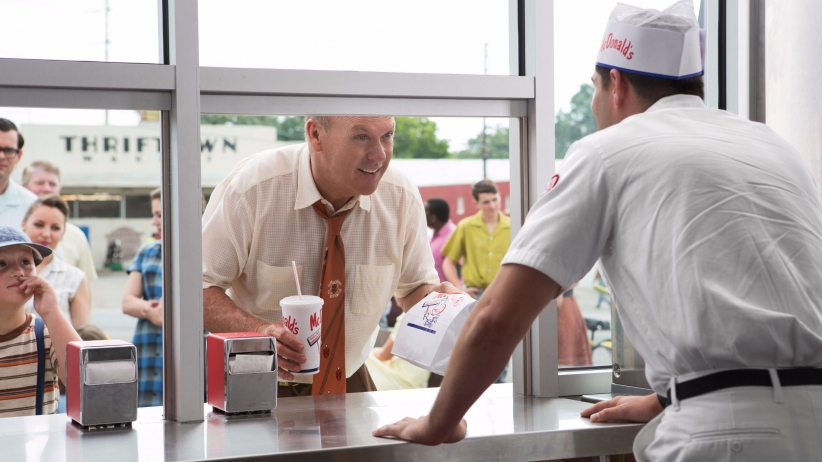
Showing posts with label Biography. Show all posts

Saturday, September 7, 2024

Stubs - Chaplin

Chaplin (1992) Starring: Robert Downey Jr., Dan Aykroyd, Geraldine Chaplin, Kevin Dunn, Anthony Hopkins, Milla Jovovich, Moira Kelly, Kevin Kline, Diane Lane, Penelope Ann Miller, Paul Rhys, John Thaw, Marisa Tomei, Nancy Travis, James Woods Directed by Richard Attenborough. Screenplay by William Boyd, Bryan Forbes, William Goldman Based on My Autobiography by Charles Chaplin, and Chaplin: His Life and Art by David Robinson. Produced by Richard Attenborough, and Mario Kassar. USA/United Kingdom Color Run time: 145 minutes. Biography

Oftentimes when you learn the truth about your heroes, they become very human. Such is the case with Charlie Chaplin, one of the most influential filmmakers to have ever lived. If you’re not familiar with him, then you should be. Besides his genius, Chaplin had a fascination with young women, read that very young women, that would eventually catch up with him and be the excuse the U.S. government would use to ban him, for two decades, from entering his adopted country.

Since Chaplin was so influential in films, his being the subject of a film seems to be a no-brainer. Director Richard Attenborough, following his success with Gandhi (1982), had announced his plans to direct a Charlie Chaplin biopic, as part of his $75 million, three-picture deal with Universal Pictures. A longtime fan of Chaplin’s, Attenborough recalled seeing The Gold Rush (1925) at the age of eleven and credited the silent film star with inspiring his early acting career. He had also become friendly with Chaplin and his family in the 1970s while vacationing near them in the south of France. With the blessings of Oona Chaplin, Charlie’s widow, Attenborough acquired the rights to Chaplin’s autobiography, My Autobiography, and footage from his films.

For the title role, Attenborough apparently tested seven of the total thirty actors considered for the role, including Kevin Kline, Dustin Hoffman, Billy Crystal, and Robin Williams. He was looking for someone between the ages of thirty and thirty-five, who was small in stature, as he believed the body likeness was more important than the face.

Sunday, August 13, 2023

Stubs - Oppenheimer


Oppenheimer (2023) starring Cillian Murphy, Emily Blunt, Matt Damon, Robert Downey Jr., Florence Pugh, Josh Hartnett, Casey Affleck, Rami Malek, Kenneth Branagh. Directed by Christopher Nolan. Screenplay by Christopher Nolan. Based on the book: American Prometheus: The Triumph and Tragedy of J. Robert Oppenheimer by Kai Bird and Martin J. Sherwin. Produced by Emma Thomas, Charles Roven, Christopher Nolan. Run time: 180 minutes US/UK Color Biography, Thriller

In mankind, there have been moments when things seemed to change. Most of us would say 9/11 was such a day. Life in the US has not been the same since. Another such moment was the birth of the atomic bomb in 1945 and its creator, J. Robert Oppenheimer, is the subject of Christopher Nolan’s Oppenheimer, the bottom half of Barbenheimer, a duo of films that hit US cinemas on July 21, 2023.

Saturday, June 10, 2023

Stubs - Julie & Julia


Julie & Julia (2009) Starring: Meryl Streep, Amy Adams, Stanley Tucci, Chris Messina, Linda Emond. Directed by Nora Ephron. Screenplay by Nora Ephron. Based on My Life in France by Julia Child with Alex Prud'homme, and Julie & Julia by Julie Powell, which was based on her blog The Julie/Julia Project. Produced by Nora Ephron, Laurence Mark, Eric Steel, Amy Robinson. Run time: 123 minutes. Color. USA. Biographical, Drama, Comedy.

For someone who has been dead for nearly 18 years, Julia Child is hot. Not only is there a successful series about her TV Series, Julia on HBO Max, but recently CNN ran a special about her, also called Julia, in May of last year. No better time to rewatch Julie & Julia, Nora Ephron’s final film and the first film to be based on a blog, though one step removed.

Julia Child is best known for her cookbook, Mastering the Art of French Cooking, and her long-running public television series, The French Chef (1963–1966; 1970–1973). Not only did she change cooking in America, but she also was a larger-than-life personality. She got into cooking because she loved eating and loved eating French food. When she couldn’t find a French cookbook in English, she took classes at the Cordon Bleu. A chance meeting with Simone Beck, who was writing a French cookbook for Americans with her friend Louisette Bertholle, lead to Child’s involvement with the project.

Saturday, November 19, 2022

Stubs - Elvis


Elvis (2022) Starring Austin Butler, Tom Hanks, Olivia DeJonge, Helen Thomson, Richard Roxburgh Directed by Baz Luhrmann. Screenplay by Baz Luhrmann, Sam Bromell, Craig Pearce, Jeremy Doner. Produced by Baz Luhrmann, Catherine Martin, Gail Berman, Patrick McCormick, Schuyler Weiss Run time: 159 minutes. Color. Australia/United States Biographical Musical Drama

The story of Elvis Presley told through the eyes of Col. Tom Parker, Elvis is a biography seen through the eyes of Baz Luhrmann.

For those of you who may not know, Elvis Presley, or as he’s also known, the “King of Rock and Roll” was the biggest singing act in the world after Frank Sinatra and before The Beatles. He had a string of number one hits beginning with “Heartbreak Hotel” and including such songs as “Love Me Tender", "Hound Dog” and “Jailhouse Rock”. His last hit, “Burning Love”, hit #2 in 1972. He made a ton of movies and recorded gospel as well as country albums.

And, if you watch the Luhrmann retelling you might or might not learn any of that. The film seems to tell the story like a stone skipping across the water, hitting on certain moments, like young Elvis’ exposure to the Blues and Gospel, but skips over things like the 30 movies Elvis made. We see him being embarrassed by Steve Allen on that comedian’s variety hour but not his appearance on Ed Sullivan’s, which was the sign you had really made it in America. We see him on the Louisiana Hay Ride, a traveling show, singing ”That’s All Right” but not him being discovered by producer Sam Phillips at Sun Records.

Sunday, April 11, 2021

Stubs - Mank

Mank (2020) Starring: Gary Oldman, Amanda Seyfried, Lily Collins, Arliss Howard, Tom Pelphrey, Charles Dance. Directed by David Fincher Screenplay by Jack Fincher. Produced by Ceán Chaffin, Eric Roth, Douglas Urbanski. USA Black and White Run time: 131 minutes. Biography, Historical.

Hollywood films about Hollywood always run the risk of being too inside baseball for the average viewer. It gets more so when the subject matter is 80 years old, as it is with Mank, a biographical film about Herman J. Mankiewicz (Gary Oldham) a screenwriter on Citizen Kane (1941), or as the film purports, the writer on the film. Based on a claim, and some would say discredited one, by Pauline Kael in her 1971 New Yorker article Raising Kane that Welles did not deserve screenwriting credit, the screenplay was written by Jack Fincher, a little-known screenwriter, whose son turned out to be film director David Fincher.

Sunday, March 21, 2021

Stubs - Judas and the Black Messiah


Judas and the Black Messiah (2021) Starring: Daniel Kaluuya, Lakeith Stanfield, Jesse Plemons, Dominique Fishback, Ashton Sanders, Darrell Britt-Gibson, Lil Rel Howery, Algee Smith, Martin Sheen. Directed by Shaka King. Screenplay by Will Berson, Shaka King. Produced by Charles D. King, Ryan Coogler, Shaka King. USA Color Run time: 126 minutes. Biography, Drama.

The effect of COVID is still being felt well into 2021. While movie theaters may be opening up again, there is no film that would be worth risking my life to see. Say what you will about Warner Bros. and their day and date releases on HBO Max but that very well may be how I watch movies for months to come. That is how I was able to watch Judas and The Black Messiah, my first new film of the year, even though it was recently nominated for Awards based on its initially planned release last year.

Fred Hampton (Daniel Kaluuya) was a very charismatic man.

Judas and the Black Messiah tells the story of Fred Hampton (Daniel Kaluuya), chairman of the Illinois chapter of the Black Panther Party in late-1960s Chicago, and an FBI informant, William O'Neal (Lakeith Stanfield).

Saturday, December 7, 2019

Stubs - The Man Who Invented Christmas


The Man Who Invented Christmas (2017) Starring: Dan Stevens, Christopher Plummer, Jonathan Pryce Directed by Bharat Nalluri. Screenplay by Susan Coyne (Based on The Man Who Invented Christmas by Les Standiford). Produced by Robert Mickelson, Ian Sharples, Paula Mazur, Mitchell Kaplan, Andrew Karpen, Vadim Jean Color Run Time: 104 minutes Ireland/Canada Biography, Drama, Christmas

One of the most adapted novels is A Christmas Carol by Charles Dickens. We have previously reviewed several of these adaptations: Scrooge (1938), A Christmas Carol (1938), A Christmas Carol (1951), Mr. Magoo's Christmas Carol (1962), and A Christmas Carol (1984), which is certainly not a complete list. This is a novel that has had a great influence, not only on society but on the Christmas holiday as well. If you say “Merry Christmas” you may not realize it but that’s from this novel.

Saturday, August 10, 2019

Stubs - The Stratton Story


The Stratton Story (1949) Starring James Stewart, June Allyson, Frank Morgan, Agnes Moorehead, Bill Williams. Directed by Sam Wood. Screenplay by Douglas Morrow and Guy Trosper. Produced by Jack Cummings. Run Time: 106 minutes. USA Black and White Drama, Biography

I will be the first to admit that I am not a big baseball fan. I didn’t grow up around a Major League team, nor did I ever have the desire to play the sport as a child. For me, the game is too slow and low scoring. I will watch the occasional game, but I am not a diehard fan. That said, I do find I like baseball films. There is just enough history in them to keep me interested. Baseball seems to have a very storied history with many stories that can be made into interesting films.

Monty Stratton was a Major League pitcher from Texas that played for the Chicago White Sox from 1934 to 1938. During his career, he amassed a record of 36-23 with an ERA of 3.71. While those may not seem like great numbers and a short career, there is a lot more to Stratton’s story. He had a promising career that was cut short by a hunting accident. Out hunting rabbits on his family farm, he fell and accidentally shot himself in the leg. A main artery was damaged to the point that in order to save his life, his leg had to be amputated. The following two seasons, Stratton worked as a batting practice pitcher and coach.

He attempted to pitch at a charity game at Comiskey Park in his honor in 1939, but was unable to transfer the weight effectively to his artificial wooden leg. He would keep trying though and would eventually pitch again for the Sherman Twins of the East Texas League (Class C) and amass a record of 18-8. In 1947, he pitched for the Waco Dons of the Big State League (Class B) with a record of 7-7.

His comeback was too much for Hollywood to ignore. However, When MGM approached him to option his story, Stratton was not initially interested, but reconsidered when the studio talked about the inspiration it would grant disabled veterans of World War II who were struggling to deal with their circumstances. In post-WWII America, there were scores of veterans who returned from the war missing limbs.

While Jimmy Stewart ended up playing the role, he wasn’t the first choice of the studio. MGM wanted Van Johnson to play the role, however, a car accident in 1943 left Johnson unable to physically handle the role. Ronald Reagan also wanted to play the role, but he was under contract to Warner Bros. and that studio would not let him out of his contract for a film they expected to be a failure. Donna Reed was also considered for the role that would go to June Allyson.

The film went into production in late October and wrapped on December 28, 1948. The film features scenes shot on location at Comiskey Park, Gilmore Field in Hollywood, and at American League fields in Chicago, Cleveland, Detroit and Washington, D.C. It Released in the summer of 1949, after playing in selected cities with American League teams before its general release. Made on a budget of $1,771,000, it would earn $4,488,000 at the box office and win the Academy Award for Best Motion Picture Story.

The film opens with a young Monty Stratton (James Stewart) walking ten miles to pitch for the Wagner Wild Cats baseball team. After the game, he walks home and works on his farm for the rest of the day. He does catch the eye of ex-catcher Barney Wile (Frank Morgan), who recognizes his talent and convinces him that he could be major league material. Barney moves in with Monty and trains him throughout the winter. Barney promises him a tryout with the Chicago White Sox, who are having spring training in California, but before they go they have to convince Ma Stratton (Agnes Moorehead) to let him go. Monty arranges for their cousin Earnie (Robert Gist) to come and take care of the farm. Reluctantly, Ma gives him $5 and wishes him luck.

Barney and Monty then hitchhike across the southwest to get to California. When they arrive, it turns out that a tryout is not a guarantee. Chicago White Sox manager Jimmy Dykes (playing himself) does know Barney, but is initially reluctant. Monty's speed and accuracy impress him and he lets the boy stay with the Sox. Because he can’t have Barney just hang around, he hires him as a pitching coach. Monty is sent to get a haircut, but gambles the money. Proving just how lucky he is, Monty wins big.

As Monty tries to learn his way around the big city, he is overjoyed when fellow teammate Eddie Dibson (Bill Williams) invites him on a double date. Monty realizes Eddie is a cad, however, when he tries to steal Monty's date, Ethel (June Allyson), who is visiting from Omaha, and leaves Monty with the whole tab for the evening. Monty grabs Ethel and leaves, quickly winning her over with his sincerity and sweetness.

Monty (Stewart) meets Ethel (June Allyson) and they fall in love.

Monty makes the team, and after sitting on the bench for most of the first season, he is finally allowed to pitch, but only against the powerhouse Yankees. But he gets beaten so badly that he is sent back to the White Sox minor league in Omaha. There, he calls Ethel to tell her that he loves her, but wants a chance to prove himself professionally before they marry.

After finding success in Omaha, Monty is asked to join the majors again, at which point he and Ethel marry. For his first outing, he is asked to pitch against the Yankees again, but this time he masters his fear and wins the game.
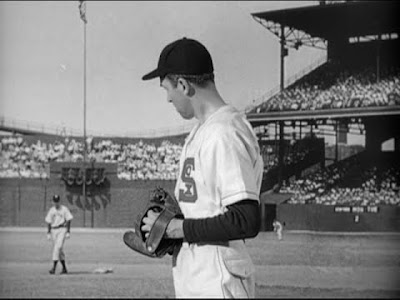
Monty gets his chance and becomes a well-respected pitcher for the White Sox.

After the season ends, Monty brings Ethel back to his family farm to meet his mother and stay for the winter. The next spring, he wins every game he plays, and, during one game, learns while on the mound that Ethel has given birth to a boy, Monty, Jr.

His success continues and within months, he is part of the All-Stars team and breaking league records, but Ethel worries that he is spending too much time out of the house. He tells her that he has meetings and interviews which make him late most nights. Even Barney suspects something is wrong. However, when they get back to Texas, he takes her to a nightclub and reveals that he has spent his extra time learning how to dance in order to please her.

Months later, while Monty is out hunting rabbits, he stumbles and his rifle discharges into his leg. His dog brings Ethel back to find him. The doctor informs her that his leg is infected and has to be amputated to save his life. Ethel doesn’t want to, but has no choice.

Monty loses a leg and his Ma (Agnes Moorehead) is concerned about him.

After the operation, Monty sits, motionless and bitter, as Ethel waits patiently for him to re-gather his resolve. Finally, however, Monty witnesses Junior taking his first steps, and realizes that he has been indulging in self-pity. He puts on his artificial leg and takes his son outside to play.

Monty starts to pitch again with Ethel playing catcher.

Soon, Monty decides to learn to walk on his false leg, and within months he is tossing a baseball with Ethel, who reveals that she is expecting another baby.

Barney (Frank Morgan) takes Ethel and Ma to the All-Star game to watch Monty pitch.

Barney comes to visit them that spring. He’s on his way to an All-Stars game in Houston and Monty, Ethel and Ma decide to go with him. Monty excuses himself to say hello to some of the players and Barney goes with him. It is then that he learns Monty has convinced the coach to let him pitch. Ethel goes down to see him before he goes out to the mound. He’s suddenly frightened, but goes out. He has trouble running and catching bunts, but he overcomes those obstacles and wins the game for the Southern League.

Ethel talks to Monty before he pitches in an All-Star game.

I’m not a baseball fan so I don’t really know the ins and outs of Monty Stratton’s career, so I imagine that he was built up a bit in the movie to make the fall even deeper. I’m sure that Stratton was depressed about losing his leg and his livelihood, but in real life he got back on his feet, so to speak, faster than James Stewart does in the film. He was back to working for the White Sox the next year while movie Stratton sat around the house moping.

And, as Stratton got back to pitching in the minor leagues, movie Stratton does so in a major league setting. This sort of deviation from reality is nothing new; movies have been doing it ever since they’ve been making them. The idea is not to replicate real life but to make a compelling film.

This is not to say Monty was not happy about his onscreen depiction. He did serve as a consultant on the film, and as recounted in Jhan Robbins' Everybody's Man: A Biography of Jimmy Stewart, the athlete knew his instincts were correct when he first screened the film: "When I saw Jimmy on the screen, I wept. He was more me than I am!"

Monty Stratton (l) and James Stewart as Monty Stratton (r).

Jimmy Stewart’s performance has a lot to do with the success of the film. He is an everyman and seems at ease in almost any film role he’s playing. Whether it’s working with Hitchcock, Frank Capra or playing a baseball player, Stewart is usually always watchable.

Adding to the film’s success has to be June Allyson, the girl next door type. She and Stewart make a winning on-screen couple. They seem to play off each other. So good in fact that they would be paired again in The Glenn Miller Story (1954) and Strategic Air Command (1955).

Somewhat underutilized is Agnes Moorehead, perhaps best known to the Baby Boomer generation as Endora in the TV Series Bewitched, but she has also given notable performances in films like Citizen Kane (1941), Mrs. Parkington (1944) and Dark Passage (1947). It is interesting to note that she was also working with her future husband, Robert Gist (Earnie), whom she would marry in 1954.

In real life, Robert Gist, who plays Cousin Earnie (r), would marry Agnes Moorehead.

Frank Morgan is perhaps best known as the Wizard in TheWizard of Oz (1939), but he had also appeared opposite Stewart in The Shop Around the Corner (1940), a perennial Christmas classic. He would twice be nominated for an Academy Award, one for Best Actor in The Affairs of Cellini (1934) and one for Best Supporting Actor in Tortilla Flat (1942). Here, he has a smaller but well-played role as Barney Wile, the vagabond former catcher who is the first to realize Stratton’s talents.

Even if you’re not a baseball fan, like me, there is a lot to like with The Stratton Story. If not 100% accurate, it is still an inspiring story that teaches that you should never quit no matter the odds.

Sunday, June 2, 2019

Stubs - Rocketman


Rocketman (2019) Starring: Taron Egerton, Jamie Bell, Richard Madden, Bryce Dallas Howard Directed by Dexter Fletcher Screenplay by Lee Hall Produced by Adam Bohling, David Furnish, David Reid, Matthew Vaughn Run time: 121 minutes. UK/USA Color Bio Fantasy Musical

Rocketman opened this past weekend and will no doubt be compared with last year's rock biopic, Bohemian Rhapsody. Both films cover music from roughly the same period of time, center on real-life men who come out as gay and were directed by the same man, Dexter Fletcher, though he only finished the Queen film when Bryan Singer became problematic. Both films also take liberties with the reality of their subjects, but that's where the comparisons end.

Saturday, March 9, 2019

Stubs - Bohemian Rhapsody


Bohemian Rhapsody (2018) Starring: Rami Malek, Lucy Boynton, Gwilym Lee, Ben Hardy, Joe Mazzello, Aidan Gillen, Allen Leech, Tom Hollander, Mike Myers Directed by Bryan Singer Screenplay by Anthony McCarten. Produced by Graham King, Jim Beach Runtime: 134 minutes UK/USA Color Biography

I’m not sure if I’ve ever had this experience before. I can say that I liked the film but at the same time think it took too many liberties with the story. What was supposed to be a biography is really more fantasy than fact. I know that’s what this year’s Rocket Man promises, this isn’t what Bohemian Rhapsody was supposed to be about.

Yes, I did get a new appreciation for the subject of the film, Freddy Mercury fka Farrokh Bulsara. He managed to transform himself from a baggage handler at Heathrow into the lead singer of one of the most popular bands in the world, which is quite a feat. And, as we always suspected, he enjoyed the company of men and ultimately died from the curse of AIDS. It’s quite a story, however, so much of what we learn that fills in all the gaps borders on pure fiction.

Brian May and Roger Taylor of Queen served as Executive Producers on the film.

The film takes his story and the story of the group Queen and twists it so that it is nearly unrecognizable as his or the group’s story. While I liked some of the group’s songs, I cannot say I was a die-hard fan but even I know that much of the film doesn’t ring true and the more I learn about the real story the more it feels like fiction, almost for the sake of fiction. And what is the biggest surprise to me is that members of the group, Brian May and Roger Taylor, people who would know the story, are Executive Producers on the film. They were apparently in on the ruse.

Rami Malek won an Academy Award for his portrayal of Freddy Mercury.

This is not to take away from Rami Malek’s portrayal of Mercury. He does a very good job in the role and is to be commended. (Since we’re publishing this after the Academy Awards, it should come as no surprise that he won for Best Actor.) Malek really does his best to become Mercury, with all his faults and talent. The singing is a mixture of Malek’s voice with Mercury’s and new recordings by Marc Martel, a Canadian Christian rock singer who sounds eerily similar to Mercury.

Lucy Boynton plays Mary Austin in Bohemian Rhapsody.

Lucy Boynton does a very good job as Mary Austin, Freddie’s one-time lover who gets pushed aside as Mercury explores his homosexuality, though he still loves her. Boynton, who is also Malek’s real-life love, should have a great future ahead of her based on her performance here.

There is a bit of brilliant stunt casting, Mike Myers as Ray Foster, a fabricated record executive who doesn’t believe in Mercury’s dream. Myers, you may recall, was Wayne Campbell in Wayne’s World (1992) and had that great scene in which the entire carload of friends bang their heads to Bohemian Rhapsody, something that gets referenced backhandedly during one of his scenes.

The more I read about the actual Mercury/Queen story, the more divergent from the truth the film seems to be. One of the big points, Mercury’s AIDS diagnosis, doesn’t come until after the group’s performance at the Live Aids concert in 1985, which serves as both a bookend and as a coda for the story. You might be left with the impression that the group came together for one last gasp but in reality, they were on tour prior to the concert and would continue to tour and record until Mercury’s death in 1991.

Despite its own issues with the real story, Bohemian Rhapsody is really a very good film and one that I would recommend not only to Queen fans but to most movie watchers. While you might not learn the real story of the group you will no doubt come away with a better understanding of Freddy Mercury thanks to Malek’s performance.

Wednesday, February 20, 2019

Stubs - Green Book


Green Book (2018) Starring Viggo Mortensen, Mahershala Ali, Linda Cardellini Directed by Peter Farrelly Screenplay by Nick Vallelonga, Brian Hayes Currie, Peter Farrelly Produced by Jim Burke, Brian Hayes Currie, Peter Farrelly, Nick Vallelonga, Charles B. Wessler Run Time: 130 minutes. USA Color  Biographical  Comedy-drama

In the last effort to see more movies nominated for Best Picture at the upcoming Academy Awards, we finally made it to see Green Book, which in addition to Best Picture is also nominated for Best Performance by an Actor in a Leading Role (Viggo Mortensen), Best Performance by an Actor in a Supporting Role (Mahershala Ali), Best Original Screenplay and Best Achievement in Film Editing
(Patrick J. Don Vito). By now the audiences have pretty much thinned out and the only people are probably ones like us, trying to see what the fuss is all about and to have some interest in the Awards show.

Frank (Viggo Mortensen) and Don (Mahershala Ali) are men from
diverse backgrounds learning to live with one another.

The film tells the story of two men with very different backgrounds. There is Frank "Tony Lip" Vallelonga, a made guy who is big, tough and unrefined. A bouncer at the Copacabana in New York, he finds he has nothing to do when the club starts renovations, which are supposed to last a couple of months. Frank has a wife and two kids that he needs to support.

Dr. Don Shirley is quite the opposite. Extremely well-educated with three doctorates, fluent in several languages, including Italian and he is also a very gifted musician. Classically trained, he has been working instead in "pop" music as part of a jazz trio. He is about to embark on an eight-week tour, which includes several shows in the Deep South.

It is 1962, Don is black and Frank is Italian and bigoted. But Frank needs the money and can overlook his own prejudices to make a buck. It is during this tour that the bulk of the film takes place. During the tour, Frank gets to appreciate Don not as a black man, but as a very talented human. Don learns that despite his rough edges, Frank is really grounded. It takes time, but the two men grow close and it is a friendship that will last until both men died in 2013.

The film is filled with the funny sort of things that happen in real life and when cultures and understandings clash. Frank paints Don with a black brush but Don is not your typical Black man or human for that matter.

But what underlies the film is the general bigotry that was running rampant in most of the South at that time with its sundown laws and white-only facilities. In fact, during that section of the tour, Frank often stays in nicer accommodations than Don, who is limited to what is available to him in the Green Book, a sort of black person's AAA directory at the time.

It is sinful that people were treated this way for no other reason than the color of their skin. While prejudice still exists in this country, one has to hope and pray that it is not this bad still, though I'm sure there are people who still carry this misguided hatred with them.

To be honest, Peter Farrelly might seem like the last director you would trust with this type of film. A history of directing lowest common denominator comedies doesn't seem like prep for tackling such a frank discussion of racial prejudice, but he does a very good job of not getting in the way of the story and deserves praise for his efforts here.

The acting is really good as well with both Mortensen and Ali as standouts in their roles. Both men give deep performances and you really get to feel that you not only get to know these men as individuals but also as friends. You get a real sense that it goes from business to personal as the tour comes to an end.

By the end of the film, Frank openly brags about Don Shirley's talent.

The music throughout the film is really good as well, from hearing snippets of Little Richard and Aretha Franklin on the radio to hearing Shirley play, though it is in this film Kim Bowers.

I'm sorry I waited so long to see this film and would readily recommend it to anyone who hasn't yet seen it. This is a very strong movie that is both intriguing and heartfelt. If you don't at least tear up by the film's end, then maybe you should check your pulse, cause your heart isn't beating.

Sunday, October 8, 2017

Stubs - Loving Vincent


Loving Vincent (2017) Starring Douglas Booth, Robert Gulaczyk, Jerome Flynn, Saoirse Ronan, Helen McCrory, Chris O'Dowd, John Sessions, Eleanor Tomlinson, Aidan Turner. Directed by Dorota Kobiela, Hugh Welchman. Screenplay by Dorota Kobiela, Hugh Welchman, Jacek Dehnel. Produced by Hugh Welchman, Ivan Mactaggart, Sean Bobbitt Run Time: 91 minutes. Polish/UK Color/BW Animated, Live Action, Biography

On July 27, 1890, at age 37, Vincent Van Gogh, a painter of little renown during his lifetime, shot himself in the chest with a 7mm Lefaucheux à broche revolver. There were no known witnesses, but the incident took place either in a cornfield or a barn. Mortally wounded, Van Gogh managed to make it back to his room, where he would die approximately 30 hours later. He would be visited by two doctors, Doctor Mazery and Doctor Gachet. While neither man was a surgeon, they made Van Gogh as comfortable as they could. Vincent's brother Theo came to visit, but before too long, Van Gogh grew weak and died.

These are the events that propel Loving Vincent, a new film with a very new technique. While originally shot as a live-action film, every frame has been painted over in oil in the impressionist style of Van Gogh.

From the film's website, showing the post-production of turning
 the live-action film into 65,000 oil painted frames.

A year after Van Gogh's death, the postmaster of Saint-Rémy, Joseph Roulin (Chris Dowd), discovers a letter that the late artist had sent to his brother and sends his son, Armand Roulin (Douglas Booth), to find Theo, not realizing the brother is also dead. Armand, who starts out grudgingly, turns into a detective as he researches the last weeks of the great artist's life.

While that might sound like an interesting endeavor on its own, it is the presentation that separates this film from anything else you have seen on the silver screen before. Armand's search takes you into the world of Van Gogh, which includes his work. We are treated to re-enactments of some of Van Gogh's more famous works, the subjects of which also include several of the main characters in this film. The colors are as vivid of Van Gogh's paintings, with black-and-white being used to simulate flashbacks detailing more about Van Gogh's life.

The actor Jerome Flynn playing Dr. Gachet, Van Gogh's painting
 of the doctor and his ultimate portrayal in the film.

A lot of experimental films are only about the experimental quality of their productions at the expense of film basics like story and acting. Thankfully, this film is both experimental without losing the basics that make it an interesting film. The story is intriguing. Even if you're not an art lover, Van Gogh's life and death have been made into movies before, probably the most memorable being Lust for Life (1956) starring Kirk Douglas. This film sort of works as a companion piece to that film, taking up the story when that one ends.

An example showing the film's transition from live action to oil painting.

The acting is also very good. More than voice work, the actors are actually the live models on which the painting is added. It's as if they were parts of a continuous painting that comes to life.  Douglas Booth, an actor I had never heard of before, gives a very strong performance as the son who becomes intrigued with an artist he doesn't really know. Other standouts include Eleanor Tomlinson as Adeline Ravoux, the daughter of the innkeeper where the artist died. Saoirse Ronan plays Marguerite Gachet, not only the subject of one of Van Gogh's paintings, but also a possible companion to the older artist. Jerome Flynn plays her father, Dr. Gachet, the last doctor Van Gogh sought treatment from after leaving the Hospital in Arles supposedly cured. Everyone feels that they had some hand in the artist's decision to commit suicide.

Douglas Booth gives a strong performance as Armand Roulin.

The sad news is that Loving Vincent is not an easy film to see. As with most art house films, it is not available in wide release. But the film is really worth seeking out. If you're not fortunate enough to see it in on a big screen, then you should be looking for it when it becomes available on home video or your favorite streaming service.

Saturday, April 22, 2017

Stubs - The Founder


The Founder (2016) Starring: Michael Keaton, Nick Offerman, John Carroll Lynch, Linda Cardellini, Patrick Wilson, B. J. Novak, Laura Dern. Directed by John Lee Hancock. Screenplay by Robert D. Siegel. Produced by: Don Handfield, Karen Lunder, Jeremy Renner, Aaron Ryder. Run Time: 115 minutes. U.S. Color Biography, Drama

If you’re looking for another reason not to eat at McDonald’s then look no further than The Founder, the story of how Ray Kroc, played here by Michael Keaton, basically stole the McDonald’s restaurant and franchise away from the two brothers who founded the original restaurant in San Bernardino, Dick (Nick Offerman) and Mac (John Carroll Lynch) McDonald.

The original McDonald's opened by the Brothers in 1948.

In 1954, Kroc, a schemer for most of his adult life and then a traveling salesman hawking Prince Castle brand milkshake multi-mixers, is finding it difficult to find buyers for his wares. That is until his assistant, June Martino (Kate Kneeland), informs him that they received an order for six of his machines. Curious about the order, he calls the McDonald’s restaurant to confirm. When he speaks to Dick, the brother ups the order to eight.
 
Ray Kroc (Michael Keaton) can't believe anyone was interested in buying six of his multi-mixers.

Wondering about the demand for his product, Kroc drives out to San Bernardino and observes the restaurant in action and is surprised when his order is accurate and ready in 30 seconds. Mac offers to show Ray the restaurant and he is impressed by the efficiency of the operation.

Kroc can't believe his order is ready in 30 seconds.

He takes the two brothers out to dinner and hears their story. It seems the Speedee process was developed mostly by Dick as the two brothers tried to maximize profits and reduce costs. Having been in the drive-in business before, they are well aware, as is Kroc, of the expense and shortfalls of that type of restaurant: wrong orders that take too much time and cost too much to make.

Mac (John Carroll Lynch) and Dick (Nick Offerman) McDonald.

When Kroc returns home to suburban Chicago, he tells his wife Ethel (Laura Dern) what he’d found.  She’s heard this sort of story before, as Ray has been involved in several get-rich-quick schemes and can’t-miss ventures. But Ray is undeterred by her lack of excitement. He believes that persistence is the key to success and goes back to the brothers to pitch his idea of franchising the restaurant. The brothers seem disinterested, having been down this path before with little success, blaming the problems with keeping the quality up to their standards.  But he persists and the brothers allow him to lead their franchising efforts, with Kroc receiving 1.9% and the brothers to receive .5% of the franchisee’s profits.

Kroc opens his own McDonald’s in Des Plaines, Illinois and uses it to solicit wealthy investors from the golf club he and his wife belong to. But he finds that they do not abide by the guidelines that led to the failure of the first franchises. Upset with them, he quits the club without telling his wife and starts to solicit middle-class franchisees. This is a successful formula and expansion happens fast, too fast for the original McDonalds, but they can’t control Kroc, who goes so far as to designate his store as #1.

Ray is a big hit when he gets to Minnesota.

When the franchise reaches Minneapolis, Ray is introduced to successful restauranteur Rollie Smith (Patrick Wilson), who is an admirer of his. But Ray is an admirer of Rollie’s wife, Joan (Linda Cardellini), with whom he openly flirts with. Rollie does open a franchise which Joan runs and to which Ray pays close attention.

Ray tracks the expansion of his empire.

Despite the success of franchising, Ray is running short of cash based on the low percent he gets per his contract with the brothers. They refuse to renegotiate as well, which drives Ray to try to secure an extension on the mortgage payment, since he put up his house as collateral, without telling Ethel. Though the bank turns him down, his plight is overheard by Harry J. Sonneborn (B.J. Novak), a vice president of finances at Tastee Freeze and an admirer of Kroc’s success. He recommends that Kroc get into real estate, buying the sites for future franchises, then leasing the land to the franchisees as part of the deal. This will give Ray a constant source of income. He would found the Franchise Realty Corporation later changed to McDonald’s, in order to execute Sonneborn’s plan. (McDonald’s would end up being one of the largest landowners in the world.)

Of course, the brothers don’t like this, but Ray stands up to them, telling them that while they control how the restaurants are run, their influence stops at the door.

Still, there is the issue of the cost of operation, much of which is tied up in refrigerating the ice cream that goes into the shakes. Enter Joan, who has found a solution, an instant milkshake that only requires water. The brothers push back, but eventually, Ray decides to go through with it anyway, deciding that he’s tired of dealing with them.

Joan (Linda Cardellini), who already has Ray's attention, comes up with a money-saving plan.

First, Ray decides to divorce Ethel, something that he announces without fanfare at dinner one night. While he’s willing to give her alimony, the house, the car and the insurance, he’s not willing to give her any shares in his McDonald’s Corporation.

Ray tells his wife Ethel (Laura Dern) that he wants a divorce.

Ray’s next legal battle is with the brothers. Push has come to shove over the powdered milkshakes. Mac, who is diabetic, collapses and is sent to the hospital. His recovery isn’t helped when Ray shows up with a blank check. But the brothers don’t accept just yet. His lawyers negotiate a $2.7 million buyout. The brothers want to keep their own restaurant and a 10% share of profits in perpetuity, but Ray refuses to put it in the contract, telling them that his lenders wouldn’t go for it. He asks them to take his handshake on the deal, which they do.

The McDonald brothers don't know what hit them.

Afterward, when Dick asks Ray about why he didn’t just take the SpeeDee method they had shown him and started his own restaurant with that, he tells him that what he wanted was the name. To Ray, McDonald's is American. But when Dick tells him he didn’t get the name, Ray asks him are you sure? Turns out the naming rights went with the deal. While they got to keep their store, they had to change their name. Eventually, The Big M, as they called their restaurant, was put out of business by a McDonald’s Kroc opened across the street. (Oh, and to make things worse, as we learn in the epilogue, the brothers were never able to prove the handshake and therefore lost out on what would amount to $100 million a year.)

The film ends with Kroc prepping himself to meet, the then governor of California, Ronald Reagan, presenting himself as the founder of the great food empire. His new wife, Joan, tells him that the car is downstairs.

As with almost any biographic film, not everything happened exactly as portrayed in the movie. For example, while Ray did divorce Ethel, there was another wife before he married Joan, Jane Dobbins, who is nowhere to be found in this picture. Another example of omission is that Ray had to pay for the McDonald’s name before he could open his first store. Apparently, the brothers had sold the name to the Frejlack Ice Cream Company for $5,000. It cost Kroc $25,000 to buy it back.

Michael Keaton shows himself once again to be a very fine actor, playing a rather evil man as a regular guy just trying to make good. He is joined in the cast by Nick Offerman, the voice of Axe Cop, and John Carroll Lynch, who play the innovative, but conservative, McDonald brothers whose whole world is turned upside down by the huckster from Illinois. They prove hapless to stop him. Their own openness gets turned against them. Before they know it they’re left holding the paper bag.

It’s odd to see Laura Dern playing such a middle-aged cipher as Ethel. She plays the character as a sort of clone to Pat Nixon and sets up the difference between her and Joan, who screams vivaciousness by comparison.

The rest of the supporting cast is good as well, with B.J. Novak being perhaps the most dynamic of them. Justin Randell Brooke plays Fred Turner, a hamburger cooker (grill operator) who caught Ray’s attention early on and stayed with the company and rose through the ranks to eventually replace Kroc as Chairman and CEO in 1977. He is shown to be mostly in the background and while he speaks a few lines of dialogue, they aren’t really memorable and his role is sort of undefined in the movie.

Kate Kneeland plays Ray’s secretary/bookkeeper, a role that doesn’t change much during the film, though we’re told she would eventually own part of the McDonald's Corporation. While I’m sure Kneeland is a fine actress, the women’s roles in this film are mostly background characters as business, in the early 50s , was still a male dominated arena.

The film, mostly shot in Georgia as a stand-in for California and the Midwest, is very involving and while it got fairly good reviews upon release, did not do well at the box-office during its theatrical run, earning less than it cost to make, $25 million. But new films don’t die and this will be around in various forms for years to come and if you have a chance to see it, you will be drawn in.

Ray Kroc liked to pretend he was the Founder of McDonald's.

If you really hate McDonald’s, and there are more than a few of you out there, then The Founder will just give you one more reason to stay away. Kroc stole the company, name and golden arches (Dick’s idea) out from under the true founders of the company. While I’m not a habitual eater there myself, I might also stay away, if it weren’t for those Shamrock shakes in March. I’m willing to overlook Kroc’s misdeeds for one of those.

Monday, January 16, 2017

Hidden Figures (2016)


Hidden Figures (2016) Starring Taraji P. Henson, Octavia Spencer, Janelle Monáe, Kevin Costner,  Kirsten Dunst, Jim Parsons. Directed by Theodore Melfi. Screenplay by Allison Schroeder, Theodore Melfi. Based on the book Hidden Figures by Margot Lee Shetterly. Produced by Donna Gigliotti, Peter Chernin, Jenno Topping, Pharrell Williams, Theodore Melfi. Run Time: 127 minutes. USA Biography, History

It is not often that a film can be as effective as Hidden Figures is. Telling the real-life stories of Katherine Goble Johnson (Taraji P. Henson) and her close friends, Mary Jackson (Janelle Monáe) and Dorothy Vaughan (Octavia Spencer). Despite their intelligence, these women are held back by the times they lived in. Not only are they working in a male-dominant industry, aerospace, but they are also Black in a time of racial segregation in the South. They work at NASA, which at the time was based in Langley, Virginia.

The three actresses and the women they depict from left to right: Taraji P. Henson plays  Katherine
Goble Johnson; Janelle Monáe plays Mary Jackson; and Octavia Spencer plays Dorothy Vaughan.

But despite the cards being stacked against them, these women rise through the ranks at NASA, where they become not only barrier breakers, but they also become valued members of the team that would send the first seven American astronauts into space and eventually send a man to the moon. These were definitely both exciting and turbulent times in America, both of which are addressed in the film.

While the film shows these women as victims of prejudice, they don’t stay victims for too long. Not only does Katherine show her worth to Al Harrison, director of the Space Task Group (Kevin Costner), and his assistant, Paul Stafford (Jim Parsons), but with the encouragement of NASA engineer Karl Zielinski (Olek Krupa) and her own gumption, Jackson gets into classes she needs at an all-White school to get an Engineering degree.

Meanwhile, Vaughan, who is under-appreciated by her own supervisor Vivian Mitchell (Kirsten Dunst), manages to save the women in her group by getting in on the ground floor of computer programming. These are very inspiring stories of women who are finally getting the recognition they deserve for their duty to country.

While their work is important, the film gives about equal time to their personal lives with church and family playing large roles. Additionally, Katherine, a widow with three children, meets and marries Jim Johnson (Mahershala Ali), a former National Guardsman.

The women rely on each other as well as their families to get through the hard times at work.

Everyone in the cast is excellent and the film does a very good job of capturing the moment in time. Things were changing, but too slowly. The women’s contributions and importance led to the breaking of barriers at NASA. It was eye-opening to see how segregated the operation was, not only by color but also by sex. More than once, Stafford tells Katherine that it is not the color barrier she’s breaking, but that women are not allowed in some of the meetings she wants to attend.

Katherine Johnson stands out in more ways than one surrounded by her co-workers at NASA.

With the earliest Mercury launches as the backdrop, it was nice to see the depiction of John Glenn (Glen Powell). The last time I’d seen him depicted as part of the story of America in space, The Right Stuff (1983), I think he was depicted as a bit of a goody-two-shoes. Here he gets depicted more as someone who goes out of his way to not only acknowledge these women’s contributions but also relies on Katherine’s calculations before he will let the launch of Friendship Seven go forward.

John Glenn (Glen Powell) is depicted as more than a goody-two-shoes in Hidden Figures.

This is really a very involving film. The audience can get caught up with the uncertainty of space travel, even though we know how the Mercury story ultimately ends. I know it’s a bit of a cliché, but at the end of the screening, the audience broke out in applause. If you don’t find yourself drawn into the movie, then there is really something wrong with you.