Showing posts with label 1949. Show all posts

Saturday, November 22, 2025

Stubs - The Big Steal


 The Big Steal (1949) Starring Robert Mitchum, Jane Greer, William Bendix, Patric Knowles, Ramon Novarro Directed by Don Siegel Screenplay by Daniel Mainwaring, Gerald Drayson Adams Based on the short story "The Road to Carmichael's" by Richard Wormser in The Saturday Evening Post (19 Sep 1942). Produced by Jack J. Gross Run time: 71 minutes. USA Drama, Crime, Film Noir

Robert Mitchum and Jane Greer starred together in Out of the Past (1947), which is considered by many to be one of the best film noirs ever made. The film was a hit at the time, so a silver screen reunion with the two of them wouldn’t seem out of the question. However, their pairing in The Big Steal almost didn’t happen.

Saturday, November 28, 2020

Stubs - The Clay Pigeon

The Clay Pigeon (1949) Starring: Bill Williams, Barbara Hale, Richard Quine, Richard Loo. Directed by Richard O. Fleischer. Screenplay by Carl Foreman. Produced by Herman Schlom. Run time: 63 minutes. USA Black and White Film Noir, Drama, Crime.

Howard Hughes purchased RKO in 1948 and while he is known for giving his input, wanted or not, on the main, or A-Pictures, produced by the studio during his reign as owner, he did not seem to have the same interest in the B-Pictures the studio made. B-Pictures, with their lower budgets and shorter run times, were the second feature in a double bill. The first film produced after Hughes’ purchase was a B-Picture, The Clay Pigeon.

Saturday, November 21, 2020

Stubs - Scene of the Crime


Scene of the Crime (1949) Starring Van Johnson, Arlene Dahl, Gloria De Haven, Tom Drake, Leon Ames, John McIntire, Donald Woods, Norman Lloyd, Jerome Cowan, Tom Powers Directed by Roy Rowland. Screenplay by Charles Schnee. Produced by Harry Rapf Run time: 95 minutes. USA Black and White. Crime, Drama, Film Noir

Under the leadership of Louis B. Mayer, MGM studios was Hollywood's "Tiffany Studio” with a long history of making glamorous films, especially musicals. Unlike Warner Bros., which was now for its gangster films, with a few exceptions, MGM did not deal with those kinds of films. Things began to change in 1948, when Dore Schary returned to the studio, after a stint at RKO, to replace Mayer as the head of production.

One of the films the studio made, post this transition, was Scene of the Crime.

Saturday, November 14, 2020

Stubs - The Third Man


The Third Man (1949) Starring: Joseph Cotten, Valli (Alida Valli), Orson Welles, Trevor Howard Directed by Carol Reed. Screenplay by Graham Greene. Produced by Carol Reed. Run time: 105 minutes. UK/US Black and White Suspense, Film Noir

After World War II, Vienna, Austria, like Berlin, was sub-divided into zones controlled by the Allied Forces: the US, the UK, the USSR and France. It is in this divided city that the film The Third Man takes place. The city is described in the film’s opening narration, as read by Carol Reed, as “in the classic period of the black market. We'd run anything if people wanted it enough and had the money to pay. Of course, a situation like that does tempt amateurs but, well, you know, they can't stay the course like a professional.”

Saturday, December 21, 2019

Stubs - Holiday Affair


Holiday Affair (1949) Starring: Robert Mitchum, Janet Leigh, Wendell Corey. Directed by Don Hartman. Screenplay by Isobel Lennart. Based on the novelette The Man Who Played Santa Claus by John D. Weaver in McCall's (Dec 1948). Produced by Don Hartman Run Time: 87 minutes. Black and White USA Christmas, Romance

In 1948, after a string of hits for RKO studios, including Crossfire (1947) and Out of the Past (1947), Robert Mitchum was arrested in a sting operation for possession of Marijuana. While that might have spelled trouble for a lesser star, Mitchum’s films afterward, including Rachel and the Stranger (1948), The Red Pony (1949) and The Big Steal (1949) were box-office successes.

In a rush to capitalize on Mitchum’s recent successes, RKO put The Man Who Played Santa Claus into production. So popular was Mitchum that just before filming started, RKO paid $400,000 to acquire sole ownership of Mitchum's contract from independent producer David O. Selznick, who had shared the contract with RKO. The film, the title later changed to Holiday Affair, went into production on July 11, 1949.

Saturday, December 14, 2019

Stubs - Cover Up


Cover Up (1949) Starring: William Bendix, Dennis O'Keefe, Barbara Britton Directed by Alfred E. Green. Produced by Ted Nasser. Screenplay by Jerome Odlum, Dennis O'Keefe (as Jonathan Rix). Additional Dialogue by Francis Swann, Lawrence Kimble Run time: 83 minutes. USA Black and White. Mystery, Christmas

Think that Christmas might be an odd setting for a murder mystery? Well, you’re not alone. The producer of Cover Up, Ted Nasser, thought so, too and took out all references to Christmas, changing the setting to Spring and removing all references to the holiday from the dialogue in the original script. This, however,, did not sit well with Dennis O’Keefe, the star as well as one of the screenwriters. O’Keefe’s production company, Strand Productions, Inc. was also making the film, and he felt the references were essential to the story. After a day's delay, Nasser relented.

Saturday, November 9, 2019

Stubs - Thieves' Highway


Thieves' Highway (1949) Starring Richard Conte, Valentina Cortese, Lee J. Cobb, Barbara Lawrence Directed by Jules Dassin, Screenplay by A. I. Bezzerides. Based on the novel Thieves' Market by A. I. Bezzerides (New York, 1949). Produced by Robert Bassler. U.S.A. Black and White Drama, Film Noir

Film Noir, as we’ve previously discussed, is one of those genres that can be applied to films that don’t seem on the surface to really be what we would classically consider film noir. Case in point, Thieves' Highway, released by 20th Century Fox in 1949. According to documents in the Twentieth Century-Fox Records of the Legal Department Collection in the Arts--Special Collections Library at UCLA, the studio purchased the rights to A. I. Bezzerides' unpublished novel The Red of My Blood in Jan 1948 for $37,500. Bezzerides was then hired at $1000 a week for 10 weeks to write the screenplay. The novel would eventually be published under the title Thieves’ Market.

Saturday, August 10, 2019

Stubs - The Stratton Story


The Stratton Story (1949) Starring James Stewart, June Allyson, Frank Morgan, Agnes Moorehead, Bill Williams. Directed by Sam Wood. Screenplay by Douglas Morrow and Guy Trosper. Produced by Jack Cummings. Run Time: 106 minutes. USA Black and White Drama, Biography

I will be the first to admit that I am not a big baseball fan. I didn’t grow up around a Major League team, nor did I ever have the desire to play the sport as a child. For me, the game is too slow and low scoring. I will watch the occasional game, but I am not a diehard fan. That said, I do find I like baseball films. There is just enough history in them to keep me interested. Baseball seems to have a very storied history with many stories that can be made into interesting films.

Monty Stratton was a Major League pitcher from Texas that played for the Chicago White Sox from 1934 to 1938. During his career, he amassed a record of 36-23 with an ERA of 3.71. While those may not seem like great numbers and a short career, there is a lot more to Stratton’s story. He had a promising career that was cut short by a hunting accident. Out hunting rabbits on his family farm, he fell and accidentally shot himself in the leg. A main artery was damaged to the point that in order to save his life, his leg had to be amputated. The following two seasons, Stratton worked as a batting practice pitcher and coach.

He attempted to pitch at a charity game at Comiskey Park in his honor in 1939, but was unable to transfer the weight effectively to his artificial wooden leg. He would keep trying though and would eventually pitch again for the Sherman Twins of the East Texas League (Class C) and amass a record of 18-8. In 1947, he pitched for the Waco Dons of the Big State League (Class B) with a record of 7-7.

His comeback was too much for Hollywood to ignore. However, When MGM approached him to option his story, Stratton was not initially interested, but reconsidered when the studio talked about the inspiration it would grant disabled veterans of World War II who were struggling to deal with their circumstances. In post-WWII America, there were scores of veterans who returned from the war missing limbs.

While Jimmy Stewart ended up playing the role, he wasn’t the first choice of the studio. MGM wanted Van Johnson to play the role, however, a car accident in 1943 left Johnson unable to physically handle the role. Ronald Reagan also wanted to play the role, but he was under contract to Warner Bros. and that studio would not let him out of his contract for a film they expected to be a failure. Donna Reed was also considered for the role that would go to June Allyson.

The film went into production in late October and wrapped on December 28, 1948. The film features scenes shot on location at Comiskey Park, Gilmore Field in Hollywood, and at American League fields in Chicago, Cleveland, Detroit and Washington, D.C. It Released in the summer of 1949, after playing in selected cities with American League teams before its general release. Made on a budget of $1,771,000, it would earn $4,488,000 at the box office and win the Academy Award for Best Motion Picture Story.

The film opens with a young Monty Stratton (James Stewart) walking ten miles to pitch for the Wagner Wild Cats baseball team. After the game, he walks home and works on his farm for the rest of the day. He does catch the eye of ex-catcher Barney Wile (Frank Morgan), who recognizes his talent and convinces him that he could be major league material. Barney moves in with Monty and trains him throughout the winter. Barney promises him a tryout with the Chicago White Sox, who are having spring training in California, but before they go they have to convince Ma Stratton (Agnes Moorehead) to let him go. Monty arranges for their cousin Earnie (Robert Gist) to come and take care of the farm. Reluctantly, Ma gives him $5 and wishes him luck.

Barney and Monty then hitchhike across the southwest to get to California. When they arrive, it turns out that a tryout is not a guarantee. Chicago White Sox manager Jimmy Dykes (playing himself) does know Barney, but is initially reluctant. Monty's speed and accuracy impress him and he lets the boy stay with the Sox. Because he can’t have Barney just hang around, he hires him as a pitching coach. Monty is sent to get a haircut, but gambles the money. Proving just how lucky he is, Monty wins big.

As Monty tries to learn his way around the big city, he is overjoyed when fellow teammate Eddie Dibson (Bill Williams) invites him on a double date. Monty realizes Eddie is a cad, however, when he tries to steal Monty's date, Ethel (June Allyson), who is visiting from Omaha, and leaves Monty with the whole tab for the evening. Monty grabs Ethel and leaves, quickly winning her over with his sincerity and sweetness.

Monty (Stewart) meets Ethel (June Allyson) and they fall in love.

Monty makes the team, and after sitting on the bench for most of the first season, he is finally allowed to pitch, but only against the powerhouse Yankees. But he gets beaten so badly that he is sent back to the White Sox minor league in Omaha. There, he calls Ethel to tell her that he loves her, but wants a chance to prove himself professionally before they marry.

After finding success in Omaha, Monty is asked to join the majors again, at which point he and Ethel marry. For his first outing, he is asked to pitch against the Yankees again, but this time he masters his fear and wins the game.
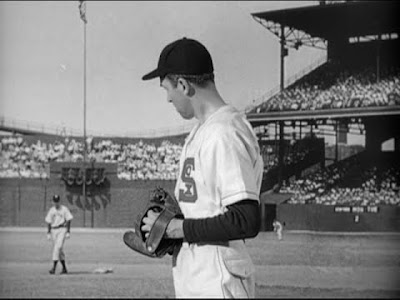
Monty gets his chance and becomes a well-respected pitcher for the White Sox.

After the season ends, Monty brings Ethel back to his family farm to meet his mother and stay for the winter. The next spring, he wins every game he plays, and, during one game, learns while on the mound that Ethel has given birth to a boy, Monty, Jr.

His success continues and within months, he is part of the All-Stars team and breaking league records, but Ethel worries that he is spending too much time out of the house. He tells her that he has meetings and interviews which make him late most nights. Even Barney suspects something is wrong. However, when they get back to Texas, he takes her to a nightclub and reveals that he has spent his extra time learning how to dance in order to please her.

Months later, while Monty is out hunting rabbits, he stumbles and his rifle discharges into his leg. His dog brings Ethel back to find him. The doctor informs her that his leg is infected and has to be amputated to save his life. Ethel doesn’t want to, but has no choice.

Monty loses a leg and his Ma (Agnes Moorehead) is concerned about him.

After the operation, Monty sits, motionless and bitter, as Ethel waits patiently for him to re-gather his resolve. Finally, however, Monty witnesses Junior taking his first steps, and realizes that he has been indulging in self-pity. He puts on his artificial leg and takes his son outside to play.

Monty starts to pitch again with Ethel playing catcher.

Soon, Monty decides to learn to walk on his false leg, and within months he is tossing a baseball with Ethel, who reveals that she is expecting another baby.

Barney (Frank Morgan) takes Ethel and Ma to the All-Star game to watch Monty pitch.

Barney comes to visit them that spring. He’s on his way to an All-Stars game in Houston and Monty, Ethel and Ma decide to go with him. Monty excuses himself to say hello to some of the players and Barney goes with him. It is then that he learns Monty has convinced the coach to let him pitch. Ethel goes down to see him before he goes out to the mound. He’s suddenly frightened, but goes out. He has trouble running and catching bunts, but he overcomes those obstacles and wins the game for the Southern League.

Ethel talks to Monty before he pitches in an All-Star game.

I’m not a baseball fan so I don’t really know the ins and outs of Monty Stratton’s career, so I imagine that he was built up a bit in the movie to make the fall even deeper. I’m sure that Stratton was depressed about losing his leg and his livelihood, but in real life he got back on his feet, so to speak, faster than James Stewart does in the film. He was back to working for the White Sox the next year while movie Stratton sat around the house moping.

And, as Stratton got back to pitching in the minor leagues, movie Stratton does so in a major league setting. This sort of deviation from reality is nothing new; movies have been doing it ever since they’ve been making them. The idea is not to replicate real life but to make a compelling film.

This is not to say Monty was not happy about his onscreen depiction. He did serve as a consultant on the film, and as recounted in Jhan Robbins' Everybody's Man: A Biography of Jimmy Stewart, the athlete knew his instincts were correct when he first screened the film: "When I saw Jimmy on the screen, I wept. He was more me than I am!"

Monty Stratton (l) and James Stewart as Monty Stratton (r).

Jimmy Stewart’s performance has a lot to do with the success of the film. He is an everyman and seems at ease in almost any film role he’s playing. Whether it’s working with Hitchcock, Frank Capra or playing a baseball player, Stewart is usually always watchable.

Adding to the film’s success has to be June Allyson, the girl next door type. She and Stewart make a winning on-screen couple. They seem to play off each other. So good in fact that they would be paired again in The Glenn Miller Story (1954) and Strategic Air Command (1955).

Somewhat underutilized is Agnes Moorehead, perhaps best known to the Baby Boomer generation as Endora in the TV Series Bewitched, but she has also given notable performances in films like Citizen Kane (1941), Mrs. Parkington (1944) and Dark Passage (1947). It is interesting to note that she was also working with her future husband, Robert Gist (Earnie), whom she would marry in 1954.

In real life, Robert Gist, who plays Cousin Earnie (r), would marry Agnes Moorehead.

Frank Morgan is perhaps best known as the Wizard in TheWizard of Oz (1939), but he had also appeared opposite Stewart in The Shop Around the Corner (1940), a perennial Christmas classic. He would twice be nominated for an Academy Award, one for Best Actor in The Affairs of Cellini (1934) and one for Best Supporting Actor in Tortilla Flat (1942). Here, he has a smaller but well-played role as Barney Wile, the vagabond former catcher who is the first to realize Stratton’s talents.

Even if you’re not a baseball fan, like me, there is a lot to like with The Stratton Story. If not 100% accurate, it is still an inspiring story that teaches that you should never quit no matter the odds.

Saturday, November 17, 2018

Stubs - Follow Me Quietly


Follow Me Quietly (1949) Starring: William Lundigan, Dorothy Patrick, Jeff Corey, Nestor Paiva, Charles D. Brown, Paul Guilfoyle, Edwin Max. Director: Richard O. Fleischer. Screenplay by Lillie Hayward. Based on a Story by Francis Rosenwald and Anthony Mann. Producer: Herman Schlom. USA Run Time: 59 minutes. Black and White. Police, Crime, Drama, Film Noir

There are some things that all film noirs have to have. Primary amongst them is that there has to be a crime, usually murder, involved. There should also be a femme fatale or at least an attractive woman involved with the protagonist, usually to his detriment. And usually, a bulk of the film will take place at night, where the long shadows of daylight are replaced by the even darker shadows of the underworld. While police are oftentimes critical to the story, so can be other occupations, like newspaper reporters. As we saw in While The City Sleeps, newspaper reporters, like the police, are always there, always answering their desk phones, no matter the time of day.

Follow Me Quietly originated as a story by Francis Rosenwald and Anthony Mann. While Rosenwald’s credits are somewhat spare, Anthony Mann’s is not. Like many directors active during the studio era, Mann directed many genres of films, including musicals, Moonlight in Havana (1942); comedy-dramas Dr. Broadway (1942), My Best Gal (1944), Sing Your Way Home (1945); biographies, The Glenn Miller Story (1954); Westerns, The Naked Spur (1953), Winchester ’73 (1950), The Far Country (1955), The Man From Laramie (1955); and Epics: El Cid (1961) and The Fall of the Roman Empire (1964). But he may be best known for his work in film noirs, beginning with The Great Flamarion (1945), and continuing with such films as Desperate (1947), Raw Deal (1948), T-Men (1948), Border Incident (1949), and Side Street (1949). A story co-written by Mann would definitely have some gravitas attached to it. There are some reports that Mann also had a hand in directing the film, though that contribution was uncredited.

Originally purchased by Jack Wrather Productions, to be released by Allied Artists with Don Castle in the lead, the story was sold to RKO in December 1947. Things weren’t settled with script or star. Martin Rackin was originally assigned to write the script and it should say something that his name doesn’t appear in the credits. Also, the original star was Kent Smith. RKO, by then, was the property of eccentric billionaire Howard Hughes. As part of his new regime, the film was given a short 16-day shooting schedule beginning on August 18, 1948. The film was released on July 14, 1949, after a New York premiere a week earlier.

Magazine reporter Ann Gorman (Dorothy Patrick) comes looking for police
 lieutenant Harry Grant in a cafe but cashier Benny (Nestor Paiva) hasn't seen him.

The film opens, when else, on a dark and rainy night. Ann Gorman (Dorothy Patrick), a writer for Four Star Crime magazine, enters a café looking for police lieutenant Harry Grant (William Lundigan). She wants to interview him about "The Judge," a serial killer who only attacks when it rains. However, Benny (Nestor Paiva), the cashier at the bar, tells her that Harry’s not there. She tries talking to his partner, Sgt. Art Collins (Jeff Corey), but he defers answers to his superior. When Harry does arrive, he rejects Ann's pleas for information and leaves with his partner, Sgt. Art Collins, when a call comes in about a new attack, this one on a newspaper editor named McGill (Frank Ferguson).

Ann tries but fails to get either police lieutenant Harry Grant (William Lundigan) or his partner
Sgt. Art Collins (Jeff Corey) to talk about the case they're working.

Though Ann tries to ride along, she has to take a cab to follow the policemen. McGill is badly injured, after taking a multi-story fall, but before he can be taken away describes what happened. While working at this desk, his assailant entered his office and tried to strangle him. In the struggle, McGill managed to get pushed out of his window. But before McGill gets around to describing his attacker, he dies. Despite that, Harry is convinced that this is indeed the work of The Judge.

McGill (Frank Ferguson) recalls the Judge's attack.

Harry and Art discover a note left by the Judge before Ann shows up at the crime scene. Harry doesn't like the fact that she's taken photos and as he escorts her out, he takes the film out of the camera.

Harry takes the film out of Ann's camera after she's taken photos at the crime scene.

Back at the office, Harry and Art discuss the many clues that have been collected about the Judge, including the kind of clothes he wears and his hat. He knows The Judge's habits and psychology, including the fact that he murders out of a sense of moral outrage. The biggest thing missing is that Harry has not been able to "put a face" to the killer.

Some of the evidence Harry has collected on The Judge.

Out of a sense of frustration, Harry comes up with an idea and asks his forensic experts to construct a dummy replica of The Judge based on the clues he has collected. Soon he has not only an artist sketch to pass around, but also a life-sized but faceless mannequin which Harry uses to instruct other officers working on the case.

The faceless mannequin the police create for their suspect.

Meanwhile, Ann continues to press Harry for information, even showing up unannounced in his apartment. She wears him down and he signs an authorization form allowing her to write about the case, but stipulates that he has final approval over any story. Later, he learns that Ann has used the authorization form to obtain information about the dummy, whose existence he wants to keep secret from the public. She has even filed a story without consulting him, which he angrily denounces.

Harry gets a call that they have supposedly caught the Judge and he goes to hear the confession. When he askes the man (Douglas Spencer) claiming to be The Judge to strangle him the way he had his one of his recent victims, the man gets unmasked as a phony.

A man (Douglas Spencer) pretends to be The Judge.

Later, back at the office, it’s another rainy night and the distraught Harry stares out the window and talks to the dummy in his darkened office. Harry is sure that The Judge is going to strike that night, and takes off in his car to drive around the city. Even though instructed to stay, Art leaves. Only after he’s gone is it revealed that the Dummy has been replaced by The Judge, who gets up and exits out a back door.

Neither Harry or Art suspect that the mannequin has been replaced by the real Judge.

Harry is soon joined by Ann, who has followed him. She gets into his car and tears up the authorization form as proof of her contrition. As predicted, that night The Judge strangles another seemingly random victim. Harry is depressed and talks about quitting the case but Ann talks him out of it. When the other police arrive, he sends Ann home and then discovers that the Judge has left another clue for Harry--a year-old copy of a Four Star Crime magazine.

After studying the magazine, Ann concludes that the killer must have purchased it from a used bookstore. Harry, Art, and Ann then canvas the city's bookstores until they find a proprietor (Maurice Cass) who confirms that a man whose build and dress match the dummy's buys crime magazines at his store.

Assuming that the killer lives near the bookstore, Harry and Art canvas other area businesses and eventually find a café waitress (Marlo Dwyer), who, after being taken to police headquarters, identifies the dummy as Charlie Roy, a nice man who lives around the corner.

The apartment manager (Michael Mark) lets Harry and Art into Charlie's apartment and they discover evidence.

After the apartment manager (Michael Mark) lets them into the apartment, Harry and Art discover crime books and souvenirs from the murders. They then stake out his building, waiting for The Judge to return. Sensing trouble, however, Charlie (Edwin Max) hesitates before entering, then flees down the street.

Harry waits with the apartment manager for Charlie to return.

During the chase, Charlie heads to the rooftop of a nearby gas works plant. Harry loses his gun and Charlie picks it up. The police arrive and surround the plant and shoot at Charlie. One of the cops hits a water tank. Charlie shoots back and fires all the bullets in the gun. After that, Harry is able to corner Charlie and handcuff him.

The chase leads to a nearby gas works.

As Harry is bringing Charlie out of the plant, the pouring water from the tank like rain, makes the killer become hysterical. He struggles with Harry, dragging him back up the catwalk by the handcuffs. Harry is finally able to free himself and pushes Charlie to his death.

Harry puts the handcuffs on Charlie (Edwin Max).

With the case solved, Harry and Ann then enjoy a quiet, romantic drink together back at the bar where they first met.

To be honest, this has “B” movie written all over it. That’s not to say it's bad, just that it could be better. With a short runtime, things have to be jettisoned in favor of action. One of the biggest missing pieces is why Charlie murders and why rain apparently sets him off. He is obviously a killer with a psychological problem, but the movie makes no effort to figure out the cause of it. No time.

Dorothy Patrick plays the part that might have perhaps been the femme fatale. A beautiful actress, her beauty is not really a factor in the film. She is never really in danger from The Judge, which would have been a good twist and for most of the film, Harry seems immune to her as well. She’s just a working girl trying to do her job. She would become a “Queen of the “Bs” appearing in a lot of what they called programmers, including High Wall (1947), New Orleans (1947), and House by the River (1950). She’s good and likable in her role here as reporter Ann Gorman.

Playing the lead was something new for Patrick as it also was for the male lead. William Lundigan would appear in more than 125 films beginning in 1937, including Dodge City (1939), The Fighting 69th (1940), The Sea Hawk (1940), Santa Fe Trail (1940) and The House on Telegraph Hill (1951), but was rarely more than a supporting player. He’s athletic and fairly handsome but still feels a little like a second choice to play the lead in a film. He plays the straight-laced detective fairly well but he, like the killer, is rather one-dimensional.

Edwin Max also seems a bit of surprise cast as the killer, Charlie. After seeing The Judge in action, Max is a bit of a disappointment. Just as a body type you wouldn’t look at him and think he could overpower people the way a strangler would have to. Max would have 60 credits to his name, including a combination of TV and film roles but in this one, he seems to be miscast.

You have to give the film some credit for the idea of using a mannequin to help catch the killer, though you have to imagine that is one of those things that would only happen in a movie. There is an impracticality about the concept that would prevent it from being used in a real murder case.

There is no way that Ann and Harry don’t get together by the end of the film. Not that they have really great on-screen chemistry, but in a movie like this, the hero always gets the pretty girl. And even a film noir needs a happy ending so you not only expect it, but you accept it as well.

With the premise being that the Judge only kills when it's raining, there are only a few cities that this would really be a big deal. In a city like Los Angeles which is burdened by droughts, a rainy-day killer would be sidelined more often than not. However, in a city like Seattle, there would be a real terror. I don’t believe the location is ever mentioned, other than it's a city.

Reviews were at best mixed. The New York Times’ Bosley Crowther’s review referred to it as an “utterly senseless little thriller is patently nothing more than a convenient one-hour time-killer between performances of the eight-act vaudeville bill.” Not high praise. Still, the film is not all that bad. With a short running time, there is a lot of action and it does provide a taste of terror and takes the viewer on the dark side of life in a big wet city.

Saturday, September 15, 2018

The Adventures of Ichabod and Mr. Toad


Following the release of Bambi in 1942, Disney released a series of package films, comprised of multiple shorts told through a framing device, throughout the 1940s, beginning with Saludos Amigos in 1942 and ending with The Adventures of Ichabod and Mr. Toad in 1949. The Adventures of Ichabod and Mr. Toad adapts two stories, those being the 1908 novel The Wind in the Willows by Kenneth Grahame and the 1820 short story “The Legend of Sleepy Hollow” by Washington Irving. Though I had not seen the movie for the longest time since I was a kid, I found it to have aged really well; as this is a collection of two stories, I will be talking about how the movie works as a whole in addition to covering each story individually.

The framing device consists of an unseen narrator reading from a book in a library, covering The Wind in the Willows first in spite of the title. Both halves of the movie are amazingly well-animated, as to be expected from a movie featuring Disney’s Nine Old Men. The quality of the animation is, aside from its narrative, one factor that allows the feature to stand the test of time, with the opposing tones of each tale demonstrating the capabilities of Disney’s animators.


The Wind in the Willows is, despite what the title may tell you, the first story presented in this movie, about a group of friends; a toad named J. Thaddeus Toad (Mr. Toad) (Eric Blore), a badger named Angus MacBadger (Campbell Grant), a water rat named Ratty (Claude Allister) and a mole named Moley (Colin Campbell). Mr. Toad is a toad known for his manias, which puts a strain on Toad Hall and MacBadger, who tracks all of Mr. Toad’s damages. Ratty and Moley soon try to stop Mr. Toad from pursuing his latest mania, a canary yellow gipsy caravan pulled by a horse named Cyril Proudbottom (J. Pat O’Malley), only for Toad to become obsessed with a motorcar. Despite Toad being locked in his room, he is later accused of stealing a motorcar. In court, Cyril testifies that Toad merely traded the deed to Toad Hall to a group of weasels at a pub to get the motorcar, however the witness and bartender Mr. Winky (Ollie Wallace, uncredited) says that Mr. Toad actually tried to sell him a stolen motorcar, landing Toad in prison. After managing to escape, Mr. Toad and co. make plans to take back Toad Hall once it turns out Cyril was telling the truth.

Prior to my most recent viewing of this movie, I had actually read a more recent (unabridged) printing of The Wind in the Willows from IDW Publishing, with illustrations by David Petersen of Mouse Guard fame (I would highly recommend this version of the book if you’re looking for a more modern printing), to see how much it differs from the book. The movie presents a Disney-fied take on an abridged version of the book, adapting the Mr. Toad-centric chapters and tying them together with its own narrative; the adaptation is done well enough that it works on its own, helped by the aforementioned stellar animation along with narration by Basil Rathbone. I wasn’t too bothered by the creative liberties taken, especially since apparently most adaptations leave out two admittedly superfluous chapters of the 12-chapter book and Mr. Toad is arguably the more popular character, though I will note some of the more major changes here.

The version of the book I read for narrative comparison.

In the book, J. Thaddeus Toad and Angus MacBadger were simply named Mr. Toad and Badger, though Water Rat and Mole were nicknamed Ratty and/or Moley at points. Additionally, the weasels (joined by some stoats in the book) were given a more expanded role in the movie, as was Cyril, who actually barely had a presence in the original story to the point where he didn’t have any lines and wasn’t even named; then there’s the addition of the character of Mr. Winky, who wasn’t even in the book at all. A more major, perhaps the most important, change is that, in the book, Mr. Toad was outright guilty of stealing the motorcar in the first place, though a different version of his prison escape still occurred. Fans of either version may recognize a much more radical change in the Mr. Toad’s Wild Ride dark ride at Disney theme parks, which ends with Mr. Toad going to hell for some reason.

In my research into The Wind in the Willows, I have found that some people apparently believe the book to be about homosexuality, which seems to stem from the interactions between Water Rat and Mole, which could admittedly get oddly personal at times in how they express their emotions (for example, there's a scene in one chapter where Mole openly cries when he senses his old home nearby and he and Water Rat nearly pass by it). In the end though, these chapters are more about world building and setting up each of the characters, including Badger and Mr. Toad (that said, two of those chapters are superfluous and are just filler to break up Mr. Toad's prison escape). At its core, however. the book is more about Mr. Toad's fascination with a motorcar to the point where he steals one and suffers the consequences; by the end of the book, he turns over a new leaf and becomes a better toad.

In adapting the book to a feature, Walt Disney cut out the Water Rat and Mole chapters because he thought they wouldn't be interesting enough, which, along with the aftereffects of WWII, necessitated adding the in-production The Legend of Sleepy Hollow (more on that later) to fill out the running time. Though a number of changes both major and minor were made to try and make what was left of the story work as a Disney movie, I think the end result is an interesting attempt at trying to capture the real essence of the book and what most readers take away from it, that being the character of Mr. Toad.


The Legend of Sleepy Hollow is the second and arguably more famous part of the movie, especially considering the poster and just about every home video box art emphasizes this story. Ichabod Crane (Bing Crosby) is a dandy who arrives in the village of Sleepy Hollow and becomes the new schoolmaster, where he wins the affections of the village’s women to get food from them, before falling in love with a woman named Katrina van Tassel; the narrator (Bing Crosby) explains that Ichabod is really after her money, as she is the daughter of the richest man in the village, Baltus van Tassel. Ichabod’s actions do not sit well with Brom Bones (Bing Crosby), a strong man whom Ichabod managed to overtake as the attractor of Sleepy Hollow’s women, leading Brom to try to take Katrina away from him. Upon seeing that Ichabod is superstitious, Brom finally gets back at him by telling him the story of the Headless Horseman at a Halloween party, which scares Ichabod. After the party, Ichabod is going home through the forest on horseback, leading to his famous encounter with the Headless Horseman.

Unlike The Wind in the Willows, I have not read “The Legend of Sleepy Hollow” prior to watching this movie, however I did enjoy it for what it was. Bing Crosby, the biggest singer of his time, demonstrates his talent in the realm of voice acting as he voices the two major characters of the story and narrates most of the events. The famous scene with the Headless Horseman is animated spectacularly, aided by a strong buildup and the absolute lack of narration throughout the entire sequence.

The Adventures of Ichabod and Mr. Toad is the result of needing to fill time after cutting The Wind in the Willows in half, however the end result is a really good package movie. The animation is spectacular and each segment features some great vocal talent as well as some well-timed humor. It’s easy to see why “The Legend of Sleepy Hollow” half took off the way it did, though the Mr. Toad’s Wild Ride Disney park ride keeps the Mr. Toad character relevant for some.

The version some people are more familiar with.

Though presented as one package, the two stories have often been released individually on home video, however you can still find a proper collected DVD in stores (incidentally, the DVD copy I watched this movie from turned out, upon being opened, to be so old that it (for some reason) included 17-years expired coupons for Energizer batteries). Though one may be more tempted by one half of the movie over the other (The Wind in the Willows segment may be a turn-off for some purists), I would still recommend watching it in its original packaged form as intended if you can find it.

Saturday, May 5, 2018

Stubs - South of St. Louis


South of St. Louis (1949) Starring Joel McCrea, Alexis Smith, Zachary Scott, Dorothy Malone, Douglas Kennedy, Alan Hale, Victor Jory, Bob Steele, Monte Blue, and Nacho. Director: Ray Enright. Screenplay by Zachary Gold, James R. Webb. Produced by Milton Sperling. Runtime: 89 minutes. U.S.A. Color, Western.

If you haven’t heard of United States Pictures before, you’re not alone. An independent studio run by producer Milton Sperling, United States Pictures produced 14 features from Cloak and Dagger (1946) directed by Fritz Lang to Battle of the Bulge (1965) directed by Ken Annakin. The studio would dabble in several genres, including film noir: Cloak and Dagger, and The Enforcer (1951) directed by Bretaigne Windust & Raoul Walsh; war films: Retreat, Hell! (1952), Merrill's Marauders (film) (1962) directed by Samuel Fuller, Battle of the Bulge; and Westerns: Pursued (1947) directed by Raoul Walsh, Distant Drums (1951) directed by Raoul Walsh, and South of St. Louis (1949) directed by Ray Enright.

South of St. Louis was originally called Distant Drums, a title that would get used later, and was set to star Lilli Palmer with a screenplay by Ben Hecht. Of course, that’s not what happened. It’s hard to know what that film might have been, but that’s not the film we’re dealing with here. The term South of St. Louis is apparently a Civil War expression used to describe army deserters, though that is not really related to the final film.

The film opens in Missouri, south of St. Louis, during the Civil War. Far from the main battlefields of the war, Luke Cottrell (Victor Jory) and his guerrilla raiders operate in the name of the Union Army. Driven from their homesteads, settlers migrate to Texas. On their way out, they pass the Three Bell Ranch which has been burned to the ground. The three owners and best friends, Kip Davis (Joel McCrea), Charlie Burns (Zachary Scott) and Lee Price (Douglas Kennedy), vow revenge.

Charlie Burns (Zachary Scott), Lee Price (Douglas Kennedy) and  Kip Davis (Joel McCrea)
find their ranch The Three Bell has been destroyed.


Despite the fact that Kip’s fiancée, Deborah Miller (Dorothy Malone), wants him to go with her to the small town of Edenton, the three head to the Texas border town of Brownsville, a Union Army stronghold, to look for Cottrell. There at a bar run by Jake Everts (Alan Hale, Sr.), they find Cottrell and Kip beats him up.

Luke Cottrell (Victor Jory) and his guerrilla raiders take a break in a Brownsville bar.

Later, Lee decides to leave and join the Confederate Army. The other two will stay behind and work to raise money to build back the Three Bell.


Lee joins the Confederate Army while Charlie and Kip keep working to raise money to rebuild the Ranch.

Afterward, Rouge de Lisle (Alexis Smith), a saloon singer and Rebel sympathizer, offers Kip $50 to transport a wagon load of furniture for her. Without hesitation, Kip agrees to do it and starts out immediately. However, on the way, he has an accident with a Union Army wagon, revealing that his freight is not furniture but guns intended for the Confederate Army. Kip is arrested and sent to the Stockade.


Rouge de Lisle (Alexis Smith) hires Kip to deliver "furniture".

On his way to the stockade, another Confederate sympathizer paid off by Rouge,  lets him go free. Immediately, a carriage carrying Rouge pulls up. She offers him a chance to work with her smuggling guns for the Confederacy from Matamoros, Mexico into Brownsville.

Rouge’s contact in Matamoros is a Frenchman, Henri Brugnon (Paul Maxey), who informs her that he has no more weapons, having sold them to Cottrell.

Meanwhile, Charlie hires a gang of men, including Slim Hansen (Bob Steele), who used to be a member of Cottrell’s gang.


Slim Hansen (Bob Steele) joins Charlie's gang after having run with Cottrell.

Some months later, Kip, Charlie, and their gang bring a load of guns across the river into Texas and find Cottrell waiting for them. A gunfight ensues, and Kip's men are rescued by a contingent of Confederate soldiers, led by Lee.


Deborah Miller (Dorothy Malone) is the girl Kip leaves behind, but she moves herself.

When they arrive in Edenton with the guns, Kip goes to see Deb, who has been working as a nurse in a converted hospital. She’s happy to see him and begs him to stay with her.  Kip, however, is still determined to rebuild his ranch and continues to smuggle guns to keep making money.

After the Confederate Army recaptures Brownsville, Kip wants to return to Three Bell. Lee, who is now a lieutenant in the army, chooses to continue fighting. Meanwhile, Charlie has become more interested in making money than returning to the ranch and decides to continue gun running.

Kip returns to Edenton and asks Deb to marry him and come back with him to the ranch. Surprisingly, she turns him down, feeling that her work as a nurse it too important and decides she can’t leave. Kip goes back to smuggling, which pleases Rouge, who has fallen in love with him.

Cottrell threatens to kill Kip and Charlie if they ever return to Matamoros, so Slim suggests that they steal the shipment before it arrives. Dressed as Union soldiers, they steal the guns. However, getting back into Texas poses a problem when they are intercepted by Confederate soldiers as they cross the river. Mistaking them for Union soldiers, the Confederates open fire and a shootout ensues. While Kip and Charlie survive, they end up killing the leader of the Confederate band. Back in Texas, Lee suspects the truth and ends his long-term partnership with Kip and Charlie.


The three friends start to splinter when Lee suspects his friends have killed his fellow soldiers.

When Cottrell kills one of Kip's men, Kip resolves to kill him. Slim, who used to ride with him, warns Cottrell, hoping that warning him will help eliminate Kip allowing Charlie to become the sole leader of the gang.

Kip avoids Cottrell’s ambush, but before Cottrell can tell him about Slim's double-cross, Slim kills him.

Returning to Edenton, Kip learns that Deb has fallen in love with Lee. After having lost both his friends and his fiancée, Kip leaves for Matamoros, accompanied by Rouge. With time on his hands, Kip starts to drink heavily.

After the war, Lee joins the newly established Texas Rangers and he is sent to Brownsville to clean things up. It’s not clear what he’s supposed to clean up, but apparently, it’s his old friend Charlie’s operations, since as soon as he arrives in town, Charlie threatens him. Concerned for his safety, Deb, who is with her husband, rides to Matamoros to ask for Kip's help.


Rouge convinces Kip to help his old friend.

At first, Kip isn’t keen to get involved, but with Rouge’s encouragement, he rides to stand by Lee’s side. There is a standoff between Charlie and his gang against Kip and Lee. When Slim tells Charlie that he has a sharpshooter ready to kill Kip and Lee, Charlie can't take it and at the last minute, he joins his old friends in a shootout with his own gang.


The Three Bells stand side by side in their last gunfight.

While the three friends are victorious, a mortally wounded Slim shoots him. As Charlie lies there dying, Kip promises him that the ranch will always be called the Three Bell and that they won’t change the brand.

Later, married to Rouge, Kip returns to rebuild the ranch. When Kip mentions that they’ll need a couple of boys to help them rebuild, Rouge promises, if he gives her a couple of years, to provide them.

The fact that this is called a Western does not sit quite right with me. Westerns are often set on the American frontier during the last part of the 19th century (1865-1900) following the Civil War, in a geographically western (trans-Mississippi) setting with romantic, sweeping frontier landscapes or rugged rural terrain. Typically, the subjects are white settlers vs. Indians, cattle ranchers vs. sheepherders, the coming of the railroad, cattle drives, and the like. Most of this film takes place during the Civil War, and while there is talk of cattle, we never really ever see any. No railroads. No Indians. Not that I’m against bending genres, but this one seems to be a Western only in passing.

Also, there are the bells that the three main characters wear on their spurs. Lee even continues to wear one with his Confederate uniform. Not sure what the motivation would be for three grown men to wear a little bell like that. There is never any explanation. This may sound a little old-fashioned on my part, but its a little too cute to be believable.

While I’m not a Civil War history buff, I am still dubious about the film’s historical accuracy. I always thought that Texas fell at the end of the war, rather than during it, as this film seems to suggest. Nor that Brownsville ever fell to the Union only to be retaken by the South. This film comes across more as bending history to make the movie work.

And speaking of the Civil War, the film’s protagonists are obviously on the wrong side of history. While there is no indication that none of them actually own slaves, we’re still supposed to be rooting for Confederate sympathizers. I’m not one of those PC types, but it still seems surprising that Hollywood would choose to make heroes out of them, even back in 1949. Don’t get me wrong, there can be some very compelling stories about people in this position, but sadly this isn’t one of them.

The acting is okay, but nothing really to write home about. Joel McCrea always seems to play the same sort of character, always earnest and likable. Not that I have seen all that many McCrea films, I don’t think I’ve ever seen him play a drunk before and he’s not all that believable as one.

Zachary Scott always seems to play the heavy, even though he starts out as a friend and ends up as one, there is a good part of the film where money has become the most important thing to him, friendships be damned.

Alexis Smith and Dorothy Malone seem to play two sides of the same character. Dorothy’s Deb is the pretty country girl who seems, at least in the beginning, to be in love with Kip. It’s only when her work and his work pull them in different directions that she ends up with another man. Alexis’ Rouge is a saloon singer, who one suspects has not been a one-woman man, but she is there to pick Kip up when he stumbles. In the end, both Deb and Rouge end up married and surprisingly it is Rouge who ends up on the ranch looking forward to being a mother.

Of all the genres, Westerns were probably the most popular in Hollywood. Relatively inexpensive to make, they always seemed to have a fan base. That said, there are several better examples of the genre out there that I would recommend over this outing. This film is sadly more forgettable than memorable. If you want a horse opera, you would be better served to look elsewhere.