Showing posts with label Suspense. Show all posts

Saturday, November 4, 2023

Stubs - The Killer is Loose


The Killer is Loose
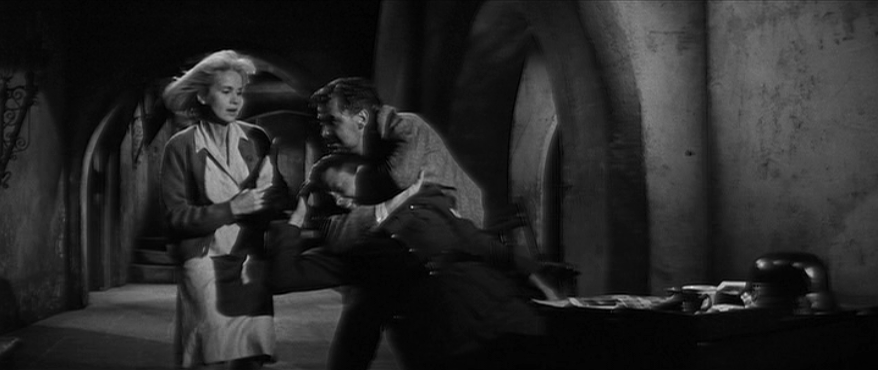
(1956) Starring Joseph Cotten, Rhonda Fleming, Wendell Corey. Directed by Budd Boetticher. Screenplay by Harold Medford. Based on the novelette The Killer Is Loose by John and Ward Hawkins in The Saturday Evening Post (13 Jun 1953). Producer: Robert L. Jacks Run time: 73 minutes. Black and White. USA Drama, Police, Suspense, Film Noir

In 1953, when Twentieth-Century Fox bought the rights to John and Ward Hawkins’ story The Killer is Loose, they intended to have Orson Welles and Victor Mature star with plans to start shooting in October. Those plans went awry, as that film was never made. In 1954, Robert Goldstein and Robert L. Jacks purchased the rights from 20th Century for their independent production company Crown Productions. Rather than Orson Welles, Wendell Corey got the lead and Joseph Cotton got the role originally meant for Mature.

Saturday, November 14, 2020

Stubs - The Third Man


The Third Man (1949) Starring: Joseph Cotten, Valli (Alida Valli), Orson Welles, Trevor Howard Directed by Carol Reed. Screenplay by Graham Greene. Produced by Carol Reed. Run time: 105 minutes. UK/US Black and White Suspense, Film Noir

After World War II, Vienna, Austria, like Berlin, was sub-divided into zones controlled by the Allied Forces: the US, the UK, the USSR and France. It is in this divided city that the film The Third Man takes place. The city is described in the film’s opening narration, as read by Carol Reed, as “in the classic period of the black market. We'd run anything if people wanted it enough and had the money to pay. Of course, a situation like that does tempt amateurs but, well, you know, they can't stay the course like a professional.”

Saturday, November 3, 2018

Stubs - Conflict


Conflict (1945) Starring: Humphrey Bogart, Alexis Smith, Sydney Greenstreet, Rose Hobart, Charles Drake, Grant Mitchell, Patrick O'Moore, Ann Shoemaker, Frank Wilcox, James Flavin Directed by Curtis Bernhardt. Screenplay by Arthur T. Horman and Dwight Taylor. Produced by William Jacobs. Run Time: 86 minutes. USA Black and White, Suspense, Mystery, Film Noir

Humphrey Bogart may arguably be the greatest star from Hollywood’s studio years, but like many other actors, he didn’t always get to make the film he wanted to. Case in point, Conflict (1945). Bogart did not like the script so much that he had to be threatened, by Jack L. Warner with suspension if he didn’t appear in the film. Bogart’s protest went so far that he didn’t report to work when ordered to on May 3, 1943. However, when production did begin on June 15 of that year, he was on set and ready to go.

Production lasted until August 25, 1943, but the film was not released until June 30, 1945, nearly two years later. The cause was a lawsuit filed over the story which delayed the film’s release. Warner Bros. must have been so concerned that they put into production a very similar story called The Two Mrs. Carrolls that went into production in April 1945 with a similar plotline and starring Bogart and his co-star here, Alexis Smith in similar roles. That film would also get shelved for two years, not getting a release until May 24, 1947. By then, Bogart was a romantic lead.

Conflict, originally called The Pentacle, opens with a handwritten note from Dr. Mark Hamilton (Sydney Greenstreet), a friend and psychologist, reminding Kathryn (Rose Hobart) and Richard Mason (Humphrey Bogart) that they’re going to be celebrating their fifth wedding anniversary at his house.

As they're getting ready for their anniversary party, Kathryn (Rose Hobart)
confronts her husband Richard (Humphrey Bogart) about his fascination with her sister Evelyn,

But all is not happy between the couple and it flares up as they’re getting ready for the party. Kathryn is a bit of a nag but that seems to roll off Richard’s back. However, their real bone of contention is that Kathryn thinks Richard is in love with her younger sister, Evelyn Turner (Alexis Smith). The two quarrel about that but do go to the party together.


Richard hangs on every word Evelyn says at the party.

Evelyn is at the party and just as Kathryn predicts, Richard hangs on her every word. Meanwhile, during a discussion of psychology, Hamilton explains that a thought can be a malignant disease and it is his job to help a patient get rid of that thought. He adds that love, not money, is the root of all evil. His job, he explains is to help a patient get rid of that thought.

Also at the party is a young professor, Norman Holsworth (Charles Drake) who is interested in Evelyn and whom all the other partygoers encourage their coupling, that is everyone except Richard.
The Masons and Evelyn leave to drive home in a driving rain. Kathryn tells Evelyn that their mother wants her to return home as soon as possible. Richard, who doesn’t want Evelyn to leave, loses control of the car and crashes. While Kathryn and Evelyn come through with only minor injuries, Richard suffers a broken leg.

Richard and Kathryn give Evelyn (Alexis Smith) a ride home that ends in an accident.

By the time Richard’s leg should be healed, he insists that he cannot stand on it or walk. Dr. Grant (Grant Mitchell) tells Richard that it is all in his head. He recommends swimming in warm water, which leads Richard to suggest to Kathryn that they go to a mountain resort. 

Dr. Grant (Grant Mitchell) doesn't understand why Richard can't walk.

On the day that they are to leave, Richard’s work, he owns an engineering company, prevents him from leaving but he encourages Kathryn to go ahead without him, promising to join her the next day, even if it means recalling their butler Phillips (Edwin Stanley) back from his own vacation.

Business prevents Richard from leaving with Kathryn on their vacation.

On her way out of town, Kathryn stops at Dr. Hamilton’s house. He’s out gardening and presents her with one of his prize roses. She asks him to check-in on Richard in the morning, since he has work to do. The good doctor agrees and then puts the rose into her suit coats buttonhole.

The mountain road is winding and it doesn’t help that the fog has come in as well. She takes a particular road and several miles from the lodge, there is a car blocking the road. There is a man standing to the side of the road in the shadows. Kathryn is about to back up and go the other way when Richard steps out and calls her name. Kathryn is both happy and scared to see Richard there.

Richard waits in the shadows for Kathryn on a mountain road.

While we don’t actually see him do it, it is clear that Richard kills her. After gathering up some of her things that had fallen out of her purse, Richard releases the brakes on her car and pushes the car down a steep ravine. As the car rolls back, it hits a neatly stacked row of logs, which follow the car over the edge and crush it under the weight.

Having killed Kathryn, Richard releases the brake on her car and pushes it over a cliff.

Richard establishes his alibi by meeting with a business associate, Robert Freston (Frank Wilcox) and feigning to worry about Kathryn calling the lodge several times during the night.  Dr. Hamilton telephones as Kathryn had asked him to do and when Richard tells him that she is missing, the doctor suggests calling the Highway Patrol. When he gets off the phone, he calls the police to institute a search.

Dr. Hamilton (Syndey Greenstreet) listens to Richard tell the police everything
 he remembers about the last time he saw Kathryn.

Dr. Hamilton is present when the police come to Richard’s house. Richard remembers great details about how Kathryn was dressed, from the color of her suit to the rose she wore on the lapel of her jacket. A highway patrolman comes by to say they’ve found nothing, even that they searched both roads leading up to the mountain resort.

Evelyn and Richard listen to a hobo explain how he ended up with Kathryn's ring.

Richard also notifies Evelyn, who comes to stay with him while he waits for news on Kathryn. While having dinner with the omnipresent Dr. Hamilton, the police call to say that they have arrested a hobo who had tried to pawn Kathryn’s distinctive cameo ring. Richard, Evelyn and Dr. Hamilton head down to police headquarters and hear the hobo’s tale about getting the items through pickpocketing a woman’s purse. The woman he describes sounds very much like Kathryn.

Back at the house, Richard smells Kathryn’s perfume in their bedroom and discovers her key to their safe on his desk. He opens the safe and finds her wedding ring inside. This prompts him to frantically call the police.

Richard and Evelyn relax up at the lake.

Dr. Hamilton suggests that Richard and Evelyn accompany him to the mountains for some fishing. Richard is happy to be there with Evelyn but Hamilton also invites Professor Norman Holdsworth to join them.

The operator tells Richard that she thought the caller said she was Mrs. Mason.

While having dinner with Dr. Hamilton, Richard is called away to take a phone call. The operator insists that she tells him is from Mrs. Mason, however, when he picks up the phone, there is no one there.

Norman Holsworth (Charles Drake) proposes to Evelyn who turns him down.

Meanwhile, Norman proposes to Evelyn but she turns him down. While they're talking, Richard interrupts them accidentally, on purpose.


Richard tells Evelyn how she feels about her. She doesn't feel the same.

Later, Richard tells Evelyn how he really feels about her. He insists that she rejected Norman because she returns his love, which Evelyn vehemently denies.

Richard goes through his mail and finds a pawn ticket in an envelope from his dead wife.

Richard returns to his office for a day, where his personal mail is waiting for him. There is a letter addressed in Kathryn's handwriting, which he confirms by comparing it to an autographed photo of her on his desk.  Inside the envelope is a pawn ticket He takes the ticket to a pawnshop, where a tall clerk (Oliver Blake) assists him in finding Kathryn's gold locket. In the ledger is Kathryn’s signature.  But the broker refuses to give him the locket since he’s not the one who pawned it.

At the pawnshop, clerk (Oliver Blake) shows Richard Kathryn's signature in the ledger and the locket she pawned.

Richard goes to the police and takes one of the detectives back to the pawnshop. However, the locket is no longer in the case, and the pawnbroker (Harlan Briggs) denies Richard's story. When the police don’t prove to be any help in finding his wife, he hires, at Dr. Hamilton’s insistence, a handwriting expert, who will verify if the writing on the envelope belongs to his wife.

Dr. Hamilton helps Richard find a handwriting expert who verifies its is Kathryn's handwriting.

Back at the resort, Richard finds Evelyn is ready to go home to her mother. He insists on driving her to the train station. As they are pulling out of the resorts parking lot, a bellhop runs out to tell Richard that he has a phone call. Returning to the lodge he takes a call from Dr. Hamilton who confirms that the handwriting belongs to Kathryn. Dr. Hamilton tells Richard that Kathryn must still be alive. 

Richard seems devastated by the news. On the way back to the car, he runs into Holdsworth, who is shaken by Evelyn’s refusal to marry him. Richard encourages him to try again, telling him that he’ll find Evelyn out in his car.

Back in town, while buying suitcases, an action never explained, Richard sees a woman through the shop window who looks a lot like Kathryn and follows after her.  Slowed by his cane, he can never make up the ground between them and she disappears into an apartment house. He follows her to the unit, flat, that she went into but no one answers his knocks.  The owner (Mary Servoss) of the apartment building informs him that the flat is empty and unrented. She gladly shows it to him upon his request. After searching every closet and room, Richard turns on her but she feigns not to know about the woman he saw enter.

From there, thinking he’s going mad, Richard goes to Hamilton's office to seek advice. The doctor tells him that there is nothing he can do for him.

Richard returns to the scene of the crime.

Now distraught, Richard drives back to the scene of the crime. The pile of logs is still on the car, so Richard climbs down the mountain. While searching with a flashlight, he hears Dr. Hamilton tell him that Kathryn’s not here. With the doctor are the police and Richard is arrested for Kathryn’s murder. Richard seems relieved that the ordeal is over.

Dr. Hamilton and the police have worked together to gaslight Richard into confessing to the crime.

Dr. Hamilton explains that he knew Richard was lying from the start when he said Kathryn was wearing a rose when she left the house since Hamilton had given her after she’d left. The police found Kathryn's body the day after the murder, but because there was no proof of Richard's guilt, they agreed to stage Hamilton's trap and let Richard's own fears prove his guilt.

This film, like so many other film noirs, is flawed. Dark storylines and deep shadows don’t make up for the problems that are apparent in Conflict. To begin with, there are problems with the story. Not only is a little hard to believe that Richard could get ahead of Kathryn on the mountain road or know for sure which route she was going to take. Also, he has to get back home before everyone else to set up his alibi, which is another time defying feat.

Richard would have to know there is no guarantee that he could actually kill her by strangulation. I’m not sure why Kathryn couldn’t have driven away or run away from him, after all, he is burdened with a cane. The only way he could have been certain to kill her would be to shoot her which we’re lead to believe he doesn’t do.

Also, it is hard to believe the police would go along with Dr. Hamilton’s gaslight scheme, which itself is a little far-fetched especially since Richard could have just skipped out of the country rather than play along.

And why would Richard, who had thought everything out, give himself away by bringing up something he must have known Kathryn wasn’t wearing when she left the house? Agreed, he wouldn’t have necessarily known she’d gotten the rose from Dr. Hamilton but if he was so careful why give himself away so easily?

I can see why Bogart was reluctant to play the lead in this film. He must have felt he had moved past these sorts of roles, especially having made it to romantic lead in Casablanca (1942). He shows his disdain by sort of sleepwalking through the role. It doesn’t feel like you get a fully engaged Bogart here.

Alexis Smith has very little to do as Evelyn except to look pretty. There isn’t much more to her character than that. There were better roles for her to come.

Sydney Greenstreet almost made a career out of playing opposite of Humphrey Bogart on film having appeared in The Maltese Falcon (1941), Across the Pacific (1942), Casablanca (1942), Passage to Marseille (1944) and this film a year later. Greenstreet has been better as well.

All that said, there are a couple of really good images in the film. I’m thinking of the image of Richard standing off the road in the trees and the fog. It is an iconic look with Bogart in trench coat and fedora. And there is the car accident itself, which I don’t believe I’ve seen depicted this way before on film. Very visceral for the viewer.

The car crash in the film is very visceral.

But those few bright spots aren’t enough to save the film. If you’re a Bogart fan, like me, you want to see everything he’s ever made but this sort of feels like a step backward for the famed actor in his career. If you want to see Bogart and Greenstreet together, their other collaborations are much better.

Be sure to check out our Film Noir Review Hub for reviews of other films in this genre.

Saturday, November 25, 2017

Stubs - 36 Hours


36 Hours (1965) Starring James Garner, Eva Marie Saint, Rod Taylor, Werner Peters, John Banner, Russell Thorson, Alan Napier Directed by George Seaton. Screenplay by George Seaton.  Based on the short story "Beware of the Dog" by Roald Dahl in Harper's (Oct 1944). Produced by William Perlberg. Runtime: 115 minutes. USA War, Drama, World War II, Suspense

Roald Dahl is not a name you usually associate with war and suspense, but World War II affected everyone, Dahl included. His short story “Beware of the Dog”, originally published in Harper’s Magazine in 1944, tells the story of an RAF pilot, Peter Williamson, who gets shot down over Vichy France, but wakes up in a hospital bed in Brighton, or so he thinks. He becomes suspicious of his surroundings, finally figuring out that he is still in Vichy France and that his English caregivers are actually Germans in disguise.

Dahl is best known for his children’s books Charlie and the Chocolate Factory, The Witches and James and the Giant Peach, all of which were also made into successful movies, some more than once. But he was actually in the RAF during the war. After he was injured on duty, he was transferred to Washington D.C. in 1942, where he worked as an Air attaché and began his writing career recounting his War experiences.

James Garner was a television star first. After leaving the US Army in 1952, he began acting. He played a non-speaking role in the Broadway stage version of The Caine Mutiny Court-Martial, letting him observe Henry Fonda on a daily basis. After that, he moved to television. According to his autobiography, Garner claims that he was almost the lead in the TV series Cheyenne, but when the casting director couldn’t reach him in time, the role went to Clint Walker.

After a couple of years, Garner landed his own starring role on TV in Maverick (1957-1960) but left after three seasons. He appeared in the film Darby’s Rangers (1958) after Charlton Heston turned down the lead. He was subsequently hired by Warner Bros. to appear in such films as Up Periscope (1959) and Cash McCall (1960). After leaving Warner Bros. he starred in such films as The Children’s Hour (1962) opposite Audrey Hepburn and Shirley MacLaine; Boy’s Night Out (1962) with Kim Novak and Tony Randall; and Move Over Darling (1963) a remake of My Favorite Wife (1940), playing the role created by Cary Grant, an actor to which Garner is often compared. Other roles in such films as The Great Escape (1963) and The Americanization of Emily (1964) followed.

By 1965, Garner had formed his own production company, Cherokee Productions, and one of the movies that company made was the adaptation of the Dahl short story, now called 36 Hours. With George Seaton writing the screenplay and directing, the film was shot on location in Portugal, Germany and Yosemite National Park, where most of the film was shot. Exterior shots were filmed at the Wawona Hotel near the entrance of Yosemite.

The Wawona Hotel in Yosemite doubles for the U.S. Army hospital in 36 Hours.

A few days before D-Day, with the plans finalized for the invasion at Normandy, Allied troops are concerned that the Germans might be onto their plan, even though Nazi troops are currently concentrated at Pas de Calais, where they anticipate the invasion will take place.

In order to check that out, his commanding officer, General Allison (Russell Thorson), and British Colonel Peter MacLean (Alan Napier) decide to send U.S. Army Major Jeff Pike (James Garner) to Lisbon on June 1st, 1944 to meet with an informant in the German consulate there. This is a contact that Pike has developed over the years and one only he knows how to read. Pike has been in on General Eisenhower's final briefing on the landings, but has been trained to withstand torture. Before he leaves, he suffers a papercut when he touches the edge of one of the maps hanging on the wall.

Pike is sent over on the midnight flight, which has been delayed an hour so that Pike can be on it. His departure is witnessed by an informant, who notifies another agent, an elderly British woman, who goes into Pike’s apartment and steals some personal items as well as hair from his brush.

When he lands in Portugal, Pike makes sure that his presence is known and that the German informant is notified. But at the rendezvous, which takes place at a café, Pike is drugged and while making his way to the meeting, becomes disoriented and eventually passes out on the street. However, the Germans abduct him and, putting him in a coffin, manage to fly him back to Germany.

The Nazis under the supervision of Dr. Walter Gerber (Rod Taylor) and with the help of nurse Anna
 Hedler (Eva Marie Saint) alter 
U.S. Army Major Jeff Pike's (James Garner) appearance.

While they keep Pike sedated, they “age” him, dying his hair with gray highlights and giving him drops to temporarily make his eyesight bad to the point where he needs to wear glasses to read. It is obvious that they know a lot about him.

Pike is helped back to bed by Dr. Gerber and nurse Hedler.

When Pike wakes up it is what looks like a U.S. Army hospital. He is told it is May 1950 and he is in post-war Occupied Germany. Psychiatrist Major Walter Gerber (Rod Taylor) explains that Pike has been having episodes of memory loss ever since he was tortured by the Nazis in Lisbon. He advises Pike that his blocked memories have always resurfaced, helped along by a therapy of remembering events prior to Lisbon and then pushing forward into the blank period.

Dr. Gerber explains to Pike the issues he's having with amnesia and how he can help him.

Various props including captured U.S. Army jeeps and uniforms, soldiers playing baseball, fake letters from Pike’s father, made up newspapers and fake radio broadcasts, are used to carefully convince Pike that the year is 1950 and that he is among fellow Americans. He is cared for by Anna Hedler (Eva Marie Saint), a nurse the Nazis have temporarily saved from a concentration camp.

Pike comes to believe that Anna is not only his nurse, but is also his wife.

Pike is completely taken in by the deception, even believing that Anna is his wife. She’s wearing an engagement ring that is, in fact, a family heirloom. Gerber, who pretends to be a close friend, even introduces Pike to SS agent Schack (Werner Peters), who he’s told runs a restaurant in a nearby village that Pike and Anna frequent. Pike apologies for not knowing him. As part of his "therapy", he recounts the critical details of the invasion plans, including the location and the date, June 5, to his eager listeners.

Pike starts to figure out the ruse when he realizes he has a paper cut he suffered a few days before.

While cleaning up from dinner, Pike gets salt in a nearly invisible paper cut he got the day he left for Lisbon. He realizes then that it is all a hoax. He tries to escape by riding a bicycle out the front gate. When the guard stops him, Pike confirms it by tricking him into reflexively snapping to attention in the German manner. He violently confronts Anna, who admits, with her neck in his grip, that the date is indeed June 2, 1944. She was recruited from a concentration camp because she was a nurse and spoke English. When pushed, she promises to help him.

Pike instructs Anna to run and tell Gerber that he was onto the plot, while he makes a feeble attempt to escape to sell it. Quickly recaptured, he states that he realized what was going soon after waking up due to his paper cut. Gerber does not believe him. After two days of interrogation, however, Pike and Anna convince SS agent Schack, who never believed the hoax would work. Pike pretends that the invasion will be at Pas de Calais and provides detailed plans, including code names. This information confirms what Schack and German high command believe, which is corroborated by counter-intelligence misinformation that has been fed to Nazi undercover agents by the British.

Pike is interrogated for two days by a German SS officer.

Gerber, however, sets the clock forward in Pike and Anna's room so when they wake, they think it is the morning of June 5. Gerber tells them that the Germans have been surprised at Normandy. Pike lets his guard down and confirms that the plan worked. Gerber comes clean about what he’s done and then tells Pike that there has been no invasion, most likely because of the rain that is taking place all over Europe. Gerber then tells Pike what he has to do and sends an emergency dispatch to Wehrmacht authorities, but since that doesn’t agree with the high command, Pike’s message is discarded. By midday June 5, Gerber has been discredited and Schack orders his arrest.

Gerber knows that when the Allies land at Normandy, Schack will kill them to cover his own blunder. Gerber, who feels like he knows Pike from his research, decides to help them escape. But he asks Pike to take his groundbreaking research on amnesiacs with him, hoping that he will live on through his work. When the Normandy landings begin on the morning of June 6, he laughs at Schack when he arrives, revealing that he has taken poison and pointing out that Schack will likely be liquidated.

Gerber helps Pike escape by giving him the key to his door.

Meanwhile, Pike and Anna make their escape, killing a guard on the way out. They find a place to hide nearby and after the location is searched, Anna tells Pike about how she doesn’t like being touched. She recounts her repeated rapes at the concentration camps and that she is cried out. Pike tells her that there is no love without tears.

Pike breaks the neck of one of the German guards so he and Anna can escape.

They take Gerber’s advice and head for a village on the border with Switzerland where they know a minister helps people to cross. The problem is that Schack knows that, too and pursues the escapees on his own, no time to wait for backup.

The minister's housekeeper, Elsa (Celia Lovsky), puts Pike and Anna in touch with Sgt. Ernst
(John Banner), who will sneak them over the border to Switzerland.

When Pike and Anna arrive, they are greeted by the minister’s housekeeper, Elsa (Celia Lovsky), who agrees to hide them. She introduces them to a jovially corrupt German border guard, Sgt. Ernst (John Banner). Ernst, who has been learning English since the war began, believes that the Nazis are eventually doomed. While he’s willing to help Pike and Anna, he requires payment. Ernst is only interested in gold, which is one thing the Nazis have taken away for the war effort. Anna, who is still wearing Pike’s engagement ring and another wedding band, has to give them to Ernst and Pike gives him his watch. Elsa is infatuated with the engagement ring and Ernst gives it to her.

Ernst demands gold jewelry to aid in their escape.

Schack shows up at the minister's after Ernst and the couple have left for the border, but he recognizes Anna's ring on Elsa’s finger and forces her to reveal their planned escape. Schack catches up at the border and has the drop on Pike and Anna, but before he can kill them Ernst shoots and kills him. He then, with Pike’s help, arranges Schack’s body to make it look as if he had been killed while trying to escape.

Pike and Anna head off to freedom in Switzerland.

Safely in Switzerland, Pike is to go to the U.S. Embassy and Anna to a refugee camp. Pike promises to look in on her before he returns to London. When they are placed in cars next to one another, Anna cries her first display of emotion in years.

Released in January 1965, in New York on January 28, the film went on to make $2.2 million in domestic box office and was enough of a success to cement Garner as a movie star. Clearly the star, Garner is a likable actor and his character is also likable. You find yourself rooting for him and Anna as well. Pike is such a good man that when he accidentally drops Gerber’s research as they’re trying to escape, that even though it might make them miss the rendezvous, he goes back to retrieve it. Truly a man of his word.

Eva Marie Saint began her career in television as an NBC page. She did get in front of the camera as early as 1946, appearing in Campus Hoopla on that network. She made her film debut in On The Waterfront (1954), which she won the Academy Award for Best Actress in a Supporting Role. Saint would appear in Raintree County (1957), Alfred Hitchcock’s North By Northwest (1959), Exodus (1960) and All Fall Down (1962) before appearing in 36 Hours. An accomplished actress, Saint gives a believable performance as a concentration camp survivor who will do anything, even help the Nazis, to avoid that fate.

Rod Taylor had a very two-dimensional supporting role in this film. He is as likable as a Nazi has been depicted on film, but there is always the loyal soldier in the background. He might like who Pike is, but Pike is still the enemy. Even if no one will believe him, his Gerber character has to try until there is no hope. Gerber is as much of a realist as SS Agent Schack claims to be.

One of the added values of watching the film is to see future television stars who seem to be everywhere in this film. Not only had Garner been a TV star before getting into films, he will eventually go back to that medium and star in the long-running Private Investigator series, The Rockford Files (1974–1980). Alan Napier would go on to portray Alfred Pennyworth, Bruce Wayne’s butler in TV’s Batman (1966-1968), a role he would be known for to the Baby-Boomer generation. James Doohan who would go on to play Scott “Scotty” Montgomery on the original Star Trek series (1966-1969) as well as the films that would follow.

But of all of these actors, the one who went on to play a very similar character on TV was John Banner. Here he provides some comic relief as Sgt. Ernst, an out for himself German border guard. In some ways, this is a blueprint for his role as Sgt. Schultz on TV’s World War II inspired comedy, Hogan Heroes (1965-1971).

The film takes an interesting approach, letting the audience know what is happening to Pike when he doesn’t know. We see the Nazis’ scheming and planning and have to wait for him to catch on. It’s always the little things that come into play. If he hadn’t cut his finger on a map, then they may have well gotten away with their ruse. We wait for him to figure it out and how he can try to correct his mistake. It helps him that the Nazis don’t trust one another while trying to stay loyal to their mistaken high command. By this point in the war, the Nazi regime’s days were numbered, but they didn’t really know it quite yet, though some like Ernst were just waiting for the day to come. The film reminded me of the television series Mission Impossible (1966-1973), when the team led by Jim Phelps regularly pulled off the kind of ruse the Nazi’s are trying to do here.

One problem I have with the film, and it is only through analyzing it that I caught this, the hero doesn’t solve his own dilemma. When Pike and Anna are caught dead to rights by Schack, it is Ernst who saves them, rather than Pike or Anna figuring a way out of the life or death situation they find themselves in. Ernst kills Schack to save his own hide, figuring Schack would put an end to his smuggling operation and to Ernst himself. Pike and Anna are the beneficiaries of Ernst’s actions, but they don’t take action themselves.

That said, overall I liked the film and would recommend it. No film is perfect, but that doesn’t mean you shouldn’t watch them. 36 Hours may not have you on the edge of your seat, but it is well-acted and with a well thought out and unique storyline for the time it was made.

Saturday, January 21, 2017

Stubs - Dial M for Murder


Dial M for Murder (1954) Starring: Ray Milland, Grace Kelly, Robert Cummings, John Williams. Directed by Alfred Hitchcock. Screenplay by Frederick Knott. Based on the play Dial M for Murder by Frederick Knott (London, 19 Jun 1952). Produced by Alfred Hitchcock. Runtime: 105 minutes. U.S.A. Color 3-D Mystery, Crime, Suspense

While 3-D is now a fairly common medium, last year over 30 films were released with either real or fake 3-D, the process really dates back to the 1950s, when the Hollywood studios were looking for anything to put people in theater seats after the emergence of television. Then it was used more as a novelty and the experimentation was short-lived.

But following the success of House of Wax (1953), studios like Warner Bros. were eager to jump on the bandwagon. While you wouldn’t think of Alfred Hitchcock as a prime candidate for making a 3-D film, the studio saw it differently.

The film is based on the very successful stage play by Frederick Knott, which originated on BBC television in 1952 before moving to a West End stage and eventually to Broadway. But before the stage version opened, Sir Alexander Korda bought the rights for $2800 and later resold them to Warner Bros. for $75,000. There was a provision in the contract that delayed any film version’s release until after the stage plays had closed. Dial M for Murder did not close until February 27, 1954, which forced Warner Bros. to delay some of their press previews.

Hitchcock had just finished I Confess (1953), a film noir starring Montgomery Clift, Anne Baxter, and Karl Malden and was planning to make The Bramble Bush, based on the 1948 novel by David Duncan.

At the time, Hitchcock was in a partnership with Sidney Bernstein called Transatlantic Pictures. But there were problems with the script (aren’t there always), problems with the budget and problems with the partnership. After Hitchcock’s Rope (1948) and Under Capricorn (1949), neither of which were big successes at the box office, a third film, Stage Fright (1950), was planned as a Transatlantic film, but was taken over by Warner Bros. When The Bramble Bush couldn’t get off the ground, the partnership was dissolved.

Even though the playwright is credited with the screenplay, there were some subtle changes made. As an example, one character’s name was changed from Max to Mark. However, for the most part, the film stays very faithful to the play.

While Anthony Dawson and John Williams were retained from the Broadway production to reprise their roles, the main leads were changed. Replacing Maurice Evans as Tony Wendice was Ray Milland, an actor best remembered for his role as an alcoholic writer in The Lost Weekend (1945), for which he would win an Academy Award.

Rather than Gusti Huber, the role of Margot Wendice would be played by Grace Kelly. Kelly was an actress who had only appeared in three prior films including High Noon (1952) and Mogambo (1953) but had already garnered an Academy Award nomination. While 1954 would be a breakthrough year for her as she would appear in five films, including two for Alfred Hitchcock, Dial M for Murder and Rear Window, it would also be one of her last. She would only appear in three more films before marrying Prince Rainer III of Monaco and gave up Hollywood as a result.

And finally, Max Halliday, renamed Mark Halliday, would be played by American actor Robert Cummings, who had already starred in Hitchcock’s Saboteur (1942). A year after this film, Cummings would star for four seasons in The Bob Cummings Show, also known in syndication as Love That Bob.

For those unfamiliar with the concept, the dial of a phone is shown behind the title.

The film never seems to shake the feeling of a stage play with almost all of the action taking place in the front room of the Wendices’ apartment in London. The film opens with Tony (Milland) kissing his wife Margot (Kelly). Over breakfast, Margot reads a notice in the London Times stating that American Mystery writer Mark Halliday was one of the passengers arriving that day aboard the ocean liner the Queen Mary.

Things look to be better between the Wendices, Tony (Ray Milland)
and his wife Margot (Grace Kelly), than they really are.

After some shots supposedly showing the liner arriving in port at South Hampton, Mark (Cummings) disembarks. Next time we see him, he’s involved in a passionate kiss with Margot. So far not a word of dialogue has been spoken. One of the strengths of Hitchcock is his ability to use visuals to help tell the story. After breaking off their kiss, Margot discusses with him why she changed her mind about leaving her husband, Tony.

Over drinks, Margot tells her former lover, Mark Halliday (Robert
Cummings), why she decided to stay with her husband.

Several months ago, when she had decided to leave him, Tony suddenly became more affectionate. He quit playing tennis and settled down. She never told Tony about Mark and doesn’t plan to. Now she’s convinced that Tony cares for her and won’t leave him even though she has a deep love for Mark, an American mystery and TV writer.

While they share a drink, Margot tells Mark that she’s burned all the letters he has sent her except one. “You know the one I mean,” she tells him. She tells him that she had kept that letter in her purse, that was until it was stolen one weekend in Victoria Station. While she was able to get the purse back after a couple of weeks, the letter was gone. But that’s not the end of her story. She tells Mark that she received a blackmail note with very specific instructions, but never got the letter back. Mark asks for, and she gives him, the two letters she’d received just ahead of Tony’s return from work.

Tony is aware of Mark’s visit but supposedly doesn’t know the relationship. They had made plans for the evening, including the theater and dinner, but now Tony tells them that he has to back out. His boss is going out of town and Tony has to complete a report before he does. As a consolation of sorts, Tony invited Mark to attend a stag party the following evening at his Club for a former tennis player. Mark is non-committal, but Tony insists and even tells Margot of their plans. Margot tries to encourage Tony to join them later and he tells her to call him and he’ll see.

Mark and Margot head out for a night on the town while Tony has to stay behind to work.

Once he’s alone, Tony calls a Captain Lesgate on the phone to inquire about a car that he has for sale. Tony invites Lesgate over under the guise of trying to negotiate a lower price for the car.

When Lesgate (Anthony Dawson) arrives it becomes clear that the two of them had been schoolmates at Cambridge. Tony even shows him a photo he has framed on the wall from a reunion where they shared the same table. (Also sitting at the same table is the director making his usual cameo.) Then known as C.A. Swann, Lesgate had been accused of stealing money from a dance treasury but managed to get the school’s handyman blamed for the theft. But Tony tells him he knows that Swann has become a petty thief and confidence man.

CA. Swann, now called Captain Lesgate (Anthony Dawson), thinks he come to sell a car to Tony.

Tony tells Lesgate that he married Margot for her money and retired from tennis when he feared that he might otherwise lose her. He became aware that she was keeping a letter from him in her purse. When he saw the opportunity to steal her purse, he did. After reading the letters, he sent her a couple of blackmail notes, but never followed through on them.

When Tony takes out the letter, which he carries in his own billfold, under the guise of showing it to Lesgate, he lets it fall to the floor. Being the gentleman, Lesgate reaches down to pick it up, but Tony is careful not to touch it himself.

Tony seems very proud of himself after getting Lesgate' fingerprints on Mark's love letter to Margot.

After reading the letter’s contents, Tony tells Lesgate he knew that he could lose out on his wife’s money and the lifestyle he had become accustomed to, so he decided to kill her. He further adds that he might have done it, too, but sitting in a pub in Knightsbridge, he saw something that changed his mind. When Lesgate asks “What did you see?”, Tony responds, “I saw you.”

Knowing about Lesgate’s shady past, Tony began to follow him around and found out of his many affairs and unpaid rents around town. Tony knows enough to manipulate Lesgate into committing the murder for him.

When Lesgate considers going to the police with Tony’s proposal, Tony tells him it would be Lesgate’s word against his. With Lesgate’s past, things could get dicey for him as landlords will come forward and Tony even tells him that he could make it look like Lesgate had stolen the handbag and was trying to blackmail the couple to get back the letter.

Tony has been setting aside money in small amounts for nearly a year and has £1000 in small untraceable notes. He offers Lesgate £100 now and the rest when the job is done. He’s worked out the mechanics and tells Lesgate when to arrive (three minutes before 11pm) and how to get in (Tony will leave his latchkey under the carpeting over the fifth step in the hallway). Tony will leave his party under the premise to call his boss, but will instead call the house at 11. His wife, who will be in bed, will get up from the bedroom and cross over to the phone. After Lesgate has killed her he should whistle into the phone and then Tony will hang up and call his boss. Lesgate is then to take a suitcase and throw some of Tony’s trophies in it to make it look like an interrupted robbery, but to leave instead.

Lesgate thinks about it, finally picking up the £100 to show he’s in on the plot, sealing his fate.

The next night, when the crime is supposed to happen, Margot nearly derails things when instead of listening to a Saturday night show on the radio she wants to go see a movie. Tony can’t have that and guilts her into staying home and putting his tennis clippings into a scrapbook. Before he leaves, he manages to steal her latch key from her purse. On the way out, he manages to sneak it into its hiding place on the stairs.

Later, following orders, Lesgate uses the key to unlock the door and puts it back where he found it. He enters the apartment and waits. And waits. And waits.

Meanwhile, at the banquet, Tony looks down at his watch and he has about twenty minutes to go before he needs to make his call. But unbeknownst to him, his watch has stopped. He doesn’t figure this out until he looks again and the time hasn’t changed.

Tony wonders about the time so he can set his alibi in motion.

Back in the apartment, Lesgate is getting anxious and is starting to rethink the circumstance. When Tony does figure it out, he is delayed further by someone else using the phone. Several minutes late, he manages to make the call. Lesgate hears the phone and gets back in place behind the drapes to wait.

Margot, as planned, comes out of the bedroom to answer the phone. But Tony doesn’t say anything at first. Lesgate is apprehensive and waits until he has a clear shot. Then he wraps his scarf around her neck and tries to strangle her, while Tony waits on the other end of the phone. It is the last thing that goes according to plan.

Lesgate waits for the right moment to strangle Margot.

Margot puts up a terrific fight and struggles. When she is forced down on the desk she reaches back for anything to thwart her attacker. Finding the scissors she’d been using with the clippings, she drives it into Lesgate’s back. It stops the attack as Lesgate struggles to find the handle. But instead he falls on his back, driving the scissors further into his back and killing him.

In the struggle, Margot stabs her assailant in the back with her scissors.

Margot picks up the phone and implores whoever is calling to call the police. Finally, Tony speaks. She tells him that she’s been attacked and the man is dead. Tony tells her to stay calm and not touch anything; he’s on his way home. Back at the table, Tony tells Mark that he needs to leave, saying Margot is not feeling well.

When he arrives at the apartment, Tony pretends to be protecting her from the police and sends Margot to bed before calling the police. While he’s waiting for them to arrive, he goes through Lesgate’s pockets and puts that key into his wife’s purse. He also puts the love letter from Mark where the police will find it. Then after finding the scarf, he lights it on fire in the fireplace. In its place he uses one of Margot’s hose which have been in her mending kit. It’s matching pair he hides under the plotter on the desk.

When Tony gets home, he rethinks his plan.

While the police are investigating the murder scene, Tony makes sure to expose the hidden hose when he puts out tea for the detectives. This leads to an investigation led by Chief Inspector Hubbard (John Williams). Tony instructs Margot to hide the fact that he didn’t tell her to call the police, to say she thought he would have called from the Club.

Chief Inspector Hubbard (John Willaims) is on the case.

During Hubbard’s interrogation, Margot makes what sound like conflicting statements. When it is determined that Lesgate must have entered through the front door, Tony claims to have seen Lesgate at the time Margot’s purse disappeared and that he must have made a copy. But Hubbard doesn’t believe this investigation because no latch key was found on the body. Hubbard concludes that Margot must have let him in and killed him over the blackmail.

In a Hitchcockian trial montage, which consists of a close up of Margot with varying light effects, she is found guilty and sentenced to death.

Margot's trial for murder is shown in minimalist fashion.

Several months pass and it is the eve of Margot’s execution. Mark shows up with a wild suggestion in order to save her; he confess to hiring Lesgate to murder her, that would make Lesgate’s murder one of self-defense. Mark tries to convince Tony that he would not be convicted for an uncommitted crime, but at the worse would have to serve a few years in prison. Tony refuses to play along, but Mark continues to weave a more involved story which mirrors the real events of the crime, including the idea that Tony was the one who stole her purse and took the letter. But Tony refuses, saying the police would never believe his story.

Just then, Hubbard shows up unexpectedly and Mark goes to hide in the bedroom. While he’s in there, he overhears Hubbard following up on some of Tony’s recent spending habits, which involve larger than normal payments. While he’s listening, Mark finds a briefcase Tony has hid in the bedroom. Inside, Mark finds the money Tony had intended to pay off Lesgate with and the source of the money he is now spending.

Just when it looks like Tony has convinced Hubbard he has nothing to hide, Mark comes forward with the briefcase, but Hubbard appears to be unconvinced that there is anything to the story. But before he leaves, Hubbard makes the point of telling Tony that he should pick up Margot’s things from the precinct, including her purse and some other possessions. He then exchanges his raincoat for Tony’s and leaves.

Later, when the apartment is vacant, Hubbard enters using Tony’s key. He is followed quickly by Mark. Hubbard tries but cannot get rid of Mark before plainclothesmen escort Margot inside. Hubbard makes her try her key in the door, but it doesn’t work. She is perplexed, asking if the lock has been changed. Hubbard intimates that he still needs proof of his suspicions and has the purse returned to the precinct. The three of them and the plainclothesmen wait for Tony to arrive.

Margot can't understand why her latch key doesn't work.

As they wait, Hubbard admits that he got the Home Secretary to let Margot out of prison, but intimates that he needs proof of his suspicions about Tony. He has one of his men return Margot’s handbag to the station. Later, Tony arrives, but has no key to get in; the key in his raincoat won’t work and he becomes aware that he has the wrong one. Hubbard watches from inside the apartment as Tony pieces everything together. Tony then goes to the police station and soon returns with Margot’s effects, including her handbag. When this key fails to open the door, Tony realizes that he took the wrong key off Lesgate on the night of the murder. He then checks under the carpet on the stairs, retrieves the key he took from Margot’s handbag and unlocks the door.

The 3-D effects in Dial"M For Murder are far from being over the top.

When he enters and finds Hubbard, Mark and Margot waiting inside, Tony acknowledges that Hubbard has correctly solved the case. Hubbard, rather proud of himself, goes to call the station.

Mark and Margot are reunited.

The film rarely gets beyond its play setting. Like the play, most of the action takes place in the front room of the Wendices’ apartment. While that can sometimes be claustrophobic, this film manages to avoid that by showing scenes at the Club where Tony and Mark are attending a banquet as Tony’s alibi.

While the film was shot in 3-D, there really is very little to show for it. The most noticeable use was when Hubbard finds Margot’s key still hidden under the carpeting on the staircase and holds it out for Mark to see. It seems like an odd mix of medium and director. On the surface, it doesn’t make sense now, but back then Warner Bros. was no doubt hoping to get as many miles as it could out of combining a top director with what was supposed to be the hottest technology. Hitchcock didn’t like the format and worked with it reluctantly. He found working in stereoscope limited his ability to exploit camera placement and angles.

But the 3-D boom was short-lived and by Dial M For Murder was released, the fad was practically over. Even the theater that premiered the film on May 18, 1954, the Randolph Theatre in Philadelphia, Kelly's hometown, switched to the flat 2D format the next evening, in what it said was a response to a low turnout and negative audience response to the 3-D print. Hitchcock was quoted as saying of 3-D, "It's a nine-day wonder, and I came in on the ninth day."

The acting for the most part is very good. It helps that two of the supporting actors, John Williams (Chief Inspector Hubbard) and Anthony Dawson (C. A. Swann/Captain Lesgate), had already played these roles on stage. While the leads may have been new to the roles, they were three very good actors.

Welsh-born Ray Milland had proven himself to be a more than capable actor in a career which dated back to 1929’s Piccadilly and had already won an Academy Award for his acting. He’s quite believable here as the husband who wants his wife dead, underplaying the role makes it so. Tony comes off as a cool character whether he’s planning her murder or giving up to authorities when he gets caught.

Grace Kelly may have been relatively new to the screen, but had begun her career at the age of 20, with appearances on the New York stage and on more than 40 appearances on live-TV back in the 1950s Golden Age of Television. Her move to film seems almost a natural progression given all the actors and actresses who had come before her. She garnered a lot of attention from one of her first screen appearances in High Noon (1951) and an Academy Award for her role in The Country Girl (1954).

Alfred Hitchcock liked working with Grace Kelly.

Kelly was a favorite of Hitchcock’s, appearing in two more films, Rear Window (1954) and To Catch a Thief (1955). The quintessential Hitchcock blonde, he would try, but never really find, a replacement for her in his future films, though he would try. Outrage in her principality over Kelly playing a kleptomaniac prevented her from starring in a fourth film for the director, Marnie (1962), a role which would ultimately go to Tippi Hedren.

Robert Cummings, a native of Joplin, Missouri, sort of got into acting as a second choice. His first love was planes and he had gone to the Carnegie Institute in Pittsburgh to study aeronautical engineering, but was forced out of school when his parents lost heavily in the 1929 Stock Market Crash. He went to study at the American Academy of Dramatic Arts in New York City because they paid their male actors $14 a week.

While he studied dramatic acting in school, Cummings was best known for his comedic acting both on the screen in such films as Three Smart Girls Grow Up (1939), The Devil and Miss Jones (1941), Moon Over Miami (1941), and The Bride Wore Boots (1946); and on television in his own sit com. But Cummings was also a capable dramatic actor as he demonstrates here. His character Mark almost borders on comedic relief as he makes up a story that exactly reflects how Tony had planned out the murder as if life were no stranger than fiction.

Dial M for Murder may not be one of Hitchcock’s most memorable films, but it does show that he’s capable of adapting someone else’s work. Usually the stories he made were his own or ones that he worked closely with a writer or writers on. While the mystery, suspense and the idea of committing the perfect murder are hallmarks of his work, it is missing the high concept that seemed to be a prominent feature of his films like Rear Window and North by Northwest (1959). The film sort of feels like a big screen version of the type of stories he would popularize on his own television show, Alfred Hitchcock Presents, which ran from 1955 until 1962. 

But even less than great Hitchcock means the film can be entertaining and that is the case with Dial M for Murder. Very much worth watching, but no need to watch it in 3-D.