Showing posts with label 1956. Show all posts

Saturday, November 4, 2023

Stubs - The Killer is Loose


The Killer is Loose
(1956) Starring Joseph Cotten, Rhonda Fleming, Wendell Corey. Directed by Budd Boetticher. Screenplay by Harold Medford. Based on the novelette The Killer Is Loose by John and Ward Hawkins in The Saturday Evening Post (13 Jun 1953). Producer: Robert L. Jacks Run time: 73 minutes. Black and White. USA Drama, Police, Suspense, Film Noir

In 1953, when Twentieth-Century Fox bought the rights to John and Ward Hawkins’ story The Killer is Loose, they intended to have Orson Welles and Victor Mature star with plans to start shooting in October. Those plans went awry, as that film was never made. In 1954, Robert Goldstein and Robert L. Jacks purchased the rights from 20th Century for their independent production company Crown Productions. Rather than Orson Welles, Wendell Corey got the lead and Joseph Cotton got the role originally meant for Mature.

Saturday, November 24, 2018

Stubs - While the City Sleeps


While The City Sleeps (1956) Starring: Dana Andrews, Rhonda Fleming, George Sanders, Howard Duff, Thomas Mitchell, Vincent Price, Sally Forrest, John Drew Barrymore, James Craig, Ida Lupino. Directed by Fritz Lang.  Screenplay by Casey Robinson. Based on the novel The Bloody Spur by Charles Einstein (New York, 1953). Produced by Bert Friedlob Runtime: 99 minutes. USA. Black and White. Drama Film Noir

One of the interesting things about Film Noir is that it is not really a genre but more of a sub-genre of films. This can lead to the label being applied to films that you might not, on the surface, think of as film noir; case study, While the City Sleeps.

Independent film producer Bert Friedlob bought the rights to Charles Einstein’s book The Bloody Spur, suspense thriller/detective tale, with the idea of making it into a film. The purchase and intention were announced in The Hollywood Reporter in May 1954. With a screenplay by Casey Robinson, the film went into production in June 1955. Originally called News is Made at Night, the film was originally set to be distributed by United Artists. However, Friedlob sold the film to RKO for a profit of $500,000. After a New York premiere on May 16, 1956, the film went into wide release on May 30.

The killer, Robert (John Drew Barrymore) sees his first target.

Set in New York City, like any good film noir, the film opens with a murder. While drugstore employee Robert Manners (John Drew Barrymore) is delivering a package to Judith Fenton’s (Sandy White) apartment, he sees that she is about to take a bath, so he surreptitiously unlocks her door, then hides outside. The building janitor, George Pilski (Vladimir Sokoloff), is there and plans to come back after she leaves on her date to finish his repair. He tells her that he can use his passkey.

However, as soon as he’s gone, Robert re-enters and strangles the young woman, leaving the message “Ask Mother” scrawled in lipstick on the wall.

The first victim, Judith Fenton (Sandy White).

When ailing media mogul Amos Kyne (Robert Warwick) receives word about the murder, he summons New York Sentinel editor John Day Griffith (Thomas Mitchell), newspaper photographer Harry Kritzer (James Craig) and Kyne wire services head Mark Loving (George Sanders). He also summons his favorite employee, former Pulitzer Prize-winning reporter and novelist Ed Mobley (Dana Andrews), who now headlines a television program on Amos’ local station. After chastising the men for failing to pick up on the story earlier, Amos instructs them to label the murderer “The Lipstick Killer” and for Griffiths to make the case front-page news.

Media mogul, Amos Kyne (Robert Warwick) orders his top three men, Kyne wire services head Mark Loving (George Sanders), Sentinel editor John Day Griffith (Thomas Mitchell), and the head of photography Harry Kritzer (James Craig) to get to the bottom of the woman's murder.

After the editors leave, Amos confides to Ed that he has made two big mistakes in his life: spoiling his only son, Walter (Vincent Price), and not convincing Ed to take over his business. When Ed demurs that he does not want power, Amos reminds him that spearheading media outlets allows free speech to flourish and aids democracy. Just before Ed is set to go on the air, Amos collapses and dies. Ed goes on the air and broadcasts the news of Amos’ death.

 Ed Mobley (Dana Andrews) prepping for his television show.

No sooner has his father’s body been removed than Walter, an immature playboy with no understanding of the media takes control of the Kyne empire. Walter only knows Kritzer and is only meeting the other three for the first time. When he’s alone with Ed, Walter reveals that he has no desire to run the business and plans to force Griffith, Kritzer and Loving to compete for the position of executive editor, the man who will make all the decisions while he takes all of the credit.

Amos' son, Walter (Vincent Price) takes over after his father's death.

Each man realizes that scooping the story of The Lipstick Killer will make him a frontrunner for the executive position, and so turns to his office allies to help him in secret. Loving calls in his girlfriend, fashion columnist Mildred Donner (Ida Lupino), who advises him to collaborate with reporter Gerald Meade (Ralph Peters).

Meanwhile, John approaches Ed, his former reporter, in the Blue Dell, the bar downstairs from the office. Ed refuses to take sides, but at home later, his girlfriend, Nancy Liggett (Sally Forrest) who is Loving’s secretary, urges him to help John, and he agrees after she promises to marry him.

At the same time, Walter invites his old friend, Kritzer, to dinner, unaware that he is secretly having an affair with Walter’s wife Dorothy (Rhonda Fleming). Kritzer hopes she will convince Walter to promote him to the new position.

Walter’s wife Dorothy (Rhonda Fleming) is having an affair with Kritzer.

Later that night, John learns that an arrest has been made and asks Ed to get the details from his friend, police lieutenant Bert Kaufman (Howard Duff). Bert allows Ed to see some of the interrogation of Pilski, whose prints were found in Judith’s room, but Ed quickly surmises that Pilksi is innocent.

At first, police think building janitor George Pilski (Vladimir Sokoloff) killed Judith.

After another murder is reported, and a Strangler comic book left by the killer is discovered at the scene of the crime, Ed and Bert surmise that it must be the same murderer. Together, they devise a plan to use Nancy as bait. The plan is for Ed to insult the killer on television in order to incite him into acting rashly.

A copy of a Strangler comic book is found at a murder scene.

Meanwhile, Meade learns about Pilski’s arrest and tells Loving that the janitor is The Lipstick Killer. At the office, when Loving tells John and Walter that he is going to print the story, John points out that they may be committing libel since it’s unproven that Pilski is the killer. Walter is embarrassed by his lack of understanding of the term libel, and Loving is forced to kill the story.

Robert watches Ed, who calls him a "mama's boy."

Not long after, Ed addresses the killer directly on his broadcast, which Robert happens to be watching at home. Ed’s description of him as a “mama’s boy” hits home and infuriates Robert, who lashes out at his mother (Mae Marsh) for treating him like a girl during his childhood.

Robert takes out his frustration on his mother (Mae Marsh).

Ed, Bert, John, and Nancy meet at the bar, where Ed informs Nancy that they must use her as bait to trap the killer. After she learns that plainclothesman Michael O'Leary (Edward Hinton) will follow her everywhere, Nancy reluctantly agrees to the plan. To further draw out the killer and alert him to Nancy’s existence, Ed announces their engagement in the newspaper.

Loving senses that he is losing the competition and solicits Mildred to entice Ed to their side. When she resists he tells her that they’re all adults and that it won’t matter to him in the long run. That night, she joins Ed at the Blue Dell and, after encouraging him to drink excessively, invites him home.

At the same time, in the apartment that Dorothy keeps for trysts with Kritzer, she informs the photo editor that if she does convince Walter to promote him, Kritzer must, from then on, answer to her.
Robert is sent to Dorothy’s to deliver liquor, and when he spots her, is inflamed with lust. He does not have time to jimmy the door lock, as Kritzer finishes the transaction before he can. Upon leaving, he spies Nancy’s name outside her apartment, which happens to be across the hall.

Robert watches as Mildred (Ida Lupino) coaxes Ed out of the bar.

He rings the bell but, getting no answer, races to the Kyne building and spies Ed and Mildred in the Blue Dell. He is there when Mildred finally encourages Ed to leave with her.

Mildred hopes to take a drunken Ed home with her.

Despite Ed’s drunkenness, his loyalty to Nancy keeps him from making love to Mildred. That doesn’t stop Mildred from telling the whole office, including Nancy, about their supposed tryst the next morning. Naturally, Nancy breaks up with Ed.

After clinching a lucrative television contract, Loving celebrates his coup and assumes he has won the contest.

Still trying to get back with her, Ed tricks Nancy into meeting with him and Bert at the bar. But she’ll have no part of it and storms out. Robert sees his opportunity but backs off when he sees Michael is trailing her.

Meanwhile, Ed and Bert deduce that the killer will seek a new stimulus and thinking he might strike regardless of Michael’s presence, rush to Nancy’s apartment.

Robert can't get Nancy to open her door for him.

Their thinking was right. Michael, thinking Nancy will be safe in her apartment, has gone to get a bite to eat. Robert tries again to gain entrance but the door is locked. When he knocks, Nancy assumes it’s Ed and refuses to open the door for him. Robert’s attention is drawn once again to Dorothy, who comes out of her apartment to see what the commotion is. Robert follows her into her apartment and starts to chock Dorothy, though her screams alert Nancy, who takes Dorothy into her apartment when she escapes Robert’s grasp.

Robert tries to strangle Dorothy (Rhonda Fleming).

Robert flees just ahead of Ed and Bert pulling up outside. From her window, Nancy points to Robert and they pursue him. Robert runs to the subway and when he’s too late to get on the next train, starts running down the tunnel instead. Ed takes chase and manages to capture him without getting killed.

With Robert under arrest, Ed calls John with the scoop. John, in turn, sends Mildred over to Nancy’s apartment to learn the identity of the latest victim who is using the alias “Mrs. Charles Smith.” Mildred, of course, recognizes Dorothy when she arrives at the apartment building and Kritzer.

Mildred discovers that "Mrs. Charles Smith) is really Dorothy.

Rather than getting the story, the three of them work out a scheme to blackmail Walter, who will no doubt want to avoid the public humiliation of his wife’s affair.

Meanwhile, back at the office, John is celebrating his triumph when Kritzer arrives and demands to talk to Walter.

John thinks that getting the story will get him the promotion.

Later, Ed and John commiserate in the bar over Kritzer’s victory. Nancy, sitting a few seats away, and Walter, who has just joined them, are surprised to hear Ed announce he is quitting, as he can no longer work for a man who puts his own interests above those of the business. When Ed gets up to leave, Nancy follows.

Walter watches on as Ed tells John what he thinks of Walter.

Days later, on their honeymoon in a hotel room in Florida, Nancy reads Ed an article reporting that Walter has fired Kritzer, appointed John executive editor and named Mildred as his “personal assistant.” She continues to read that Walter has announced Ed’s return to the paper, as managing editor, something Ed has not agreed or appears to want to do.

Suspecting that it is Walter when the phone rings, Ed throws his hat over the receiver.

Your first reaction after watching the movie is that it doesn’t seem to have been your usual film noir. It shares many of the same characteristics as the subgenre demands: crime, nighttime and people placed in danger but you might be wondering who is the femme fatale? You know, the beautiful woman leading the protagonist astray, using her sexual wiles as a siren song sending him into the rocks. Of the three beautiful women in the story, Dorothy (Rhonda Fleming), Mildred (Ida Lupino) and Nancy (Susan Forrest), Dorothy would be the closest to the normal femme fatale. Nancy is too pure and Mildred doesn’t seem to have any real loyalties. Dorothy, on the other hand, is willing to help Kritzer get what he wants from her husband but only as long as Kritzer knows she’s the real one in charge. Ultimately, however, Walter grows a pair and fires Kritzer from the top job. No telling what becomes of Dorothy.

Directed by Fritz Lang, the master German Expressionist filmmaker behind such films as Metropolis (1927) and M (1931), who became the “Master of Darkness” with his work on the Hollywood film noirs Moontide (1942), Hangmen Also Die (1943), Ministry of Fear (1944), The Woman in the Window (1944), Scarlet Street (1945), Cloak and Dagger (1946), Secret Beyond the Door (1948), House by the River (1950), Clash by Midnight (1952), The Blue Gardenia (1953), The Big Heat (1953), Human Desire (1954), and Beyond a Reasonable Doubt (1956). If I needed a director for a film noir, Lang would be on the shortlist, a very short list.

That said, I wouldn’t say While The City Sleeps is one of his best. Bosley Crowther, the New York Times’ movie critic at the time, would describe the movie as “more flamboyant than probable” and I would have to agree. The closest thing to the Kyne media empire would seem to have been Hearst’s with newspapers, and wire service, and it’s hard to imagine such an empire putting all its eggs in the basket of solving a terrible, though obscure, murder.

Crowther also closes his review stating that in the movie “the long arm of coincidence seems a lot stronger here than the arms of the law and journalism”, which is also true as well. Even though Dorothy’s apartment is only a place to meet her lover Kritzer since it is right across the hallway from another employee at the New York Sentinel, why did the affair take so long to come to light? Either sweet Nancy is truly aware of the affair and says nothing or else Dorothy and Kritzer are so secretive that Nancy is not the wiser. Neither seems plausible, though it is necessary for the film to work.

There is plenty of action, coincidental or not, and the film keeps up a pretty good pace throughout. While Robert’s motivation is somewhat similar to Norman Bates’ in Psycho (1960), sexual desire turns the delivery man into a murderer, his is not as clearly spelled out as Norman’s. It is clear there is something going on between Robert and his mother, but he is not crazy as Norman is portrayed. There is something psychological going on but the film never explores it.

The acting is pretty good but one would expect nothing less from this cast. Dana Andrews plays the world-weary Ed who really doesn’t have much at stake in solving the mystery. He is not one of the three men vying for the job that is at stake. He is only involved to help out a friend, John in his bid for the position. Andrews would team up with Director Lang again that same year in another newspaper-themed film noir, Beyond a Reasonable Doubt.

Thomas Mitchell is a good actor in almost any genre something he’s shown in the western, Stagecoach (1939), where he played the alcoholic Doc Josiah Boone; comedy-drama in Mr. Smith Goes to Washington (1939), not to mention the Christmas classic It’s a Wonderful Life (1946) to name only a few of his previous roles. He is good here, too, as John the news editor with bigger ambitions.

Vincent Price has not yet been typecast as the king of B Horror films. He carries off the role of the publisher’s spoiled son Walter Kyne, who has no interest in carrying on his father’s legacy. He is also blind to his wife’s infidelity with his best friend. Price is good in these type of roles, see Laura (1944) wherein he plays a similar character, Shelby Carpenter, a ne’er do well like Walter.

Ida Lupino’s Mildred is portrayed as a modern woman, with a career as a writer, unafraid to use sex to get what she wants. Though she fails to get Ed in bed, she does get the job done, at least temporarily wrecking Ed and Nancy’s relationship. Lupino was always a good actress before getting behind the camera as a producer and director beginning in the late 1940’s. No stranger to film noir, Lupino starred in such films as Road House (1948), Woman in Hiding (1950), On Dangerous Ground (1952), and Beware, My Lovely (1952) before directing one, The Hitch-Hiker (1953).

Rhonda Fleming gets credit, at least in my estimation, as the femme fatale, using sex to get what she wants from Walter but also from his best friend, Kritzer, the latter who would be under her control if he gets the job with her help. While we eventually know that Kritzer loses out, one has to imagine Dorothy gets through alright.

As for the rest of the cast, George Sanders is always a delight to watch, even, as in this film, the role doesn’t necessarily play to his strengths. It is interesting that the killer, John Drew Barrymore, comes from the great acting family, barely has any lines but is still a two-dimensional character. Sally Forrest’s character, Nancy, is a bit one-dimensional but there really isn’t more required from her. And Howard Duff is a versatile actor who does well with his role as Lt. Burt Kaufman.

Howard Duff plays Lt. Burt Kaufman in While the City Sleeps.

While the City Sleeps is a good, though, not great. You might not even realize you’ve watched a film noir, though it technically is. Fritz Lang has done better work but it’s hard to really complain. The film is entertaining and keeps a good pace throughout. You could do a lot worse.

For other noirs check out our Film Noir Review Hub. 

Saturday, January 27, 2018

Stubs - The Man Who Knew Too Much (1956)


The Man Who Knew Too Much (1956) Starring: James Stewart, Doris Day, Brenda de Banzie, Bernard Miles, Ralph Truman, Daniel Gélin, Mogens Wieth, Alan Mowbray. Directed by Alfred Hitchcock. Produced by Alfred Hitchcock. Screenplay by John Michael Hayes. Based on a Story by Charles Bennett, D. B. Wyndham-Lewis. Run Time: 120 minutes. USA Thriller

Throughout his long career, Alfred Hitchcock only remade one film, The Man Who Knew Too Much, one of his more successful British films and the one many credit with his long-running fascination with Thrillers. The remake was not initially his idea, but rather David O. Selznick’s, the producer Hitchcock was under contract to when he first came to Hollywood. Selznick bought the rights to the film. However, Hitchcock wasn’t ready to remake it until he was out on his own and under contract to Paramount Pictures. Then he looked at the remake as a way of fulfilling his contract with that studio.
And while he wanted to remake the film, he didn’t want it to be too closely similar to the original.

The writer, John Michael Hayes, who had worked with the director on such films as Rear Window (1954) and To Catch a Thief (1955), was not allowed to watch the original nor read the screenplay. Instead, Hitchcock told him the story and Hayes would outline the script from his notes. He had barely finished the first draft when production got underway.

For casting, James Stewart was a given as the father. The actor and director had worked together prior, in Rear Window, so there was already a familiarity. But Stewart represented a sort of everyman that Hitchcock wanted for his leading man and protagonist.

For the wife, Hitchcock had to fight for Doris Day for the mother. Best known as a singer, Day had appeared in Storm Warning (1951), a film noir thriller; a performance Hitchcock had seen and liked. But Associate Producer Herbert Coleman was not so sure. He suggested other actresses, including Lana Turner, Grace Kelly, and Kim Novak but eventually, Day was cast.

Production began on April 29, 1955, in Marrakech, Morocco. Riots broke out against the French protectorate that ruled the country and the production barely escaped Morocco before the French administrator was assassinated. Second unit photography had to rush their work as well, getting out of Morocco before Ramadan.

The production would move back to London, with shooting in and around the city, including The Royal Albert Hall. After that, the shooting returned to Paramount Studios in Hollywood, where it concluded on August 24, 1955.

The opening credits take place in Albert Hall, where the orchestra is playing Arthur Benjamin's "Storm Clouds Cantata"  which will later play a significant part in the film.
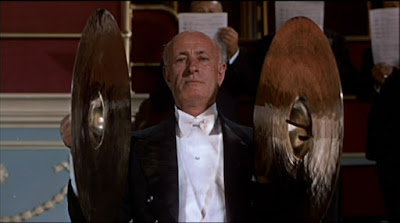
The cymbals are played at the climax of the piece.

After attending a medical conference in Paris, American physician Ben McKenna (James Stewart) takes his wife Jo (Doris Day) and son Hank (Christopher Olsen) to Casablanca, where he had been stationed during World War II and to Marrakech, Morocco. The film opens with the trio on the bus to Marrakech. Hank accidentally pulls the veil off a Muslim woman when the bus lurches, which angers her husband.

After rescuing Hank (Christopher Olsen), Louis (Daniel Gélin)
talks with Ben (James Stewart) and Jo McKenna (Doris Day)

Louis Bernard (Daniel Gélin), a Frenchman and fellow passenger, intercedes and calms the man down. For the rest of the bus ride, he questions the family, learning much about them, including that Ben is a doctor in Indianapolis, but Bernard avoids reciprocal information about himself. Jo is suspicious of Louis as a result. Louis says that he has business to attend to and can’t accompany them to the hotel. Before they separate, they make plans to have dinner that night and to meet for drinks in the McKenna’s hotel suite before.

The bus arrives in Marrakech.

Soon afterward, Jo notices that Louis speaks to the man from the bus as if they are old friends, only adding to her suspicions.

Jo is suspicious of the Draytons, Edward (Bernard Miles) and Lucy (Brenda De Banzie).

When they arrive at their hotel, Jo notices that a passing British couple seems to be watching them, but Ben thinks she’s being paranoid.

That night, Louis meets the McKennas for a drink in their hotel room before dinner. While Jo is getting Hank ready for bed, the two of them sing “Que Sera, Sera” as if this is part of their bedtime routine.

Their plans change when Rien (Reggie Nalder) appears at the McKennas' hotel room door. Rien says he’s looking for someone and leaves quickly, but it’s clear he and Louis have made eye contact. Louis makes a call before telling Ben and Jo that he has a business appointment and promises they’ll do dinner another night.

The Draytons show the McKennas the customs of eating in a different culture.

Later, at an Arab restaurant, Ben and Jo seem out of their element, that is until they meet a British couple, the Draytons, Edward (Bernard Miles) and Lucy (Brenda De Banzie), the same couple who had been eyeing Jo when they arrived at the hotel. The Draytons explain the staring by claiming to be fans of Jo, who was a well-known singer prior to her marriage to Ben. Lucy had seen her on the London stage. The Draytons help the McKennas manage local customs which also involve how to eat without utensils.

While they’re eating, the McKennas see Louis come into the restaurant with a woman.  At first, Ben doesn’t seem to think too much of it, but Jo manages to rile him up and then has to restrain him from confronting Louis.

Hitchcock makes his appearance at the marketplace.

The next morning, the McKennas and Draytons meet at the local marketplace. Lucy seems to take Hank under her wing so Jo and Ben are free to explore on their own. Besides shopping, there are performances by locals. Everyone seems to be having a good time until the police are seen chasing a man through the crowd. But the man is purposefully and fatally stabbed by another man who is also running from the crowd.

The two families witness a murder in the marketplace.

With the knife sticking out of his back, the man stumbles into the crowd toward a surprised Ben. When he collapses in Ben’s arms, some of the dark make up comes off and Ben realizes that it is Louis disguised as an Arab. When Ben leans down, Louis tells him that there is a plot to assassinate an unnamed statesman in London. Ben hurriedly writes down the little bit he’s heard.

The makeup comes off, revealing the victim to be Louis.

The police want to question them. Edward offers to go with them since he speaks French. Lucy offers to take Hank back to the hotel with her. Edward’s presence isn’t required since the police detective speaks English. Ben thinks he’s being accused of somehow being a part of Louis’ murder and bristles. When he’s informed there is a phone call for him, he leaves Jo and goes to take it.

The unidentified man on the other end of the phone threatens Hank if Ben tells the police what he knows. Edward tries to call the hotel to speak to Lucy, but she hasn’t returned. Ben asks him to go back to the hotel to make sure everything is all right and Edward willingly goes.

Ben sedates Jo before telling her Hank has been kidnapped.

When they get back to the hotel, Ben learns that the Draytons have checked out and are gone. Realizing that Hank is now missing, he gives Jo a sedative before telling her what he suspects. She is not surprisingly upset, but too sedated to do anything about it.

By the time she wakes up, Ben has found that the Draytons have flown out on a private plane headed to London, so that’s where they’re going to look for Hank.

At the London Airport, Jo and Ben hear their son's voice on the phone.

When they arrive in London, they are surprised to be greeted by Jo’s fans and the police. Inspector Buchanan of Scotland Yard (Ralph Truman) is already aware that their son has been kidnapped and informs them that Louis was, in fact, a British Secret Agent. Jo pleads with Ben to tell the inspector what he knows, but he refuses. The Inspector, who is also a father, seems to appreciate their situation.
While they’re there, Jo receives a phone call from Lucy, who lets them speak briefly to Hank. Ben tries to get Hank to tell them where he is, but the call ends. The police manage to have traced it to a public phone.

Jo's London theater friends Val (Alan Mowbray) and Helen Parnell (Alix Talton),
 Jan Peterson (Hillary Brooke), and Cindy Fontaine (Carolyn Jones) come to visit and drink.

After checking into a London hotel, the McKennas attempt to call Ambrose Chappell, the name Louis told Ben, but they are interrupted by the arrival of Jo's old acquaintances: Val (Alan Mowbray) and Helen Parnell (Alix Talton), Jan Peterson (Hillary Brooke), and Cindy Fontaine (Carolyn Jones), old friends of Jo’s from her days in London. While Jo stays behind with her friends, Ben sneaks out through the hotel's service entrance to meet Chappell.

Ben goes to the wrong Ambrose Chappell.

The address he has is for the Ambrose taxidermy shop and Ben is slow to realize that neither Ambrose Sr. (George Howe) nor Ambrose Jr. (Richard Wordsworth) is involved in his son's kidnapping, and is forced to make a quick escape after the employees try to detain him for the police.

Ben gets into a scuffle at the taxidermist.

Meanwhile, at the hotel, Jo realizes that "Ambrose Chapel" is a place, not a person, and she leaves her friends to go there. Her friends are still there when Ben returns and he is only there for a few minutes when Jo calls. He leaves again and goes to meet her.

Inside the church, we see that Hank is being held captive by the Draytons, with the help of their assistant, Edna (Betty Baskcomb), who we had seen at the airport when Ben and Jo arrived. Edna is growing tired of babysitting Hank, but Lucy wants her to be nice to the boy.

Edward shows assassin Rien (Reggie Nalder) the musical cue to shoot.

Rien is also there is being instructed by the Draytons as to the exact moment during an Albert Hall concert that it would be safe for him to commit the assassination. It is a climactic cymbal crash in the performance of a cantata, which Edward plays for him several times. It is revealed that they were in Morocco to bring him back for this very mission.

The McKennas go to the right Ambrose Chapel.

Meanwhile, the McKennas enter the chapel just as the service, administered by Mr. Drayton, is about to begin. Lucy is walking around with the collection plate when she sees them standing in the church. She tries to warn her husband, but it is not until he sees Jo leave to call the police that he cuts the service short, sending everyone home to meditate.

The McKennas try not to be seen during the church service.

Ben gets locked in after everyone else leaves. Hearing his son's voice, Ben rushes to Hank's aid, only to be knocked unconscious by one of Draytons' henchmen.

The police arrive, but there is no answer at the church’s front door and they can’t enter without a warrant. The police are told to wait for Scotland Yard. In the meantime, Jo calls Buchanan, but he is unreachable as he is attending an important diplomatic function at a concert at Albert Hall.

In the meantime, the Draytons with their henchman and Hank leave out a back way undetected by the police. They take refuge at a foreign embassy.

When Rien sees Jo in the lobby he tells her Hank is a fine boy.

When the police are ordered to leave, she asks if they can take her to Albert Hall, but they take her to a taxi stand instead. In the lobby, Rien sees her and the assassin makes a point of telling her she has a fine boy as if to remind her that Hank's safety depends on her silence.

Ben makes his escape out of the church through the bell tower.

Meanwhile, Ben makes quite a stir as he escapes the locked chapel by climbing the church bell's rope. Once out, he also makes his way to the concert.

Bernard Herrmann, the film's composer, conducts the orchestra inside Albert Hall.

The concert, which features the "Storm Clouds Cantata", is conducted by Bernard Herrmann, who is playing himself. In the audience, Jo senses that Rien is about to shoot a visiting foreign prime minister and she screams at the appropriate moment causing the startled assassin to merely wound the dignitary in the arm.

Rien's aim is thrown off when Jo screams.

Ben then jumps Rien, and in his attempt to escape, the assassin falls from the balcony to his death. After the concert, the grateful Prime Minister (Alexis Bobrinskoy) invites them back to his embassy.

Lucy is protective of Hank.

Back at the embassy, the Draytons are informed by the ambassador (Mogens Wieth) that their assassination attempt on the prime minister has failed. Over Lucy's objection, the ambassador then orders her husband to kill Hank.

Jo belts out "Que Sera, Sera" at the embassy.

The police are unable to go into the embassy due to diplomatic immunity, so the McKennas enter alone. Jo is asked to perform for the guests, and her singing voice is soon recognized by Hank, when she sings their song “Que Sera, Sera”. Mrs. Drayton, who seems to have taken a liking to the boy, instructs him to whistle along with his mother’s singing. This guides Ben to the room in which Hank is being held.

Edward tries to use Ben and Hank as shields to get out of the embassy.

Lucy encourages them to hurry, but before they’re out of the room, Edward appears, gun in hand and pointed at the boy’s head. Rather than kill them, he decides to use Ben and Hank as human shields so he can escape from the embassy.

As they make their way down the grand staircase, Ben pushed Hank out of the way and pushes Drayton, who is killed when he falls on his own gun and it goes off.

The reunited McKennas then head back to their hotel room, where Jo's friends, now asleep, have been waiting the entire time.

The film was released in the U.S. on June 1, 1956 and turned out to be a box office success, taking in $11.333 million in domestic box-office receipts and $4.1 million in theatrical rentals. The film also received mostly positive reviews, including Bosley Crowther at the New York Times who called it “lean and fluid” and that even in “mammoth VistaVision, the old Hitchcock thriller-stuff has punch.”

Hitchcock must have been pleased with his remake. In his famous interview with François Truffaut, after the French New Wave director asserts that aspects of the remake were superior to the original Hitchcock replied, "Let's say the first version is the work of a talented amateur and the second was made by a professional."

And there are certain aspects that are far better. While the original film seemed to be in a hurry, the remake seems almost languid in its approach to getting the story going. But it does allow Hitchcock to better set up the relationships between characters. Ben and Jo are shown to be a happily married couple and are presented as a typical American couple for the time period of the film. She naturally gave up her career when she married, to be a wife and mother, again expected of women at the time.

Their relationship with Louis is allowed time to develop and seems more realistic than the Lawrences had with their Louis Bernard in the original. Rather than an intimate stranger, Louis is presented here as a real stranger that the couple is simply friendly with, but still keep him at arm’s length.

James Stewart is, as usual, pretty good. While not my favorite role of his, he seems to really be living the character, warts and all. He is reserved but with a bit of a temper. Ben can be manipulated by Jo but also knows how to manipulate her in turn. He’s a lanky American who can’t help but stand out in the marketplace of Morocco.

Doris Day, despite Herbert Coleman’s reservations, seems like the perfect fit for the role of Jo, especially given her background as a singer. Her best acting here may be when she learns that Hank has been kidnapped. Despite having been drugged by her husband, she is still distraught.

The film is filled with interesting characters besides the main leads, especially the Draytons, who are surprisingly villainous for what appears at first glance to be a doting old English couple. Hitchcock has always liked to show people we think of in one regard in a different light. The nicer and more normal they appear, the more the character is hiding. The Draytons may seem like a God-fearing religious couple, but in the end, Edward would think nothing of putting a bullet through little Hank’s head.

Jo's London theater friends have small roles, but they seem to make quite an impression. You get the real sense that they are a tight-knit group who enjoy talking and drinking. They provide just the right amount of comic relief at the end of the film.

While the original film ends with the mother shooting and killing the assassin, here the ending is more comedic. Jo’s theater friends are still waiting, after many long hours, asleep in their chairs in the hotel suite’s sitting room. There are some other comedic touches, like Ben struggling to figure out how to eat with only two fingers and a thumb on his right hand but the one at the end works best.

The film looks good, though Hitchcock works against himself when he cuts between location shots and obvious studio ones. You have the same thing with other Hitchcock films, like the crop duster scene in North By Northwest (1959). While Hitchcock liked the control that a studio provided, the technology wasn’t there to seamlessly mix the two. Instead, it can be a little jarring at times.

The song “Que Sera, Sera (Whatever Will Be, Will Be)” which is featured prominently in the film, was written by Jay Livingston (composer) and Ray Evans (lyricist). Doris Day wasn’t actually thrilled with the song herself, thinking it was a children’s song. According to Livingston, “She didn't want to record it but the studio pressured her. She did it in one take and said, 'That's the last you're going to hear of this song.'” Instead, it would become Day’s signature song, reaching number two on the U.S. Billboard charts and win the Academy Award for Best Music, Original Song under the title: "Whatever Will Be, Will Be (Que Sera, Sera)".

The Man Who Knew Too Much (1956) like many of Hitchcock’s 50’s films, takes its time getting to the point. Helping to build tension and add to the suspense of the film, but you have to be willing to stick with it. If you can stick with it, the film is worth watching. While the payoff might not be as good as the original's, there is still a lot to like about the movie. If you have the time, stay with it, you’ll like it.

Saturday, October 7, 2017

Stubs - Invasion of the Body Snatchers (1956)


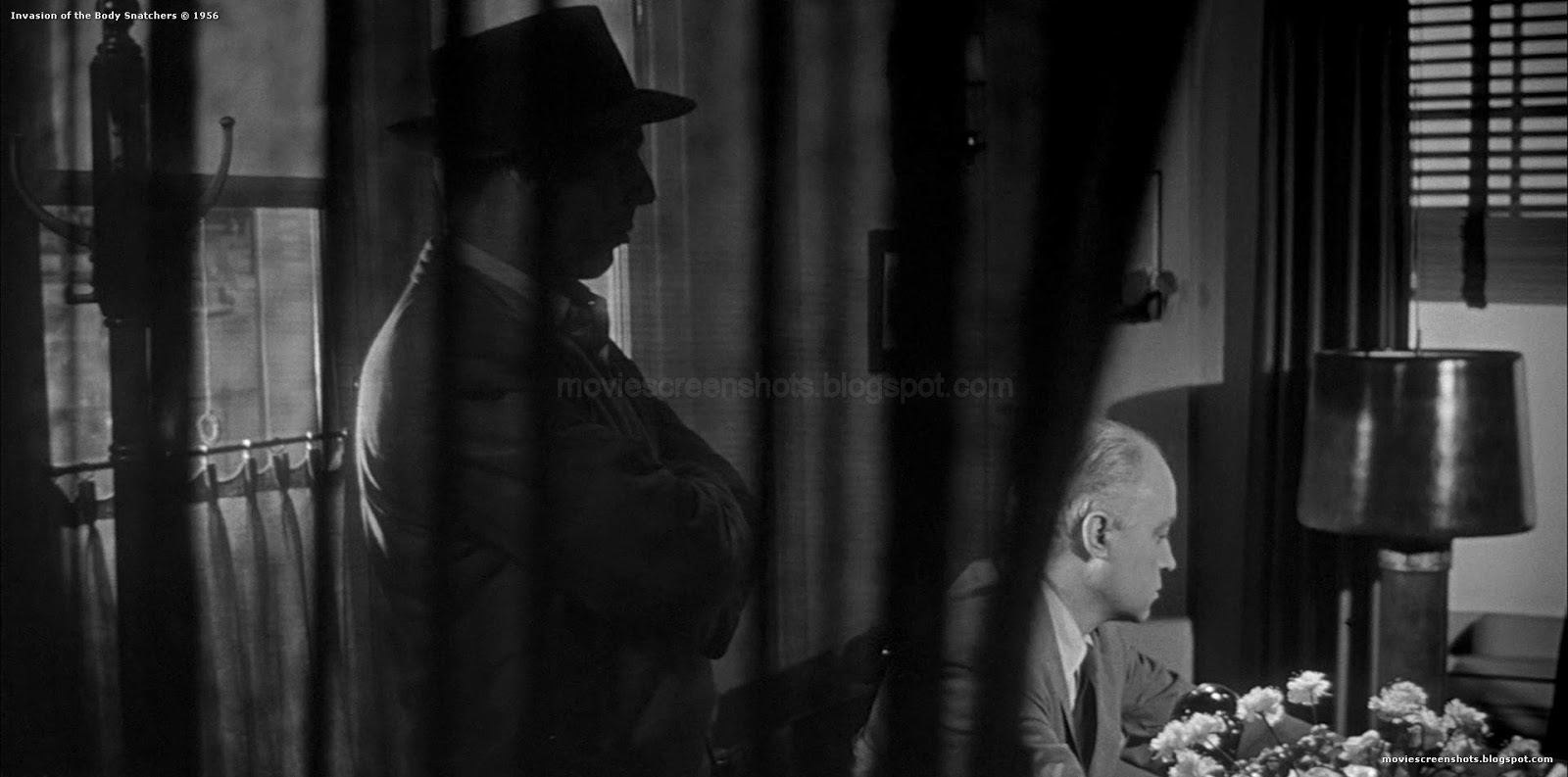
Invasion of the Body Snatchers (1956) Starring: Kevin McCarthy, Dana Wynter, Larry Gates, King Donovan, Carolyn Jones, Jean Willes. Directed by Don Siegel. Screenplay by Daniel Mainwaring. Based on the serial story The Body Snatchers by Jack Finney in Collier's (26 Nov-24 Dec 1954). Produced by Walter Wanger. Runtime: 80. USA Black and White. Science Fiction. Horror

People tend to read a lot into the movies from the 1950s, some of which may be true and some of which is simply looking for a deeper meaning than was intended by the filmmakers. For the most part, creative people want to make art and sometimes it’s politically motivated and other times it’s just to tell a good story. Case in point, Invasion of the Body Snatchers (1956). This is one of those films that is sometimes read as being Anti-McCarthy since those who don’t conform are persecuted. It can also be read as Anti-Communist since individuality is not appreciated. It can probably also be seen in today’s commentary as Anti-Illegal Immigration since no doubt these invaders were only looking for a better life for themselves.

In his autobiography, I Thought We Were Making Movies, Not History, Walter Mirisch, the head of production at Allied Artists, where the film was made, addressed that: "People began to read meanings into pictures that were never intended. The Invasion of the Body Snatchers is an example of that. I remember reading a magazine article arguing that the picture was intended as an allegory about the communist infiltration of America. From personal knowledge, neither Walter Wanger nor Don Siegel, who directed it, nor Dan Mainwaring, who wrote the script nor original author Jack Finney, nor myself saw it as anything other than a thriller, pure and simple."

The story comes from the pages of Collier’s magazine, a long-defunct publication, which popularized the short story. Jack Finney was a frequent contributor and serialized what would become the novel, The Body Snatchers in its pages from November 26 to December 24, 1954. His story was set in Mill Valley, California which was invaded by seeds that drifted to Earth from space.

Enter Walter Wanger, a Hollywood producer with credits going back to The Sheik (1921) and The Cocoanuts (1929), Stagecoach (1939), Foreign Correspondent (1940). His production company Walter Wanger Pictures, Inc., would produce the film for Allied Artists Pictures, a unit of Monogram Pictures that specialized in films with bigger budgets, run by Mirisch. The unit’s first production It Happened on Fifth Avenue (1947), cost more than $1,200,000 at a time when the average Monogram picture cost about $90,000. The budget for this film was set somewhere in between at $455,000, though the studio would ask the producer to cut it significantly. The title would be changed to Invasion of the Body Snatchers, so as not to be confused with RKO's 1945 production of Robert Louis Stevenson's The Body Snatcher, a film I had never heard of until researching this article.

Casting would go through many choices before the leads were settled. Wanger considered Gig Young, Dick Powell, Joseph Cotton amongst others, before casting Richard Kiley, who had starred in a previous Allied Artist film The Phoenix City Story (1955). But Kiley turned the role down. Kevin McCarthy, who had previously worked with Siegel before, was offered the role.

Likewise, the search for McCarthy’s co-star/love-interest went through many possibilities before casting was settled. Anne Bancroft, Donna Reed, Kim Hunter and Vera Miles were all considered before Dana Wynter was cast as Becky.

The film went into production on March 23, 1955, and principal photography would wrap about a month later on April 27. The original intention was to shoot the film on location, but that proved to be too expensive, so they settled on several locations in the Hollywood Hills and Bronson Canyon among them, the corner of Beachwood Canyon Drive and Belden. Other shooting sites included Glendale, Hollywood, Los Feliz, the San Fernando Country Club, Chatsworth railway station and Mulholland Drive at the Hollywood Freeway. In all, 38 locations were used with only four days devoted to interior shots.

The film was released on February 5, 1956, with some theaters displaying papier-mâché pods as a promotion. The film would gross about $3 million worldwide in its initial release.

Dr. Bassett (Richard Deacon) (l) and Dr. Hill (Whit Bissell) (r)
consult about Dr. Miles Bennell (Kevin McCarthy) (c)

Invasion opens in California. Psychologist Dr. Hill (Whit Bissell) has been brought in, at the request of Dr. Harvey Bassett (Richard Deacon), to consult on a recently admitted mental patient, Dr. Miles Bennell (Kevin McCarthy). Dr. Miles seems highly agitated, but the doctors agree to listen to his story.

The train station at Santa Mira where Dr. Miles Bennell (Kevin McCarthy) lives.

He takes them back to a few days prior, when his nurse, Sally (Jean Willes), had requested he come home from a medical conference he had been attending. She tells him that since he’d been gone, his waiting room had been filled with patients waiting to see him. She hints that even though nothing seems to have changed in Santa Mira, something was afoot.

Sally (Jean Willes), Miles' nurse, has requested that he come early from a medical conference.

Perhaps as an example of this, Miles narrowly avoids running over young Jimmy Grimaldi (Bobby Clark), who has darted out into the street running away from his grandmother (Beatrice Maude). Grandmother explains to Miles that Jimmy is really afraid to go to school. Miles notices that her husband’s once successful fruit and vegetable stand is closed. She explains that her husband has simply lost interest.

A young boy, Jimmy Grimaldi (Bobby Clark), running away from his grandmother (Beatrice Maude).

When they get to his office, there are a few patients, which Miles treats. He is about to sneak out for lunch when Becky Driscoll (Dana Wynter), his former girlfriend, shows up in the waiting room. She has returned recently from England and wants to ask him about her cousin Wilma (Virginia Christine). Wilma insists that someone is impersonating her Uncle Ira.

Miles and Becky talk. They are both recently divorced, she had just been to Reno. As he walks her outside, Miles stops a policeman whom Sally said had been in to see him, but he now says he’s fine.

Near the end of the day, Grandma brings in Jimmy, who claims that someone is pretending to be his mother. After speaking with him, Miles is intrigued by the similarities between his story and Wilma’s. He then goes to see Wilma and after examining Ira is convinced there is nothing wrong with him. But Wilma insists that while the man has the memories of Ira, he lacks any emotion. Miles refers Wilma to see Dr. Danny Kauffman (Larry Gates), a psychologist.

Miles treats Jimmy with nurse Sally's help.

That evening, Miles and Becky go out together and encounter Kauffman, who is with another doctor. Both of these doctors believe that mass hysteria has stricken the people of Santa Mira.

Miles and Becky go to a once-popular restaurant and find it is empty of customers and according to the proprietor it has been for the last two weeks.

An emergency call from Jack (King Donovan) and Theodora "Teddy" Belicec (Carolyn Jones) prompts Miles and Becky to visit them. In their home is a mysterious, half-formed body without facial lines or fingerprints, which they found lying on their billiard table. Teddy points out that the body is about the right height and build as Jack; he’s startled and drops a glass, cutting his hand.

Becky (Dana Wynter) and Miles go to Jack (King Donovan)
and Teddy (Carolyn Jones) because of an emergency, a replica of Jack.

Miles suggests the couple watch the body until morning and then takes Becky home. They find her father (Kenneth Patterson) is working late in the basement, which seems odd. During the night, as Jack dozes, Teddy notices that his cut hand appears on the body in the same place as Jack’s. Screaming, Teddy wakes up Jack and the two flee to Miles’ house. Miles calls Kauffman and then, on premonition, drives over to Becky’s house.

Miles rushes over to Becky's house in an attempt to save her.

When he breaks into the basement, he finds a double for her forming. He rushes upstairs and rescues the real Becky and takes her back to his house.

Later, Jack, Miles, and Kauffman go to the Belicecs and discover that the body is gone.

Returning to Becky’s, they find her double missing as well. Becky’s father has in the meantime called the police and Police Chief Nick Grivett (Ralph Dumke) responds. When Miles tells him about the mysterious body at Jack's house, Nick informs him that it belonged to a murder victim later found burning on a haystack.

Dr. Danny Kauffman (Larry Gates), a psychologist, is called
over, but by the time he gets there Jack's replica is gone.

The next morning, Miles hears noises in his basement, but it turns out to only be Charlie (Sam Peckinpah), who is a meter reader. Wilma approaches Miles when she sees him and tells him that after a good night’s sleep, she feels better and withdraws her allegations about Ira. When Miles leaves, Wilma goes back into her business, Becky’s father is waiting for her inside. She tells him that Becky is at Miles'. At Miles’ office, Grandma and Jimmy come inform him that the boy is back to normal, prompting Miles to wonder why the strange ailments have mysteriously disappeared.

 Wilma (Virginia Christine) tries to convince Miles there are no longer any problems.

Later, at Miles’ house, Miles, Becky, and the Belicecs are cooking steaks when they discover four more pods growing in his greenhouse. They watch horrified as one body pops out of a pod foaming.

There appear to be pods in Miles' greenhouse.

Miles surmises that the pods create a double for a person and replace them when they fall asleep. He tries to call the FBI in Los Angeles, but an emotionless telephone operator claims the lines are busy. (This is back in the days when long distance calls were a big thing.) Miles, who is getting more anxious, asks her to try the Sacramento office, but once again she tells him the lines are down.

A replica of Miles pops out of the pod in his greenhouse.

While they wait, the four friends try to figure out where these pods originated and how they take over their victim’s mind and memories. As they talk, one of the pods starts to resemble Teddy. Miles, sensing the immediate danger they’re in, urges Jack to take the women to safety, but Becky insists on staying with him. Miles tries to keep the operator busy for as long as possible before he kills the pods and escapes with Becky.

They stop at a gas station before leaving town. While Miles goes to try Sally’s number, the attendant borrows the keys to unlock the gas cap but also slips two pods into the trunk. But Miles is suspicious and pulls over not far away and discovers them. He pulls out the pods and sets them on fire.

Miles torches the pods that have been placed in his trunk.

He still insists on trying to rescue Sally and they drive over to her house. However, when Miles looks in the window he learns that she too has been changed. When he tries to leave, he is confronted by Nick, who, too has been changed, but Miles manages to escape.

Miles looks in through Sally's window and sees plans being discussed.

Knowing there is an all-points bulletin out for them, they ditch the car and hide out in Miles’ office, thinking that is where Jack will come back with help.

The next morning, they watch out the window as farmers distribute pods that are destined for other towns.

Pods being shipped out.

When Jack and Kauffman do appear, both transformed, and place pods in the office for Miles and Becky, Kauffman very calmly explains that the pods are the solution to humanity’s problems. The pods, he promises, reproduce an exact likeness of any form and painlessly absorbs its mind. When the being awakens, it is into an “untroubled world.” When Becky and Miles argue that they prefer to have love, Kauffman points out that life is much simpler without it. The two are then left alone so that the process can take place.

Jack and Dr. Kauffman wait in Miles' office for Miles and Becky to transform.

But instead, they trick Jack and Kauffman, and Miles injects them with sedatives. When Nick rushes in to subdue Miles, Becky injects him.

Miles injects Kauffman and Jack with a sedative.

With the men subdued, the two flee. Even though Miles tells Becky to hide their emotions, pretending to have been changed, Becky shrieks when a truck almost hits a dog, giving them away.

Miles and Becky about to step outside trying to act normal.

The two make a run for it up a hill and into an old mining tunnel, all the while being pursued by a mob of townspeople. Miles finds a place for them to hide and they outfox the mob. Exhausted, they fight sleep and wait until nightfall.

Exhausted, Miles carries Becky into a cave to hide.

They are pleased to hear the sound of beautiful music coming from outside the cave. The music gives them hope that others have survived. Miles leaves Becky to investigate and learns the music is coming from a radio in a truck that is being loaded with more pods.

Miles runs into traffic to try and warn the world.

Returning to Becky, he realizes that she has been changed, having fallen asleep in his brief absence.
Panicking, Miles runs toward the highway, but the townspeople, alerted by Becky, let Miles escape, presuming that no one will believe his story. Down on the highway, the traffic is slow and Miles runs about screaming warnings, but no one takes him seriously, assuming he’s either drunk or crazy. He jumps on the back of a transport truck and sees that it is filled with seed pods. Miles yells, “They’re here already! You’re next!”

Both doctors are skeptical of Miles' story.

Back at the hospital, Miles ends his tale, but neither of the doctors believe him, at least not at first. Then, an ambulance driver (Robert Osterloh) delivers casualties to the hospital from a highway accident. He tells the doctors that victims were buried under large pods that fell from a truck. Hearing that the truck originated in Santa Mira, the doctors call the FBI and tell the police to stop any trucks from leaving Santa Mira. Miles looks relieved that he is now believed and action is being taken.

When an ambulance driver confirms Miles' story, Drs. Bassett
and Hill finally take action and Miles can relax. 

The framing story was an add-on, shot on September 16, 1955, at the insistence of Allied which thought the original ending was too pessimistic. Neither Wanger or Siegel wanted to make the change, but both relented. Still, Siegel is quoted as saying, “the film was nearly ruined by those in charge at Allied Artists who added a preface and ending that I don't like."

This is one of those films that has risen in status as time has gone on. The film has been remade three times, one that I have seen, Invasion of the Body Snatchers (1978) directed by Philip Kaufman starring Donald Sutherland, and two I haven’t seen, Body Snatchers (1993) directed by Abel Ferrara, and The Invasion (2007) directed by Oliver Hirschbiegel and starring Nicole Kidman. There is also Invasion of the Bunny Snatchers (1992), a Looney Tunes parody directed by Greg Ford starring Bugs Bunny, Daffy Duck, Elmer Fudd, Yosemite Sam, and Porky Pig. If the 1978 version is any indication, remakes are sort of like impersonations, the sincerest form of flattery without being quite as good.

A lot of horror films in the 1950s deal with the fear of the different and the unknown. Every day in America was another step into the unknown, as a former ally, now bitter rival, the USSR, had the atomic bomb and people feared that the end could come at any minute. Why else practice Duck and Cover drills in schools? America might be in a post-war heyday, but the fear that some outside force could make it go away in an instant was probably palpable to many.

You can read in all of the politics you want to, but the film works as it was intended, to scare audiences. This is an example of the horror genre before gore was the standard. This is what they call psychological horror. Knowing that everything looks the same but is at the same time radically different. Humans devoid of emotions are not capable of creating; this new world might be more stable, but it would definitely be dull as dishwater. If you think there’s nothing to watch on TV now, just imagine if Pod people were in control. And wouldn’t that be scary?

Jokes aside, the film works as Miles’ world literally closes in around him. He is the last normal person left and if he doesn’t survive and warn the rest of the world it’s over for the planet as nothing seems to stop these pods. Miles’ motivations are somewhat heroic, as it would be all too easy just to give up. While Kevin McCarthy sort of has B-movie actor written all over him, he really rises to the occasion here. It is hard to imagine someone else in this role.

Dana Wynter is cute as Becky, but she doesn’t necessarily bring more to the role than anyone else might have. Women in these films from this time are more hangers-on than partners or heroes, which says more about Hollywood and American tastes than anything else.

The film is filled with a lot of character actors at the top of their games, including: Richard Deacon, better known for his role as Mel Cooley on The Dick Van Dyke Show; Carolyn Jones, Morticia Addams on The Addams Family; Virginia Christine, best remembers as Mrs. Olson in a long-running series of Folger Coffee ads; Whit Bissell, General Heywood Kirk in TV’s Time Tunnel and Station Manager Lurry in the famous and over-rated “Trouble with Tribbles” episode of the original Star Trek TV series; and King Donovan, an actor turned director for one picture Promises! Promises! (1963), the first sound film to feature a mainstream star, Jayne Mansfield, in the nude. Larry Gates, who played Dr. Kaufman, is another recognizable face who appeared in numerous roles throughout his career.

One face that might not be as recognizable as his name is Sam Peckinpah, who plays Charlie in the film. He would go on to direct such films as The Wild Bunch (1969), Straw Dogs (1971), Pat Garrett and Billy the Kid (1973) and Bring Me the Head of Alfredo Garcia (1974). He was a dialogue coach on the film and had worked on the screenplay without receiving credit.

Future director Sam Peckinpah makes a brief appearance as Charlie the meter reader.

While the film did not start out to be a classic, it certainly ended up as one. Invasion of the Body Snatchers is not over the top horrifying, but it works and continues to scare to this day. Not great but good cinema. If you’re a fan of 1950’s science fiction then you should definitely see this film, as it is one of the better examples of the genre from that time.

Be sure to check out other Horror films in our Horror Films Review Hub.