Showing posts with label World War II. Show all posts

Saturday, February 8, 2020

Stubs - Jojo Rabbit


Jojo Rabbit (2019) Starring: Roman Griffin Davis, Thomasin McKenzie, Taika Waititi, Rebel Wilson, Stephen Merchant, Alfie Allen, Sam Rockwell, Scarlett Johansson Directed by Taika Waititi. Screenplay by Taika Waititi Based on Caging Skies by Christine Leunens. Produced by Carthew Neal, Taika Waititi, Chelsea Winstanley Run time: 108 minutes USA Comedy, Drama, War, World War II

While Nazi Germany might seem like an odd backdrop for a comedy, Jojo Rabbit, the latest film from Taika Waititi, the director of Thor: Rangnarok, manages to pull it off so well that the film received several Academy Award nominations, including Best Picture (Carthew Neal and Taika Waititi) ; Best Supporting Actress (Scarlett Johansson); Best Adapted Screenplay (Taika Waititi); Best Production Design (Ra Vincent and Nora Sopková); Best Costume Design (Mayes C. Rubeo); and Best Film Editing (Tom Eagles).

Saturday, November 25, 2017

Stubs - 36 Hours


36 Hours (1965) Starring James Garner, Eva Marie Saint, Rod Taylor, Werner Peters, John Banner, Russell Thorson, Alan Napier Directed by George Seaton. Screenplay by George Seaton.  Based on the short story "Beware of the Dog" by Roald Dahl in Harper's (Oct 1944). Produced by William Perlberg. Runtime: 115 minutes. USA War, Drama, World War II, Suspense

Roald Dahl is not a name you usually associate with war and suspense, but World War II affected everyone, Dahl included. His short story “Beware of the Dog”, originally published in Harper’s Magazine in 1944, tells the story of an RAF pilot, Peter Williamson, who gets shot down over Vichy France, but wakes up in a hospital bed in Brighton, or so he thinks. He becomes suspicious of his surroundings, finally figuring out that he is still in Vichy France and that his English caregivers are actually Germans in disguise.

Dahl is best known for his children’s books Charlie and the Chocolate Factory, The Witches and James and the Giant Peach, all of which were also made into successful movies, some more than once. But he was actually in the RAF during the war. After he was injured on duty, he was transferred to Washington D.C. in 1942, where he worked as an Air attaché and began his writing career recounting his War experiences.

James Garner was a television star first. After leaving the US Army in 1952, he began acting. He played a non-speaking role in the Broadway stage version of The Caine Mutiny Court-Martial, letting him observe Henry Fonda on a daily basis. After that, he moved to television. According to his autobiography, Garner claims that he was almost the lead in the TV series Cheyenne, but when the casting director couldn’t reach him in time, the role went to Clint Walker.

After a couple of years, Garner landed his own starring role on TV in Maverick (1957-1960) but left after three seasons. He appeared in the film Darby’s Rangers (1958) after Charlton Heston turned down the lead. He was subsequently hired by Warner Bros. to appear in such films as Up Periscope (1959) and Cash McCall (1960). After leaving Warner Bros. he starred in such films as The Children’s Hour (1962) opposite Audrey Hepburn and Shirley MacLaine; Boy’s Night Out (1962) with Kim Novak and Tony Randall; and Move Over Darling (1963) a remake of My Favorite Wife (1940), playing the role created by Cary Grant, an actor to which Garner is often compared. Other roles in such films as The Great Escape (1963) and The Americanization of Emily (1964) followed.

By 1965, Garner had formed his own production company, Cherokee Productions, and one of the movies that company made was the adaptation of the Dahl short story, now called 36 Hours. With George Seaton writing the screenplay and directing, the film was shot on location in Portugal, Germany and Yosemite National Park, where most of the film was shot. Exterior shots were filmed at the Wawona Hotel near the entrance of Yosemite.

The Wawona Hotel in Yosemite doubles for the U.S. Army hospital in 36 Hours.

A few days before D-Day, with the plans finalized for the invasion at Normandy, Allied troops are concerned that the Germans might be onto their plan, even though Nazi troops are currently concentrated at Pas de Calais, where they anticipate the invasion will take place.

In order to check that out, his commanding officer, General Allison (Russell Thorson), and British Colonel Peter MacLean (Alan Napier) decide to send U.S. Army Major Jeff Pike (James Garner) to Lisbon on June 1st, 1944 to meet with an informant in the German consulate there. This is a contact that Pike has developed over the years and one only he knows how to read. Pike has been in on General Eisenhower's final briefing on the landings, but has been trained to withstand torture. Before he leaves, he suffers a papercut when he touches the edge of one of the maps hanging on the wall.

Pike is sent over on the midnight flight, which has been delayed an hour so that Pike can be on it. His departure is witnessed by an informant, who notifies another agent, an elderly British woman, who goes into Pike’s apartment and steals some personal items as well as hair from his brush.

When he lands in Portugal, Pike makes sure that his presence is known and that the German informant is notified. But at the rendezvous, which takes place at a café, Pike is drugged and while making his way to the meeting, becomes disoriented and eventually passes out on the street. However, the Germans abduct him and, putting him in a coffin, manage to fly him back to Germany.

The Nazis under the supervision of Dr. Walter Gerber (Rod Taylor) and with the help of nurse Anna
 Hedler (Eva Marie Saint) alter 
U.S. Army Major Jeff Pike's (James Garner) appearance.

While they keep Pike sedated, they “age” him, dying his hair with gray highlights and giving him drops to temporarily make his eyesight bad to the point where he needs to wear glasses to read. It is obvious that they know a lot about him.

Pike is helped back to bed by Dr. Gerber and nurse Hedler.

When Pike wakes up it is what looks like a U.S. Army hospital. He is told it is May 1950 and he is in post-war Occupied Germany. Psychiatrist Major Walter Gerber (Rod Taylor) explains that Pike has been having episodes of memory loss ever since he was tortured by the Nazis in Lisbon. He advises Pike that his blocked memories have always resurfaced, helped along by a therapy of remembering events prior to Lisbon and then pushing forward into the blank period.

Dr. Gerber explains to Pike the issues he's having with amnesia and how he can help him.

Various props including captured U.S. Army jeeps and uniforms, soldiers playing baseball, fake letters from Pike’s father, made up newspapers and fake radio broadcasts, are used to carefully convince Pike that the year is 1950 and that he is among fellow Americans. He is cared for by Anna Hedler (Eva Marie Saint), a nurse the Nazis have temporarily saved from a concentration camp.

Pike comes to believe that Anna is not only his nurse, but is also his wife.

Pike is completely taken in by the deception, even believing that Anna is his wife. She’s wearing an engagement ring that is, in fact, a family heirloom. Gerber, who pretends to be a close friend, even introduces Pike to SS agent Schack (Werner Peters), who he’s told runs a restaurant in a nearby village that Pike and Anna frequent. Pike apologies for not knowing him. As part of his "therapy", he recounts the critical details of the invasion plans, including the location and the date, June 5, to his eager listeners.

Pike starts to figure out the ruse when he realizes he has a paper cut he suffered a few days before.

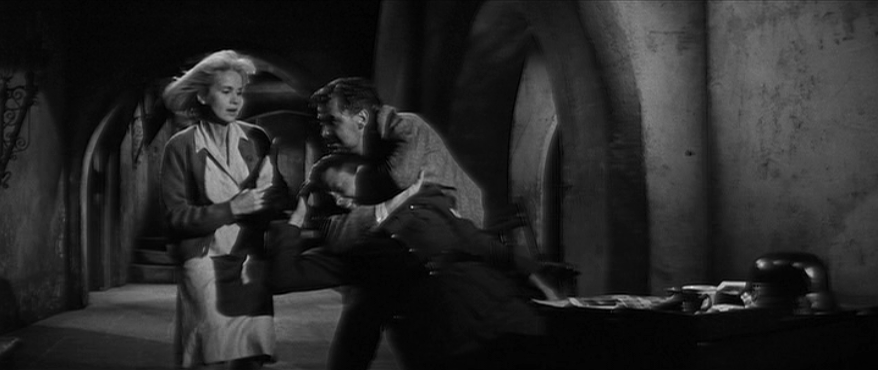
While cleaning up from dinner, Pike gets salt in a nearly invisible paper cut he got the day he left for Lisbon. He realizes then that it is all a hoax. He tries to escape by riding a bicycle out the front gate. When the guard stops him, Pike confirms it by tricking him into reflexively snapping to attention in the German manner. He violently confronts Anna, who admits, with her neck in his grip, that the date is indeed June 2, 1944. She was recruited from a concentration camp because she was a nurse and spoke English. When pushed, she promises to help him.

Pike instructs Anna to run and tell Gerber that he was onto the plot, while he makes a feeble attempt to escape to sell it. Quickly recaptured, he states that he realized what was going soon after waking up due to his paper cut. Gerber does not believe him. After two days of interrogation, however, Pike and Anna convince SS agent Schack, who never believed the hoax would work. Pike pretends that the invasion will be at Pas de Calais and provides detailed plans, including code names. This information confirms what Schack and German high command believe, which is corroborated by counter-intelligence misinformation that has been fed to Nazi undercover agents by the British.

Pike is interrogated for two days by a German SS officer.

Gerber, however, sets the clock forward in Pike and Anna's room so when they wake, they think it is the morning of June 5. Gerber tells them that the Germans have been surprised at Normandy. Pike lets his guard down and confirms that the plan worked. Gerber comes clean about what he’s done and then tells Pike that there has been no invasion, most likely because of the rain that is taking place all over Europe. Gerber then tells Pike what he has to do and sends an emergency dispatch to Wehrmacht authorities, but since that doesn’t agree with the high command, Pike’s message is discarded. By midday June 5, Gerber has been discredited and Schack orders his arrest.

Gerber knows that when the Allies land at Normandy, Schack will kill them to cover his own blunder. Gerber, who feels like he knows Pike from his research, decides to help them escape. But he asks Pike to take his groundbreaking research on amnesiacs with him, hoping that he will live on through his work. When the Normandy landings begin on the morning of June 6, he laughs at Schack when he arrives, revealing that he has taken poison and pointing out that Schack will likely be liquidated.

Gerber helps Pike escape by giving him the key to his door.

Meanwhile, Pike and Anna make their escape, killing a guard on the way out. They find a place to hide nearby and after the location is searched, Anna tells Pike about how she doesn’t like being touched. She recounts her repeated rapes at the concentration camps and that she is cried out. Pike tells her that there is no love without tears.

Pike breaks the neck of one of the German guards so he and Anna can escape.

They take Gerber’s advice and head for a village on the border with Switzerland where they know a minister helps people to cross. The problem is that Schack knows that, too and pursues the escapees on his own, no time to wait for backup.

The minister's housekeeper, Elsa (Celia Lovsky), puts Pike and Anna in touch with Sgt. Ernst
(John Banner), who will sneak them over the border to Switzerland.

When Pike and Anna arrive, they are greeted by the minister’s housekeeper, Elsa (Celia Lovsky), who agrees to hide them. She introduces them to a jovially corrupt German border guard, Sgt. Ernst (John Banner). Ernst, who has been learning English since the war began, believes that the Nazis are eventually doomed. While he’s willing to help Pike and Anna, he requires payment. Ernst is only interested in gold, which is one thing the Nazis have taken away for the war effort. Anna, who is still wearing Pike’s engagement ring and another wedding band, has to give them to Ernst and Pike gives him his watch. Elsa is infatuated with the engagement ring and Ernst gives it to her.

Ernst demands gold jewelry to aid in their escape.

Schack shows up at the minister's after Ernst and the couple have left for the border, but he recognizes Anna's ring on Elsa’s finger and forces her to reveal their planned escape. Schack catches up at the border and has the drop on Pike and Anna, but before he can kill them Ernst shoots and kills him. He then, with Pike’s help, arranges Schack’s body to make it look as if he had been killed while trying to escape.

Pike and Anna head off to freedom in Switzerland.

Safely in Switzerland, Pike is to go to the U.S. Embassy and Anna to a refugee camp. Pike promises to look in on her before he returns to London. When they are placed in cars next to one another, Anna cries her first display of emotion in years.

Released in January 1965, in New York on January 28, the film went on to make $2.2 million in domestic box office and was enough of a success to cement Garner as a movie star. Clearly the star, Garner is a likable actor and his character is also likable. You find yourself rooting for him and Anna as well. Pike is such a good man that when he accidentally drops Gerber’s research as they’re trying to escape, that even though it might make them miss the rendezvous, he goes back to retrieve it. Truly a man of his word.

Eva Marie Saint began her career in television as an NBC page. She did get in front of the camera as early as 1946, appearing in Campus Hoopla on that network. She made her film debut in On The Waterfront (1954), which she won the Academy Award for Best Actress in a Supporting Role. Saint would appear in Raintree County (1957), Alfred Hitchcock’s North By Northwest (1959), Exodus (1960) and All Fall Down (1962) before appearing in 36 Hours. An accomplished actress, Saint gives a believable performance as a concentration camp survivor who will do anything, even help the Nazis, to avoid that fate.

Rod Taylor had a very two-dimensional supporting role in this film. He is as likable as a Nazi has been depicted on film, but there is always the loyal soldier in the background. He might like who Pike is, but Pike is still the enemy. Even if no one will believe him, his Gerber character has to try until there is no hope. Gerber is as much of a realist as SS Agent Schack claims to be.

One of the added values of watching the film is to see future television stars who seem to be everywhere in this film. Not only had Garner been a TV star before getting into films, he will eventually go back to that medium and star in the long-running Private Investigator series, The Rockford Files (1974–1980). Alan Napier would go on to portray Alfred Pennyworth, Bruce Wayne’s butler in TV’s Batman (1966-1968), a role he would be known for to the Baby-Boomer generation. James Doohan who would go on to play Scott “Scotty” Montgomery on the original Star Trek series (1966-1969) as well as the films that would follow.

But of all of these actors, the one who went on to play a very similar character on TV was John Banner. Here he provides some comic relief as Sgt. Ernst, an out for himself German border guard. In some ways, this is a blueprint for his role as Sgt. Schultz on TV’s World War II inspired comedy, Hogan Heroes (1965-1971).

The film takes an interesting approach, letting the audience know what is happening to Pike when he doesn’t know. We see the Nazis’ scheming and planning and have to wait for him to catch on. It’s always the little things that come into play. If he hadn’t cut his finger on a map, then they may have well gotten away with their ruse. We wait for him to figure it out and how he can try to correct his mistake. It helps him that the Nazis don’t trust one another while trying to stay loyal to their mistaken high command. By this point in the war, the Nazi regime’s days were numbered, but they didn’t really know it quite yet, though some like Ernst were just waiting for the day to come. The film reminded me of the television series Mission Impossible (1966-1973), when the team led by Jim Phelps regularly pulled off the kind of ruse the Nazi’s are trying to do here.

One problem I have with the film, and it is only through analyzing it that I caught this, the hero doesn’t solve his own dilemma. When Pike and Anna are caught dead to rights by Schack, it is Ernst who saves them, rather than Pike or Anna figuring a way out of the life or death situation they find themselves in. Ernst kills Schack to save his own hide, figuring Schack would put an end to his smuggling operation and to Ernst himself. Pike and Anna are the beneficiaries of Ernst’s actions, but they don’t take action themselves.

That said, overall I liked the film and would recommend it. No film is perfect, but that doesn’t mean you shouldn’t watch them. 36 Hours may not have you on the edge of your seat, but it is well-acted and with a well thought out and unique storyline for the time it was made.

Sunday, September 25, 2011

Stubs - Eye of the Needle

EYE OF THE NEEDLE (1981) Starring: Donald Sutherland, Kate Nelligan, Christopher Cazenove. Directed by Richard Marquand. Screenplay by Stanley Mann. Based on the book by Ken Follett. Produced by Stephen Friedman. Run Time 118 minutes, Color. U.K. World War II, Drama, Thriller, Romance

Set during World War II, EYE OF THE NEEDLE follows two storylines. First it is the story of Henry Faber (Donald Sutherland), whose important position at the railway keeps him from national service. He seems like an affable, though lonely man, who lives in a boarding house and goes for a pint down at the local pub. But in reality, Faber is a Nazi spy. A German military officer, Faber is also known as the Needle. One is given to believe he got that name because of his favorite weapon, the stiletto, which we see him use over and over throughout the film.

Juxtaposed to Faber’s story is that of David (Christopher Cazenove) and Lucy Rose (Kate Nelligan). Newlyweds, married on the eve of David’s assignment, they have a terrible accident on the way to their honeymoon. Drunk and driving too fast, David drives off the road and crashes the car. The result is his paralysis from the waist down. He exchanges flying in the air force for tending sheep on Storm Island off the English coast. There they live a Spartan life with only their young son Jo (Jonathan Nicholas Haley) and the lighthouse keeper and helper Tom (Alex McCrindle) for company. While Lucy keeps a brave face, she is in fact miserable. David drinks too much with Tom and David and Lucy’s romantic life is down to zilch.

Faber, meanwhile, has been given the very important assignment of spying on General Patton’s Army, which the German military is convinced will be the lead force when the Allies invade Europe. Faber is told to find out what he can and to report back to the Fuhrer in person. A German U-boat will pick him up off the shore when he relays to them he is ready to be picked up. He is given two weeks to report back.

The truth is that Patton’s Army was a decoy and Faber takes photographs to prove the point and even with the authorities chasing him, manages to escape to Storm Island where his canal boat crashes in a storm. There he is rescued by the Roses. While Lucy nurtures him back to health, she also falls in love with him. And with her husband sleeping one of upstairs or at Tom’s, Lucy and Faber become lovers.

When David discovers the canister of photographs, he confronts Faber. And even though David puts up a heroic fight, he is no match for the stronger Faber, who throws him over one of the many cliffs on the island. Next Tom is also killed and Faber must wait for his next window to contact the U-boat, which waits for his signal between 6 pm to 6 am every day.

Faber tells Lucy that David is too drunk to come home, giving the two lovers another night together. The next day, when Faber goes to retrieve David, Lucy and Jo go for a walk on the island and Lucy discovers her husband’s dead body in the water. She is very upset, but when Faber gets back, he tells her that David is still too drunk to come home. Lucy knows something is up and bides her time to escape, even going so far as to have sex with Faber one more time, as if nothing is wrong.

When she gets her chance, Lucy grabs Jo and takes off towards Tom’s lighthouse, where there is the only radio on the island. Faber takes chase and even though her car gets stuck, Lucy manages to barricade her and Jo in the lighthouse. This is when she finds Tom dead as well.

Faber arrives and tries to gain entrance. Lucy does her best to stop him, even hacking his hand with an axe as he reaches in to undo one of the locks on the door. But Faber still gets in and while holding Jo hostage manages to contact the U-boat just before Lucy manages to short out the electricity. Faber must have feelings for Lucy, because he lets her live. And it is this act of “kindness” on his part that will lead to his own death.

Faber leaves the lighthouse and heads down to a row boat on the beach to get to the waiting U-boat. Lucy finds a handgun she had misplaced and takes chase. She shoots at Faber, but doesn’t stop him until he is in the row boat. With her last bullet, Lucy kills Faber and unknowingly saves the Normandy invasion.

A taught thriller, EYE OF THE NEEDLE has held up very well in the thirty years since its original theatrical release. While Donald Sutherland is great as Faber, it is really Kate Nelligan’s Lucy that holds the film together. She is the pivotal character, torn between the love for her impudent husband and the strong embrace from a virile stranger. A lonely young woman, who has never really been given a chance to enjoy life, Lucy rises to the challenge and single-handedly saves the world.

Saturday, September 3, 2011

Stubs – The Bridge on the River Kwai


THE BRIDGE ON THE RIVER KWAI (1957) Starring: William Holden, Alec Guinness, Jack Hawkins, Sessue Hayakawa, James Donald, Ann Sears and introducing Geoffrey Horne. Directed by David Lean. Screenplay by Carl Foreman and Michael Wilson. Based on the book by Pierre Boulle. Produced by Sam Spiegel. Run Time 162 minutes, Color. U.S. and U.K. World War II, Drama, Action

Did David Lean ever make a movie that clocked in short of an epic run time? Clocking in at just under three hours, THE BRIDGE ON THE RIVER KWAI is long, but it is never dull. While I’m also a big fan of LAWRENCE OF ARABIA (1962), there are definitely places where that film seems to be filling time. And the structure of BRIDGE provides a more defined beginning, middle and end that LAWRENCE doesn’t seem to have. This is a much more straight forward film in that respect.

There are two plots running simultaneously. The first involves Shears (William Holden), a Navy seaman who has copped the identity of a Commander hoping for better treatment as a P.O.W. He has been in Camp 16, run by Colonel Saito (Sessue Hayakawa) long enough to know how to game the system. Reminiscent of his character in STALOG 17, Holden trades with the guards, dead soldiers’ lighters for being on sick call or cigarette butts. Shears has one thing on his mind, escape and getting back to America. When the opportunity arises, Shears and two accomplices make a run for it. But only Shears survives. First, he stumbles to a native village which patches him up and gives him a boat. Second, when he can no longer paddle and the boat drifts out to sea, he is rescued by the British Navy.

Recuperating at a hospital in Ceylon as a U.S. commander and the privileges that provides him, Ann Sears playing the role Nurse, all Shears can think about is going home. He even has figured out what he will do when they discover his true rank, he’ll claim what we know as a section 8. Things seem to be going as plan and he is a couple of days away from going home when he is visited by Major Warden (Jack Hawkins) who wants to talk to him about joining Force 316.

Camp 16 is using P.O.W. labor to build a railroad bridge that will help link the Japanese railroad from Singapore to Rangoon. Saito has been having enough trouble getting the railroad completed when a new group of British prisoners arrive, thanks to the surrender of Singapore. Led by Lt. Colonel Nicholson (Alex Guinness), the new troops are to be treated as prisoners not as soldiers. Saito has contempt for the British who have surrendered rather than fight to the death.

And that is where the second plot takes place and it is a battle of wills between Saito and Nicholson. Saito, who is under a tight deadline to get the bridge completed. He demands that British officers be treated like the rest of the prisoners and do manual labor. But Nicholson refuses, citing the Geneva conventions. Saito doesn’t want anything to do with the code, so he punishes Nicholson and the other officers. But progress on the bridge is slow. The British soldiers do as bad of a job as they can and even manage to set production back. Saito at first blames the engineer in command and takes over the project personally. But progress is still slow and with the deadline approaching, Saito capitulates to Nicholson’s demands.

Nicholson, being a man of principal, champions the project as being a good morale booster for the men. He wants to show his captors what good work the English can do. He takes pride to a whole new level and becomes obsessed with the bridges’ construction. While still the titular head of the project and the commander of the camp, it is clear that Saito loses and cedes control of the project to Nicholson. His crew not only moves the location of the bridge but increases the workload on the men. He even goes so far as to have the officers help with the manual labor and recruits the sick and wounded prisoners to lend a hand. The result is that the bridge is completed on time and is a marvel to behold. While Nicholson celebrates the accomplishment, even putting a plaque on the bridge with his name on it, Saito goes about the steps to prepare for hari kari when the bridge is completed.

While Shears doesn’t want to go back to Camp 16, he is left with little choice. The British and the Americans have figured out what his true rank is, and the U.S. Navy has reassigned him to Warden’s Force 316. When he sees no way to avoid it, he volunteers to go. Rounding out their group are two more men, the supposed experienced Chapman, who dies when they parachute in behind Japanese lines, and the inexperienced Lt. Joyce (Geoffrey Horne). As they make their way to blow up the bridge, Warden gets shot when Joyce freezes before a Japanese soldier. Warden kills the soldier, but not before he gets shot in the foot. This of course, slows down their expedition and changes the roles each will assume. Warden for a time gives the leadership up to Shears, but he really doesn’t want it. Warden is not left behind as he wished, but is carried on stretcher when he can no longer walk.

The trio reach the bridge on the eve of it’s opening, when the first train will cross its trestle. Planting plastic explosives three feet below the water line seems sufficient, as does hiding the detonator across the river. However, overnight, the river recedes and some of the wiring is left exposed.

And it is this wiring that Nicholson sees on his last check of the bridge as the train is approaching. Bringing Saito with him, Nicholson goes down under the bridge and follows one of the wires straight to Lt. Joyce who is manning the detonator. There doesn’t seem to be a plan B in mind, as Warden and Shears want Joyce to explode the bridge, but he seems intent on waiting for the train. Joyce, who has always been slow to act, kills Saito, but can’t get through to Nicholson. While the two men struggle, Joyce is killed by Japanese fire. Warden shoots mortar at the bridge as a diversion and Shears swims across the river to kill Nicholson. Shears has come too far not to complete the mission. But he too is shot and killed, but not before Nicholson sees him. It is then and only then that Nicholson realizes the error of his ways and has the “What have I done?” moment, the film is famous for.

One of Warden’s mortar lands next to Nicholson, mortally wounding him. But Nicholson tries for a moment to shake off its effects. Stooping to pick up his cap, he is a proper British officer after all; he instead collapses, falling on the detonator, blowing up the bridge, just as the train starts across.

The acting in the film is great. Guinness won the Academy Award for Best Actor and Hayakawa was nominated for Best Supporting. Alec Guinness had, up until then, been considered a comedic actor, having worked in a series of comedies produced by the British Ealing Studios. These films include: THE LAVENDER HILL MOB (1951), THE LADYKILLERS (1955) and THE MAN IN THE WHITE SUIT (1951). He would work again with David Lean in such films as LAWRENCE OF ARABIA (playing Prince Faisal) and DR. ZHIVAGO (1965) (playing Gen. Yevgraf Zhivago). Guinness is probably best known to the under forty crowd as Obi-Wan Kenobi, in the original STAR WARS (1980).

William Holden, who had been a star since GOLDEN BOY (1939), was at the top of his game when he appeared in BRIDGE, having won the Oscar the year before for STALAG 17 (1954). In addition to these films, he had also starred in SUNSET BOULEVARD (1950), for which he was nominated for an Oscar; BORN YESTERDAY (1950); SABRINA (1954) and THE COUNTRY GIRL (1954), LOVE IS A MANY-SLEPENDORED THING (1955) and PICNIC (1955), by the time he made BRIDGE. He would go on to star in such films as THE HORSE SOLDIERS (1959); THE WILD BUNCH (1969); THE TOWERING INFERNO (1974) and NETWORK (1976), for which he would be nominated again for an Academy Award. His last film was 1981’s S.O.B., a forgettable Blake Edwards comedy.

THE BRIDGE ON THE RIVER KWAI won seven Academy Awards, including Best Picture. But it also won for Best Adapted Screenplay, an award originally given to the “screenwriter” Pierre Boulle, the author of the book it was based on. This is because the two men, who wrote the script, though not together, were on the Hollywood Blacklist. It wasn’t until 1984 that the Academy rectified the situation and gave the awards posthumously to Foreman and Wilson. And since then the credits have been updated to show these two men, not Boulle, as the screenwriters.

This film also made the Library of Congress National Film Registry in 1997.

THE BRIDGE ON THE RIVER KWAI is an interesting psychological study and is a fun film to watch. Somewhat slow by today’s standard it makes up for it by having good writing, directing and acting, things few big budget films have these days. And unlike most current big budget films, the big explosion isn’t the only thing worth watching.

Sunday, August 14, 2011

Stubs - Patton


PATTON (1970) Starring: George C. Scott, Karl Malden, Michael Bates, Karl Michael Volger. Directed by Franklin J. Schaffer. Screenplay by Francis Ford Coppola and Edmund H. North; based on Patton Ordeal and Triumph by Ladislas Farago and A Soldier’s Story by Omar Bradley. Music Composed by Jerry Goldsmith. Produced by Frank McCarthy. Run Time 172 minutes, Color. U.S. Biography, War.

This is an epic film about a larger than life figure, General George S. Patton. Set during World War II, the movie tells the mostly true life adventures of one of the great generals to ever serve in the U.S. Army. A poet, a believer in reincarnation, but still a devote Christian, Patton is a complex man. Patton’s biggest enemy wasn’t the Germans, rather it was himself. Brilliant with war strategy, Patton got into trouble over things he said and how some of his actions were covered by the press.

George C. Scott, who throughout his career gave great performances in such films as ANATOMY OF A MURDER (1959); THE HUSTLER (1961); DR. STRANGELOVE, OR HOW I LEARNED TO STOP WORRYING AND LOVE THE BOMB (1964), seemed to find a defining role as the foul-mouthed, Bible reading, Blood and Guts Patton. Scott got the role when the likes of Rod Steiger turned it down and made the most of the opportunity. His portrayal was good enough to earn Scott the Academy Award for Best Actor, a well-deserved accolade that the actor turned down.

Karl Malden, himself an Academy Award winner [Best Supporting Actor for A STREETCAR NAMED DESIRE (1951)], portrays Omar Bradley, who was also known as the G.I.’s General. As down to earth as Patton was a diva, Bradley was nevertheless an important part of the war effort. But Bradley is portrayed as more of a plodder to Patton’s genius, and as someone who gets promoted by not rocking the boat. Eventually, Bradley becomes his old friend’s superior officer.

The film starts with the arrival of Patton in North Africa, where he takes over the command of the U.S. forces, who had recently suffered a devastating loss to the Germans, led by Field Marshall Erwin Rommel (Karl Michael Volger). While Patton was bigger than life, he expected his men to toe the line when it came to being disciplined soldiers. He turns his troops around and hands Rommel a major defeat.

This leads the Germans to have an increased awareness of Patton. He becomes someone they both admire and fear. And they find it hard to believe he is later punished for slapping a soldier suffering from battle fatigue, which is tantamount to cowardice in Patton’s eyes. It is the furor over this incident that makes you wish Patton could have learned from his mistakes, because he keeps making them.

When his plans for the invasion of Sicily are scuttled for ones drawn up by Field Marshall Sir Bernard Law Montgomery (Michael Bates), Patton goes along, but only long enough until he can go his own way. Ultimately, Patton disobeys orders but is there to meet Montgomery when he marches into Mesina.

After the slapping incident, Patton is sidelined by Allied Forces. With the Germans believing Patton will lead the invasion of Europe, the Allied Forces set him up with the fictitious First United States Army Group in southern England. But Patton isn’t satisfied with being the commander of a dummy army and fearing he is missing out on his destiny, Patton pleads for reassignment.

Given the U.S. Third Army by Eisenhower, he marches through Europe, stopped only when supplies are diverted to other troops, including Montgomery’s. Still Patton plays a major part in the defeat of the Germans. But when the German’s surrender, Patton is relieved of command because of things he has said, including comparing the Nazi Party to the Democrat and Republican Parties in the U.S. and for badmouthing our then allies, the Russians, whom Patton felt we were destined to fight next.

Perhaps the most interesting aspect of the film isn’t the war and battle scenes, it’s the relationships between the generals. While the film concentrates more on the relations between Patton and Bradley, there is also the more important one, career-wise, between Eisenhower and Patton. Eisenhower is often referred to, but never seen in the movie. Rather he is shown working through intermediaries, like and Major General Walter Bedell Smith (Edward Binns). This leaves the viewer with the idea that Eisenhower never dealt directly with Patton, though in real life he did. Since they were close friends before the war, it must have been difficult for Eisenhower to have to discipline a man he once considered his mentor.

There is also the battle of the divas between Patton and Field Marshall Sir Bernard Law Montgomery (Michael Bates). Throughout the movie, Patton always seems to be competing with Montgomery for both supplies and the spotlight. While they have a common enemy, the Germans, there appears to be no love lost between these two as they fight alongside and with each other throughout Africa, Sicily and Europe.

Technically, this is a great movie. The battle scenes are still quite powerful to watch and the re-enactments seem very real even by today’s standards; maybe even more so. One of the differences is that there are no CGI special effects. This makes the action more real and more visceral.

This is simply a well-made film and it succeeds on all levels, both in front of and behind the camera. It is no surprise that it would win not only the Best Picture, in addition to Actor, but also Best Art Direction – Set Decoration, Best Director, Best Editing, Best Sound and Best Writing, Story and Screenplay based on Factual Material or Material Previously Published or Produced.

Patton is more than a war film. One of the great films of the 1970’s, it is driven as much by the characters it develops as by the action it depicts. Patton is a biography that shows all of its subject’s warts, faults and eccentricities, well as the attributes that made him a hero.

Sunday, April 10, 2011

Stubs - Casablanca


CASABLANCA (1942) Starring Humphrey Bogart, Ingrid Bergman, Paul Henreid, Claude Rains, Conrad Veidt, Sydney Greenstreet, Peter Lorre. Directed by Michael Curtiz, Produced by Hal Wallis, Written by Julius J. Epstein, Philip G. Epstein and Howard Koch. Based on the unproduced play: Everyone Comes to Rick’s by Murray Burnett and Joan Alison. Run Time: 102. Black and White. USA, Drama/Romance

Having CASABLANCA on a top ten list is nothing new. It has been hailed by many to one of the best movies ever made. But there is no shame in jumping on the bandwagon where this movie is concerned. Set against one of the biggest events of all time, World War II, CASABLANCA plays out as a film about relationships in one small, yet important, corner of the world. After the German occupation of France, the French Sahara was considered part of Free France. But Casablanca, like Paris, was really run by the Nazis. People fled to Casablanca in hopes of getting out of town and out from under Nazi Europe. Many of the hopefuls came to Rick’s Café American, a night club run by the mysterious Rick Blaine, played by Humphrey Bogart, to drink and to gamble before fleeing.

There is so much to enjoy about this movie, starting with the cast.

Humphrey Bogart, who plays Rick, is considered by many to be one of the greatest stars from the Hollywood system. His films are talked about now as much or more than other stars of the time, with perhaps the exception of Cary Grant. When is the last time anyone talked about the films of Clark Gable, with the exception of GONE WITH THE WIND (1939)? And when is the last time anyone talked about GONE WITH THE WIND except in comparison of box-office with AVATAR? Bogart had been in films since the 30’s and on the Broadway stage before that. On film, while he played a lot of gangsters like Duke Mantee in Petrified Forest (1936), Roy Earle in High Sierra (1941) and George Hally in The Roaring Twenties (1939), to name but a few. He played Dashiell Hammet’s Sam Spade in the 1941 Maltese Falcon. The list of characters goes on and on, but the one Bogart had never been asked to play before was a romantic lead.

Rick’s romantic interest is Ilsa, played by Ingrid Bergman. The Swedish-born actress was not only one of Hollywood’s leading ladies, she was also gorgeous. One look and you could see how Rick would fall in love with her. Bergman had only been making films in Hollywood since 1939, uses her European allure to great effect. The fact that she was European brings a certain authenticity to the part that an American actress could have only hoped to mimic. She conveys the turmoil of being in love with one man, but married to another. You know in the end that she has made her choice, but she doesn’t get her way.

Victor Laszlo, played by Paul Henreid, is the third point in the romantic triangle and also the object of the Nazis. Victor is an anti-Nazi leader who, the story tells us, could help the cause by getting to America. The Nazis while they don’t have the power to arrest him in Casablanca, can at least, they think, keep him from escaping, marginalizing him. Victor is in many ways the antithesis of Rick. Straight, where Rick is shifty, Laszlo has a cause to die for. He loves Ilsa, but she is not the love of his life; the cause is.

Claude Rains portrays Captain Louis Renault, the chief of police. Not adverse to bribes and kickbacks, Rains has a pretty sweet gig going for himself. That is until events bring Major Heinrich Strasser, played by Conrad Veidt to Casablanca. And then like his home country, Renault has to kowtow to his Nazi superior.

Veidt’s career dates back to before the silent German Expressionist film The Cabinet of Dr. Caligari (1920), in which he played the somnambulist [sleepwalker] Cesare. Veidt had fled Nazi Germany and became a British citizen, funneling part of his pay, including playing Nazis, to the war effort against them. While he had played Nazis in previous films, his part in CASABLANCA, his penultimate film, is perhaps how he is best remembered.

Sydney Greenstreet, the rotund actor, plays Signor Ferrari, the owner of the Blue Parrot, a rival nightclub, and a big man in the underworld of the city. Greenstreet was great at playing sinister characters. Something on display in other films, one of which will be reviewed later, The Maltese Falcon.

Peter Lorre, the Hungarian born actor, and another cast member from The Maltese Falcon, plays Ugarte, a criminal who has stolen transit papers from a German courier that would allow anyone to leave Casablanca. It’s finding and using these papers that become the plot of the film. Who will be the one to use these magic tickets to freedom? Lorre, who was born to play shifty, pleads for Rick to help him, but to no avail.

Rounding out the cast of characters: Carl played by S.K. Sakall, a waiter at Rick’s, who one supposes came to Casablanca to escape, but couldn’t. Yvonne, Madeleine LeBeau, a French beauty and former acquaintance of Rick’s, who’s loyalty seems to be bought for a few drinks. And Sascha, Leonid Kinskey, a Russian who has found his way to Casablanca only to end up a bartender at the night club.

Tom Dooley needs to get a special mention. He plays Sam, the one constant in Rick’s life, at least before the war. Sam is the piano player at the nightclub, the one people come to see and who Signor Ferran wants to hire away.

With a cast like this, the plot would almost seem secondary, but thankfully it is not. Ugarte steals two letters of transit from German couriers and heads to Rick for help. But Rick will only put his neck out for Rick and while he hides the passes, he lets the police arrest Ugarte. At about the same time, Ilsa and her husband arrive in Casablanca and, of course, end up at Rick’s. Now the question becomes who will use the passes to get out? Only Rick really knows for sure and maybe he doesn’t really know until the last moments out on the tarmac.

It is that uncertainty that drives the film. Ilsa means a lot to both Rick and to Victor, but the audience is kept in suspense as to whom she loves. She does what every wife should do and asks Rick for the letters of transit for her husband, even going so far as pulling a gun on him. But she loves Rick, even more than she apparently loves her husband, and too much to kill him. Now she wants only Rick to let her husband go, so that he can go on with his work and she can remain in Casablanca with him. She leaves it up to Rick to make the decisions and Rick knows best.

CASABLANCA does not reveal its outcome to the viewer until the very end and it is a powerful ending. I won’t reveal it, for those who may never have seen the film, but even knowing the end does not ruin it. The writing is so good that it is the journey through the story that is the most interesting part. This is a movie that can be watched over and over again and one that I watch every time it is on TCM. Even if the movie is half way over, half of CASABLANCA is better than most films in their entirety.