Showing posts with label 1970. Show all posts

Monday, May 13, 2024

Stubs - Second Look - Let It Be


Let it Be (1970, re-released 2024) starring John Lennon, Paul McCartney, George Harrison, Ringo Starr. Directed by Michael Lindsay-Hogg Produced by Neil Aspinall Run time: 88 minutes (originally 80 minutes) Color, United Kingdom, Music, Documentary

Having waited nearly 50 years to rewatch Let It Be, your first reaction may very well be, what was all the fuss about? There is a mythology surrounding the film, perhaps more to do with what had happened soon before its release in May 1970, The Beatles' breakup, rather than what actually happens in the film itself.

Having more recently seen the longer, Peter Jackson version, Get Back, it is hard not to compare the two. The original film was intended to be a television documentary about The Beatles doing their first live concert since the Cow Palace on August 29, 1966. The film turned into a documentary of the group working, but still ended with a live performance, the unannounced, free, rooftop concert on January 30, 1969.

Saturday, March 25, 2023

The Aristocats (1970)


Although I have seen a number of animated Disney films when I was younger, there are some gaps in my knowledge of the Animated Canon that I have sought to gradually fill in based on personal interest and word of mouth. One such film is The Aristocats, an original production that is noted for being the final animated film Walt Disney personally approved of in his lifetime. Though I was aware of it at the time, I eventually gained more interest in giving it a fair look after noticing how much shelf presence the character Marie had on a trip to Disneyland, as well as having read a manga featuring the character. While it’s not quite as good as some other Disney movies from the time period in my opinion, I still liked it and was able to see the appeal.

Saturday, April 18, 2020

Stubs - Little Big Man


Little Big Man (1970) Starring Dustin Hoffman, Faye Dunaway, Martin Balsam, Richard Mulligan, Chief Dan George, Jeff Corey Directed by Arthur Penn. Screenplay by Calder Willingham Based on the novel Little Big Man by Thomas Berger (New York, 1964). Produced by Stuart Millar. USA Run time: 150 minutes. Color Western, Comedy, Drama

Before there was Forrest Gump’s retelling of the 1960s and 70s through the eyes of a simpleton who just happened to be at the most critical events, there was Little Big Man’s Jack Crabb as a witness to the Indian Wars of the 1860s and 70s.

Saturday, March 2, 2013

Stubs - Five Easy Pieces


FIVE EASY PIECES (1970) Starring: Jack Nicholson, Karen Black, Susan Anspach, Ralph Waite and Sally Struthers. Directed by Bob Rafelson. Screenplay by Adrien Joyce Based on s Story by Adrien Joyce and Bob Rafelson. Produced by Bob Rafelson, Richard Wechster. Run Time: 96 minutes. Color. U.S. Drama.

Sometimes when you look back on an older film, especially one that earned a lot of praise and award nominations at the time of its release, you wonder what all the fuss was about. When Five Easy Pieces was released in 1970, Rafelson, the man behind the Monkees TV show, and Nicholson, who co-wrote that same group’s mystifying film, Head (1969), were both in demand. Nicholson had received attention the year before in a supporting role in Dennis Hopper’s Easy Rider, but now he was the leading man. While Rafelson’s career as a director would be somewhat spotty, Nicholson, who had been acting in films since the end of the 50’s, would go on to become a rich icon of Hollywood power and excess.

But watching the film over forty years later, one wonders what all the fuss was about. The film, which garnered nominations for Best Picture, Best Screenplay, Best Actor and Best Supporting Actress, thankfully did not win any of these awards. I can see why the film would have gotten attention at the time. While this is a linear narrative, it is also less a whole story than a series of sketches about a man who seems discontent for no real good reason other than he can’t deal with himself. He takes it out on everyone around him, in one way or another.

At the same time, the film spends too much time on the trivial scenes that don’t really move the story forward and doesn’t really come to any real conclusion. For a film that is only a little over an hour and a half it drags in places. We never really get inside our characters and the relationships the film sets up seems unrealistic.

Five Easy Pieces tells the story of Robert “Bobby” Eroica Dupea (Nicholson), a California oil field worker who is a classically-trained pianist and from a family of musicians. But that comes out later in the film. In the beginning, we see Bobby working in the fields with his friend Elton (Billy “Green” Bush), who has a laugh that gets on your nerves pretty quickly. Then Bobby goes home to his live-in girlfriend, Rayette Dipesto (Karen Black), a waitress with whom he has little in common with, he dislikes her music, or little respect for. The two of them go bowling with Elton and his wife Stoney (Fannie Flagg) and argue throughout because Rayette is not much of a bowler. 


Robert (Jack Nicholson) working in the oil fields.

Afterwards, while Rayette waits in the car, Bobby starts up a conversation with two girls from the next lane, Betty (Sally Ann Struthers, better known as Sally Struthers from All in the Family fame) and Twinky (Marlene MacGuire). Betty and Twinky mistake him for a TV announcer and Bobby does little to persuade them otherwise.

Between scenes of work, in which we’re led to believe Robert and Elton are old friends, and scenes of domesticity with Elton’s and Stoney’s child, we see Bobby and Elton sitting around with Betty and Twinky in someone’s living room drinking. Betty and Twinky are down to their bras and we hear Betty talk about some anecdotal event in her life that she feels compelled to share at that moment, though it has nothing to do with the scene or resonates with the rest of the movie.
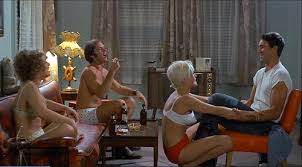
Betty tells a story no one really cares about.

When Bobby and Elton show up drunk to work, they are sent home, which leaves them stuck in morning rush hour traffic on their way back into town. Restless, Bobby gets out of the car and eventually climbs into the bed of a truck with a piano in it. Bobby starts to play Chopin’s Fantasy in F minor and gets so carried away that he doesn’t notice that when the traffic starts moving the truck takes off in a different direction. But somehow, Bobby ends up back in town and at the diner where Rayette is working.
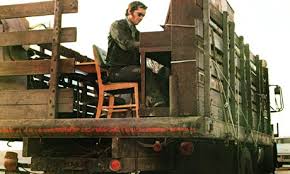
Bobby Dupea plays Chopin's Fantasy in F minor during a traffic jam. 

Bobby sort of finds out that Rayette is pregnant from Elton, though nothing is ever really talked about her condition for the rest of the film. Bobby reacts to the news by pushing Elton away and then quitting his job at the oil field. The second after he does, Elton gets arrested for a gas station robbery a year before that he has neglected to tell Bobby about. (So much for being old friends.) Immediately, it seems Bobby heads for Los Angeles. No reason is given, but he knows that his sister, Partita (Lois Smith), also a pianist, is making a recording there. Partita informs Bobby that their father, Nicholas (William Challee), has suffered a series of strokes. Bobby agrees to visit him on Puget Sound in Washington state. Next, we see Bobby having sex with Betty before going back to Rayette. Again no reason is given for the scene, but it just underlines what a rat Bobby is to Rayette. He packs a bag, just suits and shirts, and starts to leave. Obviously, though, Rayette has gotten under his skin, because before he drives away he gets mad at himself and goes back to ask her along.

On the way, they pick up two women, who are referred to in other synopses about the film as lesbians, Palm Apodaca (Helena Kallianiotes) and Terry Grouse (Toni Basil). Apparently, their car broke down and they force themselves on Bobby and Rayette. For a man that has little time for the rest of the world, the fact he lets them come along is a bit of a surprise and out of character. The two women are headed for Alaska, because Palm thinks there won’t be as much filth there. Palm literally talks so much Rayette and Terry fall asleep (and so could the audience). 

Pot calling the kettle black. Cigarette smoking Palm lectures the car about filth

This sequence goes on longer than was needed, if it was needed at all. The only purpose seems to set up the film’s most famous scene in which Bobby gets into a discussion about substitutions on the menu with a waitress (Lorna Thayer), involving wheat toast and chicken salad. Needless to say, Bobby’s solution gets the four kicked out. After more talk about filth, Palm and Terry are dropped off. It is not made clear if Bobby has tired of them or if this is the place they wanted to get dropped off. This lack of motivation is a hallmark of the movie.
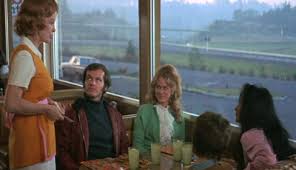
Most memorable scene in the movie. "I want you to put it between your knees."

Instead of taking Rayette home with him, Bobby sets her up in a motel with the promise to try to call her in a couple of days. It seems left to Rayette to decide how long she wants to wait and what she’ll do when she gets tired of waiting. When Bobby goes to his family home he meets Catherine Van Oost (Susan Anspach), a pianist, the fiancĂ©e of his brother, Carl Fidelio Dupea (Ralph Waite), a violinist, who has suffered a freak accident and has a permanently strained neck. Nicholas is an emotionless blob being cared for by a male nurse, Spicer (John Ryan). Over dinner, Bobby is attracted to Catherine and later tries to find some time they can be alone. She tells him she’ll be free when Carl goes into the mainland for treatment.

Before he goes to catch the ferry, Carl and Bobby, with Partita watching, play a game of ping pong. The purpose of this seems to be that Bobby can belittle Carl and feel better about his wanting to bed Catherine. Catherine asks Bobby to play something for her and he plays what he claims to be the easiest piece he knows, Chopin’s Prelude in E minor. While Catherine at first scorns him for his lack of feeling, she nevertheless sleeps with him and wants to sleep with him again while Carl is away.

Catherine (Susan Anspach) doesn't really like Bobby, but she's just about to sleep with him.

Rayette, after two weeks, gets bored at the motel and goes to the Dupea house unannounced. Her presence creates an awkward situation. Bobby, as is his way, runs away, only to return, crossing paths with Catherine who is on her way to pick up some friends. The most annoying friend turns out to be Samia Glavia (Irene Dailey), who talks in esoteric terms about everything and belittles Rayette about the latter’s love of television. But Bobby defends Rayette and lashes out at Samia for being a pompous ass. Storming from the room, Bobby goes looking for Catherine, instead finding his half-naked sister Partita getting a massage from Spicer. Angry now without cause, Bobby picks a senseless fight with Spicer, who easily overpowers him.

Bobby tries to convince Catherine to run away with him, but she refuses, telling him that she cannot because he doesn’t love himself and can’t expect love in return. In what is the closest thing to a climax Bobby tries to talk to his father. He tells him that he runs away from life when things get bad so that they don’t get worse. Seeing how Nicholas is comatose, he doesn’t respond. Frustrated, Bobby leaves with Rayette and heads back home. When they stop at a gas station, Rayette goes to get coffee at the diner next door. While she’s gone, Bobby abandons her, hitching a ride on a truck for Alaska while she’s inside. We watch as the truck drives off and Rayette goes looking for him.

Bobby tries to have a heart to heart with his father, Nicholas.

Praised at the time of its release as the future of Hollywood films, thankfully that has not proven to be the case. I don’t have a problem with stories that meander since sometimes the journey is the best part of the adventure, but this is a film full of unsympathetic characters that ultimately ends without any sort of resolution. While these sorts of films make for great fodder in film critical studies classes, they are not really all that entertaining or ultimately enlightening. This is an esoteric joyride, which is to say there is no joy at all.

Five Easy Pieces came out at the time when the anti-hero was emerging in Hollywood. The anti-hero is a protagonist without qualities we usually expect in the hero: morally good, idealistic, courageous, noble, etc. Under the production code, Hollywood had been forced to make films about upstanding people, so when the code went away, films could explore the darker side of the human equation. But all that doesn’t mean that the anti-hero can’t also be sympathetic. If we’re supposed to invest our time in a character, there should be some way for us to connect with him. Even Clyde Barrow in Bonnie and Clyde (1967) were portrayed as a victim of his circumstances and with some redeeming quality.

But Bobby has none and as an audience we’re not given any reason to care or root for him. He is a misogynistic self-absorbed ass, with talent, that he’s squandered. He cannot fit in with the intellectual world of his family nor can he make a place for himself in the blue-collar world of the California oil-fields.

Rayette is too dumb for words and cannot see that Bobby doesn’t care for her only that he puts up with her when it suits him. She is the puppy he kicks, but expects to lick his face when he wants attention. Catherine doesn’t love Bobby but sleeps with him anyway. Afterward, she can’t tell him enough about what a great man his brother Carl is and how good he’s been to her. What a prize she turns out to be.


Rayette (Karen Black) is too dumb for words in Five Easy Pieces.

Jack Nicholson is really good at playing Bobby. And except for squandering his talent, you have to think there is something of Nicholson in the character. To list all the films Nicholson has been in would take pages. He is a great success at playing misfits and outsiders and is good in lead roles as well as playing supporting characters. He has thrice won the Academy Award for acting, twice as Best Actor in One Flew Over the Cuckoo’s Nest (1975) and As Good As it Gets (1997). He won for Best Supporting Actor in Terms Of Endearment (1983).  While his career has slowed down as of late, his last film was James L. Brook’s How Do You Know (2010), he can afford to rest on his acting laurels if he so chooses.

Rafelson, who would team up again with Nicholson for a somewhat similar story, The King of Marvin Gardens (1972), would see his career get derailed by the popularity of such films as Jaws (1976) and Star Wars (1977), in which tastes shifted to spectacle and special effects. Rafelson’s films didn’t seem to fit in as studios shifted their attention from small films to ones that were supposed to hit home runs financially. He only made two more films in the ’70s, King of Marvin Gardens and Stay Hungry (1976). In 1981, he re-teamed with Nicholson in a failed remake of the classic The Postman Always Rings Twice. (Note: don’t remake good films.) The last film he directed was No Good Deed (2002).

The title of Five Easy Pieces refers to five simple pieces that are a primer for piano players: Frederic Chopin’s Fantasy in F minor; Johann Sebastian Bach’s Chromatic Fantasia and Fugue; Wolfgang Amadeus Mozart’s Piano Concerto No. 9 in E-flat Major; Chopin’s Prelude in E minor; and Mozart’s Fantasy in D minor. All of which get played in the film.

After watching this film again, I cannot recommend it. There are some interesting moments, some gems of dialogue, but they are too few and far between to make Five Easy Pieces worthwhile. This is a film whose big statement is to make no statement at all.

Monday, February 27, 2012

Stubs - Let It Be


LET IT BE (1970) Starring: John Lennon, Paul McCartney, George Harrison, Ringo Starr, Billy Preston, Mal Evans, Yoko Ono, and George Martin. Directed by Michael Lindsay-Hogg. Produced by Neil Aspinall. Songs by John Lennon and Paul McCartney, George Harrison and Ringo Starr. Run Time: 81 minutes. Color. UK. Documentary

It all comes down to this. The penultimate project of the Beatles as a group before breaking up, Let It Be documents the disintegration of the band that defined music in the 1960s. What the documentary set out to do was something very different. After the unpleasant recording sessions for the previous album, The Beatles aka The White Album, the group wasn’t sure how to proceed. Despite the album’s title, the recording sessions had been less a cooperative effort, with Paul and John oftentimes recording in different studios. George Martin, the Beatles longtime producer, left for a holiday in the middle of the sessions and even Ringo quit the group for a couple of weeks, tired he was of how things were going.

By 1969, Paul had taken over leadership of the band. He was filling the hole left when John, who was more fascinated with Yoko Ono than the Beatles, abdicated his position as leader of the group. Paul wanted very much for the band to continue and looked for ways of creating harmony. His first idea was to tour again, but the others were not open to it. Then the idea was to play a live concert, but once again, despite throwing around a lot of ideas, they couldn’t decide on one. They finally decided on a TV special of the band performing new songs and it was suggested that they film their rehearsals as part of perhaps a companion special. To this end, the Beatles hired Michael Lindsay-Hogg, the director of some of their earlier promotional films for "Paperback Writer", "Rain", "Hey Jude" and "Revolution".

Filming began on January 2, 1969, at Twickenham Film Studios in London. Since the group was working with a film crew, they had to work more during the day rather than at night, which had become their preferred work time. The film studio, unlike Abbey Road Studios, where the group had done most of their recordings, was cold and austere. This combined with being followed around constantly by a camera crew and it is easy to see that tension within the group did not get better. 


Twickenham Studios was not conducive to recording and harmony. 
On January 10th, Harrison announced he was leaving the band (in a scene omitted from the film). While rehearsals and filming continued in his absence, Harrison did agree to return on the 15th. However, he had conditions, including moving the recording sessions to Apple Records and abandoning the idea of an elaborate live concert. 


George also wanted Billy Preston (l) to be in on the sessions.
However, filming was to continue for a feature film to complete the group’s obligation to UA for a third film. (UA did not accept their brief live appearance in Yellow Submarine as a Beatles film.)

On January 21st, filming began again. In order to improve the vibe, George invited Billy Preston, a keyboardist the Beatles had known since 1962 to join them. During these sessions, the Beatles apparently played many songs that were not featured in the film or would appear on a Beatles record. During the film, we do see the band run through McCartney’s "Teddy Boy", which appeared on this first solo album the next year. They also work on some songs that would appear on the next and last studio album, Abbey Road; "Maxwell Silver’s Hammer", "Oh! Darling" and "Octopus’s Garden".

In an effort to complete the film, the Beatles agreed on January 30th, to do a lunchtime rooftop concert. From those sessions, the next Beatles single "Get Back" and its B-side; "Don’t Let Me Down" would be culled.


The last Beatles live appearance was the lunchtime rooftop concert that ends Let It Be.
The final film shows the Beatles falling apart, but still managing to make some pretty good music along the way. One of the original concepts of the album was to just have the Beatles play, and the film retains some of that with Paul singing "Besame Mucho", a standard they no doubt covered in Hamburg and used in their Decca audition. The group also plays covers of "You’ve Really Got a Hold on Me", "Rip It Up", "Shake, Rattle and Roll", "Kansas City", and "Lawdy Miss Clawdy" and others from their Hamburg days, some which they had previously released.

Despite the bickering, which the film manages to document, including a famous exchange between George and Paul prior to the former’s departure, there is a feeling of nostalgia. Paul can be seen talking about footage of them he had recently seen of images of them following after the Maharishi Yogi looking like they were in a trance (if memory serves me.) The group also rerecords one of their earliest songs "One After 909", the original recording of which dates back to March 1963 and can be found on the Beatles Anthology 1 album.

And despite the discord one can sense while watching, the Beatles still manage to make some great songs, including "Get Back", "Don’t Let Me Down", "Two of Us" and "I’ve Got A Feeling", all of which seem to show the Beatles enjoying playing together. "I’ve Got A Feeling" is a throwback of sorts, as it seems to be a combination of snippets that John and Paul had written individually, a la "A Day In The Life" from the Pepper album.


John and Paul could make great music together. Here they're singing "Two of Us".
Overall, the quality of the film is not helped by the fact that the original footage was shot in 16mm, blown up to 35 mm and then edited from full-frame to a wider aspect ratio by cropping off the top and bottom of every frame. So the resulting film is grainy and the composition within the frames differs from what was originally shot.

There are two problems with writing a review of the film Let It Be. First is that the soundtrack album, produced by the infamous Phil Spector, features versions of songs not found in the film, leaves out "Don't Let Me Down" entirely and, of course, the songs are overdubbed, in some cases adding strings and a choir. An attempt to correct that, Let It Be…Naked, really isn’t much better. McCartney’s 2003 attempt to strip away Spector’s Wall of Sound, sometimes uses different takes than what appeared on the 1970 soundtrack. Naked also changes the running order and eliminates the ambient talking. So one can’t listen to either and remember how it was shown in the film.


The album Let It Be isn't a true soundtrack to the movie of the same name.

The second problem is that this final Beatles film has never been released on DVD, though it was briefly released on VHS in the 1980s. It is reported that the surviving Beatles, Paul, and Ringo, don’t want it released since it shows the group in a bad light. And that is true. 

This is not the happy go lucky Beatles of A Hard Day’s Night. This is the real group at the precipice of its own dissolution. But by now, everyone knows the story and no one would be shocked to watch them bicker their way through another project. The Beatles themselves discussed the end of the group in their own Anthology documentary series.

But for a group that wanted to give their fans the best they could, it is time to once again let the fans see the men behind the curtain. Let It Be should be released so that the fans of the group can see the reality of what happened and not rely on the memories of those who managed to see it before the Beatles withdrew it from the public.

For other Beatles films, see our Beatles Film Review Hub: http://trophyunlocked.blogspot.com/2014/02/review-hub-beatles-on-film.html

Sunday, August 14, 2011

Stubs - Patton


PATTON (1970) Starring: George C. Scott, Karl Malden, Michael Bates, Karl Michael Volger. Directed by Franklin J. Schaffer. Screenplay by Francis Ford Coppola and Edmund H. North; based on Patton Ordeal and Triumph by Ladislas Farago and A Soldier’s Story by Omar Bradley. Music Composed by Jerry Goldsmith. Produced by Frank McCarthy. Run Time 172 minutes, Color. U.S. Biography, War.

This is an epic film about a larger than life figure, General George S. Patton. Set during World War II, the movie tells the mostly true life adventures of one of the great generals to ever serve in the U.S. Army. A poet, a believer in reincarnation, but still a devote Christian, Patton is a complex man. Patton’s biggest enemy wasn’t the Germans, rather it was himself. Brilliant with war strategy, Patton got into trouble over things he said and how some of his actions were covered by the press.

George C. Scott, who throughout his career gave great performances in such films as ANATOMY OF A MURDER (1959); THE HUSTLER (1961); DR. STRANGELOVE, OR HOW I LEARNED TO STOP WORRYING AND LOVE THE BOMB (1964), seemed to find a defining role as the foul-mouthed, Bible reading, Blood and Guts Patton. Scott got the role when the likes of Rod Steiger turned it down and made the most of the opportunity. His portrayal was good enough to earn Scott the Academy Award for Best Actor, a well-deserved accolade that the actor turned down.

Karl Malden, himself an Academy Award winner [Best Supporting Actor for A STREETCAR NAMED DESIRE (1951)], portrays Omar Bradley, who was also known as the G.I.’s General. As down to earth as Patton was a diva, Bradley was nevertheless an important part of the war effort. But Bradley is portrayed as more of a plodder to Patton’s genius, and as someone who gets promoted by not rocking the boat. Eventually, Bradley becomes his old friend’s superior officer.

The film starts with the arrival of Patton in North Africa, where he takes over the command of the U.S. forces, who had recently suffered a devastating loss to the Germans, led by Field Marshall Erwin Rommel (Karl Michael Volger). While Patton was bigger than life, he expected his men to toe the line when it came to being disciplined soldiers. He turns his troops around and hands Rommel a major defeat.

This leads the Germans to have an increased awareness of Patton. He becomes someone they both admire and fear. And they find it hard to believe he is later punished for slapping a soldier suffering from battle fatigue, which is tantamount to cowardice in Patton’s eyes. It is the furor over this incident that makes you wish Patton could have learned from his mistakes, because he keeps making them.

When his plans for the invasion of Sicily are scuttled for ones drawn up by Field Marshall Sir Bernard Law Montgomery (Michael Bates), Patton goes along, but only long enough until he can go his own way. Ultimately, Patton disobeys orders but is there to meet Montgomery when he marches into Mesina.

After the slapping incident, Patton is sidelined by Allied Forces. With the Germans believing Patton will lead the invasion of Europe, the Allied Forces set him up with the fictitious First United States Army Group in southern England. But Patton isn’t satisfied with being the commander of a dummy army and fearing he is missing out on his destiny, Patton pleads for reassignment.

Given the U.S. Third Army by Eisenhower, he marches through Europe, stopped only when supplies are diverted to other troops, including Montgomery’s. Still Patton plays a major part in the defeat of the Germans. But when the German’s surrender, Patton is relieved of command because of things he has said, including comparing the Nazi Party to the Democrat and Republican Parties in the U.S. and for badmouthing our then allies, the Russians, whom Patton felt we were destined to fight next.

Perhaps the most interesting aspect of the film isn’t the war and battle scenes, it’s the relationships between the generals. While the film concentrates more on the relations between Patton and Bradley, there is also the more important one, career-wise, between Eisenhower and Patton. Eisenhower is often referred to, but never seen in the movie. Rather he is shown working through intermediaries, like and Major General Walter Bedell Smith (Edward Binns). This leaves the viewer with the idea that Eisenhower never dealt directly with Patton, though in real life he did. Since they were close friends before the war, it must have been difficult for Eisenhower to have to discipline a man he once considered his mentor.

There is also the battle of the divas between Patton and Field Marshall Sir Bernard Law Montgomery (Michael Bates). Throughout the movie, Patton always seems to be competing with Montgomery for both supplies and the spotlight. While they have a common enemy, the Germans, there appears to be no love lost between these two as they fight alongside and with each other throughout Africa, Sicily and Europe.

Technically, this is a great movie. The battle scenes are still quite powerful to watch and the re-enactments seem very real even by today’s standards; maybe even more so. One of the differences is that there are no CGI special effects. This makes the action more real and more visceral.

This is simply a well-made film and it succeeds on all levels, both in front of and behind the camera. It is no surprise that it would win not only the Best Picture, in addition to Actor, but also Best Art Direction – Set Decoration, Best Director, Best Editing, Best Sound and Best Writing, Story and Screenplay based on Factual Material or Material Previously Published or Produced.

Patton is more than a war film. One of the great films of the 1970’s, it is driven as much by the characters it develops as by the action it depicts. Patton is a biography that shows all of its subject’s warts, faults and eccentricities, well as the attributes that made him a hero.