Showing posts with label Roy Rowland. Show all posts

Saturday, November 21, 2020

Stubs - Scene of the Crime


Scene of the Crime (1949) Starring Van Johnson, Arlene Dahl, Gloria De Haven, Tom Drake, Leon Ames, John McIntire, Donald Woods, Norman Lloyd, Jerome Cowan, Tom Powers Directed by Roy Rowland. Screenplay by Charles Schnee. Produced by Harry Rapf Run time: 95 minutes. USA Black and White. Crime, Drama, Film Noir

Under the leadership of Louis B. Mayer, MGM studios was Hollywood's "Tiffany Studio” with a long history of making glamorous films, especially musicals. Unlike Warner Bros., which was now for its gangster films, with a few exceptions, MGM did not deal with those kinds of films. Things began to change in 1948, when Dore Schary returned to the studio, after a stint at RKO, to replace Mayer as the head of production.

One of the films the studio made, post this transition, was Scene of the Crime.

Saturday, August 26, 2017

Stubs - A Night at the Movies


A Night At the Movies (1937) Starring Robert Benchley, Betty Ross Clarke, Gwen Lee. Directed by  Roy Rowland. Screenplay by Robert Lees, Frederic I. Rinaldo, Robert Benchley. Produced by Jack Chertok Run Time: 10 minutes. USA Comedy, Short

Following the success of How To Sleep (1935), MGM kept producing Robert Benchley Miniatures. While all featured Benchley, unfortunately not all of them were also written by the humorist. How to Behave (1936), How To Train a Dog (1936), How to Vote (1936), How to Be a Detective (1936), The Romance of Digestion (1937) and How to Start The Day (1937) followed, but with much less fanfare and accolades. That changed with A Night At The Movies (1937).

Robert Benchley and wife (Betty Ross Clarke) look for a movie to see.

The film opens with Robert Benchley and his wife (Betty Ross Clarke) looking at the newspaper looking for a movie to go see. The problem is that they’ve each seen one of the two movies that are playing at their neighborhood theater. The solution is that they go see a film he has already seen, Souls on a Tandem.

Trying to communicate with the girl in the box office.

Now, these are the days before online ticket buying and reserved seats, so they actually have to go to the theater's box office to purchase them. There are other differences between their experience and the modern moviegoer’s. The theater is having a drawing to give away a car and there are ushers in uniforms to help them, though they don’t help them actually find a seat. Rather, they ask for their ticket, which it turns out he has put in for the raffle.

The theater has a raffle. Benchley will accidentally put his theater tickets in the raffle box.

Their lack of tickets causes the Usher, one of several on duty, to call over her supervisor, Mr. Pennelly (Hal K. Dawson), who doesn’t believe Benchley, so he calls over the theater manager, Mr. Baum (Frank Sheridan). Mr. Baum makes the command decision and lets them go inside.

The agent calls Mr. Pennelly (Hal K. Dawson) and Pennelly calls for Mr. Baum (Frank Sheridan).

But once they find seats, all is not well. Benchley fumbles with what to do with his hat, but the real annoyance comes from a staring child (Ricardo Lord Cezon) who unnerves Benchley. 

Little boy stares at Benchley.

While he is busy being stared down, a rather large patron (Jack 'Tiny' Lipson) sits in front of him and totally blocks his view. Benchley’s fidgeting to see around ‘Tiny” irritates the man sitting behind them, so Benchley decides to move.

Jack "Tiny" Lipson sits down in front of Benchley and blocks his view.

His first choice of seats gets nabbed by a faster younger couple, forcing them to look for seats closer to the screen. But sitting so close and to the side causes the image to look distorted.

Sitting too close distorts the motion picture.

Feeling dry, Benchley pops a lozenge, probably a Lifesaver, into his mouth after offering one to the Mrs. But he begins to cough and despite his wife’s help, he seeks solace to recover. Accidentally, he ends up outside and locked out.

Benchley manages to get locked outside the theater.

His wife doesn’t seem to notice that Benchley is missing until the lights come on between features.
On stage, a live prelude with dancing girls starts their routine. Meanwhile, Benchley searches for a way in and finds an unlocked door. You can see it coming, so it is no surprise that Benchley walks out onto the stage in the middle of the dancer’s routine. A little embarrassed, Benchley exits the stage and the film ends.

At the end, Benchley walks out into the middle of the live prelude.

Released on November 6, 1937, A Night at the Movies was Benchley’s best-received miniature since his first one. The film was even nominated for an Academy Award for Best Short Subject (One-Reel), losing to The Private Life of the Gannets (1934), a British documentary about a colony of Northern Gannet (Morus bassanus) on the small rocky island of Grassholm, off the coast of Wales produced by Alexander Korda.

The director, Roy Rowland, would helm many different types of films in his career. In addition to comedy, he also directed romance: Lost Angel (1943); film noir: Scene of the Crime (1949); musical fantasy: The 5,000 Fingers of Dr. T; suspense: Witness to Murder (1954); and even spaghetti Westerns: Gunfighters of Casa Grande (1964). Rowland would never get further than being considered a journeyman director, able to work in many genres, but a master of none.

Similar to How To Sleep, A Night At the Movies is all about Robert Benchley. The film relies on his presence because without it, it would verge on being unwatchable. And like his first miniature, it deals with a situation many people have experienced themselves. Who hasn’t had a bad experience at the movies?

But even the relatable premise and the presence of Benchley are not enough to save it. There seems to be something missing this time around. Less an instructional film, A Night At the Movies feels much less structured and almost seems to be ad-libbed in places.

Again, the short provides the modern viewer a look back at life in the 1930s. Films were the main out of the house entertainment and it wasn’t unusual for a couple to go out during the week to see a movie; there was no Netflix or DVDs or even TV. Also, there wasn’t necessarily a firm start time as people would enter the theater when they got there and not wait for the next showing. (You can thank Alfred Hitchcock’s 1960 Psycho for changing that.)

All that said, A Night at the Movies was not quite as much fun to watch as How To Sleep and therefore I can’t recommend it.

Saturday, September 17, 2016

Stubs – Witness to Murder


Witness to Murder (1954) Starring: Barbara Stanwyck, George Sanders, Gary Merrill. Directed by Roy Rowland. Produced by Chester Erskine. Screenplay by Chester Erskine and Nunnally Johnson (uncredited). Run Time: 83 minutes. U.S. Black and White. Suspense

This film has B-Movie written all over it. While the cast is good: Barbara Stanwyck (the femme fatale from Double Indemnity (1944)) with George Sanders and Gary Merrill (both known for their work in All About Eve (1950)) and the premise, a single woman witnesses the brutal strangulation of another woman, is intriguing, it is the execution that holds this film back from being really good.

Stanwyck, who had one of the most interesting careers in Hollywood, was watching that career transition. At 47, she was a little old to be playing some of the roles that she had once been associated with, such as the Burlesque queen in Ball of Fire (1941) and seductress as she played in the aforementioned Double Indemnity. An Academy bridesmaid, Stanwyck had been nominated four times as Best Actress for her work in Stella Dallas (1937); Ball of Fire; Double Indemnity and Sorry Wrong Number (1948), but never won the award. By 1954, her best roles were behind her, though she was far from done in films or on television. She might be best remembered by a certain generation for her four-year turn as Victoria Barkley on TV’s The Big Valley (1965-1969).

Cheryl Draper (Barbara Stanwyck) is awakened in the middle
 of the night and  happens to look out her window.

In Witness to Murder, Stanwyck plays Cheryl Draper, a single woman who works as an interior designer at Sloane in Beverly Hills (W & J Sloane would get a credit for supplying furniture for the movie. Can anyone say product placement?). A trick of the light awakes Cheryl and as she gets out of bed to close her drapes, she looks out the window. What she sees will change her life forever.


Albert Richter (George Sanders) disposes of Joyce Stewart (Lyn Thomas).

Across the street, through the open window, she sees Albert Richter (George Sanders) strangling a woman. In the struggle, the woman rips the curtains, but can’t fight Richter off. When the killing is over, Cheryl calls the police. Richter sees the police cars arrive and, taking his time, hides the woman’s body in the conveniently unlocked and unoccupied apartment down the hall. Police Lt. Lawrence Mathews (Gary Merrill) and Sgt. Eddie Vincent (Jesse White) arrive and speak to Cheryl before going across the street.

Detective Lawrence Mathews (Gary Merrill) and Eddie Vincent
 (Jesse White) interview Cheryl about what she saw.

At Richter’s apartment, the police do what at best could be considered a cursory investigation. They don’t notice the ripped curtain or the woman’s earring that Richter clumsily conceals. Satisfied that it is nothing, the police go back across the street to speak to Cheryl. Richter can see the apartment they’re going to. Mathews is very dismissive of what Cheryl claims to have seen, trying to convince her it was only a dream.

The next day, Cheryl notices Richter doing something suspicious.

But the next morning, Cheryl watches as Richter loads a large crate into the back of his car as she leaves for work, which is slap-you-in-the-face suspicious. At work, Cheryl can’t concentrate, so after a run out to far away Van Nuys to meet with a client, she goes over to Richter’s apartment building. The manager (Dick Elliott) is only too eager to show her a vacant apartment, which happens to be the same one that Richter had temporarily hidden the dead body in. She notices drag marks on the floor. When she says she would need to see an apartment that’s furnished, he takes her, without permission, into Richter’s apartment.

There she sees a pair of earrings on his desk, which she pockets. Richter though happens to be in the hallway when she leaves and notices that the earrings are missing. Cheryl beelines it down to police headquarters and straight to Lt. Mathews, but Richter has already reported the theft of the evidence. Richter also comes down unannounced. He apparently already knows Cheryl’s name, though they’ve never been formally introduced. He refuses to press charges and Cheryl is set free.


Cheryl thinks she's found evidence, but she is almost charged with theft.

Mathews takes more than a professional interest in Cheryl. He comes over to see her and talks her into letting him take her out to dinner. We learn from Mathews that he knows Richter’s past as a former Nazi, which is shorthand in anyone’s book for evil. Currently, he claims to be an author, though his books don’t sell, and historian. Richter is currently engaged to the widow of a rich banker, who lives in Pasadena.

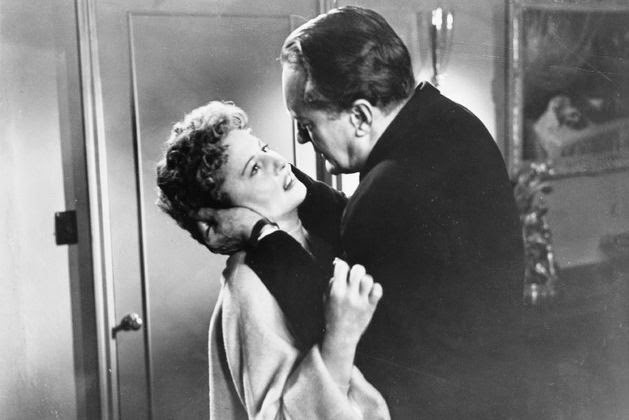
Cheryl, who has bought a copy of Richter’s book, reads a passage from it that reveals a Nazi elitism in his views for the role of violence in society. Mathews also reveals what he knows about Cheryl’s backstory; former architecture student, she was once engaged to a boy who died in the war, which she doesn’t seem to have completely gotten over. Mathews, whose sole purpose at this point is exposition, tells Cheryl that he’s going to law school at night, is six months from his degree and hopes one day to be a respected judge. We can tell that Cheryl is somewhat attracted to Mathews, but their fledgling relationship gets off to a rocky start when Richter posts a letter to himself as if written by Cheryl. He even goes so far as to confront her with his own letter in her apartment. He tells her he won’t press charges and balls up the letter in front of her.


Richter confronts Cheryl over letters he accuses her of writing.

But the confrontation is only a ruse to get inside her apartment so that he can jimmy with her door lock. Upset by his intrusion and allegation, Cheryl hurries out to look for Mathews, but, of course, doesn’t check to see if the front door to her apartment is locked. Richter sneaks back in and types more blackmailing letters to himself on her conveniently obvious typewriter. He even retypes the first letter he’d sent himself.

Well, Richter goes so far as to complain to Mathews’ superior, Captain Donnelly (Harry Shannon), about the multiple letters he’s received. Mathews tries to let his Captain let him handle the situation, but it’s already too late. Cheryl has been called down to the station, where Donnelly accuses her of writing the letters and produces, as evidence, the typewriter from her office (can anyone say illegal search and seizure?). He brow beats her into conceding that it looks bad and commits her to a psychiatric ward for observation. Richter is trying and succeeding at ruining her reputation as a witness. But Mathews gets her out.


Cheryl ends up in a psychiatric ward before Mathews gets her out.

Meanwhile, a naked woman’s body has been found in Griffith Park and has been identified based on her fingerprints. Mathews cajoles his partner into doing a little moonlighting on someone else’s case. They go to the woman’s apartment with the Richter’s book jacket photo and ask around if anyone had ever seen him around. But no one has. They go into her apartment, which is being babysat by a policeman (Claude Akins). There they find, in the possessions of a woman described as a dancer/hooker, a copy of Richter’s book. That is enough evidence for Mathews to draw a connection between the dead woman and Richter. They hurry to Cheryl’s apartment.

But Richter is already inside Cheryl’s apartment (did she never lock her front door again?). He reveals to her his master plan, using his thinking and his fiancée’s money he can rule the world, so to speak. But the blonde was in his way and now so is Cheryl. He decides that it’s time for her to commit suicide and has even conveniently typed out her suicide note. But Cheryl fights him off. When a policewoman Mathews has sent over to check on her arrives, she, of course, misreads the situation and assumes Cheryl is crazy. A foot chase takes place with Cheryl gathering a posse of Richter, the policewoman, bystanders and eventually Mathews and Vincent.


Things get heavy for Cheryl before she manages an escape.

Cheryl runs to a building site and runs up the scaffolding to the top of the building, (Why do women in distress run up buildings rather than stay on the ground?) Richter pursues her and manages to toss her over the side before Mathews can make it up the stairs. We’re shown that quite a crowd has miraculously assembled below with police holding back the lines of spectators (How did they organize so fast?). But Cheryl falls only a few feet to a conveniently-placed scaffold. Mathews and Richter struggle, with Mathews managing to pitch Richter down a multi-story shaft to his assumed death.

A conveniently placed scaffold saves Cheryl's life.

But in one more suspense scene, Mathews has to get Cheryl off the scaffolding before it collapses. And wouldn’t you know it he does, grabbing her wrist just as the scaffolding falls. Cheryl becomes so much “dead” weight that the policemen have to pull her up and into Mathews’ waiting arms. And off they walk to a presumed happy ever after.


Cheryl has to be hauled up like so much dead weight.

In my review of Double Indemnity, I had referred to Witness to Murder, in discussing Stanwyck’s career, as “highly under-rated.” Having seen it more recently I need to adjust my proclamation. This is really just an okay movie with problems that keep it from being better. Some of those problems have to do with the writing. Chester Erskine is a bit of a mystery as a writer. His best-known film was The Egg and I (1947), a comedy which paired Fred MacMurray and Claudette Colbert about a woman who finds out her new husband wants to be a chicken farmer (a precursor of sorts to the Green Acres TV Series). But the film is perhaps best remembered for introducing the Ma (Marjorie Main) and Pa (Percy Kilbride) Kettle characters that would go on to have their own series of films. Hardly the resume for writing suspense. On the other hand, Erskine wrote and produced the excellent film noir, All My Sons (1948), which is far superior to the effort here.

The script seems to rely on exposition rather than showing and there are far too many conveniences and shortcuts. Why would an empty apartment be unlocked? Why didn’t Richter just walk away from Cheryl after it was shown she was thought to be unreliable? Why was there a scaffold just right where it needed to be when there didn’t seem to be any purpose for it? Making Richter a former Nazi is too easy a way to make him a villain. I could go on and on with problems with the story. And try as hard as Cheryl does, she never really gets anything on Richter until he confesses to her, which again was just dumb on his part.

This is far from Stanwyck’s best performance. Merrill is, I’m afraid, not that great of an actor, but his Mathews is a little too one-note good cop. His fight with Richter seems to be a little out of left field since up until now his character has been milquetoast. Jesse White seems clearly on his way to being the lonely Maytag repairman, a part he played in TV commercials from 1967 to 1988, as he seems to spend most of the film at a desk waiting for the phone to ring.

Witness to Murder is an example of a concept that gets handled better by a better director. The premise of seeing a murder from your window and then having to convince the police it really happened was also the basis for Alfred Hitchcock’s Rear Window (1954), which came out later the same year as this film. Rear Window is considered a classic and Witness for Murder is not. If the premise intrigues you, I’d recommend Rear Window.