
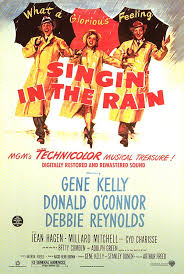
SINGIN’ IN THE RAIN (1952) Starring: Gene Kelly, Donald O’Connor, Debbie Reynolds. Directed by Gene Kelly and Stanley Donen. Screenplay by Betty Comden and Adolph Green. Produced by Arthur Freed. Run Time: 103. Color. U.S. Musical, Comedy.
Okay, it seems to me that I’m starting to let Turner Classic Movies determine the titles I write about for this blog. The film, celebrating its 60th anniversary is being shown in an encore presentation at movie theaters around the country next week. This isn’t the old revival type of release, either, but a digital cinema presentation, sort of akin to pay per view on a really big TV screen, but with only one start time to choose from. Some things are better left on film.
The first time I saw Singin’ in the Rain, I was in Junior college, taking an English course that was basically watching movies and writing a few papers on what we had seen. At the time, I was not a big fan of musicals (not that I’m a really huge fan now) and I thought the film was rather silly. I remember writing in my critique that I thought the lyric: “Moses supposes his toeses are roses” was exceptionally so.
Several years later, I’m more open to the musical genre on film and have already written praises of a few on this blog. It is time now to write appreciatively about Singin’ In The Rain. I’m not a fan, in that I’ll watch any musical, but if they’re good and star someone other than Barbara Streisand or Jeanette MacDonald, I might give it a go.
While thinking about what to write about this film, I’m struck by the similarities in the story between this film and last year’s Academy Award-winning The Artist. Both films deal with Hollywood’s transition from silent films to talkies and in particular the impact of the change on the leading man, who starts out as an action-adventure star and ends up as a song and dance man. In fact, Jean Dujardin, who played George Valentin, has acknowledged that Gene Kelly inspired his work. [It should be noted that both Dujardin’s Valentin and Kelly’s Don Lockwood are homages to silent swashbuckling star Douglas Fairbanks.] And whereas The Artist dealt with this transition by staying black and white and silent through 99% of the film, Singin’ In the Rain, depicts the change through vibrant Technicolor and music.
One of the differences though is that while The Artist seems to concentrate on the characters over the technology, Singin’ In The Rain actually provides a bit more of a history lesson, actually showing what went on behind the scenes with vocal coaching and microphone placement. And while I’m sure a true film historian might quibble with this, I think the film is fairly accurate with this portrayal.
The films opens, again like The Artist, at a Hollywood movie premiere. Lockwood and his film love interest Lina Lamont (Jean Hagen) are linked romantically by their studio’s, Monumental Pictures, publicity department. The problem is Lina believes her own publicity, despite Lockwood’s attempts to keep her at arm’s length.
One day, while to get away from his fans, Lockwood climbs into a car driven by Kathy Selden (Debbie Reynolds). Kathy, who claims to be a stage actress, holds Lockwood in disdain. At a party, R.F. Simpson (Millard Mitchell), the head of Monumental, shows a Vitaphone short demonstrating talking pictures. But no one in attendance is impressed or sees the writing on the wall. When a cake is wheeled out, Kathy, to Lockwood’s amusement, pops out. But Kathy doesn’t appreciate Lockwood’s teasing and throws real cake at him, but hits Lina instead. Later, Lockwood manages to find Kathy, who is working, oddly enough, as an extra on another Monumental production and they begin to fall in love.
But the winds of change are already blowing. Warner Bros.'s success with the Jazz Singer in 1927 turns Hollywood on its ear. R.F. makes the decision that talkies are the wave of the future and decides to turn Lockwood’s and Lamont’s latest film, The Dueling Cavalier, into a talkie. The problem is Lina’s voice, which is comical at best. The studio hires a diction coach, but they only get exasperated (and where we get “Moses supposes”). A test screening is also a disaster and when the sound gets out of synch, the results are unintentionally funny.
Don’s best friend, the multi-talented Cosmo Brown (Donald O’Connor) gets the idea to dub Lina’s voice with Kathy’s. Together they persuade R.F. to turn The Dueling Cavalier into a musical, The Dancing Cavalier, complete with a modern sequence, called Broadway Melody, which seems out of place from the get-go (if you asked me). Lina finally clues into the romance between Kathy and Lockwood and tries to break them up. She even becomes angrier when she finds out about her voice being dubbed and R.F.’s plans to give Kathy a screen credit and publicity push. Lina threatens to sue unless R.F. forces Kathy to remain anonymous. R.F. reluctantly capitulates.
While The Dancing Cavalier is a crowd-pleaser, the audience at the premiere clamor for Lina to sing live. R.F., Don, and Cosmo convince Lina to lip-synch to Kathy singing behind a curtain. When the audience applauds, R.F., Don, and Cosmo raise the curtain to show Kathy is really doing the singing. Lina is embarrassed and runs away. Kathy starts to do likewise, but Don announces to the crowd that Kathy is the real star of the film. The film ends with Kathy and Don kissing in front of a billboard for their next film, aptly named Singin’ In The Rain.
There are so many things great at work in this film that make it successful. To start off with, Gene Kelly is a tremendously talented dancer. He doesn’t have Fred Astaire’s finesse, but he makes up for it with athleticism. At the time of Singin’ In the Rain, Kelly had just come off starring in the Academy Award-winning An American in Paris, a musical inspired by George Gershwin’s music, especially the orchestral work from which the film got its name.
Kelly co-directed and co-choreographed the film with Stanley Donen. Donen had come to Hollywood to work for Kelly as an assistant choreographer. They had previously co-directed On The Town (1949) together. Despite their working relationship, the two did not end up as fast friends. Part of the problem was that Donen didn’t feel Kelly gave him the respect and credit he deserved and part of it was the fact the two men both married the same woman, dancer Jeanne Coyne.
Donen was a talented director on his own, included in his canon are Royal Wedding (1951), Funny Face (1955), Indiscreet (1958), Charade (1963), Two For the Road (1967), Bedazzled (1967) and Movie Movie (1978).
You wouldn’t know to look at her on the screen, but at the time she made Singin’ In The Rain, Debbie Reynolds was not a dancer. While she had been a gymnast, Kelly was upset with her lack of experience. Fred Astaire, who happened to be hanging around the studio, offered to help her with her dancing.
Reynolds is a little force of nature. She can sing and dance, as demonstrated in this film and many others; she could also act. In the epic Cinerama western How the West Was Won, Reynolds’ character Lilith Prescott is the thread that holds the film together. She has also proven to be a smart businesswoman, buying warehouses of movie costumes and props, which she has recently been selling for a profit. She is also the mother of Princess Leia, Carrie Fisher. She continues to act, appearing in Albert Brook’s Mother (1996) and has an appearance in One For the Money (2012).
Donald O’Connor began acting in films at the age of 12, appearing with Bing Crosby in Sing, You Sinners (1937). He worked at Universal in 1942, hitting it big with Mister Big (1943). After serving in the Army during World War II, O’Connor returned to Hollywood and got a unique co-star, Francis (1949), the talking mule. He would make a Francis movie every year until 1955. He got an illness from Frances that prevented him from appearing again with Bing Crosby in White Christmas (1954), a part that would go to Danny Kaye. O’Connor is the comedy relief in Singin’ In The Rain and is perhaps best remembered for the dance number Make ‘Em Laugh from that film.
And what is a musical without songs? Singin’ In The Rain recycles many songs from previous MGM musical films, including the title track, which originally appeared in Hollywood Revue of 1929, itself an early talkie and only the second musical produced at the home of Hollywood musical’s MGM. “Fit as a Fiddle (And Ready For Love)” was originally in College Coach (1933); Going Hollywood (1933) provided “Temptation” and “Beautiful Girl”; “Good Morning” is from Babes in Arms (1939), and so on and so on. There are only two original songs; “Moses Supposes” and “Make ‘Em Laugh”, with the latter considered by many to plagiarized from Cole Porter’s “Be A Clown”.
But it is the production numbers that this film is best known for. Who can forget Kelly sloshing his way through a downpour in “Singin’ In The Rain”, O’Connor’s athletic dancing in “Make ‘Em Laugh” or Kelly, O’Connor, and Reynolds dancing their way through “Good Morning”. Reynolds danced so hard in the latter that her feet began to bleed. “Broadway Melody Ballet” always seems a little tacked on to me, but it is still a very impressive number featuring Cyd Charise, whom Kelly chose over Reynolds.
There is very little not to like about Singin’ In The Rain. If you’ve never seen it, you are in for a real treat. One of the last great MGM musicals, Singin’ In The Rain, is something to behold.

