Monkey Business (1952) Starring: Cary Grant,
Ginger Rogers, Charles Coburn, Marilyn Monroe, Hugh Marlowe Directed by Howard
Hawks. Produced by Sol C. Siegel. Screenplay by Ben Hecht, Charles Lederer and I.A.L. Diamond. Run Time: 97 minutes. U.S. Black and White. Screwball
Comedy
Sometimes it seems that Hollywood
becomes derivative, telling the same stories over and over again, rebooting, retelling
and making sequels of the same story, whether it’s Spider-Man or Batman or the
Fantastic Four or the Pirates of the Caribbean. The excuse is the cost of
making big budget films. Studios are cautious, if unwilling, to spend large
amounts of money on untried stories, rather hoping that the tried and true will
bring audiences in for more of the same.
Of course, this retelling of
stories is nothing really new. Hollywood has always been making films like
other films that were popular. In the case of Hollywood during the 30’s, 40’s
and 50’s, the assembly line approach sometimes did not allow for great
innovation and originality. Sometimes filmmakers were forced to rely on their
own works for inspiration. In the case of Monkey Business (1952), I would not
be the first to recall Hawks' earlier film Bringing Up Baby
(1938) to which this has more than a passing resemblance, including the
male lead.
Howard Hawks is one of the true
greats of the Hollywood studio era, so you can’t blame him for borrowing from
himself. Originally called Darling, I’m Growing Younger, the film was not going
to star Grant, with whom Hawks had already worked four times, but rather Danny
Kaye and with Ava Gardner instead of Marilyn Monroe.
But casting weren’t the only
changes. The original screenplay was rejected on February 6, 1952 by the Breen
Office stating: "the reason for this
unacceptability lies in the fact that the story of Dr. Fulton's youth formula
amounts to a story of the invention of an aphrodisiac, which mainly exploits
the lurid, or what might be called 'sexsational' aspects of such a drug." Sex was a definite no-no under the
Production Code, which was definitely being enforced at the time. Hawks and
producer Sol C. Siegel met with the PCA and agreed to make changes, including
changing formula name from “Cupidone" to a "pseudo-scientific type
of vitamin," and toning down Oliver Oxly’s sexual interest in Lois Laurel.
The changes must
have not been too severe, since the PCA approved the amended screenplay and
production began on March 5 and continued until late April, 1952. The film
would have its opening five months later on September 3, 1952.
The film begins
with Cary Grant opening the front door of a house and being told by an
off-screen Howard Hawks "Not yet, Cary” several times; an obvious breaking
of the fourth wall, not common at that time.
After the
sufficient credits have run and the film actually starts, Cary is now Barnaby
Fulton, an absent-minded scientist who can’t help but think about his work. He
is developing a formula he hopes will reverse the aging process. He is so lost
in thought about it, that even after his wife, Edwina (Ginger Rogers), gives him
exact directions on locking up the house, so they can leave, he still gets it
wrong, ending up inside rather than out.
 |
Barnaby Fulton (Cary Grant) would rather stay home and think
than go to a party with his wife Edwina (Ginger Rogers). |
After more than
one false start, Edwina gives up and decides that instead of going out to a party,
they’ll stay at home so Barnaby can keep thinking. Edwina slips off her dress
(off camera, of course), puts on a house coat and starts to make them eggs for
dinner.
Hank Entwhistle
(Hugh Marlowe), a family friend and lawyer, comes over to encourage them to go
the party. He tells Edwina that if she had married him she wouldn’t have to
stay home and cook. It is about then that Barnaby realizes Edwina’s backside,
clothed in only undergarments, is visible. In the first scene that is
reminiscent of Bringing Up Baby, Barnaby covers her up, the same way David
(Grant) covers up Susan (Katherine Hepburn) when her dress gets torn. In this
case, he puts an apron on her backwards. Hank takes some convincing, but he
does finally leave.
When Edwina
serves Barnaby soup, his mouth gets burned, which gives him an idea that he
takes with him to the office the next day, using heat to encourage the
absorption of the formula. He arrives at Oxly Chemical Factory, where he works, and is immediately summoned to President Oliver Oxly’s (Charles Coburn) office
for an update on the formula Oxly is anxious to exploit, already having worked
up an ad campaign for what he calls B-4.
 |
Barnaby's boss at the plant is Oliver Oxly (Charles Coburn). His
secretary is the curvaceous Lois Laurel (Marilyn Monroe). |
While Barnaby
waits to see Oxly, Lois Laurel (Marilyn Monroe), Oxly’s curvaceous secretary, shows him the hosiery his acetate formula had led to and her leg on which they
cover. Oxly is not amused when he walks in on the tableaux.
But Oxly is more
interested in money and brings Barnaby into his office. But they are quickly
called away to the lab, where one of the older monkeys they are experimenting
the formula on, the 84-year-old equivalent Rudolph, is bounding around like a
youngster. Everyone is fooled until Barnaby discovers that the monkey’s numbers
have been accidentally switched and the much younger Esther is wearing
Rudolph’s number.
Once the mistake
has been noticed and Esther is back in her unlocked cage, Barnaby begins to
work on his idea, but when he leaves the laboratory, Esther frees herself and, copying Barnaby’s actions, mixes a batch of the ingredients that he uses in his
formula. Hearing him return, Esther pours her chemicals into the water cooler,
after which Barnaby mixes his own batch.
 |
| Esther the monkey mimics Barnaby's actions and mixes up her own batch of chemicals. |
Against the
wishes of his assistant, Dr. Jerome Lenton (Henri Letondal), Barnaby swallows his
version. The bitter taste forces him to get some water from the cooler, soon
after which Barnaby notices that the bursitis he suffers from no longer hurts
and he no longer needs his thick glasses to see.
Barnaby feels so
good and youthful that he leaves the laboratory. Wanting a more youthful look,
he gets a then popular crew cut. Next he changes his appearance by buying a loud
sports coat. His last stop is a car dealership where he trades in his sedan for
a sports car, a 1950 MG TD.
Miss Laurel has
been sent to find him and shows up just as he is concluding the purchase of the
car. He asks her if she wants to go for a ride. Miss Laurel, who has a crush on
the older man, gladly accepts. While they race through the city, it is obvious
that Miss Laurel is getting aroused by the speed, the danger they’re in and by
him. But Barnaby gets distracted and can’t stop before he runs into a truck
that blocks the street.
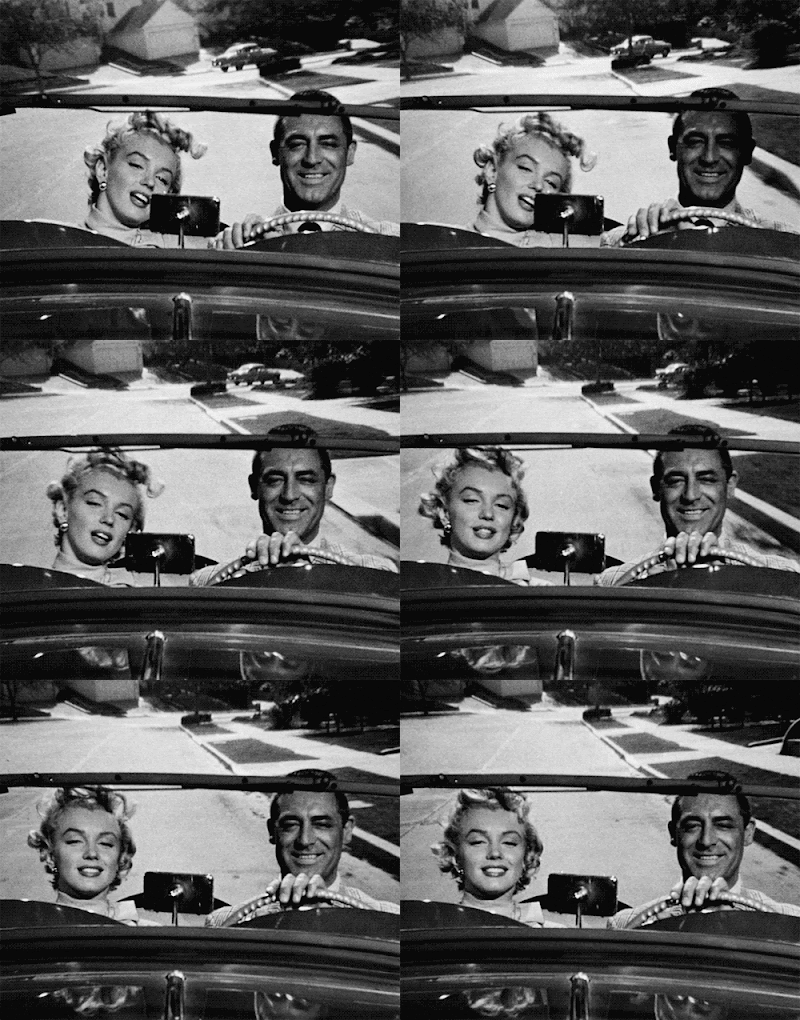 |
| Barnaby and Laurel go for a drive in his new MG. |
They take the
car to the shop and are told it’ll be good as new by five o’clock. To kill time,
the two go roller-skating and, after Barnaby falls, they go swimming. At the
pool, Barnaby attempts a swan dive, but ends up doing a belly flop. But no one
is watching him, but rather Miss Laurel in a one-piece.
 |
| She only have eyes for Barnaby, but everyone else has eyes on Lois in her one-piece. |
After the car is
fixed, Barnaby drives them back to Oxly. While they’re driving, she kisses him
on the cheek, but pouts when she discovers that he’s married. Before they get
back to the office, the formula starts to wear off. Barnaby’s eyesight starts
to fade and he ultimately crashes the car into a chain-link fence.
When he returns
to the lab, Barnaby falls asleep. By the time he awakens, Edwina, who has been
called by a night watchman, has arrived. She’s not happy to hear about his
haircut or by his antics, especially the lipstick on his cheek from Miss Laurel.
Barnaby insists it was the formula and tries to reassure her that the kiss
meant nothing to him.
Barnaby wants to
retest the formula on himself, but Edwina has other plans, drinking the latest
double strength batch, so her husband can observe her. Again she takes a glass
of water after drinking the sour concoction. The formula starts to take effect
when Oxly comes in to inquire about Barnaby’s progress. Edwina is overly
playful, putting a goldfish down the side of Oxly’s pants.
Barnaby and
Edwina get away and Edwina demands that they drive to the hotel where they
spent their honeymoon. When they get to the hotel, Edwina wants to go dancing,
eventually exhausting Barnaby. When they finally get back to the room, Edwina
gets emotional, acting like a new bride and crying for her mother.
 |
| Their honeymoon reenactment doesn't come off as planned. |
Barnaby tries to
find out what’s going on with Edwina, but it quickly turns into a quarrel, in
the middle of which Barnaby’s glasses fall off. When he pushes her gently away
from them on the floor, she throws him out of the room. While the nearly blind
Barnaby feels his way through the halls in his pajamas, missing the tie string,
which has been caught in the room’s door, Edwina calls Hank. She tells him that
Barnaby has brutalized her and she wants to file for divorce.
Meanwhile,
Barnaby, who is looking for help, ends up going head first down the laundry chute
and ends up in one of the large wheeled carts. The force of his entry sends the
cart rolling straight into a wall on which poor Barnaby hits his head and
passes out.
The next
morning, Edwina has fully recovered from the formula and is checking out of the
hotel, when Barnaby has been brought up from the laundry room by a couple of
confused maids. He refuses to change, but rather just wants to go home.
When they
arrive, they are set upon by a horde of reporters and Hank is inside waiting.
Edwina realizes that she still very much loves Hank and wants to call off the
divorce. But Barnaby, realizing the harm the formula does, and a little
disheartened to have found out Edwina once kissed Hank, decides the best course
of action is to destroy the formula.
Edwina goes with
Barnaby to the lab and there, using the water from the cooler, she makes them a
pot of coffee. After a couple of cups, both are acting like ten-year-olds.
Meanwhile, Oxly
has heard about the success of the formula and has called an emergency meeting
of the board to come up with an offer to Barnaby for the rights. When it’s
pointed out that he made the formula while working for them, Oxly points out
that there seems to be an ingredient or step missing as they can’t recreate it
with the same results.
Barnaby is
called in and enters with Edwina and a monkey between them. When they ask him how much he wants, he says
a "zillion" dollars. When he lets slip his idea about adding heat,
the board thinks they have the answer they need and Barnaby and Edwina escape.
The couple walks
home, too young to drive, and while they do, Edwina starts to annoy the 10-year-old acting Barnaby, who is turning into a girl-hater. After getting into a
fight and throwing paint on each other, he runs off to join real ten-year-olds,
who are playing “Indian”. Edwina, meanwhile, goes home and calls Hank to
complain again about Barnaby. She then takes a nap, which seems to be a
side-effect of the formula.
As she sleeps,
Barnaby puts on war paint and convinces his playmates to help him scalp Hank,
whom he is still jealous about.
When Edwina
awakens from her nap, she is once again her old self. But the neighbor’s baby,
Johnny, has walked into their house and crawled in next to her. She mistakenly
assumes the baby to be Barnaby on an overdose of the formula and dashes back to
Oxly with the baby in her arms.
 |
| Edwina mistakes the neighbor's baby for Barnaby and rushes him back to Oxly. |
Meanwhile,
Barnaby and his friends succeed in capturing Hank, but instead of scalping him,
cut his hair into a Mohawk.
 |
| Barnaby convinces the boys in the neighborhood to help his scalp Hank (Hugh Marlowe). |
Back at Oxly,
everyone thinks Johnny is Barnaby. Edwina puts the baby down on Barnaby’s
couch, hoping that if he falls to sleep, the formula will wear off. Out in the lab,
the men, including the Board of Directors, Oxly and Lenton, pace and when
they’re thirsty, drink water from the cooler. Oxly orders the bitter-tasting
water thrown out, but it’s too late to stop the formula from taking effect.
 |
| Still wearing warpaint, Barnaby returns to Oxly. |
Barnaby shows up
and climbs through the window of his office. When Edwina finds him, she
realizes her mistake about Johnny. But when they go out to the outer
laboratory, they find everyone, Oxly, the board members and the scientists
acting like children. It is Lenton who
finally deduces that Esther has concocted the formula. While Oxly is chasing
Miss Laurel around the lab with a seltzer bottle, the Fultons leave.
 |
| Craziness ensues in the lab when everyone drinks the formula. |
Three days
later, there is a new Oxly contract ensuring Barnaby’s future with the firm.
Barnaby tells Edwina that a person is old only when he forgets that he is
young.
Hawks was
somewhat disappointed by the film, thinking the premise was too unbelievable
and that the film was not as funny as it could have been. Hawks was right, but
the premise was
only the beginning of the problems. Monkey Business suffers
from many ailments, one of which is a surprisingly lackluster screenplay given
the talents of Ben Hecht and I.A.L. Diamond. Gags and characters seem to have
been recycled from previous films, but what makes it all right at all is that
Hawks is mostly stealing from himself.
The best line in
the film is delivered about Monroe’s sex appeal. While it is best seen in
context, I’ll try to set it up:
Early in the film, Barnaby and Oxly are in the
latter’s office with Lois. There is a call waiting for Mr. Oxly and Lois is
about to be dismissed.
Oliver Oxly: Oh, yes. Just a moment, Miss Laurel.
Find someone to type this.
Lois Laurel: Oh, Mr. Oxly, can't I try again?
Oliver Oxly: No, it's very important. Better find
somebody to type it for you.
Lois Laurel: Yes, sir.
As she walks to the door and closes it, both Barnaby and Oxly
admire her swaying hips and backside.
As if to answer the unasked question of
why he has her as his secretary, but won’t let her type his letters, Oxly turns
to Barnaby and deadpans:
Oliver Oxly: Anybody can type a letter.
It’s too bad
there’s not more laugh out loud lines like this one. Too much of the humor is based
on adults acting like kids and mistaken identity. It doesn’t take much of
either to get old.
I don’t know if
I’ve ever seen a bad Grant film, that is to say a bad performance by the actor.
Even in this film, he is good, but his best scenes are with Marilyn Monroe and
not Ginger Rogers. As stated before, his Barnaby Fulton feels like a redo of
his Bringing Up Baby David character, so it’s sort of like seeing a photocopy
of the original; close, but not as good. It’s too bad that Monkey Business
would be his last film with Grant, with whom he’d made Bringing Up Baby, Only
Angels Have Wings (1939), His
Girl Friday (1940) and I Was A Male War Bride (1949).
Ginger Rogers, whom I’ve already gone on record as loving, is
not at her best here. In fact, I think she overacts the part. When she’s
supposed to be twenty she comes off as being closer to ten. I sometimes think
she’s trying too hard, which is bad when it shows. Like Grant, Rogers has
played a similar character before, previously playing “young” in The Major and
the Minor (1942) a decade earlier.
The film feels over long, especially with the back and forth
between Barnaby and Edwina. While both Grant and Rogers are great movie stars,
I don’t really get the sense that they have great chemistry together and the
off again on again divorce seems a contrivance at best.
The best pairing
in the film seems to be Grant with Monroe, but that looks more like a happy
accident than the intent of the filmmakers. For all the star power of Cary
Grant and Ginger Rogers, Monkey Business is often sold as one of Marilyn
Monroe’s early films. In some ways, she steals the film, though her part is
rather small, she is in a lot of scenes and is often the object of the attention
of both Barnaby and Oxly, as well as any other men that might be around. It is
the scenes with Grant that give a glimpse into Monroe’s comedic sensibilities
mixed with her abundant sexuality.
So much has been
written about Monroe that there is no point in getting too deep here. Simply
put she is the iconic sex symbol.
There have been many contemporary imitators, including Jayne Mansfield and Cleo
Moore, but accept no substitute. Monroe was the sex kitten by which all others
should be judged as inferior.
 |
| Marilyn Monroe is the iconic sex symbol. |
While Grant and Rogers seem to be replaying character types
from their long film careers, Monroe is at the beginning of hers and there is a
real sense that she is bringing something new to the screen. While sex symbols
were nothing new in Hollywood, there had never been one like Monroe since
perhaps Jean Harlow in the 1930s.
If Monroe had lived longer, we might be looking at Monkey
Business as a changing of the guard in Hollywood. However, Monroe would be dead
in ten years, her last film being The Misfits (1961). Ginger Rogers’ last film
would be Harlow (1965) and Grant’s would be Walk, Don’t Run (1966).
Still, Monroe is the real reason to watch this film, not the
proven stars with top-billing. Not a great film, Monkey Business has its
moments, but given the director, the writers and the actors involved in the
project, it fails to deliver on all of its potential.