Showing posts with label Silent. Show all posts

Saturday, July 11, 2026

Stubs - Moana (1926)


Moana. A Romance of the Golden Age (1926) starring Ta’avale Uni, Fa’amgase Súa-Filo, Pe’a Taulealea, Tu’ungaita. Directed by Robert J. Flaherty and Frances Hubbard Flaherty. Produced by Robert J. and Frances Hubbard Flaherty. Written by Robert J. and Frances Hubbard Flaherty. Black and White. Run time: 98 minutes. USA. Silent with sound, Documentary

If you ever wondered where the term "documentary" comes from, you need look no further than a contemporary review of this film. Scottish filmmaker, film theorist, and critic John Grierson, writing for The New York Sun under the name “The Moviegoer”, coined the term in his review on February 8, 1926, the day after Moana opened. Grierson is considered by many to be the father of British and Canadian documentary film. Despite that, many view the film as more docufiction.

Saturday, May 2, 2026

Stubs - Le Ballet Mécanique


Le Ballet Mécanique (1924) Starring Alice Prin aka Kiki of Montparnasse. Directed by Fernand Léger, Dudley Murphy. Written by Fernand Léger. No Producer Credited. Run time: 19 minutes. Black and White/Color. France. Experimental, Silent, Short.

Filmmakers have been experimenting with celluloid almost as long as the technology has existed. One of the earlier examples is Le Ballet Mécanique (1924), a French film with American input released and mostly credited to Fernand Léger, although American Dudley Murphy was also involved in the filmmaking.

The film they made is, to quote The Silent Era review, a montage “of live action cinematography, shots of geometric shapes, colors, odd found items, commercial product photography, observations through a mirrored prism, image repetition, household items and machinery in movement, fairground attractions, and stop-motion animation.”

Saturday, January 3, 2026

Stubs - Blackmail (1929)

Blackmail (1929) starring Anny Ondra, John Longden, Cyril Ritchard. Directed by Alfred Hitchcock Screenplay by Alfred Hitchcock, Benn W. Levy. Produced by John Maxwell. Run time: 85 minutes (sound). Black and White. United Kingdom. Thriller.

1929 was not only a crucial year in Hollywood history, with the coming of sound, but was also in Britain. With local film production in decline and the British film industry having to compete with the more polished and financially successful American studio product, British films were fighting for survival.

That year, Alfred Hitchcock’s Blackmail began as a silent film production. However, the producer, John Maxwell, was anxious to cash in on the new technology and gave Hitchcock the okay to reshoot some of the film as, what was called back then, a “talkie.” However, it has been reported that Hitchcock wanted to reshoot the entire film with sound. However, the finished film was a combination of the two technologies.

The first six and half minutes of the sound version are lifted from the silent film. So much so, that at one point you might be wonder if you’re watching the silent version before you hear non-synchronized dialogue. There are other sequences of the sound film that are also from the silent version as well.

There was some other obstacles to get over, including the fact that the lead actress, Prague-born Anny Ondra, had a noticeable Czech accent, and according to some, a "reedy voice", that was judged unsuitable for the film. With sound in its infancy, something like dubbing was not possible. Rather that re-casting the lead, Hitchcock hired actress Joan Barry to read the dialogue off-camera while Ondra lip-synched her lines.

Saturday, August 30, 2025

Stubs - 3 Bad Men


3 Bad Men (1926) starring George O’Brien, Olive Borden, Lou Tellegen, Tom Santschi, J. Farrell MacDonald, Frank Campeau, Priscilla Bonner, Otis Harlan, Phyllis Haver, Georgie Harris, Alec Francis, Jay Hunt Directed by John Ford. Screenplay by  John Stone, Ralph Spence, Malcolm Stuart Boyla. Based on the novel Over the Border by Herman Whitaker (New York, 1917). Producer: William Fox. Run time: 93 minutes. Black and White. USA. Western, Silent

3 Bad Men came to my attention through reading Joy Girl: A Novel of Olive Borden (Forgotten Actresses) by Laini Giles. Even though the book is historical fiction, it is based on real events, including Olive Borden meeting George O’Brien on the set of this film. Turns out I had the film in the Ford at Fox collection, which came out in 2007.

Following his success with The Iron Horse (1924), director John Ford was given carte blanche by Fox. He chose as his next project the novel, Over the Border by British writer Herman Whitaker. The book tells the story of Three Bad Men - Sliver Smith, Bull Perrin, and Jake Evers - who have established their hideout in a desolate region of the Mexican desert. The narrative captures their adventures and confrontations in a land marked by revolution, rustling, and crossing borders, while exploring themes of survival, loyalty, and the blurred lines between right and wrong.

Saturday, January 25, 2025

Stubs - The Johnstown Flood

The Johnstown Flood (1926) starring George O'Brien, Florence Gilbert, Janet Gaynor Directed by Irving Cummings Screenplay by Edfrid Bingham, Robert Lord. Produced by William Fox Run time: 60 minutes. Black and White with tints. USA. Silent, Melodrama, Disaster

On Friday, May 31, 1889, the South Fork Dam, located on the south fork of the Little Conemaugh River, catastrophically failed. The result was a flood in Johnstown, Pennsylvania that killed 2208 people and accounted for $17 million (equivalent to $580,000,000 in 2023 dollars) in damage. The death total made the disaster the largest loss of civilian life in the U.S. at the time. It has only been surpassed twice, by the 1900 Galveston hurricane and the 9/11 attacks in 2001.

Saturday, September 14, 2024

Stubs - The First Auto

The First Auto (1927) starring Barney Oldfield, Patsy Ruth Miller, Charles Emmett Mack, Russell Simpson. Directed by Roy Del Ruth. Screenplay by Anthony Coldeway, Jack Jarmuth. Produced by Darryl F. Zanuck. Run time: 75 minutes. Black and White. USA. Silent with sound, Drama.

Made at a time when Hollywood, specifically in this case, Warner Bros., was experimenting with synchronized sound, the beginning of the end of the silent era, the studio was making a film about the end of the horse as the main mode of transportation, The First Auto. The synchronized sound, captured on a disc synchronized with the film, included music, sound effects and a few spoken words.

Sunday, May 26, 2024

Stubs - Speedway


Speedway (1929) Starring William Haines, Anita Page, Ernest Torrence, Karl Dane, John Miljan. Directed by Harry Beaumont. Story by Byron Morgan. Adapted by Alfred Block, Ann Price, Byron Morgan. Producer (None Credited). USA Black and White. Run time 82 minutes. Silent, Melodrama            .

The Indianapolis 500 has been the subject of several films. The Crowd Roars (1932), and its remake, Indianapolis Speedway (1939) may be more famous but one of the first was Speedway (1929), which came at the end of the silent era. In fact, it is noted as William Haines last such film.

Saturday, March 9, 2024

Stubs - The Last Command

The Last Command (1928) Starring Emil Jannings, Evelyn Brent, William Powell. Directed by Josef von Sternberg; Screenplay by John Goodrich. Presented by Adolph Zukor, Jesse L. Lasky. Black and White. USA Run time: 88 minutes. Silent, Melodrama.

Once considered by the Library of Congress American Silent Feature Film Survival Database to be extant, the rumors of its demise have been overly exaggerated. The Last Command is a noteworthy work mostly because of its prominence in Academy Awards history. The lead actor, Emil Jannings would be the first actor to win for his work. Back then, the award wasn’t for one film, but for a body of work for the year, so Jannings won for this film, as well as his performance in The Way of All Flesh.

Thursday, February 29, 2024

Stubs - Leap Year (1924)


Leap Year (1924) Starring Roscoe “Fatty” Arbuckle, Mary Thurman, Lucien Littlefield, Harriet Hammond, Clarence Geldart. Directed by Roscoe Arbuckle, James Cruze. Screenplay by Sarah Y. Mason, Walter Woods No Producer Credited. Run time: 56 minutes. Black and White. USA. Silent, Comedy

Though finished in 1921, Leap Year would not get released in the United States until 1981. This was due to the scandal that would strike star, Fatty Arbuckle, a few months after he completed this film in connection with the death of actress Virginia Rappe following a Labor Day party Arbuckle was hosting at the Hotel St. Francis in San Francisco.

Charged with rape and manslaughter in connection with Rappe’s death from a ruptured bladder, Arbuckle had three trials in connection with the charges. The first two would end in mistrials, but the third would end on April 12, 1922 with a jury acquittal. In addition to the verdict, the jury released a statement, “Acquittal is not enough for Roscoe Arbuckle. We feel that a great injustice has been done to him … there was not the slightest proof adduced to connect him in any way with the commission of a crime. He was manly throughout the case and told a straightforward story which we all believe. We wish him success and hope that the American people will take the judgment of fourteen men and women that Roscoe Arbuckle is entirely innocent and free from all blame.”

Despite the jury’s sentiments, by 1923, after most theaters refused to run his films due to the scandal, Paramount had shelved the film, as well as two other films he had already finished, The Life of the Party (1921) and Brewster's Millions (1921) in the US. But the studio did release Leap Year overseas, the first being Finland on April 27, 1924.

Should a Man Marry, the film’s original title, went before cameras on Catalina Island in late May, 1921 and had a four-week shoot. The title changed in August, 1921 to This Is So Sudden, and again in September to Skirt Shy. Leap Year  would be the name it would be released under in Europe.

Despite the title, Leap Year, has nothing to do with the additional day added to the Georgian calendar every quadrennial.

Saturday, December 10, 2022

Stubs - Big Business


Big Business
(1929) Starring: Stan Laurel, Oliver Hardy, James Finlayson, Tiny Sandford, Lyle Tayo. Directed by James W. Horne, Leo McCarey. Screenplay by H.M. Walker (titles). Produced by Hal Roach. Run time: 19 minutes. USA Black and White. Silent. Comedy. Christmas, Short.

Laurel and Hardy’s place as one of the great comedic teams in Hollywood history is already well-established. And while The Music Box (1932) may be their best-known short, which is their best short is somewhat up for debate. One possible entry is Big Business, one of their last silent shorts before making their successful move to sound films with Unaccustomed As We Are (1929). Big Business would be the first of the duo’s films added to the National Film Registry in 1992.

Saturday, June 11, 2022

Stubs - Nanook of the North


Nanook of the North
(1922) Starring Allakariallak, Nyla, Cunayou. Directed by Robert J. Flaherty. Written by Robert J. Flaherty. Produced by Robert J. Flaherty. Run time: 79 minutes. USA. Black and White. Silent. Documentary.

The very earliest films, produced by the Lumière Brothers were what are known as "Actualités", short pictures of real people in real places. The first of these films was La sortie des usines Lumière (Workers Leaving the Lumière Factory), (1895), was also the first film exhibited by the Lumières on December 28, 1895. These sorts of films were the precursors to what would become documentary films.

While not the first documentary, Nanook of the North by Robert J. Flaherty was the first full length documentary to achieve commercial success. As such, it would show the financial viability of the genre and would inspire other filmmakers and films to come.

Saturday, August 14, 2021

Stub - Yankee Doodle in Berlin

Yankee Doodle in Berlin (1919) Starring: Bothwell Browne, Ford Sterling, Malcolm St. Clair, Bert Roach Directed by F. Richard Jones. Written by Mack Sennett. Produced by Mack Sennett. USA Run time: 65 minutes. Black and White. Silent. Comedy. WWI.

Propaganda films about evil Huns were quite common from Hollywood during World War I. Titles like The Kaiser, the Beast of Berlin (1917) and To Hell With the Kaiser (1918), gave little to the imagination about whose side the US was on during the war. While Eric Von Stroheim is best remembered as a director, during this time period he was pretty busy playing sadistic Prussian officers in films like The Unbeliever (1918), The Hun Within (1918), The Heart of Humanity (1918), and D. W. Griffith's Hearts of the World (1918).

Late to the game was Mack Sennett’s send-up, Yankee Doodle in Berlin. And by late, I mean after the war had ended. The armistice which ended World War I happened on November 11, 1918 but this film wasn’t released until March 2, 1919.

Saturday, August 7, 2021

Stubs - The Racket (1928)

The Racket (1928) Starring: Thomas Meighan, Louis Wolheim, Marie Prevost. Directed by Lewis Milestone. Screenplay by Del Andrews (Scenario), Harry Behn (Scenario), Tom Miranda (titles). Based on the play The Racket by Bartlett Cormack (New York, 22 Nov 1927). Produced by Howard R. Hughes Run time 84 minutes. USA Black and White. Silent. Gangster

During the first Academy Awards, in 1929, films like Sunrise (1927) and Wings (1927) may have captured glory but there were other films that were also nominated for the two top awards. A film like The Racket was overlooked then but deserves a second look now.

Saturday, May 8, 2021

Stubs - Straight Shooting


Straight Shooting (1917) Starring: Harry Carey, Duke Lee, George Berrell, Molly Malone, Ted Brooks, Hoot Gibson, Milt Brown, Vester Pegg. Directed by John Ford. Screenplay by George Hively (credited as Story). Producer not credited. USA 62 minutes. Silent. Western.

Westerns had been a staple of American films almost as long as there have been films made in the U.S. One of the earliest examples is Edwin S. Porter’s The Great Train Robbery (1903). One director who is perhaps most associated with the genre is John Ford, who would direct such classics as Stagecoach (1939) and The Searchers (1956) to name only a few of his best-known films. It should come as no surprise that Ford’s first feature film would also be a Western, Straight Shooting (1917).

Saturday, December 19, 2020

Stubs - A Christmas Carol (1910)


A Christmas Carol (1910) Starring: Marc McDermott, Charles S. Ogle. Based on A Christmas Carol by Charles Dickens. Directed by J. Searle Dawley. Produced by J. Searle Dawley (uncredited). USA. Black and White. Run Time: 10 minutes. Silent, Christmas, Drama.

Films have been made based on Charles Dickens’ 1843 novella, A Christmas Carol, for almost as long as they’ve been making movies. The first was a short British film Scrooge, or Marley's Ghost (1901), and the latest, at least at this writing, was A Christmas Carol (2020), a film adaptation by David and Jacqui Morris. The story has been adapted in animated form, as television specials and some direct to DVD releases. It should therefore come as no surprise that Edison Studios would have also made a version.

Saturday, February 23, 2019

Stubs - The High Sign


The High Sign (1921) Starring: Buster Keaton, Bartine Burkett, Charles Dorety, Ingram B. Pickett, Al St. John. Directed by Eddie F. Cline, Buster Keaton. Screenplay by Eddie F. Cline, Buster Keaton. Produced by Joseph M. Schenck Runtime 19 minutes USA Black and White, Silent, Comedy

Just because you are a comedic genius doesn’t mean you’re a good judge of your own work. Case in point, The High Sign. When his co-star for 14 films, Roscoe “Fatty” Arbuckle left to accept Paramount’s $3 million offer to make 18 films in three years, Buster was given Arbuckle’s controlling interest in Comique, Arbuckle’s partnership with Joseph Schenck. The new company was called Buster Keaton Productions.

The first film that company made was The High Sign, in January and February 1920, shot on location in Long Beach, where Keaton made several of his movies with Arbuckle, as well as in Venice. But in the end, Keaton was disappointed with the effort. According to Keaton biographer Rudi Blesh, when Keaton screened The High Sign for Arbuckle, he took Arbuckle's enthusiasm as a sign that it was too gag-oriented and lacked a strong enough story.

Keaton would later explain his disappointment, recalling that the preview audience didn't respond well to him setting up and then subverting a gag based on a man dropping a banana peel on the street. "When the audience saw me approaching they expected me to slip on it. I tried to get a laugh by using the Mafia's secret sign, thumbs held crossed under the nose with the hands spread out on both sides of the face. [...] In the end, I decided that I had made the mistake of outsmarting the audience a little too much. But instead of cutting this scene out I added a shot. In this, after passing the camera and giving the sign, I slipped on a second banana peel somebody had dropped. That worked fine."

Instead of releasing or trying to fix it, Keaton convinced Schenck to let him make another film, One Week (1920). While The High Sign would eventually get released it was nearly a year later on April 18, 1921 (ed. note: per the@BusterKeatonSoc it was released on April 12, 1921).

Our Hero (Buster Keaton) reaches into a spinning carousel and pulls out a newspaper.

Our introduction to Our Hero (Keaton) is him being thrown from a passing train. He quickly gets to his feet and then goes walking around. At a carousel, he reaches in an pulls out a newspaper. He walks away and starts to unfold and unfold the paper until it is the size of a bed sheet. He finds a help wanted ad for an expert shot at a shooting gallery.

What starts out as a regular newspaper ends up being the size of a bed sheet.

When the man he stole it from gets off the carousel, he goes looking for another one. He takes the one from Keaton and pays him for it. Keaton knows he needs to practice for his new job and takes a distracted cop's gun, replacing it with a banana. He then heads to the beach for some target practice.

Buster "borrows" a distracted cop's gun, replacing it with a banana.

There he encounters Al St. John, who assists him. No matter how carefully Our Hero aims the gun, he hits something else. Trying to hit the middle of three bottles, he hits everything but, even shooting St. John in the rear. St. John hurries away ending up a Dr. Pullem’s Dentist’s office.

Al St. John gets caught up in Buster's target practice at the beach.

Keaton’s last shot lands a duck, who falls from the sky, dropping on Keaton’s head. Dropping the gun in the sand, he hurries off to his job interview. Tiny Tim (Ingram B. Pickett), the extremely tall proprietor of the shooting range, engages him and tells him to practice, for when he comes back, he wants to hear the bell ring every time.

Buster is left alone to practice but to no avail.

Tim leaves Keaton to practice and goes downstairs to join his gang, the Blinking Buzzards, which are described on the interstitial card as "a bold bad bunch of bloodthirsty bandits." To gain admission, he gives them the high sign: thumbs on nose, with wiggling fingers spread wing-like.

The Buzzards have been trying to extort $10,000 from a skinflint aptly named August Nicklenurser, who has refused to pay the protection money. The film describes Nicklenurser as “tight as a fourteen collar on a sixteen neck”. Since he’s refused to pay, the gang decides to kill him.

Buster rigs a system to get the bell to ring with every shot.

Meanwhile, Keaton has rigged the gallery bell (using string, a dog, and a bone) to ring whenever he presses a lever. A crowd gathers and when Tim returns, he passes his employment test.

Meanwhile, August has received a final warning from the Blinking Buzzards. It says that if he doesn’t pay them 10,000 dollars by the first of September, it will be the end of August. His daughter (Bartine Burkett) convinces him that he needs a bodyguard. They go down to the shooting range and are impressed with Keaton's abilities. August asks him to be his bodyguard. Keaton, impressed with Nicklenurser's daughter, accepts.

Buster accepts the job when the daughter (Bartine Burkett) asks him to help.

But he is not the only one impressed by Our Hero’s abilities with a gun. Tim takes him to the Buzzard’s hideout, where he is made a member of the gang. They tell him they want him to kill someone, which turns out to be the same man he’s supposed to protect. They tell him to kill Nicklenurser and send him on his way.

Tiny Tim (Ingram B. Pickett) takes Buster to the Blinking Buzzards' hideout.

Back at the shooting range, Keaton deals with three increasingly aggressive customers. One, a drunk, shoots the place up, while the last man, a hunter, sneaks in his own rifle and basically destroys the shooting range. Keaton makes his own escape after that.

A cop tries to arrest Tiny Tim with a banana.

Meanwhile, a cop tries to arrest Tim, but when he reaches for his gun it turns out to be the banana Keaton had put there. Rather than fight, the cop runs away. Tim takes the banana and eats it, depositing the peel on the ground. Keaton walks over it without a misstep, and gives the audience the high sign. Then Keaton runs into the cop who chases him. He tries to turn his jacket around to disguise himself as a member of the clergy. When that doesn’t work, he flashes him the high sign, but the cop isn't a Buzzard. Luckily the nearby fruit vendor is, and he smacks the cop over the head.

Tiny Tim about to throw the banana peel on the sidewalk.

August shows his daughter some of the secret wall panels and trap doors he's had installed, so he can escape from assassins from every room in their house. Keaton arrives and he has a look at the secrets. The butler reveals himself to be a Buzzard, and when Keaton shows no inclination to do his murderous duty, the butler tries to poison him and calls the rest of the Buzzards to the house.

After the butler threatens Keaton with a knife, he hatches a plan to fake Nickelnurser's death in front of the Buzzards, who have gathered around the house. It works until the Buzzards see Nickelnurser is really still alive.

The Buzzards then chase Keaton through every window, door, and secret escape route the house has and Keaton eliminates each in his turn. Tim is the last; as he threatens Miss Nicklenurser, Keaton drops him through a trap door. Our hero and heroine embrace and Keaton once again flashes the high sign.

While One Week is a better movie, it is not to say The High Sign is devoid of laughs. There are several laugh out loud moments, including the ever-unfolding newspaper at the beginning. Or when Tiny Tim opens the door and knocks Our Hero over the counter in the shooting gallery.

There are also some really good visuals, the best of which may be a surreal moment when Keaton paints a hook on the wall and then hangs his hat on it. One of the funniest scenes is at the end of the film, when the Buzzards are chasing Keaton around and through all the secret passages in Nickelnurser’s house.

In a specially made gif, Keaton runs through all the trap doors
and secret passages in Nickelnurser's house.

If you had never seen a Buster Keaton film, I would suggest One Week over this film. It is easy to see why Keaton might have wanted that film as his first solo effort. Still, The High Sign has its moments and should not be missed if you have the chance to see it.

Saturday, February 16, 2019

Stubs - Making a Living


Making a Living (1914) Starring: Charles Chaplin, Henry Lehrman, Emma Bell Clifton, Chester Conklin. Directed by Henry Lehrman. Written by Henry Lehrman. Produced by Mack Sennett. Run Time: 13 minutes. U.S.A. Black and White, Silent, Short, Comedy

Fred Mace might not be a name that you’ve ever heard of before but if it wasn’t for his desire to leave Mack Sennett’s Keystone Studios, Charles Chaplin may not have ever gotten into films. He was on his second U.S. tour with Fred Karno’s comedy troupe when he was approached by a representative of Keystone who saw his performance and thought Chaplin could be a good replacement for Mace, who would appear in more than 150 films from 1909 and 1916 and was at the time the big star at the studio and wanted to leave. Though Roscoe Arbuckle would take over the roles Mace would have played, Chaplin was signed to a $150 a week contract in September 1913. He arrived in Los Angeles in December and began work for Keystone on January 5, 1914.

Almost immediately he began working on his first film that was written and directed by Henry Lehrman, who would also appear in the film. Chaplin was used to rehearsing parts was also not used to films which are made out of sequence. There are stories that he and his director butted heads early on.

Edgar English (Chaplin) swindles a reporter (Lehrman) out of money and a ring.

The short film opens with Edgar English (Chaplin), described as a swindler is in conversation with a man on the street who later turns out to be a newspaper reporter (Lehrman) whom he is apparently trying to convince him to give him money, as Edgar is down on his luck. Somehow during their talk, Edgar manages to steal a ring from the man.

The reporter is not happy to find that his sweetheart (Minta Durfee) is now engaged to
 Edgar. The girl's mother (Alice Davenport) looks on.

Edgar goes almost immediately to a mother (Alice Davenport) and daughter (Minta Durfee) who are standing out in front of their mansion. Edgar comes on to the daughter and they become engaged when he gives her the ring he’d taken from the reporter.

The butler moves to break up the ensuing fight.

The reporter, who had stopped to buy the daughter flowers, soon arrives to not only find out that his girl is engaged, not only with the ring he intended to give her but the bum on the street who asked him for money. The two get into a fight, which is eventually broken up by the butler, who gives the reporter the old heave-ho.

Edgar sees a help wanted sign outside what was the old
LA Times Bldg. The Bum is played by Chester Conklin.

Later, Edgar is looking for work and sees a sign looking for a writer on the local newspaper. Before he goes in to apply, he has some interplay with a Bum (Chester Conklin) who is hanging around outside. When he goes in to apply to the manager, he finds the Reporter works there. The reporter gets the Editor of the paper (Charles Inslee) to throw Edgar out.

The Editor of the paper throws Edgar out.

Later that day, the Reporter is out on the street when he sees a car lose control and go over the edge crashing down a hill, pining the driver under the car. The reporter is the first on the scene and takes photos with his camera and interviews the victim. He is about to leave the scene when others arrive and try to right the car and free the driver. The reporter is encouraged to help and he puts down his notes and camera.

The reporter interviews and photographs the victim of a traffic accident.

Edgar, who happens to be walking by, sees the accident and goes to investigate. While there he sees the reporter's notes and camera, which he scoops up and runs away. When Edgar sees a Keystone Kop policeman (Chester Conklin), he runs up the stairs to hide in a house where the woman living there (Emma Clifton) tries to throw him out. However, the reporter takes chase and follows him into the house. Edgar manages to get away but the reporter ends up in the bed with the woman and is discovered there by her husband (Billy Gilbert).

Husband (Billy Gilbert) finds his wife (Emma Clifton) in bed with the reporter.

Edgar takes the story and camera back to the newspaper. An extra is issued based on his story and the paper is on the street almost before the reporter realizes his things are missing.

Edgar's story rates an Extra edition of the paper.

He chases Edgar down and the two get into a fight on the street, ending up in the cow-catcher of a passing trolley car.

Edgar and the reporter take their fight out into the streets.

Chaplin was apparently disappointed in the finished film, feeling that his best performances were left on the cutting room floor. Supposedly, Lehrman would admit to having done just that out of spite for Chaplin.

The film was released on February 2, 1914 and despite his own misgivings, he received very positive reviews from Moving Picture World, an influential early trade journal for the American film industry, which wrote, "The clever player who takes the role of the nervy and very nifty sharper in this picture is a comedian of the first water, who acts like one of Nature's own naturals. It is so full of action that it is indescribable, but so much of it is fresh and unexpected fun that a laugh will be going on all the time almost. It is foolish-funny stuff that will make even the sober-minded laugh, but people out for an evening's good time will howl."

Henry Lehrman may not be a name that gets a lot of attention today, but back in the beginnings of silent films, he was very prominent, working with not only Mack Sennett but also D.W. Griffith. The next year, he would leave Sennett to start his own company, the L-KO Kompany, making two-reelers for Universal. He had a bad reputation for putting his actors in precarious and dangerous situations, earning the name "Mr. Suicide." One more connection to silent films is that Lehrman was engaged to Virginia Rappe, the actress whose death in 1921 led to the downfall of Roscoe "Fatty" Arbuckle's career.

The film also features Chester Conklin, a film comedian, and one-time Keystone Kop. He would go on to co-star with Mabel Normand in a series of films, including  Mabel's Strange Predicament (1914), Mabel's New Job (1914), Mabel's Busy Day (1914) and Mabel at the Wheel (1914). He was also teamed with Mack Swain and became known for his Walrus-like mustache. In 1920, he left Sennett and went to work at Fox Film Corporation. Conklin would have a significant role in Erich von Stroheim's acclaimed Greed (1924). However, his part was cut from the finished film and lost. Conklin would also appear in Chaplin's films Modern Times (1936) and The Great Dictator (1940).

Minta Durfee was married to Arbuckle at the time the film was made with whom she would appear in several films. A close friend of Mabel Normand, Durfee would be best remembered for her role in Normand's Mickey (1918).

Just a quick note, the Billy Gilbert in this film is not the same Billy Gilbert from The Music Box (1932) or His Girl Friday (1940). Even though they were acting at about the same time, the two only share a name.

But the star of the film is Charlie Chaplin. This is certainly not the best work Chaplin would ever do but it does show certain glimpses of what was to come. Chaplin would be a quick study and it wouldn’t be long before he was one of the most famous people in the young fledging film industry, becoming a worldwide phenomenon.

Making a Living is one of the few films when Chaplin is not seen as his trademark Little Tramp. That character would appear in his next film, also directed by Lehrman, Kid Auto Races at Venice. Here he is dressed in a long grey coat and a large mustache with a more villainous look.

As far as should you watch this short, the answer would be a qualified “yes” though I would not say it would be for everyone. If you’re a fan of Chaplin’s already, you owe it to yourself to see all of his films that you can. If you’re not a fan then there are other films I would suggest, like City Lights (1931), which may be my favorite of his.

Saturday, June 16, 2018

Stubs - Seven Chances


Seven Chances (1925) Starring: Buster Keaton, T. Roy Barnes, Snitz Edwards, Ruth Dwyer, Frankie Raymond, Jules Cowles, Erwin Connelly, Jean Arthur. Directed by: Buster Keaton and Edward F. Cline. Screenplay by Clyde Bruckman, Jean Havez, Joseph A. Mitchell. Based on the play Seven Chances by Roi Cooper Megrue. Produced by Joseph M. Schenck, Buster Keaton. Runtime: 56 minutes. USA Black and White with Technicolor insert, Comedy, Silent

Sometimes films are made with the lowest of expectations. Consider Seven Chances, the 1925 silent comedy directed by and starring Buster Keaton. Originally a rather unsuccessful stage play of the same name by Roi Cooper Megrue, Joseph M. Schenck bought the film rights for $25,000 as a vehicle for either Keaton or one of the acting Talmadge sisters, Norma, Constance or Natalie. 

The play opened August 8, 1916, at the George M. Cohan's Theatre and closed in December after 151 performances. Buster Keaton, who saw the play during its original run, considered it a creaky, overly contrived farce. However, he owed Schenck money and had no choice but to make the film.  He turned the play over to his writers, Clyde Bruckman, Jean Havez, Joseph A. Mitchell to take the static, stage-bound play and make something out of it.

Production got underway on September 16, 1924, with Jack McDermott directing. However, two weeks into the production McDermott left amicably, leaving Buster to direct the film. There was a short delay when he took over but production was completed on November 30, 1924. Seven Chances was shot at the Buster Keaton Studio located at 1025 Lillian Way as well as in and around Los Angeles, utilizing the streets around Greater Page Temple Church of God in Christ; Jefferson Boulevard & Arlington Avenue; and Chatsworth including Beale’s Cut, a natural formation once used as a stagecoach route and used in the films of John Ford, and D.W. Griffith. Keaton had also used the gap in his 1922 short, The Paleface.

Jimmy Shannon (Buster Keaton) and Mary Jones (Ruth Dwyer)
 at the beginning of their relationship. (Note: the small dog).

This film opens with an early technicolor insert (275 feet), showing the long courtship between Jimmy Shannon (Buster Keaton) and his girlfriend, Mary Jones (Ruth Dwyer). As the seasons pass and her dog grows, Jimmy cannot bring himself to tell her he loves her.

Seven Chances reverts to standard black and white as we see Jimmy with his partner, Billy Meekin (T. Roy Barnes) facing the financial ruin of their brokerage firm, Meekin and Shannon, as well as legal consequences. When a lawyer (Snitz Edwards) shows up at their firm, with news of a large inheritance for Jimmy, they initially try to dodge him, thinking that he is there to give Jimmy a subpoena or other court order. Even though he can see them in their office, he’s told by their secretary he’s not in. Determined to wait for them, the lawyer doesn’t leave.

Jimmy and his partner  Billy Meekin (T. Roy Barnes) listen to a lawyer
 (Snitz Edwards) as he reads Jimmy's grandfather's will.

They take solace at their Country Club and that is where the lawyer’s persistence finally pays off. Through the window of the dining room, he shows them the clause about the inheritance. They run after him, stopping the guards from walking him off the property. In the office at the club, the three finally sit down to review the document. It seems that Jimmy will inherit $7,000,000 from his grandfather if he’s married by 7 pm on his 27th birthday, which turns out to be that same day. Jimmy, of course, thinks of Mary and leaves to ask her.

This is one of the cases where the film gets inventive, using a technique from the brilliant Sherlock Jr. (1924). We see Jimmy get into the driver’s seat in the driveway of the Country Club and then the background changes and he is getting out in front of Mary’s home. The audience knows, without having to watch, that Jimmy has driven to her house.

Jimmy practices his proposal to Mary, who overhears and at first accepts.

After speaking with her mother, Frances Raymond, Jimmy goes to wait for her in the backyard. There he practices his proposal, which unbeknownst to him, Mary overhears and accepts. But, of course, the film can’t stop there and when Jimmy tries to explain why they have to get married that day, he makes her feel like it has less to do with love and more to do with convenience, saying things along the lines of any girl would do. Feeling less than special, Mary turns him down.

Jimmy returns to the Country Club and tells his partner and lawyer the bad news. Meanwhile, Mary and her mother discuss the proposal and her mother suggests Mary let Jimmy explain. She calls the Country Club and the receptionist, Miss Smith (Jean Arthur) puts the call through to the office, but the men don’t answer, assuming it is not for them.

Mary writes a note to Jimmy telling him not to marry anyone else and gives the note to their black Hired Hand (Jules Cowles in blackface) to deliver. Despite her plea to hurry, the Hired Hand’s horse plods along to make the delivery.

They make a list of names or Seven Chances and tick them off as they turn Jimmy down.

Meanwhile, The three go to the dining room of the Country Club to see if there are any suitable candidates for Jimmy to marry. Billy asks Jimmy if he knows any of the women and he writes down all seven chances. The list includes Eugenia Gilbert, Doris Deane, Judy King, Hazel Deane, Bartine Burkett, Connie Evans, and Pauline Toller the real names of the actresses who appear, and in the order, they do, in the film.


Jimmy's proposal to Second Chance (Doris Deane) gathers a crowd. 

First Chance (Eugenia Gilbert) laughs in Jimmy’s face, so loud in fact that the entire room can’t help but notice. Jimmy follows Second Chance (Doris Deane) outside to the edge of the golf course, where he gets down on one knee, only to be embarrassed by the crowd that gathers to watch. For his Third Chance (Judy King) he tries writing a note “Will You Marry Me” that he tosses to her in a mezzanine seat. She shreds the notes and the pieces fall down on Jimmy.

Jimmy tries to propose to his Third Chance (Judy King) by tossing a note up to her. She turns him down.

Billy takes it upon himself to handle the next proposal to Fourth Chance (Hazel Deane), who initially thinks it is Billy who is proposing. But when Billy insists its for a friend and points to where Jimmy had been standing and had walked away when he saw how chummy they were, she only sees the lawyer and refuses.

Billy asks Jimmy's Fourth Chance (Hazel Deane) who thinks he's proposing for the lawyer.

Jimmy fails with his Fifth Chance (Bartine Burkett), and Sixth Chance (Connie Evans) on the stairs, one on the way up and one going down. He follows Seventh Chance (Pauline Toller) into a telephone booth to get his final rejection from those women he knew. 

Following her rejection, Billy comes up with a plan and tells Jimmy to meet him at the Broad Street Church at five o’clock and he’ll provide the bride. On their way out, the lawyer turns to Jimmy and tells him to keep trying in case Billy fails and offers if there are two brides to marry the other one.

Thinking it might be his appearance, Jimmy goes to check out himself in a mirror. He looks at his reflection and then at himself. Meanwhile, a Black Man comes through the door, momentarily surprising Jimmy and he runs away.

Jimmy gets turned down by the Country Club's receptionist (Jean Arthur).

He next proposes to the Country Club receptionist (Jean Arthur), who shows him her own wedding ring before going back to her reading. On his way out, Jimmy draws a line through the Miss on her nameplate.


On his way out, Jimmy asks the hatcheck girl (Rosalind Byrne)

Next up, Jimmy goes to get his hat but the Hatcheck girl (Rosalind Byrne) waits for a tip before giving him his skimmer. When Jimmy sees one more candidate, he leaves the hat and takes back the tip. He starts into his spiel before realizing that the woman has a baby with her that she doesn’t want to part with to marry him. Back to hat check and before he can ask her his question she shakes her head no.

On his way out of the club, Jimmy stops again by the door with the mirror and out pops a girl who asks if anyone would want to marry her.  After fainting, Jimmy gets up and escorts her out. The seven chances are waiting for him outside and laugh at his misfortune. Their posture changes when Jimmy’s bride-to-be emerges and takes his arm.

But on the way to the car, the woman’s mother (Lori Bara) reveals that Jimmy’s bride to be is really just a child playing dress up. Embarrassed, Jimmy drives away as the Seven Chances laugh at him.

At a railroad crossing, the hired hand catches up to Jimmy. Holding up what he thinks is a stop sign, he is surprised Jimmy just keeps driving, narrowly missing a charging train. Turns out one side of the sign read STOP and the other side he was holding out toward Jimmy, read GO. 

Meanwhile, the man’s horse has taken off and he has to track it down.

On the road, an ever-desperate Jimmy pulls up to a woman in a car (Marion Harlan) but before he can get too far, he runs the car up a tree which is growing in the road.

Meanwhile, Billy and the lawyer go to The Daily News, an afternoon paper to place an ad, looking for a wife for Jimmy who will inherit $7 million.

Jimmy, now walking to the church, stops when he sees a woman reading a paper at a bus stop. He proposes but she doesn’t understand, since she apparently only know Hebrew, judging by her newspaper. Passed on the sidewalk by a woman, Jimmy is about to propose until he sees that she’s, in fact, Black and he backs off.

On his way to the church, Jimmy stops at a beauty parlor
where he mistakes a woman's head for a mannequin's.

Passing a beauty shop, Jimmy stops to watch the male beautician and is probably thinking of proposing to the customer when he sees that she is a mannequin and her head gets removed. He enters the shop and sees another woman in a chair and thinking she, too, is a mannequin tries to remove her head before realizing his mistake and running off.

Jimmy mistakes a female impersonator for a real woman.

Next, he passes a stage and sees the image of a woman on the advertisement. Tipping the stagehand, he goes into propose. While he’s inside, someone moves some boxes that cover up the name of the performer (Julian El Tinge), who at the time was a well-known female impersonator. When Jimmy emerges, his skimmer has been purposefully pulled down over his head so that the brim is around his neck. Jimmy takes back his bribe and walks away.

The church is empty when he arrives.

By the time Jimmy arrives at the Church, in top hat and tails and carrying flowers, he is exhausted. 
He settles into the front row pews and falls asleep. Meanwhile, women answering the ads, come to the church walking, driving cars, bikes, and train. And not only fill the pews but back out into the street. By the time, Jimmy wakes up, he is surrounded by bridesmaids wearing makeshift and real wedding dresses.

After a short nap, he's surrounded by potential brides.

When the minister (Erwin Connelly) sees all the gathered women he tells them that they’ve been pranked and to go home. This does not sit well with the mob of brides and they decide to take it out on Jimmy.

Under the church, Mary's Hired Hand (Jules Cowles
 in blackface) catches up to him with Mary's note.

He ends up taking shelter under the church where Mary’s Hired Hand finally catches up to him. 


Trying to learn the time isn't easy for Jimmy.

Seeing the note, he decides to go to her. Jimmy manages to get away but when he pulls out his pocket watch to read the time, it breaks from its chain and falls down the sewer drain. Trying to find the correct time proves difficult. The first person he asks the time, a bootblack, doesn’t have a watch on the end of his chain but rather a bottle opener. The woman whose shoes he’s shining has a watch on an anklet but when Jimmy tries to look she thinks he’s being fresh. Next stop, a clock shop but each one in the window is set to a different time. When he goes into the shop, the watch repairman’s own seems to have stopped as well. It is not until a drunk trying to sleep one off throws his alarm clock out the window, which hits Jimmy in the head, does he know that it is 6:15.

He tries to catch the trolley but it passes him by. Jimmy starts to walk down the center of the street towards Mary’s when he is spotted by some of the jilted brides, who are angry at the deception. They are joined by more and more brides and are almost upon him before he notices and starts running.

Jimmy runs for his life just ahead of angry mob of jilted brides.

When the mob passes a bricklayer building a wall, they pick the bricks clean and continue the chase.
Billy and the lawyer come upon Jimmy and the two run together for a spell. Jimmy tells him to have the ministers at Mary’s house and that he’ll meet them there. As they’re running, they run into another group of brides that take chase after Jimmy, leaving Billy and the lawyer to get trampled on by the rest of the pack.

Like a stampeding herd, nothing seems to stop the brides as they chase Jimmy through a football game leaving injured players in their wake.

Jimmy thinking he’s gotten ahead of them slows down, only having to accelerate when he see’s another group coming towards him from a side street. The women commandeer a street car, throwing the driver and conductor off, as they continue their chase.

Jimmy tries to take refuge in a Turkish Bath but it turns out to be Ladies Day.

Jimmy manages to grab the spare tire on a car and rides that until it gets involved with a trolley driven by brides. He tries to take refuge in a Turkish Bath but it turns out to be ladies day so the chase continues.

Jimmy makes a run for it down LaSalle.

He tries to blend in with a police regiment that is marching down the street picking up and depositing beat cops. But when they see the approaching wave of brides, they run away, leaving Jimmy marching alone.

Jimmy tries to grab a cab but there is a bride in there as well. She grabs ahold of him and only lets go when she falls into a ditch. Jimmy doesn’t know what to do but runs as the workmen from the ditch jump out and seek shelter.

Jimmy escapes a mob of angry would-be brides by grabbiing onto a crane.

When he finds an iron works, Jimmy runs inside only to be chased inside by the mob. A crane pulls him to safety but a bride commandeers it from the operator. She can’t figure out the controls and instead of lowering him back down, she swings him over the fence next to the railroad tracks.  When the crane lowers he jumps to safety, but the women inside think he’s been killed when a train comes roaring by. They’re all sad and crying until he walks by. Anger returns and they take chase again.

Meanwhile, at Mary’s house, Billy, the lawyer, Mary, her mother and the minister are waiting.

Now out in the country, the brides chase Jimmy through a cornfield, demolishing it as they run through. Jimmy runs through a barbed wire fence and into an apiary where a beekeeper is tending to the hives. But Jimmy and the brides knock most of them over, making the bees angry. When he stops to free himself from the barbed wire, a bull chases him back through the apiary. The bees chase him to the water’s edge, where Jimmy commandeers a boat.
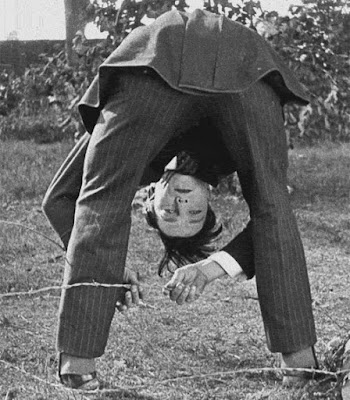
Jimmy is in an awkward position when he spies a bull watching him.

But the water doesn’t impede the chase and eventually, Jimmy has to make a swim for it. On the other side of the river, he discovers that he’s picked up a turtle on his tie. When he stops to pull that off, he’s in the sightline of duck hunters who fire their guns in his direction.

Jimmy makes a leap while on the run.

Finally, he’s chased to the edge of the wilderness and when he runs up the side of a hill, the leader of the brides takes them another way to cut him off.  He jumps over the Beal Cut, rides a tree that is cut down from a cliff to the ground. Throws himself down a sandy hillside before he ends up dislodging some rocks.


Jimmy throws himself down a sandy hillside.

Small rocks cause larger ones to move and pretty soon there is an avalanche of rocks chasing Jimmy down a long and steep hillside. This is perhaps the most memorable sequence in the film. The rocks scatter the brides who have taken their shortcut, finally freeing Jimmy for a last-gasp run to Mary’s house, over one car and under another. When he gets to Mary’s house, his coat gets caught in the gate. Unable to free himself, he breaks the gate off from the fence and drags into the house.

A snippet of the sequence of Jimmy being chased by rocks of all sizes.


When Jimmy arrives, Billy checks his watch. Jimmy appears to be too late as it is now a few minutes past seven. But when the church clock shows there are few minutes to spare, Jimmy runs back in and the wedding ends just as the clock strikes seven.

Jimmy has until 7 to get married.

Everyone but Jimmy kisses the bride so he takes her outside. But before he can kiss her, the dog, now even bigger gets in between them.


Jimmy wants to kiss his bride but the dog gets in the way.

The film had its New York premiere on March 15, 1925, and went into general released the next day on March 16, 1925. The would be another success for Keaton, making $598,288 domestically.

While many may not consider this to be one of Buster Keaton’s masterpieces, compared to Sherlock Jr or The General (1926), this is still very funny and inventive especially considering that the director and star were not fond of the story, to begin with.

Like his contemporaries, Charlie Chaplin and Harold Lloyd there is a sense of improvisation. That they seemed to take every opportunity to make the film better, whether taking advantage of locale or situation. Did someone see the potential for a crane at the metal works or was that part of the script? 

As the viewer, you’re not sure because it seems natural in its way.

One scene that was added to after the film was finished was the boulder scene.  Keaton told his biographer, Rudi Blesh, that they had decided to end Seven Chances with a fade-out on the chase, not being able to think of anything to top it. However, at a preview screening, Keaton noticed that during the fade out, the few laughs the chase had gotten turned into a real belly laugh.

Running the film slowly back at the studio, they noticed that the laughs coincided when Keaton accidentally dislodged a rock that dislodged three other rocks, all of which were chasing Keaton down the hill. They decided to milk the gag for bigger laughs, building about 150 papier-mache rocks on chicken wire, ranging in size from a baseball to eight-feet in diameter. Using a longer ridge and kicking them off in a sequence they created a four-minute sequence that sort of saves the film and one of the greatest sight gags in cinematic history.

For some reason, there is nothing more fascinating to watch than Keaton running, which he does throughout the film. I’m not sure how much of it is due to hand cranking and how much of it is his pure speed. He just seems to move faster than anyone has a right to.

There are other actors in the film but the only one that really counts is Keaton. The role played by T. Roy Barnes could have been played by practically anyone. A British actor, Barnes had appeared in over 50 films in a career that lasted from 1920 to 1935. While he appeared mostly in comedies, here he’s pretty much the straight man.

Snitz Edwards, born Edward Neumann in Budapest, Hungary, emigrated to the US where he had a successful career on the Broadway stage and in Hollywood. Never a star, Edwards was a character actor, appearing in such films as The Thief of Bagdad (1924), The Phantom of the Opera (1925), College (1927) and The Public Enemy (1931).

Ruth Dwyer, the love interest in the film, had a 20-year plus career in films, but never really received immortality. She is all right but nothing spectacular. However, the same cannot be said for Jean Arthur, who has an uncredited role as the Country Club receptionist in this film. Arthur was very near the start of a film career that would include such films as Mr. Deeds Goes to Town (1936), You Can't Take It with You (1938), Mr. Smith Goes to Washington (1939), Only Angels Have Wings (1939), A Foreign Affair (1948) and Shane (1953).  Here her part as the receptionist is like that of T. Roy Barnes, anyone could have played it.

The story, unsurprisingly, has been remade though not to the same success as this film. Clyde Bruckman would rework the story for The Three Stooges twice, once as Brideless Groom (1947) and Husbands Beware (1956), the latter of which cannibalized the former. The French made their own version, The Suitor (1962) Directed by and starring Pierre Étaix. Hollywood would come back to the story with The Bachelor (1999) with Chris O'Donnell and Renée Zellweger, which turned out to be a minor hit.

Seven Chances received mixed reviews when it was first released but is one of those films that has grown in stature as the years have passed. It is funny, innovative, and smart, which never gets old. If you haven’t seen Seven Chances, then you should see it. If you’re a fan of Buster Keaton, and you should be, it is worth watching again.