Showing posts with label Melodrama. Show all posts

Saturday, December 13, 2025

Stubs - Miracle on Main St.


Miracle on Main St. (1939) Starring Margo, Walter Abel, William Collier Sr., Lyle Talbot. Directed by Steve Sekely. Screenplay by Frederick Jackson. Produced by Jack H. Skirball. Run time: 78 minutes. Black and White. USA Christmas, Melodrama

Before there was Cher or Madonna, there was Margo. Born MarĂ­a Marguerita Guadalupe Teresa Estela Bolado Castilla y O'Donnell, in Mexico City, Margo began her career as a dancer, at age 9, working for her uncle Xavier Cugat and his band in performances at nightclubs in Mexico. While accompanying Cugat and his orchestra at the Waldorf Astoria in New York City, Margo was discovered by producer and director Ben Hecht and screenwriter Charles MacArthur, who cast the 17-year-old performer as the lead in their film Crime Without Passion. She would also have a memorable part in Frank Capra’s Lost Horizon (1937).

Saturday, January 25, 2025

Stubs - The Johnstown Flood

The Johnstown Flood (1926) starring George O'Brien, Florence Gilbert, Janet Gaynor Directed by Irving Cummings Screenplay by Edfrid Bingham, Robert Lord. Produced by William Fox Run time: 60 minutes. Black and White with tints. USA. Silent, Melodrama, Disaster

On Friday, May 31, 1889, the South Fork Dam, located on the south fork of the Little Conemaugh River, catastrophically failed. The result was a flood in Johnstown, Pennsylvania that killed 2208 people and accounted for $17 million (equivalent to $580,000,000 in 2023 dollars) in damage. The death total made the disaster the largest loss of civilian life in the U.S. at the time. It has only been surpassed twice, by the 1900 Galveston hurricane and the 9/11 attacks in 2001.

Saturday, January 11, 2025

Stubs - An American Tragedy


An American Tragedy (1931) Starring: Phillips Holmes, Sylvia Sidney, Frances Dee Directed by Josef von Sternberg Screenplay by Samuel Hoffenstein Based on the novel An American Tragedy by Theodore Dreiser (New York, 1925). Produced by Josef von Sternberg Runtime: 96 minutes. USA Black and White Melodrama, Romance, Pre-Code.

On July 11, 1906, Chester E. Gillette drowned Grace Brown in a lake in Herkimer County, New York. That murder was the basis of Theodore Dreiser’s 880-page novel, An American Tragedy, published in 1925. When Paramount bought the rights, the film was originally planned as the American debut of Sergei Eisenstein, the renowned Soviet film director; Battleship Potemkin (1926).

Apparently, Eisenstein was so interested in the project that he wrote, what the Associate Producer David O. Selznick called “the most moving script I have ever read." However, B.P. Schulberg, the head of Paramount, wasn’t so impressed and replaced Eisenstein with Josef von Sternberg. Eisenstein never did make a Hollywood film and returned to the Soviet Union.

The change in director didn’t change the Hays Office’s objections to the film and the aspect of the story that dealt with an abortion. Colonel Jason S. Joy, the Director of the Studio Relations Office, wrote to Schulberg on April 25, 1931, "If the references to abortion remain in "American Tragedy"...it will surely tend to eventually open the way for a more serious development of this subject in pictures." However, Schulberg wasn’t willing to eliminate Roberta's attempts to secure an abortion from the film because of an earlier approval given by Father Daniel J. Lord, a clergyman who collaborated on the draft of the Hays Code. But on July 15, 1931, Jesse Lasky wrote to Hays agreeing to eliminate the following dialogue, which refers to abortion: "You went to the druggist who testified here." "Yes sire." "Anyone else?" "Yes sire, to seven others before I could get anything at all." "But what you got didn't help, did it? "No sir."

Sunday, May 26, 2024

Stubs - Speedway


Speedway (1929) Starring William Haines, Anita Page, Ernest Torrence, Karl Dane, John Miljan. Directed by Harry Beaumont. Story by Byron Morgan. Adapted by Alfred Block, Ann Price, Byron Morgan. Producer (None Credited). USA Black and White. Run time 82 minutes. Silent, Melodrama            .

The Indianapolis 500 has been the subject of several films. The Crowd Roars (1932), and its remake, Indianapolis Speedway (1939) may be more famous but one of the first was Speedway (1929), which came at the end of the silent era. In fact, it is noted as William Haines last such film.

Saturday, March 9, 2024

Stubs - The Last Command

The Last Command (1928) Starring Emil Jannings, Evelyn Brent, William Powell. Directed by Josef von Sternberg; Screenplay by John Goodrich. Presented by Adolph Zukor, Jesse L. Lasky. Black and White. USA Run time: 88 minutes. Silent, Melodrama.

Once considered by the Library of Congress American Silent Feature Film Survival Database to be extant, the rumors of its demise have been overly exaggerated. The Last Command is a noteworthy work mostly because of its prominence in Academy Awards history. The lead actor, Emil Jannings would be the first actor to win for his work. Back then, the award wasn’t for one film, but for a body of work for the year, so Jannings won for this film, as well as his performance in The Way of All Flesh.

Saturday, November 11, 2023

Stubs - Tomorrow is Another Day


Tomorrow is Another Day (1951)
Starring Ruth Roman, Steve Cochran, Lurene Tuttle, Ray Teal. Directed by Felix E. Feist. Screenplay by Art Cohn, Guy Endore. Produced by Henry Blanke. Run time: 92 minutes. USA. Black and White. Melodrama, Romance, Film Noir

For some reason, Ruth Roman didn't strike me as the type of actress I would expect to see in a film noir, so when TCM's Summer of Darkness highlighted her in one several years ago, I was intrigued enough to record it for future viewing. I will admit I was glad I did, but sorry I waited so long to actually watch it.

Friday, July 2, 2021

Stubs - The Sign of the Cross


The Sign of the Cross (1932) Starring: Fredric March, Elissa Landi, Claudette Colbert, Charles Laughton Directed by Cecile B. DeMille. Screenplay by Waldemar Young, Sidney Buchman. Based on the play The Sign of the Cross by Wilson Barrett (London, 27 May 1895). Cecil B. De Mille's Production. Run time: 126 minutes. USA Black and White. Melodrama, Historical, Religious. Pre-Code.

Feature filmmaking in Hollywood owes a lot to Cecile B. DeMille. Along with Jesse Lasky, Sam Goldfish (later Samuel Goldwyn), and a group of East Coast businessmen created the Jesse L. Lasky Feature Play Company in 1913, one of the companies that would eventually become Paramount Pictures. DeMille became director-general of the company. He would also co-direct the first full-length film shot In Hollywood with The Squaw Man (1914).

Saturday, February 13, 2021

Stubs - The St. Valentine's Day Massacre


The St. Valentine’s Day Massacre (1967) Starring Jason Robards, George Segal, Ralph Meeker, Jean Hale, Clint Ritchie, Frank Silvera, Joseph Campanella, Richard Bakalyan, David Canary, Bruce Dern. Directed by Roger Corman. Screenplay by Howard Browne. Produced by Roger Corman. United States. Color. Run time: 100 minutes. Melodrama, Docudrama, Gangster.

The name Roger Corman is almost synonymous with low-budget cinema. Called "The Pope of Pop Cinema", Corman is perhaps best known for a series of low-budget films adapted from the tales of Edgar Allan Poe at AIP. He also mentored such directors as Francis Ford Coppola, Ron Howard, Martin Scorsese, Jonathan Demme, John Sayles, and James Cameron. Corman also had a hand in launching the careers of actors like Peter Fonda, Jack Nicholson, Dennis Hopper, Bruce Dern, Sylvester Stallone, Diane Ladd, and William Shatner.

While Corman spent most of his career as an independent producer/director, he did for a time work with some of the Major studios in Hollywood. One of those films was The St. Valentine’s Day Massacre, for then major Twentieth Century Fox. Given a budget of $2.5 million, he managed to make the film for $400,000 less. He apparently didn’t like the restrictions placed on him by the studio but many consider the finished work to be one of his best.

Saturday, February 6, 2021

Stubs - Susan Lenox (Her Fall and Rise)


Susan Lenox (Her Fall and Rise) (1931) Starring Greta Garbo, Clark Gable, Jean Hersholt, John Miljan, Alan Hale Directed by Robert Z. Leonard Screenplay by Wanda Tuchock Based on the novel Susan Lenox: Her Fall and Rise by David Graham Phillips (New York, 1917). No Producer Credited (Irving Thalberg) Run time: 75 minutes USA Black and White Melodrama, Pre-code

David Graham Phillips was an American writer and novelist who was killed by a paranoid named Fitzhugh Coyle Goldsborough, a violinist in the Pittsburgh Symphony Orchestra in 1911. Goldsborough thought Phillips had cast literary aspersions on his family, to be more exact, he thought Phillips had used his sister as “as a model for the complaisant heroine" of the novel. After shooting Phillips, Goldsborough turned the gun on himself, shooting himself in the head.

Saturday, April 21, 2018

Stubs - Hell's Angels


Hell’s Angels (1930) Starring: Ben Lyon, James Hall, Jean Harlow Directed by Howard Hughes with James Whale (uncredited) and Edmund Goulding (uncredited). Screenplay by Harry Behn, Howard Estabrook, and Joseph Moncure March (uncredited) Produced by Howard Hughes. Run Time 131 minutes USA Black and White w/ Color inserts. War. Melodrama

One of the first casualties of the coming of sound may be actress Greta Nissen, a Norwegian actress who had appeared in several Hollywood silent films. Originally hired to play Helen, the female lead of Howard Hughes’ big-budget production, Hell’s Angels. The critically acclaimed actress was with the production from its inception on October 31, 1927 and was involved until Hughes decided to get onboard the coming of sound and scrapped much of the film he’d already shot. While accents are not issues with silent films, they are with sound and Nissen’s was too noticeable for a film that up to that point was the most expensive film production to date.

Howard Robard Hughes Jr. was a lanky millionaire from Texas, who came to Hollywood after dropping out of Rice University. While Hughes’ fortune was inherited, his father’s Hughes Tool Company, he wanted to make his first splash in Hollywood. The first two films he produced, Everybody's Acting (1927) and Two Arabian Knights (1928), were financial and critical successes, the latter receiving the Academy Award for Best Director. His films The Racket (1928) and The Front Page (1931) were also nominated for Academy Awards for Best Picture, the latter also receiving nominations for Best Director and Best Actor.

The idea to film a World War I aviation picture was first suggested to Hughes by Marshall Neilan, an actor, director, producer, and writer, in the fall of 1926. The film was set to star Ben Lyon, James Hall, and Greta Nissen.

Ben Lyon had been in films since 1918 after finding success on the Broadway stage opposite Jeanne Eagels. He would develop into a leading man starring opposite such renowned silent era actresses as Pola Negri, Gloria Swanson, Colleen Moore, Barbara La Marr, Viola Dana, Anna Q. Nilsson, Mary Astor and Blanche Sweet.

James Hall hailed from Dallas, Texas and had been acting in films since 1923’s Man Alone. His sound debut had come in The Canary Murder Case (1929), opposite William Powell and Louise Brooks.

Neilan would be the film’s first director when production began at Metropolitan Studio. But Neilan didn’t last long and left the production because of Hughes’ overbearing techniques.

Luther Reed, a director from Paramount, was the next to take the helm, but he didn’t last long either, quitting in January 1928 again because of Hughes’ annoying interference.

After Reed’s departure, Hughes decided to direct the film himself, taking special interest in the air sequences of the film. For the film, he personally acquired forty warplanes, many authentic fighters from World War I. Over the next three years, the production was plagued by a number of fatal and near-fatal accidents. In three separate air tragedies, two pilots and one assistant were killed.

When finished, the silent version of Hell’s Angels was previewed in March 1929 and did not fare well. At the urging of co- but uncredited director James Whale, Hughes scrapped the entire film and reshot it as a sound picture. The rewrite fell to MGM’s Joseph Moncure March, who thought that the original silent film was "depressingly bad."

Shooting began again in September 1929 without a female lead. Hughes auditioned many women as a replacement for Greta Nissen including June Collyer, Ann Harding, Carole Lombard (then known as Carol Peters) and Dorothy Mackaill. It was Lyon who introduced Hughes to Jean Harlow after picking out the 18-year-old actress out of a chorus line performing on a nearby sound stage.

Whale, who was new to Hollywood, would work closely with Harlow, even shutting down production for three days so that he could get the performance out of her that he wanted. Whale, who would not receive credit on the final film, handled dialogue scenes while Hughes would concentrate on the aerial scenes and dogfights.

The final scene of the film was shot on December 7, 1929, and involved 1700 extras. The entire production involved 20,000 extras and a total of 2,254,760 feet of film (about 560 hours) that were shot and developed, the largest amount of negative discarded for a single film.

The film begins with three Oxford students vacationing together in Munich, Germany; Roy Rutledge (James Hall), his brother Monte (Ben Lyon) and their German-born classmate Karl Arnstedt (John Darrow).

Roy and Karl are waiting in a beer garden for Monte, who arrives with a woman clinging to him. Unlike his brother, Roy has already found love with Helen (Jean Harlow) and has no interest in other women. Monte begs his brother and Karl to take the woman off his hands, as he has another engagement to attend to.

Roy shows Karl a photo of Helen (Jean Harlow), the woman he loves.

His other engagement is with a married woman, the Baroness von Krantz (Jane Winton), who thinks her husband, Baron von Krantz (Lucien Prival), is out on military business, but he arrives home early and catches the two lovers. The Baron does not get angry, but rather challenges Monte to a duel.

Baron von Krantz (Lucien Prival) challenges Monte (Ben Lyon) to a
duel when he catches him with his wife (Jane Winton).

Monte’s first reaction is to run and he is packing his bags when Roy comes back to the hotel. Monte doesn’t tell Roy why he’s leaving in such a hurry and is gone by the time the Baron’s seconds arrive to make final arrangements for the duel. Roy upholds his brother’s honor by taking his place in the duel.

In a tinted color scene, we see the duel from a distance as the Baron shoots but only wounds Roy.

The Baron shoots Roy (James Hall), unaware he's not the man he challenged.

Back at school, there is talk of war. Karl speaks openly about not wanting to fight against the British. Meanwhile, Roy takes Monte to meet his girl, Helen, but when they get to her house, she’s out and Monte doesn’t have the patience to wait to meet her. Roy though stays, what seems to be hours, to see her.

Roy takes Monte to meet Helen, only to find out that she's out.

When war does break out, Karl is called back to Germany and Roy enlists with the Royal Fighting Corps. Monte, who seems to have a cowardly streak, wants nothing to do with it, but ends up enlisting accidentally in order to get a kiss from a pretty girl being used to lure men to enlist.

Roy, who is anxious for Monte to meet Helen, finally gets his wish at a Charity Ball given by Lady Randolph (Evelyn Hall) which he also helped organize.

Helen is obviously taken with Monte when they're introduced by Roy.

Helen is obviously taken with Monte and uses her considerable charms on him. Roy keeps getting called away, which allows Helen more opportunity to snare Monte. She asks him to take her home and while there slips out of her slinky dress into something more comfortable, a loose-fitting dressing gown. Monte thinks twice but, in the end, can’t resist her.

Helen makes her play for Monte.

The Germans mount an attack on London using one of their Zeppelins, whose commander (Carl von Haartman) uses Karl as the spotter. Not wanting to see London destroyed, Karl leads them to an unpopulated lake area which he convinces his commander is right about Trafalgar Square. The Zeppelin unloads all of its missiles, which explode harmlessly in the lake below.

German-born classmate Karl Arnstedt (John Darrow) is used as the spotter for the
attack, but feeds his commander bad information to save London.

The British are not too unaware and send up several planes, including one with both Rutledge brothers flying it. The Zeppelin tries to outrun their pursuers and when they are not getting the speed and height their commander wants, they start to get rid of excess weight, starting with Karl, whose observation gondola is thought to be slowing them down and would take too long to retrieve.

Karl is the first to be sacrificed in an effort to save the zeppelin.

When they are still too heavy, all excess equipment is thrown overboard. And when they need to go even lighter, men volunteer to jump to their deaths in order to keep the zeppelin from falling into enemy hands.

German soldiers jump to their deaths to keep the Zeppelin from being shot down.

While the Rutledge brothers are shot down, Roy manages to land the plane. They have a view of the Zeppelin which is struck down when one of the British fighters crashes into it. The Rutledges narrowly escape harm when the burning wreckage falls to Earth on top of their stranded plane.

The Zeppelin gets struck by a plane and catches fire before falling to Earth.

The brothers are sent to France, where Helen is also working in Lady Randolph's Canteen. Roy goes to see her there and she is openly flirting with another man.

Back at their base, Monte pretends to be ill to get out of Night Patrol, a duty that always seems to cost someone their life. Monte wants nothing to do with the war and openly says so in front of the other pilots in the mess hall.

Somewhat surprisingly when superiors are looking for two volunteers for a dangerous mission behind enemy lines, Monte is the first to volunteer. Not wanting to let his brother go on alone, Roy also volunteers. The mission is to fly a captured German bomber over the enemy’s munitions dump. The goal is to fly the plane back but in event of being shot down, they are to destroy the plane. And, if they are captured, they will be shot as spies since they will be pretending to be German pilots rather than enemy combatants.

The brothers find Helen in a backroom with another man.

On their last night, the boys are given freedom to do whatever they want. Roy wants to see Helen but when he gets to the canteen he’s told that she’s out. He leaves her a note and then joins Monte when they go to a nearby cafĂ©. There, in the back room, they see Helen with another man. They are both drunk and affectionate. When Roy tries to get the other man to leave, Helen informs him that she’s never loved him and tells him to get out.

Helen tells Roy that she never loved him and to get out.

The brothers retreat to a bar across the street where they get drunk with two French girls. Monte tries to encourage Roy to forget about Helen. The brothers keep drinking and the closer it gets to their time to report, the more Monte talks about not wanting to go. But Roy won’t hear of it and drags his brother away and back to base.

While Roy flies, Monte lines up the bombs.

While the mission is initially successful, their bombing is witnessed by Von Richter (William von Brinken), who is commanding his Flying Circus. They attack the bomber which is trying to outrun them. The plane is hit by machine gun fire but continues to fly. Finally, a contingency of British fighters appear and take on the Germans. A large-scale dogfight takes place in which both sides lose planes. But when it looks like the Rutledge brothers might get away, Von Richter sweeps down and shoots the bomber down.

British fighters come to the Rutledges' rescue.

The plane crashes and burns but the Rutledge brothers survive. They are taken to a military prison run by Baron von Krantz, who recognizes Monte but not Roy. Despite their duel, the two never actually met. Von Krantz is interested in the position of the British troops and airplanes. If the boys cooperate, von Krantz promises them they will be sent to a POW camp near Munich where they can wait out the war in relative comfort. If they don’t it is the firing squad that awaits them. He gives them fifteen minutes to discuss.

The brothers are captured and taken to see General von Krantz.

It should come as no surprise that Monte wants to talk, but Roy talks him into letting him speak with von Krantz. Roy doesn’t reveal that the two men are brothers and instead tells von Krantz that they are rivals for the same girl. He says he’ll talk if von Krantz lets him kill the other pilot, a request the General agrees to.

Roy lies to von Krantz about his relationship with Monte.

Monte is all too willing to talk to spare himself. Seeing no other alternative, Roy shoots and kills his brother with the one bullet the General gave him. After watching his brother die, Roy is taken back to the General, who is surprised to learn the men were brothers. Roy refuses to talk and is taken away to be executed before a firing squad.

Roy stays with Monte while he dies.

The brothers' sacrifice is not in vain, however, for their brigade's attack on the Germans is a complete success.

The total budget of the film was reportedly $4 million, per Hughes, but in truth was closer to $2.8 million. Still a lot of money in its day, but far less than the $4 million M-G-M spent on Ben-Hur: A Tale of the Christ (1925). Hell’s Angels premiered on May 27, 1930, with a huge fanfare at Grauman’s Chinese Theater but wasn’t released to the public until November 15, 1930. The film was a box-office success, making nearly $2.5 million in rentals. However, considering it took in less than it cost to make, it lost money for its wealthy producer.

Hells Angel's premiere at Grauman's Chinese Theater.

While the film has some spectacular scenes, they aren’t necessarily as involving as say similar scenes in Wings (1927) were. In Wings, the actors actually flew the planes they were in. That is not the case here. The dogfights, while enormous, are for the most part not all that exciting. Too many long shots of small planes against enormous cloud formations.

Impressive but involving dogfights.

There are some really interesting shots in the film, like seeing a Zeppelin falling down with the camera underneath it. And the pyrotechnics, no doubt real explosions, are spectacular as well. But for a war film, there is relatively little war footage. Hell’s Angels is, after all, more melodrama than action.

Fairly impressive pyrotechnics.

The film has remnants of its silent roots, including the use of tinted scenes, like the violet hues used during the early morning duel scene or the use of blue tints during obvious nighttime shots. There is actually a color sequence in the film. The party where Helen falls in love with Monte was shot in a two-strip process called Multicolor, though the actual sequence was printed by Technicolor. (Multicolor was not prepared to print the number of inserts needed for the wide release Hughes wanted.) This would turn out to be the only time Jean Harlow would ever be seen in color in a film that wasn’t colorized.

Hell's Angels is the only film to feature Jean Harlow in color.

It should also be remembered that this is a pre-code film, meaning there is some fairly frank sexuality, and a surprising amount of adult language (for the time). During the final dogfight sequence, you can hear such phrases as "son of a bitch", "goddamn it", and "for Christ's sake", along with the words "ass", "hell", and a few uses of "God" in other scenes. These were not common on the screen then and would not become a staple of films until the MPAA Rating system was adopted in 1968 and films could be rated according to the language used.

Despite the setting, the story itself is sort of mundane. None of the actors, including Harlow, really burn up the screen with their acting prowess or develop beyond being one-dimensional characters. Harlow was in fact, called out by New York Times critic, Mourdant Hall. In his review, Hall says that while the overall film is “absorbing and exciting. But while she is the center of attraction, the picture is a most mediocre piece of work."

Jean Harlow at the beginning of her career still exudes sex appeal.

That criticism is a little harsh. I don’t think her shortcomings as a leading lady in Hell’s Angels is really her fault, so to speak. This was, after all, her first major role. She’s only 18 with very little experience acting. It’s not her fault that she might have been thrust into the limelight before she was ready just because she’s pretty. Despite the critical reviews, Harlow became a star based on the film. She does exude sex, especially when wearing her barely-there gown at the party. She has the same platinum blonde hair that would help make her a star at MGM, though her eyebrows would be thinner than they are here. While her acting was oftentimes a little stiff, that would not keep her from becoming an icon in American culture, even though she died when she was only 26.

Her impact is somewhat reflected in the story of Ben Lyons, her co-star and the man who discovered her. While he received generally positive reviews for his performance as Monte, his career began to wane and he went to work on the business-side at 20th Century Fox in the mid-1940s. On July 17, 1946, he met a young aspiring actress named Norma Jeane Dougherty. After their first meeting, he stated that she was "Jean Harlow all over again!”.  He organized a color screen test for her, renamed her, and finally signed her as Marilyn Monroe to her first studio contract. Talk about a man with a good eye for beauty, as he discovered arguably the two most iconic actresses in Hollywood history.

James Hall’s career in films ended in 1932, with Manhattan Tower, when he went to work in vaudeville. By the time of his death in 1940 at the age of 39, he had basically fallen into obscurity. Hall is part of one of the most powerful scenes in the film. Roy feels that for the greater good of the war effort he has to kill his own brother. No doubt Monte would have done just about anything to save his life and Roy finds it in himself to kill the brother he’s been looking after and cleaning up after his whole life.

Even though he has a relatively small part, Lucien Prival’s appearance as Baron von Krantz provides bookends for the film. It is a nice touch to have the husband of Monte’s lover be the one who gets to decide his and Roy’s future. Even though he’s not in this film, Prival’s performance as von Krantz predates how many Nazis would be depicted in World War II films.

While I prefer Wings, I am glad to have finally seen Hell’s Angels and would recommend it to anyone interested in early sound films or anyone who is a fan of World War I themed films. Though flawed there is still a lot to like and there are some spectacular shots. To top it off, you get to see a young and still learning Jean Harlow.

Saturday, October 3, 2015

Stubs – The Picture of Dorian Gray


The Picture of Dorian Gray (1945) Starring: George Sanders, Hurd Hatfield, Donna Reed, Angela Lansbury, Peter Lawford. Directed by Albert Lewin. Screenplay by Albert Lewin. Based on the novel, The Picture of Dorian Gray by Oscar Wilde (1890). Produced by Pandro S. Berman. Run time: 110 minutes. U.S. Black and White with Color Inserts. Drama, Horror.

Irish author Oscar Wilde was a man whose beliefs and lifestyle were often at odds with contemporary mores. An example of this would be his only novel, The Picture of Dorian Gray. When it was first published in the July 1890 edition of Lippincott's Monthly Magazine was assailed by critics for its decadence and homosexual allusions. Even rewrites prior to being published in book form didn’t assuage such criticism. The Picture of Dorian Gray might therefore seem like an odd choice to be adapted in a production code controlled Hollywood.

Prior to MGM’s production, there were three films made based on the novel, all silent released in consecutive years 1916, 1917 and 1918, the last one being a Hungarian film starring future Dracula Bela Lugosi.

MGM’s interest began back in 1943, when several actors were considered for roles, including Basil Rathbone and Herbert Marshall for the role of "Lord Henry Wotton" and Michael Dyne, Kenneth Donner, John Good and Robert Alton, Jr. were tested for the lead role of Dorian Gray.

You can be sure that anything remotely decadent or homosexual was excised from the screenplay, as they would not pass muster with the Production Code Administration.

Paintings would be crucial to the story, director Albert Lewin turned to a painter whose works he admired, Ivan Le Lorraine Albright. Originally he was commissioned to paint four portraits and while he completed the ravaged Dorian Gray, he fell behind and did not paint the others. MGM hired Henrique Medina to paint the picture of the young Dorian.

The film went into production on March 8, 1944 and was completed in mid-June, but was not released until March 3, 1945.

The story opens in London, 1886 and Lord Henry Wotton (George Sanders) is an aristocrat with little to do but check on his friends’ lives. He decides to drop in, quite unexpectedly, on Basil Hallward (Lowell Gilmore), who is involved with painting a portrait of a young, handsome 22-year old gentleman, Dorian Gray (Hurd Hatfield). 

Basil Hallward (Lowell Gilmore) introduces the young and impressionable Dorian Gray
 (Hurd Hatfield) to Lord Henry Wotton (George Sanders).

While Hallward wants Lord Wotton to leave, Dorian lets him stay and Wotton imparts the rather shallow advice that youth is fleeting and the pursuit of desire is the only real goal in life. Lord Wotton's words strike a chord in Dorian, and as Basil completes his portrait, Dorian makes what would be considered a Faustian-like deal, trading his soul if the painting would grow old while he remained forever young. But instead of the devil, Dorian makes his wish in front of a statue of a minor Egyptian God represented by a statue of a cat.

The original portrait of Dorian Gray.

Inspired by Lord Wotton’s advice, Dorian starts his pursuit of desire in a part of town unaccustomed to the presence of a gentleman. He wanders into the Two Turtles music hall and catches the eye of the young singer Sibyl Vance (Angela Lansbury).

Dorian sees Sibyl Vance (Angela Lansbury) singing at a music hall 

After a short romance, Dorian informs Hallward and Wotton that he and Sibyl plan to marry, but Wotton has more advice for Dorian. He suggests that Dorian test Sibyl’s integrity by inviting her to spend the night. If she accepts, then she is not virtuous and not worthy to marry. But if she refuses and leaves, then she is worth it.

Dorian brings Sibyl back to his house where he tests her virtuosity.

Sibyl at first refuses Dorian’s request, but agrees in order not to displease him. Dorian is disillusioned and writes her a letter telling her that she has killed his love and that he never wants to see her again.  When he glances at his portrait, he sees that the face has grown hardened, reflecting his own soul. In a last ditch effort to change his fate, Dorian writes Sibyl again, begging her to forgive him. But just as he finishes the letter, Lord Wotton arrives to inform him that a distraught Sibyl has killed herself.

Dorian is at first shocked and guilt-ridden by the news, but takes Lord Wotton’s advice to expunge the experience from his mind. To Hallward’s annoyance, Dorian goes to the opera that night and that he night he goes to see him and tells him so. After Hallward leaves, Dorian locks the portrait away in his childhood nursery. Having given up on trying to be virtuous, Dorian sets out to live a more sinful life.

Years pass and even though Dorian is approaching his fortieth birthday, he still looks like he did when he was 22. The only vulnerability he still has is Gladys (Donna Reed), Hallward’s niece, who has had a crush on Dorian since she was a child. Now grown up, Gladys impetuously proposes to Dorian at a dinner party in front of her date, David Stone (Peter Lawford). Dorian rejects her offer, but Hallward is still concerned.

A fancy dinner party Gladys (Donna Reed) proposes to Dorian.

One foggy night, on his way to catch a train on a trip to Paris, Hallward runs into Dorian in the street. He asks Dorian to deny the rumors of his wicked ways, but instead, Dorian takes him up to the nursery to see the portrait. By now, it is so disfigured by Dorian’s rotting soul that Hallward barely recognizes his own work.

Hallward barely recognizes his own work.

But Dorian quickly realizes that he has revealed his great secret to Hallward, who will no doubt tell Gladys. In a moment of panic, Dorian stabs Hallward to death in front of the portrait. He then blackmails an old friend, Allen Campbell (Douglas Walton), into disposing of the body.

After killing Hallward, Dorian covers up his portrait.

Dorian then proposes to Gladys and she accepts. Months pass and the police search in vain for Hallward. The police then notify Dorian that Campbell has committed suicide.

Finally, Dorian’s decadent life begins to catch up to him. Sibyl's brother, James Vane (Richard Fraser), has for years been looking for the man responsible for his sister's death. He only knows him as "Sir Tristam," a pet name of sorts that Sibyl called Dorian when she first met him.

One night, in a cheap pub, Vane hears Dorian called “Sir Tristam” and thinking he’s found his man, follows him out into the alley, with the intent to kill him. But Dorian explains that he is too young to be the man who knew his sister eighteen years before.

But soon, James learns Dorian’s strange, but true story. He tracks Dorian to his country estate and while waiting for him behind a clump of bushes, James is accidentally shot by a hunter.

Suddenly, Dorian starts to feel guilt, blaming himself with being indirectly the cause for Vane’s death. He decides he can’t hurt Gladys and decides to break off their engagement. He leaves her a letter before returning to London.

In an attempt to free his soul, Dorian tries to destroy the portrait, plunging a knife through the heart of the portrait. But as the knife pierces the painting, Dorian falls to the floor, mortally wounded. Dorian prays as he lies dying on the floor.

Soon after, Lord Wotton, Gladys and David burst into the room and find the horribly deformed creature lying on the floor, but the portrait in the room has returned to the original portrait of a young, handsome Dorian.

As mentioned above, there had to be certain changes to the book in order to make it into a movie under the Production Code. For this film version, one can assume that anything too decadent was removed, leaving most of Dorian’s indiscretions to happen off–screen; told rather than shown. As an example, Dorian has something on Allen Campbell to blackmail him into helping Hallwell's body, but we're not sure exactly what. While no doubt necessary to pass the PCA, this tactic unfortunately takes away some of the film’s power as well. Only through his portrait do we really see what a bad man Dorian is. 

Other changes were also made to the story, including changing Sybil Vance from a Shakespearean actress, in the novel, to a tavern singer. Her nickname for Dorian in the book is "Prince Charming" in the movie, "Sir Tristan." Also, Gladys, the last woman Dorian has an affair with, is changed from a village girl to the painter Basil Hallward’s niece, who has had a lifelong crush on Dorian. The mystical Egyptian cat to which Dorian makes his plea, is not found in the book, but was added by the filmmakers. 

The Picture of Dorian Gray was shot in black and white, but there are four color inserts in the film used for effect every time the portrait is shown from the young Dorian to the hideous person he’s become reflected in the painting. The switch to color is very effective as it really emphasizes the difference between the reality we think we know, the black-and-white world; and the reality we don’t know, what is going on inside Dorian Gray's soul.

The Picture of Dorian Gray would garner three Academy Award nominations, one for Best Art Direction-Interior Decoration, Black-and-White, one for Best Actress in a Supporting Role for Angela Lansbury and win for Best Cinematography, Black-and-White. (The movie has recently received a Blu-ray release by the Warner Archive, which restores the film’s crisp black and white cinematography to full effect.) Still, the film was not a financial success. According the MGM’s record keeping, the film, which cost $1.9 million, actually lost $26,000 after all was said and done.

Pandro S. Berman is not someone that you might associate with horror. He’s perhaps better known for his work at RKO spearheading the Fred Astaire-Ginger Rogers films or the early career of Katherine Hepburn, before kicking her and director George Cukor out after the catastrophic box-office failure of Sylvia Scarlett (1936). After losing a power play at RKO, that saw his position there diminished, Berman moved over to MGM in 1940.

MGM, then known for glamour, might seem like an odd studio for horror, but this was far from their first endeavor into the genre. While they might be best remembered for having more stars than in the heavens, MGM had also made a few horror films along the way, including London After Midnight (1927) and Dr. Jekyll and Mr. Hyde (1941).

George Sanders, who gets top-billing despite not playing the main character, is almost always fun to watch. No one seems to play pompous better than Sanders; see All About Eve (1950) if you need a good example. He is so right for the part of Lord Wotton that it makes you wonder how the studio could have considered anyone else but him.

No one plays pompous blowhard aristocrat better than George Sanders.

For many of us, it may be difficult to picture Angela Lansbury as a young woman. An actress whose career is still going at the age of 89, she may be best remembered for her “older” characters like Jessica Fletcher, she played on television for a dozen years in Murder, She Wrote (1984-1996) or as the voice of Mrs. Potts in Beauty and the Beast (1991), but her film career began back in 1944 with a role in Gaslight opposite Charles Boyer and Ingrid Bergman. Lansbury’s nomination for her role as Sibyl would be her second in two years, no small feat for someone under the legal drinking age at the time. The Picture of Dorian Gray is only Lansbury’s third film.

Angela Lansbury as Sibyl Vance.

Donna Reed, by comparison, was an old pro at the age of 24 when Picture was released. She had been in about 16 films since her debut in MGM’s The Get-Away (1941), including Shadow of a Thin Man (1941), The Courtship of Andy Hardy (1942) and a couple of Dr. Gillespie films, Calling Dr. Gillespie (1942) and Dr. Gillespie’s Criminal Case (1943). The Picture of Dorian Gray would be a break out role of sorts for her with her most memorable roles in It’s A Wonderful Life (1946) and From Here to Eternity (1953) were still ahead of her. Reed is probably best known for her role as Donna Stone on the long running Donna Reed Show (1958-66).

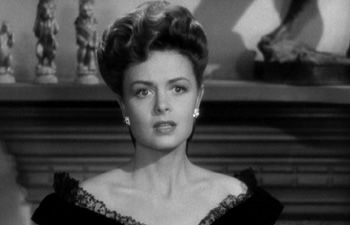
Donna Reed plays Gladys, the last love interest of Dorian Gray.

If ever there was a role right for an actor’s range it was Dorian Gray and Hurd Hatfield. In the limited roles that I’ve seen Hatfield in, I’ve found him to have a rather narrow range of emotions, which is perfect for a character that doesn’t show any. I’m not sure he’s what I would consider Adonis-like, but maybe others prefer their Greek gods to be pasty-white.

Hurd Hatfield plays Dorian Gray.

Victorian London’s aristocracy has been the setting for many literary horror stories like Dr. Jekyll and Mr. Hyde and science-fiction like The Time Machine, as well as the real life Jack-the-Ripper, that it must be something in the fog. Setting the movies in the locations of their novels has a down side; these films come off as period pieces as much as genre stories which “ages” this already melodramatic film even more. If you like your horror modern and truly scary, then this might not be the horror film for you.

The Picture of Dorian Gray is more of a psychological horror than what the genre seems to have descended to over the years. The only gruesomeness here is on canvas. If you like your horror raw and gory, then this is certainly not the film for you. But if you like your horror slightly melodramatic and hinted rather than shown then be sure to see this film as part of your Halloween viewing.

Be sure to check out our other Horror film reviews here.

The Picture of Dorian Gray on Blu-Ray is available through the Warner Archive Collection:

www.warnerarchive.com

The DVD is also available through the WB Shop:

Free Shipping on All Orders Over $50!

Saturday, April 4, 2015

Stubs – Sinners’ Holiday


Sinners’ Holiday (1930) Starring: Grant Withers, Evalyn Knapp, James Cagney, Lucille La Verne, Joan Blondell. Directed by John G. Adolfi. Screenplay by George Rosener, Harvey F. Thew. Based on the play Penny Arcade by Marie Baumer (New York, 10 Mar 1930). No Producer Credited.  Run Time: 59 minutes. U.S. Black and White. Melodrama, Crime, Romance.

On March 10, 1930, an original play opened on Broadway called Penny Arcade. Written by Marie Baumer and directed by William Keighley, the play ran for only 24 performances at the Fulton Theatre, closing on or about March 19th. Considered a flop by anyone’s terms, the play caught the eye of Al Jolson, a singer/actor perhaps best known for The Jazz Singer (1927), the film that ushered in the sound era in Hollywood.

Jolson paid $20,000 for the film rights, which he later sold to Warner Bros. studios. Jolson had one provision, two of the cast members, James Cagney and Joan Blondell, be given parts in the film version. While they apparently auditioned for the leads, they did end up playing the same parts they had on stage.

What probably attracted the brothers Warner to the story was the gangster element. After the success of The Lights of New York (1928), the studios’ first all-talking feature, the gangster genre was developing into their specialty.

The play’s director, William Keighley would later go onto a career as a film director, but for this film John G. Adolfi was chosen. Adolfi’s career dated back to silent films, but he was not known as a director of gangster films, usually working on the films of genteel actor George Arliss.

Shot in three weeks, the film would open by the end of September and go into general release on October 10th. Penny Arcade went through a few name changes, including Women in Love, before settling on Sinners’ Holiday. Cagney would recall in his autobiography that: “There was a great vogue for pictures with “holiday” in the title, and Sinners’ Holiday was a part of that trend. That title has as much to do with the picture as Winnie the Pooh!”

On an amusement park prier, Ma Delano (Lucille La Verne) owns and operates a penny arcade, along with other booths like the one next door run by Buck Rogers (Noel Madison) which is like a dunking booth with a twist. 

Rather than dumping the girl in the cage into water, hitting the bull’s-eye tips her back so that you can see up her skirt. If you hit the target hard enough and knock her so far back she falls off her perch, you win a cigar.


Harry (James Cagney) is Ma's (Lucille La Verne) favorite. Still, he's up to no good.

Ma Delano runs her arcade with the help of her children, Joe (Ray Gallagher), Jennie (Evalyn Knapp) and Harry (James Cagney). Joe does his best to keep the attractions running while Jennie is mostly sent on errands by Ma. Harry is Ma’s favorite and is a ne’er-do-well. Despite her ban on liquor, Harry spends most of his time at a nearby speakeasy run by Mitch (Warren Hymer). Mitch’s sideshow, which serves as a cover, features women in skimpy outfits. His barker for the sideshow is Angel Harrigan (Grant Withers), a drifter with a jail record.

Angel (Grant Withers) works as a barker for a sideshow run by Mitch.

Angel is in love with Jennie and, so apparently, is Mitch. When Mitch puts on the heavy pass on Jennie, Angel intercedes. Knowing that Jennie prefers Angel gets him fired, but Angel quits before Mitch can. Angel is about to leave town without saying good-bye, when Jennie sees him and talks him into staying, getting him a job with Ma at the penny arcade. She hires him to try to keep the machines running when Joe can’t.

Publicity shot re-enacting Angel stopping Mitch (Warren Hymer) from harassing Jennie (Evalyn Knapp).

Harry, unbeknownst to Ma, has been working with Mitch and actually takes over the operation of the speakeasy when Mitch is arrested by Detective Sykes (Purnell Pratt) on suspicion of murdering a cohort. Ma hates liquor, not because it’s illegal, but because what it had done to Harry’s father, her late husband. When she finds the Buck has been directing people to Mitch’s speakeasy, she fires him from his booth.

Mitch isn’t in jail for long, as the evidence wasn’t enough for an indictment. But as soon as he’s out of jail, he finds that Harry has been skimming profits from the speakeasy. He plans to get him and sends Buck to find Harry.

To celebrate his release, other barkers on the pier throw him a party. Harry doesn’t go and instead makes a date with Myrtle (Joan Blondell), who works as a model at another booth run by Happy (Hank Mann). Her job is to pose in a prop car with strange men. But Harry has to go see Ma first, leaving Myrtle to wait for him. But Ma doesn’t like Myrtle and doesn’t want Harry to leave the house, which is right next to the penny arcade.


Harry makes a date with Myrtle (Joan Blondell), but has to go see his Ma first.

Harry though, knowing that Mitch is looking for him, takes his brother’s gun, which is in with Angel’s things, and sneaks out of the house. Angel has previously been sent by Ma to look for Harry. Meanwhile, Mitch has commandeered Buck’s booth to wait for Harry to leave the house. Upstairs, Jennie is about to go to bed when she looks out her bedroom window which overlooks the pier. She sees Mitch confront Harry gun drawn. Harry, though, takes out his own gun and shoots and kills Mitch. Jennie watches while her brother pulls the dead body into the booth and locks it inside out of view.


Mitch confronts Harry about skimmy profits from the speakeasy.

A patrol cop hears the gunshots and comes running. Angel is returning back to Ma’s, where he has a room as part of his employment. The two talk, but Angel convinces him that it must have been a car backfire. Once the cop leaves, Harry sneaks back into the house.

The next morning, Detective Sykes returns to the pier looking for Mitch. Harry begs Myrtle to give him an alibi, which she agrees to do. When Angel tries to break into Buck’s old booth to retrieve a pair of pliers he had lent him and now needs, Jennie stops him.

Later, Buck returns to his booth and breaks in to retrieve some personal items he’d left there. When he finds the body, he tells Sykes, who is speaking to Ma at the penny arcade. Det. Sykes is suspicious of Harry at first, but Myrtle gives him an alibi, much to Happy’s dissatisfaction. (The relationship between Happy and Myrtle is never defined, but Happy, who has the most elaborate and still worst comb-over ever, at least, seems jealous of Myrtle being with other men.)


Happy (Hank Mann) has an elaborate but really obvious comb-over.

Sykes then suspects Angel, who not only had a public falling out with Mitch, but also has a criminal record. The police start to search the park and close it down to the public, much to Ma’s and the other proprietor’s dismay. While you would expect the police to start with Ma’s house, they don’t. While they’re waiting, Harry breaks down and confesses to Ma. Not happy about Jennie and Angel’s burgeoning romance and their plans to leave, Ma decides to kill two birds with one stone. She decides to hide the gun in plain sight, putting it back with Angel’s suitcase.

Eventually, the police find the murder weapon and arrest Angel for the murder. While they are taking him away, Jennie finally breaks down and tells Sykes that she saw her brother Harry shoot Mitch. Harry is then led away.
With the murder solved, the park is reopened. Ma has no time to worry about Harry; there are suckers to fleece. She even puts Angel back to work as barker out to bring in customers.

In order to save Angel from being taken away by Det. Sykes (Purnell Pratt),
Jennie finally admits her brother Harry shot Mitch.

There are no records available about how well the film did at the box-office; Time magazine did appreciate its length and concise story. However, for only 60 minutes there is still filler. There is a scene in the film with Jennie and Angel down at the beach. She seems to run hot and cold throughout the movie, openly flirting with Angel one minute and then here not wanting him to kiss her even when they are all alone under the pier. While I’m sure this might have played well on stage and their relationship is important to the plot, this still feels like wasted time.

Grant Withers, who is the lead, had his greatest success in early talkies. Young, handsome and able to show sensitivity, Withers would get top billing in two early Cagney films, this and Other Men’s Women (1931). But as the years went by, Withers' stature fell. While he did manage to get a 10 year contract at Republic Films, he did not have the splashy career Cagney was destined to have. In Sinners' Holiday, he seems to be good-natured with a dry sense of humor. He’s likable, which is about all his character is required to be.

Likewise, Evelyn Knapp was a star out of the gates with talking pictures. She was one of fourteen girls, along with the likes of Ginger Rogers and Gloria Stuart, selected as "WAMPAS Baby Stars" in 1932. She would star in Bachelor Mother (1932), a film that would be remade in 1939 with Ginger Rogers in the lead. Knapp would co-star with Cagney and Edward G. Robinson in Smart Money (1931) and find success in serials, starring in the title role in the Perils of Pauline (1933). In Sinners' Holiday, she is mostly fickle eye candy. Her character can’t seem to make up her mind if she’s in love with Angel or not, but she finally rises up to do the right thing, even If it means her brother goes to jail.

Lucille La Verne had been acting since 1888, starting out on stage before moving to silent films in 1915 with Over Night. She may be best remembered for, but uncredited as, the voice of the Queen and the Witch in Walt Disney’s Snow White and the Seven Dwarfs (1937), which would turn out to be her last film. Here she plays a strong and somewhat devious woman. She manages to infuse a rather one-dimensional role with a little depth.

While Cagney is not the star, you get the feeling he’s being prepared by the studio for bigger things. However, I wouldn’t say Cagney hit it out of the ballpark on his first time at bat. His character may play a killer, but it is almost by accident. This is not the tough gangster character that Cagney will become famous for playing. Harry, like Cody Jarrett in White Heat (1949), is a momma’s boy. Cagney, to his credit, plays it well and you can see the beginnings of a movie persona that he would get to develop over time. The Warner Bros. obviously say something, because his original contract, which had only covered the three week shoot, was extended and he was added to The Doorway to Hell (1930), starring Lew Ayres, that was already in production.

James Cagney, whose career was just starting, was going places after Sinners' Holiday.


Joan Blondell had appeared in a few Warner Bros. shorts before Sinners' Holiday, including Broadway’s Like That (1930), which also starred Humphrey Bogart, and the feature The Office Wife (1930), which was shot at the same time as, but released before, Sinners' Holiday. Blondell is underused in this role, mostly limited to looking pretty, but there doesn’t seem to be a lot of meat on Myrtle’s bones.


Joan Blondell isn't given much to do in Sinners' Holiday.

One other note about the actors in the film, Hank Mann, Myrtle’s boss Happy, got his start as one of cinema’s first film comedians, working with Mack Sennett’s Keystone Studios, as an original Keystone Cop. Fellow ensemble actor, Edgar Kennedy, credits Mann with originating the idea for the Cops in the first place. Again, his part in the film doesn’t really stretch the actor or give him a chance to demonstrate any comedic capabilities.

This is one of those films that is almost over before you know it. Typical of Warner Bros. programmers of the time, no grass grows under the characters in this film. The plot keeps moving forward, taking only a slight break for the scene with Jennie and Angel on the beach. The story really isn’t that bad, complete with treachery and deceit and, of course, murder. While this definitely has the elements of the gangster genre, including prohibition and a speakeasy, Sinners' Holiday is not nearly as violent nor the characters as menacing as would become more typical of the genre.

Overall, Sinners' Holiday is a film that might have gone completely unnoticed if it hadn’t been the debut of James Cagney, one of the biggest stars of the 1930s and 40s. A decent film, but certainly not a great one, it is worth watching if you’re a fan of Cagney’s.