Showing posts with label 1931. Show all posts

Saturday, April 12, 2025

Stubs - Mata Hari (1931)


Mata Hari (1931) Starring Greta Garbo, Ramon Novarro, Lionel Barrymore, Lewis Stone. Directed by George Fitzmaurice. Screenplay by Benjamin Glazer, Leo Birinski. Produced by George Fitzmaurice, Irving Thalberg (uncredited). Run time: 92 minutes. Black and White. USA Drama. Espionage.

While the film Mata Hari is based on Mata Hari’s life, hers is a bio that flies in the face of the Production Code that the Hays Office was there to enforce. A one-time exotic dancer, Mata Hari was known for using her sexuality to get men to do her will, which was supposedly giving her military secrets. Thought to be a double-agent working for both France and Germany during World War I, she was eventually executed for her treason.

Saturday, January 11, 2025

Stubs - An American Tragedy


An American Tragedy (1931) Starring: Phillips Holmes, Sylvia Sidney, Frances Dee Directed by Josef von Sternberg Screenplay by Samuel Hoffenstein Based on the novel An American Tragedy by Theodore Dreiser (New York, 1925). Produced by Josef von Sternberg Runtime: 96 minutes. USA Black and White Melodrama, Romance, Pre-Code.

On July 11, 1906, Chester E. Gillette drowned Grace Brown in a lake in Herkimer County, New York. That murder was the basis of Theodore Dreiser’s 880-page novel, An American Tragedy, published in 1925. When Paramount bought the rights, the film was originally planned as the American debut of Sergei Eisenstein, the renowned Soviet film director; Battleship Potemkin (1926).

Apparently, Eisenstein was so interested in the project that he wrote, what the Associate Producer David O. Selznick called “the most moving script I have ever read." However, B.P. Schulberg, the head of Paramount, wasn’t so impressed and replaced Eisenstein with Josef von Sternberg. Eisenstein never did make a Hollywood film and returned to the Soviet Union.

The change in director didn’t change the Hays Office’s objections to the film and the aspect of the story that dealt with an abortion. Colonel Jason S. Joy, the Director of the Studio Relations Office, wrote to Schulberg on April 25, 1931, "If the references to abortion remain in "American Tragedy"...it will surely tend to eventually open the way for a more serious development of this subject in pictures." However, Schulberg wasn’t willing to eliminate Roberta's attempts to secure an abortion from the film because of an earlier approval given by Father Daniel J. Lord, a clergyman who collaborated on the draft of the Hays Code. But on July 15, 1931, Jesse Lasky wrote to Hays agreeing to eliminate the following dialogue, which refers to abortion: "You went to the druggist who testified here." "Yes sire." "Anyone else?" "Yes sire, to seven others before I could get anything at all." "But what you got didn't help, did it? "No sir."

Saturday, June 1, 2024

Stubs - The Guardsman


The Guardsman (1931) Starring: Alfred Lunt, Lynn Fontanne, Roland Young. Directed by Sidney Franklin Screenplay by Ernest Vajda Based on the play Testör by Ferenc Molnár (Budapest, 1911). Produced by Albert Lewin (Supervising Producer). Run time: 83 minutes. USA Black and White. Comedy, Drama.

Things don’t always work out as planned. That’s as true today as it was back in 1931, when Irving Thalberg wanted to add husband and wife Broadway actors Alfred Lunt and Lynn Fontanne to the growing stable of MGM stars. To this end, he brought them out west to recreate their 1924 Broadway hit play The Guardsman on film.

The Guardsman went into production on June 25, 1931 and completed on July 23rd. Made on a budget of $374,000, it was released on November 7, 1931.

Saturday, May 25, 2024

Stubs - The Secret Six


The Secret Six (1931) Starring: Wallace Beery, Lewis Stone, John Mack Brown Directed by George Hill. Screenplay by Frances Marion. Producer: Irving Thalberg. Run time: 83 minutes. USA Black and White. Drama. Gangster.

1931 seems to be the beginning of the gangster genre in Hollywood with the release of three films that sort of set the standards for the genre: Scarface, Little Caesar and The Public Enemy. Not wanting to be left out of the trend, MGM released their first such film that same year, The Secret Six.

According to Variety, writing about the film at the time it was being made, several elements of this film are traceable to actual gangster activities of the time and about a group of rich vigilantes who helped take down mobsters in 1930’s Chicago. While the film is not hailed by critics the way the other three films were, The Secret Six is notable for other reasons. The film marks the debut of actor Ralph Bellamy and the rise of both Clark Gable and Jean Harlow on their way towards stardom.

Saturday, May 11, 2024

Stubs - Smart Woman


Smart Woman (1931) Starring; Mary Astor, Robert Ames, John Halliday, Edward Everett HortonNoel Francis. Directed by Gregory La Cava. Screenplay by Salisbury Field. Based on the play Nancy's Private Affair by Myron C. Fagan (New York, 13 Jan 1930). Produced by William LeBaron. Run time 68 minutes. USA Black and White. Pre-Code, Drama.

Mary Astor may be best known for her role as Brigid O'Shaughnessy in The Maltese Falcon (1941) but before that film, and for many years after, she was a movie star with a career that dated back to silent films. Her first film role at the age of 14 in Sentimental Tommy (1921) may have ended up on the cutting room floor but that didn’t deter her. She would appear in other films before moving to Hollywood in 1923, with her parents, and signed with Paramount Pictures.

Saturday, January 13, 2024

Stubs - Illicit


Illicit (1931) Starring: Barbara Stanwyck, James Rennie, Ricardo Cortez, Natalie Moorhead. Directed by Archie Mayo. Screenplay by Harvey Thew. Based on a play by Edith Fitzgerald and Robert Riskin (copyrighted 1 Jul 1930). Produced by Darryl F. Zanuck Run time: 82 minutes. USA Black and White Pre-Code, Drama.

So much has changed since the day that Illicit was originally released on February 14, 1931. Back then, the film was condemned by the Catholic Legion of Decency and enraged women’s groups. What had once been scandalous is now rated TV-G when it recently aired on TCM.

Saturday, October 14, 2023

Stubs - Drácula (1931)


Drácula (aka Spanish-language Dracula) (1931) starring Carlos Villar, Lupita Tovar, Barry Norton Directed by George Melford. Screenplay by Garrett Fort, Spanish adaptation by Baltasar Fernández Cué. Based on the novel Dracula by Bram Stoker (London, 1897) and Dracula (play) by Hamilton Deane, John L. Balderston. Produced by Carl Laemmle Jr. Run time: 103 minutes. Black and White. USA Horror

Hollywood has always had an eye on the foreign markets. When they were making silent films, it was easy to do as only the interstitial cards could be translated and inserted. The coming of sound presented a different set of issues for doing this. As an example, between October 1929 and February 1931, the comedy team of Laurel and Hardy shot 10 of their films in Spanish, French, German and Italian, relying on interpreters writing the dialogue phonetically on a blackboard just out of camera range. Laurel and Hardy featurettes La Vida Nocturna (1930) is the Spanish-language equivalent of the team’s short Blotto (1930), while Politiquerias (1930) is a greatly amplified version of Chickens Come Home (1930).

Universal took a different approach when it came to Dracula. By 1930, the studio had focused primarily on developing Spanish-language films for the foreign market and rather than have Bela Lugosi learn Spanish on the set, they instead set out to make an entirely Spanish-language version with a Spanish-speaking cast. While Tod Browning would shoot during the day, the George Melford production would shoot at night and on the same sets.

The idea originated with Paul Kohner, a producer at the studio who convinced Carl Laemmle to make Spanish language movies that could be shot simultaneously at night with their English originals. While Drácula maybe the most famous, it was not the only film shot like this at the studio.

Apparently, the cast and crew would arrive in the evening, look over what was shot that day and then shoot their own version. They were apparently not required to be slavish to the original. While they used the same marks as the daytime production, they were free to make some changes. As an example, the Spanish version has more dialogue, different costumes and some different camera work. According to Lupita Tovar, who starred as Eva, they wanted theirs to “be the best” of the two releases. As some critic referred to it, Drácula was sort of like a second draft, which are usually better than the first.

Again, according to Tovar, director George Melford did not speak Spanish and had to use an interpreter to speak with the cast. That is not apparent on the screen.

Saturday, June 24, 2023

Stubs - The Sin of Madelon Claudet


The Sin of Madelon Claudet
(1931) Starring Helen Hayes, Lewis Stone, Neil Hamilton, Robert Young. Directed by Edgar Selwyn. Screenplay by Charles MacArthur. Based on the play The Lullaby by Edward Knoblock (New York, 17 Sep 1923). Produced by Harry Rapf. Run time: 74 minutes. USA. Black and White. Pre-Code Drama, Academy Awards

Helen Hayes was known as the “First Lady of the Theatre” but she was more than that, having won not only the “Triple Crown of Acting”, a competitive Academy Award, Emmy Award, and Tony Award in the acting categories, she was also one of only 18 people who have won an EGOT. Hayes would, in fact win two Academy Awards, Best Supporting Actress for Airport (1970) but also one for Best Actress for her role in The Sin of Madelon Claudet.

Based on a play, The Lullaby by Edward Knoblock, Hayes was not the first choice for the role, Kay Francis was. But Francis rejected the offer, stating "I would have to be out of my mind to play that silly French prostitute. Why that dumb little bunny actually walked the streets so that she could buy clothes for her son. Phooey! How can you generate sympathy for such a shallow woman?" While Francis was ultimately wrong about that, the first previews seemed to indicate that she may have not been.

Saturday, June 3, 2023

Stubs - Five Star Final


Five Star Final (1931) Starring: Edward G. Robinson, Marian Marsh, H. B. Warner, Anthony Bushell Directed by Mervyn LeRoy Screenplay by Louis Weitzenkorn. Based on the play Five Star Final by Louis Weitzenkorn (New York, 30 Dec 1930). Produced by Hal Wallis (uncredited). USA Run time: 89 minutes. Black and White. Drama.

Warner Bros. was a studio that didn’t shy away from social protest films. No other studio would have released such films as I Am a Fugitive from a Chain Gang (1932), The Public Enemy (1931) and Heroes for Sale (1933). Five Star Final represents a different kind of protest film, that against tabloid journalism, an issue that seems as fresh today as it did in 1931.

Wednesday, June 30, 2021

Stubs - The Last Flight

The Last Flight (1931) Starring: Richard Barthelmess, David Manners, John Mack Brown, Helen Chandler. Directed by William Dieterle. Screenplay by John Monk Saunders. Based on the novel Single Lady by John Monk Saunders (New York, l931). No Producer Credited. Run time: 80 minutes. USA Black and White Drama, Pre-Code.

After the First World War, many American soldiers chose to stay in Europe rather than return to the States. They needed to forget the horrors they encountered during the war and with a generous exchange rate for the U.S. dollar, they could afford a more hedonistic lifestyle. Besides, Prohibition had taken a stranglehold back in the States and drinking seemed in order for these Vets.

Tuesday, June 29, 2021

Stubs - Chances


Chances (1931) Starring: Douglas Fairbanks Jr., Rose Hobart, Anthony Bushell. Directed by Allan Dwan. Screenplay by A. Hamilton Gibbs. Based on the novel Chances by Arthur Hamilton Gibbs (Boston, 1930). Producer Not Credited. Run time: 72 minutes. USA Black and White. Pre-Code, Drama.

There is no one way that you can become aware of a particular movie. In the case of Chances, for me, it was purely by accident. One morning while I was getting ready for work, the film happened to be on TCM and I happened to be watching. Since I didn’t have the time to watch it, I decided to DVR it and watch it later, which I recently did.

There were several things that attracted me to the film. I haven’t seen a lot of Douglas Fairbanks, Jr. films, and those I have seen, especially from this time period, I have liked. Then there is the backdrop to the story, World War I. For most of my life, World War II has been so dominating, and rightly so, that the first World War is somewhat forgotten. However, during the 1920s and 30s, it was the last major war that most people had lived through, so it was used quite often for a backdrop for films. And then there was the obvious story detail that becomes quickly apparent, two close brothers fall in love with the same woman. I’m happy to say that on all these points, the film does not disappoint.

Saturday, February 6, 2021

Stubs - Susan Lenox (Her Fall and Rise)


Susan Lenox (Her Fall and Rise) (1931) Starring Greta Garbo, Clark Gable, Jean Hersholt, John Miljan, Alan Hale Directed by Robert Z. Leonard Screenplay by Wanda Tuchock Based on the novel Susan Lenox: Her Fall and Rise by David Graham Phillips (New York, 1917). No Producer Credited (Irving Thalberg) Run time: 75 minutes USA Black and White Melodrama, Pre-code

David Graham Phillips was an American writer and novelist who was killed by a paranoid named Fitzhugh Coyle Goldsborough, a violinist in the Pittsburgh Symphony Orchestra in 1911. Goldsborough thought Phillips had cast literary aspersions on his family, to be more exact, he thought Phillips had used his sister as “as a model for the complaisant heroine" of the novel. After shooting Phillips, Goldsborough turned the gun on himself, shooting himself in the head.

Saturday, October 3, 2020

Stubs - Dr. Jekyll and Mr. Hyde (1931)


Dr. Jekyll and Mr. Hyde (1931) Starring Fredric March, Miriam Hopkins, Rose Hobart Directed by Rouben Mamoulian. Screenplay by Samuel Hoffenstein, Percy Heath. Based on the novella The Strange Case of Dr. Jekyll and Mr. Hyde by Robert Louis Stevenson (London, 1886). Producer: Adolph Zukor (Presents) Run time: 98 minutes. United States Black and White Pre-code Horror

Robert Louis Stevenson was a Scottish-born writer who lived between 1850 and 1894. He is best remembered for such books as Treasure Island and The Strange Case of Dr. Jekyll and Mr. Hyde. The latter of the two is one of the most adapted stories in film history, with nearly 123 different versions made since Dr. Jekyll and Mr. Hyde (1908), produced by William N. Selig. By the time Paramount made their version in 1931, 14 other films had been produced in the U.S., the UK, Denmark, and Germany.

Saturday, June 6, 2020

Stubs - Smart Money


Smart Money (1931) Starring: Edward G. Robinson, James Cagney, Evalyn Knapp Directed by Alfred E. Green. Screenplay: Kubec Glasmon, John Bright, Lucien Hubbard, Joseph Jackson. Producer: None Credited. Run time: 81 minutes. United States. Black and White Drama, Gangster Pre-Code

By 1931, James Cagney’s star was rising at Warner Bros. In only his fourth film with the studio, he was put in a movie with Edward G. Robinson. Already an established film actor, Robinson was already one of the studio’s biggest stars after Little Caesar (1931), the first of the major gangster films of the 1930s. This film went into production while Cagney was filming his own breakthrough gangster film, Public Enemy, which would come out later that same year. The film would prove to be the only ever pairing of these two actors. The film would also be the feature film debut of prominent character actor Charles Lane, who over the next 72 years would appear in more than 250 films.

Saturday, September 9, 2017

Stubs - Blonde Crazy


Blonde Crazy (1931) Starring James Cagney, Joan Blondell, Louis Calhern, Noel Francis, Ray Milland Directed by Roy Del Ruth. Screenplay by Kubec Glasmon and John Bright. Producer: None Credited. Run Time: 78 minutes. U.S.A. Black and White. Pre-Code, Crime, Comedy, Drama

James Cagney and Joan Blondell had arrived in Hollywood together, both brought from Broadway to recreate their roles in Sinner’s Holiday (1930). Both seemed meant for stardom from almost the beginning. Warner Brothers knew what they had and would pair them in six more movies through 1934, including Other Men’s Women (1931); The Public Enemy (1931), The Crowd Roars (1932); Footlight Parade (1933); He Was Her Man (1934). But before those films, there was Blonde Crazy (1931), which would be Blondell’s first starring role. Cagney by then had become a star thanks to The Public Enemy, which had already been released on May 15th.

Saturday, June 10, 2017

Stubs - Dance, Fools, Dance


Dance, Fools, Dance (1931) Starring Joan Crawford, Lester Vail, Cliff Edwards, William Bakewell, William Holden, Clark Gable. Directed by Harry Beaumont. Screenplay by Aurania Rouverol. Produced by Irving Thalberg (uncredited). Runtime: 80 minutes. U.S.A. Drama

Born Lucille LeSueur, Joan Crawford became a star at MGM in the mid-1920s, almost willing herself to stardom. While a dancer in New York in 1924, LeSueur was dancing in the chorus line in Jacob J. Shubert’s Innocent Eyes, at the Winter Garden Theatre on Broadway. She wanted more work and managed to secure work with singer Harry Richman’s act through Loews Theater publicist Nils Granlund, who also arranged for a screen test that he sent to MGM producer Harry Rapf. On December 24, Rapf notified Granlund that MGM had offered her a contract at $75 a week. She left the day after Christmas from mother’s house in Kansas City and arrived in Culver City on January 1, 1925.

After she would appear in several uncredited parts in several films, Crawford decided to become a star. She danced her way to stardom by attending dances in the afternoon and at night, winning several competitions by dancing the Charleston and the Black Bottom, popular dances at the time. That got her cast in Edmund Goulding's Sally, Irene and Mary (1925), where she got attention from audiences for the first time.

In 1926, she was one of the WAMPAS Baby Stars along with Mary Astor, Dolores del Río, Janet Gaynor, and Fay Wray among others. Despite feeling like Norma Shearer, MGM’s biggest female star and the wife of the studio’s Head of Production, Irving Thalberg, was her nemesis, Crawford became the romantic lead to many of the studio’s male stars, including Ramón Novarro, John Gilbert, William Haines, and Tim McCoy.

She even drew attention from F. Scott Fitzgerald, who wrote of her, “Joan Crawford is doubtless the best example of the flapper, the girl you see in smart night clubs, gowned to the apex of sophistication, toying iced glasses with a remote, faintly bitter expression, dancing deliciously, laughing a great deal, with wide, hurt eyes. Young things with a talent for living.”

In 1929, she married Douglas Fairbanks, Jr., despite his parents, Douglas Fairbanks and Mary Pickford, not approving. It was eight months before the couple was invited to Pickfair, though they would become frequent guests.

Crawford, who was originally from San Antonio, Texas, worked with diction and elocution coaches to rid herself of her accent, helping her to make the transition to sound when it came. She appeared in one of MGM’s first talkies, The Hollywood Revue of 1929 (1929), in which she also sang.

A star on the rise, Crawford would appear in three films in 1930 and five films in 1931, including Dance, Fools, Dance, which was her first pairing with an up and coming actor, Clark Gable. Apparently, Crawford had the power at MGM to ask for him as her male lead, even though he received sixth billing in the film. The two would go on to make eight films together, not to mention have a torrid love affair despite they're both being married at the time, but that's really fodder for another blog.

As an example of the turn-around at the Hollywood Dream Factories, Dance, Fools, Dance went in front of the cameras on November 4, 1930, and hit the screens February 21, 1931.

Bonnie (Joan Crawford) and beau Bob (Lester Vail) dance at a party on board a yacht.

The film opens just before the beginning of the Great Depression. Rich kids are frolicking on board a yacht, including Bonnie Jordan (Joan Crawford). She is accompanied by Robert “Bob” Townsend (Lester Vail), a boy that she is romantically linked to. When she gets bored, Bob suggests everyone go for a swim in their underwear and everyone goes along. Later, she doesn’t turn down his sexual advances, no strings attached. Her brother, Rodney (William Blakewell), enjoys the high-life, but also likes to drink, despite prohibition. He has his own contact with bootleggers, so he’s never without alcohol.

The guests think nothing of stripping down to their underwear to dance.

Despite their carefree lifestyle, their father, Stanley (William Holden), is worried. His unusual presence on the stock exchange floor to check on his investments doesn’t go unnoticed. Neither does his dying of an apparent heart attack during the stock market crash.

Bonnie with her father Stanley (William Holden) shortly before he dies.

His death reveals that not only is he broke, but deep in debt. Everything, including their house and possessions, has to be sold. Bob comes to Bonnie and offers to marry her, but she turns him down.

Instead, she and her brother strike out on their own and get an apartment together. Through her connections, Bonnie lands a job at The New York Star, a daily newspaper, which at the time was uncommon. Her co-workers don’t seem to be bothered by her presence. She is befriended by the paper’s leading reporter, Bert Scranton (Cliff Edwards).

Bonnie ends up working at a newspaper next to and befriending the
paper's leading reporter, Bert Scranton (Cliff Edwards).

Rodney tells Bonnie that he’s in sales, but doesn’t tell her what he sells. Through his bootlegger connections, he’s found a job working for Jake Luva (Clark Gable) to peddle his liquor to his wealthy friends. But his job duties also include driving and he ends up at the wheel when Jake decides to take care of a rival gang Valentine’s Day Massacre-style. Rodney can’t stomach the sight.

Bonnie's brother Rodney (William Blakewell) gets a job through his
bootleg connections with gangster Jake Luva (Clark Gable).

All the reporters at the Star are sent to investigate the shooting. Bonnie is sent to the morgue to cover that angle, while Bert goes to investigate his underworld connections to see if he can find any leads as to who is behind the massacre. This leads him to the gin joint that serves as Jake’s headquarters, where he happens to talk to Rodney. Acting like he is one of the gang, Bert gets Rodney to say more than he should about the crime.

Over drinks, Bert gets Rodney to talk about his role in a recent gangland hit.

Bert gets along well with the criminal element and is invited by Luva’s right-hand man, Wally (Earl Foxe), to have a few drinks at the bar with him. But it is really a ruse to keep Bert in the bar. Luva has heard about Rodney talking and gives him a hard choice to make good. Either he shoots Bert or Luva will have his men shoot him. They overtake Bert down at the subway entrance. Reluctantly, Rodney shoots the ever-friendly Bert dead.

Rodney is given the choice to kill Bert or be killed for talking to him.

The paper goes into mourning and suspects correctly that Bert’s murder is attributable to Luva’s gang. Bonnie goes in undercover to find out what she can, posing as "Mary Smith" from Kansas City, a dancer. When she makes her debut at the club, some of her old socialite friends, including Bob, are in the audience and horrified by seeing their old friend dancing for a living. Bob comes backstage and tries to take Bonnie away from this existence, but fearing he’ll blow her cover, she sends him away.

Bonnie convinces the paper's editor to let her help with finding Bert's killer.

Later, Luva invites Bonnie back to his place and eventually puts the moves on her, which she rejects. But while she’s there, the phone rings and she answers. Hearing her brother’s voice on the other end leads her to conclude that her brother is more involved with Luva than she had any idea.

Wally (Earl Foxe) and Luva come to Rodney's hideout to kill Bonnie.

She goes to Rodney’s hiding place and tries to convince him to leave with her, but Luva and Wally arrive. They realize that Bonnie is not who she says she is and threaten to kill her, i.e. take her for the proverbial ride. But Rodney intercedes, shooting and killing Wally and Luva, but gets mortally wounded in the process.

Rodney saves her life but ends up dying in Bonnie's arms.

The police bust into the apartment and recognize Luva right off the bat.

Bonnie ends up a hero at the newspaper but decides it is time for her to move on. On her way out, she is confronted by Bob, who has been trying to see her. He asks her again to marry him and she accepts. When they kiss, the newspaper staff is there taking a photo of the event for the society page.

While Crawford is the star of the film and had asked for Gable as her co-star, she was supposedly somewhat intimidated by acting with someone with stage experience. Since so many Hollywood stars had come from Broadway, it is a little hard to believe that she hadn’t worked with someone with that experience before. Gable, who had known Crawford back when they were both uncredited bit players, was supposedly intimidated by her star status. While they must have had chemistry, hence their long-running affair, they don’t really mix well here. A lot of that has to do with the script, there is supposed to be no heat between them on purpose.

Crawford’s Bonnie is definitely a modern woman, partially by choice. Her attitudes about sex out of wedlock seem to be more liberal than we’re used to seeing in Hollywood films post the Code. No strings attached sex wouldn’t be common on screen until the 1960s though one has to imagine not everyone was as chaste as they were made out to be in the movies.

While there were career women, hard news reporters were not usually considered choices back then. But it is circumstances that force her to grow up. And while you can credit Bonnie for making the most out of a bad situation, financial ruin, one gets the idea that if her father hadn’t died, she would have been content to spend her days skinny dipping off the side of yachts. That is why a lot of the film is spent showing her background in order to show how far she comes when the chips are down.

Joan Crawford is less an actress and more of a presence at this point. To those that only know her from the Mildred Pierce era she is a far younger and prettier version here. Soft and easy on the eyes, she has none of the “mannish” features, like thick eyebrows, that she chose as her post-MGM look.  We even get to see her skills as a dancer as she performs twice in the film.

Up and comer Gable is once again cast as the heavy, a part he would play several times before becoming a romantic lead and the King of Hollywood. We’ve seen him before as Nick in Night Nurse (1931), but here there is a little more to his character. Still one-dimensional, there is more meat on the bones and more screen time to go with it. He is not as likable as Luva, but he is not supposed to be. His character, after all, has more in common with Al Capone than Rhett Butler.

But despite his title as King of Hollywood, Gable’s is a star that has seemed to dim over time. With few exceptions, like Gone With the Wind, his films don’t seem to get a lot of attention today. That’s not to say his title wasn’t deserved, just that his films have fallen out of favor. They still talk about Joan Crawford, the recent TV miniseries Feud (2017) about her troubles with Bette Davis on the set of What Ever Happened to Baby Jane? (1962) being one such example. And one shouldn’t forget Mommie Dearest (1981) either. But the legend of Gable doesn’t get the same treatment.

Just as Gable and Crawford would go on to be big stars, the others in the film didn’t necessarily fare as well. Take William Blakewell, who played Bonnie’s brother Rodney. He had previously appeared in All Quiet on the Western Front (1930) and would appear in such movies as Gone With the Wind (1939) and The Bachelor and the Bobby-Soxer (1947), but would never receive star status.

Likewise, Cliff Edwards, who played jovial reporter Bert Scranton, would never be more than a sidekick. While he never became a star on his own, he still did have a distinguished career. Mostly known for playing supporting roles, Edwards does have the distinction of having a number one hit. He was the first singer to record “Singin’ In the Rain” in 1929. Edwards would later get into voice work. His most memorable and enduring role may have been voicing Jiminy Cricket in Walt Disney’s Pinocchio (1940). It was as Jiminy Cricket he would also record the classic “When You Wish Upon A Star” which maybe his biggest hit of all.

And in the name-sounds-familiar category, the actor in the film, William Holden, who appeared briefly as Bonnie’s father and whose death would plummet her into poverty, is not the William Holden most of us have ever heard of. This William Holden was born in 1862 and would appear in only sixteen films between 1920 and 1932. He would die for real in 1932 at the age of 69. The William Holden we’re all more familiar with, the star of such films as Golden Boy (1939), Stalag 17 (1953), Sabrina (1954), The Bridge Over the River Kwai (1957) and The Wild Bunch (1969), wouldn’t make his first film until 1938.

Dance, Fools, Dance is a movie that could only have been made during the Great Depression and resonate with its intended audience. While Bonnie’s story is somewhat unique, the fact that the depression caused an upheaval in her life was something most in the movie going public could identify with. The added reference to Capone and the evils of gangland violence were taken from the headlines of the day; the Valentine’s Day Massacre had occurred only two years prior.

While not necessarily a classic of cinema, the film does hit on most of the checkpoints of films from that era. Social relevance, true or nearly true crime and a happy ending, even if some complain the proposal scene and her acceptance of a future of being a housewife seem tacked on. But those were how films from that time ended.

I would recommend the film to anyone interested in early 1930’s Hollywood cinema and anyone who are fans of either Joan Crawford or Clark Gable. While not the best film either star would appear in, it is formative in each of their careers and a time capsule of the era in which it was made.

Saturday, May 27, 2017

Stubs - Night Nurse


Night Nurse (1931) Starring Barbara Stanwyck, Ben Lyon, Joan Blondell, Clark Gable. Directed by William Wellman. Screenplay by Oliver H.P. Garrett, Charles Kenyon Based on the novel Night Nurse by Dora Macy (New York, 1930). Producer: None Credited. Runtime: 72 minutes. U.S.A. Crime, Drama, Mystery

As discussed here previously, Pre-Code Hollywood films are not filled with debauchery or nudity, but deal more openly with issues that Hollywood would have to hint at from 1934 until the mid-1960s, when all provincial thoughts were tossed aside. Films are labelled Pre-Code the same way home video releases sometimes come in unrated versions. To be unrated, a film only has to differ in length from the version that was rated by the MPAA. It doesn’t take much, only a few seconds, to make a film unrated, in the much the same way that saying a film is Pre-Code means anything more than it was made before 1934.

Still, there are touches about Pre-Code films that you won’t see in films from the mid-30s on. Case in point, Night Nurse (1931), starring Barbara Stanwyck, Ben Lyon and Joan Blondell. There was also a supporting actor you may have heard of in it as well, Clark Gable, who would someday warrant the title "The King of Hollywood". And to top it off, the film is directed by one of Hollywood’s early greats, William Wellman, who only a few years prior had directed Wings (1927), one of the better silent films; the first film to win “Best Picture” and the last, until The Artist (2011), to garner that honor.

All were brought together in a Warner Bros. film adaptation of the novel Night Nurse by Dora Macy, the non-de plume of Mrs. Fulton Oursler, printed only the year before. (Don’t go looking for the book, as I can’t find any reference to it other than it was the basis for this film.)

Lora Hart (Barbara Stanwyck) is at first rejected by Miss Dillon (Vera Lewis).

In Night Nurse, Lora Hart (Barbara Stanwyck) wants very badly to be a nurse, but her lack of a high school degree gets her rejected by Miss Dillon (Vera Lewis), the Superintendent of Nurses. But Lora’s fortunes change when she encounters the hospital's chief of staff, Dr. Arthur Bell (Charles Winninger), in a revolving door. He knocks her purse out of her hands and while he picks up it contents, he becomes enamored with Lora. He intercedes on her behalf with Miss Dillon and gets the requirement waived.

A change encounter with a smitten Dr. Bell (Charles Winninger) gets Lora the job.

Miss Dillon assigns another nursing student, Miss Maloney (Joan Blondell), to help get her settled and assigns them to be roommates in the dorms provided for student nurses. While Miss Maloney is sarcastic, the two become best friends. Maloney warns her about the interns, one of whom has a crush on Lora.

Miss Maloney (Joan Blondell) doesn't seem thrilled to be assigned Lora as a roommate.

One night when Maloney and Lora are out past curfew, the intern puts a skeleton in Lora’s bed. Her screams are enough to wake Miss Dillon, who is across the hall. Suspecting that the women have broken her rules, she comes down harder on Maloney, who has broken the rules more often.

A practical joke and the girls' reaction to it gives away that they've been out past curfew.

We also see the two nurses as they learn their craft. When both are assigned to the emergency room, Lora ends up treating bootlegger Mortie (Ben Lyon) for a gunshot wound. Even though she is required by law, and admonished by Maloney, to report any gunshot wound to the police, she doesn’t, earning Mortie’s gratitude.

While working in the Emergency room they meet bootlegger Mortie (Ben Lyon), who has been shot.

The final test for both nurses is surgery, with Lora worried about how she’ll react to all the blood. A bottle of Rye is delivered from Mortie as a good luck gesture. When Dr. Bell’s patient dies on the table, Lora makes it through, but faints to the floor when she is alone.

After the patient dies, Lora passes out in surgery.

This is followed by graduation, with the nurses singing a song related to Florence Nightingale as part of their graduation.

Maloney's heart isn't in singing the Florence Nightingale song.

After graduation, Lora and Maloney accept a private nursing job, through Dr. Milton Ranger (Ralf Harolde), caring for Nanny (Marcia Mae Jones) and Desney (Betty Jane Graham), children of a wealthy alcoholic socialite, Mrs. Ritchey (Charlotte Merriam). Maloney has the day shift and Lora the night.

At the Ritchey mansion there always seems to be a party going on. Lora’s first meeting with Mrs. Ritchey comes at the urging of Eagan (Edward Nugent), one of the perpetually drunken party guests. Mrs. Ritchey has collapsed on the floor in a drunken stupor. Nick (Clark Gable), the family chauffeur, intercedes and tells Lora to pump out Mrs. Ritchey’s stomach. But Lora insists she doesn’t have the right equipment to do the procedure and when she tries to call for help, Nick stops her. When Lora persists, Nick punches her (off screen), knocking her out and onto the floor. He eventually carries her out of the room.

After knocking her out, Nick (Clark Gable) carries Lora out of the room. Mrs. Ritchey (Charlotte
Merriam) and party guest Eagan (Edward Nugent) are too drunk to help or care.

The next morning, Lora, a bandage on her chin, goes to see Dr. Ranger to complain about Nick. But Dr. Ranger is unsympathetic and while he plans to do nothing about the incident, still promises her that it will never happen again. Lora is convinced it won’t happen to her because she quits.

Dr. Milton Ranger (Ralf Harolde) doesn't want to hear about Lora's problems with Nick.

Lora goes immediately to see Dr. Bell and tells him that she thinks the children are not getting good care, but at first Dr. Bell doesn’t want to interfere with another doctor’s case. But he listens, suspicious about Dr. Ranger’s treatment of the children. He convinces Lora to stay on at the Ritchey’s as the best way to take care of the girls and she goes back to Dr. Ranger and gets her job back.

After moving back to the mansion, Lora runs into Mortie again while she’s at a pharmacy picking up medicine. Over a soda, he tells her that he’s quit the racket and she believes him.

Lora runs into Mortie and they share a soft drink.

Later, at the mansion, Eagan tries to molest Lora in front of a passed out Mrs. Ritchey and Lora decks him.

Eagan gets more than he bargained for when he puts the moves on Lora.

Lora is alarmed by Dr. Ranger’s treatment of the girls, whom she feels are being starved to death. Finally, Nanny Ritchey is so weak that Lora fears for her life and tries unsuccessfully to get Mrs. Ritchey to show some concern. The housekeeper, Mrs. Maxwell (Blanche Friderici), who up until then has had a hands-off approach to the children, also finally becomes concerned. She gets drunk on Mortie’s liquor and tells Lora that Nick and Dr. Ranger are conspiring to starve the children to death in order to gain control of their trust fund. The trust fund will pass to the drunken and infatuated Mrs. Ritchie, and Nick will marry her for the money.

Mrs. Maxwell also suggests a milk bath, a home remedy to bring down Nanny’s fever, but there is not enough milk in the house and the stores are closed. Lora is not sure that will help, but she can’t reach anyone by phone to help her.

Into the mansion walks Mortie, still a bootlegger after all, on his way to make a delivery to Nick. Lora implores him to help her and he goes out looking for milk. He ends up breaking into a Jewish delicatessen to get what she needs. Lora tells Mortie that she can’t get a hold of Dr. Bell and he disappears.

The bath doesn’t work and Nick flushes the milk down the drain.

Dr. Bell shows up and tells Lora that some guy named Mortie tracked him down and threatened him if he didn’t go to the Ritchey Mansion. Dr. Bell examines Nanny and wants to take her to the hospital, but Nick knocks him out.

Mortie arrives with a gun in his pocket and keeps Nick at bay so Lora can try to save Nanny.

Mortie shows up again, this time with a gun, and prevents Nick from interfering any further. Dr. Bell suggests the only thing they can do is an emergency blood transfusion between Lora and Nanny, since both have the same blood type.

The transfusion saves Nanny Ritchey's (Marcia Mae Jones) life.

The next morning, Lora awakes and finds that Nanny has been saved. Still a little woozy, she insists on going to the police to report Nick and asks Mortie to give her a lift. He wants to keep his arm around her and so she has to shift the gears for him. Mortie tells her not to worry about Nick, as some of his friends have taken care of him.

While Mortie is supposed to be taking Lora to the police, he
informs her that his friends have taken care of Nick.

To emphasize this, we see out the front of a rushing ambulance as it pulls into the hospital and up to the emergency room. When the doctors rush out to help, they’re told it’s a morgue job now for a man dressed in a chauffeur's uniform.

The star of the film, Barbara Stanwyck, began her career as a Ziegfeld girl in 1922 at the ripe old age of 15. She would become a Broadway star in Burlesque (1927), her first leading role. She lost out on the lead in the silent film Broadway Nights (1927) because she couldn’t cry on cue during the audition. Instead she ended up with a minor and uncredited role as a dancer in the now lost film.

Her first sound film was The Locked Door (1929), followed up by the also forgettable Mexicali Rose (1929). It was Frank Capra who gave her the big break in Ladies of Leisure (1930). Night Nurse was one of five films she made that year. Unlike many actresses of the time, Stanwyck was more of a freelance actress, making films for United Artists, Columbia and Warner Bros. early in her career.
She’s good in the role of Lora, able to show her earnest determination against all odds. Stanwyck’s character is sexy enough to get doors opened and, once they are, smart enough to take advantage of the opportunity presented.

Her co-star in Night Nurse was Ben Lyon. While not a name much remembered today, in silent films, Lyon had been successfully paired with Pola Negri, Gloria Swanson, Colleen Moore, Barbara La Marr, and Mary Astor. His best-known role may have been Hell’s Angels (1930), which was also responsible for launching the career of actress Jean Harlow. When his acting career waned in the early 1940s, he took a job working at 20th Century Fox. It was there, on July 17, 1946, that he met a young aspiring actress named Norma Jeane Dougherty. She was a woman he called "Jean Harlow all over again!" He would organize a color screen test for her, rename her and sign her; the legend of Marilyn Monroe was born.

In Night Nurse, he plays a lovable bad guy, a bootlegger with a soft spot for Lora. It’s a bit of a cliché character, but he carries it off rather effortlessly.

Joan Blondell came to Hollywood with James Cagney as the two recreated their stage roles in the 1930 play Penny Arcade in the film Sinner’s Holiday. This film was supposed to reunite them again, but Cagney’s career trajectory changed with the release of The Public Enemy (1931) and he was now a star. The role of Nick, originally intended for Cagney, fell to Clark Gable, in a year in which he would appear in 12 films.

Blondell may have been getting typecast, as once again she is in familiar territory as a cute but sarcastic friend of the lead. She gets off one of the better lines in the film. When introducing Lora to life at the hospital, she quips Say, I was afraid the hospital would burn down before I could get into it. Now I have to watch myself with matches.” I know she didn’t write it, but she delivers it like it was her own idea.

While Clark Gable was not a star at the time, apparently Stanwyck and Blondell both knew he was star material. In the biography, Starring Miss Barbara Stanwyck by Ella Smith, the actress recalled “The instant Clark walked onto the set I knew - we all knew - that here was a striking personality. He commanded attention." Wellman also realized his star potential, writing in his autobiography, A Short Time For Insanity, that Gable was "one of the most despicable heavies imaginable, and he did it with such savoir faire that he became a star. The powers-that-be at Warner Brothers liked his performance but decided he was not worth fooling with, not star material: his ears were too big. They forgot to look at his dimples and listen to his voice and see his smile." MGM noticed though and signed him to a long-term contract the same year and he quickly established himself as one of the studio's top male leads.

Clark Gable plays Nick, the Ritchey family chauffeur and all-around unsavory guy.

Gable’s Nick character is pretty one-dimensional. He manages to play handsome and mean at the same time. While this is not the film where he got to show what he could really do on screen, he still makes an impression and not just because it is Clark Gable in an early role. His Nick might have been remembered even if Gable never became the King of Hollywood.

There is a real efficiency to the story-telling, which seems to be typical for William Wellman’s work at this time. There is just enough exposition given to take you to the next scene. And the film never stops moving the story forward. The pacing seems to be somewhat typical of the Warner Bros. style, though Wellman still manages to make the audience care for Lora despite the quick tempo. Maybe not as grandiose a story as Wings, but Wellman still tells a good story. And there is a lot of story covered in its 72-minute run time.

There are so many things that recommend Night Nurse despite its cookie cutter approach to filmmaking. This is a chance to see so many good actors at the beginning of their careers in one film. If you like Stanwyck you won’t be disappointed, neither will you be if you’re a Blondell fan or one of Clark Gable’s. While not a great film, Night Nurse is still compelling and a good example of Pre-code Hollywood at its best.

Saturday, February 6, 2016

Stubs – Monkey Business (1931)


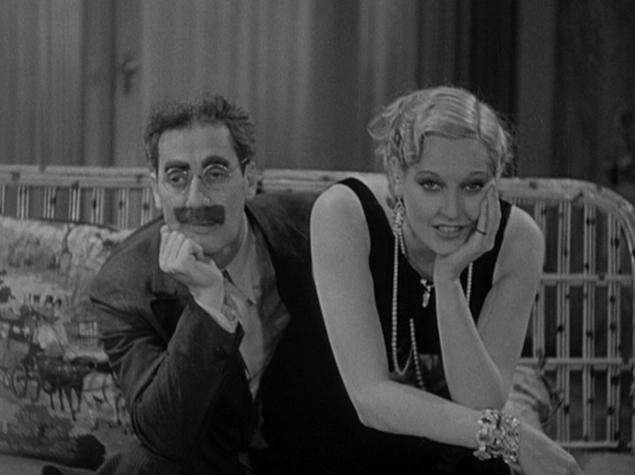
Monkey Business (1931) Starring: Groucho Marx, Chico Marx, Harpo Marx, Zeppo Marx, Rockcliffe Fellowes, Harry Woods, Thelma Todd. Directed by Norman Z. McLeod.  Screenplay by S.J. Perelman, Will J. Johnstone. Produced by Herman J. Mankiewicz (credited as Associate Producer) Run Time: 77 minutes. U.S. Black and White. Comedy.

Monkey Business marks a departure for the Marx Bros. After two successful films shot in New York at Paramount’s Astoria Studios, The Cocoanuts (1929) and Animal Crackers (1930), their third film would be shot in Hollywood. More than that, however, it was the first film not to be based on a previous stage production.

Between the features and following their move to Los Angeles, the Brothers had appeared in a short film, celebrating the studio's twentieth anniversary, The House That Shadows Built (1931), in which they adapted the opening scene from I’ll Say She Is, a 1924 stage revue written by Will J. Johnstone and his brother Tom Johnstone. The revue, which starred the Marx Brothers, also featured Lotta Miles, is attributed to have led to the Brothers' rise in Vaudeville and their eventual entry into films. In the short, the four Marx Brothers are seen auditioning for the same play by imitating Maurice Chevalier, another Paramount star, performing a song.

Much has been made about the screenplay for Monkey Business. While S.J. Perelman, a humorist and screenwriter, is credited along with Johnstone, there is some argument about how much Perelman actually wrote that makes it into the final film.

The Marx Brothers' relationship with Perelman dates back to their Broadway days, when Groucho read his book, Dawn Ginsbergh’s Revenge. After a complimentary letter from Groucho prompted a meeting backstage, Perelman was asked if he could write something for a proposed Marx Brothers’ radio show with W. B. Johnstone. The fact that Harpo didn’t speak caused the writers some issues. The one idea they came up with was presented to Groucho at a story conference – the Marx Brothers as stowaways on a luxury liner. Groucho liked the idea so much that he took the writers directly to Paramount’s New York offices, so they could be put under contract.

Perelman was warned by producer Herman Mankiewicz about working with the Marx Brothers, “They're mercurial, devious and ungrateful,” he is quoted as saying. “I hate to depress you, but you'll rue the day you ever took the assignment. This is an ordeal by fire. Make sure you wear asbestos pants." Perelman didn’t have to wait long for Mankiewicz’s warning came true. As soon as he read them the first draft, Groucho either said, depending on whom you listen to, “It stinks” or “I think we need a script." Neither of which would be considered encouraging.

It’s not certain who all contributed to the screenplay. Director Norman McLeod said that over the next five months, 12 different writers were involved. Even cartoonist J. Carver Pusey, who created the pantomime comic strip Benny, which ran in newspapers from 1929 to 1939, is listed in copyright paperwork. It is also said that when Eddie Cantor visited the set, he made contributions. But as McLeod, in his first time solo in the director’s chair, would soon learn, the Marx Brothers liked to ad lib and once he kept the camera running was able to capture some of that for the movie.

One more change for the brothers was their leading lady. In Cocoanuts and Animal Crackers, Margaret Dumont had been Groucho’s love interest/foil as it were. For their next two films, she was replaced by Thelma Todd, a blond beauty with a long comedic background. While she is perhaps best known for her work with the Marx Brothers, she also worked with Charley Chase, Buster Keaton and Laurel and Hardy. Todd also appeared in any early version of the Maltese Falcon, as Iva Archer, opposite Ricardo Cortez’s Sam Spade. Todd would appear in two Marx Brothers’ movies, this one and Horse Feathers (1932).

There isn’t really that much of a plot. Per the premise, the Brothers are stowaways on a luxury liner that is already out to sea. They are being searched for by the First Mate Gibson (Tom Kennedy), who is sure there are four in the cargo hold, since he’s heard the four-part harmony of Sweet Adeline. We’re even treated to a little snippet of them singing each in their own Kippered Herring barrel, the first time Harpo’s voice is heard on film.


The Marx Brothers (Harpo, Zeppo, Chico and Groucho) stowaway on board ship in barrels.

Even when the First Mate brings down a crew of sailors to search the hold, the Brothers manage to avoid detection until he orders the barrels taken topside to get them out of the way. The hoist lifts the barrels off the brothers, leaving each exposed. The Brothers scatter when they’re noticed, but they always manage to stay one step ahead of their pursuers, even hiding in plain sight pretending to be a four-piece band.


They hide in plain sight pretending to be a four-piece band.

Harpo is chased into a Punch and Judy show, where he becomes part of the show and torments the First Mate who followed him in. When the Captain (Ben Taggart) finds his First Mate is fighting with a puppet, he sends him to his room. Even after they discover their mistake, Harpo manages to elude them. At one point, Chico and Harpo take over the ship’s barbershop and “snoop” away an officer’s moustache.


The Captain (Ben Taggart) finds his First Mate Gibson (Tom
Kennedy) fighting with Harpo, whom he thinks is a puppet.

The Brothers are not through with the Captain, as Groucho and Chico follow him into his quarters and order up his lunch, even going so far as to share his lunch without his permission and then locking the Captain in a closet.


Groucho and Chico crash the Captain's lunch.

Zeppo avoids his pursuers by hooking up with a woman walking on deck. While she’s resistant at first, he charms her with his comment about the might pretty country around here, meaning the ocean. The girl, who turns out to be Mary Helton (Ruth Hall), is so enamored that she comments about the number of trees.

Meanwhile, Chico and Harpo get hired as henchmen for a gangster on board the ship, Joe Helton (Rockcliffe Fellowes), who turns out to be Mary’s father. Groucho and Zeppo are hired by Helton’s rival, “Alky” Briggs (Harry Woods), but only after Groucho’s made a pass at his wife, Lucille (Thelma Todd).


Joe Helton (Rockcliffe Fellowes) hires Chico and Harpo as henchmen.

Each pair of brothers follows their new boss around the decks of the ship. Harpo and Chico, who don’t pay close attention, end up following any man who passes by them, until they end up following an older man, who is not in disguise. Groucho, who is working for Briggs, approaches Helton to make nice.


Groucho is hired by "Alky" Briggs (Harry Woods), but only after he's
 already made a pass at Briggs' wife Lucille (Thelma Todd)

Once the ship reaches the docks, getting off the ship proves to be difficult without a passport. They try in vain to pickpocket one of the other passengers and fail, that is until Zeppo runs into Maurice Chevalier, an action that takes place off screen. But using Chevalier’s passport proves difficult, since none of the brothers really resemble the well-known French born actor and fellow Paramount star. Zeppo suggests that they sing a song to prove their identity and all four sing "You Brought a New Kind of Love to Me", which Chevalier sang in The Big Pond (1930). [Chevalier actually had a bonafide hit with another song from The Big Pond: "Livin' in the Sunlight, Lovin' in the Moonlight"]


Maurice Chevalier in The Big Pond (1930).

The Brothers manage to get off the boat when one of the passengers faints while departing. An ambulance is called and the boys stowaway on the passenger’s stretcher.

On dry land, the fun continues at a party Helton is throwing for his daughter’s coming out, something that used to be reserved for debutantes. The Brothers through hook or crook manage to be in attendance. Zeppo appears there at Mary’s invitation, Groucho at the father’s and Chico and Harpo out of the force of their nature.


Groucho enjoys attention hanging out at the party.

In what seems customary with any Marx Brothers film is a musical interlude. Chico leads an orchestra in a piano medley. While I don’t think anyone would mistake Chico for Van Cliburn, I doubt anyone had more fun and was more fun to watch playing. Harpo ends up accompanying Maxine Castle, a contralto, in her rendering of "O Sole Mio.", before playing solo. It is interesting to note that what he plays, a little under two minute ditty, “I’m Daffy Over You”, was written by brother Chico.

But “Alky” Briggs has other plans for the night; to kidnap Mary and use her as leverage over her father, no doubt to take control of his operation. He and Lucille are in attendance, which allows him to tell Groucho of his plans and for Groucho to make one more play for Lucille.


Groucho with Lucille at the party.

When the kidnapping occurs, Groucho knows where Mary is being taken, the “old Barn” and the Brothers take chase. The Brothers manage to fight and defeat Alky’s henchmen, Zeppo rescues Mary and knocks out Briggs just as Helton and his men arrive.

The film was a huge success for Paramount, for the writers involved and for the Marx Brothers, establishing them as major stars in Hollywood. There were even plans, according to Robert Osborne, for a sequel in keeping with the mafia themes from this film. However, those plans were scuttled when Charles Lindbergh’s son was kidnapped and killed by gang members. Instead, the next film Horse Feathers ended up being a re-working of sorts of a Marx Brothers’ stage show “Fun in Hi Skule”. [The Lindbergh kidnapping was such a big event that it had a definite impact on films from Hollywood. Another example was Three on a Match (1932), which also faced censorship because of its plot points involving kidnapping.]

Some of the themes and plot points in this film would be mined later. The concept of them as stowaways would be used in their eventual radio show, Flywheel, Shyster, and Flywheel, a situational comedy starring Groucho and Chico that ran for 26 episodes on NBC’s Blue Network from November 28, 1932 to May 22, 1933. And of course, would be recycled again in the three Marx Brother’s A Night at the Opera (1935), by which time the act had moved to MGM.

The Marx Brothers are a unique force of comedy, being able to successfully merge wordplay with slapstick in a way no one else seems to pull off. Throw in their musical talents and there has really been no act like them in the history of Hollywood. Perhaps it’s the numbers, there are four in this film, allowing each to concentrate on what they do best. Harpo is the king of pantomime in the sound era of film, but also the source of chaos, not to mention his harp playing. Chico is the conniving “immigrant” who doesn’t quite understand English or understands only what he wants to and plays a mean piano.

Groucho is unmatched in his verbal wordplay, oftentimes opposite Chico, and manages to pull off a grease pencil moustache better than anyone. Zeppo, the group’s straight man and love interest so to speak, even gets a few laughs and gets the girl. The four brothers make a complete package in this film.

This film is an example of the Marx Brothers’ style of anarchy, driven home by Harpo’s complete lack of respect for authority when they’re trying to get past the passport check point. He literally walks on the tables in a defiance of standing in line and when he makes it to the front he throws papers off the table for no real reason but to make a mess of the order. Everything, everyone and every location is simply a backdrop for the Marx's to react to, play off and make fun of; no one is immune. The higher up the social or authority ladder, the more of a come-uppance the Marx's try to provide. You have to know that this played well with a depression-era movie-going crowd.

Harpo creates havoc at the passport check point and shows his complete lack of respect for authority.

Monkey Business is one of the funniest of the Marx Brothers films, but that’s a little like asking a parent to pick their favorite twin child. [The proper answer is the one in the middle.] They are all, for the most part, fun to watch. This film illustrates how much the Marx Brothers can do with very little and that sometimes it’s best to sit back and let them do what they do, rather than try to reel them in.