The Cocoanuts (1929) Starring Groucho Marx, Harpo Marx, Chico Marx, Zeppo Marx, Oscar Shaw, Mary Eaton, Kay Francis, Margaret Dumont, Cyril Ring, Basil Ruysdael, Sylvan Lee Directed by Joseph Santley and Robert Florey. Screenplay by Morrie Ryskind. Based on the Musical Play by George S. Kaufman and Morrie Ryskind. Music by Irving Berlin. Produced by Walter Wanger. Run Time: 93 minutes. U.S.A. Black and White. Musical, Comedy.
While the Marx Brothers appeared in a silent film, Humor Risk (1921), now lost, their humor is very much associated with the coming of sound. While Harpo Marx could have been, and in essence was, a silent comedian, so much of not only his personality as well as the humor of Groucho and Chico requires sound. While part of the Brothers’ act was physical humor, it is the fast-talking, sarcastic, wordplay the propels much of the dialogue throughout their film career.
The group, which had started as singers, didn’t discover comedy until one night in 1912 while performing at the Opera House in Nacogdoches, Texas (or in Ada, Oklahoma, according to Harpo in Harpo Speaks; or in Marshall, Texas, according to the San Antonio Express) a runaway mule outside interrupted the performance and the audience even left to investigate what was going on. Angered by the interruption, Groucho, then a singer, made snide comments at the audience’s expense, but rather than getting angry, the audience laughed and the family realized there was potential as a comedic troupe.
While the act evolved from singing to singing with humor to comedy with music, the brothers numbered four, but that fourth was Gummo Marx. The brothers performed an act "Fun in Hi Skule" with Groucho playing the part of a German-accented professor presiding over a classroom that contained his brothers. In 1915, in Flint, Michigan, a 14-year old Zeppo joined his brothers on stage and there were five Marx Brothers. However, Gummo, thinking anything was better than being an actor, left to join the war effort. Zeppo stayed with the troupe from then through the Paramount years.
Under Chico’s management and Groucho’s creative direction, the brothers turned Vaudeville success into Broadway success with their first play, I’ll Say She Is, in 1924. Written by Will B. Johnstone, the musical comedy made stars out of them, when such notable critics such as Alexander Woollcott raved about the show. This was followed up the next year by The Cocoanuts, which ran on Broadway initially from December 8, 1925, through August 7, 1925, and revived with the Marx Brothers again in May 1927 for 16 performances.
Monta Bell, Paramount’s East Coast production head, wanted to make stage acts into sound movies, see The Letter (1929), so it is no surprise he was attracted to the Marx Brothers' stage success. That doesn’t mean he didn’t want to make changes. Most notably, he objected to Groucho’s thick greasepaint "mustache." Bell didn’t believe audiences would believe anything as "phony-looking" as that. Groucho is said to have replied, “The audience doesn't believe us anyhow. All they do is laugh at us, and isn't that what we're being paid for?"
To direct, Paramount brought in French-born Robert Florey for the dialogue sequences and Joseph Santley to handle the musical numbers. Referring to them later, Groucho was obviously not impressed, "One of them didn't understand English and the other didn't understand comedy.”
On January 12, 1929, it was announced that Paramount was expecting to begin production on February 1 in the studio’s Astoria Studio soundstages in Queens. Filming would take place during the day while the Brothers were performing in the musical Animal Crackers on stage at night. Animal Crackers, which would also be the Marx Brothers’ next film, ran at the 44th Street Theatre from October 23, 1928, until April 6, 1929. Like Cocoanuts, the musical comedy was written by George S. Kaufman and Morrie Ryskind. Filming on The Cocoanuts lasted until late March.
 |
| The opening dance number of The Cocoanuts. |
Despite the song and dance routine at the beginning, things are slow at the Hotel de Cocoanut, so much so that the Bell Hops have not been paid in a couple of weeks. When they confront the owner, Mr. Hammer (Groucho Marx), he tries to make them believe that is a good thing. “Well, what makes wage slaves? Wages! I want you to be free.”
 |
| Jamison (Zeppo Marx) delivers a telegram to Hammer (Groucho Marx) while the bellhops are demanding pay. |
The encounter is stopped when Hammer’s assistant Jamison (Zeppo Marx) delivers some telegrams that have come in and things go from good to worse.
HAMMER (to the bellboys) There you are. Business is beginning to pick up already. Now, if you gir--boys will only be calm... (reads telegram) Uh huh. (reads aloud) "We arrive this afternoon on the 4:30. Kindly reserve two floors and three ceilings." (aside) Must be mice. (reads) "If we like your property, we will immediately buy it." (to the delighted bellboys) See that? Things have started our way already.
JAMISON Who's it from?
HAMMER (reads) Western Union. (to the bellboys) And they've got a lot of money, too. On the 4:15, eh? Well, I'll take the bus down myself.
JAMISON Here's another one, Mr. Hammer.
Jamison hands a second telegram to Hammer who opens it.
HAMMER (to the bellboys) See? We're gonna be stuffed by tonight. This hotel will be so crowded that we'll be turning away thousands of people. (reads telegram) "If there's another hotel in Cocoanut Beach, cancel our reservation." (aside) I knew it. It was too good. The bellboys groan in disappointment.
 |
| Penelope (Kay Francis) conspires with Harvey Yates (Cyril Ring). |
Meanwhile, Penelope (Kay Francis) is out front on the hotel terrace conspiring with Harvey Yates (Cyril Ring). Harvey is worried that his chances with Polly Potter (Mary Easton) and more importantly her mother’s, Mrs. Potters’ (Margaret Dumont) millions are being undercut by hotel clerk Robert Adams (Oscar Shaw), to whom Polly is courting. Penelope devises a plan to have Robert accused of stealing Mrs. Potters’ diamond necklace, which is in an unlocked box in the room next to Penelope’s.
 |
| Robert Adams (Oscar Shaw) and Polly (Mary Easton) plan for "When My Dreams Come True". |
Not far away, Robert and Polly are discussing their own plans for the future. Robert, who wants to be an architect, has a design he’s anxious to sell that would transform the hotel and its property. He’s sent it to a developer named Berryman and has hopes they are reviewing his plans. If everything goes according to plan, that will be "When My Dreams Come True" for both young lovers.
 |
| Penelope and Harvey catch Robert and Polly kissing. |
Penelope and Harvey come across the two sealing their dreams with a kiss, but when Robert realizes they’ve been discovered, he pretends that he’s been telling Polly a story, Little Red Riding Hood.
In the hotel lobby, Mrs. Potter tells her daughter that she’s unhappy that she’s in love with the wrong man. She desperately wants her daughter to marry Harvey, for the supposed status.
When Hammer returns empty-handed after waiting for the afternoon trains, he finds Jamison asleep at the desk and fires him.
 |
| Hammer tries his sales pitch out on Mrs. Potter (Margaret Dumont). |
Soon, Mrs. Potter comes through the lobby and Hammer goes into the same sales routine she has apparently heard before.
MRS. POTTER You told me about this yesterday.
HAMMER (takes a map from his pocket) I know, but I left out a comma…
Soon afterward, Chico and Red (Harpo) arrive at the hotel and Hammer mistakes them for paying guests. He notices that their luggage is empty.
CHICO That's all right. We fill it up before we leave.
While they’re at the front desk, Chico and Red disrupt Mr. Hammer and Red starts eating inanimate objects and drinking the inkwell. When Hammer goes to attend some business, he leaves the two alone, telling them to register. Instead, they hit the cash register and empty it. Chico and Red then discover that ringing the service bell brings one pretty bellhop after another until Red can no longer control himself and they chase after the girls.
 |
| Chico (Chico Marx) and Red (Harpo Marx) start to raise havoc right away in The Cocoanuts. |
Chico and Red overhear Penelope and Harvey still planning the break-in. As is their way, the two disrupt the planning, forcing Penelope and Harvey into dancing with them before leaving them alone. Penelope adds them to the plan, telling Harvey that she’ll flirt with them and invite them up to her room, which is next to Mrs. Potter's. Then she’ll complain to management and when the necklace disappears they’ll be questioned as well.
Later, Red returns to the lobby with a salt shaker and begins again to eat the inanimate objects including the telephone. Chico stops him.
CHICO All the time you eat. That's a no good. We got to get-a money. Right now, I'd do anything for money. I'd kill somebody for money. I'd kill you for money.
Red looks slightly worried.
CHICO Ha ha ha! Ah, no, you're my friend -- I kill you for nothing.
Red smiles.
Enter Hennessy (Basil Ruysdael), a plainclothes detective. Hennessy thinks something’s suspicious about the two of them and tries to identify them using photos he’s brought from headquarters, but Chico and Red get into a diversionary fight. Hennessy gets fed up and leaves.
When a hotel guest comes through the lobby asking about the next train, Chico answers him. Red relieves him of his jacket which he gives to Chico to wear, but not before relieving it of its wallet. Red leaves, but Penelope returns.
She flirts with Chico and invites him up to her room.
PENELOPE Tell me, what are you doing tonight?
CHICO Maybe you got a good idea, eh?
PENELOPE Well, don't you dare come to room three-twenty at eleven o'clock.
CHICO All right, I come half past ten.
After he leaves, she tries her charms on Red, who instead of picking up her handkerchief when she drops it, pockets it. She still invites him up to her room at 11 that night.
Later that night, Hammer returns with Mrs. Potter and they sit down together. But when Hammer makes him move, Mrs. Potter pushes him away.
There is an interlude in which Red plays a soulful chorus of "When My Dreams Come True" on a harp that happens to be there.
 |
| Harpo plays "When My Dreams Come True". |
What follows next is known as the Door Routine. There are little snatches of dialogue but it is mostly a visual gag. To give you the idea how much frenetic energy is in the scene, which lasts 5 minutes and 49 seconds, I consulted a script that detailed the action:
We see Rooms 318 and 320 with a connecting door. Room 320, on the right, is Penelope's. Mrs. Potter’s is 318 on the left. Penelope opens the connecting door carefully and enters Mrs. Potter’s room. Simultaneously, Red enters 320, sees Penelope in 318 and moves to the connecting door. Getting down on hands and knees he tries to peer under the door. Red crawls backward as Penelope re-opens the connecting door. When she finally re-enters 320, Red crawls under Penelope’s bed.
Harvey enters 320 soon after and he and Penelope make their final plans. They can’t be found with the necklace on them and Harvey thinks up a solution. There is a hollow tree stump in Cocoanut Manor where they can hide it. He draws Penelope a map. He wishes her luck and leaves. Penelope studies the map and then throws it away in what she thinks is a waste can, but it is, in reality, Red’s hat.
 |
| Penelope moves to the connecting door, Hammer opens the door to 318, while Chico peers in room 320. |
Penelope moves to the connecting door and slowly opens and closes it. As she does, Hammer opens the hall door to 318, peers in, then closes the door. Penelope slowly opens and closes the connecting door, then Hammer opens and closes the hall door to 318. Now, simultaneously, Hammer opens the door to 318, Penelope opens the connecting door and Chico opens the hall door to 320 and enters. He sees Penelope at the connecting door and slams the hall door. In turn, Penelope slams the connecting door. And in turn, Hammer enters 318 and slams his door. Penelope confronts Chico who takes her hands romantically. Hammer knocks at the connecting door and bursts in on Penelope as Chico ducks out the hall door.
Somehow, Red is now in 318, sitting in a chair. He gets up and hops around on a sore foot as
Hammer, in 320, listens at the connecting door. We hear a knock at the hall door to 320.
Instantly, Red exits 318 by the hall door, Hammer enters 318 by the connecting door and Chico enters 320 from the hall to confront Penelope. Chico enters 318 by the connecting door, Hammer exits 318 by the hall door and Red enters 320 from the hall and gives Penelope a big hug. Hammer pounds on the hall door to 318. Instantly, Red exits 320 by the hall door, Chico enters 320 by the connecting door, and Hammer enters 318 from the hall where he dizzily paces the room and does a nifty spin.
HAMMER (to the camera): This hotel not only has running water, it has running guests.
In 320, Chico confers with Penelope. In 318, Hammer knocks at the connecting door. Instantly, Chico exits 320 by the hall door, Hammer enters 320 by the connecting door, and Red enters 318 from the hall. Listening at the connecting door, Hammer hears the phone in 318 ring. Red answers it. Since he either can't or won't speak, he merely HONKS his horn several times, then slams down the earpiece. Instantly, Red rushes out of 318 by the hall door, Hammer enters 318 by the connecting door, and Chico enters 320 from the hall, arms outstretched to greet Penelope who is listening at the connecting door. The hall door to 320 opens and Chico ducks under Penelope's bed to hide. Red enters from the hall, sees Penelope listening at the connecting door, quietly closes the hall door, then knocks on it.
Red immediately exits 320 into the hall. Hammer enters 320 by the connecting door, much to Penelope's surprise. Before Hammer can say or do anything, there's a knock at the hall door to 320. Hammer quickly hides under Penelope's bed as she moves to answer the hall door.
Simultaneously, Chico crawls out from under the front of the bed, then follows Hammer back under again. Penelope opens the hall door to reveal a bellhop who enters with a pitcher.
Bellhop puts the pitcher on the table. Bellhop heads for the door and exits as Hammer's voice drifts in from under the bed and chides Penelope.
Now, Mrs. Potter enters her room (318) from the hall door and closes it. As she moves toward the connecting door, there's a knock. Red enters from the hall, grinning like a maniac and carrying a pitcher of ice water. Red hops on Mrs. Potter's bed and lies down, inviting her to join him. She is completely offended. Red leaves the pitcher on her bureau, waves goodbye and exits out the hall door. As Mrs. Potter again moves toward the connecting door, there's another knock. Red enters from the hall, grinning, turns right around, and exits again.
Hammer enters from the connecting door and flops down in an armchair next to Mrs. Potter.
Meanwhile, Red has entered 320 from the hall just long enough to approach Penelope, HONK at her, and exit again. In 318, Hammer rises and, after feinting an exit through the hall door, moves to feint an exit at the connecting door. Instead, he grins mischievously and starts to take his jacket off. Hammer has moved to the hall door. Mrs. Potter moves to the phone. A knock at the hall door. Hennessy enters 318 and looks around.
Mrs. Potter exits out the hall door as Hennessy knocks at the connecting door. He opens it and enters 320, looking it over. Penelope watches as Hammer exits the closet and, with a crouching saunter, passes through the connecting door and circles Hennessy who fails to notice Hammer keeping pace behind him. Finally, Hammer, having circled Hennessy, exits out the connecting door unnoticed.
Hennessy exits out Penelope's hall door. Hammer enters 320 through the connecting door and puts his arms around Penelope whereupon there is a pounding at the door. Hammer ducks under Penelope's bed just as Hennessy enters 320 from the hall door and Penelope enters 318 through the connecting door.
In 318, Penelope opens the drawer of Mrs. Potter's dressing table and removes a necklace from a case. She slips the jewelry down the front of her dress, rises and exits out the hall door. A moment later, Hennessy enters 318 through the connecting door to find the room empty. He exits out the hall door just as Penelope enters 320 from the hall door. Penelope leans against her door and breathes a sigh of relief. She sits on the edge of her bed. Red's head emerges
from the center of the mattress, startling Penelope.
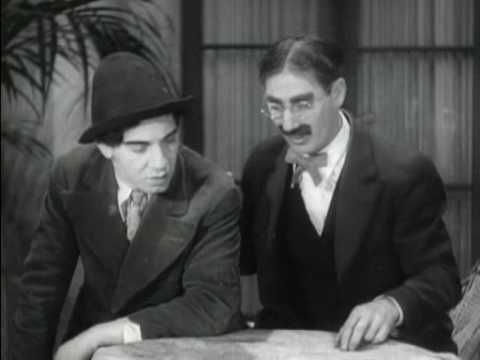 |
| Hammer shows Chico a map of his planned development, including the viaduct. |
The next morning, Hammer and Chico sit down to have a talk. Hammer is about to auction off some swamp land and needs Chico’s help in driving up the prices. In order to help familiarize Chico with the layout, Hammer sits down with a blueprint. While the Door Routine was essentially visual, the humor in this scene is all verbal, ending with what may be the most famous question in film.
HAMMER Now, right over here, this is the residential section.
CHICO Oh, people live there, eh?
HAMMER No, that's the stockyard. Now, all along here, this is the riverfront. And all along the river, all along the river, those are all levees.
CHICO That's the Jewish neighborhood?
HAMMER (pause) Well, we'll Passover that. You're a peach, boy. Now, here is a little peninsula, and, eh, here is a viaduct leading over to the mainland.
CHICO Why a duck?
There’s more to the exchange, but you get the idea.
Later that day at the auction, after Polly performs “The Monkey-Doodle-Doo", Groucho starts the auction. To his frustration, Chico keeps raising his bid, outbidding everyone, including himself. It is during the auction that Mrs. Potter announces that her necklace has been stolen and offers a thousand-dollar reward, whereupon Chico offers two thousand. No one, except the perpetrators and Harpo, knows that the jewels are only a few feet away.
Detective Hennessy decides that the culprit is Bob Adams, Polly’s suitor. Penelope and Harvey help to frame him and Bob is taken off to jail. Even though Polly is heartbroken, Mrs. Potter decides that for her own daughter’s reputation she will wed Harvey and announces that there will be an engagement party that night at the hotel. Polly is distressed and stays behind after everyone else has gone, finally breaking down and crying when she is left alone.
That night, Chico and Red go to the jail and hide from view when Hennessy leaves. Red positions himself so that when Hennessy thinks he’s putting the keys in his own pocket he is actually putting it in Red’s. With the key, they go inside and let Bob out of his cell. Chico tells him about the engagement party that night and that Polly needs him.
Playfully, Red lets himself into the cell and closes the door. When he realizes that he’s locked himself in, he briefly panics and honks his horn for help. Then he realizes one of the bars is loose and lets himself out through the very small opening.
 |
| Robert examines the writing on the map Harvey drew for Penelope. |
Back at the hotel, Bob tries to convince Hammer of his innocence but doesn’t know how. Red produces a folded-up piece of paper, but it’s a newspaper story about him, "Silent Red wanted by the police." Red snatches it away, but while he’s searching his pocket other items fall out, including an alarm clock, fruit, silverware, etc. The three men scramble around trying to pick these things up.
Red finally hands Bob the right piece of paper but continues his shenanigans including snatching Bob’s handkerchief out of his breast pocket with his teeth and continuing to snatch it no matter where Bob puts it. He then steals Bob’s watch and Hammer’s tie. Bob finally manages to read the note, which, in Harvey’s handwriting, is the directions he had written for Penelope.
Later, the engagement party is in full swing. Guests are dressed in vaguely Spanish or South American styles. There is a chorus line with dancers in a number similar to the type Busby Berkeley would become famous for, complete with an overhead camera view, one of the first times this was used in a feature. Polly is once again called upon to perform, singing a sad refrain of "When My Dreams Come True."
Guests are greeted by Mrs. Potter and Harvey, while Irving Berlin’s “Tango Melody” plays, including Penelope who makes a point of telling Harvey what a lucky man he is.
Hammer shows up in a fez with extra-long tassels, much to the amusement of Mrs. Potter.
 |
| Hennessy (Basil Ruysdael) about to sing "The Tale of a Shirt" to the tune of Bizet's Carmen. |
Hennessy also attends, offering that Mrs. Potter can use protection from a couple of shady characters to which Red and Chico take offense. In an effort to humiliate Hennessy, Red steals the shirt off his back and from under his vest, even going so far as to put it on himself. Chico draws using a crayon on Hennessy’s undershirt. This leads the lawman to launch into song, "The Tale of a Shirt" sung to Bizet’s Carmen with special lyrics by Irving Berlin. During the number, Red returns the shirt to Hennessy who exits in triumph.
 |
| Harpo pretends to be drunk at the party. |
There is some nonsense in which Red pretends to be drunk throughout the dinner, getting up and walking away, only to come back. Repeat and repeat again.
 |
| Chico plays a verse and two choruses of Victor Herbert's "Gypsy Love Song” |
Chico finally sits down at the piano and plays a verse and two choruses of Victor Herbert's "Gypsy Love Song”. He plays half the song in a classical style and the second half in a more upbeat jazz idiom, complete with Chico’s own unique fingerings. Audiences would become accustomed to his style of playing in future films, but it had to seem somewhat unique to many at the time.
Hammer introduces Polly, who reveals to everyone two pieces of paper. The map that he drew Penelope of the hiding place for her mother’s stolen necklace and a note that he wrote her as an engagement present. Before things get figured out, Harvey makes his escape.
Bob Adams shows up wearing a tuxedo. He has good news: not only have his architecture plans been accepted, but a Mr. John W. Berryman is there to buy Cocoanut Manor for the development.
Mrs. Potter, realizing that Bob is a better choice, tells those gathered that they are invited to the wedding of Polly and Bob Adams, to which there are cheers from the party.
Meanwhile, Hennessy lights a cigarette for Penelope, who we see is handcuffed to Harvey.
While Polly leads the bridesmaids in song, we see Jamison, Hammer, Chico, and Red standing together smiling and waving to the camera.
 |
| The four Marx Brothers wave to the camera at the end of The Cocoanuts. |
It is reported when the Marx Brothers first saw the film, they were so appalled that they tried to buy back the negative to prevent the film from being released. Paramount, however, was not in the selling mood and The Cocoanuts was released on August 3, 1929. The film, which cost $500,000 to make, made $1.8 million at the box office, which at the time was considered a big hit. This would lead to other films the Four Marx Brothers would make at Paramount: Animal Crackers (1930), Monkey Business (1931), Horse Feathers (1932), and Duck Soup (1933). When the last film didn’t live up to expectations at the boxoffice, they were dumped by Paramount. Zeppo left the group to become an agent and the Three Marx Brothers would move to MGM.
 |
| Margaret Dumont will be a foil for Groucho in several Marx Brothers films. |
One of the staples of future Marx Brothers films was Margaret Dumont. Dumont appeared with the brothers in the stage musical The Cocoanuts. She would play straight man to Groucho in most of the best Marx Brothers films, including The Cocoanuts, Animal Crackers, A Night at the Opera (1935), A Day at the Races (1937), At The Circus (1939), and The Big Store (1941). She would have a career outside her appearances with the Marx Brothers, including the low budget Shake, Rattle & Roll (1957) from American International Pictures (AIP) opposite the likes of Mike Connors, Sterling Holloway, Big Joe Turner and Fats Domino.
Like Dumont, Basil Ruysdael was also in the stage version of The Cocoanuts and revived his role as Detective Hennessy in the film version. An opera singer, Ruysdael appeared with the Metropolitan Opera in New York as a bass-baritone from 1910 to 1918. Given that background, it seems his talents were sort of wasted with “The Tale of a Shirt". Most of his best-known film appearances would come in the late 1940s to the early 1960s, including Colorado Territory (1949), People Will Talk (1951), Blackboard Jungle (1955), The Horse Soldiers (1959) and One Hundred and One Dalmatians (1961) - Truck Driver (voice), his final film role.
With the exception of Dumont and Ruysdael, most of the supporting cast would be remembered, if at all, for their performances in this film. As an example, Mary Eaton who played Polly may have had a successful stage career appearing in eight Broadway productions during the 1920s. However, she had a rather brief film career. She seems talented, but the choices of when they have her sing seem forced.
 |
| Mary Eaton singing "When My Dreams Come True". |
Sadly, Eaton had a rather short film career and died when she was only 42 of liver failure.
A veteran of the Broadway stage, Oscar Shaw would only appear in eight films and only one after 1929. He seems likable in the role, but he was already near the end of his career when he made The Cocoanuts.
Cyril Ring, who played Harvey Yates, would appear in 330 films, between 1921 and 1947, including two more with the Marxes: Monkey Business and A Day in the Races. Ring would also appear in such films as Topper (1937), Young Dr. Kildare (1938), My Favorite Wife (1940), The Great Dictator (1940), The Lady Eve (1941), Citizen Kane (1941), Meet John Doe (1941), Du Barry Was a Lady (1943), Mr. Skeffington (1944) and Laura (1944), though he is not often credited. He seems devious enough here, but it may be his best-known role of his career.
Bucking the trend of having The Cocoanuts be their most memorable role, was Kay Francis, who played Penelope. While her part in The Cocoanuts was important to the plot, it wasn’t all that large. While she participated in the Door Routine, most of the humor is thanks to Groucho and Harpo. She had been on the Broadway stage since 1925’s Hamlet, in which she made her debut as the Player Queen; a part she claimed she got by “lying a lot, to the right people”. She would return to Broadway in the play Crime in support of Sylvia Sidney, but Francis was said to have stolen the show. After appearing in Elmer The Great (1928), she was encouraged by her co-star, Walter Huston, to take a screen test at Paramount Pictures for the film Gentlemen of the Press (1929). She made that film as well as The Cocoanuts before coming to Hollywood.
 |
| Kay Francis would go on to be the queen of the Warner Bros. lot. |
She would find success at Paramount, making 21 films between 1929 and 1932, before being lured away by Warner Bros. From 1932 to 1936, Francis was the queen of the Warner Bros. lot. She frequently played long-suffering heroines, in films such as I Found Stella Parish (1935), Secrets of an Actress (1938), and Comet Over Broadway (1938). But eventually, she tired of these roles and began to feud with Warners, which led to her demotion to programmers and her eventual termination in 1939.
After appearing in The Independent Theatre Owners Association’s 1938 list of “box office poison” (along with the likes of Greta Garbo, Joan Crawford, Fred Astaire, Mae West, and Katharine Hepburn), Francis could not secure another studio contract. While she would have the lead in King of the Underworld (1939) opposite Humphrey Bogart, Francis began to play character and supporting parts in films like The Feminine Touch (1941).
Essentially, The Cocoanuts is nothing more than a filmed stage play. The camera is pretty much stagnant as it records the action, not unlike an audience member with really good seats might also see. This is due to the practice of making early sound films. Since early sound cameras were noisy, the only way to eliminate the noise was to enclose the camera and the cameraman in a large soundproof booth which forced the camera to remain static. So sensitive were the early sound recording equipment that paper just in the film, like the map, was soaked in water to avoid the sound of crackling paper to avoid overloading them.
However, it is what is recorded that counts. While The Cocoanuts may not be a great film or even a great Marx Brothers film, many of the gags that we will see in all future films have their roots here. While the Marxes will eventually come together, they always seem to start on opposite sides with Chico and Harpo, as the ne’er-do-wells, on one side pitted against Groucho (and Zeppo), the authority figure, on the other. And that is true here, as Groucho’s hotel becomes another place for Chico and Harpo to freeload and rob. They do finally come together to save Robert from jail and to reunite him with Polly. We will see that repeated in other films as well.
 |
| A little bit of lunacy, the Brothers imitate the Spirit of '76. |
There are the musical interludes which don’t always seem to fit in with the story. Here, some of the songs seem out of place for the story (“The Monkey-Doodle-Doo") or seem to be show-stoppers but not in a good way. And while the Marx Brothers are surrounded by some talent, it is really Chico and Harpo who are the real virtuosos in their films. Harpo’s playing always seems to come as a surprise given the anarchy his character brings to everything else around him. Chico’s piano-playing always looks so effortless.
The film also shows off the group's great wordplay, much of which had been developed through improv over the run of the musical on Broadway. So prevalent was the group's improv that George S. Kaufman, one of the writers of the 1925 Broadway production, was heard to have muttered from the back of the theater, "I may be wrong, but I think I just heard one of the original lines." The brothers would apparently work in bits and keep those that got the biggest laughs. So what we see on film was the culmination of that work. But this sort of wordplay, especially between Groucho and Chico, would be repeated over and over again throughout their film careers.
Despite the predominance of the spoken word, the brothers also relied on physical comedy, not only in scenes like the Door Routine but also through Harpo’s actions. Not only does he seem to get people to hold his knee, but he also eats the telephone and drinks the ink. He is a walking sound effect with the ever-present horn that he uses in place of dialogue or just to make people around him uncomfortable. Physical comedy is the basis of many of the Brothers’ greatest scenes, like the Mirror Scene in Duck Soup.
Now all that said, The Cocoanuts is not a great Marx Brothers film. Their films at Paramount would improve from this point on; which is the best is really very subjective. If you’re new to the Marx Brothers (where have you been?) then this might not be the one you want to start with. However, you should definitely watch it at some point. Also remember that the film is almost 90 years old, so that the film may not be politically correct in today’s world. It’s just funny and that’s what the Marx Brothers were going for.