

Monkey Business marks a departure for the
Marx Bros. After two successful films shot in New York at Paramount’s Astoria
Studios, The Cocoanuts (1929) and Animal Crackers (1930), their third film
would be shot in Hollywood. More than that, however, it was the first film not
to be based on a previous stage production.
Between the features and following their move
to Los Angeles, the Brothers had appeared in a short film, celebrating the
studio's twentieth anniversary, The House That Shadows Built (1931), in which
they adapted the opening scene from I’ll Say She Is, a 1924 stage revue written
by Will J. Johnstone and his brother Tom Johnstone. The revue, which starred
the Marx Brothers, also featured Lotta Miles, is attributed to have led to the
Brothers' rise in Vaudeville and their eventual entry into films. In the short,
the four Marx Brothers are seen auditioning for the same play by imitating
Maurice Chevalier, another Paramount star, performing a song.
Much has been made about the screenplay for
Monkey Business. While S.J. Perelman, a humorist and screenwriter, is credited
along with Johnstone, there is some argument about how much Perelman actually
wrote that makes it into the final film.
The Marx Brothers' relationship with Perelman
dates back to their Broadway days, when Groucho read his book, Dawn Ginsbergh’s
Revenge. After a complimentary letter from Groucho prompted a meeting
backstage, Perelman was asked if he could write something for a proposed
Marx Brothers’ radio show with W. B. Johnstone. The fact that Harpo didn’t speak caused the writers some issues. The one idea they came up with was presented to
Groucho at a story conference – the Marx Brothers as stowaways on a luxury
liner. Groucho liked the idea so much that he took the writers directly to
Paramount’s New York offices, so they could be put under contract.
Perelman was warned by producer Herman
Mankiewicz about working with the Marx Brothers, “They're mercurial, devious
and ungrateful,” he is quoted as saying. “I hate to depress you, but you'll rue
the day you ever took the assignment. This is an ordeal by fire. Make sure you
wear asbestos pants." Perelman didn’t have to wait long for Mankiewicz’s
warning came true. As soon as he read them the first draft, Groucho either
said, depending on whom you listen to, “It stinks” or “I think we need a
script." Neither of which would be considered encouraging.
It’s not certain who all contributed to the
screenplay. Director Norman McLeod said that over the next five months, 12
different writers were involved. Even cartoonist J. Carver Pusey, who created
the pantomime comic strip Benny, which ran in newspapers from 1929 to 1939, is
listed in copyright paperwork. It is also said that when Eddie Cantor visited
the set, he made contributions. But as McLeod, in his first time solo in the
director’s chair, would soon learn, the Marx Brothers liked to ad lib and once
he kept the camera running was able to capture some of that for the movie.
One more change for the brothers was their
leading lady. In Cocoanuts and Animal Crackers, Margaret Dumont had been Groucho’s
love interest/foil as it were. For their next two films, she was replaced by
Thelma Todd, a blond beauty with a long comedic background. While she is
perhaps best known for her work with the Marx Brothers, she also worked with Charley
Chase, Buster Keaton and Laurel and Hardy. Todd also appeared in any early
version of the Maltese Falcon, as Iva Archer, opposite Ricardo Cortez’s Sam
Spade. Todd would appear in two Marx Brothers’ movies, this one and Horse Feathers (1932).
There isn’t really that much of a plot. Per
the premise, the Brothers are stowaways on a luxury liner that is already out
to sea. They are being searched for by the First Mate Gibson (Tom Kennedy), who
is sure there are four in the cargo hold, since he’s heard the four-part
harmony of Sweet Adeline. We’re even treated to a little snippet of them
singing each in their own Kippered Herring barrel, the first time Harpo’s voice
is heard on film.
Even when the First Mate brings down a crew of sailors to search the hold, the Brothers manage to avoid detection until he orders the barrels taken topside to get them out of the way. The hoist lifts the barrels off the brothers, leaving each exposed. The Brothers scatter when they’re noticed, but they always manage to stay one step ahead of their pursuers, even hiding in plain sight pretending to be a four-piece band.
Harpo is chased into a Punch and Judy show, where he becomes part of the show and torments the First Mate who followed him in. When the Captain (Ben Taggart) finds his First Mate is fighting with a puppet, he sends him to his room. Even after they discover their mistake, Harpo manages to elude them. At one point, Chico and Harpo take over the ship’s barbershop and “snoop” away an officer’s moustache.
 |
| The Marx Brothers (Harpo, Zeppo, Chico and Groucho) stowaway on board ship in barrels. |
Even when the First Mate brings down a crew of sailors to search the hold, the Brothers manage to avoid detection until he orders the barrels taken topside to get them out of the way. The hoist lifts the barrels off the brothers, leaving each exposed. The Brothers scatter when they’re noticed, but they always manage to stay one step ahead of their pursuers, even hiding in plain sight pretending to be a four-piece band.
 |
| They hide in plain sight pretending to be a four-piece band. |
Harpo is chased into a Punch and Judy show, where he becomes part of the show and torments the First Mate who followed him in. When the Captain (Ben Taggart) finds his First Mate is fighting with a puppet, he sends him to his room. Even after they discover their mistake, Harpo manages to elude them. At one point, Chico and Harpo take over the ship’s barbershop and “snoop” away an officer’s moustache.
 |
| The Captain (Ben Taggart) finds his First Mate Gibson (Tom Kennedy) fighting with Harpo, whom he thinks is a puppet. |
The Brothers are not through with the Captain, as Groucho and Chico follow him into his quarters and order up his lunch, even going so far as to share his lunch without his permission and then locking the Captain in a closet.
 |
| Groucho and Chico crash the Captain's lunch. |
Zeppo avoids his pursuers by hooking up with a woman walking on deck. While she’s resistant at first, he charms her with his comment about the might pretty country around here, meaning the ocean. The girl, who turns out to be Mary Helton (Ruth Hall), is so enamored that she comments about the number of trees.
Meanwhile, Chico and Harpo get hired as
henchmen for a gangster on board the ship, Joe Helton (Rockcliffe Fellowes),
who turns out to be Mary’s father. Groucho and Zeppo are hired by Helton’s
rival, “Alky” Briggs (Harry Woods), but only after Groucho’s made a pass at his
wife, Lucille (Thelma Todd).
Each pair of brothers follows their new boss around the decks of the ship. Harpo and Chico, who don’t pay close attention, end up following any man who passes by them, until they end up following an older man, who is not in disguise. Groucho, who is working for Briggs, approaches Helton to make nice.
Once the ship reaches the docks, getting off the ship proves to be difficult without a passport. They try in vain to pickpocket one of the other passengers and fail, that is until Zeppo runs into Maurice Chevalier, an action that takes place off screen. But using Chevalier’s passport proves difficult, since none of the brothers really resemble the well-known French born actor and fellow Paramount star. Zeppo suggests that they sing a song to prove their identity and all four sing "You Brought a New Kind of Love to Me", which Chevalier sang in The Big Pond (1930). [Chevalier actually had a bonafide hit with another song from The Big Pond: "Livin' in the Sunlight, Lovin' in the Moonlight"]
 |
| Joe Helton (Rockcliffe Fellowes) hires Chico and Harpo as henchmen. |
Each pair of brothers follows their new boss around the decks of the ship. Harpo and Chico, who don’t pay close attention, end up following any man who passes by them, until they end up following an older man, who is not in disguise. Groucho, who is working for Briggs, approaches Helton to make nice.
 |
| Groucho is hired by "Alky" Briggs (Harry Woods), but only after he's already made a pass at Briggs' wife Lucille (Thelma Todd) |
Once the ship reaches the docks, getting off the ship proves to be difficult without a passport. They try in vain to pickpocket one of the other passengers and fail, that is until Zeppo runs into Maurice Chevalier, an action that takes place off screen. But using Chevalier’s passport proves difficult, since none of the brothers really resemble the well-known French born actor and fellow Paramount star. Zeppo suggests that they sing a song to prove their identity and all four sing "You Brought a New Kind of Love to Me", which Chevalier sang in The Big Pond (1930). [Chevalier actually had a bonafide hit with another song from The Big Pond: "Livin' in the Sunlight, Lovin' in the Moonlight"]
 |
| Maurice Chevalier in The Big Pond (1930). |
The Brothers manage to get off the boat when one of the passengers faints while departing. An ambulance is called and the boys stowaway on the passenger’s stretcher.
On dry land, the fun continues at a party Helton is throwing for his daughter’s coming out, something that used to be reserved for debutantes. The Brothers through hook or crook manage to be in attendance. Zeppo appears there at Mary’s invitation, Groucho at the father’s and Chico and Harpo out of the force of their nature.
 |
| Groucho enjoys attention hanging out at the party. |
In what seems customary with any Marx Brothers film is a musical interlude. Chico leads an orchestra in a piano medley. While I don’t think anyone would mistake Chico for Van Cliburn, I doubt anyone had more fun and was more fun to watch playing. Harpo ends up accompanying Maxine Castle, a contralto, in her rendering of "O Sole Mio.", before playing solo. It is interesting to note that what he plays, a little under two minute ditty, “I’m Daffy Over You”, was written by brother Chico.
But “Alky” Briggs has other plans for the
night; to kidnap Mary and use her as leverage over her father, no doubt to take
control of his operation. He and Lucille are in attendance, which allows him to
tell Groucho of his plans and for Groucho to make one more play for Lucille.
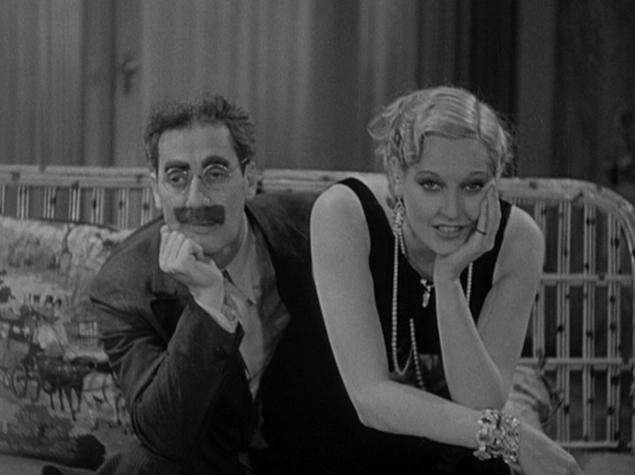 |
| Groucho with Lucille at the party. |
When the kidnapping occurs, Groucho knows where Mary is being taken, the “old Barn” and the Brothers take chase. The Brothers manage to fight and defeat Alky’s henchmen, Zeppo rescues Mary and knocks out Briggs just as Helton and his men arrive.
The film was a huge success for Paramount,
for the writers involved and for the Marx Brothers, establishing them as major
stars in Hollywood. There were even plans, according to Robert Osborne, for a
sequel in keeping with the mafia themes from this film. However, those plans
were scuttled when Charles Lindbergh’s son was kidnapped and killed by gang
members. Instead, the next film Horse Feathers ended up being a
re-working of sorts of a Marx Brothers’ stage show “Fun in Hi Skule”. [The
Lindbergh kidnapping was such a big event that it had a definite impact on
films from Hollywood. Another example was Three on a Match (1932), which also
faced censorship because of its plot points involving kidnapping.]
Some of the themes and plot points in this
film would be mined later. The concept of them as stowaways would be used in
their eventual radio show, Flywheel, Shyster, and Flywheel, a situational
comedy starring Groucho and Chico that ran for 26 episodes on NBC’s Blue
Network from November 28, 1932 to May 22, 1933. And of course, would be
recycled again in the three Marx Brother’s A Night at the Opera (1935), by
which time the act had moved to MGM.
The Marx Brothers are a unique force of
comedy, being able to successfully merge wordplay with slapstick in a way no
one else seems to pull off. Throw in their musical talents and there has really
been no act like them in the history of Hollywood. Perhaps it’s the numbers,
there are four in this film, allowing each to concentrate on what they do best.
Harpo is the king of pantomime in the sound era of film, but also the source of
chaos, not to mention his harp playing. Chico is the conniving “immigrant” who
doesn’t quite understand English or understands only what he wants to and plays
a mean piano.
Groucho is unmatched in his verbal wordplay, oftentimes opposite
Chico, and manages to pull off a grease pencil moustache better than anyone.
Zeppo, the group’s straight man and love interest so to speak, even gets a few
laughs and gets the girl. The four brothers make a complete package in this
film.
This film is an example of the Marx Brothers’
style of anarchy, driven home by Harpo’s complete lack of respect for authority
when they’re trying to get past the passport check point. He literally walks on
the tables in a defiance of standing in line and when he makes it to the front
he throws papers off the table for no real reason but to make a mess of the
order. Everything, everyone and every location is simply a backdrop for the
Marx's to react to, play off and make fun of; no one is immune. The higher up
the social or authority ladder, the more of a come-uppance the Marx's try to
provide. You have to know that this played well with a depression-era movie-going crowd.
 |
| Harpo creates havoc at the passport check point and shows his complete lack of respect for authority. |
Monkey Business is one of the funniest of the Marx Brothers films, but that’s a little like asking a parent to pick their favorite twin child. [The proper answer is the one in the middle.] They are all, for the most part, fun to watch. This film illustrates how much the Marx Brothers can do with very little and that sometimes it’s best to sit back and let them do what they do, rather than try to reel them in.


