Showing posts with label 1951. Show all posts

Saturday, May 24, 2025

Stubs - When Worlds Collide


When Worlds Collide
(1951) Starring: Richard Derr, Barbara Rush, Peter Hanson, John Hoyt. Directed by Rudolph Maté. Screenplay by Sydney Boehm. Based on the serial story "When Worlds Collide" by Edwin Balmer and Philip Wylie in Blue Book Magazine (Sep 1932--Feb 1933). Produced by George Pal. USA. Run time 83 minutes. Science Fiction

I’ll be honest, part of my interest in seeing When Worlds Collide was that it gets a mention in the song “Science Fiction - Double Feature” from The Rocky Horror Picture Show (1975); “…But when worlds collide / Said George Pal to his bride…” When I saw this was going to be on TCM, on went the DVR.

The movie rights for the novel, When Worlds Collide, were originally purchased by Paramount Pictures in 1922 with the idea of Cecil B. DeMille making a film called End of the World. But that film wasn’t made. The story was shelved until October 1949 when Paramount sold them to George Pal, a producer best known for a puppet-cartoon series The Puppetoons. When Pal signed a production contract with the studio, he sold the rights back.

Following the success of Pal’s Destination Moon (1950), Paramount rushed When Worlds Collide into production to capitalize on that film’s success.

Saturday, January 18, 2025

Stubs - The Red Badge of Courage


The Red Badge of Courage (1951) starring Audie Murphy, Andy Devine, Robert Easton Burke, Douglas Dick. Directed by John Huston. Screenplay by John Huston, Albert Band. Based on the novel The Red Badge of Courage by Stephen Crane (New York, 1895). Produced by Gottfried Reinhardt. Run time: 69 minutes. Black and White. USA. Drama, War

Texan born Audie Murphy enlisted in the Army as soon as he could after the attack on Pearl Harbor at the start of World War II. He first saw action in the 1943 Allied invasion of Sicily; then in 1944 he participated in the Battle of Anzio, the liberation of Rome, and the invasion of southern France. Murphy fought at Montélimar and led his men on a successful assault at L'Omet quarry near Cleurie in northeastern France in October. He received every American combat award for valor available at the time of his service, including the Medal of Honor. He also received recognitions from France and Belgium.

As a result, he made the cover of Life magazine on July 16, 1945. That cover brought him to the attention of actor James Cagney, who had recently formed a production company with his brother William. They gave him training in acting, voice and dance, but never cast him in any production. A personal disagreement ended the arrangement in 1947.

Saturday, November 11, 2023

Stubs - Tomorrow is Another Day


Tomorrow is Another Day (1951)
Starring Ruth Roman, Steve Cochran, Lurene Tuttle, Ray Teal. Directed by Felix E. Feist. Screenplay by Art Cohn, Guy Endore. Produced by Henry Blanke. Run time: 92 minutes. USA. Black and White. Melodrama, Romance, Film Noir

For some reason, Ruth Roman didn't strike me as the type of actress I would expect to see in a film noir, so when TCM's Summer of Darkness highlighted her in one several years ago, I was intrigued enough to record it for future viewing. I will admit I was glad I did, but sorry I waited so long to actually watch it.

Saturday, July 29, 2023

Alice in Wonderland (1951)


Lewis Carroll’s 1865 novel Alice’s Adventures in Wonderland, and its 1871 sequel Through the Looking Glass, is quite possibly one of the best-known works of English literature, having received a number of adaptations and reinterpretations in the centuries to follow. Perhaps one of the better-known versions of the story is the animated 1951 Alice in Wonderland film from Walt Disney Productions, likely being one of the first things people might think of if they haven’t read the books, if not two live-action films from the same company. While the movie was critically-panned upon release, it has since been regarded as a Disney classic, and is one of my personal favorites from the Animated Canon. After revisiting it again in light of other, more recent reinterpretations of Alice in Wonderland, including two from Disney themselves, I would say that the film still holds up and is well deserving of its “classic” status.

Saturday, November 7, 2020

Stubs - No Questions Asked


No Questions Asked (1951) Starring: Barry Sullivan, Arlene Dahl, George Murphy, Jean Hagen Directed by Harold F. Kress Screenplay by Sidney Sheldon. Produced by Nicholas Nayfack USA Run time: 82 minutes. Black and White. Film Noir, Police, Drama, Crime

In 1948, Dore Schary left RKO studios where he was Head of Production, choosing to return to MGM and a contemptuous relationship with Louis B. Mayer, rather than work for RKO’s new owner, Howard Hughes. With Schary as Vice-President in charge of Production, MGM began make grittier films, including Tension (1949), SideStreet (1950), Caught (1949), Border Incident (1949), Act of Violence (1949), TheAsphalt Jungle (1950), and No Questions Asked (1951).

Saturday, August 31, 2019

Stubs - The African Queen


The African Queen (1951) Starring Humphrey Bogart, Katharine Hepburn, Robert Morley, Peter Bull, Theodore Bikel. Directed by John Huston. Screenplay by Peter Viertel, John Collier. Adapted for the screen by James Agee, John Huston. Based on the novel The African Queen by C. S. Forester (London, 1935). Produced by Sam Spiegel. Run time: 106 minutes. United States/United Kingdom Color. Romance, Drama, War, Adventure

There has been a long history of directors working with particular actors. Arguably, one of the best well-known is the teaming of John Huston and Humphrey Bogart. Their first film together, The Maltese Falcon (1941), can be seen as setting the tone for Film Noir, finally cementing Bogart as a star and showing Hollywood that John was something more than just the son of actor Walter Huston.  They would go on to make four films together, including The Treasure of the Sierra Madre (1948), Beat the Devil (1953), and The African Queen, which finally won Bogart the Academy Award for Best Actor.

Their friendship is fairly storied and the two enjoyed working together and playing practical jokes on each other on the set. However, it is reported that it was his co-star Katharine Hepburn who recommended Bogart for the lead role. Producer Sam Spiegel sent her the book and she felt Bogart "was the only man who could have played that part.” The chance to work with Huston again and the chance to work with Hepburn was more than enough to interest Bogart in the project. But prior to him, the film was considered as a vehicle for Elsa Lanchester and Charles Laughton. David Niven and Paul Henreid were also looked at for the lead.

Though the book was written in 1935, Warner Bros. didn’t buy the rights to it until 1946. John Collier wrote the first screenplay adaptation in 1949, which supposedly adhered closely to the book. With plans to produce it himself, Collier than bought the rights to the book and the screenplay from Warner Bros. But instead of making the film, he sold the rights to Horizon Enterprises, which was co-owned by Huston and Spiegel.

The production itself would be legendary. Hepburn would write her own account in The Making of “The African Queen,” or How I Went to Africa with Bogie, Bacall and Huston and Almost Lost My Mind. In 1953, writer Paul Viertel published the book White Hunter, Black Heart, a thinly fictionalized account of his experience writing the script for The African Queen with Huston. The book follows the exploits of a tyrannical director who stalls the production of his African-set film by obsessively hunting an elephant. The book would be made into a film in 1990 by Clint Eastwood and starred Eastwood and Jeff Fahey.

The film was made partly on location in Africa, which was quite a feat at the time, especially considering they were using rather bulky Technicolor cameras. Production got underway in late May and continued until mid-August 1951 at the Isleworth Studios, London. The film would open in Los Angeles on December 26, 1951, so it could qualify for the Academy Awards, and open nationwide on March 21, 1952.

Katharine Hepburn plays Rose Sayer, the sister of a British Methodist missionary (Robert Morley) in German Africa.

The film is set in September 1914 in German East Africa at the beginning of World War I. The action opens in the village of Kungdu, where British Reverend Samuel Sayer (Robert Morley) and his spinster sister Rose (Katharine Hepburn) lead prayers at the makeshift First Methodist Church.  While the natives struggle to follow the English-language psalm, they race outside when they hear Canadian Charlie Allnut's (Humphrey Bogart) ancient launch the African Queen chug into the village laden with mail and goods.

Charlie Allnut (Humphrey Bogart) is warmly greeted by the natives in the village of Kungdu.

Though conscious of his lower social standing than the Sayers, Charlie lunches with them. They have to delicately ignore his loud rumbling stomach. Before leaving, he informs them about the encroaching war in Europe, and although the Sayers are frightened by the news, they refuse to desert the village.

Though they are of different social tiers, the Sayers invite Charlie to have lunch with them.

However, hours later, German troops invade Kungdu, imprison the natives and burn down the huts. By the time the smoke clears, Samuel has begun to lose his mind from shock and grief. He soon collapses, unintentionally wounding Rose by raving that their attraction to missionary work grew out of a lack of more attractive social options.

Charlie returns the next day and he finds Samuel dead and helps Rose bury him. She then accepts Charlie's offer to hide from the Germans on his boat. Once they are on the river, Charlie explains to her that the Germans have positioned a heavily armed steamer, the Louisa, at the mouth of Lake Tanganyika to block British troops. He tells her that the Germans even had to dismantle the boat and carry it overland to the Lake.

Rose almost immediately forms a plan to attack the Louisa by crafting torpedoes out of explosives and oxygen tanks, strapping them to the African Queen and ramming into the steamer. Charlie tries desperately to dissuade her, describing the German fort and impassable rapids they will have to face along the way, but Rose's determination eventually shames him into agreeing to the plan.

After they set sail, Charlie teaches Rose how to read the river, and they negotiate how to bathe in private. That night, a pouring rain forces Charlie to seek shelter under Rose's tarpaulin, and after at first banishing him, Rose softens and allows him to sleep near her.

The African Queen nears a set of rapids.

The next day, they reach the first set of rapids and Charlie hopes that the death-defying experience will frighten Rose. But his hopes are dashed when she proclaims it the most stimulating physical experience she has ever had.

Charlie drinks gin while Rose drinks tea.

That night, a frustrated Charlie taps into his gin reserves. Drunk, he rants that he will not sail any farther, calling Rose a "skinny old maid." He awakes the next morning to find Rose pouring his gin bottles into the river. Hours later, he begs her to speak to him and she finally reveals that it is his refusal to sail which has infuriated her.

Rose dumps out all of Charlie's gin while he helplessly looks on.

Charlie quickly backs down, agreeing to accompany her while still doubting their chances for success. Their first obstacle is the German fort he spoke about that overlooks the river. The soldiers open fire on the African Queen, hitting the engine. Charlie, however, manages to repair it and they sail on and get out of the line of fire.

Their joy at surviving the rapids turns romantic.

Almost immediately, however, they reach another set of rapids. Rose struggles to steer while Charlie races to keep the engine stoked, and although they are badly pummeled, they miraculously reach calm waters. Thrilled, Charlie and Rose fall into an embrace which quickly becomes romantic. When they declare their love, they finally learn each other's first name.

They then sail peacefully past exotic flora and fauna until they hit a waterfall, which damages the rudder. Although Charlie despairs, Rose devises a plan to weld a new rudder. For every problem Charlie can think they might have with the repair, Rose thinks of a solution. She even gets into the water to help Charlie get the old rudder off. A few days later, the boat is fixed and on its way.

Together, Rose and Charlie fashion a new rudder for the African Queen.

Just miles down the river, they are attacked by a horde of mosquitoes, which terrifies Rose and forces them to stay in open water. Within days, they become lost in the stagnant shallows as thick reeds bog down the boat. Charlie has to get into the water and pull the African Queen through the reeds.

When he finally gets back on board, he finds leeches covering his body, and even though he is shaking with revulsion, he instructs Rose to use salt on them rather than pull them out. Still reeling, he must return to the water to keep the boat moving. Hours later, they’re stuck on land. Charlie is feverish and tells Rose they may not make it, but that he loves her. They both collapse into sleep.

Feverish, Charlie confesses to Rose that they might not reach their goal.

During the night, a fresh rain upstream raises the water level and sweeps the launch downstream onto Lake Tanganyika. When they awaken, they find the Louisa only miles away, and are forced to retreat into the reeds to hide. By the next day, they have discerned the ship's sailing pattern and they make the African Queen ready. Not only do Charlie and Rose make the torpedoes, but they scrub and polish the boat for its last mission.

Charlie figures out the fuse for the torpedoes.

They set out that night on their attack, but a sudden storm capsizes the launch and Rose and Charlie are separated in the dark.

The next day, Charlie is imprisoned by the Germans and, not wanting to live without Rose, accepts his sentence of hanging. Just then, however, Rose is brought in, and when she hears that Charlie is to be killed, proudly admits their whole scheme to the soldiers.

Before they're to be hanged, Charlie and Rose are married by the German ship's captain (Peter Bull).

Before they are hanged, though, Charlie requests that the captain (Peter Bull) marry them, and just as the service ends, the African Queen surfaces, hits the Louisa and explodes. The German boat goes down and Charlie and Rose manage to escape. Floating together in the water, the newlyweds see the boat's nameplate floating by and realize that their plan has succeeded after all. Happily, and singing, they swim together towards the shore.


After the African Queen sinks the Louisa, Charlie and Rose swim away to safety.

During the filming, Hepburn and Humphrey develop a great rapport and that shows on the screen. Even though Bogart couldn’t manage an English-accent, forcing them to change Charlie’s nationality, he does a really good job as Allnut. This allows him to show a range. No longer the gangster or a true romantic lead, Bogart shows himself to be a fine actor and not just a movie star. The role would earn Bogart his only Academy Award of his long and esteemed career.

The film is essentially a two-person show and Hepburn gives a fine performance herself as Rose.  Bogart is only as good as he is because he has an equal acting partner in Hepburn. The trip down the river in the African Queen is as much a journey of discovery for Rose as she goes from the virginal sister of the missionary into a woman discovering both her emotional and, yes, sexual self. She would also receive a nomination for her performance.

Robert Morely makes a brief appearance as Rose's brother and Methodist minister. His part was all shot in the studio and he did not make the trip to Africa. His role is small though important, however, he doesn't really bring anything more than name recognition to the role.

The film would also receive nominations for Best Adapted Screenplay for both James Agee and John Huston as well as one for Huston as Best Director. The film also did well at the box-office, making over $10.75 million on a budget of $1 million. The film has had legs and often lands in the top 100 films of all time in many polls.

This is definitely one of those classic films that everyone should watch. The film is unusual given the star power of the leads and the strong performances they give despite the hardships of filming. Much of this is done on location, which would be difficult at best but both give top-notch performances. The action is good as the couple grow closer and have to fight the dangers of the jungle to achieve their goal. I can’t say enough good things about the film and would highly recommend it.

Saturday, April 28, 2018

Stubs - Cry Danger


Cry Danger (1951) Starring: Dick Powell, Rhonda Fleming, Richard Erdman, William Conrad, Regis Toomey, Jean Porter, Joan Banks, Jay Adler, Renny McEvoy, Lou Lubin Directed by Robert Parrish. Screenplay by William Bowers. Based on a Story by Jerome Cady. Produced by Sam Wiesenthal and W.R. Frank. Runtime: 79 minutes. USA. Black and White. Film Noir, Drama

If you’ve never heard of Olympic Productions, it may have a lot to do with the fact that the production company, owned by Sam Wiesenthal and W.R. Frank only made one film, Cry Danger. Like many independent productions, Cry Danger was made quickly on a low budget. The initial shoot lasted about 22 days beginning on June 9, 1950, with additional shooting in late July to early August. Much of the shooting took place in and around downtown Los Angeles, CA, including Union Station and Bunker Hill.

Jerome Cady’s story was originally purchased by Santana Pictures, a company owned by Humphrey Bogart and his producing partner Robert Lord with Columbia Pictures originally set to distribute. No word how the story went from Santana to Olympic, but that is what happened. No telling what the resulting film would have been like with Bogart in the lead.

Dick Powell and Humphrey Bogart in a publicity still from the film Johnny O'Clock
(1947) with technical adviser John Jake Barrett in between.

Dick Powell, however, was no slouch when it came to film noir. A one-time song and dance man in films like 42nd Street, Gold Diggers of 1933 and Footlight Parade, all from 1933, Powell made the transition to film noirs with Murder, My Sweet (1944) playing a character Bogart had also played, Phillip Marlowe. He would go on to make several film noirs including Cornered (1945), Johnny O’Clock (1947), To The Ends of The Earth (1948) and Pitfall (1948). Well-versed in the genre, Powell would turn out to be a good choice for the lead here.

Newspaper headlines welcome Rocky Mulloy home.

Powell plays Rocky Mulloy, fresh from prison having served five years of a life sentence for robbery and murder. When the film opens, Rocky is just getting off the train at Los Angeles’ Union Station where he is greeted by a newsboy hawking the paper with a headline about Rocky’s release. Outside, Lt. Gus Cobb (Regis Toomey), the detective who helped put him behind bars, is waiting for him. With Gus is Delong (Richard Erdman), a decorated, disabled ex-Marine and alcoholic, who provided Rocky with an alibi that got him released.

Rocky (Dick Powell) is greeted off the train by Lt. Gus Cobb (Regis Toomey),
the detective who helped put him behind bars, and Delong (Richard Erdman), the man who freed him with an alibi.

Gus doesn’t necessarily buy the alibi but invites the two men out for a drink. At the bar, Delong explains that he shipped out the day after the holdup, saying he was unaware that Rocky was in trouble. Delong’s story is that Rocky and he had been out together drinking with other Marines the night the robbery was committed. Gus isn’t convinced and informs Rocky that he’s putting a tail on him 24/7, hoping he’ll lead authorities to the money from the holdup which was never recovered.

First stop is a bar, where we learn Delong likes to drink.

Once Gus leaves, Delong comes clean with Rocky, telling him that he had made up the alibi, thinking that he might be entitled to a share of the loot. Rocky repeats his claim that he wasn’t part of the robbery but knows who was involved and who has the money and that he intends to find it.
Delong takes Rocky to the Clover Trailer park, where Nancy Morgan (Rhonda Fleming) lives. Nancy is not only Rocky’s ex- but she is also the wife of his best friend, Danny, who was also found guilty of the robbery and is still in prison.

The trailer park where Nancy lives and where Rocky and Delong rent a trailer.

The first person they meet is a cute blonde, Darlene (Jean Porter), part-time model and part-time pickpocket, to whom Delong is drawn. The two men rent a trailer from the manager of the park, Williams (Jay Adler), who warns them that he doesn’t want any trouble. Nancy is thrilled to see Rocky again.

The first person they meet at the trailer park is Darlene (Jean Porter).

That night, Rocky goes to see Louie Castro (William Conrad), a racketeer who had engineered the holdup. Rocky accuses him of a frame-up and demands Castro pay him $50,000, the amount he had been offered to participate in the robbery. Castro refuses. He claims not to have the money. Rocky will settle for $5000 as a down payment. Instead, Castro gives Rocky $500 with which to place a bet the next day on a fixed horse race. The horse will pay 8 to 1 which will get Rocky some money for now.

Louis Castro (William Conrad) gives Rocky a racing tip rather than a payout.

Later that night, Rocky is shot at by an unseen assailant at the trailer park. Nancy begs Rocky to drop the matter, but Rocky instead goes the next morning to see Arthur Fletcher, a witness that provided damning evidence against Rocky at his trial. However, he finds out from Alice (Joan Banks), Arthur’s wife, that he’s dead. Alice tells him that Arthur received $5000 soon after the trial, which Rocky assumes was a bribe from Castro.

Arthur Fletcher's widow, Alice (Joan Banks), seems to fancy Rocky.

Alice makes a play for Rocky, but instead he calls Castro to find out how to place his bet. He’s instructed to go to a hotel's cigarette stand to place the bet and is instructed to see the bookie (Hy Averback) downstairs in the delicatessen for the payout. The bookie, who comes out of the backroom, complains about the payment saying no one considers that he’s got a wife and kid at home.


While Rocky, Nancy, Delong, and Darlene are out celebrating Rocky’s good fortune, Gus shows up to let him know that the money is part of a heist. Trying to prove his innocence, Rocky takes Gus back to the delicatessen, but the proprietor acts like he’s never seen him before and informs them there is no backroom, which Gus and Rocky find is true. Upstairs, there is a different woman working the concession and has no idea what he’s talking about. When they fail to find the other woman who took the bet, Gus takes Rocky downtown to police headquarters.

Gus shows up to ruin Rocky's celebration, which includes Nancy (Rhonda Fleming) at left.

Gus calls Castro, who claims he’s never seen Rocky, which Gus knows is a lie, having followed Rocky since his release. Still, he’s reluctant to believe Rocky’s story, though he does let him go.

Soon after he gets back to the trailer park, Delong and Darlene leave to get a drink. They are, however, mistaken for Rocky and Nancy by Castro's thugs. In a hail of bullets, Delong crashes the car and Darlene is killed instantly.

After the shooting, Gus brings in all of the suspects, including Castro.

Gus brings Rocky, Nancy, and Castro in for questioning, but can’t get any answers from any of them. He lets them go, though he holds on to Castro. When he returns to his car, Castro finds Rocky waiting for him.

Rocky is waiting for Castro to come out of police headquarters.

Incensed, Rocky takes Castro to his office and forces him at gunpoint to lie down on the desk. He then plays Russian roulette with Castro until he admits where his half of the loot is hidden, in a safe under his desk. Castro also reveals that Nancy has the other half, as Danny, unlike Rocky, agreed to participate in the holdup and committed the murder.

Castro eventually confesses to Rocky about his half of the money.

Rocky instructs Castro to call Gus to arrange for a confession, Gus instead calls his thugs, who leave to come to his office. Afterward, Rocky calls the real Gus. When the police arrive, the thugs engage them in a shootout on the sidewalk out front.

When the police get to Castro’s office, Rocky informs Gus where half of the money is, but claims not to know where the other half is.

Nancy wants to run away with Rocky and confesses that she has her husband's share of the loot.

Back at the trailer park, Nancy wants to run away with Rocky. He tells her that they'll need money and she admits that she has Danny’s share of the money. When Rocky asks how she could have remained silent when he was sent away to prison, she admits that she was afraid of Castro. She also confesses to shooting at Rocky to stop his snooping. Still, she claims she still loves him and begs him to run away with her. Rocky agrees and they split up to pack. But once he’s outside her trailer, Gus is there. Rocky tells him about Nancy's deception and while Gus goes inside to arrest her, Rocky walks quietly away.

Released by RKO on February 3, 1951, the film received positive reviews, though there is no information on its box office. Variety noted that "All the ingredients for a suspenseful melodrama are contained in Cry Danger…”

There is a lot to like about the film, starting with the cast. Dick Powell seems to be in his element as Rocky. He’s just tough enough and snarky enough to carry off the part. Not a forbidding figure, Rocky is driven by his anger over having been wronged. He doesn’t let much stand in his way, even Castro, played by William Conrad.

No stranger to crime dramas, Conrad appeared in The Killers (1946) as one of the assassins sent at the beginning to kill Burt Lancaster’s Swede character. He had also appeared in such films as Body and Soul (1947), Sorry, Wrong Number (1948), Tension (1949), and Dial 1119 (1950). Conrad would become a radio actor, playing Marshal Dillon on the long-running radio production of Gunsmoke (1952-1961), and eventually have his own TV show, Cannon (1971-1976). Conrad is used to playing the heavy, no intended joke about his weight, and he’s good here as Rocky’s foil.

Nicknamed the “Queen of Technicolor”, Rhonda Fleming was known for her pale complexion and flaming red hair. She acted in films beginning with In Old Oklahoma (1943), but her big break came in Spellbound (1945) directed by Alfred Hitchcock followed by The Spiral Staircase (1945). She would also appear in Out of The Past (1947). Her first starring role came in Adventure Island (1947), a low-budget action film shot in color. She would then star opposite Bing Crosby in her first Technicolor film, A Connecticut Yankee in King Arthur’s Court (1949).

Even in black and white, Fleming is still a beautiful woman and a fine actress. Nancy is a little one-dimensional, though Fleming does her best to make the most out of her. The twist at the end seems a little anticlimactic, but that’s not her fault.

Richard Erdman made a career as a supporting actor, appearing in 160 film and television productions over the years. His first appearance was in Mr. Skeffington (1944) and his most recent appearance was in the sit-com Community (2009–2015), as one of the elder students. Here he makes a good sometime partner for Rocky. He’s a good actor but he doesn’t steal focus from the star. Erdman does, however, get to deliver one of the better lines in the film.

Darlene LaVonne: You drinkin' that stuff so early?
Delong: Listen, doll girl, when you drink as much as I do, you gotta start early.

Jean Porter came to Hollywood at the age of 12 in 1934 from Cisco, Texas. While she would never achieve stardom, she did appear in such films as The Youngest Profession (1943), Bathing Beauty (1944), Abbott and Costello in Hollywood (1945), Till the End of Time (1946), and in The Left Hand of God (1956). She did attract the attention of director Edward Dmytryk, who ended up as one of the Hollywood Ten during the McCarthy Era. They would stay married from 1948 until his death in 1999. Porter is more eye-candy in this film and except for minor characters, she is pretty one-dimensional.

The film is good but not great. While Rocky’s journey is interesting it is somewhat short and to the point. There are a couple of diversions along the way to keep it from being too straightforward but there really is nothing all that unique about the story. Wrongly accused man gets out of prison and seeks revenge on those that put him there. In this case, it’s Castro, who is 60% legit (sort of like being a little pregnant) and doesn’t want to give Rocky his due.

The twist, and you pretty much have to have one for film noir, is that the woman he loves and who claims to love him back is also responsible for putting him away. It’s a good one but not as shocking, perhaps, as it could be.

If you’re a fan of film noir, then you should like Cry Danger. While it doesn’t hold up as one of the greats of the genre, it is still good and fun to watch. I would recommend it if you have not seen it.

Be sure to check out our Film Noir Review Hub for reviews of other films in this genre.

Saturday, July 22, 2017

Stubs - He Ran All the Way


He Ran All The Way (1951) Starring: John Garfield, Shelley Winters, Wallace Ford, Selena Royle, Gladys George, Norman Lloyd. Directed by John Berry. Screenplay by Hugo Butler, Dalton Trumbo. Based on the novel He Ran All the Way by Sam Ross (New York, 1947). Produced by Bob Roberts. Run Time: 78 minutes. USA Black and White. Drama, Film Noir

The early 1950s were a turbulent time in Hollywood. Blacklisting for your political affiliations real or presumed had been going on since November 25, 1947 when ten writers and directors were cited for contempt of Congress for refusing to testify to the House Un-American Activities Committee. The Hollywood Ten, which included Alvah Bessie, screenwriter; Herbert Biberman, screenwriter and director; Lester Cole, screenwriter; Edward Dmytryk, director; Ring Lardner Jr., screenwriter; John Howard Lawson, screenwriter; Albert Maltz, screenwriter; Samuel Ornitz, screenwriter;  Adrian Scott, producer and screenwriter; and Dalton Trumbo, screenwriter, were summarily fired by their studios on advice from the Association of Motion Picture Producers, now called the Alliance of Motion Picture and Television Producers or AMPTP.

Now being blacklisted and not working in Hollywood were two different things. Take Dalton Trumbo as an example. Using pseudonyms and other writers as fronts, Trumbo would work on such films as Gun Crazy, 1950 (co-writer, front: Millard Kaufman); He Ran All the Way, 1951 (co-writer, front: Guy Endore); The Prowler, 1951 (uncredited with Hugo Butler); Roman Holiday, 1953 (front: Ian McLellan Hunter); They Were So Young 1954, (under pseudonym Felix Lutzkendorf); The Boss, 1956 (front: Ben L. Perry); The Brave One, 1956 (under pseudonym Robert Rich); The Green-Eyed Blonde, 1957 (front: Sally Stubblefield); From the Earth to the Moon, 1958 (co-writer, front: James Leicester); and Cowboy, 1958 (front: Edmund H. North), before receiving screen credit again under his own name with Spartacus (1960) thanks to the star and producer of the film, Kirk Douglas.

But Trumbo was not the only involved with this film that was being blacklisted. The film’s star John Garfield was also being caught up in the Red Scare. When called before HUAAC, he not only refused to name names, but went so far as to say that he didn’t know of any communist party members in Hollywood. As a result of his testimony, Garfield was blacklisted in the early 1950s and He Ran All the Way would turn out to be his last film. He did return to Broadway in Golden Boy (1952), but also died that year from Coronary thrombosis at the age of 39.

Sam Ross’ novel He Ran All the Way was originally bought by Liberty Films in 1947 as a vehicle for director George Stevens. In 1950, Bob Roberts of Roberts Productions, Inc. bought the property from Liberty. The Production Code Office, or as it was known by then as the Breen Office, objected to much of the violence in the original script and alterations were made accordingly. Rather than having a policeman killed in the opening, he is rather mortally wounded.

Prior to the making of He Ran All the Way, Shelley Winters was under contract to Universal to make a low budget turn-of-the-century drama about the legendary World's Fair belly dancer named Little Egypt (1951). But Winters was so anxious to start work on Berry's film that she concocted a plan to get herself fired, gaining enough weight to make herself look particularly unappealing. The ruse worked and after she was fired, Winters went on a crash diet, losing fifteen pounds in a week right before He Ran All the Way went into production.

And as if Garfield didn’t have enough to contend with, a few months before the film went into production he suffered a severe heart attack at the Beverly Hills Tennis Club. But despite the risks to his own health, Garfield insisted on doing his own stunts during the filming, including underwater swimming.

The film went into production on November 6, 1950 at the Motion Picture Center Studios, now known as Red Studios Hollywood. Location shooting took place at the Long Beach Plunge public swimming pool and Nu-Pike, formerly known as The Pike, a mile-long waterfront amusement park also located in Long Beach. (The Plunge would close in 1941 and the Nu-Pike in 1979.) Production would conclude in mid-December with the film going into release on July 13, 1951.

When the story opens, Nick Robey (John Garfield) lives at home with his mother (Gladys George).

Even though he has premonitions that he will forever be on the run for murder, Nick Robey (John Garfield) allows himself to get talked into committing a robbery by his disreputable friend, Al Molin (Norman Lloyd). The two men hold up a man for the local train yard warehouse’s payroll, but when they make their getaway, Al is killed by a policeman and Nick is forced to shoot a policeman so he can make his own escape.

Norman Lloyd (l) plays Al Molin, Nick's partner in crime.

Once out on his own, Nick tries to hide out in a public swimming pool to avoid detection by the police. There he makes the acquaintance of Peg Dobbs (Shelley Winters), a nervous beginning swimmer. Nervous that he’ll be conspicuous on his own, Nick tries to help her. When the lesson is over, Nick offers to take Peg home. 
Flattered by his attention, Peg agrees and she lets him take her back to her family’s tenement apartment.
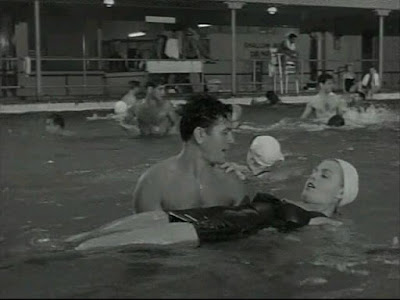
While running from the police, Nick takes refuge at a public swimmnig pool and befriends
Peg Dobbs (Shelley Winters), whom he helps learn to swim.

There, she introduces Nick to her father (Wallace Ford), mother (Selena Royle) and younger brother Tommy (Bobby Hyatt), who are on their way to see a movie. Left alone in the apartment, Nick is uneasy and even though Peg urges him to relax, he can’t. Nick finally breaks down and tells her that he is in big trouble.
When her parents return home, Nick is suspicious that they are talking to the police about him. Even though Peg tries to tell him that they’re talking down on the street with neighbors, there is no really talking to Nick. Convinced that they’re on to his real identity, he pulls a gun on Peg and admits to her that he’s a killer to her and her family.

Mr. Dobbs, a newspaper press operator, says that the paper only identified Molin in the article. But that isn’t enough for Nick. Even though he says he does not want to hurt anyone, Nick decides he must spend the night so he can collect his thoughts and plan his next move. He promises that he’ll be leaving in the morning.
However, when the morning paper arrives, it features a prominent photo of Nick on the front page. Mr. Dobbs tries to hide it from him, but Nick spies it and, thinking that he has caught the family in a conspiracy against him, decides he must stay.

Nick takes out his suspicions on Peg's father (Wallace Ford) while her mother (Selena Royle) watches. 

While he allows the family to continue their daily routine, he insists he keep one family member with him at all times, which usually means Mrs. Dobbs. While on lunch break from her bakery job, Peg returns to the apartment to plead with Nick to leave. She reminds him that he liked her at the pool, but Nick informs her the situation he was in at the time was the only reason he took interest in her.

When Peg returns to the bakery, her father comes to visit her. He demands that she hide out at a girl friend's house for the night and not come home.

One of her co-workers on the assembly line suggests that Peg shed her shyness and that, with some primping, she could get a man to do anything for her.

Peg takes advice from one of her co-workers at the bakery, Marge (Vici Raaf).

While he is at home with Mrs. Dobbs, an argument starts when Nick tells her that Peg thinks fondly of him. Distracted, Mrs. Dobbs has a sewing accident, getting her hand caught, and faints. After freeing her, Nick carries her to the couch.

Nick helps Mrs. Dobbs free herself when she has an accident while sewing.

When Mr. Dobbs returns home, he finds Tommy hiding outside the apartment afraid to go in the apartment because of Nick. They enter the apartment together and Nick gathers the family for a feast he has provided. Mr. Dobbs, however, refuses to allow his family to eat Nick’s food. Nick pulls out his gun and orders them to eat, but Mr. Dobbs calls his bluff, saying a gunshot would attract too much attention. Accepting the challenge, Nick fires his gun. When no one calls the police, Mr. Dobbs backs down. But it’s too late for Nick. With his banquet now spoiled, Nick rebukes the family for not willingly giving him temporary shelter, "something you would give an alley cat."

Mr. and Mrs. Dobbs  and Tommy ((Bobby Hyatt) refuse to eat the feast that Nick has provided.

Even though her father had told her not to, Peg does return home late in the night. She is wearing an evening gown and her womanly figure catches Nick's eye. He comes onto her, kisses her and asks for her support, to which Peg replies "all the way." Later that night, while the others are asleep, Mr. Dobbs inspects the living room and finds Peg's gown draped across the chair. He assumes the worst has happened: sex.

The next morning, while Mrs. Dobbs and Tommy are at church, Nick asks Mr. Dobbs what he wants out of life. Mr. Dobbs turns the question around on him, to which Nick answers "money." He then informs Mr. Dobbs that Peg is out buying a car for him. Tensions between the two men escalate and a fight ensues. Only Peg’s return breaks it up.

When Nick asks about the car, Peg informs him that it will be delivered later that evening after some work is completed on it. Mr. Dobbs manages to leave.

Meanwhile, Mrs. Dobbs and Tommy report to the police that Nick is hiding at their apartment.

Nick, now paranoid, demands to know the kind of car Peg has bought and to see the receipt. She describes a yellow convertible that he wanted her to buy, but when she cannot produce the receipt, Nick pulls a gun on her and drags her, at gunpoint, down the stairs to the lobby, all the way hysterically accusing her of double-crossing him.

Nick doesn't seem to trust that Peg has done as ordered and bought him a car.

Once they reach the lobby, Mr. Dobbs is waiting outside and fires several shots into the foyer. Nick drops his gun near Peg and leaps for cover to the other side of the foyer. Nick orders her to pick up the gun. When she does, Nick lurches forward to take it from her, but she shoots him, fatally wounding him.

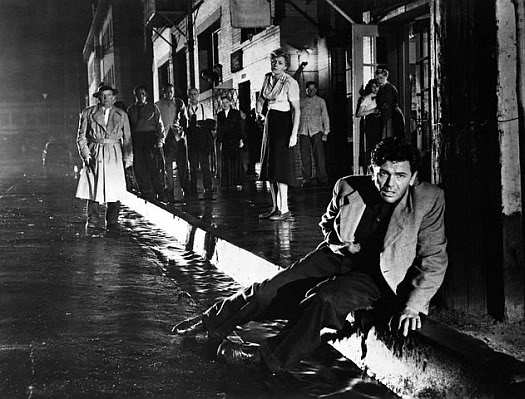
Nick manages to stumble outside, just as the convertible is delivered and parked at the curb. Staring into its headlights, Nick dies. Meanwhile, Mr. Dobbs holds his traumatized daughter to his side.

Nick dies in the gutter, only then realizing the car Peg purchased has arrived.

This is not a feel-good film either, so don’t expect to come away with a smile on your face. The world in which the Dobbs live is no picnic to begin with, as they struggle to make ends meet. Add to that an armed cop-killer keeping them hostage and the days only get longer.

The film drew praise for Garfield’s performance. Bosley Crowther, the film critic of the New York Times, wrote "John Garfield's stark performance of the fugitive who desperately contrives to save himself briefly from capture is full of startling glints from start to end. He makes a most odd and troubled creature, unused to the normal flow of life, unable to perceive the moral standards of decent people or the tentative advance of a good girl's love. And in Mr. Garfield's performance, vis-a-vis the rest of the cast, is conveyed a small measure of the irony and the pity that was in the book."

The marriage of actor and role was rarely better than John Garfield and Nick Robey. While Nick was being persecuted for murdering a policeman, Garfield had to feel the same way about his own career as he was feeling the heat for his testimony at the HUAAC hearing. The sense of paranoia Garfield must have been feeling was channeled into his portrayal of Nick. While not necessarily the most enjoyable film he had been in, his acting was never better.

While there are other characters in the movie, they are minor in comparison to Nick and Peg. The story revolves around their relationship. While there is an attraction on both sides, Peg is the key. The script and director John Berry do a good job at making her look ambiguous about it. There are other fine performances in the film, but it does boil down to Garfield and Winters as most of the film is spent with them acting with each other.

Shelley Winters has the unenviable task of playing Peg in this neutral way. As an audience member, we’re never really sure if Peg was really in love with Nick or just playing him to protect her family. The arrival of the car doesn’t necessarily change that either. Even the fact that she shoots him doesn’t really answer that either. Love is a powerful emotion and many a lover shoots their partner when that love goes sour; and nothing says the relationship has gone sour more than when Nick pulls a gun on her.

While Garfield is remembered as one of the greats, Winters doesn’t get the credit she deserves. Too many people only remember her later in her career, when she was overweight in such films as The Poseidon Adventure (1972), even though she would receive a nomination for Best Supporting Actress for her part, that seemed to be as much about her past work as it did her work in that film.

Shelley Winters began her career in the films playing blonde bombshells.

Originally a blonde bombshell type of actress, Winters soon tired of those types of roles. She purposefully sought out the role of Alice Tripp in A Place in the Sun (1951). She had to convince director George Stevens that she could play the very unglamorous role. She also showed she could act, receiving a nomination for the Academy Award as Best Actress in a Leading Role. She would win the award for Best Supporting Actress twice, once for The Diary of Anne Frank (1959) and A Patch of Blue (1965). Her role in this film is more of a continuation in Winters’ exploration of non-glamorous roles. In part similar to the one she played in A Place in the Sun, her character works on an assembly-line at a bakery.


For a film noir, most of the story takes place in the Dobbs’ apartment. The main action in the film does seem to take place at night, which seems to fit in with the genre. The film is more psychological than anything else, which again is not unusual for a film noir. But unlike many other film noirs, there is not a lot of action outside the beginning and ending of the film nor detective work involved. The film makes up for this by two fine performances by the lead actors. Even though you won’t come out of the theater or your living room with a smile on your face, this is still a movie worth watching.