Key Largo (1948)
Starring Humphrey Bogart, Edward G. Robinson, Lauren Bacall, Lionel Barrymore,
Claire Trevor. Directed by John Huston. Screenplay by
Richard Brooks and John Huston. Based on the play Key Largo by Maxwell
Anderson, as produced by The Playwrights Company (New York, 27 Nov 1939).
Produced by Jerry Wald. Run Time: 100 minutes. USA. Black and White. Drama,
Crime, Film Noir.
Tell me if this sounds familiar, a deserter of the Spanish
Civil War redeems himself in death by defending the family of a true war hero
against Mexican bandidos on the tiny island of Key Largo, Florida. No? Well,
that’s the story of the play Key Largo that was the basis for the film. With World
War II still on everyone’s mind, it is no surprise that the story was updated.
Mexican Bandidos are replaced with prohibition-era gangsters. There are some
other changes made to the point that the original story is all but impossible
to see in the finished film. But that’s Hollywood.
Born in Bucharest, Romania, Robinson had been a star since
Little Caesar (1931). Often cast as gangster, Robinson had worked with James
Cagney, Bette Davis and Bogart. But he had also shown his versatility starring
in comedic send ups of his tough guy image, A Slight Case of Murder (1938), as
well as a political film, Confessions of a Nazi Spy (1939), and biographical
films as Paul Ehrlich in Dr. Ehrlich's Magic Bullet (1940) and Paul Julius
Reuter in A Dispatch from Reuter's (1940). He also made film noirs including Billy Wilder's Double Indemnity (1944),
Fritz Lang's The Woman in the Window (1944) and Scarlet Street (1945); and
Orson Welles' The Stranger (1946) and Irving Reis’ All My Sons (1948).
In their four previous films, Bullets or Ballots (1936), Kid
Galahad (1937), The Amazing Dr. Clitterhouse (1938) and Brother Orchid (1940),
Robinson had received top-billing. Now, while Bogart would receive top-billing,
Robinson’s name would appear in second place, but slightly higher than Bogart’s
on the poster to show that he was an equal.
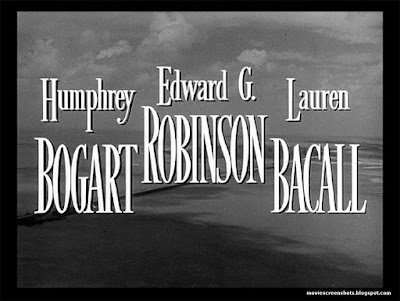 |
| Edward G. Robinson gets second, but equal billing to Bogart. |
The film is also notable for Bogart’s teaming with wife Lauren
Bacall. After success in To Have and to Have Not (1944), The Big Sleep (1946)
and Dark Passage (1947), Key Largo would represent their fourth and final
pairing.
Key Largo would be in production between December 1947 and
mid-March 1948. The hurricane footage was stock, having been shot for a Ronald
Reagan melodrama, Night Unto Night (1948).
Following the end of World War II, disillusioned ex-Major
Frank McCloud (Humphrey Bogart) arrives
on the island of Key Largo, Florida to visit the family of George Temple, a friend from
the Army who had served under him and was killed in the Italian campaign.
 |
| In the hotel's bar, Frank McCloud (Humphrey Bogart) meets (from left to right) Janes Temple (John Barrymore), Ralph Feeney (William Haade), "Toots" Bass (Harry Lewis), Curly Hoff (Thomas Gomez), Angel Garcia (Dan Seymour) and George's widow, Nora (Lauren Bacall). |
Entering the rundown Hotel Largo, where Frank is to meet
George’s father, the wheel-chair bound James (Lionel Barrymore) and George’s
widow, Nora (Lauren Bacall), he encounters guests in the hotel’s bar: Curly Hoff
(Thomas Gomez), "Toots" Bass (Harry Lewis), Angel Garcia (Dan
Seymour), Ralph Feeney (William Haade) and Gaye Dawn (Claire Trevor). Frank is
informed by Curly that the hotel is closed for the season, but he still seeks
out the Temples, who invite him to spend the night.
 |
| Frank tells James and Nora about George's bravery under fire. |
Frank tells James and Nora about where George is buried and
recounts his heroism under fire. Nora seems taken with Frank, stating that
George frequently mentioned him in his letters home. Frank tells them that George
had told him personal and confidential details about the Temples and that he
had committed to memory the small and
cherished details George had spoken of, to relieve the boredom, stress, and
terror that was the stark reality of combat.
Nora offers that the guests have offered Mr. Temple an
amount of money that he couldn’t refuse to open the hotel even though it was
closed for the winter and there is a Hurricane expected. He also learns that
there is a sixth guest who remains secluded in his room. The guests insist that
they are in the Florida Keys on a fishing trip and have a charter boat waiting
down by the docks.
With a hurricane coming, the three go about preparing the
hotel. They are interrupted when Sheriff Ben Wade (Monte Blue) and his deputy
Sawyer (John Rodney) arrive looking for the Osceola brothers, John (Jay
Silverheels) and Tom (Rodd Redwing), a pair of Seminole Indians who escaped
custody after being arrested on minor charges. Mr. Temple promises Sheriff Wade
that he has some influence with the local Indians and will get the Osceolas to
surrender. But soon after the Sheriff leaves, local Indians come to the hotel
seeking refuge from the approaching hurricane, including the Osceolas.
Back inside the hotel, Curly, Ralph, Angel and Toots pull
guns and take the Temples and Frank as their hostage. The sixth member and
leader of the group finally makes an appearance. Frank recognizes him as
notorious gangster Johnny Rocco (Edward G. Robinson), who was exiled to Cuba
some years before for being an undesirable alien. Rocco has entered the country
illegally in order to make a delivery of counterfeit money, but his contacts
have been delayed by the approaching storm.
 |
| Johnny Rocco (Edward G. Robinson) is an old-style gangster who has already been deported from the U.S. |
It is revealed to the Temples and Frank that the gang had discovered
Sawyer looking about, so they beat him up and knocked him unconscious. As they
are held at gunpoint, Temple lets go a stream of insults toward Rocco, who
responds by taunting Temple, explaining how he will one day return back to
prominence.
 |
| Rocco makes an inappropriate pass at Nora. |
Rocco is impressed by Nora's feistiness and makes a pass at
her. In response to his overtures, she spits in his face.
 |
| She spits in his face. |
Angry, Rocco wants to
kill her, but Frank stops him with some fast talking. Mocking Frank's heroics, Rocco
gives Frank a pistol and tells him that he can rid the world of Rocco if he is
willing to die in the process. To the disappointment of both Nora and Temple,
Frank refuses to shoot, stating that he believes in self-preservation over
heroics and that "One Rocco more or less isn't worth dying for!"
After Frank throws the gun down, Sawyer grabs it and tries to use it to escape,
but Rocco shoots him. Turns out the gun Sawyer picked up, the one given to
Frank by Rocco, wasn’t loaded.
 |
| Claire Trevor plays Rocco's ex, Gaye, who is now an alcoholic. |
James
wants to believe Frank knew that Rocco gave the gun to him unloaded, but Frank is
adamant that he didn’t. Rocco orders his men to take Sawyer's body by boat to
deep water and throw it overboard.
Rocco then demands that Gaye, his alcoholic former mistress,
sing a song before she can have another drink. She sings "Moanin' Low," (words
by Howard Dietz, music by Ralph Rainger) a capella, but doesn’t sing very well.
Rocco still refuses to give her a drink and Frank takes pity on her. Frank goes
to the bar, pours a drink and gives it to Gaye. While Gaye says "Thanks,
fella" to Frank, Rocco slaps him in the face several times for disobeying
his orders. Frank ignores the slaps, and says, "You're welcome" to
Gaye.
 |
| Rocco slaps Frank for disobeying him and giving Gaye a drink. |
The full force of the hurricane then hits, which terrifies
Rocco and Frank uses the opportunity to “shame” him:
Frank McCloud:
You don't like it, do you Rocco, the storm? Show it your gun, why don't you? If
it doesn't stop, shoot it.
The storm also gives Nora
a chance to challenge Frank about his disillusionment. Nora tells Frank that
she knows his story about her husband's heroism was false and that Frank was
the real hero. Mr. Temple then invites Frank to come live with them at the
hotel, a prospect that seems to intrigue Nora.
After the storm has passed, Sheriff Wade returns looking for
Sawyer and finds his body on the road, where it had been washed up during the
storm. Rocco blames the murder on the Oceola brothers.
 |
Sheriff Ben Wade (Monte Blue) finds the body of Officer
Sawyer after it is washed up after the Hurricane. |
Along with the other Seminoles, they hadn’t
been been allowed inside the hotel at Rocco’s orders. Sheriff Wade then goes
out to the dock where the Indians are preparing their own boats to leave. When
the Oceolas try to escape, Wade shoots them down.
After Wade leaves with Sawyer's body, Rocco's contact, Ziggy
(Marc Lawrence), arrives to conclude their business deal. Rocco sells Ziggy a
large amount of counterfeit money. Even though the meeting is tense. Rocco and
Ziggy are old friends and joke about better days ahead for gangsters like
themselves.
 |
| Curly looks on as Ziggy (Marc Lawrence) and Rocco do some business. |
Once the business is concluded, Rocco is ready to leave. It
is then that he finds out the Skipper (Alberto Morin) of the boat, against Rocco’s direct orders, has moved it to deeper water to avoid damage from the hurricane. They need another boat and commandeer
Temple’s. Rocco then forces Frank, who has skills as a seaman, to take him and
his henchmen back to Cuba on the small boat.
 |
| Even though Rocco threatens him, the Skipper (Alberto Morin) moves the boat of out the way of the Hurricane. |
Rocco pays James Temple for their stay and has his henchmen
gather everyone's bags, except for Gaye's. Even though she wants to come with
him, Rocco tells her he won’t be taking her with him. Instead, he gives her some
money for expenses.
Both Nora and Gaye try to convince Frank to make a break for
safety once he is outside the hotel, but he agrees to take the men to Cuba.
Gaye appears to make a last-ditch attempt to convince Rocco to take her with
him. She hugs him and, while embracing him, steals Rocco's gun. She then manages
to slip the gun to Frank.
 |
| Gaye makes a last desperate attempt to get Rocco to take her with him. |
Once they’re out at sea, Curly worries that Gaye will tell
the authorities about Ziggy, but Rocco tells him that is exactly what he wants
to happen.
Up on deck, Toots is sea sick. Frank sees his opportunity.
He first tricks Ralph into looking over stern under the guise that there might
be something on the propeller. When Ralph looks over the edge, Frank races the
engine and knocks him into the water.
 |
| Toots fires at Frank after Ralph has been dumped in the ocean. |
Toots realizes that Ralph has been lost at sea and when
Frank won’t go back, he shoots him. Even though he’s wounded, Frank returns
fires back and kills him.
Hearing shots, Curly goes up to the main deck and is
mortally wounded by Frank in an exchange of gunfire. Curly staggers down the
ladder, but before he can respond to Rocco’s questions, he dies.
Rocco wants Angel to go up and see what has happened, even
lying to him that Frank is dead. But Angel refuses and Rocco kills him.
 |
| Angel doesn't want to go up, so Rocco kills him. |
Rocco then tries to trick into surrendering by offering to
share the money with him. He even throws one of the guns out on deck, as if
it’s his. But from Frank’s vantage point, he can see that Rocco still has his
gun. When Rocco comes up on deck, Frank shoots him, but Rocco isn’t dead yet,
and fires one more time at Frank, before Frank shoots again and kills him.
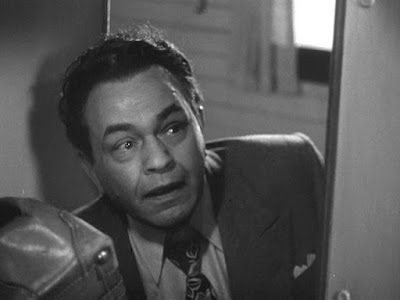 |
| Rocco tries to trick Frank into trusting him. |
Frank then radios the Miami Coast Guard station, “NAM”, and
radios his position. He then asks them to connect him to the hotel so he can tell
Nora and Temple that he is coming back home.
 |
| From his vantage point, Frank can see everything and kills Rocco. |
The film opened in New York on July 16, 1948 and nationwide
on July 31st. In his review for The New York Times, Bosley Crowther gave much
of the credit for the film’s success to director John Huston for his tightening
and speeding up the action. “He has dropped out a lot of prior build-up, thrown
away some complexities and avoided the final fatalism which Mr. Anderson (the
playwright) always seems to indulge.”
Crowther also credits Huston with getting “stinging
performances out of most of his cast—notably out of Mr. Robinson” and calls
Bogart’s performance “penetrating.” He calls Claire Trevor’s performance “picturesque.”
 |
| Director and co-writer on the set with Bogart and Bacall. |
For the most part, Crowther’s is still right. Despite the staging,
which is mostly interiors within the hotel, the action never seems to stop.
There is never a dull moment in the film. This is due both to the screenplay by
Richard Brooks and Huston as well as Huston’s directing. He always seems to get
a good performance out of Bogart, from their first film together, The Maltese
Falcon, to their last, The African Queen (1951), for which Bogart would finally
win a long overdue Academy Award for Best Actor.
I have seen my fair share of Edward G. Robinson films and I
don’t believe I’ve seen him give a really bad performance, even if the film
isn’t all that good. Here he is able to channel his earlier gangster film roles
into something new. His Rocco knows that he’s a relic of the past, but he’s not
going gently into that dark night.
Lauren Bacall always does well when playing opposite her
then husband, Bogart. They make a very engaging couple on the screen. She is a
strong-spirited woman, but still a product of her time. Rather than going out
on her own, she has stayed to take care of her deceased husband’s father, an
admirable task. It is obvious that there are underplayed sparks between husband and wife on screen, which adds to the subtle flirtation going on between Frank and Nora.
 |
| Lionel Barrymore plays James Temple. |
Lionel Barrymore is also one of those actors that leaves it all on the screen. Even wheelchair bound, Barrymore gives a very strong
performance. He can play a grumpy doctor as in Three Men in White (1944), a heartless villain as in It's A Wonderful Life (1946) and even helpless victim all while seated.
But of all the actors and actresses in the film, it was
Claire Trevor who was singled out by the Academy Awards for her performance as the alcoholic ex-gun moll.
Her win as Best Supporting Actress came after her second of three nominations she
would receive in her career, the others for Francey in Dead End (1937) and her
last would be for May Holst in The High and the Mighty (1954). Trevor may be
best remembered though for her portrayal of Dallas in John Ford’s Stagecoach (1939).
Key Largo is an easy film to recommend. A film
noir at heart, the film shows what happens when the ideals of post-war America
runs smack into its own darker past. Under John Huston’s direction, Key Largo is
a really great movie. You should see it if you’re a film noir fan, a fan of
Edward G. Robinson or a fan of Humphrey Bogart, with or without Lauren Bacall.
There is so much to enjoy that the trip to Key Largo is one worth taking.
Be sure to check out our Film Noir Review Hub for reviews of other films in this genre.


_01.jpg)
.jpg)




%20POSTER.jpg)

