Showing posts with label 1939. Show all posts

Saturday, December 13, 2025

Stubs - Miracle on Main St.


Miracle on Main St. (1939) Starring Margo, Walter Abel, William Collier Sr., Lyle Talbot. Directed by Steve Sekely. Screenplay by Frederick Jackson. Produced by Jack H. Skirball. Run time: 78 minutes. Black and White. USA Christmas, Melodrama

Before there was Cher or Madonna, there was Margo. Born MarĂ­a Marguerita Guadalupe Teresa Estela Bolado Castilla y O'Donnell, in Mexico City, Margo began her career as a dancer, at age 9, working for her uncle Xavier Cugat and his band in performances at nightclubs in Mexico. While accompanying Cugat and his orchestra at the Waldorf Astoria in New York City, Margo was discovered by producer and director Ben Hecht and screenwriter Charles MacArthur, who cast the 17-year-old performer as the lead in their film Crime Without Passion. She would also have a memorable part in Frank Capra’s Lost Horizon (1937).

Saturday, July 5, 2025

Stubs - Gulliver's Travels


Gulliver’s Travels (1939) Voices by Sam Parker, Pinto Colvig, Jack Mercer, Tedd Pierce, Jessica Dragonette, Livonia Warren, Lanny Ross, Cal Howard. Directed by Dave Fleischer. Screenplay by Dan Gordon, Cal Howard, Ted Pierce, I. Sparber, Edmond Seward. Based on the book Travels Into Several Remote Nations of the World by Lemuel Gulliver by Jonathan Swift (London, 1726). Produced by Max Fleischer. Run Time: 76 minutes. USA Color Animated, Fantasy

While Walt Disney’s Snow White and the Seven Dwarfs (1937) was the first animated feature, animation rival Fleischer Studios’ Gulliver’s Travels was the second. The brothers Fleischer left Bray Studios to found their own company Out of the Inkwell, Inc., in 1921, changing its name in 1929. In the beginning, the studio produced novelty films called Out of the Inkwell, which used the Rotoscope, invented by Fleischer. Rotoscoping is an animation technique used to trace over live-action motion picture footage, frame-by-frame. It produces a realistic animation. Out of the Inkwell also used live-action footage mixed with the animation in such shorts as Modeling (1921).

Wednesday, April 3, 2024

Stubs - Fast and Furious (1939)

Fast and Furious (1939) Starring Franchot Tone, Ann Sothern, Ruth Hussey. Directed by Busby Berkeley. Screenplay by Harry Kurnitz. Produced by Frederick Stephani. Run time: 73 minutes. Black and White. USA Comedy, Mystery

Long before the never-ending sequel machine franchise Fast & Furious (aka The Fast and the Furious) began appearing on the big screen in 2001, the title was used as part of a different franchise in 1939.

With exhibitors unhappy with the long intervals between pictures in The Thin Man series of films, MGM made Fast Company (1938) because its "light" detective theme featured main characters in the Nick and Nora Charles mode. Following Fast Company, which starred Melvyn Douglas and Florence Rice, was Fast and Loose (1939) starring Robert Montgomery and Rosalind Russell, and Fast and Furious (1939) starring Franchot Tone and Ann Sothern. The one thing all three films have in common is that all three were written by Harry Kurnitz. All three sets of stars played the same characters, Joel and Garda Sloane, a rare book seller and his wife who become amateur detectives.

This edition of the series was rather rushed to the theaters. Shot between August 4 and September 1, 1939, it was in the theaters on October 6, 1939.

Saturday, August 19, 2023

Stubs - Nancy Drew. . . Trouble Shooter


Nancy Drew... Trouble Shooter (1939) Starring Bonita Granville, Frankie Thomas, John Litel. Directed by William Clemens. Screenplay by Kenneth Gamet. No Producer Credited. Based on the character "Nancy Drew" created by Carolyn Keene. Run time: 70 minutes. Black and White. USA. Drama, Mystery, Comedy

Nancy Drew first appeared in the book The Secret of the Old Clock (1930) and was created by publisher Edward Stratemeyer as a female counterpart to the Hardy Boys series of books. The Nancy Drew books were written by a series of writers using the same pseudonym, Carolyn Keene. Nancy Drew would appear in 175 novels from first publication to 2003.

The book series was so popular that Warner Bros. bought the rights to make “B” pictures. Fifteen-year-old child star Bonita Granville, who had already been nominated for an Academy Award for her role in These Three (1936), was picked to play the lead in a series of films. Warner Bros. wanted the series to resemble the popular Torchy Blane films starring Glenda Farrell, which mixed comedy and crime.

There were four films in all: Nancy Drew... Detective (1938), Nancy Drew... Reporter (1939), Nancy Drew... Trouble Shooter (1939), and Nancy Drew and the Hidden Staircase (1939).

Shot during February 1939, this, the third film, was released on June 17, 1939.

Saturday, October 23, 2021

Stubs - The Return of Doctor X


The Return of Doctor X
(1939) Starring: Wayne Morris, Rosemary Lane, Humphrey Bogart, Dennis Morgan. Directed by Vincent Sherman. Screenplay by Lee Katz. Based on the short story "The Doctor's Secret" by William J. Makin in Detective Fiction Weekly (30 Jul 1938). Producer (Executive Producer): Jack L. Warner, Hal B. Wallis. Run time: 63 minutes. USA Black and White. Mystery. Horror.

If you ever needed proof that Warner Bros. didn’t know what they had in Humphrey Bogart, you need look no further than The Return of Doctor X. Signed, at the insistence of Leslie Howard, to recreate his stage success as Duke Mantee, the psychotic gangster in The Petrified Forest (1935), Bogart landed at a studio that already had two gangster stars on the payroll, James Cagney and Edward G. Robinson. Warners used Bogart in as many films as they could, including seven in 1939 alone.

Saturday, March 16, 2019

Stubs - Gone With the Wind


Gone With the Wind (1939) Starring: Clark Gable, Vivien Leigh, Leslie Howard, Olivia de Havilland, Thomas Mitchell, Evelyn Keyes, Ann Rutherford, Hattie McDonald, Butterfly McQueen. Directed by Victor Fleming. Screenplay by Sidney Howard. Based on the novel Gone With the Wind by Margaret Mitchell (New York, 1936). Produced by David O. Selznick Runtime: 220 minutes. USA Color. Romance

Few films have made as big a splash as Gone With the Wind, based on the runaway best seller of the same name written by Margaret Mitchell and published in 1936. The book, which was a top seller for two years, sold 30 million copies worldwide.

Making it into a movie might seem like a foregone conclusion, and it was independent producer David O. Selznick who, prior to its publication, saw the potential, writing in one of his famous memos to his Eastern Story Editor, Katherine “Kay” Brown, “...the more I think about it, the more I feel there is excellent picture in it....”. It was Brown who first read a galley of the 1000+ page book and suggested it to Selznick. The book was published on June 30, 1936, and by early July, he had purchased film rights for $50,000.

Not letting any grass grow up under his feet, he brought in director George Cukor in September 1936 and by September had hired Sidney Howard to do a treatment and write a screenplay. But like practically everything associated with the film, they would not be the last ones. Cukor’s relationship with Selznick seemed to strain as pre-production went on. And even though the film’s principal photography began on January 26, 1939, Cukor left the film on February 14th.

Saturday, January 28, 2017

Stubs - The Girl From Mexico


The Girl From Mexico (1939) Starring: Lupe Vélez, Donald Woods, Leon Errol, Linda Hayes, Donald MacBride, Edward Raquello, Elisabeth Risdon, Ward Bond Director: Leslie Goodwins. Screenplay by Lionel Houser, Joseph Fields Producer: Robert Sisk Runtime: 71 minutes USA Comedy

If you’re a friend of the TV show Fraiser or have read Hollywood Babylon by Kenneth Anger, you have no doubt heard of Lupe Velez, but not for her acting. Rumor has it that with her career waning, Lupe wanted to commit suicide in such a way that she would be forever remembered, you know, make an impression on the way out. She took seconal and then, in her best dress, lay down on the rose petal covered bed and waited for death. But the spicy Mexican meal that she had chosen for her last meal didn’t agree with her. She managed to get out of bed, but on the way to the bathroom, she tripped, hit her head and was found dead in the toilet. While it might make for a great story, that is all it is.

Still, having heard the story made me interested in seeing her act and when The Girl From Mexico played on TCM, I got my chance to see Lupe in action.

The Girl From Mexico has B-movie written all over it. A low-budget offering from RKO, the film is just one more example that not every film released in Hollywood’s Golden Year was up to the standards of Gone With The Wind or The Wizard of Oz or even Gunga Din.

The story revolves around Dennis Lindsey (Donald Woods), an advertising executive who is sent to Mexico to find a singer for one of his company’s client's radio shows. He is not the first one sent down and he is anxious to please his boss, L. B. Renner (Donald MacBride), even if his fiancĂ©e, Elizabeth Price (Linda Hayes), is not happy about it.

But things don’t go as planned. On his way to see one singer, Dennis’ car breaks down in a small town. Without parts to fix his car, Dennis is stuck. That night, at a local festival, he hears the hot-tempered Carmelita Fuentes (Lupe Velez) sing and offers to take her to New York and fame and fortune. But Carmelita doesn’t want to leave. Finally, Carmelita, after several incendiary confrontations with Dennis, accedes to her family's wishes and signs a singing contract with him. After Dennis promises to look after her welfare in New York and puts up a $10,000 bond, she accompanies him back home.

He invites her to stay with him as well as his aunt Della (Elisabeth Risdon), who has moved in with him to help get him ready for the upcoming wedding. And along with aunt Della comes uncle Matt (Leon Errol), a rather shiftless sort who makes fast friends with Carmelita. Meanwhile, Carmelita has decided to steal him from his fiancée.

Although Dennis tells her to stay home on the day before her audition, Carmelita persuades Uncle Matt to take her to a baseball game and a wrestling match, where she loses her voice cheering on wrestler Mexican Pete (Ward Bond). During the match, Mexican Pete ends up sitting in her lap at ringside and a newspaper photographer snaps a photo.

Carmelita cheers on Mexican Pete (Ward Bond) at a wrestling match.

The next day at her audition, despite uncle Matt’s attempts to help, Carmelita’s voice croaks, causing the sponsor to cancel the show and Dennis great embarrassment. When the photo of Mexican Pete and Carmelita comes out, Dennis questions her about it. To cover for Uncle Matt, Carmelita tells Dennis that she was out with an unnamed man, prompting Dennis to threaten to send her back to Mexico.

Uncle Matt (Leon Errol) tries to help Carmelita get her voice back before her big audition.

Angry Carmelita blames Mexican Pete for her bad luck and goes to a restaurant that the wrestler owns. But Mexican Pete offers her a job in his nightclub as compensation.

Meanwhile, Renner and his wife and Dennis and Elizabeth are out entertaining a new and divorced client, Tony Romano (Edward Raquello), at the same club. Romano is so impressed by Carmelita's performance that he hires her to advertise his perfume. As the night progresses, Elizabeth becomes jealous of Dennis' attention to Carmelita and Dennis becomes jealous of Romano's attention to Carmelita.

Dennis (Donald Woods) pays too much attention to Carmelita at Mexican Pete's cantina.

After the performance, Carmelita escapes with Uncle Matt and the two of them stay out all night at the six-day bike races then going on in New York. (An NYC six-day bike race was also featured in 1933's International House, so it was a real thing.) When they get home the next morning, Dennis has been waiting up for her. Carmelita leads Dennis to believe that she was out with Romano, so as not to implicate uncle Matt and to make Dennis jealous.

Carmelita uses Romano's perfume in prep for Dennis' arrival.

While at a photo session for the perfume at Romano's house, Carmelita calls Dennis and tells him that she is thinking of moving in with Romano. When Dennis decides to leave his own wedding rehearsal to rescue Carmelita, Elizabeth breaks off their engagement. Dennis rushes to Romano's house to defend her honor, and after an altercation with Romano, Dennis scoops up Carmelita and carries her to the altar.

Dennis breaks off his own engagement to save Carmelita.

When the film was released on June 2, 1939, it was a surprise hit. At the time the film was made, RKO had no plans to make a series out of it, but its success led to a sequel, Mexican Spitfire (1940) and a series of films starring Lupe: The Mexican Spitfire's Baby (1941), Mexican Spitfire at Sea (1942), Mexican Spitfire Sees a Ghost (1942), Mexican Spitfire's Elephant (1942) and Mexican Spitfire's Blessed Event (1943).

Having seen the film, it’s hard to imagine why it was a hit. While Lupe Velez may have had talent, the character she played was loud and annoying and hard to take. It’s hard to know how much of it was the actress or the script, but no matter, I can’t see why anyone would want to see more of the same.

The story is also as bad as it is predictable. This is one of those films, and there are many, where the couple falls in love only because it is in the script. There is no chemistry, no development or obvious attraction that would lead them to the altar. While Elizabeth is no real prize herself, she's rather a cold fish, she and Dennis do seem to have some history that Dennis is all too quick to throw away for a woman he barely knows and who is wildly annoying. But the script says he falls in love with Carmelita, so he does.

To call Donald Woods bland would be doing a disservice to plain yogurt. His uninspired acting is the perfect blank slate for the vivacious Velez to dance all over. He doesn’t add much more than a fairly good-looking actor who had blood in his veins and was available. He would be gone from the Mexican Spitfire series after Mexican Spitfire Out West.

It is interesting that the relationship with Uncle Matt would be the best one in the film, which isn’t saying much, and would eventually become the focus of the Mexican Spitfire series. The actors playing her husband Dennis would change, but Leon Errol would become a staple.

The Australian-born Errol has Vaudeville routine written all over him in this film, so it’s no surprise that he had spent time on the circuit. After moving to America, he got involved with not only performing but also management, giving an early boost to a young comedian, Roscoe Arbuckle.

His flirtation with movies began in the silent era, but it wasn’t until 1930 that he gave up Broadway for films, working for Samuel Goldwyn, Columbia Pictures, Warner Bros. and RKO, where he would make six shorts a year from 1934 until his death in 1951. While he’s not as off-putting as Velez is, a little Errol seems to go a long way.

The teaming of Leon Errol with Lupe would last
 through the run of  Mexican Spitfire movies.

Lupe Velez, born MarĂ­a Guadalupe Villalobos VĂ©lez in 1908, had been a fixture in the Pre-Code party days of Hollywood. She was a regular at the Garden of Allah, a famous hotel known for having the same sort of reputation the Chateau Marmont has today. She had begun on the Mexican stage performing in revues. The recommendation of Frank A. Woodyard to stage director Richard Bennett, brought her to Los Angeles to appear as a Mexican cantina singer in his play The Dove. But she arrived too late and was replaced in the role.

But while in Los Angeles, she made the acquaintance of comedian Fanny Brice, who was quite taken with her. Brice recommended her to Flo Ziegfeld, who hired her to perform in his New York City club. As she was preparing to leave, she got a phone call from Metro-Goldwyn-Mayer producer Harry Rapf, who offered her a screen test. That screen test was seen by Hal Roach, who hired her to perform in the Laurel and Hardy comedy short Sailors, Beware! (1927).

She would go on to appear in The Gaucho (1927) opposite Douglas Fairbanks and Wolf Song (1929) opposite Gary Cooper, both were silent. One of the first successful Mexican actresses in Hollywood, she was often typecast as a hot-tempered Latin woman, known as The Mexican Spitfire. She successfully made the transition to sound and was featured in many Pre-Code films, including playing Naturich in Cecile B. DeMille’s 1931 remake of The Squaw Man. She would eventually find a place in comedies playing beautiful but volatile characters. As time went on and her star dimmed, Velez would drift into B-Pictures, like this one and the series of related films that followed. She would make 13 films after The Girl From Mexico, so her suicide at age 36 had little to do with her career tanking; she seemed to be working steadily.

Instead, it was love gone wrong and perhaps undiagnosed bi-polarity that led her to take her own life. The former wife of Tarzan’s Johnny Weissmuller, she began to date a struggling young Austrian actor named Harald Maresch (aka Harald Ramond) in 1944. In September, she discovered she was pregnant by Ramond and announced their engagement in November. But that only lasted until December 10, when she announced their engagement was off and he had moved out of her house.

Harald Ramond and Lupe together in happier times.

On the night of December 13, Velez dined with her friends, actress Estelle Taylor and Benita Oakie from 9 pm to 3:30 am the next day. When she retired to her room, she consumed the 75 seconal pills and a glass of brandy, after leaving a suicide note. Apparently, after they had broken up, Ramond having told her he was only marrying her to “give the baby a name,” Velez didn’t see any other way out. A devout Catholic, she couldn’t have an abortion and so she took her own life.

Not being an expert on Velez, I have read that at the end of her last Spitfire film, Mexican Spitfire's Blessed Event, released five months before her suicide, Carmelita and her husband Dennis, then played by actor Walter Reed, learn that she is pregnant. It is ironic that her own would lead to suicide.

Carmelita and Dennis (Walter Reed) learn they are expecting in Mexican Spitfire's Blessed Event,
the last in the series of  films inspired by the success of The Girl From Mexico.

While her life came to a very sad end, that was five years away when this film was made and is no excuse to watch it now. I have no idea if any of the films from the sequel series were any better, but it is hard to imagine they could be any worse. The Girl From Mexico is almost unwatchable unless you’re a die-hard fan of Lupe Velez, and I’m doubtful there are many of those around these days if there ever were.

Saturday, November 29, 2014

Stubs - Each Dawn I Die


Each Dawn I Die (1939) Starring: James Cagney, George Raft, Jane Bryan, George Bancroft. Directed by William Keighley. Screenplay by Norman Reilly Raine, Warren Duff. Based on the novel Each Dawn I Die by Jerome Odlum (Indianapolis, 1938). Produced by Hal B. Wallis (Exec. Producer) Run Time: 92 minutes. U.S. Black and White. Drama, Prison

We’re wrapping up our celebration of the 75th anniversary of Hollywood’s Golden Year, 1939, on Trophy Unlocked with Each Dawn I Die. There were so many great films that came out of that year there is no way to write about them all and do much of anything else. While we wanted to highlight some of the great films from that year, like Stagecoach and Mr. Smith Goes to Washington, we also wanted to pay homage to some of the lesser films from that year as well: Indianapolis Speedway. Not every film was Gone With the Wind or The Wizard of Oz.

Films about men and women behind bars have been popular since the 1930’s, when the production code shifted emphasis away from gangsters committing crimes to showing the punishment for criminal behavior. Films like I Am a Fugitive From a Chain Gang (1932) showed that harsh punishment can be handed out to the innocent as well. Each Dawn I Die touches on some of those same themes, but is not nearly as dark or message-laden.

Frank Ross (James Cagney) is a crusading newspaper reporter who is on the trail of a crooked District Attorney, Jesse Hanley (Thurston Hall). We watch as he stakes out the Bantom Construction Company and observes Hanley and his accomplice, W.J. Grayce (Victor Jory), burning the company’s books and ledgers to thwart a possible investigation and derail Hanley’s campaign for Governor. When Ross files his story, his editor, Patterson (Selmer Jackson), isn’t initially behind the story, but changes his tune when Hanley calls him to threaten the paper. Knowing that they are really onto something, Patterson tells Ross to keep writing.


Frank Ross (James Cagney) really thinks he's onto a big story. His editor, Patterson
(Selmer Jackson), tells him to keep writing. Fellow reporter and love interest,
Joyce Conover (Jane Bryan), looks on.

But Hanley makes good on his threats. One day after work, Ross is indentified by Shake (Abner Biberman) and knocked out by Polecat Carlisle (Alan Baxter). Still unconscious, Ross is put behind the wheel of a car and covered in whiskey. The car is then sent down the street where it collides with another car, turning it on its side and catching it on fire, killing the three young people inside.


An unconscious Ross is set up to take the fall for an accident that kills three.

The crowd gathers around a still groggy Ross and loudly declares his guilt. This carries over to the courtroom where, prosecuted by Hanley and Grayce, Ross is found guilty of manslaughter while driving drunk, a crime made more heinous by Ross’ previous reporting about the horrors of DUI.

On the way to prison, Ross is handcuffed to “Hood” Stacey (George Raft), a hardened criminal and notorious racketeer who is serving a 199 year term for murder, the state they’re in does not have a death penalty.


On the train trip to prison, Ross finds he's handcuffed to Stacey (George Raft), a hardened criminal.

John Armstrong (George Bancroft) is the warden at the prison, who tries to be hard, but fair, to his prisoners. Ross and Stacey both work in the prison’s twine manufacturing plant. The two become friends when Ross saves Stacey from a knife thrown by another inmate, Limpy Julien (Joe Downing). Intending to get his own revenge, Stacey takes a shiv to a prison showing of Wings of the Navy (1939), but someone else kills Limpy.


Prison warden John Armstrong (George Bancroft) is tough but fair.

Stacey offers Ross a deal. If Ross will implicate him, Stacey will be tried in the courthouse; there, he can make an escape. When he’s out, he can find Shake, whom Ross knows identified him to whomever framed him. At first Ross does not want to be a part of it, but a visit from his fellow reporter/girlfriend, Joyce Conover (Jane Bryan), who has brought his mother (Emma Dunn) with her, changes his mind.

Ross' mother (Emma Dunn) and his reporter/girlfriend, Joyce Conover (Jane Bryan), visit him in prison.

When Ross gets back to the twine factory, he accepts Stacey’s deal as his best bet to get out. But, being a newspaperman, Ross can’t resist tipping off his paper to cover the trial heavily. Ross is in the courtroom, as a witness for the prosecution, and watches as Stacey makes an escape, jumping out the window, landing in a truck filled with down and escaping in a waiting car driven by one of his cohorts.


Under a table in the twine factory, Ross accepts Stacey's deal.

Stacey feels betrayed by Ross because of all of the press coverage. Ross is treated back at the prison as an accomplice, beaten by the brutal guards and sentenced to five months in solitary confinement, or, as it is known, “the hole”. In solitary prisoners are handcuffed to the bars in the dark and fed bread and water once a day at noon. While Stacey had warned Ross of this treatment, Ross is changed by it, becoming hardened and unruly. He keeps thinking Stacey is looking out for him, but it takes Joyce, who arranges a meeting through Stacey’s attorney, Lockhart (Clay Clement), to convince the criminal that Ross is worth helping.


Ross is hardened by his time in "the hole".

She goes back to the prison and convinces the Warden to give Ross a second chance. He agrees and puts him up for parole after he’s turned himself around. But now Governor Hanley has appointed Grayce as the head of the parole board. Because Ross insists he’s innocent of the crime he was charged with and since he isn’t repentant, Grayce tells him that they can’t grant him parole. Ross lashes out and has to be physically restrained. He then breaks down and asks for forgiveness. The parole board, of course, turns him down and says he can reapply in five years.


The parole hearing doesn't go Ross' way.

On the outside, Stacey’s men find Shake, who gives them the name of the man who hired him, Polecat, who turns out is back in prison, sent there for cover. The only way for Stacey to make good for Ross, who he’s convinced is "square guy", is to go back to prison and root out Polecat. Ross is unaware that Stacey is back until he sees him being taken to solitary. Ross is convinced Stacey can’t help him.


At Joyce's request, Stacey has his men find Shake in an effort to clear Ross.

Stacey’s presence instigates a prison breakout, led by Dale (Edward Pawley), as part of his plan, arming the men in the twine factory with guns. Ross doesn’t want to be a part of it, but is forced along. He does manage to keep one prisoner from getting involved by knocking out the Fargo Kid (Maxie Rosenbloom). Ross tries to stop the riot, but is forced at gunpoint to participate. Stacey, who is freed from solitary, orders the prisoners to bring along Polecat.

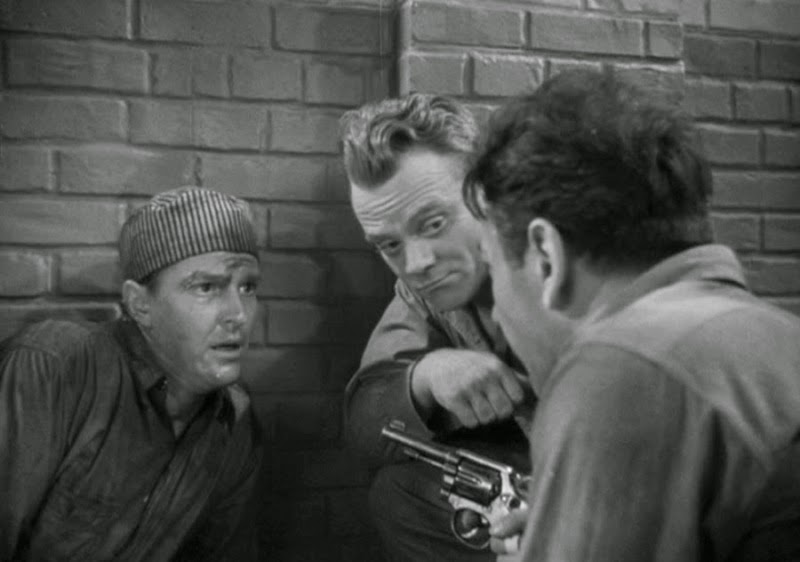
A prison guard is killed when he tries to disarm a convict. While the warden and some of his men are held as hostages, the National Guard is called out to stop the riot. Armed with machine guns, gas and hand grenades, they trap the rioters in solitary and hold them down. Under fire, Stacey forces Polecat to confess to framing Ross with the warden and his men as witnesses. Stacey, who is wounded, forces Polecat to go with him and be killed so he cannot recant his confession. All the rioters are killed, with only Ross spared.


During the aborted escape attempt, Stacey gets Polecat Carlisle (Alan Baxter) at gunpoint
to confess to setting Ross up for the crime that sent him to prison.

The warden helps to have Ross released and Governor Hanley and Grayce are indicted for murder. I’m not sure what this film says about the justice system in the 1930’s or at least how it was perceived. Men like Ross get convicted of crimes they did not commit and confessions taken with a gun to one’s head are enough to free men from prison.

While both Cagney and Raft were well known for their portrayals as gangsters at Warner Bros., this is the first and only time the two shared leads in a film. While we’ve written before about Cagney’s career at Warner Bros., we haven’t had an opportunity to discuss the career of George Raft except when discussing roles he’d turned down, including the role of Chips Maguire in It All Came True (1940) and Rick in Casablanca (1942), both of which went to Humphrey Bogart. He would also pass on Sam Spade in The Maltese Falcon (1941), another role that would have a significant impact on Bogart’s career.

Having made a career as a dancer in New York and London, Raft moved to Hollywood in 1929 to act in the film Queen of the Night Club (1929) starring Texas Guinan, a saloon keeper and actress in who’s stage act Raft had danced. Raft had such prowess as a dancer that the great Fred Astaire would remark in his autobiography that Raft was lightning fast and did the fastest Charleston he’d ever seen.

He had small uncredited roles in some early Cagney films such as Taxi! (1932), in which he played a dance competitor, and Winner Take All (1932). That same year he would also draw attention as a nickel-flipping second lead alongside Paul Muni in Scarface (1932). So strong was Raft’s identification as a gangster that he was often thought to have been a former gangster himself. Raft was friends with some very famous underworld figures, including Bugsy Siegel and Siegel’s old friend Meyer Lansky. Raft reportedly interceded on behalf of Gary Cooper when the actor’s romantic escapades led him to inclusion on one gangster’s hit list.

Even though he would move to Paramount Pictures, Raft would continue to be a major gangster star, along with Cagney and Edward G. Robinson, throughout the 1930s. Bogart, who would ultimately be the bigger star, was a distant fourth in popularity. Raft is also credited for giving Mae West her first break in Hollywood, when he got her cast in Night After Night (1932) after the studio refused to cast Texas Guinan as Maudie Triplett because of her age, even though the character was based on her.

The success of Each Dawn I Die led Warner Bros to signing Raft to a long term contract. However, his career would peak in the early 1940’s. Following the release of Background to Danger (1943), a film meant to capitalize on Casablanca’s success, Raft demanded termination of his contract with Warners. Offered a $10,000 settlement, Raft inexplicably sent a check for that amount to the studio, rather than the other way round.

After that, Raft continued to make movies, but they were of declining quality and were often made overseas for tax benefits. During the 50’s he spent a lot of time as the greeter at the Capri Casino, of which he was a part owner in Havana, Cuba, a well-known haven for organized crime. He appeared on the syndicated television series I’m The Law (1953) which ran for one season. While he made the occasional appearance in films, his career got a definite boost when he appeared in Billy Wilder’s comedy Some Like it Hot (1959) as Spats. Raft followed up that part with the role of a casino owner in the Rat Pack starrer Ocean’s 11 (1960). He made a brief cameo in Casino Royale (1967) after going to the UK in 1966. Raft’s last film appearances were in Mae West’s Sextette (1978) and The Man with Bogart’s Face (1980). He would die of leukemia in Los Angeles at the age of 85.

While I’ve always found Raft to be a little stiff and while he was good in this film, that opinion didn’t change after watching Each Dawn I Die. Raft isn’t very expressive, so he comes off as wooden. But I did see a wide variety of emotions from Cagney, who plays it hard and then moments later breaks down crying. There is one scene after the visit with his mom, Ross is walking back to the twine factory; no words are spoken, but through his gait you see him transform himself from broken man to someone with determination.  It is when he gets back to the twine factory that Ross accepts Stacey’s offer.

The female lead, Jane Bryan had a very short screen career, lasting only from 1936 until 1940. She was being groomed at Warners as a leading lady and given prominent roles in films like Marked Woman (1937), Kid Galahad (1937), A Slight Case of Murder (1938) and Invisible Stripes (1939). But in 1940, Bryan married Justin Dart, the wealthy owner of Dart-Kraft, Inc., formerly Rexall Drugs, and retired from acting.


Actress Jane Bryan.

Her character is pivotal to the plot as she does most of the behind the scenes heavy lifting to convince Stacey to help Ross and the warden to give Ross a second chance. She is the strong female that binds all the men together in these kinds of films, similarly to how Ann Sheridan’s May Kennedy character was the link between Captain of the yard Jameson (Pat O’Brien) and her brother Red (Humphrey Bogart) in San Quentin (1937).

Unlike earlier Cagney films that we’ve reviewed on this blog, more care seems to have been taken with Each Dawn I Die. For one the shooting schedule lasted about two months, so you don’t have the sped up sense of Winner Take All and The Crowd Roars (1932), films that seemed to be literally cranked off an assembly line.

Like directors of some of the other films we’ve reviewed, William Keighley is not a name that appears on a list of great film directors, but that doesn’t mean he didn’t make some well known films. He directed a variety of genres and directed Cagney in several films, including G Men (1935), The Fighting 69th (1940), Torrid Zone (1940) and The Bride Came C.O.D. (1941). Keighley also directed Bullets or Ballots (1936), Brother Rat (1938) and The Man Who Came To Dinner (1942). Keighley started to direct The Adventures of Robin Hood (1938), but was replaced by Michael Curtiz. Keighley would retire from films in 1953 and move to Paris with his second wife Genevieve Tobin.

While prison films are not for everyone, Each Dawn I Die is a pretty good one. I would say that it's definitely better than San Quentin. There seems to be more meat on the bone here. Not that either Red's or Ross' stories are typical of real prisoners, there are more layers in Each Dawn I Die than San Quentin. And given the status of each actor at Warner Bros. at the time of their respective prison films, you can see the difference between an A film (Cagney) and a B film (Bogart).

Anyone who is a fan of Cagney’s or Raft’s will no doubt enjoy this film as much as I did.

Interested in seeing the movie? It is available as part of a four feature two disc set at WBShop:

Free Shipping on All Orders Over $50!

Saturday, November 22, 2014

Stubs – Mr. Smith Goes to Washington


Mr. Smith Goes to Washington (1939) Starring: James Stewart, Jean Arthur, Claude Rains, Edward Arnold, Guy Kibbee Directed by Frank Capra. Produced by Frank Capra Screenplay by Sidney Buchman. Based on the unpublished story "The Gentleman from Montana" by Lewis R. Foster. Run Time: 129 minutes. U.S. Black and White, Drama, Political, Comedy.

Quick, name the most controversial film of 1939 at the time of its release? Now I’m sure we would all say Gone with the Wind, with its depiction of slavery and blacks in general. But not when it was released. The answer we were looking for is Frank Capra’s Mr. Smith Goes to Washington; but more on the controversy later.

The story the film was based on had been around before Columbia Pictures bought it. Both Paramount and MGM had submitted the story to the Hays Office of the Production Code Administration for approval in January 1938. Joseph Breen, the director of the PCA had warned Paramount upon their submission "we would urge most earnestly that you take serious counsel before embarking on the production of any motion picture based on this story. It looks to us like one that might well be loaded with dynamite, both for the motion picture industry, and for the country at large."

Rouben Mamoulian was supposedly interested in directing the film, but his involvement disappeared quickly as did Paramount’s and MGM’s. Perhaps they were put off by Breen’s reaction. Columbia Pictures became interested in the story as a vehicle for Ralph Bellamy, with Harold Wilson slated to produce. However, when Capra was brought on as director, the idea changed to a sequel of the very successful of Mr. Deeds Goes To Town (1936), a screwball comedy directed by Capra and starring Gary Cooper and Jean Arthur. The plan was to call it Mr. Deeds Goes to Washington, but Cooper wasn’t available, so Capra thought of James Stewart and Arthur. They had worked together the year before in Capra’s Academy Award Winning Best Picture, You Can’t Take It WithYou (1938). Stewart had to be borrowed for the film from MGM, his home studio at the time.

Like Paramount and MGM before it, Columbia submitted the story to the Hays Office. Once again, Breen warned Columbia that the picture needed to emphasize that "the Senate is made up of a group of fine, upstanding citizens, who labor long and tirelessly for the best interests of the nation," as opposed to `"Senator Joseph Paine" and his cohorts.

Breen’s opinion changed radically after reading Sidney Buchman’s script. He wrote a letter to Will H. Hays, the President of the Motion Picture Producers and Distributors of America (forerunner to today’s MPAA) in which he stated: "It is a grand yarn that will do a great deal of good for all those who see it and, in my judgment, it is particularly fortunate that this kind of story is to be made at this time. Out of all Senator Jeff's difficulties there has been evolved the importance of a democracy and there is splendidly emphasized the rich and glorious heritage which is ours and which comes when you have a government 'of the people, by the people, and for the people.'”

But even though Breen’s opinion might have changed, not everyone wanted to be associated with the project. The Boy Scouts of America wanted no part of what they called “Mr. Capra's reform movement," and Capra therefore had to use the fictitious name of the Boy Rangers.

Shooting began in early April, 1939. Capra and his crew went to Washington, D.C. to film background material and to study the Senate Chamber, which was replicated, full scale, in precise detail on the Columbia lot. James D. Preston, a former superintendent of the Senate press gallery, acted as Capra's technical advisor for the Senate set and political protocol. A report at the time referred to the production utilizing the New York Street Set at the Warner Brothers lot near the end of their shooting schedule which wrapped on July 7th.

Political boss James Taylor (Edward Arnold) has big plans to perpetrate a scam against at Willett Creek by getting the federal government to build a dam there. But plans go awry when Senator Foley dies unexpectedly. There is no time for mourning as the spending bill, with the dam buried in it, is about to come up for a vote. Taylor needs the Governor to appoint someone who won’t ask too many questions.


"Nosey" (Charles Lane) calls his paper to report the death of Senator Foley.

Taylor has all the politicians in the state in his back pocket, including Governor Hubert Hopper (Guy Kibbee) and Senator Joesph Paine (Claude Rains). Hopper can’t make a move without Taylor’s approval. And while Taylor has a particular candidate, the public, represented by a citizen’s committee, wants someone else and Hopper bends to public will, which draws Taylor’s ire.

However, the governor’s sons have a different candidate in mind, Jefferson Smith (James Stewart), the patriotic leader of the Boy Rangers and a hero who put out a forest fire by himself. Hopper sees Smith as a way out and appoints him to replace Foley. He convinces Taylor that the naĂ¯ve Smith could be controlled.


Gov. Hopper (Guy Kibbee) introduces his choice to fill the vacancy, Jefferson Smith (James Stewart).

It is only after the fact that Paine realizes he knows Smith and was his father’s best friend. Jeff’s father ran a small paper that fought for the lost cause. Paine, who was a lawyer back then, would fight the good fight along with him. Then one day, the elder Smith was killed in the fight, shot in the back at his typewriter.

When they arrive in Washington, accompanied by Taylor’s stooge, Chick McGann (Eugene Pallette), they are met by some reporters, including “Nosey” (Charles Lane), who we had seen at the beginning of the film announcing Foley’s untimely passing. But despite the best laid plans to introduce Smith to the press, they can’t control him. As soon as Smith sees the Capitol building he is overwhelmed and walks away from the group and finds himself on a tour bus. Seeing the Lincoln Memorial and reading the President’s words that are chiseled into the walls strike Smith about the importance of his job.


Smith finds the Lincoln Memorial humbling.

Waiting for Smith to arrive at his office are Foley’s secretary, Clarissa Saunders (Jean Arthur), and a cynical reporter, “Diz” Moore (Thomas Mitchell). Jefferson is five hours overdue when he finally comes through the door. Saunders almost chases him away before realizing he’s the new Senator.

Saunders (Jean Arthur) nearly chases Smith away from his office.

Saunders, as she’s called, and Diz both find Jefferson’s patriotic enthusiasm hokum. To fix his wagon, Saunders arranges for a press conference for Smith. He’s naĂ¯ve, honest and forthcoming and is consequently made fun of in the papers, with photos and quotes taken out of context for maximum effect.


In a publicity still, Saunders, Smith and Diz (Thomas Mitchell) confer.

The next day, when Paine is to be sworn into office, one senator objects to his appointment, citing the newspaper stories as proof that Smith is not fit for office. But the President of the Senate (Harry Carey) won’t be party to the smear job and swears Smith into office. But Smith is outraged and hurt by his treatment in the press. He goes looking for the reporters who had made fun of him, slugging each one he finds. When he sees Nosey, he chases him into the National Press Club. There, Moore, Nosey and Sweeney Farrell (Jack Carson) tell him they think he is nothing more than an “honorary stooge” and is getting the treatment he thusly deserves.


In a publicity still, Sweeney Farrell (Jack Carson) helps hold back Smith from punching Nosey.

Hearing the truth hurts and Smith goes to see his mentor Senator Paine. There he makes the acquaintance of Paine’s daughter, Susan (Astrid Allwyn), whom he’d met briefly at the train station. She is pretty and sophisticated and makes Smith nervous when he’s around her. Paine convinces Smith that he should write a bill to establish the national Boy Rangers camp he’s been championing.

Excited, Smith goes back to his office to enlist Saunders’ help in writing it up. She tries to dissuade him with a lesson on how the Senate really works. Even if he can jump through all the hoops necessary to get his bill to the floor for a vote, the Senate will go into recess before the vote ever comes to pass. But Smith is enthralled by the challenge and Saunders resigns herself to help him. When Smith describes the 200 acres where he proposes to locate the camp grounds, Saunders recognizes it as the same place where Taylor plans to build his dam.

The next morning, Smith is excited about presenting his first bill for legislation. Saunders gives Moore a heads up about what will happen when Smith gets around to reading his bill to the floor. And no sooner does he utter the words Willett Creek, Chick jumps into action and calls Taylor.


Mr. Smith reads his proposed bill to start a Boy Rangers
camp to the Senate. Page Boy (Dickie James) proudly watches.

But despite Jeff’s nervousness, the other senators are receptive to his idea, with the exception of Paine, who is horrified. Not wanting to have Smith in the Senate the next day when the appropriation bill with the Willet Creek dam is discussed, Paine conspires to have his daughter Susan distract him for the day. Susan calls Saunders to help arrange the deception and Jeff is thrilled by Susan’s attention.

Saunders, however, is not happy with the way Jeff is being deceived and her role in that deception and gets drunk with Diz at dinner. She vows to quit her job and asks Diz to marry her. But when they go back to the office to get her things, Jeff is there, happy from his day with Susan. Saunders takes the opportunity to let Smith know what’s really going on before she leaves. Diz, realizing she’s too drunk to get married, takes her home.


At dinner with Diz, Saunders decides to quit her job and marry Diz. 

Smith, shocked by Saunders’ admission, goes to confront Paine, but Paine simply smooth-talks him. Alarmed, Taylor comes to Washington to twist Smith’s arm. Paine, who is also in the hotel room, doesn’t want any part of it and leaves out a side door. Taylor tries to tell Smith how things work. Taylor informs Smith that Paine works for him and offers a similar treatment for Smith if he plays it smart and doesn’t make waves.


Political boss James Taylor (Edward Arnold) comes to Washington to educate
Smith on how things really work. Taylor's stooge, Chick McMann (Eric Pallette), looks on.

But Smith doesn’t want to play ball and the next day, attempts to speak against the crooked bill. Not understanding the protocol, Smith yields the floor to Paine, who uses the opportunity to launch into an attack on Smith’s character, claiming Smith is using the boys camp for personal gain.

Smith's hero, Senator Paine (Claude Rains) leads the attack on him.

The allegations continue at a hearing before the Committee on Privileges and Elections. Hopper, Paine and others present phony evidence and lie about Jeff owning the land upon which he wants to build the camp. Jeff is so dumbfounded by Paine's lies that he cannot testify on his own behalf and decides to leave Washington.


Things get out of hand at Smith's hearing. He is dumbfounded by the lies told about him.

Bags packed, Jeff goes to the Lincoln Memorial, where Saunders finds him and convinces him not to give up and to attempt a filibuster to clear his name.


Saunders finds Smith, bags packed and ready to leave town at the Lincoln memorial.
She convinces him to stay and fight for his name and his cause.

H. V. Kaltenborn, a CBS radio correspondent in real life, is there the next morning to explain to us the rules of a filibuster, at least in 1939. As long as Smith remains talking on his feet and only yields for a question, he can hold the floor. (This is a really good device since I doubt very many people are up on U.S. Senate filibuster rules and they are important to the story.)


In a nice device, H.V. Kaltenborn, a real CBS radio correspondent,
is employed  to explain the rules of filibuster to the audience.

Before the Senate can vote to expel him, Smith gets recognized by the President of the Senate and launches into his filibuster, using the opportunity to reveal the truth about Taylor and Paine to the Senate, even as Paine continues trying to condemn him. The rest of the Senate doesn’t want to listen, but Jeff intends to talk until his news reaches his home state, and the people rise up against Taylor’s corrupt political machine.

But Taylor, who owns all the newspapers back home, organizes a massive campaign against Jeff. Many hours later, Saunders cheers up Jeff with a note telling him she loves him, and then calls his mother, telling her to enlist the Boy Rangers to spread the truth with their little four page paper. The boys publish and start to distribute their newspaper. There are protests on both sides, but Taylor’s men shut down the opposition, even going so far as harming some of the boys.

Taylor gets on the phones to lead the smear campaign against Smith back home.

Back at the Senate, Paine brings in 50,000 telegrams drummed up by Taylor, all of them urging Jeff to quit. Discouraged, Jeff resolves to keep fighting, but collapses from exhaustion after a nearly twenty-four hour filibuster. Paine breaks down, and after attempting suicide outside the senate chamber, confesses, saying that everything Jeff has said is true.

Everyone in the room cheers, Saunders jumps for joy and the film ends.


Smith is confronted by the 50,000 telegrams sent from his state urging him to quit.

Apparently, a slightly different ending was planned, one of which saw Smith and Saunders return to a hero’s welcome in his hometown and the implication that the two would wed and start a family. Perhaps clocking in at over two hours, Capra thought better of the anti-climatic ending and didn’t include it.


In an alternative ending, Smith returns home in triumph with Saunders.

The film had its premiere at Constitution Hall in Washington, D.C., on October 17, 1939, sponsored by the National Press Club, an event to which 4,000 guests were invited, including 45 senators. Apparently some senators in attendance did not appreciate how their institution was portrayed and in his autobiography, Name Above the Title, Capra claims several walked out of the screening. (News reports of the day are unclear about this, or whether senators yelled back at the screen during the film, which has also been reported. But it makes a good story.)

Senate Majority Leader Alben W. Barkley, a Democrat from Kentucky who would serve as Truman’s Vice-President, is quoted as calling the film "silly and stupid," and that it "makes the Senate look like a bunch of crooks." He also remarked that the film was “a grotesque distortion” of the Senate, “as grotesque as anything ever seen! Imagine the Vice President of the United States winking at a pretty girl in the gallery in order to encourage a filibuster!” Barkley thought the film “...showed the Senate as the biggest aggregation of nincompoops on record!” Thou seems to protest too much.

The Senate is said to have gotten retaliation as only a legislative body can with the punitive Neely Anti-Block Booking Bill (which in the late 1940s led to the breakup of the studio-owned theater chains and led to the decline of the film industry.) Punishing your critics is another great Senate tradition, I guess.

But outrage wasn’t limited to elected officials. Capra also claims in his book that after the film's general release, he and Harry Cohn, the President and Production Director at Columbia Pictures, received a cablegram from Joseph P. Kennedy, then the U.S. Ambassador to Great Britain. Kennedy claimed that the film would damage "America's prestige in Europe" and should therefore be withdrawn from European distribution.

Pete Harrison, a respected journalist and publisher of the motion picture trade journal, Harrison's Reports, suggested that the Senate pass a bill allowing theater owners to refuse to show films that “were not in the best interest of our country”.

Across the Atlantic, the film seemed to have the opposite effect. The film was banned in some countries, like Hitler's Germany, Mussolini's Italy, Franco's Spain and Stalin's USSR, not places considered bastions of democracy. When a ban on American films was imposed in German occupied France in 1942, some theaters chose to show Mr. Smith Goes to Washington as the last movie before the ban went into effect. One theater owner in Paris reportedly screened the film nonstop for 30 days. So much for damaging American prestige, rather it showing it was the last act of rebellion against those who didn’t appreciate free speech.

Film critics didn’t go along with the condemnation. Frank S. Nugent, the film critic for the New York Times, wrote that Capra “is operating, of course, under the protection of that unwritten clause in the Bill of Rights entitling every voting citizen to at least one free swing at the Senate. Mr. Capra’s swing is from the floor and in the best of humor; if it fails to rock the august body to its heels — from laughter as much as from injured dignity — it won’t be his fault but the Senate’s, and we should really begin to worry about the upper house."

The film, made on a budget of $1.5 million, had a respectful boxoffice. While the numbers from back then are not considered as reliable as they are now, Mr. Smith Goes to Washington is ranked as the 5th biggest film of 1939, behind the juggernaut of films, Gone With the Wind, The Wizard of Oz and in line with The Hunchback of Notre Dame and Jesse James.

Mr. Smith Goes to Washington would be nominated for 11 Academy Awards, including for Best Picture, Best Director, Best Actor, Best Screenplay, Best Supporting Actor (one each for Harry Carey and Claude Rains), Best Art Direction, Best Music, Best Editing and Best Sound, winning only one for Best Original Story. The film is also considered to be one of Capra’s best films.

The film represents a darker view of the human condition for Capra as a filmmaker. The crazy optimism of You Can’t Take It With You has been replaced by a more sinister view of the world. One in which people will lie, cheat and steal to get what they want; a world view that is unfortunately more realistic. This dark view can also be seen in It’s A Wonderful Life (1946); George Bailey does try to kill himself when he sees no way out from his predicament and feels that his life has been a waste up to the moment Clarence, the Angel, arrives on the scene. Suicide as a premise for a Christmas film is pretty dark you have to admit.

But, like It’s A Wonderful Life, Capra still has a sense that the individual can make a difference; that a lost cause can be won if the individual is persistent enough. Jefferson Smith goes on a filibuster that somehow changes Senator Paine’s attitude and he breaks down and confesses all on the verge of getting away with it. I wish I could share this sentiment. My opinion of politicians is that they skate as close to the edge of corruption and deceit as they can and will, even if their hand is caught in the cookie jar on video, deny the truth in order to stay in office. But to paraphrase Woody Allen in Annie Hall, you try to make right in art what isn’t in real life.

James Stewart and Jean Arthur are reunited again, having been paired only the year before in You Can’t Take it With You. They seem to have good screen chemistry, but they would never be paired again on the big screen. While Stewart would go onto be the bigger star, Arthur was the more established actor at the time and received top-billing.


Despite their chemistry on screen, Stewart and Arthur never appeared again on screen.

Arthur had been in films since being discovered by Fox in the 1920s. She made her film debut in Cameo Kirby (1923), a film directed by John Ford. But she wasn’t at the time considered a good actress and was even replaced on The Temple of Venus (1923), a film that she was supposed to star in. But Arthur did not give up on acting.

She was signed by Action Pictures in 1924 and made over twenty westerns in two years there, making $25 a film. She also appeared in an uncredited part in Buster Keaton’s Seven Chances (1925). She kept getting acting jobs in films, but she wasn’t happy with the direction her career was going. Her break came in Warming Up (1928), Famous Players-Lasky’s first sound film, starring Richard Dix. The film was heavily promoted and Arthur received praise and a three year contract with the studio, which would soon become Paramount.

She started to get positive reviews for her acting in films like Party Wire (1935), Public Hero No. 1 (1935) and If Only You Can Cook (1935), but her big break came when Capra cast her in Mr. Deeds Goes to Town (1936). Her roles in such films as You Can’t Take it With You made her so popular that she was one of the four finalists for the coveted role of Scarlett O’Hara in Gone With the Wind.

She would follow up Mr. Smith with performances in Only Angels Have Wings (1939) and Talk of the Town (1942) and The More the Merrier (1943), the latter for which she received an Academy Award nomination for Best Actress. She would retire when her contract with Columbia expired in 1944, coming back to star in A Foreign Affair (1948) and Shane (1953). In Mr. Smith, she is vivacious and funny, charming the audience with her presence as she does Dix Moore and, more importantly, Jefferson Smith.

While Stewart and Arthur carry the movie, one of the joys of watching older films is to see the supporting cast and character actors and Mr. Smith Goes to Washington has one of the better collections of such talent. Thomas Mitchell, who we wrote about in our review of Stagecoach (1939), is one of many who give superb performances in little roles. Mitchell seems to excel at playing drunks and heavy drinkers, something he would do to great effect as Uncle Billy in It’s A Wonderful Life.

Mitchell is one of several actors who would also appear in that classic film, besides Stewart. Beulah Bondi, who plays Ma Smith, would go onto to portray Ma Bailey. She would also play Stewart’s mother in two other films as well. H.B. Warner, the Senate Majority Leader, would play the drunken druggist Mr. Gower. And Charles Lane, who plays the reporter, Nosey, was Potter’s rent collector.

Claude Rains is one of my favorite supporting actors. While I’m very partial to his performance in Casablanca (1942), I also have enjoyed his work in such films as Here Comes Mr. Jordan (1941), Notorious (1946), The Unsuspected (1947) and Lawrence of Arabia (1962). He appeared in one British film, Build Thy House (1920), before emigrating to act on Broadway in 1920 at the age of 31.

In his next film, Rains was cast in the lead as The Invisible Man (1933), directed by James Whale, the director of Frankenstein. It was his distinctive voice that won him the part, since most of the film he is either wrapped in bandages or is invisible. The film, based on a novel by H.G. Welles, is a bit over the top with its special effects and frankly Rains’ laugh gets to be like fingernails on the chalkboard before the film is through.

Rains would find steady work in Hollywood, usually in a supporting role. He played the father, Adam Lemp, in the Four Daughters/Wives/Mothers series of films with the Lane Sisters. He portrayed Sir John Talbot in The Wolf Man (1941), as well as a string of films including Moontide (1942), Now, Voyager (1942), Casablanca. He would also appear in the Casablanca redux, Passage to Marseille (1944). But he wasn’t always cast to show off his talent, including what I thought was a dud, Phantom of the Opera (1943).

While the role of the President of the Senate is small, the actor, Harry Carey, had been one of cinema’s first superstars. He made his debut in D.W. Griffith’s Bill Sharkey’s Last Game (1909). He was one of the earliest Western film heroes, appearing as the character Cheyenne Harry in a series of films that ran from A Knight of the Range (1916) to Acres Wild (1936). He starred in John Ford’s first feature, Straight Shooting (1918). One of his last films was Red River (1948), in which he played Mr. Melville, who buys the cattle at the end of the drive. The film was released posthumously, as Carey had died in 1947 at the age of 69.

The film features some of the heavyweights of supporting actors: Edward Arnold, Guy Kibbee and Eugene Pallette. All three are those faces you see in films from this era, but whose names you might not know.

Arnold, who plays James Taylor, had once been considered a leading man in Hollywood. Despite being labeled "box office poison" in 1938 by an exhibitor publication  along with the likes of Joan Crawford, Greta Garbo, Marlene Dietrich, Mae West, Fred Astaire and Katharine Hepburn. Arnold never seemed to lack work, as he appeared in over 150 films usually in a supporting role. Politically active, Arnold lost a closely contested election for Los Angeles County Supervisor and said at the time that perhaps actors were not suited to run for political office.

Guy Kibbee was known for playing jovial and slightly daft characters in such earlier 30s  films as The Crowd Roars (1932); 42nd Street (1933); Footlight Parade (1933); and The Gold Diggers of 1933 (1933). He would also appear in Captain Blood (1935); Our Town (1940); Girl Crazy (1943); Fort Apache (1948) and 3 Godfathers (1948).

Eugene Pallette began his career as a thin and athletic actor, appearing in such films as Birth of a Nation (1915) and Intolerance (1916), but success didn’t come until he gained weight. He appeared in Hal Roach films, including a few Laurel and Hardy films. His distinctive raspy voice served him well with the coming of sound and he appeared in supporting roles throughout the 30s and 40s, appearing in such films as My Man Godfrey (1936), Topper (1937), The Adventures of Robin Hood (1938), Young Tom Edison (1940), The Lady Eve (1941) and The Bride Came C.O.D. (1941).

In 1946, he sort of shot his career in the foot; when fearing the world was about to come to an end, he retreated to a fortress he had built on a mountain side in Oregon. Stocked with cattle, a canning plant and a lumber mill, Pallette was waiting for the atomic bomb to be dropped and waited two years before deciding it wasn’t going to happen. He returned to Hollywood, but never appeared in another film.

William Demarest, Uncle Charley to a generation of TV viewers, had a career that spanned back to silent films. Perhaps best known for being one of Preston Sturges’ stock company, appearing in some of that filmmaker's better known films: The Lady Eve, Sullivan's Travels (1942) and The Miracle of Morgan's Creek (1944). He also had a part in It’s a Mad, Mad, Mad, Mad World (1963) and Viva Las Vegas (1964). But Demarest is still perhaps best known for his role on My Three Sons (1965 – 1972).

Ruth Donnelly has a small, but familiar part in Mr. Smith. She plays Guy Kibbee’s wife, something she did before in Footlight Parade and again in Wonder Bar (1934). Originally a Broadway actress, Donnelly was discovered by George M. Cohan, who cast her in some of his productions. During her career she had several memorable roles: Mary Brian's domineering mother in Hard to Handle (1933); and Edward G. Robinson's wife in A Slight Case of Murder (1938). She would also appear in Mr. Deeds Goes to Town (1936) and later The Bells of St. Mary's (1945) and The Snake Pit (1948).

One last name to mention, Dickie James, who played the page boy who helped Smith get settled when he first got to the Senate and latter displayed his Boy Ranger pin to show his support for Jeff’s filibuster. A successful child actor, James is perhaps best remembered as the voice of Pinocchio in that Walt Disney film from 1940, which proved to be that year’s biggest film.

Mr. Smith Goes to Washington is a mix of romantic comedy and political drama, depicting corruption at the highest levels of the Legislature. Every politician in Smith’s home state seems to be in debt to James Taylor’s political machine. And that influence allows him to place a piece of legislation on a spending bill that the nation desperately needs passed for the other provisions included in it. This is a very dark view of the U.S. government for 1939, though the premise seems quite believable now and has no doubt happened many times in real life. Sadly, over my lifetime, I have watched as the government has gone from always being right to being doubted, mocked and stymied. If it worked half as well as what is depicted in this film, corrupt as it may be, then it would still be working much better than it does today.

The speed at which the political machine gets the smear campaign going seems a little fast. Even in this age of instant communication and flash mobs, it takes a little time to get banners printed and marches organized. The film would have us believe that these can be pulled together in a matter of hours. James Taylor’s power is portrayed like a dictator, keeping all news reports out of his state as if nameless state was an island which radio waves could not reach. I know this is done for effect and is no doubt sped up due to the twenty-four hour time frame of Smith’s filibuster, but I doubt such organization could be mobilized as quickly today, which makes me doubt it could be done so back when the film is set. The same is true for the publishing of the Boy Rangers paper, which is an attempt to get the real news out to the masses through a grassroots organization. This is a very well-funded organization to have the resources to print so many papers and distribute them, again, overnight without the benefit of the internet or FedEx. I only have to believe audiences of the day were more accepting of such anomalies.

That said, I must admit I really enjoyed so much of Mr. Smith Goes to Washington that I would heartily recommend it. Perhaps a bit long, the film maintains your interest throughout. The writing, acting and directing are all solid. Any other year, Mr. Smith Goes to Washington may have won Best Picture. As it stands though, it is one of the better films in a year that saw so many great ones.