Showing posts with label William Keighley. Show all posts

Saturday, July 1, 2017

Stubs - The Bride Came C.O.D.


The Bride Came C.O.D. (1941) Starring: James Cagney, Bette Davis, Stuart Ervin, Eugene Pallette, Jack Carson, George Tobias, William Frawley, Harry Davenport. Directed by William Keighley. Screenplay by M. M. Musselman, Julius J. Epstein, Philip G. Epstein. Produced by Hal Wallis. Run Time: 92 U.S.A. Screwball Comedy

If you think you’ve seen the story of The Bride Came C.O.D. before, you may have if you’ve seen It Happened One Night (1934), directed by Frank Capra. Like that film, Bride is about a rich girl’s wedding to a man she doesn’t really love being derailed by an everyman who wins her heart. In It Happened One Night, the heiress was originally supposed to be Bette Davis, but Jack Warner bawked at loaning out his star a second time after her appearance in RKO’s Of Human Bondage (1934). Things worked out well for the woman who replaced her, Claudette Colbert, who won that year’s Academy Award for Best Actress.

That slight might be one of the reasons Davis wanted to play the role of Joan Winfield. That role was originally offered to Olivia de Havilland, who lost out on the role when Davis became interested in playing the part. Davis badly wanted to take a break from the sort of dramatic roles and try her hand at comedy. Hal Wallis learned of her interest and, with his support, was cast in the role.

Cagney was also trying to change his image from gangsters to playing other roles as well, having earlier in the year starred in the romantic comedy The Strawberry Blonde (1941), opposite de Havilland. He was also eyeing going independent and insisted that his brother William, his future production partner, serve as Associate Producer. It was the Cagneys who brought in twin brothers/screenwriters Julius J. Epstein and Philip G. Epstein with the hopes they could punch up M. M. Musselman’s original screenplay. Musselman, more of a book writer, had only written one other screenplay, The Three Musketeers (1939).

The Epsteins were the writers behind The Strawberry Blonde, which no doubt was the attraction to the Cagneys. However, their most famous screenplay was still to come the next year with Casablanca (1942). The hope was that they could spice up the screenplay, but apparently, there were still unresolved issues when the film went into production in January 1941, including ten days on location in Death Valley. When Cagney complained about the heat of the location, which hit 100 degrees, to director William Keighley, he was told that they were lucky that it wasn’t summer, when temperatures routinely hit 130 degrees.

Production lasted until the end of February and the film was released on July 12, 1941. While the studio publicity department claimed this was the first pairing of Cagney and Davis, it wasn’t. The two had started together seven years earlier in Jimmy The Gent (1934), a comedy crime film.

Oil heiress Joan Winfield plans to marry bandleader Allen Brice (Jack Carson). Gossip
columnist Tommy Keenan (Stuart Erwin) offers to help them eloop.

The film opens with radio gossip broadcaster Tommy Keenan (Stuart Erwin) urging oil heiress Joan Winfield (Bette Davis) and band leader Allen Brice (Jack Carson) to elope to Las Vegas. To make it happen, Keenan charters an airplane from pilot Steve Collins (James Cagney), who runs a one-plane airline with the help of  Peewee Dafoe (George Tobias). Business is so slow that Steve is about to lose the plane to repossession by the finance company.

Even though Steve is a bit of ladies’ man, he likes to pretend that he’s married with two children so he can stay unattached long enough to buy a fleet of planes. Seeing the money-making possibilities of the situation, Steve then offers to sell his services to Joan’s father, Lucius K. Winfield (Eugene Pallette), who is none too anxious for his daughter to marry a bandleader. Steve promises to deliver his daughter unwed to Winfield at Amarillo, Texas, as far as he can fly his plane on one tank of gas. The price, $10 for every pound Joan weighs, 110 pounds, is enough to pay off his debt on the plane.

Steve Collins (James Cagney) is hired to fly the couple to Las Vegas.

When Keenan, Joan and Brice arrive at the airport, Peewee helps uses the ruse of a phone call in the office to get Keenan and Brice off the plane. Once they’re in the plane alone, Steve informs Joan that she is being kidnapped. She offers to pay Steve twice the ransom he is asking if he will take her back to Los Angeles. But Steve refuses and continues to fly to Amarillo.

Peewee (George Tobias) helps Steve with a ruse, allowing him to fly off with Joan alone.

But Joan is not going to go along quietly. In flight, she puts on a parachute and tries to jump out, but Steve thwarts here by banking the plane sharply. But that process causes the plane to malfunction and Steve has to land it in the middle of the desert. When Joan jumps out of the plane, she lands on a cactus bed and Steve has to remove the quills from her behind one at a time.

Steve has to pull cactus quills from Joan's rear end.

While Joan frets, Steve gathers up a couple of blankets and makes up a bed for each of them to sleep for the night. Joan wants him to sleep away from her until she hears the howl of a wolf, which turns out to be Steve, causing her to sleep right up next to him.

The howl of a wolf makes Joan sleep next to Steve for safety.

The next morning, they see a town out in the distance. Thinking that it is a thriving place, they wander off towards it. However, the town, called Bonanza, is really a deserted mining town. There turns out to be only one resident, "Pop" Tolliver (Harry Davenport). He runs the only hotel and is waiting for them to arrive and even prepares breakfast for them.

The next morning, they spy an abandoned town called Bonanza.

Briefly, Pop locks Steve up in what’s left of the town’s jail, believing Joan’s story that he had kidnapped her. He even tries to get his old car to run so that he can drive her to the next town, but to Steve’s delight, the old car pretty much disintegrates on them. Later, Pop changes his mind about Steve.

 "Pop" Tolliver (Harry Davenport) is the only resident of Bonanza.

Oil heiresses don’t disappear without someone looking for her, and there are search planes in the sky. Joan manages to signal one of them, leading to her fiancĂ©e and her father to separately fly to retrieve her.

Unaware that anyone is coming for them, Steve locks Joan in what’s left of the town’s jail, at Pop’s advice, so he can fix the plane. But Joan escapes and heads into one of the abandoned mine shafts. Steve goes after her, but she causes a cave-in that traps both of them. While Steve goes off to try to find an escape route, Joan is left alone. Believing that she is going to die, Joan re-examines her life with regret.

Steve and Joan find themselves trapped in a cave in the old mine.

Meanwhile, Steve follows the shaft, which leads him into Pop’s underground storage locker under the hotel’s kitchen. Pop convinces Steve to leave Joan in the mine until her father arrives. Steve goes back into the mine and confesses to Joan that not only is he not married, but he is in love with her. But when he kisses her, Joan can taste food on his lips and realizes he’s been out of the mine. She makes him take her out and when they emerge, they find that Brice has arrived along with a Judge Sobler (Harry Holman), a Nevada judge, along with several reporters. Also on the scene is Lucius and L.A. County Sheriff McGee (William Frawley), who is there to confiscate the plane and arrest Steve.

Judge Sobler (Harry Holman) marries Brice and Joan while Steve looks on.

Steve tries unsuccessfully to fight Brice for Joan’s hand, but he is out-muscled. When Pop tells him that Bonanza is located in California, Steve encourages them to get married right away before Lucius arrives, knowing that it won’t be legal. Later, Pop also tells McGee that Bonanza is in Nevada, playing fast and loose to help Steve out.

Not knowing they aren’t really married, Joan flies off with Brice to Los Angeles. But as soon as she realizes that they aren’t legally married, Joan parachutes out of the plane. She lands on a cactus and her anguished screams bring Steve and Lucius running. Later, Steve and Joan, now married, spend their honeymoon in Bonanza with Lucius and Pop.

The film received sort of lukewarm reviews. The New York Times review: “As we were intimating, 'The Bride Came C. O. D.' is neither the funniest comedy in history nor the shortest distance between two points. But for the most part it is a serviceable romp in which Mr. Cagney, as usual, gives better than he takes, George Tobias steals a scene or two and Miss Davis can learn her comic ABC's. Next time we hope she'll relax a little and not take her fun quite so strenuously. Meanwhile, we'll pay the charges.” Bette Davis herself would later sarcastically say that the film “was called a comedy." She would later complain that all she got out of the film was “a derriere full of cactus quills."

The Bride Came C.O.D. is at its heart a routine film. It is only memorable because of the acting, not just from its stars, but also by the supporting cast. George Tobias, whose work is done rather early, is very good in a minor role. Jack Carson, who plays bandleader Allen Brice, is, as usual, good in his role as well. They are joined by other character actors, like Eugene Pallette, Harry Holman and William Frawley. The latter would later find lasting fame as Fred Mertz on the seminal TV comedy “I Love Lucy.”

One of the reasons to see The Bride Came C.O.D. is to see Cagney and Davis work together.

But the stars of the film is what would have brought the audience into the theaters. While on their own, Cagney and Davis are both engaging actors, it’s too bad that together they are not more than the sum of their parts. There is some chemistry, but they don’t light up the screen as a couple. They’re good, but not great in these roles. While the interest is there, to see them work together, it is a double-edged sword. The pairing isn’t as magical as Warners would have wanted, but it is the pairing that makes the film worth watching.

The Bride Came C.O.D. is at best, to quote the NY Times, “serviceable,” but it pales in comparison to It Happened One Night, the film it most closely resembles. So the choice is, if you want to see a classic, watch It Happened One Night, but if you’re a fan of either Cagney’s or Davis’ then watch The Bride Came C.O.D. It’s not as good, but who doesn’t need a little serviceable comedy in their lives?

Saturday, November 29, 2014

Stubs - Each Dawn I Die


Each Dawn I Die (1939) Starring: James Cagney, George Raft, Jane Bryan, George Bancroft. Directed by William Keighley. Screenplay by Norman Reilly Raine, Warren Duff. Based on the novel Each Dawn I Die by Jerome Odlum (Indianapolis, 1938). Produced by Hal B. Wallis (Exec. Producer) Run Time: 92 minutes. U.S. Black and White. Drama, Prison

We’re wrapping up our celebration of the 75th anniversary of Hollywood’s Golden Year, 1939, on Trophy Unlocked with Each Dawn I Die. There were so many great films that came out of that year there is no way to write about them all and do much of anything else. While we wanted to highlight some of the great films from that year, like Stagecoach and Mr. Smith Goes to Washington, we also wanted to pay homage to some of the lesser films from that year as well: Indianapolis Speedway. Not every film was Gone With the Wind or The Wizard of Oz.

Films about men and women behind bars have been popular since the 1930’s, when the production code shifted emphasis away from gangsters committing crimes to showing the punishment for criminal behavior. Films like I Am a Fugitive From a Chain Gang (1932) showed that harsh punishment can be handed out to the innocent as well. Each Dawn I Die touches on some of those same themes, but is not nearly as dark or message-laden.

Frank Ross (James Cagney) is a crusading newspaper reporter who is on the trail of a crooked District Attorney, Jesse Hanley (Thurston Hall). We watch as he stakes out the Bantom Construction Company and observes Hanley and his accomplice, W.J. Grayce (Victor Jory), burning the company’s books and ledgers to thwart a possible investigation and derail Hanley’s campaign for Governor. When Ross files his story, his editor, Patterson (Selmer Jackson), isn’t initially behind the story, but changes his tune when Hanley calls him to threaten the paper. Knowing that they are really onto something, Patterson tells Ross to keep writing.


Frank Ross (James Cagney) really thinks he's onto a big story. His editor, Patterson
(Selmer Jackson), tells him to keep writing. Fellow reporter and love interest,
Joyce Conover (Jane Bryan), looks on.

But Hanley makes good on his threats. One day after work, Ross is indentified by Shake (Abner Biberman) and knocked out by Polecat Carlisle (Alan Baxter). Still unconscious, Ross is put behind the wheel of a car and covered in whiskey. The car is then sent down the street where it collides with another car, turning it on its side and catching it on fire, killing the three young people inside.


An unconscious Ross is set up to take the fall for an accident that kills three.

The crowd gathers around a still groggy Ross and loudly declares his guilt. This carries over to the courtroom where, prosecuted by Hanley and Grayce, Ross is found guilty of manslaughter while driving drunk, a crime made more heinous by Ross’ previous reporting about the horrors of DUI.

On the way to prison, Ross is handcuffed to “Hood” Stacey (George Raft), a hardened criminal and notorious racketeer who is serving a 199 year term for murder, the state they’re in does not have a death penalty.


On the train trip to prison, Ross finds he's handcuffed to Stacey (George Raft), a hardened criminal.

John Armstrong (George Bancroft) is the warden at the prison, who tries to be hard, but fair, to his prisoners. Ross and Stacey both work in the prison’s twine manufacturing plant. The two become friends when Ross saves Stacey from a knife thrown by another inmate, Limpy Julien (Joe Downing). Intending to get his own revenge, Stacey takes a shiv to a prison showing of Wings of the Navy (1939), but someone else kills Limpy.


Prison warden John Armstrong (George Bancroft) is tough but fair.

Stacey offers Ross a deal. If Ross will implicate him, Stacey will be tried in the courthouse; there, he can make an escape. When he’s out, he can find Shake, whom Ross knows identified him to whomever framed him. At first Ross does not want to be a part of it, but a visit from his fellow reporter/girlfriend, Joyce Conover (Jane Bryan), who has brought his mother (Emma Dunn) with her, changes his mind.

Ross' mother (Emma Dunn) and his reporter/girlfriend, Joyce Conover (Jane Bryan), visit him in prison.

When Ross gets back to the twine factory, he accepts Stacey’s deal as his best bet to get out. But, being a newspaperman, Ross can’t resist tipping off his paper to cover the trial heavily. Ross is in the courtroom, as a witness for the prosecution, and watches as Stacey makes an escape, jumping out the window, landing in a truck filled with down and escaping in a waiting car driven by one of his cohorts.


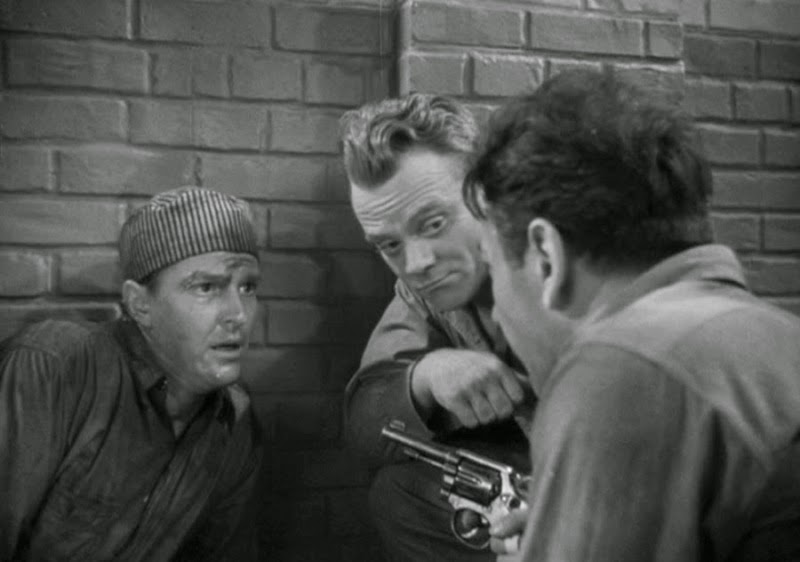
Under a table in the twine factory, Ross accepts Stacey's deal.

Stacey feels betrayed by Ross because of all of the press coverage. Ross is treated back at the prison as an accomplice, beaten by the brutal guards and sentenced to five months in solitary confinement, or, as it is known, “the hole”. In solitary prisoners are handcuffed to the bars in the dark and fed bread and water once a day at noon. While Stacey had warned Ross of this treatment, Ross is changed by it, becoming hardened and unruly. He keeps thinking Stacey is looking out for him, but it takes Joyce, who arranges a meeting through Stacey’s attorney, Lockhart (Clay Clement), to convince the criminal that Ross is worth helping.


Ross is hardened by his time in "the hole".

She goes back to the prison and convinces the Warden to give Ross a second chance. He agrees and puts him up for parole after he’s turned himself around. But now Governor Hanley has appointed Grayce as the head of the parole board. Because Ross insists he’s innocent of the crime he was charged with and since he isn’t repentant, Grayce tells him that they can’t grant him parole. Ross lashes out and has to be physically restrained. He then breaks down and asks for forgiveness. The parole board, of course, turns him down and says he can reapply in five years.


The parole hearing doesn't go Ross' way.

On the outside, Stacey’s men find Shake, who gives them the name of the man who hired him, Polecat, who turns out is back in prison, sent there for cover. The only way for Stacey to make good for Ross, who he’s convinced is "square guy", is to go back to prison and root out Polecat. Ross is unaware that Stacey is back until he sees him being taken to solitary. Ross is convinced Stacey can’t help him.


At Joyce's request, Stacey has his men find Shake in an effort to clear Ross.

Stacey’s presence instigates a prison breakout, led by Dale (Edward Pawley), as part of his plan, arming the men in the twine factory with guns. Ross doesn’t want to be a part of it, but is forced along. He does manage to keep one prisoner from getting involved by knocking out the Fargo Kid (Maxie Rosenbloom). Ross tries to stop the riot, but is forced at gunpoint to participate. Stacey, who is freed from solitary, orders the prisoners to bring along Polecat.

A prison guard is killed when he tries to disarm a convict. While the warden and some of his men are held as hostages, the National Guard is called out to stop the riot. Armed with machine guns, gas and hand grenades, they trap the rioters in solitary and hold them down. Under fire, Stacey forces Polecat to confess to framing Ross with the warden and his men as witnesses. Stacey, who is wounded, forces Polecat to go with him and be killed so he cannot recant his confession. All the rioters are killed, with only Ross spared.


During the aborted escape attempt, Stacey gets Polecat Carlisle (Alan Baxter) at gunpoint
to confess to setting Ross up for the crime that sent him to prison.

The warden helps to have Ross released and Governor Hanley and Grayce are indicted for murder. I’m not sure what this film says about the justice system in the 1930’s or at least how it was perceived. Men like Ross get convicted of crimes they did not commit and confessions taken with a gun to one’s head are enough to free men from prison.

While both Cagney and Raft were well known for their portrayals as gangsters at Warner Bros., this is the first and only time the two shared leads in a film. While we’ve written before about Cagney’s career at Warner Bros., we haven’t had an opportunity to discuss the career of George Raft except when discussing roles he’d turned down, including the role of Chips Maguire in It All Came True (1940) and Rick in Casablanca (1942), both of which went to Humphrey Bogart. He would also pass on Sam Spade in The Maltese Falcon (1941), another role that would have a significant impact on Bogart’s career.

Having made a career as a dancer in New York and London, Raft moved to Hollywood in 1929 to act in the film Queen of the Night Club (1929) starring Texas Guinan, a saloon keeper and actress in who’s stage act Raft had danced. Raft had such prowess as a dancer that the great Fred Astaire would remark in his autobiography that Raft was lightning fast and did the fastest Charleston he’d ever seen.

He had small uncredited roles in some early Cagney films such as Taxi! (1932), in which he played a dance competitor, and Winner Take All (1932). That same year he would also draw attention as a nickel-flipping second lead alongside Paul Muni in Scarface (1932). So strong was Raft’s identification as a gangster that he was often thought to have been a former gangster himself. Raft was friends with some very famous underworld figures, including Bugsy Siegel and Siegel’s old friend Meyer Lansky. Raft reportedly interceded on behalf of Gary Cooper when the actor’s romantic escapades led him to inclusion on one gangster’s hit list.

Even though he would move to Paramount Pictures, Raft would continue to be a major gangster star, along with Cagney and Edward G. Robinson, throughout the 1930s. Bogart, who would ultimately be the bigger star, was a distant fourth in popularity. Raft is also credited for giving Mae West her first break in Hollywood, when he got her cast in Night After Night (1932) after the studio refused to cast Texas Guinan as Maudie Triplett because of her age, even though the character was based on her.

The success of Each Dawn I Die led Warner Bros to signing Raft to a long term contract. However, his career would peak in the early 1940’s. Following the release of Background to Danger (1943), a film meant to capitalize on Casablanca’s success, Raft demanded termination of his contract with Warners. Offered a $10,000 settlement, Raft inexplicably sent a check for that amount to the studio, rather than the other way round.

After that, Raft continued to make movies, but they were of declining quality and were often made overseas for tax benefits. During the 50’s he spent a lot of time as the greeter at the Capri Casino, of which he was a part owner in Havana, Cuba, a well-known haven for organized crime. He appeared on the syndicated television series I’m The Law (1953) which ran for one season. While he made the occasional appearance in films, his career got a definite boost when he appeared in Billy Wilder’s comedy Some Like it Hot (1959) as Spats. Raft followed up that part with the role of a casino owner in the Rat Pack starrer Ocean’s 11 (1960). He made a brief cameo in Casino Royale (1967) after going to the UK in 1966. Raft’s last film appearances were in Mae West’s Sextette (1978) and The Man with Bogart’s Face (1980). He would die of leukemia in Los Angeles at the age of 85.

While I’ve always found Raft to be a little stiff and while he was good in this film, that opinion didn’t change after watching Each Dawn I Die. Raft isn’t very expressive, so he comes off as wooden. But I did see a wide variety of emotions from Cagney, who plays it hard and then moments later breaks down crying. There is one scene after the visit with his mom, Ross is walking back to the twine factory; no words are spoken, but through his gait you see him transform himself from broken man to someone with determination.  It is when he gets back to the twine factory that Ross accepts Stacey’s offer.

The female lead, Jane Bryan had a very short screen career, lasting only from 1936 until 1940. She was being groomed at Warners as a leading lady and given prominent roles in films like Marked Woman (1937), Kid Galahad (1937), A Slight Case of Murder (1938) and Invisible Stripes (1939). But in 1940, Bryan married Justin Dart, the wealthy owner of Dart-Kraft, Inc., formerly Rexall Drugs, and retired from acting.


Actress Jane Bryan.

Her character is pivotal to the plot as she does most of the behind the scenes heavy lifting to convince Stacey to help Ross and the warden to give Ross a second chance. She is the strong female that binds all the men together in these kinds of films, similarly to how Ann Sheridan’s May Kennedy character was the link between Captain of the yard Jameson (Pat O’Brien) and her brother Red (Humphrey Bogart) in San Quentin (1937).

Unlike earlier Cagney films that we’ve reviewed on this blog, more care seems to have been taken with Each Dawn I Die. For one the shooting schedule lasted about two months, so you don’t have the sped up sense of Winner Take All and The Crowd Roars (1932), films that seemed to be literally cranked off an assembly line.

Like directors of some of the other films we’ve reviewed, William Keighley is not a name that appears on a list of great film directors, but that doesn’t mean he didn’t make some well known films. He directed a variety of genres and directed Cagney in several films, including G Men (1935), The Fighting 69th (1940), Torrid Zone (1940) and The Bride Came C.O.D. (1941). Keighley also directed Bullets or Ballots (1936), Brother Rat (1938) and The Man Who Came To Dinner (1942). Keighley started to direct The Adventures of Robin Hood (1938), but was replaced by Michael Curtiz. Keighley would retire from films in 1953 and move to Paris with his second wife Genevieve Tobin.

While prison films are not for everyone, Each Dawn I Die is a pretty good one. I would say that it's definitely better than San Quentin. There seems to be more meat on the bone here. Not that either Red's or Ross' stories are typical of real prisoners, there are more layers in Each Dawn I Die than San Quentin. And given the status of each actor at Warner Bros. at the time of their respective prison films, you can see the difference between an A film (Cagney) and a B film (Bogart).

Anyone who is a fan of Cagney’s or Raft’s will no doubt enjoy this film as much as I did.

Interested in seeing the movie? It is available as part of a four feature two disc set at WBShop:

Free Shipping on All Orders Over $50!

Tuesday, December 24, 2013

Stubs – The Man Who Came To Dinner


The Man Who Came to Dinner (1942) Starring: Bette Davis, Ann Sheridan, Monty Woolley  Directed by William Keighley. Produced by Jerry Wald. Screenplay by Julius J. Epstein, Philip G. Epstein. Based on the play by Moss Hart, George S. Kaufman  Run Time: 112 minutes. U.S.  Black and White, Comedy, Christmas

We conclude our look at drive-by Christmas films with The Man Who Came to Dinner, the 1942 movie based on the 1939 play by Moss Hart and George S. Kaufman; The story of a pompous radio personality who descends on a family in small-town Ohio, where he takes over the house and makes their lives miserable at Christmastime.

The play was a big hit on Broadway, playing at the Music Box Theatre from October 16, 1939, to July 12, 1941, for a total of 739 performances. Produced by Sam Harris, the same one depicted in Yankee Doodle Dandy and directed by Kaufman, the play starred Monty Woolley as Sheridan Whiteside, a character based on the then well-known theater critic and radio star, Alexander Woollcott. Woollcott was a friend of Hart and Kaufman and while they tried to find a vehicle for him, they couldn’t find the right story. That changes when Woollcott showed up unannounced at Hart’s estate and took over the house, sleeping in the master bedroom and terrorizing the staff of the house. But when Woollcott wasn’t available to play the part on stage, Woolley was signed.

Woollcott wasn’t the only celebrity mentioned or who had a character based on him in the play. The character of actress Lorraine Sheldon is drawn from musical stage actress Gertrude Lawrence, an English born actress, singer, dancer and musical comedy performer; the playwright Beverly Carlton was based on renowned wit NoĂ«l Coward; and Banjo, the actor, is based on Harpo Marx. Even Katherine Cornell, who gets mentioned more than once but is not seen, was a real-life Broadway actress and producer.
When Bette Davis saw the play on Broadway, she thought the part of Maggie Cutler would be a good part for her and a change of pace after her heavily dramatic role in The Little Foxes (1941). She urged Jack L. Warner to purchase the screen rights for her and John Barrymore. While Barrymore would test for the role, he wasn’t able, after years of heavy drinking, to handle the complicated and fast-paced dialogue of the part.
With Barrymore out of the question, casting for the lead role led through a succession of actors vying to play the part, including Charles Laughton, Orson Welles, Laird Creger and Robert Benchley. But none of them seemed right. A rather desperate idea of Cary Grant was suggested by Warner, but he was deemed “too young and attractive” for the role. While they hadn’t wanted to cast him, they ended up with Woolley in the part he had created on Broadway. But, of course, Davis wasn’t happy with the casting and didn’t enjoy the production.
Arriving in theaters in early 1942, just weeks after the Japanese attack on Pearl Harbor and the U.S. subsequent entry into World War II, the comedy was just what the nation needed.and was well-received by critics and the public at the time of its release. 
During a cross-country lecture tour, notoriously acerbic, but popular, radio personality Sheridan Whiteside (Monty Woolley), in Mesalia, Ohio to give a lecture, is also invited to dinner at the house of the Stanleys, Ernest W. (Grant Mitchell ) and Daisy (Billie Burke), a prominent family. With him is his long-suffering secretary, Maggie Cutler (Bette Davis).
But on the way into the house, Whiteside stumbles on the icy stairs, hurting his hip. He insists on recuperating in their home during the Christmas holidays. Treating him is the local physician, Dr. E. Bradley (George Barbier) with Nurse Preen (Mary Wickes) having to take care of him and his daily needs and whims for the three weeks he’s stuck in their home.


One tumble leads to a lot of trouble in The Man Who Came to Dinner.

Not surprisingly, Whiteside is an overbearing, self-centered celebrity who takes over the Stanley household. He overwhelms the staff by the get-well presents and phone calls he receives. Sherry (as Whiteside is sometimes called) runs the household ragged with his demands. When Sherry finally emerges from his sick bed in a wheelchair, it is to announce that he plans to sue the Stanleys for $150,000, claiming Thomas E. Dewey will represent him. Additionally, Sherry commandeers the downstairs rooms, the telephone, and the cook and butler for himself and his secretary, Maggie. He even uses the Stanleys' son Richard (Russell Arms) to run errands.


The Stanleys, Ernest  W. (Grant Mitchell) and Daisy (Billie Burke), bring in Dr.
 Bradley (George Barbier) to treat Whiteside (Monty Woolley), but their troubles have only just begun.

It is only a matter of time before Ernest has had his fill of Whiteside. But not all of the Stanleys detest him. Harriet (Ruth Vivian), Ernest’s strange sister, has a crush on the celebrity radio man.
Bert Jefferson (Richard Travis), the handsome young owner of the Mesalia Journal, comes to the house and asks the broadcaster for an interview. Sherry instructs Maggie to turn him away, but Bert charms Sherry, however, and is invited to lunch along with five convicts from Sherry's fan club at the state penitentiary.


Nurse Preen (Mary Wickes) tries to take care of Whiteside, while Bert
Jefferson (Richard Travis) tries to score an interview for the local paper.

Whiteside has a luncheon for convicts that have started a Whiteside Appreciation Society in the state prison. An octopus is delivered from a naturalist.
He encourages young adults Richard (Russell Arms) and June (Elisabeth Fraser) Stanley to pursue their dreams, much to the dismay of their conventional father Ernest. Fed up, Ernest demands that Sherry leave their home immediately and Sherry counters that he will sue for an even larger sum if he has to leave.
Meanwhile, Maggie finds herself attracted to Bert Jefferson (Richard Travis). After the two go ice skating together, Bert reads her a play that he has written. She thinks it’s so good, she gives it to Whiteside and asks him to show it to his contacts, hoping he will send it to his friend, actress Katherine Cornell. She then announces her plan to quit his employ and marry Bert. However, Sherry is loath to lose such an efficient aide and does his best to sabotage the blossoming romance.
Sherry then learns Doctor Bradley has been looking at the wrong X-rays and that his hip was never injured, but Sherry is determined to stay in town long enough to prevent Maggie from marrying Bert. He makes a deal with the doctor to help him with his memoirs if he stays quiet. He also suggests that June and Richard leave home so that June can marry Sandy, a union organizer who is working at her father's ball bearing plant, and Richard can pursue his interest in photography.
Determined to break up the affair, Sherry telephones his friend, Lorraine Shelton (Ann Sheridan), a glamorous actress, and suggests that she could have the lead role in Bert's play if she came to Mesalia right away. His intent is for Lorraine to steal Bert away from Maggie.
On Christmas Eve, Bert gives Maggie a charm bracelet and Ernest's strange sister Harriet gives Sherry a picture of herself as a young woman. After Lorraine arrives in town, dressed in furs and jewels, Sherry warns her not to mention the play in front of Maggie and urges her to use her charms on Bert.


Ann Sheridan as Lorraine Shelton is brought in to steal Bert's affections.

Lorraine immediately goes to work on Bert convincing him to spend time with her to fix up the play. Maggie quickly understands Sherry's intentions. She thinks her problem is solved when writer Beverly Carlton (Reginald Gardiner) arrives and does a devastating imitation of Lorraine's latest millionaire lover, Lord Bottomley. At Maggie's request, Beverly telephones from the train station, pretending to be Lord Bottomley and asks Lorraine to marry him. At first, Sherry is furious that his plans are failing, but when Bert innocently mentions seeing Beverly phoning from the station, Sherry reveals the trick to Lorraine, who then doubles her attention to Bert.

Reginald Gardiner as Beverly Carlton and Bette Davis as Maggie Cutler in a scene with Woolley. 

On Christmas morning, Maggie realizes Whiteside is behind the underhanded scheme and she quits. A drunken Bert tells her he is going away with Lorraine to work on his play. Then a penguin that was sent as a gift to Sherry bites his nurse, Miss Preen, and she quits, and Ernest finds his runaway children and hires a couple of sheriffs to evict Sherry. In the midst of this chaos, Sherry's friend Banjo (Jimmy Durante) arrives from Hollywood, and a contrite Sherry, realizing that Maggie really loves Bert, begs him to get rid of Lorraine. They trap Lorraine in a sarcophagus, and Banjo ships her off to Nova Scotia.


Jimmy Durante plays a movie star named Banjo. Here with
a blonde on his knee, he talks with Whiteside from Hollywood.
One of the film's few scenes that doesn't take place in the Stanleys' living room.

Finally fed up with Whiteside's shenanigans, insults, and unbearable personality, and realizing that he has been "faking" his injuries for quite some time, Mr. Stanley orders him to leave. Before he does, Whiteside blackmails him into allowing his children to do as they please by threatening to reveal Stanley's sister Harriet's past as an infamous axe murderess. Having recognized Harriet he blackmails Ernest into taking the case to the airport. With Maggie's happiness now assured, Sherry warns Ernest that his children should be allowed to follow their own paths, "Or else."
To everyone's great relief, Sherry is on his way out, but then he falls down the slippery steps and is carried back into the Stanley house to begin his reign of terror all over again, much to Ernest’s consternation.

The film feels very much like a stage play, as action rarely leaves the downstairs of the Stanleys' house. However, the unimaginative direction really secedes the play to Woolley, who has to do the heavy lifting from the seat of his wheelchair.

For an actor who was never the first choice to play the role on stage or in film, Monty Woolley certainly made the part his own. As a matter of fact, it is hard to imagine anyone else playing Sherry, even though others have in revivals and on television, most notably Orson Welles. In fact, Woolley’s performance is so big that he overshadows everyone else, including Davis’, who helped bring the play to the screen.


Woolley, who had appeared in a few films before this one, would leave the Great White Way for Hollywood. He would go on to play himself in the Cole Porter biography Night and Day (1946), Professor Wutheridge in The Bishop’s Wife (1947) and Omar in Kismet (1955), which turned out to be his last film. Woolley, whose white beard was his trademark, became known as “the Beard”.

Bette Davis really only has a small part in the film, playing the somewhat mousy Maggie Cutler, who only blossoms when she meets Bert Jefferson. Love gives her a backbone and she stands up to Sherry and even quits her job over his underhanded scheme to ruin her relationship.


Despite her efforts to have the play made into a movie and receiving top-billing,
Bette Davis takes a supporting role in the cast of The Man Who Came to Dinner.

Ann Sheridan, who plays the conniving Lorraine Shelton, really doesn’t have the much to do, but to look beautiful and she does that very well. One has to wonder if Bert would have come back to Maggie if Lorraine hadn’t been shipped off to Canada.

The supporting cast, as it is with any good film or play, is really good and each actor makes the most of their roles. Jimmy Durante as Banjo sort of swoops in and comes the closest of anyone to stealing a scene from Woolley. Mary Wickes 
(reprising the role she played on Broadway) as the haggard Nurse Preen and George Barbier as the befuddled Dr. Bradley are also worth mentioning. And it's odd to see Billie Burke in any role other than Glinda, The Good Witch of the North. Despite a very long career in radio, on stage and in movies, Burke is forever associated, in my mind at least, with her role in The Wizard of Oz (1939).


Jimmy Durante as Banjo adds a touch of mayhem to the proceedings.
Here, he literally picks up Nurse Preen.

But Woolley's performance as Sherry Whiteside is what makes The Man Who Came to Dinner worth watching. This is his part and we are lucky enough to see him play it. While this film may drive by Christmas on its way to comedy, this is a movie that you can watch any time of the year and enjoy.

Monty Woolley's performance as Sherry Whiteside is more than
enough reason to watch The Man Who Came to Dinner.

That concludes our salute to drive by Christmas movies. We hope you have a Merry Christmas and will leave a comment this time and every time you visit Trophy Unlocked. Hey go ahead and make that a New Year's resolution while you're at it. Write it down next to the one for joining a gym.

To read reviews of other Christmas films, please see our Christmas Review Hub.