Showing posts with label 1928. Show all posts

Saturday, March 9, 2024

Stubs - The Last Command

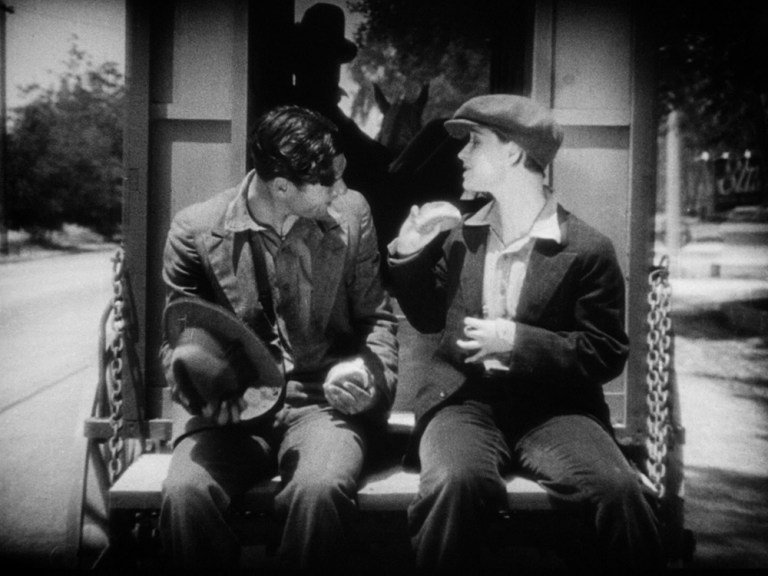
The Last Command (1928) Starring Emil Jannings, Evelyn Brent, William Powell. Directed by Josef von Sternberg; Screenplay by John Goodrich. Presented by Adolph Zukor, Jesse L. Lasky. Black and White. USA Run time: 88 minutes. Silent, Melodrama.

Once considered by the Library of Congress American Silent Feature Film Survival Database to be extant, the rumors of its demise have been overly exaggerated. The Last Command is a noteworthy work mostly because of its prominence in Academy Awards history. The lead actor, Emil Jannings would be the first actor to win for his work. Back then, the award wasn’t for one film, but for a body of work for the year, so Jannings won for this film, as well as his performance in The Way of All Flesh.

Saturday, August 7, 2021

Stubs - The Racket (1928)

The Racket (1928) Starring: Thomas Meighan, Louis Wolheim, Marie Prevost. Directed by Lewis Milestone. Screenplay by Del Andrews (Scenario), Harry Behn (Scenario), Tom Miranda (titles). Based on the play The Racket by Bartlett Cormack (New York, 22 Nov 1927). Produced by Howard R. Hughes Run time 84 minutes. USA Black and White. Silent. Gangster

During the first Academy Awards, in 1929, films like Sunrise (1927) and Wings (1927) may have captured glory but there were other films that were also nominated for the two top awards. A film like The Racket was overlooked then but deserves a second look now.

Saturday, January 6, 2018

Stubs - Beggars of Life


Beggars of Life (1928) Starring Wallace Beery, Richard Arlen, Louise Brooks. Directed by William A. Wellman. Screenplay by Benjamin Glazer with Titles by Julian Johnson. Based on the novel Beggars of Life by Jim Tully (New York, 1924). Produced by Benjamin Glazer Run Time: 80 minutes USA Black and White. Silent. Drama.

In the fall of 1925, Outside Looking In was a minor hit on Broadway. Based on the biography of Jim Tully, who had spent seven years riding the rails of the US as a Hobo (what they used to call wandering homeless men), the play, written by Maxwell Anderson, ran for a total of 113 performances during the fall. One of the fans of the play was Charles Chaplin, who was in New York for the premiere of his film The Gold Rush (1925). He saw the play three times during its run. While he was in town, he also had a short love affair with a young dancer featured in the Ziegfeld Follies on Broadway. The third time he attended the play, he brought his young lover with him. She was not nearly as impressed as he was with the play. She would later comment she would have paid more attention to the play if she knew someday she would star in the film version. That young woman was Louise Brooks.

Perhaps known now for her later films in Europe: Pandora's Box (1929); Diary of a Lost Girl (1929) and Prix de Beauté (1930), in 1928, Brooks was a contract player at Paramount Pictures, having also been discovered by producer Walter Wanger while dancing in the Ziegfeld show. Wagner, who was also at Paramount, had actually encouraged Brooks to sign with MGM, the other studio interested in her, but she, as she often did, did it her way and signed with Paramount for a five-year contract in 1925. Never really sold on a film career, Brooks never took Hollywood fame or acting very seriously, though she did appear in a dozen films before Beggars of Life, working with directors like Frank Tuttle, Malcolm St. Clair and Howard Hawks and with such actors as W.C. Fields, Ford Sterling, Adolphe Menjou, and Wallace Beery before making Beggars of Life.

Wallace Beery, whom we’ve discussed before in our review of Min and Bill (1930), was already a big star in Hollywood. He had broken in playing comedy, even in a series of cross-dressing films as Sweedie, a Swedish maid character. He had turned to villains in such films as Patria (1917), in which he portrayed the still active Pancho Villa. Beery had appeared in a wide range of films prior to Beggars of Life, including The Last of the Mohicans (1920); The Round-Up (1920) with Fatty Arbuckle); Robin Hood (1922) with Douglas Fairbanks playing King Richard the Lionheart; reprising the role in the sequel Richard the Lion-Hearted (1923); The Lost World (1925), as Professor Challenger; Old Ironsides (1926); Casey at the Bat (1927); and Now We're in the Air (1927) opposite a still new talent, Louise Brooks.

Richard Arlen got into films in a rather unusual way. After World War I, Arlen worked in the oilfields of Oklahoma and Texas before heading to Hollywood to become a movie star. However, he found that no producer was interested. He took a job as a delivery boy for a film laboratory when the motorcycle which he was riding landed him with a broken leg outside the Paramount Pictures lot.  A director took pity on Arlen and gave him his start as an extra. His first screen appearance was in Ladies Must Live (1921). Arlen would appear in several films, but mostly in uncredited roles or in supporting roles. Wings was his breakout role.

At about the same time as Chaplin was discovering Outside Looking In, Paramount was also interested in the property, thinking Beggars of Life would make a good film. That job fell to William A. Wellman, their contracted director, who had recently finished their biggest hit from 1927, Wings.  Tully was originally going to adapt his own book, but in the end, the credit went to Benjamin Glazer. Glazer at the time was a very successful screenwriter, having won an Academy Award in 1927 for Best Writing (Adapted Screenplay) for his adaptation of the novel Seventh Heaven by Austin Strong.

While Tully’s book would have been considered an autobiography, the film is anything but. There is no Tully character and the story isn’t really based on his adventures on the rails. It was rumored at the time that Tully would appear in the film, that didn’t happen either.

Jim Tully didn't appear in the film, but he did visit the set. Seen here
with Louise Brooks, Wallace Beery and Richard Arlen.

Production began in May 1928, either on the 19th (according to Exhibitors Herald and Moving Picture World) or the 24th (according to Film Daily). There were 10 days of work done at the studio before the production team, seventy-five strong, left for location shooting at Jacumba Hot Springs California, down near the Mexican border, on June 3rd. They would stay on location until June 27th, when the crew returned to Hollywood.

The main reason for shooting in Jacumba was the use of the railroad as the train plays a large part in the telling of the story. All of that activity occurred in and around Locomotive 102. Since there were few trains scheduled to use the track, it allowed for Wellman and crew plenty of time to get shots without having to worry about being disturbed.

Location shooting had its ups and downs, especially for Brooks. She found that Arlen, despite his smiling demeanor, did not think much of her or her acting, letting it all go one night over whiskey when the two were alone. Not only did he not like the fact that he made far less than she did, but he thought she was a non-talent actress as well. According to Brooks, in her essay “On Location with Billy Wellman” written many years after the fact, Arlen, already drunk, told her “… You – why, you can’t even act! You’re not even good-looking. You’re a lousy actress and your eyes are too close together.”

Brooks seemed to have given her all to the production, letting herself get talked, by the director, into doing her own stunt on occasion. One time, while trying to run and hop on a moving train, she was nearly swept up underneath it.

The production crew on location at Jacumba.

While she worked hard, she also played hard. After watching her male stunt double, Harvey Parry, complete an arduous stunt and admiring his physique, she offered to let him come to her room that night, which he did. Brooks was known as a sexually liberated woman, long before it was considered fashionable. Her reputation followed after her. The next morning, Harvey confronted her. He had heard from someone that Brooks was the girlfriend of a studio executive whom she didn’t know. Harvey had heard that this executive had syphilis, so in front of the whole crew, Harvey asked Louise if she had syphilis, much to her great embarrassment.

But these distractions didn’t really affect the actual production of the film. What did impact it was the transition from silent to sound films. As theaters across the country were transitioning, Paramount Pictures wanted to have a sound product, so the film was released in both versions. Using the Movietone process, the sound effects, a synchronized musical score, a bit of dialogue and a song were included. Beggars of Life would be the studio’s first release to include spoken dialogue. No sound elements from the original release still exist.

The song was sung by Wallace Beery, who, ironically, would later be fired by Paramount most likely because of the same vocal qualities that would make him a memorable actor at this next studio, MGM; his basso voice and gruff, deliberate drawl.

The film opens with a hobo, Jim (Richard Arlen), walking up to a farmhouse. The door is open, but the screen door is closed. Jim can see and smell the food on the table in front of a farmer (Frank Brownlee), who appears to be sleeping. Jim tries to rouse the man, and when that fails takes the bold step of going inside. He finds that the man is not asleep, but dead with blood on the floor.

The only person inside is Nancy (Louise Brooks), who is dressed in men’s clothing. She admits that the man is her adoptive father and that ever since she’s lived with him, the man had been making sexual overtones towards her. Finally, this morning, after she made him breakfast, the man grabbed her. In her struggle to escape, she ended up shooting him with a rifle. Mortally wounded, the man ended up sitting down at his place at the table.

Nancy (Louise Brooks) tells Jim the story of the murder.

Nancy wants to get out before the murder is discovered. She feels her odds are better if she looks like a boy rather than a girl.

Jim is reluctant to help her but agrees to help her escape. He is used to riding the rails and agrees to get her on a train going in one direction, while he gets on one going in the opposite. He makes a point of packing the food from the dead man’s plate before the two leave the house.

Jim (Richard Arlen) tries to teach Nancy how to jump on a moving boxcar.

Nancy claims to have caught a train before, but her first attempt goes badly and she gets thrown. Jim takes pity on her and agrees to have her come with him. With his help, the two manage to scramble into an open flatbed and are about to indulge in a little picnic when a train detective catches them. He makes the two of them jump off the train. Nancy is a little worse for wear, but manages to walk off her injury.

Nancy ends up in the weeds next to the track.

The two walk until it gets to be nightfall. Jim leads her into a farmer’s pasture, where he cleans out enough room for them to sleep. While Nancy is a bit nervous about sleeping next to a strange man, the two talk about their dreams. Jim is on his way to Canada where his Uncle will set him up if he wants to settle down. That sounds good to Nancy, who has similar dreams as well. The two sleep next to each other without incident until the next morning. That’s when a Farmer discovers the two. They run off before he can stop them.

A publicity still showing the moment they're discovered in the farmer's hay.

But by the next morning, there are already wanted posters out for Nancy, which Jim tries to hide from Nancy. They’re both hungry and when a horse-drawn bakery cart goes by, they hop on the back and help themselves to buns to eat. The driver (Guinn “Big Boy” Williams) who had been asleep, awakes when he hears them. Moving a lever, the seat they’re on withdraws and Jim and Nancy fall onto the street.

For a few moments, things are looking up as they grab and eat breakfast on a bakery cart.

Jim leads Nancy off the main road and into the jungle, eventually ending up at a hobo camp run by The Arkansaw Snake (Robert Perry) where they are not allowed to eat any of the stew that is being prepared since they didn’t contribute to the pot.

Oklahoma Red (Wallace Berry) show up carrying a stolen keg of moonshine.

After a while, Oklahoma Red (Wallace Beery) shows up, carrying a stolen keg over his shoulder and singing a song about being a hobo. Arkansaw relents control to Oklahoma and he offers up his moonlighting to everyone including Jim and Nancy, whom everyone still thinks is a boy. It is only after her backside is noticed that her true identity is revealed.

The hobos take a prurient interest in her and Jim is no position to physically stop them. However, he shows them her wanted poster and the men back away. They don’t have any plans to let her come with them, but Red insists they bring her along.

Officials raid the camp, but the hobos fight back, subduing their cops. When the train they plan to ride comes by, the hobos run off with Red even going back to collect the keg. All of the men make it into the same boxcar. They all have colorful names, like Lame Hoppy (Roscoe Karns), a one-legged hobo; Black Mose (Edgar “Blue” Washington), a black hobo who is accompanying a sick white hobo; Skinny (Horace “Kewpie” Morgan); Baldy (George Kotsonaros); Ukie (Jack Chapin); Rubin (Johnnie Morris); and Skelly (Andy Clark).

Red sees Jim as an obstacle to get to Nancy and plans to get rid of him.

Red takes control of the situation, stating that if he’s in a gang, it’s his gang. Giving Nancy the once over, he adds that any girl in the gang is his girl. There is a very real sense that rape and/or gang rape is not too far away from happening. Jim seems to be all that is standing in the way, so Red organizes a Kangaroo court to find Jim guilty and sentence him to death by being thrown from the train. Dressing up like judge and jury, Red finds Jim guilty before any evidence is given.

With Red's gun, Jim manages to hold everybody back away from Nancy.

But Nancy insists on choosing Arkansaw as her champion and a fight ensues amongst the hobos. Jim manages to pick up Red’s gun when it falls to the floor. But their confrontation is interrupted when more railroad detectives aboard the train start making their way back to the boxcar. Red climbs out and detaches the car from the rest of the train, sending several cars, including the caboose, back down the perilous track and crashing into a barricade at the bottom of the hill.
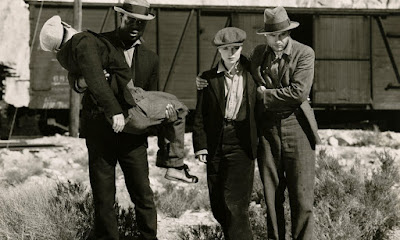
Black Mose (Edgar “Blue” Washington) takes Nancy and Jim to an abandoned shack.

With the authorities coming, the hobos scatter. Black Mose, who is carrying his sick companion, leads Jim and Nancy to a nearby abandoned shack where they can hide out. After a while, Black Mose goes off to look for food for his friend and while he is gone, the hobo dies. Jim and Nancy cover him up to his eyes.

Red shows up in a stolen car with a stolen dress for Nancy.

Out of the blue, Oklahoma Red shows up driving a car he's managed to pilfer and a dress for Nancy, which she puts on while Jim and Red step outside to talk. Jim keeps the gun on Red but allows him to make one final play for Nancy, using the tact that they’re looking for the two of them and splitting up would be in everyone’s best interest. While what he says makes some sense, Nancy and Jim decide to stay together. Red starts to leave, but comes back one more time and manages to take the gun away from Jim.

Jim continues to train his gun on Red even after he's tried to help them out.

Red claims to be tired and, with time to kill before the next train, lays down next to the dead hobo to take a nap.

Black Mose returns with food, including a chicken, which he proceeds to pluck, not realizing his friend is already dead. With Red pretending to be asleep, Jim and Nancy make a run for it, steal the car and drive off. Red stops pretending to sleep and tells Black Mose that he was waiting for them to make a run, hoping to help them since they’re in love.

When Black Mose discovers his friend is dead, it hatches a plan with Red. To better aide in Nancy’s escape, they dress the dead man in her man clothes and then take him back to the wreckage. There they place his body in amongst the lumber cargo along with igniter fuel to create a fire. Black Mose warns Red about getting trapped, but Red tells him his foot hasn’t slipped yet.

Authorities arrive and arrest Black Mose and reattach the caboose and other cars to the main train. After they’re going, Red sets a fire. The authorities are trapped in the caboose with the fire in the car next to them. Red manages to escape from the car and once again uncouples the cars from the main train. But this time he’s shot by authorities as he climbs on top of the boxcar.

The caboose and flatcar head back down the track and eventually off the track into the gorge below.

Cut to Jim and Nancy on a train headed to Canada, thinking about how Red helped them escape.

Meanwhile, Red, who is only semi-conscious, slips off the boxcar and over the edge of the cliff. He lands hard on a landing and with his last breath says, “I guess my foot slipped”.

The film had its premiere in Indianapolis on September 5, 1928, and its New York opening on September 22. Seeing as it was Wellman’s next film after Wings, as well as Paramount’s first film with synchronized dialogue, there was a lot of anticipation around its release. However, the film did not fare well with film audiences or critics, receiving mixed reviews at best. As an example, Variety in its review on September 26th review called it “not an exceptionally good picture.” Mordaunt Hall, in his review in the New York Times, dated September 24, states, “It is a picture that might have been infinitely better handled, for William Wellman, who is responsible for the direction, reveals but little intimate knowledge of his subject.”

Some of the thought about the film’s lack of success has to do with its dark tones during what was still the good times in the U.S.; the great depression was still over a year away and this wasn’t the right film at the right time. Audiences at the time were said to want their stars to look glamorous on film, rather than dressed like hobos.

There are some interesting features about the film. One that comes to mind is how Nancy tells Jim about the farmer attacking her. In what would normally now be a flashback with voice-over is told by showing the action with Nancy’s face superimposed over it, linking the teller with the story.

While Wallace Beery might not be my favorite actor, he certainly does have a star’s presence when he appears on the screen. You can’t help but look at him and I found him easier to take without sound. His character Red is hard to pin down. At one point, it is pretty obvious that he wants to rape Nancy, but only a few hours later, he lets the love he sees between Nancy and Jim change his mind to help them. He’s just a really bad guy with a heart o’ gold.

Louise Brooks, who is as good in this film as Richard Arlen is, never really looks like a boy. She is far too pretty to pass. Also, while she looks good in her signature bob haircut, I wonder if the farmer’s daughter that she’s supposed to portray would have that same exact style. I’m only guessing that Paramount didn’t want to deglamorize one of its buddy stars too much and wanted her to be recognizable on screen.

Arlen’s character is also hard to pin down. He at first takes pity on Nancy and then falls in love with her, but I get the feeling he’s somewhat subdued in defending her. He doesn’t really try to stand up to Arkansaw or Red to defend her and doesn’t try to take charge until he has a gun in his hand. But even then, you know that Red will turn the tables on him, which he does.

I don’t know enough about hobo life to comment on the film’s authenticity in that regard, but I do question one of the main points, the murder. The farmer was, after all, trying to rape his adoptive daughter, which one has to imagine was against the law even in the most rural of areas. The murder was therefore in self-defense. Now maybe you can tell me things were different back then, but I always wince when the plot is forwarded by dumb decisions.

William A. Wellman directing from on top of the train.

Despite the film’s shortcomings and lack of praise, Wellman considered it to be one of his favorites and his best silent film. In 1965, when the San Francisco International Film Festival was going to do a career retrospective on Wellman, he wanted them to show this film and had plans to bring Louise Brooks to the event. However, they couldn’t find a print of the film and Wings was shown instead.

While considered by some to be a hidden treasure, I was not as enamored with the film as I had hoped. However, there are so few films that survive from this era and so few films that star Louise Brooks survive (of her nearly two dozen films, six are lost or all but lost) that each one is therefore special. If you’re a fan of hers, of silent films or of the work of William A. Wellman, then you should see Beggars of Life.

For other Silent films, please see our Silent Film Review Hub.

Saturday, May 28, 2016

Stubs - The Camerman


The Cameraman (1928) Starring: Buster Keaton, Marceline Day, Harold Goodwin. Directed by Edward Sedgwick, Buster Keaton (uncredited). Story by Clyde Bruckman, Lew Lipton. Titles by Joseph Farnham. Produced by Buster Keaton, Lawrence Weingarten. Run Time: 67 minutes U.S. Black and White, Silent, Comedy.

As we mentioned in our review of Steamboat Bill, Jr. (1928), Buster Keaton soon afterwards lost the financial backing of Joseph M. Schenck and signed with Metro-Goldwyn-Mayer, which was run by Nicholas Schenck, Joseph’s younger brother. He may not have thought he had much choice at the time and it would be a move Keaton would soon regret. When he was making features for Joseph, Keaton had the flexibility to shoot when an idea inspired him. Nicholas’ MGM was less forgiving, wanting product on a schedule.

I’m a little unsure whose idea The Cameraman was. Clyde Bruckman, who gets partial credit for the story, was one of Keaton’s gag men, but Lew Lipton was a studio writer. I’ve heard, in commentary on TCM, that Keaton pitched a lot of ideas to MGM, but all were turned down. Instead, they presented him with this, so perhaps he took a studio idea and re-worked it with his usual troupe of writers. Whatever the results, at least one more time, Keaton was able to come up with a winner.

Even before Steamboat Bill, Jr. was released in theaters (May 12, 1928), Keaton was already shooting The Cameraman (April 12 to June 26, 1928), so there wasn’t a lot of moss growing under his feet. Looking back on the output of the studios it seems like everything came out quickly and often. Making genius, however, was less common.

The film opens with a tribute to the hardworking newsreel cameraman, showing various men in dangerous and daring situations. But there is also another type of cameraman like Buster (Buster Keaton), a sidewalk tintype portrait photographer in New York City. When we first see him, he’s scrambling hard to find business. He is about to take a customer’s photo, when a crowd gathers and news crews, including MGM Newsreel, show up with cameras cranking to document the event. Buster is caught up in the crowd and thrust up against Sally (Marceline Day), a woman in the crowd.

Buster (Buster Keaton) is thrust up against Sally (Marceline Day) when the crowd surges.

She is beautiful and after the crowd has gone he asks is he can take her tintype. She reluctantly agrees and while Keaton gets caught up with posing her, he does manage to take her photo before Harold (Harold Goodwin), one of the MGM cameramen, comes back to get her. She is whisked away before Buster can give her the tintype.

Sally reluctantly poses so Buster can take a tintype of her.

But Buster knows where she works and has a photo of her to go by. Finding the MGM Newsreel office is easy, but tracking her down is not so. After finding out her name from the doorman, Buster follows a cameraman into the MGM office. When he asks the first person he sees if he’s seen Sally, the man thinks he’s daft, because Sally is sitting right by the door. Buster is almost out of the office before he finally sees her. When she offers to pay for the tintype, ten cents, he gives it to her as a gift.

He wants to take her portrait again and even though she doesn’t get off for hours, decides to wait for her. When he notices Harold around, Keaton decides the best way to get close to her is to work at MGM. He asks about working there, but the cameramen scoff at him. Sally, feeling sorry for his treatment, tells Buster he needs to get his own camera first and he rushes out to get one.

Buster wants to make good and goes looking for a fire. 

But new camera equipment is expensive and Buster has to settle for an old used one. More scoffs when he returns to MGM, but when a big fire at a warehouse breaks out, Sally encourages Buster to go film it. Trailing behind the other cameramen, Buster asks the first cop (Henry Gribbon) he runs into about where the fire is. When Buster sees a firetruck hurrying by, he runs and leaps onto the side of the engine, only to discover it’s returning to the station.

Buster jumps on a passing fire engine only to end up back at the station rather than the fire.

Unable to find the fire, Buster, as Sally suggests, tries to film anything and everything. He hits on the idea of filming the New York Yankees, but they’re playing in St. Louis. Left alone down on the field at Yankee stadium, Buster imagines himself playing in a game in one of the funnier sequences in the movie. First he is the pitcher, trying to pick off a runner at third, before trying to get the next batter out. Once that’s done, Buster turns to offense and takes a turn at batting. After a wild pitch that nearly beans him, Buster hits a home run, sliding head first into home plate. While he accepts the cheers of the imaginary crowd he realizes the groundskeeper has been watching him. Buster hurries away to look for other subjects to shoot.

The groundskeeper kicks Buster off the field after one of the funnier sequences in the film.

The first batch of film he brings back to MGM is not usable. As an example, through accidental double exposure, Buster has managed to make it look like a battleship is coming down on the city’s thoroughfares. While some of the effects could not have been done with a camera alone, the idea is that Buster is not up to MGM Newsreel standard and he is kicked out.

Buster's first footage ends up being laughed at.

Feeling sorry for him, Sally intercepts him in the hall and gives him some pointers about shooting film, like never crank backwards. Encouraged by her attention, Buster screws up the courage to ask her to go on a long walk with him the next day, which is Sunday. Sally tells him that she has other plans, but asks for his number in case they fall through.

Sunday and Buster is fully dressed early in the morning, waiting for the phone, which is several floors below, to ring. But first, he needs money and tries to open his bank of dimes. This proves harder than it should. Taking a hammer to the bank and using the wall for backing doesn’t work as the bank is pushed through the thin wall. Using the claw of the hammer, Buster rips into the wall to find the bank. Unable to break it open he throws the bank to the floor and the dimes fly out.

When the phone rings, Buster runs down several flights to the lobby, only to find it’s not for him. Dejected, Buster walks back up the stairs and, without noticing he’s overshot his own floor, ends up on the roof before he knows it. When he hears the phone is for him, he runs all the way back down, overshooting the lobby this time and ending up in the basement. Finally at the phone, Sally tells him she’s available.

While she’s still talking to him, Buster excitedly runs over to her boarding house, passing the cop again who takes notice. Sally is just realizing Buster is no longer on the phone when he shows up in the lobby behind her. After she goes to finish getting ready, Buster waits in the sitting room with the other tenants and the landlady who chaperons the girls. It isn’t long before he causes a commotion.

Sally doesn't realize that Buster is not on the other end of the call.

Finally out on the street, Sally goes one way and Buster the other. He decides to take her to The Plunge, a pool, and they hurry to catch the bus. But once on board, they get separated, Sally takes seat on the bottom floor and Buster gets pushed up to the top of the double decker bus. When he realizes Sally is seated below him, he climbs down and sits on the bumper so he can be next to her. Once again, the cop takes notice, especially when Buster gets bumped off his perch and must run to get back on.

Buster rides next to Sally even though there is no room on the bus.

At the Plunge, the two rent swimsuits and Sally goes into the ladies room to change. Buster ends up sharing a changing cube with a heavyset man (Edward Brophy). Rather than taking turns the two men try to change at the same time, getting into each other’s way and clothes as they do. Squeezed and throttled, Keaton does emerge, though he is wearing a swim suit that is easily three sizes too large.

Keaton ends up at a changing room with a heavyset man (Edward Brophy).

Sally, who is quite fetching in her skintight suit, gets the attention of a gaggle of boys who follow her and Buster into the water. When Sally tries to play catch with Buster, the men, who are much larger, practically drown him as they fight for the ball. Finally, Sally pulls Buster away and they sit together on the rim of a fountain in the center of the pool.

It should come as no surprise that Sally attracts the attention of other men at the Plunge pool.

Watching the divers, Buster decides to show off for Sally and climbs up to the high dive. But when he hits the water, his suit comes off. Buster doesn’t realize he’s naked until he starts to get out. Sally wants to leave and gets out of the pool to change. Buster, though, is stuck. That is until he hits on the idea and steals a large woman’s bloomer bottoms and wears them out of the water.

Buster tries to get out of the pool when he realizes he's lost his swimsuit.

Sally wants to go to the beach, but they aren’t able to squeeze into the taxi going that way. Things are so tight that when Buster opens the door, passengers fall out. After helping push the doors closed again, Buster and Sally are still on the outside looking in. Just then Harold drives up in his convertible coupe and offers Sally a ride home. It looks like rain and Buster helps Harold put up the top, but Harold insists Buster ride in the rumble seat. By the time they get to Sally’s, Buster is soaked. Sally gives Buster a kiss on the cheek and he starts to walk home in the rain.

Buster is soaked by the time he gets Sally  home after their date.

But our friend the cop, having seen Buster do some crazy looking things all day, pulls him aside to check his reflexes to see if he’s crazy. But Buster manages to escape into the rainy night, losing the cop who falls down while chasing him.

The next day, Buster is waiting in the MGM newsreel office bright and early. When a hot tip comes in about trouble in Chinatown, Sally gives the scoop to Buster, who once again rushes out to cover the story. He is in such a rush that he runs into an organ grinder and the two collapse on top of the man’s monkey. Thinking it’s dead, a passing policeman makes Buster pay the hurdy gurdy man for the animal and then forces him to take it away. But the monkey is not dead, only stunned and insists on staying with Buster from then on.

The Tong Wars are just getting underway and Buster takes great effort and risk to shoot the events. More than once, a leader of one of the rival tongs sends someone to kill Buster, to stop the filming, but each assassin is thwarted. Despite escaping gunfire, Buster finds himself stuck in a room with one of the Tong leaders and some of his loyal followers. They are moving menacingly towards him when the police arrive and save Buster. But one of the cops is the one who has been observing Buster and he tries to get Buster thrown into a paddy wagon headed to Bellevue hospital. But once again, Buster escapes and makes his way back to the newsreel office.

Buster dutifully keeps hand cranking his camera while bullets fly during the Tong Wars.

Excited, Buster tells Sally what he’s been through. When Edward J. Blake (Sidney Bracey), the newsreel company’s boss, overhears, he wants to see the footage. But when Buster opens the camera the film is missing from the reel and all that remains is a torn piece. Buster apparently forgot to load the film, even though he’s sure he had. When Blake wants to know who gave Buster the tip, Sally is the only likely candidate. But rather than see her get fired, Buster offers to leave and never return to MGM.

Buster though doesn’t give up filming and sets out to record a regatta/boat race. When he loads the film, he realized that he has the Tong footage and suspects that the mischievous monkey had switched reels on him.

Meanwhile, for whatever reason, Sally and Harold are involved in the regatta and go speeding by in one of the boats. When Harold tries to take a sharp turn the two are ejected from the boat. Harold makes it back to shore, but Sally is trapped by the boat, which continues to speed around her in a tight circle. Buster jumps into another boat, which he steers into the unmanned boat’s way. Buster than swims back to shore with Sally and lays her down on his coat. Not sure what to do, Buster hurries to a nearby drug store to get supplies to revive her.

Buster carries an unconscious Sally out of the water after the boat accident.

Harold, meanwhile makes it to shore and sees Sally. He walks over to her and cradles her just as she wakes up. She is impressed by Harold’s bravery for saving her and the two walk off together. Buster arrives just in time to see them leave.

Broken-hearted, Buster sends his Tong war footage to MGM offering it free of charge. Edward decides to screen it for a laugh with Sally and Harold sitting in. But not only is the Tong footage some of the best camera work the boss has ever seen, but there is also footage from the boat race and rescue, which the monkey apparently shot. Sally now knows the truth about Harold and Edward sends her out to find Buster.

Edward J. Blake (Sidney Bracey), the boss at the newsreel office, is impressed by Buster's footage. So is Sally.

Back to being a tintype photographer, Sally finds Buster on the street. She tells him that the boss wants him back and that there is going to be a great reception for him. At that moment, the streets once again fill with cheering fans and ticker tape. Buster thinks the fuss is for him, but we see that it is really for Charles Lindbergh.

Buster thinks the crowd and adulation is for him, instead it's for Charles Lindbergh.

Two historical notes: Tintypes are photographs taken on a sheet of iron that is coated with lacquer or enamel. These have been around since the 1860’s and were falling out of favor by the time this film was made. The other is that most movie studios, like TV broadcast networks today, had news divisions, which presented newsreels as part of their program of films. MGM News was actually produced by William Randolph Hearst’s company. In 1930, they were renamed News of the Day.

While the film received good reviews, MGM took away most of Buster’s creative control over his films. This is not to say that the films he made at MGM were not financially successful, only that they were no longer really Keaton films. His independence and creativity were stifled by the studio in favor of the bottom line.

The Cameraman was followed by Spite Marriage (1929), Keaton’s last silent film. He would successfully transition to the talkies with Free and Easy (1930). In those early sound days, the studio would have the actors do three takes of each scene, one in English, one in Spanish and the third in French or German. The actors would have to learn to speak the foreign languages phonetically. Keaton would later complain that not only did MGM make him do bad films, he had to do them three times.

The studio would eventually pair him with Jimmy Durante for a series of films: The Passionate Plumber (1932) Speak Easily (1932), and What! No Beer? (1933). By the time the last film was released, things had gotten so bad between MGM and Keaton, that they fired him despite the film being a success.

Edward Sedgwick directed all of Keaton’s MGM films. Like many of Keaton’s independent films, the actor would have a hand in the direction, whether credited or not. Despite the fact that MGM thrust Sedgwick onto Keaton, the two were actually good friends, bonding over a mutual love of baseball. The two would at one time share an office at MGM. Keaton would even suggest Sedgwick as a director for the Red Skelton starrer, A Southern Yankee (1948).

Buster sits next to director Edward Sedgwick on the set of The Cameraman.

Marceline Day would start her film career as one of Mack Sennett’s Bathing Beauties appearing in Picking Peaches (1924). She would make comedies with Harry Langdon and Westerns with Hoot Gibson, Art Acord and Jack Hoxie, before appearing in more dramatic roles opposite the likes of Lionel Barrymore, John Barrymore, Ramon Navarro and Lon Chaney. In 1927, she was named one of the 13 WAMPAS Baby Stars, a group of “future” starts which included Joan Crawford, Mary Astor, Janet Gaynor and Dolores Del Rio. Despite her successes, Day retired from the movie business by 1933. Perhaps her best known role, outside of The Cameraman, was in London After Midnight (1927) opposite Chaney directed by Tod Browning.

Like London After Midnight, The Cameraman was, for a time, considered lost. However, a complete print was discovered in Paris in 1968 and a higher quality print, though with missing scenes, was found in 1991. The two prints were combined for the film we have today.

And it would have been a shame if The Cameraman had been lost to the world. While the film doesn’t have the same death-defying acts as say Steamboat Bill Jr., there are still some very challenging stunts, such as Keaton leaping onto the fender of a moving bus or riding a collapsing platform as it falls two stories to the ground. I hate to say it, but Keaton is funny just running and he does a lot of that in this film.

Like some other of his films, the big premise is often there as a backdrop for other sight gag sequences. Take the imaginary game at Yankee Stadium; being a cameraman only tangentially sets that up. But it’s watching what Keaton does with the place and situation that makes it memorable. This is a genius at work. While the sequence is probably well planned in advance, it comes across as one long improvisation; like a silent and subdued version of what Robin Williams used to do so well.

Another example is the sequence at The Plunge. This has more to do with setting Keaton off in an indoor aquatic environment and seeing what he and his writers can make of it, than anything else. You can almost imagine the thinking process. Start off with him changing clothes in the same small room as a larger man and have him end up wearing a suit that is too large for him. The look is funny, but it’s what happens to him in and out of it that makes the routine a classic.

Shooting the changing room scene with Edward Brophy.

And the film isn’t in a hurry for its jokes to pay off. The too big suit coming off is accomplished, but only after setting up the still tenuous relationship between Sally and Buster. You get a real sense from Sally that while she’s flattered by the attention of the other men in the pool, she’d still rather be alone with Buster. She’s a girl who wants to have fun, but still keep her morals in check. Having recently seen her in the stills that make up London After Midnight, it is good to remember that she was a fine actress in her day. And she is the right type of actress Buster needs for the romantic angle that is a part of most of his films to date; pretty, smart and playful.

While the film is funny, there is also pathos. Buster is in love with Sally and very shy at the same time. You don’t need words to know what he’s going through. Like Charlie Chaplin, Buster was able to be more than just the comedian in his best films. The Cameraman’s Buster is a three-dimensional character with love, hope and ambition. Keaton doesn’t get any real credit as an actor, few comedians do, but he is able to do more than just make you laugh; he makes you care about his character.

In an example of the pathos, Buster is heart-broken when he
returns after saving her life and  finds Sally is gone.

There is so much to like about The Cameraman. I’ve seen it three times, including once at the Silent Movie Theater in Los Angeles, the subsequent DVD release and once on TCM. This is definitely a comedy that stands up to multiple viewings. Rather than knowing what’s coming next, you anticipate how Keaton will do his next bit. And he never disappoints.

If you’re a Keaton fan like I am, then you should definitely see The Cameraman. If you’re not a Keaton fan than this film should make you one.

Be sure to check out other silent film reviews at our Silent Cinema Review Hub.

Saturday, September 20, 2014

Stubs – Steamboat Bill, Jr. (1928)


Steamboat Bill, Jr. (1928) Starring: Buster Keaton, Ernest Torrence, Tom Lewis, Tom McGuire, Marion Bryon. Directed by Charles F. Reisner. Story and Screenplay by Carl Harbaugh. Produced by Joseph M. Schenck. Run Time: 70 minutes. Black and White. U.S. Silent, Comedy

Sometimes it takes age for a film to get the credit it deserves. Steamboat Bill, Jr., the last film from the independent Buster Keaton Studios, considered today to be a classic of the silent slapstick comedy, was not a financial success when first released.

The film was a culmination of a creative partnership between comedian Keaton and his brother-in-law and producer Joseph M. Schenck, which included such features as Sherlock, Jr. (1924), Seven Chances (1925), The General (1927) and College (1927), not to mention nineteen shorts including One Week (1920), The High Sign (1921), The Boat (1921) and The Balloonatic (1923). While ultimately Schenck would shut down the Buster Keaton Studio and convince the star to sign with his brother Nicholas Schenck’s MGM studios, the work they did together has stood the test of time. (Keaton had previously worked with Roscoe “Fatty” Arbuckle on a series of shorts from 1917 to 1920 that were also produced by Joseph Schenck, but these are really Arbuckle starring vehicles in which Keaton is a featured player.)


Joseph M. Schenck. Buster's brother-in-law (they both married Talmadge girls) and producer.

The relationship with Schenck allowed Keaton to make movies on his own schedule with his own group of writers/gagmen. If a scene wasn’t working out the way he wanted, the crew would play baseball until a better idea gelled. In this artist-friendly environment, Keaton flourished, producing some of the funniest movies ever made, as well as classics like The General, Sherlock, Jr. and Steamboat Bill, Jr. When Schenck became more involved with United Artists, he removed his support and Keaton went to work for MGM, where his career would tailspin downward after one more classic, The Cameraman (1928).

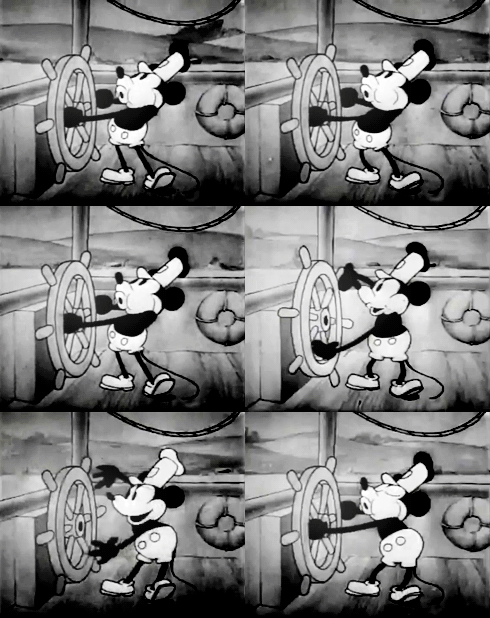
The idea of Steamboat Bill, Jr. was brought to Keaton by director Charles F. Reisner, based on a popular song made famous by singer Arthur Collins from 1911, Steamboat Bill. The song would also appear in another 1928 film of note, the Disney short “Steamboat Willie”, which was a parody of Steamboat Bill, Jr. and helped to launch the career of animated character Mickey Mouse.


Mickey Mouse made his debut in Steamboat Willie (1928), a parody of Steamboat Bill, Jr.

Despite the writing credit of story and screenplay by Carl Harbaugh, Keaton and his gagmen did the bulk of the "writing" that made it on screen. Keaton would say that Harbaugh was useless. And while Reisner is credited as director, Keaton also had a hand in that as well.

The film opens with the text, Muddy Waters, which is not a reference to the legendary blues singer, but to the Mississippi River. Up to the pier in the small town of River Junction steams a new paddle-wheel, the King, named after John James “J.J.” King (Tom McGuire), who also owns the River Junction Bank and the Hotel King.


The newest steamboat in River Junction is King, the namesake of J.J. King.

King’s plan is to run William “Steamboat Bill” Canfield (Ernest Torrence) and his ship, steamboat Stonewall Jackson, out of business. Even Bill’s first (and last) mate, Tom Carter (Tom Lewis) practically concedes defeat. But Bill is not going to give up without a fight.

Returning to port, Bill is handed a vaguely worded telegram from his son in Boston, whom he hasn’t seen since he was a baby. Bill, Jr. has recently graduated from college and has been sent by his mother to visit his father. Bill and Tom imagine that Bill, Jr. must be like Bill, a strapping, muscular sort, perhaps, as Bill imagines, even bigger’n than he is.


 Bill, Jr. (Buster Keaton) is not all what his father Bill, Sr.(Ernest Torrence)
was expecting. First mate Tom Carter (Tom Lewis) looks on from the left.

He is no doubt disappointed when he realizes that the meek-looking, fancy-dressed. beret-wearing man carrying a ukulele under his arm is his son, Bill, Jr. (Buster Keaton). Bill tries to remake his son in his own image, first taking him to the Hotel King barber to get his pencil-thin mustache cut off. There Bill, Jr. is reunited with alumni, Kitty King (Marion Bryon), who has also just returned home. She can’t wait to introduce Bill, Jr. to her “loveable” father, unaware of the feud between their fathers (think Romeo and Juliet).


Kitty King (Marion Byron) Bill Jr.'s alumni also home from college. This was Marion's first film.

While she runs off looking for her dad, Bill, Jr.’s drags him to the hat shop to find a suitable replacement for the beret. In a bit of slapstick, we see the father and milliner try on a succession of hats, including, though only Bill, Jr. seems to notice, Buster Keaton’s iconic porkpie hat. After finally agreeing on a hit brimmed white hat, no sooner do they step outside than a gust of wind blows it off of Bill, Jr.’s head and back comes on the beret.


While trying on hats, Bill, Jr. is fitted with a porkpie hat synonymous with Keaton.

This time, Bill takes his son to get new clothes, more suitable replacements for the striped blazer, wide-legged pants and checkered bow tie he’s wearing. Bill leaves his son alone and Kitty runs to help. With her help, as the movie attests, Bill, Jr. reunites with his father dressed more like a yachtsman than a crew member aboard a steamboat. When he sees him swagger onto the docks, Tom hands Bill, Sr. a wrench saying “No jury would convict you.”

Bill, Jr. is nothing but clumsy. He knocks into a deckhand and sends a life preserver into the water (where it sinks). On board the ship, he hits his head as he ascends the stairs, runs into wires and nearly falls off the deck of the Stonewall Jackson. When he sees Kitty on the deck of the King, he poses for her benefit and even when he is upended when a deckhand pulls the rope out from under his feet, Bill, Jr. tries his best to impress her.


Bill, Jr. is not at ease on board his father's boat the Stonewall Jackson.

With the two boats docked so close together, Kitty jumps on board the Stonewall Jackson to be near Bill, Jr. When King tries to drag his daughter back to his boat, Bill, Jr. follows. Then Bill demands his son return to his boat. King ups the ante by having one of his uniformed officers throw Bill, Jr. off the King, but Kitty follows her man back to the Stonewall Jackson. Bill, Jr. talks her into returning to her father's boat. But that’s not good enough for King, who warns Bill that if his son returns to the King, he will personally wring his neck.

Bill prods his son to step back on board the King and Bill, Jr. is thrown back and forth between the two boats. Finally thrown back on the deck of the Stonewall Jackson, Bill, Jr. brings the King’s officer with him. The officer gets up and tries to fight Bill, Jr., who declines. But Bill doesn’t quit; he takes his son’s hand, balls it into a fist and knocks the officer back into the water.


Buster becomes a pawn between his father and his rival J.J. King (Tom McGuire).

Bill threatens King, by saying if any of his men board his ship, Bill, Jr. will take care of them. But before Bill, Jr. can feel too smug, his dad pulls him away and over another of the ship’s cables. King likewise pulls Kitty off in the opposite direction.

Bill tries to get a crewman to show Bill, Jr. how to run a steamship, but the curious boy pulls a chain which sends the boat forward, ramming the King repeatedly, eventually sending its namesake into the water. Bill is mad at his son until he sees his rival in the water. Trying to celebrate, he gives his son a plug of chewing tobacco. When he slaps his son on the back, Bill, Jr. swallows and faints to the floor.

That night, Bill, Jr. sneaks off the Stonewall Jackson to rendezvous with Kitty, who has left him a note saying that she’ll wait for him at the salon. But his father catches him and makes Bill, Jr. give up the uniform. Meanwhile, King admonishes his daughter for her interest in the Canfield boy. He tells her that he will pick the right man for her, while at the same time Bill tells his son that he’ll pick the right girl for him.

But undeterred, Bill, Jr. sneaks out. His clumsiness gets the best of him when his attempt to bridge the gap between the two decks with a plank fails and he ends up in the water. Bill watches as his drenched son climbs on board the King in defiance. Eventually, King, an officer and Bill, Jr. all end up back in the water again.

The next morning, Bill wakes his son with cold water and presents him with cash and a train ticket back to Boston.

Bill gives his son a ticket back to Boston.

Meanwhile, the Stonewall Jackson is condemned. Thinking King is behind the notice, Bill confronts him in public. Their confrontation escalates into a brawl and Bill is arrested for assaulting King.

Bill, Jr. has by now started for the train station. He pauses when he sees Kitty walking towards him, but she continues past him into a building. Not sure if he just imagined her or not, he continues towards the station. But Kitty has a change of heart and follows after him.

Kitty is only a few feet behind him when Bill, Jr. sees his father being taken to jail. Determined to get his father out of prison, he tears up his ticket and turns to return to the ship. Kitty turns at the same time and appears to be walking away from him, which gives him pause.

A box on the front page of the local paper declares that the weather will be wet and cloudy on the day Bill, Jr. goes to visit his father in jail. After sinking waist deep into a puddle, Bill, Jr.’s over-sized umbrella gets turned inside out. Once in the jail, Bill, Jr. unwraps the white bundle he’s been carrying to reveal a loaf of bread he’s brought for his father, who turns it down. Bill tells the jailer to throw him out, but Bill, Jr. decides to wait it out until his father gets hungry enough for the bread.


Bill shows the Sheriff the loaf of bread he's brought his father in jail.

While he waits for his father to come around, Bill, Jr. comes across the posted lyrics to ‘The Prisoner Song’, which he sings. Then he tries to pantomime to his father how a prisoner could escape, by sawing through the bars and knocking out the guards, but Bill does not understand the message.

Bill, Jr. tries a second strategy. He stages a rock being thrown through the glass of the jail and while a dim-witted sheriff sorts it out, Bill, Jr. opens the loaf of bread to show his father that it is filled with escape tools. But when he is escorted to his father’s cell, all the tools fall out on to the floor. He is also taken into custody, but manages to escape, setting off a chase which ends when the sheriff drops his keys, which Bill, Jr. hands back to him.

Unappreciative the sheriff throws him up against the bars. But Bill encourages his son to fight back and Bill, Jr. knocks out the sheriff with a blow to his stomach. Bill escapes outside to the bushes, but his son’s long coat gets caught in the jail door, but the keys, where his father dropped them, are a little out of reach. By the time he finally frees himself, deputies arrive and hold him. The revived sheriff whacks Bill, Jr. over the head with his gun.

Then Bill, upon seeing the blow and his son being taken to the “receiving” hospital, punches the sheriff and then walks back into his cell.


While Bill, Jr. is at the hospital, hurricane force winds start to destroy the town, ripping the sides off buildings if not completely off their foundations. There is chaos in the streets as men and women seek shelter from the destructive winds.

And it is at this time that the daredevil athleticism of Buster Keaton really takes over. It would be near impossible to describe all of his antics as he moves from one near-fatal stunt to another. But it is in this sequence that we do get perhaps the best-known bit from Buster Keaton’s film when the three-story front of a house falls and the great stone face escapes by standing precisely where a window is. There’s been a lot written about Keaton’s frame of mind at the time the film was made. His marriage to Natalie Talmadge was falling apart and knew his days as an independent filmmaker was coming to an end. Some say he was suicidal when he took such risks, but these were well-calculated stunts, if not grander versions of ones he’d already performed. (The house façade narrowly missing him was also done on a smaller scale in the short, One Week.)


Keaton couldn't move, literally. His shoes were nailed down.

The stunts, all done by Keaton, have to be seen to be believed and fully appreciated. This sequence truly rivals anything from a Harold Lloyd film, another silent comedian known for his dangerous comedy bits (see Safety Last (1923)). In addition to the falling house, Keaton is blown around by the high winds, electrocuted by downed power lines and even rides an uprooted tree. Towards the end of the sequence, Bill, Jr. climbs onto the paddle wheel of the Stonewall Jackson, which has broken free of its mooring and is floating down river.

Bill, Jr. quickly becomes a hero. When the house Kitty is trapped in floats by, he uses the ship’s anchor as a grappling hook to stabilize the house. He attempts to use a rope to save Kitty, but on returning to the ship the weight is too much and the rope breaks. Thrown into the water, Bill, Jr. swims Kitty back to the ship and gets her up on deck.

Next, he rescues his father from the jailhouse, which is now also floating by in the river, with Bill waist deep in water. Using an elaborate web of ropes and levers, Bill, Jr. crashes the Stonewall Jackson into the jailhouse and frees his father, pulling him from the river.

After that, Bill, Jr. steers the ship to rescue J.J. King from his floundering namesake. Diving nearly two stories into the river, Bill, Jr. rescues Kitty’s father and swims him back to safety. Kitty and Bill pull her father up onto the deck and the two fathers seem to reconcile during the tragedy.

And just when it seems everyone is safe, Bill, Jr. grabs a life preserver and jumps back into the river. Kitty is dismayed until she sees him swimming back with a minister (James T. Mack) in tow.


Bill rescues a minister (James T. Mack) so he can marry Kitty.

The cyclone/hurricane ending was not the original one they had in mind, but a devastating flood on the Mississippi River in 1927 caused a rewrite. The Mississippi flood, the worst in U.S. history, impacted 14 states, caused over $400 million in damages and killed 246 people in seven states. Feeling the events were too recent, the flood was changed to winds. The change also drove up the $200,000 budget, as on short notice $135,000 worth of breakaway sets were constructed and six powerful wind machines were deployed to knock them down.

Shot in Sacramento with a budget of over $400,000, the film, which opened to mixed reviews, actually lost money in its initial release. Despite its less than grand debut, the movie is now considered a classic and an essential Keaton film. The film combines the best elements of Keaton’s work, from the humor of human interaction to his death-defying slapstick stunts.

Steamboat Bill, Jr. was the first film for Marion Byron, who played Kitty King. She would appear in 44 films, but none would be as memorable as this one. After this movie, she would sign with Hal Roach and appear in several comedy shorts with the likes of Charley Chase and Edgar Kennedy. After the talkies became all the rage, she moved into musicals, now mostly forgotten. Her last film was Five of a Kind (1938).


Ernest Torrence was a Scottish born actor who came to America in 1911 and found work on the Broadway stage. His role in the musical The Night Boat (1920) got the attention of Hollywood. His first film role was Luke Hatburn in the enormously popular Tol'able David (1921), which was voted a Photoplay Magazine Medal of Honor, a big pre-Academy honor. He would also appear in the Lon Chaney Hunchback of Notre Dame (1923). Like Byron, Torrence moved into talkies, making his last film I Cover the Waterfront (1933). Soon after that film was completed, he died suddenly from an acute attack of gall stones.


Buster Keaton, along with Charlie Chaplin and Harold Lloyd, is considered one of the great silent film comedians. Up until the time Keaton joined MGM, all three had retained a certain independence from the major studios. Keaton’s films, like Chaplin’s, were made when inspiration struck. If one gag didn’t work, then re-do it until the desired effect was obtained. (The Unknown Chaplin TV series, from 1983, details Chaplin’s reworking of bits and shelving ideas that he couldn't get to work on film.) None of them could have been as creative in a studio environment which at the time prized speed over quality.

It is sad that for Keaton, Steamboat Bill, Jr. was a last hurrah of sorts. His career and life would never be the same after this. But the film stands as a testament to his talent and must be/should be seen to be appreciated.