

Beggars of Life (1928) Starring Wallace Beery, Richard Arlen, Louise Brooks. Directed by William A. Wellman. Screenplay by Benjamin Glazer with Titles by Julian Johnson. Based on the novel Beggars of Life by Jim Tully (New York, 1924). Produced by Benjamin Glazer Run Time: 80 minutes USA Black and White. Silent. Drama.
In the fall of 1925, Outside Looking In was a minor hit on Broadway. Based on the biography of Jim Tully, who had spent seven years riding the rails of the US as a Hobo (what they used to call wandering homeless men), the play, written by Maxwell Anderson, ran for a total of 113 performances during the fall. One of the fans of the play was Charles Chaplin, who was in New York for the premiere of his film The Gold Rush (1925). He saw the play three times during its run. While he was in town, he also had a short love affair with a young dancer featured in the Ziegfeld Follies on Broadway. The third time he attended the play, he brought his young lover with him. She was not nearly as impressed as he was with the play. She would later comment she would have paid more attention to the play if she knew someday she would star in the film version. That young woman was Louise Brooks.
Perhaps known now for her later films in Europe: Pandora's Box (1929); Diary of a Lost Girl (1929) and Prix de Beauté (1930), in 1928, Brooks was a contract player at Paramount Pictures, having also been discovered by producer Walter Wanger while dancing in the Ziegfeld show. Wagner, who was also at Paramount, had actually encouraged Brooks to sign with MGM, the other studio interested in her, but she, as she often did, did it her way and signed with Paramount for a five-year contract in 1925. Never really sold on a film career, Brooks never took Hollywood fame or acting very seriously, though she did appear in a dozen films before Beggars of Life, working with directors like Frank Tuttle, Malcolm St. Clair and Howard Hawks and with such actors as W.C. Fields, Ford Sterling, Adolphe Menjou, and Wallace Beery before making Beggars of Life.
Wallace Beery, whom we’ve discussed before in our review of Min and Bill (1930), was already a big star in Hollywood. He had broken in playing comedy, even in a series of cross-dressing films as Sweedie, a Swedish maid character. He had turned to villains in such films as Patria (1917), in which he portrayed the still active Pancho Villa. Beery had appeared in a wide range of films prior to Beggars of Life, including The Last of the Mohicans (1920); The Round-Up (1920) with Fatty Arbuckle); Robin Hood (1922) with Douglas Fairbanks playing King Richard the Lionheart; reprising the role in the sequel Richard the Lion-Hearted (1923); The Lost World (1925), as Professor Challenger; Old Ironsides (1926); Casey at the Bat (1927); and Now We're in the Air (1927) opposite a still new talent, Louise Brooks.
Richard Arlen got into films in a rather unusual way. After World War I, Arlen worked in the oilfields of Oklahoma and Texas before heading to Hollywood to become a movie star. However, he found that no producer was interested. He took a job as a delivery boy for a film laboratory when the motorcycle which he was riding landed him with a broken leg outside the Paramount Pictures lot. A director took pity on Arlen and gave him his start as an extra. His first screen appearance was in Ladies Must Live (1921). Arlen would appear in several films, but mostly in uncredited roles or in supporting roles. Wings was his breakout role.
At about the same time as Chaplin was discovering Outside Looking In, Paramount was also interested in the property, thinking Beggars of Life would make a good film. That job fell to William A. Wellman, their contracted director, who had recently finished their biggest hit from 1927, Wings. Tully was originally going to adapt his own book, but in the end, the credit went to Benjamin Glazer. Glazer at the time was a very successful screenwriter, having won an Academy Award in 1927 for Best Writing (Adapted Screenplay) for his adaptation of the novel Seventh Heaven by Austin Strong.
While Tully’s book would have been considered an autobiography, the film is anything but. There is no Tully character and the story isn’t really based on his adventures on the rails. It was rumored at the time that Tully would appear in the film, that didn’t happen either.
 |
| Jim Tully didn't appear in the film, but he did visit the set. Seen here with Louise Brooks, Wallace Beery and Richard Arlen. |
Production began in May 1928, either on the 19th (according to Exhibitors Herald and Moving Picture World) or the 24th (according to Film Daily). There were 10 days of work done at the studio before the production team, seventy-five strong, left for location shooting at Jacumba Hot Springs California, down near the Mexican border, on June 3rd. They would stay on location until June 27th, when the crew returned to Hollywood.
The main reason for shooting in Jacumba was the use of the railroad as the train plays a large part in the telling of the story. All of that activity occurred in and around Locomotive 102. Since there were few trains scheduled to use the track, it allowed for Wellman and crew plenty of time to get shots without having to worry about being disturbed.
Location shooting had its ups and downs, especially for Brooks. She found that Arlen, despite his smiling demeanor, did not think much of her or her acting, letting it all go one night over whiskey when the two were alone. Not only did he not like the fact that he made far less than she did, but he thought she was a non-talent actress as well. According to Brooks, in her essay “On Location with Billy Wellman” written many years after the fact, Arlen, already drunk, told her “… You – why, you can’t even act! You’re not even good-looking. You’re a lousy actress and your eyes are too close together.”
Brooks seemed to have given her all to the production, letting herself get talked, by the director, into doing her own stunt on occasion. One time, while trying to run and hop on a moving train, she was nearly swept up underneath it.
 |
| The production crew on location at Jacumba. |
While she worked hard, she also played hard. After watching her male stunt double, Harvey Parry, complete an arduous stunt and admiring his physique, she offered to let him come to her room that night, which he did. Brooks was known as a sexually liberated woman, long before it was considered fashionable. Her reputation followed after her. The next morning, Harvey confronted her. He had heard from someone that Brooks was the girlfriend of a studio executive whom she didn’t know. Harvey had heard that this executive had syphilis, so in front of the whole crew, Harvey asked Louise if she had syphilis, much to her great embarrassment.
But these distractions didn’t really affect the actual production of the film. What did impact it was the transition from silent to sound films. As theaters across the country were transitioning, Paramount Pictures wanted to have a sound product, so the film was released in both versions. Using the Movietone process, the sound effects, a synchronized musical score, a bit of dialogue and a song were included. Beggars of Life would be the studio’s first release to include spoken dialogue. No sound elements from the original release still exist.
The song was sung by Wallace Beery, who, ironically, would later be fired by Paramount most likely because of the same vocal qualities that would make him a memorable actor at this next studio, MGM; his basso voice and gruff, deliberate drawl.
The film opens with a hobo, Jim (Richard Arlen), walking up to a farmhouse. The door is open, but the screen door is closed. Jim can see and smell the food on the table in front of a farmer (Frank Brownlee), who appears to be sleeping. Jim tries to rouse the man, and when that fails takes the bold step of going inside. He finds that the man is not asleep, but dead with blood on the floor.
The only person inside is Nancy (Louise Brooks), who is dressed in men’s clothing. She admits that the man is her adoptive father and that ever since she’s lived with him, the man had been making sexual overtones towards her. Finally, this morning, after she made him breakfast, the man grabbed her. In her struggle to escape, she ended up shooting him with a rifle. Mortally wounded, the man ended up sitting down at his place at the table.
 |
| Nancy (Louise Brooks) tells Jim the story of the murder. |
Nancy wants to get out before the murder is discovered. She feels her odds are better if she looks like a boy rather than a girl.
Jim is reluctant to help her but agrees to help her escape. He is used to riding the rails and agrees to get her on a train going in one direction, while he gets on one going in the opposite. He makes a point of packing the food from the dead man’s plate before the two leave the house.
 |
| Jim (Richard Arlen) tries to teach Nancy how to jump on a moving boxcar. |
Nancy claims to have caught a train before, but her first attempt goes badly and she gets thrown. Jim takes pity on her and agrees to have her come with him. With his help, the two manage to scramble into an open flatbed and are about to indulge in a little picnic when a train detective catches them. He makes the two of them jump off the train. Nancy is a little worse for wear, but manages to walk off her injury.
 |
| Nancy ends up in the weeds next to the track. |
The two walk until it gets to be nightfall. Jim leads her into a farmer’s pasture, where he cleans out enough room for them to sleep. While Nancy is a bit nervous about sleeping next to a strange man, the two talk about their dreams. Jim is on his way to Canada where his Uncle will set him up if he wants to settle down. That sounds good to Nancy, who has similar dreams as well. The two sleep next to each other without incident until the next morning. That’s when a Farmer discovers the two. They run off before he can stop them.
 |
| A publicity still showing the moment they're discovered in the farmer's hay. |
But by the next morning, there are already wanted posters out for Nancy, which Jim tries to hide from Nancy. They’re both hungry and when a horse-drawn bakery cart goes by, they hop on the back and help themselves to buns to eat. The driver (Guinn “Big Boy” Williams) who had been asleep, awakes when he hears them. Moving a lever, the seat they’re on withdraws and Jim and Nancy fall onto the street.
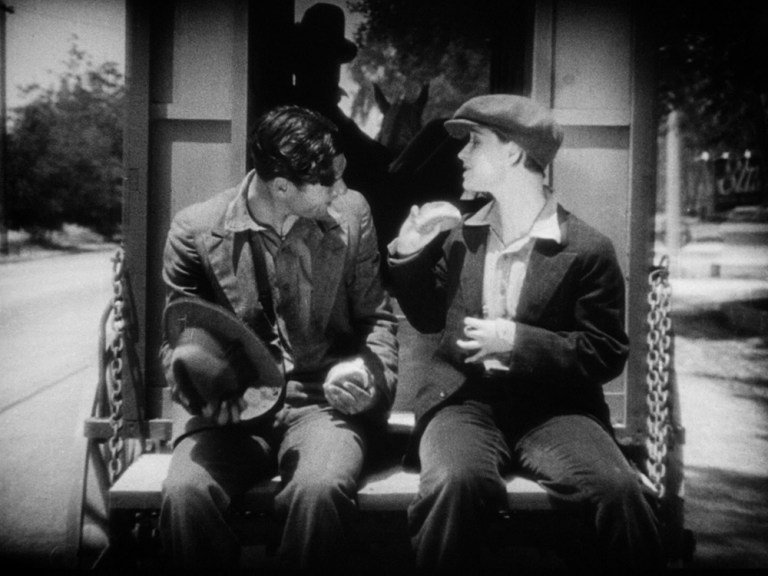 |
| For a few moments, things are looking up as they grab and eat breakfast on a bakery cart. |
Jim leads Nancy off the main road and into the jungle, eventually ending up at a hobo camp run by The Arkansaw Snake (Robert Perry) where they are not allowed to eat any of the stew that is being prepared since they didn’t contribute to the pot.
 |
| Oklahoma Red (Wallace Berry) show up carrying a stolen keg of moonshine. |
After a while, Oklahoma Red (Wallace Beery) shows up, carrying a stolen keg over his shoulder and singing a song about being a hobo. Arkansaw relents control to Oklahoma and he offers up his moonlighting to everyone including Jim and Nancy, whom everyone still thinks is a boy. It is only after her backside is noticed that her true identity is revealed.
The hobos take a prurient interest in her and Jim is no position to physically stop them. However, he shows them her wanted poster and the men back away. They don’t have any plans to let her come with them, but Red insists they bring her along.
Officials raid the camp, but the hobos fight back, subduing their cops. When the train they plan to ride comes by, the hobos run off with Red even going back to collect the keg. All of the men make it into the same boxcar. They all have colorful names, like Lame Hoppy (Roscoe Karns), a one-legged hobo; Black Mose (Edgar “Blue” Washington), a black hobo who is accompanying a sick white hobo; Skinny (Horace “Kewpie” Morgan); Baldy (George Kotsonaros); Ukie (Jack Chapin); Rubin (Johnnie Morris); and Skelly (Andy Clark).
 |
| Red sees Jim as an obstacle to get to Nancy and plans to get rid of him. |
Red takes control of the situation, stating that if he’s in a gang, it’s his gang. Giving Nancy the once over, he adds that any girl in the gang is his girl. There is a very real sense that rape and/or gang rape is not too far away from happening. Jim seems to be all that is standing in the way, so Red organizes a Kangaroo court to find Jim guilty and sentence him to death by being thrown from the train. Dressing up like judge and jury, Red finds Jim guilty before any evidence is given.
 |
| With Red's gun, Jim manages to hold everybody back away from Nancy. |
But Nancy insists on choosing Arkansaw as her champion and a fight ensues amongst the hobos. Jim manages to pick up Red’s gun when it falls to the floor. But their confrontation is interrupted when more railroad detectives aboard the train start making their way back to the boxcar. Red climbs out and detaches the car from the rest of the train, sending several cars, including the caboose, back down the perilous track and crashing into a barricade at the bottom of the hill.
 |
| Black Mose (Edgar “Blue” Washington) takes Nancy and Jim to an abandoned shack. |
With the authorities coming, the hobos scatter. Black Mose, who is carrying his sick companion, leads Jim and Nancy to a nearby abandoned shack where they can hide out. After a while, Black Mose goes off to look for food for his friend and while he is gone, the hobo dies. Jim and Nancy cover him up to his eyes.
 |
| Red shows up in a stolen car with a stolen dress for Nancy. |
Out of the blue, Oklahoma Red shows up driving a car he's managed to pilfer and a dress for Nancy, which she puts on while Jim and Red step outside to talk. Jim keeps the gun on Red but allows him to make one final play for Nancy, using the tact that they’re looking for the two of them and splitting up would be in everyone’s best interest. While what he says makes some sense, Nancy and Jim decide to stay together. Red starts to leave, but comes back one more time and manages to take the gun away from Jim.
 |
| Jim continues to train his gun on Red even after he's tried to help them out. |
Red claims to be tired and, with time to kill before the next train, lays down next to the dead hobo to take a nap.
Black Mose returns with food, including a chicken, which he proceeds to pluck, not realizing his friend is already dead. With Red pretending to be asleep, Jim and Nancy make a run for it, steal the car and drive off. Red stops pretending to sleep and tells Black Mose that he was waiting for them to make a run, hoping to help them since they’re in love.
When Black Mose discovers his friend is dead, it hatches a plan with Red. To better aide in Nancy’s escape, they dress the dead man in her man clothes and then take him back to the wreckage. There they place his body in amongst the lumber cargo along with igniter fuel to create a fire. Black Mose warns Red about getting trapped, but Red tells him his foot hasn’t slipped yet.
Authorities arrive and arrest Black Mose and reattach the caboose and other cars to the main train. After they’re going, Red sets a fire. The authorities are trapped in the caboose with the fire in the car next to them. Red manages to escape from the car and once again uncouples the cars from the main train. But this time he’s shot by authorities as he climbs on top of the boxcar.
The caboose and flatcar head back down the track and eventually off the track into the gorge below.
Cut to Jim and Nancy on a train headed to Canada, thinking about how Red helped them escape.
Meanwhile, Red, who is only semi-conscious, slips off the boxcar and over the edge of the cliff. He lands hard on a landing and with his last breath says, “I guess my foot slipped”.
Cut to Jim and Nancy on a train headed to Canada, thinking about how Red helped them escape.
Meanwhile, Red, who is only semi-conscious, slips off the boxcar and over the edge of the cliff. He lands hard on a landing and with his last breath says, “I guess my foot slipped”.
The film had its premiere in Indianapolis on September 5, 1928, and its New York opening on September 22. Seeing as it was Wellman’s next film after Wings, as well as Paramount’s first film with synchronized dialogue, there was a lot of anticipation around its release. However, the film did not fare well with film audiences or critics, receiving mixed reviews at best. As an example, Variety in its review on September 26th review called it “not an exceptionally good picture.” Mordaunt Hall, in his review in the New York Times, dated September 24, states, “It is a picture that might have been infinitely better handled, for William Wellman, who is responsible for the direction, reveals but little intimate knowledge of his subject.”
Some of the thought about the film’s lack of success has to do with its dark tones during what was still the good times in the U.S.; the great depression was still over a year away and this wasn’t the right film at the right time. Audiences at the time were said to want their stars to look glamorous on film, rather than dressed like hobos.
There are some interesting features about the film. One that comes to mind is how Nancy tells Jim about the farmer attacking her. In what would normally now be a flashback with voice-over is told by showing the action with Nancy’s face superimposed over it, linking the teller with the story.
While Wallace Beery might not be my favorite actor, he certainly does have a star’s presence when he appears on the screen. You can’t help but look at him and I found him easier to take without sound. His character Red is hard to pin down. At one point, it is pretty obvious that he wants to rape Nancy, but only a few hours later, he lets the love he sees between Nancy and Jim change his mind to help them. He’s just a really bad guy with a heart o’ gold.
Louise Brooks, who is as good in this film as Richard Arlen is, never really looks like a boy. She is far too pretty to pass. Also, while she looks good in her signature bob haircut, I wonder if the farmer’s daughter that she’s supposed to portray would have that same exact style. I’m only guessing that Paramount didn’t want to deglamorize one of its buddy stars too much and wanted her to be recognizable on screen.
Arlen’s character is also hard to pin down. He at first takes pity on Nancy and then falls in love with her, but I get the feeling he’s somewhat subdued in defending her. He doesn’t really try to stand up to Arkansaw or Red to defend her and doesn’t try to take charge until he has a gun in his hand. But even then, you know that Red will turn the tables on him, which he does.
I don’t know enough about hobo life to comment on the film’s authenticity in that regard, but I do question one of the main points, the murder. The farmer was, after all, trying to rape his adoptive daughter, which one has to imagine was against the law even in the most rural of areas. The murder was therefore in self-defense. Now maybe you can tell me things were different back then, but I always wince when the plot is forwarded by dumb decisions.
 |
| William A. Wellman directing from on top of the train. |
Despite the film’s shortcomings and lack of praise, Wellman considered it to be one of his favorites and his best silent film. In 1965, when the San Francisco International Film Festival was going to do a career retrospective on Wellman, he wanted them to show this film and had plans to bring Louise Brooks to the event. However, they couldn’t find a print of the film and Wings was shown instead.
While considered by some to be a hidden treasure, I was not as enamored with the film as I had hoped. However, there are so few films that survive from this era and so few films that star Louise Brooks survive (of her nearly two dozen films, six are lost or all but lost) that each one is therefore special. If you’re a fan of hers, of silent films or of the work of William A. Wellman, then you should see Beggars of Life.
For other Silent films, please see our Silent Film Review Hub.
While considered by some to be a hidden treasure, I was not as enamored with the film as I had hoped. However, there are so few films that survive from this era and so few films that star Louise Brooks survive (of her nearly two dozen films, six are lost or all but lost) that each one is therefore special. If you’re a fan of hers, of silent films or of the work of William A. Wellman, then you should see Beggars of Life.
For other Silent films, please see our Silent Film Review Hub.


.jpg)


