Showing posts with label A Christmas Carol. Show all posts

Saturday, July 9, 2022

Mickey's Christmas Carol


Considering the longevity of Charles Dickens’ immortal novella, A Christmas Carol, and Disney’s penchant for adapting public domain works, it was only inevitable that the two would eventually cross paths. That was exactly what happened in 1983, when Disney released Mickey’s Christmas Carol, an adaptation of A Christmas Carol starring Scrooge McDuck and featuring Mickey Mouse and friends, as well as characters from other Disney films. This featurette would also mark Mickey’s return to theaters after a thirty-year gap, with The Simple Things (1953) serving as his last original venture, and accompanied a re-release of The Rescuers (1977). Naturally, Mickey’s Christmas Carol would also receive its own home video release, which was how we watched it for the first time, specifically through a Blu-ray, and how we concluded that despite its short length, it could still easily serve as a Christmas staple.

Saturday, December 19, 2020

Stubs - A Christmas Carol (1910)


A Christmas Carol (1910) Starring: Marc McDermott, Charles S. Ogle. Based on A Christmas Carol by Charles Dickens. Directed by J. Searle Dawley. Produced by J. Searle Dawley (uncredited). USA. Black and White. Run Time: 10 minutes. Silent, Christmas, Drama.

Films have been made based on Charles Dickens’ 1843 novella, A Christmas Carol, for almost as long as they’ve been making movies. The first was a short British film Scrooge, or Marley's Ghost (1901), and the latest, at least at this writing, was A Christmas Carol (2020), a film adaptation by David and Jacqui Morris. The story has been adapted in animated form, as television specials and some direct to DVD releases. It should therefore come as no surprise that Edison Studios would have also made a version.

Review Hub - A Christmas Carol


Though not his only Christmas-related work, A Christmas Story by Charles Dickens has become one of, if not the, most famous and celebrated Christmas stories of all time since its original publication in 1843. Owing to this, the book has never been out of print and its public domain status has seen it a number of adaptations over the years in just about any given medium, often (in the context of this blog) in cinema or as a stock plot for a Christmas episode or special in numerous television series, often animated. The countless interpretations of the story has led to some trying to find different ways to spin the story or, in the case of stories such as The Man Who Invented Christmas, exploring Dickens' writing process and backstory for the book, to varying results. With new adaptations of the story coming out on an annual basis, it appears that there is no stopping it any time soon.

Below is a list of links to every review of A Christmas Carol adaptations or related on this blog, listed in order of release.

Update (12/19/2020): Added A Christmas Carol (1910)
Update (7/10/2022): Added Mickey's Christmas Carol (1983)


Saturday, December 24, 2016

Stubs - A Christmas Carol (1984)


A Christmas Carol (1984). Starring George C. Scott, Frank Finlay, David Warner, Susannah York, Edward Woodward, Roger Rees. Directed by Clive Donner. Screenplay by Roger O. Hirson. Based on  A Christmas Carol (1843) a novel by Charles Dickens. Produced by George F. Storke and Alfred R. Kelman. Runtime 100 minutes. United Kingdom/United States. Color. Christmas. Drama

A Christmas Carol continues to be a source for Christmas movies, including comedic send-ups, like Scrooged (1988) starring Bill Murray and A Christmas Carol (1999) starring Patrick Stewart. The story seems to attract a lot of big names, the same way that the Christmas album does in music with everyone and their brothers putting out holiday releases. But perhaps the biggest movie star to appear in one of these films is George C. Scott, the winner of the Best Actor for his role in Patton (1970), an honor he ultimately refused.

In the early 1980s, the UK became a production location for not only American films but also television. Drawn to the island by tax incentives and lower costs, Hollywood was also drawn to the wealth of talent that lived there, too. Shot on location in Shrewsbury, England, this Christmas Carol was to receive a television release in the U.S., but a theatrical release in the UK.  Like Mr. Magoo’s Christmas Carol (1962), which was sponsored by Timex watches, when this version aired on U.S. television, it had a single sponsor, IBM, then a personal computer maker.

The story starts on a foggy, snowy Christmas Eve, 1843. Our narrator, Roger Rees, reads the first lines of Charles Dickens’ A Christmas Carol, “Marley was dead, to begin with. There is no doubt whatever about that.” We are introduced to Ebenezer Scrooge (George C. Scott), a miserly man who does not share the rest of the world's merriment at Christmas. When his nephew, Fred (Roger Rees) comes to his office to invite Scrooge to dinner the next day, he is turned down.


Fred (Roger Rees) invites his Uncle Scrooge (George C. Scott) over for Christmas dinner.

On his way out, Fred says hello to Bob Cratchit (David Warner), Scrooge’s long-suffering employee. Fred asks about his family and wishes them a Merry Christmas before leaving. Scrooge is on his way out to the London Stock Exchange and admonishes Cratchit for using too much coal in the fire and for wanting the whole next day off. He makes Bob promise to be early the next day and hurries off.


Bob Cratchit (David Warner) is Sctooge's long sufering employee.

Outside, he encounters a cripple, whom he mistakes for a beggar. But the boy, Tim (Anthony Walters) tells him that he’s waiting for his father to get off work.


Scrooge initially mistakes Tiny Tim (Anthony Walters) for a beggar.

At the exchange, Scrooge drives a hard bargain for corn that he has that three men want to buy. Apparently, discussed this transaction the day before and want to accept Scrooge’s asking price, but he’s now raised it 5%. The men tell him that it will make the grain too expensive for the poor to afford, but he is adamant about the price, even threatening to raise it further if they don’t buy now. They capitulate and he demands payment in full before it will be shipped.  (For the first time in our survey, we are given an occupation for Scrooge, commodities.)

Scrooge is then accosted by two businessmen, Mr. Poole (Michael Gough) and Mr. Hacking (John Quarmby) who are collecting charity for the poor. Scrooge asks them about the prisons and the workhouses, which both men acknowledge are still operating. Relieved that those institutions, which his taxes are paying for, are still open, he refuses to give them anything. When he’s told that many would rather die than go to one of them, Scrooge encourages them to hurry up and relieve the surplus population. Dismayed, the men move on.


Scrooge is stopped by Mr. Poole (Michael Gough) and Mr. Hacking
(John Quarmby) looking for donations for the poor. 

When Bob gets off work, he finds Tim still waiting for him. Tim wants to stop by and watch the other boys play in the snow and Bob is only too happy to take him. After a little while, though, he decides they should go home.

Scrooge meanwhile returns home in the dark. On his way in, he notices that on the door knocker is the image of his deceased partner, Marley (Frank Finlay) who had died seven years before on this day. Going inside, Scrooge makes a point of locking all the doors behind him, even setting the dead bolts on the door to his bedroom, before settling down to a bowl of gruel.


Scrooge the face of his deceased partner Marley (Frank Finlay) on his door knocker.

It is not too long before the locks are opened and Marley’s Ghost enters the room. His mouth is tied shut and he is wrapped up in and is dragging long thick chains. At first, Scrooge tries to dismiss Marley as a reaction to a bad piece of food but is made to believe that the Ghost is truly there in front of him. Marley notifies his ex-partner that in the afterlife he is being made to walk the earth as punishment for not doing more with his life.  He informs Scrooge that a similar fate awaits him unless he changes his ways.


Marley comes to warn Scrooge about the fate that awaits him.


To help him, Scrooge is informed that three spirits will visit him, the Ghost of Christmas Past at one o’clock; the Ghost of Christmas Present at two and the Ghost of Christmas Future sometime after that. Marley then disappears out the open window.


The Ghost of Christmas Past (Angela Pleasance) appears to Scrooge.

Scrooge is not convinced and when the clock strikes one and there is no Ghost, he is pretty sure that Marley was just a bad dream. But a few seconds later, the Ghost of Christmas Past (Angela Pleasance) appears, carrying with her a large dunce cap looking object.


The Ghost of Christmas Past takes Scrooge back to hisScrooge days.

She takes Scrooge back to his old days at school. It is Christmas time and he is lonely with only books to keep him company. Flash forward, years have passed and Scrooge is older, but still alone at school. Older Scrooge explains to the Ghost that his father blames him for the death of his mother who died during childbirth. That is until one day when his sister Fan (Joanne Whalley) comes to collect him. She tells her brother (Timothy Bateson) that father has changed and that they’re here to take him home for Christmas. But outside his father Silas (Nigel Davenport) is waiting and he’s not as bubbly as Fan or as changed as she had claimed. He informs his son that even though he will not return to school, he will be going in three days to an apprenticeship.


Scrooge watches as his younger self (Timothy Bateson) hears about his apprenticeship.

The Ghost and Scrooge end up at Fezziwig’s (Timothy Bateson) establishment. Once again it is Christmas Eve and Fezziwig tells all his employees, including Scrooge to put away their work and clear the office for the holiday party to come that night and once again, elder Scrooge and the Ghost are there to bear witness. They watch as the younger Scrooge dances with Belle (Lucy Gutteridge), a young woman with whom he is in love and to whom he is engaged.

But, as we see, as time goes by, their love starts to wane. Belle begins to feel that she is running an increasingly second place to Scrooge’s love of making money. In fact, when we see them again, the younger Scrooge is running late for their date because he had business to take care of. That seems to be the last resort for Belle, who frees him from their commitment.


Belle (Lucy Gutteridge) breaks off  her engagement with Scrooge

Again, we see into the future and see Belle surrounded by her children. When her husband arrives home he relates that he’s seen an old acquaintance of hers. She guesses Ebenezer Scrooge, which he confirms. He tells her that while his partner Jacob Marley lies near death, Scrooge is still hard at work in his office rather than visiting his deathbed. 

Scrooge has had enough and tries to force the spirit to stop. Using the cap the Ghost has been carrying, Scrooge smothers her, but in reality, he’s on the floor of his bedroom at home. Thinking it all a bad dream, Scrooge goes back to bed.

Once again, the clock strikes the hour and when there is no instant appearance of the second ghost, he dismisses Marley’s warnings. But it is only a few seconds before Scrooge hears himself being beckoned into the adjoining room that is filled with bright lights. There sits the towering figure of the Ghost of Christmas Present (Edward Woodward).


The Ghost of Christmas Present (Edward Woodward) is the second one to visit Scrooge.

He takes Scrooge out to see how other people are celebrating Christmas. They stop at the Cratchits, where they observe the family enjoying the holiday, being content with their small dinner. Scrooge takes notice of Tiny Tim. When he asks about Tim’s future, the Ghost tells him that he sees an empty chair at next year’s table and a well-preserved cane leaning by the fireplace.


The Cratchits are happy even if they have very little.

They next go to Fred’s where Scrooge’s nephew tells those in attendance that he wishes his Uncle would accept his invitation but remarks that he continues to turn it down. When the party plays a game of similes, Scrooge is hurt when he is the punchline for Fred’s wife Janet (Caroline Langrishe) answer to “Tight as…"

Next, the Ghost takes Scrooge out into the street where we see homeless people trying to survive. One family sustains themselves on the wood and food the husband can find. When he gets depressed about their situation and suggests they go to the poorhouse, the wife insists that if they go they’ll be separated and turns down the idea.

If that doesn’t drive the point home, the Ghost warns Scrooge about the evils of “ignorance” and “want” symbolized by two destitute children. They are thin and sickly and more than Scrooge can bear to look at for long.


The Ghost shows Scrooge Ignorance and Want.

It is on the street that the Ghost leaves Scrooge alone and afraid. At this point, the final ghost, the Ghost of Christmas Yet to Come appears. Silent and cloaked, this Ghost takes Scrooge to the future. At the London Stock Exchange, Scrooge observes three businessmen talking about the death of another man. None of them are really sorry about the death and are willing to go to the funeral as long as a meal is provided.


The Ghost of Christmas Yet to Come appears to Scrooge.

When Scrooge asks who the man is, he’s taken to a room like his house where a body lies alone under a blanket. The Ghost wants Scrooge to pull back the sheet, but Scrooge can’t get himself to do it. Next Scrooge is taken to a fence named Old Joe (Peter Woodthorpe). Mrs. Dilber (Liz Smith) has brought in several pieces of Scrooge’s possessions to sell. Scrooge tries to pretend they are not his things, but it is clear that he’s bothered by the practice.


Old Joe (Peter Woodthorpe) pays some of Scrooge's possessions for cheap from Mrs. Dilber (Liz Smith).

Scrooge demands to see someone mourning a death and he’s taken to the Cratchits. Tim has indeed not survived and the entire family mourns his passing, especially Bob who is heart-broken by the death of his son.

When Scrooge pushes to know the identity of the man they saw under the blanket and he’s taken to a cemetery. There he brushes the snow from the marker and sees that it has his name engraved on it. Scrooge begs to know that if what he’s seen can be changed and promises to change himself.


Scrooge uncovers his name on a grave in the cemetery.

Awakening in his own bed, Scrooge wonders what day it is. He hurries to a window and through it sees a young boy (Ian Giles) running by down on the street. When he asks the boy what day it is, the boy replies that it is Christmas Day. Scrooge is gleeful that the spirits have done their work in one night. He implores the boy to go and bring the poulterer (Alan Bodenham) who has a large turkey in his window. The boy hurries off in an effort to earn the half-crown Scrooge promises him.

Scrooge pays the boy (Ian Giles) for bringing the poulterer (Alan Bodenham).

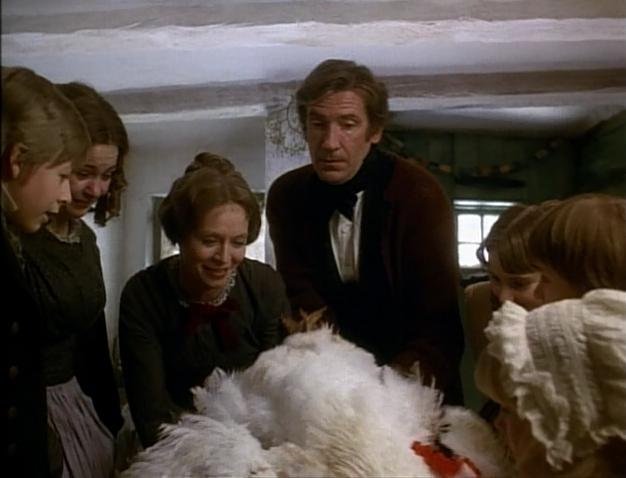
Dressed, Scrooge greets the man and has him anonymously deliver the turkey to Bob Cratchit’s house. The Cratchits are surprised to receive the but are happy about their good fortune.


The Cratchits are surprised by their unexpected bounty.

While out and about, Scrooge bumps into Mr. Poole and Mr. Hacking, offering them a substantial donation for the poor.

Scrooge is a surprise guest at Fred and Janet’s party. Still, they welcome him with open arms, happy that he’s come, even though he is the first to have arrived. In a lighter moment, Scrooge coaches Janet that the answer to the simile question “Tight as…?” is “a drum.”


Scrooge shows up at Fred's house and meets his wife Janet (Caroline Langrishe) for the first time.

The next morning, Cratchit, who is already late, arrives at the office. Unbeknownst to him, Scrooge is already there and calls him out. No doubt fearing a stiff reprimand or, worse, termination, Cratchit is pleasantly surprised when Scrooge doubles his salary and tells him that he wants to help him with his family.

Having made changes in the present, Scrooge has altered the future. Going forward he is said to keep the spirit of Christmas inside him all year long. Not only does Tiny Tim live, we’re told in narration, but Scrooge becomes like a second father to him.


Scrooge becomes like a second father to Tiny Tim.

Dickens’ A Christmas Carol is one of those books that has been adapted so many times that films and TV movies based on it, sometimes rely more on past adaptations than on the source material, as if trying to feed our expectations. As an example, the visitation of the three Ghosts; in the original story, Scrooge is visited by one each successive evening. But in all of the adaptations we’ve reviewed, including this one, all the visits happen on the same night. While it does work better from a story standpoint, I wonder which was the first adaptation to decide the first Ghost would appear at one o’clock, the second at two and the third at three?

Another example is when Scrooge tells the Ghost of Christmas Past that his father blamed him for the death of his mother during childbirth. Again, this is not from the novella, but rather from the 1951 Scrooge, released in the U.S. as A Christmas Carol, replicating dialogue Alastair Sim had with his Ghost. While this is a convenient and somewhat believable explanation for the frosty father-son relationship, it does give rise to its own unresolved complication. Scrooge has a younger sister and there is no mention of the father remarrying. If Scrooge’s mother died giving birth to him, how does Fan exist?

There are other ways that this version diverts from its source material. To begin with, Scrooge’s father, here named Silas, is referred to in the novella but never seen. Nephew Fred is given the last name Holywell, in the book he is not given a surname. And in an effort to make the story more relevant, the movie introduces the idea that Scrooge feels his lack of a fortune makes him unworthy of Belle’s affections and that he must be able to finance their future life together in order to deserve her. These were not Victorian attitudes.

But perhaps the biggest departure is the portrayal of Scrooge himself. Unlike his earlier counterparts, Scott’s Scrooge is far from a fragile and scrawny old man. Scott also makes his Scrooge into more of a ruthless businessman than simply a miser. Finally, this Scrooge seems to think himself funny, as he laughs at his own joke when delivering the "stake of holly through his heart" line.

Like all the other adaptations, Scrooge is the center of the story and no other actor brings as much clout as Scott does to the role. An American, rather than British, Scott doesn’t try to sound English nor does he affect an accent. But to his credit, this isn’t Patton in Victorian England either. Scott is a fine actor who can and does handle the role with skill.

Roger Rees also stands out, but he like the rest of the cast, is subordinate to Scott’s Scrooge. Rees, a fine actor in his own right, might best be remembered for his year-long stage portrayal of Nicholas Nickleby in The Life and Adventures of Nicholas Nickleby in 1980-1981. He also played the role of Robin Colcord during season eight of the long-running sitcom Cheers.


Roger Rees plays Fred in A Christmas Carol.

Edward Woodward appears to relish the role of the Ghost of Christmas Present, with a hearty laugh to go with his bare chest. His performance is one of the highlights of a very strong cast.

Of all the Tiny Tim Crachits we’ve seen, Anthony Walters certainly looks the role with the dark makeup shadows under his eyes. He also underplays the role with a subtlety better than any of his fellow actors that we’ve seen in the role.


Anthony Walters is made up to look sickly as Tiny Tim.

One area where this version is lacking are the special effects. As impressive as the 1938 version was, especially given when it was made, this is a bit of a letdown. To begin with, Marley’s Ghost stops being an apparition and becomes a solid body almost as soon as he enters Scrooge’s bedroom, which is a little unexpected, given the advancements in technology. There’s not the sense of flight that the 1938 version did so well or the multitude of ghosts out the window as there was in the 1951 version. Not sure how much of this were artistic choices and/or budgetary ones. This is a more of a no-frills vision of the story. Not that it suffers too much from this more-straight forward approach, just that one would expect more, especially if you’d seen previous versions.


The Ghost of Marley becomes a solid body rather than remaining an apparition.
It is interesting to note that the director of this film, Clive Donner, who began his career as an editor, is credited as the film editor on the 1951 version of the film. His directing career began with some low-budget films and shorts, including the Edgar Wallace Mystery Theatre film and TV series in 1960. His other features include What’s New Pussy Cat? (1965), perhaps best known as Woody Allen’s first screenplay; and The Nude Bomb (1980), an attempt to resurrect TV’s Agent Maxwell Smart (Don Adams). Donner does well by this material, but I’m not sure what effect if any, his previous work with the story had on this adaptation. 

There is something very satisfying about this adaptation of A Christmas Carol. While certainly not a page per page adherence to the original story, none of them are, this one feels more complete somehow and approachable. It no doubt gets the benefit of trodding some very familiar territory. Charles Dicken’s novella is one of the most familiar literary offerings. While it’s hard to pick a favorite, this adaptation, while perhaps not as family friendly as either MGM’s 1938 version or Mr. Magoo’s, is still a very strong entrant in a very crowded field.

To read reviews of other Christmas films, please see our Christmas Review Hub.

Saturday, December 10, 2016

Stubs - A Christmas Carol (1951)


A Christmas Carol (aka Scrooge) (1951) Starring Alastair Sim, Mervyn Johns, Hermione Baddeley, Jack Warner, Kathleen Harrison, Michael Hordern, George Cole Directed by Brian Desmond Hurst, Screenplay by Noel Langley. Based on A Christmas Carol (1843 novella) by Charles Dickens. Produced by Brian Desmond Hurst Run Time 86 minutes. United Kingdom Black and White. Christmas, Drama

Thirteen years after MGM released their version of Charles Dickens’ A Christmas Carol, the British Renown Pictures Corporation released what many consider to be the definitive version. Released as Scrooge in England, the film was renamed A Christmas Carol when it was released in the U.S. by United Artists.

While the part of Ebenezer Scrooge may be the role Alastair Sim is best known for, it is far from the only role he played. An accomplished stage actor, Sim began acting in films in 1935. Since British films generally did not get a wide release in the U.S., he may not be a household name in this country.  I have only seen a couple of other films that Sim was starred in, Green for Danger (1946), an excellent British home front war film; and The Ruling Class (1972). While I remember his performance in the former, I will admit I don’t remember him in the latter; nor do I remember much about The Ruling Class except for Peter O’Toole’s over-the-top performance as a paranoid schizophrenic British nobleman.

The film opens with the book version of A Christmas Carol being taken off a shelf and narrator Peter Bull reading the last sentence of the first paragraph of Dickens’ novel: "Old Marley was as dead as a doornail” before the action starts at the London Stock Exchange.

It’s Christmas Eve 1843 and Ebenezer Scrooge (Alastair Sim), on his way out of the Exchange, is accosted by a debtor who owes Scrooge 20 pounds and needs more time to pay him back. But Scrooge will hear none of his excuses and returns to his office.

He is visited by two businessmen (Noel Howlett and Fred Johnson) who are trying to collect money for the poor and disadvantaged at this time of the year. Scrooge asks about the poor houses and work houses and when he finds out they’re still in operation, he tells them he’s relieved. When they tell him that some can’t go and that some would rather die than go, Scrooge tells them that they should go ahead and die and relieve the population.

When he gets there, his nephew Fred (Brian Worth) comes by to invite him to Christmas dinner at his house. But Scrooge tells Fred that he disapproves of his marriage and wants no part of his celebration, finding Christmas as he does to be a humbug. Fred leaves, but not before wishing his Uncle a Merry Christmas and a Happy New Year.

Fred (Brian Worth) invites his Uncle Ebenezer (Alastair Sim) to Christmas dinner.

On his way out, Fred runs into Bob Cratchit (Mervyn Johns) and enquires about his family, especially his disabled son, Tiny Tim. Bob says that his son is getting stronger, a sentiment we find out later that his wife does not share.

When Scrooge leaves later, he offers grudgingly to give Bob Christmas Day off, comparing it to robbing him for his wage. Bob, though, is still happy to have the day off.

Scrooge then leaves and goes to have dinner where we see his cheapness in action, asking for and then turning down more bread with his meal because he would be charged an extra half-penny.

Ebenezer sees a vision of his deceased partner Marley on his front door knocker.

When he gets home, Scrooge sees the vision of his dead partner, Jacob Marley (Michael Hordern), in one of the knockers on his front door. Upstairs in his private quarters, while trying to eat a hot bowl of gruel, he hears bells ringing, but looking around he sees none moving. He tries to go back to his eating, but the locked door to his room flies open and the apparition of Marley comes into the room. His body is wrapped in chains he "forged in life" as the results of how he treated his fellow man. While Marley is trapped, forced to walk the earth for eternity, he tells Scrooge that he is there to try to save him from his fate.
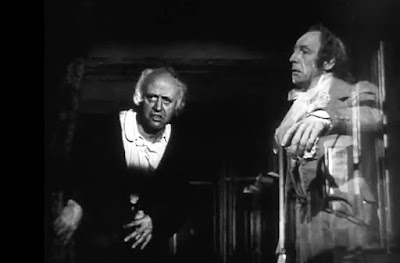
Marley (Michael Hordern) comes to warn Ebenezer of what could await him.

Marley tells Scrooge that three spirits will visit him: first The Ghost of Christmas Past, second The Ghost of Christmas Present and third and last, The Ghost of Christmas Yet to Come. After that, Marley leaves to join the other ghosts, who are forced to suffer the same torment.

Marley shows Scrooge other ghosts who suffer the same torment he does.

Scrooge is obviously shaken up and takes refuge in his bed before he is visited by The Ghost of Christmas Past (Michael J. Dolan).

The Ghost Of Christmas Past (Michael J. Dolan) is first to visit Scrooge.

A good part of the film involves The Ghost of Christmas Past, who first takes Scrooge back to a holiday at school, when a young Scrooge (George Cole) thinks he’s been left once again by an unloving father. But his sister, Fan (Carol Marsh), has been sent to bring him home by their father, whom she says has changed his ways.

Sister Fan (Carol Marsh) comes to bring Ebenezer home for the holidays.

Next, the Ghost takes Scrooge to the holiday party thrown by his first employer old Fezziwig (Roddy Hughes). While they are watching the party, the Ghost points out Scrooge’s younger self proposing to his girlfriend, Alice (Rona Anderson).

Young Ebenezer (George Cole) has a girlfriend, Alice (Rona Anderson).

But there is also the appearance of Mr. Jorkin (Jack Warner), who tries to convince Fezziwig to sell his company, but Fezziwig refuses. But Mr. Jorkin does manage to seduce Scrooge away with the promise of better pay and more advancement. It is at Jorkin’s company that he meets a young Jacob Marley (Patrick Macnee).

Scrooge relives the death of his sister Fan, who died after giving birth to her only child, Frank. Scrooge begs her not to die, but when he thinks she’s dead he leaves the room. But with her last breath, she asks Scrooge to take care of Fred.

Later, together Scrooge and Marley buy out Fezziwig’s warehouse and shipping company and turn it into a counting house (an accounting firm).

Feeling that money is more important to Scrooge than her love, Alice breaks off their engagement. She breaks down crying as soon as he leaves.

Still later, when Jorkin is found to have embezzled monies from his own firm, Scrooge and Marley offer to make up the difference, avoiding scandal for the company and its shareholders, but for 51 % of the stock, adding Jorkin’s company to their own.

Fast forward to Christmas Eve seven years ago. Marley lies dying at home and sends a messenger to bring him. But when Bob Cratchit informs his boss of his partner’s condition, Scrooge informs him that he won’t be visiting him during business hours. When Scrooge does arrive, Marley tries to warn Scrooge to change his avarice ways, but in the end Scrooge takes Marley’s house and money.

The Ghost of Christmas Present (Francis de Wolff).

Next, Scrooge is visited by The Ghost of Christmas Present (Francis de Wolff ), who shows him how others spend the holiday. They observe the Cratchit family who, though poor, still celebrate the holiday with a small dinner. When Bob and Tiny Tim come home from church, it becomes obvious that Tim is not doing as well as Bob likes to think. Scrooge queries the Ghost about Tim’s future and it appears to be bleak. The spirit tells that without medical care, Tim will not live to see the next Christmas.

The Cratchit family gathers around when Bob (Mervyn Johns) and Tiny Tim (Glyn Dearman) return from Church.

Next, Scrooge is taken to the Christmas party being thrown by Fred and his bride (Olga Edwardes).  Despite Scrooge’s refusal to attend, Fred still insists on drinking a toast to his Uncle, a man he feels sorry for.

The Spirit takes Scrooge to observe Alice as she is now, selflessly nursing impoverished women in a workhouse in another part of London.

The Ghost of Christmas Present shows two children symbolizing the ignorance and want in the world.

Finally, the Spirit reveals two scrawny children cowering under his robes, a boy and a girl, symbolizing ignorance and want, problems that face many in the World.

Scrooge goes almost immediately from one spirit’s guidance to another as the Ghost of Christmas Yet To Come (Czeslaw Kornaski), who's dressed in a black hooded gown and never speaks. He sets about showing him the future if Scrooge doesn’t change.

The Ghost of Christmas Yet To Come (Czeslaw Kornaski).

The first stop is the Cratchits’ house, where the family is still in mourning at the loss of Tim, who’s crutch leans against the fireplace as a constant reminder of his passing.

Next Scrooge is taken to a seedy junk dealer, where an undertaker (Ernest Thesiger), his maid Mrs. Dilber (Kathleen Harrison) and a laundress meet to sell items they have pilfered from a dead man’s house.

At the Stock Exchange, a couple of businessmen laugh about the sudden passing of a man no one will mourn. Scrooge begins to wonder who has died and is taken to the cemetery by the spirit. When Scrooge presses the spirit to know who has died, the Ghost silently points to a headstone. Carved on it, Scrooge sees his name. Falling to his knees, Scrooge promises to repent.

Scrooge wakes up in bed, awakened by the knocking of Mrs. Dilber on his door. She is scared by Scrooge’s enthusiasm, screaming as she tries to flee the house. Scrooge manages to catch her on the stairs trying to convince her that he has not gone crazy. He manages to change her attitude by giving her a Christmas present, raising her salary and giving her the rest of the day off.

Scrooge's childish antics scare his maid, Mrs. Dilber (Kathleen Harrison).

Next, Scrooge goes to the window and offers to give a boy passing on the snowy street below to fetch the butcher from the shop a couple of streets up. He then has the butcher deliver the large turkey from his window to the Cratchits.

Ebenezer, at the window, is pleased to not have missed Christmas day.

The Cratchits are surprised by the anonymous gift of the bird and laugh at Tim’s suggestion that it is a gift from Scrooge.

Next, Scrooge goes to Fred’s house where he gets Fred’s maid (Theresa Derrington) to let him enter unannounced. His presence comes as a pleasant surprise to Fred and his wife.

Ebenezer surprises everyone when he shows up at Fred's Christmas party.

The next day, Scrooge makes it to work early before Cratchit arrives. Bob is late and is expecting the worst, when Scrooge calls him into his office. Expecting the worst, Bob is pleasantly surprised when Scrooge is not really angry and offers him a hefty raise. Scrooge tells Bob that he’s come to his senses and that he wants to help him raise his family, taking special interest in Tim.

Late for work the day after Christmas, Bob Cratchit is surprised to get a raise.

The narrator then recounts that Ebenezer Scrooge became "as good a man as the old city ever knew", and becomes like a second father to Tiny Tim. We see that not only did Tim live, but he also learned to walk without a crutch. At the end, Scrooge and Tim walk off together between the buildings, into the distance in a snowy London town.

The film did well in the United Kingdom, but was considered too grim and not family friendly to open at Radio City Music Hall, considered one of the premiere theaters in the U.S., so it opened at a nearby one that was less prestigious. Perhaps unfortunately, the opening took place on another holiday, Halloween, which couldn’t have helped. Back then, people were not in the Christmas mood since Labor Day, like we seem to be now, so a Christmas-movie opening then would have had the cards stacked against it. Mixed reviews did not help either and the film was a box-office disappointment in the U.S.

After having watched the earlier MGM version of the story, I found this British production to be a much more visceral experience. As an example, Marley’s ghost doesn’t just moan the way Leo G. Carroll did in the MGM film, rather he screams. You better sense the terror Scrooge must be feeling at that moment.

The film is a little more involving, delving a little deeper into the story, even making up details that are not in the original novella. As an example, in order to show Scrooge’s corruption for money, the film invents Mr. Jorkin. The film also shows Alice, named Belle in the novel, treating the less fortunate at a workhouse; again, this is something not in the book. Another tearful scene is when Scrooge’s sister dies in childbirth; something the novel doesn’t state. We’re also told that Ebenezer’s mother also died giving birth to him, but that again is not in the original story. While made up for the film, these serve to give Scrooge a stronger tie to his nephew Fred.

But these additives serve to enrich the story, sort of the way Peter Jackson’s inferior King Kong remake added backstory to the Ann Darrow and Carl Denham characters, as well as more gore than was necessary.

Like the 1938 film, this one, too, has its share of special effects. Nothing really spectacular, but well-done nonetheless and were no doubt well received in their day. Sometimes simpler is better and they work fine for the story.

The acting is really good, on par with, if not better than, MGM’s version of the story. There is something about a completely British cast performing a perennial like Dickens' A Christmas Carol. It’s hard to better Alastair Sim’s performance. He is much subtler in the beginning than Reginald Owen was and his Scrooge’s transformation comes a little harder and is more effective as a result.

Alastair Sim is Ebenezer Scrooge.

Glyn Dearman is also subtler as Tiny Tim than was his American film counterpart, Terry Kilburn. Tim is one of the most sad and pathetic figures to grace a printed page and it has to be difficult not to give in to the temptation to play it for tears or overplay it the other way. Dearman does fine with the part.

Glyn Dearman is more subtle as Tiny Tim than was this MGM counterpart, Terry Kilburn.

The Cratchits take a bit of a backseat in this production, as it concentrates more on the main character. We don’t get the scene that we may have come accustomed to, of Scrooge bringing the fatted goose or turkey himself to the Cratchit family as a surprise on Christmas morning. Frankly, this film handles it better than the American one, since in that film Bob already had bought a big bird for the family feast and Scrooge’s gift, while generous, doesn’t quite have the same impact that it does here. In this film, the Cratchits don’t have the money for the big bird to start with.

One of the things that is a little disappointing, is that the film brings us up to date with Alice, but doesn’t go so far as to reunite Scrooge with his former fiancée. Maybe I’m rooting too much for a Hollywood happy ending, but it’s not meant to be in these films and I’ll have to deal with that.

While maybe not as family friendly as MGM’s 1938 filmed version, the 1951 British Scrooge is still a little truer to the story, at least in the spirit it was intended.

To read reviews of other Christmas films, please see our Christmas Review Hub.