Showing posts with label 1984. Show all posts

Saturday, October 22, 2022

Frankenweenie (1984)


Among the many films directed by Tim Burton, one was the stop-motion animated feature Frankenweenie, which released in 2012 to positive reviews and modest success. What most may not know, however, is that it was based on a 1984 live-action short also called Frankenweenie. Of course, no one would blame you if you didn’t, as it had a fairly niche audience for the longest time, with only one theatrical run alongside a rerelease of Pinocchio, as well as the critically panned Baby: Secret of the Lost Legend in the UK, with every home video release attached to certain versions of The Nightmare Before Christmas before the inevitable Disney+ listing. In the spirit of the season, we decided to look back on this lesser-known part of Tim Burton’s career. Unfortunately, it’s not very remarkable.

Saturday, December 24, 2016

Stubs - A Christmas Carol (1984)


A Christmas Carol (1984). Starring George C. Scott, Frank Finlay, David Warner, Susannah York, Edward Woodward, Roger Rees. Directed by Clive Donner. Screenplay by Roger O. Hirson. Based on  A Christmas Carol (1843) a novel by Charles Dickens. Produced by George F. Storke and Alfred R. Kelman. Runtime 100 minutes. United Kingdom/United States. Color. Christmas. Drama

A Christmas Carol continues to be a source for Christmas movies, including comedic send-ups, like Scrooged (1988) starring Bill Murray and A Christmas Carol (1999) starring Patrick Stewart. The story seems to attract a lot of big names, the same way that the Christmas album does in music with everyone and their brothers putting out holiday releases. But perhaps the biggest movie star to appear in one of these films is George C. Scott, the winner of the Best Actor for his role in Patton (1970), an honor he ultimately refused.

In the early 1980s, the UK became a production location for not only American films but also television. Drawn to the island by tax incentives and lower costs, Hollywood was also drawn to the wealth of talent that lived there, too. Shot on location in Shrewsbury, England, this Christmas Carol was to receive a television release in the U.S., but a theatrical release in the UK.  Like Mr. Magoo’s Christmas Carol (1962), which was sponsored by Timex watches, when this version aired on U.S. television, it had a single sponsor, IBM, then a personal computer maker.

The story starts on a foggy, snowy Christmas Eve, 1843. Our narrator, Roger Rees, reads the first lines of Charles Dickens’ A Christmas Carol, “Marley was dead, to begin with. There is no doubt whatever about that.” We are introduced to Ebenezer Scrooge (George C. Scott), a miserly man who does not share the rest of the world's merriment at Christmas. When his nephew, Fred (Roger Rees) comes to his office to invite Scrooge to dinner the next day, he is turned down.


Fred (Roger Rees) invites his Uncle Scrooge (George C. Scott) over for Christmas dinner.

On his way out, Fred says hello to Bob Cratchit (David Warner), Scrooge’s long-suffering employee. Fred asks about his family and wishes them a Merry Christmas before leaving. Scrooge is on his way out to the London Stock Exchange and admonishes Cratchit for using too much coal in the fire and for wanting the whole next day off. He makes Bob promise to be early the next day and hurries off.


Bob Cratchit (David Warner) is Sctooge's long sufering employee.

Outside, he encounters a cripple, whom he mistakes for a beggar. But the boy, Tim (Anthony Walters) tells him that he’s waiting for his father to get off work.


Scrooge initially mistakes Tiny Tim (Anthony Walters) for a beggar.

At the exchange, Scrooge drives a hard bargain for corn that he has that three men want to buy. Apparently, discussed this transaction the day before and want to accept Scrooge’s asking price, but he’s now raised it 5%. The men tell him that it will make the grain too expensive for the poor to afford, but he is adamant about the price, even threatening to raise it further if they don’t buy now. They capitulate and he demands payment in full before it will be shipped.  (For the first time in our survey, we are given an occupation for Scrooge, commodities.)

Scrooge is then accosted by two businessmen, Mr. Poole (Michael Gough) and Mr. Hacking (John Quarmby) who are collecting charity for the poor. Scrooge asks them about the prisons and the workhouses, which both men acknowledge are still operating. Relieved that those institutions, which his taxes are paying for, are still open, he refuses to give them anything. When he’s told that many would rather die than go to one of them, Scrooge encourages them to hurry up and relieve the surplus population. Dismayed, the men move on.


Scrooge is stopped by Mr. Poole (Michael Gough) and Mr. Hacking
(John Quarmby) looking for donations for the poor. 

When Bob gets off work, he finds Tim still waiting for him. Tim wants to stop by and watch the other boys play in the snow and Bob is only too happy to take him. After a little while, though, he decides they should go home.

Scrooge meanwhile returns home in the dark. On his way in, he notices that on the door knocker is the image of his deceased partner, Marley (Frank Finlay) who had died seven years before on this day. Going inside, Scrooge makes a point of locking all the doors behind him, even setting the dead bolts on the door to his bedroom, before settling down to a bowl of gruel.


Scrooge the face of his deceased partner Marley (Frank Finlay) on his door knocker.

It is not too long before the locks are opened and Marley’s Ghost enters the room. His mouth is tied shut and he is wrapped up in and is dragging long thick chains. At first, Scrooge tries to dismiss Marley as a reaction to a bad piece of food but is made to believe that the Ghost is truly there in front of him. Marley notifies his ex-partner that in the afterlife he is being made to walk the earth as punishment for not doing more with his life.  He informs Scrooge that a similar fate awaits him unless he changes his ways.


Marley comes to warn Scrooge about the fate that awaits him.


To help him, Scrooge is informed that three spirits will visit him, the Ghost of Christmas Past at one o’clock; the Ghost of Christmas Present at two and the Ghost of Christmas Future sometime after that. Marley then disappears out the open window.


The Ghost of Christmas Past (Angela Pleasance) appears to Scrooge.

Scrooge is not convinced and when the clock strikes one and there is no Ghost, he is pretty sure that Marley was just a bad dream. But a few seconds later, the Ghost of Christmas Past (Angela Pleasance) appears, carrying with her a large dunce cap looking object.


The Ghost of Christmas Past takes Scrooge back to hisScrooge days.

She takes Scrooge back to his old days at school. It is Christmas time and he is lonely with only books to keep him company. Flash forward, years have passed and Scrooge is older, but still alone at school. Older Scrooge explains to the Ghost that his father blames him for the death of his mother who died during childbirth. That is until one day when his sister Fan (Joanne Whalley) comes to collect him. She tells her brother (Timothy Bateson) that father has changed and that they’re here to take him home for Christmas. But outside his father Silas (Nigel Davenport) is waiting and he’s not as bubbly as Fan or as changed as she had claimed. He informs his son that even though he will not return to school, he will be going in three days to an apprenticeship.


Scrooge watches as his younger self (Timothy Bateson) hears about his apprenticeship.

The Ghost and Scrooge end up at Fezziwig’s (Timothy Bateson) establishment. Once again it is Christmas Eve and Fezziwig tells all his employees, including Scrooge to put away their work and clear the office for the holiday party to come that night and once again, elder Scrooge and the Ghost are there to bear witness. They watch as the younger Scrooge dances with Belle (Lucy Gutteridge), a young woman with whom he is in love and to whom he is engaged.

But, as we see, as time goes by, their love starts to wane. Belle begins to feel that she is running an increasingly second place to Scrooge’s love of making money. In fact, when we see them again, the younger Scrooge is running late for their date because he had business to take care of. That seems to be the last resort for Belle, who frees him from their commitment.


Belle (Lucy Gutteridge) breaks off  her engagement with Scrooge

Again, we see into the future and see Belle surrounded by her children. When her husband arrives home he relates that he’s seen an old acquaintance of hers. She guesses Ebenezer Scrooge, which he confirms. He tells her that while his partner Jacob Marley lies near death, Scrooge is still hard at work in his office rather than visiting his deathbed. 

Scrooge has had enough and tries to force the spirit to stop. Using the cap the Ghost has been carrying, Scrooge smothers her, but in reality, he’s on the floor of his bedroom at home. Thinking it all a bad dream, Scrooge goes back to bed.

Once again, the clock strikes the hour and when there is no instant appearance of the second ghost, he dismisses Marley’s warnings. But it is only a few seconds before Scrooge hears himself being beckoned into the adjoining room that is filled with bright lights. There sits the towering figure of the Ghost of Christmas Present (Edward Woodward).


The Ghost of Christmas Present (Edward Woodward) is the second one to visit Scrooge.

He takes Scrooge out to see how other people are celebrating Christmas. They stop at the Cratchits, where they observe the family enjoying the holiday, being content with their small dinner. Scrooge takes notice of Tiny Tim. When he asks about Tim’s future, the Ghost tells him that he sees an empty chair at next year’s table and a well-preserved cane leaning by the fireplace.


The Cratchits are happy even if they have very little.

They next go to Fred’s where Scrooge’s nephew tells those in attendance that he wishes his Uncle would accept his invitation but remarks that he continues to turn it down. When the party plays a game of similes, Scrooge is hurt when he is the punchline for Fred’s wife Janet (Caroline Langrishe) answer to “Tight as…"

Next, the Ghost takes Scrooge out into the street where we see homeless people trying to survive. One family sustains themselves on the wood and food the husband can find. When he gets depressed about their situation and suggests they go to the poorhouse, the wife insists that if they go they’ll be separated and turns down the idea.

If that doesn’t drive the point home, the Ghost warns Scrooge about the evils of “ignorance” and “want” symbolized by two destitute children. They are thin and sickly and more than Scrooge can bear to look at for long.


The Ghost shows Scrooge Ignorance and Want.

It is on the street that the Ghost leaves Scrooge alone and afraid. At this point, the final ghost, the Ghost of Christmas Yet to Come appears. Silent and cloaked, this Ghost takes Scrooge to the future. At the London Stock Exchange, Scrooge observes three businessmen talking about the death of another man. None of them are really sorry about the death and are willing to go to the funeral as long as a meal is provided.


The Ghost of Christmas Yet to Come appears to Scrooge.

When Scrooge asks who the man is, he’s taken to a room like his house where a body lies alone under a blanket. The Ghost wants Scrooge to pull back the sheet, but Scrooge can’t get himself to do it. Next Scrooge is taken to a fence named Old Joe (Peter Woodthorpe). Mrs. Dilber (Liz Smith) has brought in several pieces of Scrooge’s possessions to sell. Scrooge tries to pretend they are not his things, but it is clear that he’s bothered by the practice.


Old Joe (Peter Woodthorpe) pays some of Scrooge's possessions for cheap from Mrs. Dilber (Liz Smith).

Scrooge demands to see someone mourning a death and he’s taken to the Cratchits. Tim has indeed not survived and the entire family mourns his passing, especially Bob who is heart-broken by the death of his son.

When Scrooge pushes to know the identity of the man they saw under the blanket and he’s taken to a cemetery. There he brushes the snow from the marker and sees that it has his name engraved on it. Scrooge begs to know that if what he’s seen can be changed and promises to change himself.


Scrooge uncovers his name on a grave in the cemetery.

Awakening in his own bed, Scrooge wonders what day it is. He hurries to a window and through it sees a young boy (Ian Giles) running by down on the street. When he asks the boy what day it is, the boy replies that it is Christmas Day. Scrooge is gleeful that the spirits have done their work in one night. He implores the boy to go and bring the poulterer (Alan Bodenham) who has a large turkey in his window. The boy hurries off in an effort to earn the half-crown Scrooge promises him.

Scrooge pays the boy (Ian Giles) for bringing the poulterer (Alan Bodenham).

Dressed, Scrooge greets the man and has him anonymously deliver the turkey to Bob Cratchit’s house. The Cratchits are surprised to receive the but are happy about their good fortune.


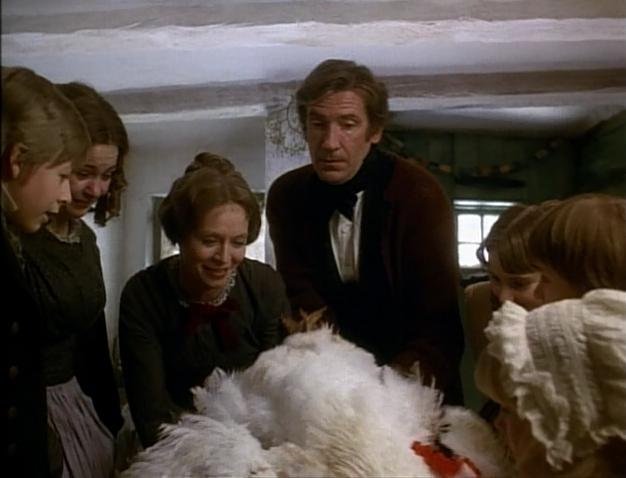
The Cratchits are surprised by their unexpected bounty.

While out and about, Scrooge bumps into Mr. Poole and Mr. Hacking, offering them a substantial donation for the poor.

Scrooge is a surprise guest at Fred and Janet’s party. Still, they welcome him with open arms, happy that he’s come, even though he is the first to have arrived. In a lighter moment, Scrooge coaches Janet that the answer to the simile question “Tight as…?” is “a drum.”


Scrooge shows up at Fred's house and meets his wife Janet (Caroline Langrishe) for the first time.

The next morning, Cratchit, who is already late, arrives at the office. Unbeknownst to him, Scrooge is already there and calls him out. No doubt fearing a stiff reprimand or, worse, termination, Cratchit is pleasantly surprised when Scrooge doubles his salary and tells him that he wants to help him with his family.

Having made changes in the present, Scrooge has altered the future. Going forward he is said to keep the spirit of Christmas inside him all year long. Not only does Tiny Tim live, we’re told in narration, but Scrooge becomes like a second father to him.


Scrooge becomes like a second father to Tiny Tim.

Dickens’ A Christmas Carol is one of those books that has been adapted so many times that films and TV movies based on it, sometimes rely more on past adaptations than on the source material, as if trying to feed our expectations. As an example, the visitation of the three Ghosts; in the original story, Scrooge is visited by one each successive evening. But in all of the adaptations we’ve reviewed, including this one, all the visits happen on the same night. While it does work better from a story standpoint, I wonder which was the first adaptation to decide the first Ghost would appear at one o’clock, the second at two and the third at three?

Another example is when Scrooge tells the Ghost of Christmas Past that his father blamed him for the death of his mother during childbirth. Again, this is not from the novella, but rather from the 1951 Scrooge, released in the U.S. as A Christmas Carol, replicating dialogue Alastair Sim had with his Ghost. While this is a convenient and somewhat believable explanation for the frosty father-son relationship, it does give rise to its own unresolved complication. Scrooge has a younger sister and there is no mention of the father remarrying. If Scrooge’s mother died giving birth to him, how does Fan exist?

There are other ways that this version diverts from its source material. To begin with, Scrooge’s father, here named Silas, is referred to in the novella but never seen. Nephew Fred is given the last name Holywell, in the book he is not given a surname. And in an effort to make the story more relevant, the movie introduces the idea that Scrooge feels his lack of a fortune makes him unworthy of Belle’s affections and that he must be able to finance their future life together in order to deserve her. These were not Victorian attitudes.

But perhaps the biggest departure is the portrayal of Scrooge himself. Unlike his earlier counterparts, Scott’s Scrooge is far from a fragile and scrawny old man. Scott also makes his Scrooge into more of a ruthless businessman than simply a miser. Finally, this Scrooge seems to think himself funny, as he laughs at his own joke when delivering the "stake of holly through his heart" line.

Like all the other adaptations, Scrooge is the center of the story and no other actor brings as much clout as Scott does to the role. An American, rather than British, Scott doesn’t try to sound English nor does he affect an accent. But to his credit, this isn’t Patton in Victorian England either. Scott is a fine actor who can and does handle the role with skill.

Roger Rees also stands out, but he like the rest of the cast, is subordinate to Scott’s Scrooge. Rees, a fine actor in his own right, might best be remembered for his year-long stage portrayal of Nicholas Nickleby in The Life and Adventures of Nicholas Nickleby in 1980-1981. He also played the role of Robin Colcord during season eight of the long-running sitcom Cheers.


Roger Rees plays Fred in A Christmas Carol.

Edward Woodward appears to relish the role of the Ghost of Christmas Present, with a hearty laugh to go with his bare chest. His performance is one of the highlights of a very strong cast.

Of all the Tiny Tim Crachits we’ve seen, Anthony Walters certainly looks the role with the dark makeup shadows under his eyes. He also underplays the role with a subtlety better than any of his fellow actors that we’ve seen in the role.


Anthony Walters is made up to look sickly as Tiny Tim.

One area where this version is lacking are the special effects. As impressive as the 1938 version was, especially given when it was made, this is a bit of a letdown. To begin with, Marley’s Ghost stops being an apparition and becomes a solid body almost as soon as he enters Scrooge’s bedroom, which is a little unexpected, given the advancements in technology. There’s not the sense of flight that the 1938 version did so well or the multitude of ghosts out the window as there was in the 1951 version. Not sure how much of this were artistic choices and/or budgetary ones. This is a more of a no-frills vision of the story. Not that it suffers too much from this more-straight forward approach, just that one would expect more, especially if you’d seen previous versions.


The Ghost of Marley becomes a solid body rather than remaining an apparition.
It is interesting to note that the director of this film, Clive Donner, who began his career as an editor, is credited as the film editor on the 1951 version of the film. His directing career began with some low-budget films and shorts, including the Edgar Wallace Mystery Theatre film and TV series in 1960. His other features include What’s New Pussy Cat? (1965), perhaps best known as Woody Allen’s first screenplay; and The Nude Bomb (1980), an attempt to resurrect TV’s Agent Maxwell Smart (Don Adams). Donner does well by this material, but I’m not sure what effect if any, his previous work with the story had on this adaptation. 

There is something very satisfying about this adaptation of A Christmas Carol. While certainly not a page per page adherence to the original story, none of them are, this one feels more complete somehow and approachable. It no doubt gets the benefit of trodding some very familiar territory. Charles Dicken’s novella is one of the most familiar literary offerings. While it’s hard to pick a favorite, this adaptation, while perhaps not as family friendly as either MGM’s 1938 version or Mr. Magoo’s, is still a very strong entrant in a very crowded field.

To read reviews of other Christmas films, please see our Christmas Review Hub.

Tuesday, July 19, 2016

Stubs - Star Trek III: The Search for Spock


Star Trek III: The Search for Spock (1984) Starring: William Shatner, Leonard Nimoy, DeForrest Kelley, Dame Judith Anderson, Christopher Lloyd. Directed by Leonard Nimoy. Screenplay by Harve Bennett, Harvey F. Thew. Based on characters created by Gene Roddenberry Produced by Harve Bennett. Run Time: 105 minutes. U.S. Color. Adventure, Science Fiction

Following the success of Star Trek II: Wrath of Khan (1982), Paramount was eager for a sequel; so eager in fact that the studio commissioned Harve Bennett to write the follow up the day after its release. Bennett, who had been working in television, was the man studio heads Barry Diller and Michael Eisner and then owner Charles Bluhdorn turned to save the franchise after the disappointing Star Trek: The Motion Picture (1979).

Instead of turning back to the series, from which Bennett drew the plot of Wrath of Khan, he wrote a script that continued that film’s story. While it was no doubt a forgone conclusion that Spock would not stay dead, great effort was made to keep the story a secret.

When Leonard Nimoy was approached by the studio to resurrect, as it were, his role of Spock, they were somewhat surprised at his enthusiasm. Thinking that he had grown tired of the part, they certainly didn’t expect him to want to direct the film as well. While Nimoy had directed some television before, including his directorial debut with an episode of Night Gallery, "Death on a Barge" (1973), he had never directed a movie, let alone the key sequel in a franchise. (Nicholas Meyer, who had directed Wrath of Khan, did not want to return due to artistic differences with that film’s ending.)

Given the budget of only $16 million, the original had a budget of $46 million, shooting would have to take place in the soundstages at Paramount, notably Stage 15. Principal photography got underway on August 15, 1983. Security was tight to say the least, as the studio tried hard to keep wraps on the story. Leonard Nimoy’s name did not appear on call sheets, scripts were chemically treated so that copies could be traced back to the original and set designers were only given enough pages so that they could do their jobs.

While the Director of Photography, Charles Correll, wanted to shoot some scenes on location, namely Kuaui in Hawaii and the Red Rock Canyon in California, the budget would not allow it. The only location shooting were the stairs at Occidental College that were used to represent Vulcan. Even a fire at an adjacent soundstage did not prevent all but two days to be shot indoors.

Paramount worked with George Lucas’ Industrial Light and Magic for special effects as well as minatures used for the Enterprise and other ships from the Federation and the Klingon’s Bird of Prey. The biggest problem was the 400 miles that separated Paramount and ILM, but still the effects house provided 120 shots for the movie.

The film, with a score by James Horner, was released on June 1, 1984.

As mentioned before, the story takes place right after the events of Wrath of Khan and, in fact, opens with some scenes from that film, including Spock’s (Leonard Nimoy) mind meld with Dr. McCoy and his selfless act to save the Enterprise and its crew. After Spock dies, his casket is sent to the planet that is also getting the Genesis treatment.

When the ship returns to Spacedock over the Earth, McCoy starts to act oddly, even speaking in Spock’s voice and is placed in detention as a result. Meanwhile, Admiral Kirk (William Shatner) and crew are visited by Starfleet Admiral Morrow (Robert Hooks), who informs them that the Enterprise will not be repaired, but instead will be decommissioned after twenty years of service. The crew is further admonished not to mention the Genesis Project due to political fallout about the use of the device.

The only ship allowed to explore the Genesis Planet is the science ship, Grissom. On board is David Marcus (Merrick Butrick), who happens to be Kirk’s son, and the Vulcan Lieutenant Saavik (Robin Curtis). They discover an unexpected life form on the surface and transport to the planet’s surface to investigate. The life form turns out to be Spock as a baby and figure that he’s been resurrected by the Genesis device. But because of the instability of the device, Marcus admits to using unstable Proto-matter, the planet is self-destructing and Spock is rapidly aging. We see him progress from 9 (Carl Steven) to 13 (Vadia Potenza) to 17 (Stephen Manley) and to 25 (Joe W. Davis). When Spock reaches 17, the mating drive called pon farr overtakes the adolescent and we’re led to believe that Saavik participates in his rite of passage.

17 year-old Spock (Stephen Manley) goes through pon farr with Vulcan Lt. Saavik (Robin Curtis).

Meanwhile, the Klingons, led by Kruge (Christopher Lloyd), have intercepted information about the Genesis project, which they believe is a potential weapon. Kruge takes his cloaked ship, a Bird of Prey, to the Genesis planet, destroys the Grissom and captures Marcus, Saavik and Spock.

25 year-old Spock (Joe W. Davis), Kirk's son David Marcus (Merrick
Butrick) and Saavik are taken prisoner by the Klingons.

Back on Earth, Spock’s father, Sarek (Michael Leonard), visits Kirk about Spock’s death. Sarek wants Spock’s katra, or living spirit, returned to Vulcan. They discover, by viewing video shot onboard the Enterprise, that Spock had transferred his katra to McCoy, who will eventually die from carrying it. Disobeying orders, Kirk springs McCoy from detention and steals the Enterprise with the help of Scotty (James Doohan) and Sulu (George Takei). The Excelsior, led by Captain Styles (James Sikking), goes to take chase, but Scotty, who had been assigned to that ship has disabled their vaunted trans-warp drive. The Enterprise then heads to the Genesis planet to retrieve Spock’s body.

Spock's father, Sarek (Michael Leonard), visits Captain Kirk (William Shatner).

The Enterprise is disabled by the Klingon ship in battle. In the standoff that follows, Kruge demands that Kirk hand over the Enterprise and the secret of Genesis or he will kill one of the hostages on the planet. When a Klingon guard looks poised to kill Saavik, Marcus tries to stop him, but gets killed in the process. Kirk pretends to hand the Enterprise over to Kruge, but as the Klingons are about to transport order, Kirk, Scotty and Chekov (Walter Koenig) start the ships self-destruct sequence and transport down the planet’s surface. When Kruge’s crew boards the ship, they are already doomed and before they can do anything, the Enterprise blows up.

The Enterprise confronts the Klingon's Bird of Prey.

Kirk manages to lure Kruge down to the planet’s surface and, while the planet is disintegrating beneath them, the two get into hand to hand combat. Kirk wins, kicking Kruge into one of the lava flows that have developed. He tricks the Bird of Prey into beaming them aboard and then overwhelms the last member of the Klingon crew, taking the ship to Vulcan, where Sarek and Uhura (Nichelle Nicholls) are waiting.

Klingon leader Kruge (Christopher Lloyd) fights Kirk in hand-to-hand combat.

Spock’s katra ceremony goes forward overseen by T’Lar (Dame Judith Anderson), a Vulcan high priestess, and with Dr. McCoy’s cooperation, Spock’s spirit is reunited with his body and the Spock we’ve all come to love (Leonard Nimoy) is once again with us. His memories are somewhat fragmented, but Kirk helps him remember and Spock recognizes the rest of the crew that has gathered there as well. A happy ending and we’re told in advance that the journeys will continue, setting us up for Star Trek IV: The Journey Home, though no mention is made of that title.

At the end, Spock (Leonard Nimoy) recognizes Kirk as his friend, paving the way for more sequels.

The movie opened in theaters on June 1, 1984 into a market already crowded with Indiana Jones and the Temple of Doom, Gremlins, Ghostbusters and Top Secret!. As such it opened in second place with an opening weekend gross of about $16 million, despite a heavy marketing campaign. All in all, the film took in a rather disappointing $87 million worldwide. (Wrath of Khan had done $97 million and the Motion Picture had done $139 million, this was not a good trend.)

The film was not a critical success. While Nimoy’s direction is generally praised, cited for being the best of the three and for capturing the spirit of the television show, the film was generally considered everything from “b-a-a-a-d” (Susan Ferrier Mackay in Canada’s The Global and Mail) to “Good, but not great” (Roger Ebert The Chicago Sun-Times). Even Ronald Reagan, the former actor turned real-life President, screened the film and wrote “It 
wasn’t too good.”

I fall more in line with Ebert’s sentiments about the film. There is belief that the odd numbered Star Trek films are the bad ones. Star Trek: The Motion Picture certainly started that trend and while Search for Spock is better than the first one it is not as good as Wrath of Khan. Part of the problem may be that like Khan, Search for Spock is reminiscent of the TV show. That, in and of itself, is not a good thing.

While I understand the temptation to make a popular TV show into a movie, there is delicate balance that has to be struck. As an audience member, I want to see all the old familiar faces, but as a movie-goer I want to have a theatrical experience, not just see a TV show blown up to larger proportions. With the original Star Trek series of films, as I go in wanting to like it; wanting the film to boldly take me someplace I’ve never been before. The failure of Star Trek: The Motion Picture is that it made the mistake of not giving the characters we all know and love the screen time they deserved and instead spent too much time on new characters we didn’t care about and who we, thankfully, have never seen again.

The Search for Spock goes back to the series and picks up what has become the dominate villain in the canon, the Klingons [Romulans wouldn’t be revisited as a villain until Star Trek (2009)] and tries to right the wrong of Spock’s death, since the series could not continue without him. With friendship being one of the key themes of the movie, the triumvirate of Kirk, Spock and McCoy has to be maintained, though less seems to be made of McCoy and Kirk’s in this one.

The film manages to have special effects without having them dominate the way they did in The Motion Picture. Perhaps distancing itself further from the first film, the U.S.S. Enterprise, which I felt the first one doted on too much, is blown up. The fact that the series could continue without the original ship shows that the power is not in the models and VFX but with the relationships of the crew and especially the three main characters. The one problem with the special effects is that it starts to blur the line between Star Wars and Star Trek, which are competing mythologies to a certain extent. By making Star Trek look visually like its sci-fi rival, it seems to be capitulating to the other's dominance.

I’m sort of ambivalent about The Search for Spock, while I see it as necessary for the franchise to continue, as an audience member I’m frustrated that the movie series has taken so long to gel. I have a similar complaint about the rebooted series, which also acts like it has all the time in the world. By Search for Spock, the actors are really starting to show their age, nearly twenty years on, and the sooner we can move forward with something new for them to do the better. You want to see them take more than just a victory lap.

The story is somewhat ambitious in that it tries to tie up a lot of loose strings, including getting rid of Marcus as Kirk’s son. While I have nothing against the role or the actor playing it, he simply doesn’t belong in this version of the Star Trek universe. He’s one of those extra characters that the film’s producers want to add, perhaps in the hopes of bringing in younger fans, but it is really a misstep in retrospect.

And at the same time the story is over-plotted. There is no time as an example to worry about the crew of the Grissom, which is blown up or for Kirk to really mourn for the loss of Marcus, his only son. The film tries to cover a lot of ground and a lot of relationships and some things get left behind in its wake.

I look at The Search for Spock as a good, but not great addition to the Star Trek universe. It is a necessary evil to get the franchise out of dry dock, so to speak. If the franchise was to survive it would have to shed the television series to a certain extent. The cast would need to remain intact, that’s a given, but the adventures needed to differentiate themselves from those of the series.

Saturday, April 30, 2016

Stubs - Purple Rain


Purple Rain (1984) Starring Prince, Apollonia Kotero, Morris Day, Olga Karlatos, Clarence Williams III. Directed by Albert Magnoli. Written by Albert Magnoli and William Blinn. Produced by Robert Cavallo, Joseph Ruffalo and Steven Fargnoli. Color. USA Run Time 111 minutes. Drama, Musical

With the sudden passing of Prince, everyone is reexamining his career as an innovator, a musician, a cultural icon and as an actor. Since this is primarily a film blog, we will concentrate on the latter. While we are fans of Prince’s, we are not rabid fans. We did re-watch Purple Rain as a tribute and have been listening to the Sirius channel set up as a tribute while we’re writing this.

As a follow up to his most successful album to date, 1999, released in 1982, Prince made the same move other successful musicians like Elvis Presley and The Beatles had made previously, into the realm of filmmaking, with the release of Purple Rain in 1984.

Supposedly the idea for the movie was dreamed up by Prince himself, while he was on tour supporting the 1999 double album. Semi-autobiographical in nature, the initial screenplay was supposedly darker in nature. Prince also had hoped to cast Vanity of the Vanity 6 in the film, but she had left his management by then and moved on to a solo career. To replace her, Prince cast Apollonia Kotero, an actress he had seen on television.

Purple Rain was filmed in and around Prince’s hometown of Minneapolis, with one pickup done in Los Angeles (the hotel where Apollonia stays when arriving in town is in downtown LA). Several scenes were shot at the First Avenue Club, which the movie made famous and which later turned into a center of the mourning for the deceased star.

The title of the film. The Kid (Prince) is performing "Let's Go Crazy".

The film starts with The Kid (Prince) and his band, The Revolution, playing “Let’s Go Crazy.” The band is one of three house bands at the First Avenue Club. There is also Morris Day and The Time and Dez Dickerson and The Modernaires. While their music has a similar sound and the groups dress somewhat similarly, none are as talented or look as good as Prince and his band.

Wendy (Wendy Melvoin), guitar, and Lisa (Lisa Johnson), keyboard, want The Kid to listen to their music.

But things are not good behind the scenes. Wendy (Wendy Melvoin) and Lisa (Lisa Johnson), the band’s guitarist and keyboardist, are not happy off with The Kid. They have begun writing songs, but he never listens to them.

The Kid doesn't take Wendy and Lisa's music very seriously, using ventriloquism  to turn them down.

There is pressure at the club, as Billy (Billy Sparks), the club owner, is always wanting full houses. While The Kid is good, he’s not bringing them in like he used to. (Maybe it’s because he appears to do only one song a night.) Morris, who likens himself to be a great entertainer, is always pressuring Billy to get rid of The Kid. Morris convinces Billy that he needs a female group performing at the club.

Morris Day (Morris Day), on the right, tries to convince Billy (Billy Sparks) to get rid of The Kid. 

And there is trouble at home as well for The Kid. His Mother (Olga Karlatos) and Father (Clarence Williams III) fight often. A former musician, Father is always threatening Mother and when The Kid tries to intervene, he is thrown to the floor.

The Kid's home life is volatile as Mother (Olga Karlatos) and Father (Clarence Williams III) fight.

Into this comes Apollonia (Apollonia Kotero), a singer from New Orleans, who has come to Minneapolis, hoping to get a gig at First Avenue. Apollonia is tricky and conniving, first she skips out on a $37 plus taxi fare, even though she has the money. After taking a room at a rooming house across the street from the club, she manages to sneak her way in when the bouncer, Chick (Charles Huntsberry), is otherwise occupied. While she doesn’t see Billy, she does get the attention of both Morris and The Kid.

The Kid, who looks more like he's dressed for the stage
than a trip to the lake, takes Apollonia (Apollonia Kotero) for a long bike ride.

The Kid acts first, taking her on a long motorcycle ride out into the country. When they stop lakeside and talk, she tells him why she came and asks for his help. But at first, he says no, telling her that first she needs to purify herself in the waters of Lake Minnetonka. That seems to be all the encouragement she needs to strip down to her panties and jump into the water. The Kid tries feebly to stop her, because they’re not at Lake Minnetonka. He then drives off, leaving the half-naked woman alone, but he comes back telling her to get on the bike, only to pull up when she tries to get on. Repeat and repeat, before he lets her on his bike.

If it means stripping to get The Kid's help, Apollonia is very willing to oblige.

When they go to his house, his parents aren’t fighting anymore, just the opposite on the living room couch. They sneak into The Kid’s room through a window and make love.

The next morning, Morris, being driven by his sidekick Jerome (Jerome Benton), try to pick Apollonia up by offering her a gig with his band. She accepts.

That night, when she comes over to The Kid’s house, she brings him a guitar she’d seen him eyeing, having hawked a gold anklet to come up with the money. The Kid gives her one of his earrings to wear, sort of like a friendship ring. But when she tells him that she’s going to sing with Morris, he slaps her hard, knocking her to the ground.

The next night, when he’s on stage, he eyes her with Morris and sings “Darling Nikki,” a sexually explicit song, the performance of which humiliates Apollonia, who runs off in tears, which angers both Morris and Billy, further jeopardizing the Kid’s position at the club. Billy will later confront The Kid, making mention of his father’s wasted musical talents, adding that he’s following in the same path.

The debut of the Apollonia 6, her new group, is a big success. Their only song, “Sex Shooter,” is probably the weakest of the songs in the movie, but the women’s attire pleases the males in the audience, as they’re dressed scantily in corsets, stockings and high heels. To show their appreciation, some of the men throw dollar bills at them, like they're strippers rather than musicians.

Apollonia proudly displays her ample talents on stage.

After her performance, The Kid grabs her away from a drunken Morris and takes her off on his bike. They argue and she abandons him.

When The Kid returns home, he finds the house is a mess and that his mother is gone. Down in the basement, his father is lurking with a gun. His father, apparently distraught over something, shoots himself in the head. After an ambulance takes his father away and The Kid is questioned by the police, The Kid tears apart the basement to release his anger. As he does, he finds a box of his father’s musical compositions; this is after his father tells him that he doesn’t write them down.

The Kid finds a box of his father's music, which apparently
triggers a change in his attitude about Wendy and Lisa's music.

The next day, he plays the cassette of Wendy and Lisa’s song and starts to compose his own lyrics to go with it. That night at the club, he announces the song “Purple Rain” as having been written by Wendy and Lisa. As seems to be his practice, after the one song he prepares to leave the club and ride away on his motorcycle. But before he can he realizes that the audience really likes his song, so he goes back to the stage and plays two encores, winning the approval of everyone, including Billy and Morris.

Even Morris Day and Jerome (Jerome Benton) approve of The Kid's performance.

During his performance of “Baby I’m a Star,” we see shots of The Kid visiting in his father in the hospital and kissing his sleeping mother, who is at his bedside. Also, we see The Kid organizing his father’s compositions with Apollonia there as well.

The movie ends as abruptly as it began with a tableaux of The Kid on stage. Snippets of the songs from the movie play under the credits in a rather uneven medley.

When it was released on July 17, 1984, the film did fairly well at the box office, making about $68.4 million off a budget of $7.2 million. Reviews were fairly positive, but not overwhelmingly so. And Prince won an Oscar for Best Original Song Score, the last person to win that award. This was enough success to allow Prince to pursue other film ventures. Purple Rain was followed up by three more films, each of them directed by Prince himself: Under a Cherry Moon (1986), Sign o’ the Times (1987) and Graffiti Bridge (1990), the latter being a sequel to Purple Rain. However, none were as successful as his first.

Prince was a very dynamic performer in Purple Rain, giving his all for the fans.

At its best, Purple Rain is a concert film, especially those scenes featuring Prince and the Revolution on stage at First Avenue. Prince is a unique and interesting performer to watch on stage. He can sing, dance and shred the guitar with an onstage persona that is part James Brown, part Jimi Hendrix and part Little Richard, perhaps the first performer to play publicly with gender roles. His songs are best when they’re catchy and dance-able, which thankfully most of them are in this film. But this is strictly the Prince show, while his band the Revolution backs him up, with the exception of Wendy and Lisa, the others have few lines and are not even named, though they do receive credit.

Oh, yeah, these guys and some other people are also in the Revolution.

Morris Day and the Time, which started out as a side-project for the prolific Prince, are definitely a step down. Likewise, Dez and the Modernaires are really just fillers. Further down the talent tree are the Apollonia 6, who’s greatest talent seems to be their bodies. Since there are only three members the 6 comes from the number of breasts, which should tell you something about the quality of their singing. Apollonia's own singing career didn't last much longer, as Prince realized she didn't have much of a voice.

Morris Day leads the Time on stage.

The film suffers from many ailments, including a rather thin plotline and a lack of motivation for its characters. The father beats his wife and then shots himself, but besides mother keeping a messy house, there doesn’t seem to be any reason for the father’s behavior. If he’s a mean drunk, that’s never made clear. The only professional actors in the film, Olga Karlatos and Clarence Williams III (remember Link from the old TV series The Mod Squad), seem somewhat wasted here. Karlatos, who gets higher billing than Williams, doesn’t really have that many lines of dialogue.

Clarence Williams III is somewhat underused in Purple Rain.

And say what you will about Prince’s versatility, acting was not his strong suit. His The Kid character comes off as a narcissistic asshole to nearly everyone, including his band mates, the club manager and his girlfriend. He regularly performs one show gigs, which is no way to create a career, doesn’t let his bandmates have any say in the music they play, he pulls the old get on my bike joke with Apollonia and actually slaps her across the face when she says something he doesn’t like. Not a wonderful guy. For a performer, he comes off surprisingly stiff in front of the camera when he’s not on stage.

Blame it on the director, Albert Magnoli, who worked for Prince, that characters seem to react without motivation or get messages that as a viewer I’m not really sure are there. As when Prince sings “Darling Nikki,” Apollonia knows it’s meant as an assailment against her. I know that because she reacted like it was, but given the types of songs Prince was known for playing, this one, about a woman masturbating in public, didn’t seem like it was that much out of line with the rest of his oeuvre nor aimed at Apollonia because she was seeing someone else. Maybe it's me.

The Kid’s family life story seems totally superfluous, as if showing trouble at home would give the story more depth. There really isn’t enough of it to make it worth all the screen time it has. The original concept apparently called for a darker story, so maybe this is left over plot, at least that's how it plays.

Purple Rain is the film that many have turned to following Prince’s death. The film came back to theaters for a limited run and was shown for free by the Minnesota Twins at their stadium in honor of the town’s favorite son. While it is certainly his best film it is honestly not a great movie. It is worth seeing for any Prince fan, that’s for sure. His performances are for the most part very engaging and would be worth the price of admission. But if you’re looking for a great story to go along with the music you will be disappointed.

Perhaps Prince’s memory is best served by what he was known for, his music.