Showing posts with label 1983. Show all posts

Saturday, July 9, 2022

Mickey's Christmas Carol


Considering the longevity of Charles Dickens’ immortal novella, A Christmas Carol, and Disney’s penchant for adapting public domain works, it was only inevitable that the two would eventually cross paths. That was exactly what happened in 1983, when Disney released Mickey’s Christmas Carol, an adaptation of A Christmas Carol starring Scrooge McDuck and featuring Mickey Mouse and friends, as well as characters from other Disney films. This featurette would also mark Mickey’s return to theaters after a thirty-year gap, with The Simple Things (1953) serving as his last original venture, and accompanied a re-release of The Rescuers (1977). Naturally, Mickey’s Christmas Carol would also receive its own home video release, which was how we watched it for the first time, specifically through a Blu-ray, and how we concluded that despite its short length, it could still easily serve as a Christmas staple.

Saturday, January 9, 2016

Stubs – Dave (1993)


Dave (1993) Starring: Kevin Kline, Sigourney Weaver, Frank Langella, Kevin Dunn, Ving Rhames, Ben Kingsley, Tom Dugan, Charles Grodin. Directed by Ivan Reitman. Produced by Ivan Reitman, Lauren Shuler Donner. Screenplay by Gary Ross.  Run Time: 110 minutes. U.S. Color, Political Comedy

Politics has been the subject of movies for quite some time. While Mr. Smith Goes To Washington (1939) may be one of the most famous, it is far from the only one. And as in Mr. Smith, politicians aren’t shown in a very good light.

Gary Ross may be most famous for his work on the first Hunger Games (2012) film, but he had been working as a writer in Hollywood since Big (1988), starring Tom Hanks and directed by Penny Marshall. It was Ross who had the idea for Dave and presented it to his good friend producer Lauren Shuler Donner in 1988. She tried to place the film at Columbia Pictures, but they turned it down. Warner Bros. bought it, but it sat on the shelf until Shuler could get out of her contract and Ivan Reitman, the director of the film, was available.

Dave Kovic (Kevin Kline) supplements his income from running a temporary employment agency in the Georgetown section of Washington, D.C. by impersonating the current President, Bill Jefferson Mitchell (Kevin Kline), for whom he is a dead ringer. One day after placing his umpteenth employee at his friend’s Murray Blum’s (Charles Grodin) accounting agency, Dave goes home.


Dave Kovic (Kevin Kline) runs a temp agency and supplements his income impersonating the Preisdent.

Waiting for him are two Secret Service Agents; one, Duane Stevensen (Ving Rhames), informs Dave that his country needs him as a decoy for the President after an appearance at a downtown hotel that night. Dave assumes that it is a matter of national security and agrees. In reality, it’s a rouse to cover up an extramarital affair Mitchell is having with one of his White House secretaries, Randi (Laura Linney).

It is during his tryst that things go wrong. Mitchell suffers a severe and debilitating stroke, which leaves him alive, but in a vegetative state. Now, of course, this is when the Vice President would step in to run the country. But White House Chief of Staff Bob Alexander (Frank Langella) and Communications Director Alan Reed (Kevin Dunn) have other ideas. Not wanting the honest VP to ruin their good thing, they convince Dave that VP Gary Nance (Ben Kingsley) is mentally incompetent and he would be helping the country until Mitchell can recover.
Dave, who admires Mitchell, is a novice when it comes to politics and doesn’t realize that Mitchell and his wife, 
First Lady Ellen Mitchell (Sigourney Weaver), essentially lead separate lives.


Not wanting to change their politics, Communications Director Alan Reed
(Kevin Dunn) and Chief of Staff Bob Alexander (Frank Langella) convince Dave
to pretend to be President, for the good of the country,after a stroke debilitates him.

With Dave on board and with some coaching from Alexander and Reed, the nation is notified that Mitchell had suffered a “minor circulatory problem of the head” and should make a full recovery. Once Dave, as Mitchell, is given a clean bill of health and returns to public display, Nance is sent on a 12-nation goodwill tour of Africa. Alexander and Reed use his absence to set him up as a participant in a Savings and Loan fraud, which Mitchell had actually been involved with.

Alexander plans to force Nance to resign his office, have the fake Mitchell appoint him as Vice President and then assume office when Mitchell publicly suffers a more serious stroke.

Ironically, Dave's enthusiasm for public service revives Mitchell's poll numbers. We see commentary about the new Mitchell from political round tables, like the McLaughlin Report, CNN’s Crossfire and even Jay Leno’s Tonight Show monologue. To capitalize on his newfound popularity, Reed arranges for him to spend the day with the First Lady when she goes to visit a homeless shelter for children. Dave is touched by their plight and actually, to the First Lady’s and the media’s notice, connects with a little boy at the shelter.


A fully recovered Mitchell jokes around with the real Arnold
 Schwarzenegger, at the time a harmless spokesperson for fitness.

But just when Ellen is starting to feel differently about her husband, Alexander, forging the President’s signature, vetoes the spending bill that included the $650 million of funding for that and like homeless shelters to run. Outraged, Ellen confronts Dave while he’s in the shower about the veto.

Not sure what to do, Dave has Duane call back Alexander and Reed to the White House. Mad about being disturbed by the stand-in, Alexander does tell him that if he can find $650 million in the budget to cut he can have his shelters. And Dave goes about doing just that. Calling in Marvin to help him go over the Federal Budget, Dave uses the next press-covered cabinet meeting to find ways of freeing up the money, much to the anger of Alexander.


Dave calls in his best friend and accountant Murray
 Blum (Charles Grodin) to help him trim the budget.

Ellen, however, suspects that Dave is not her husband and tricks him into revealing himself. She wants to see her husband and Duane takes them down to a secret room under the White House where Mitchell is being cared for by doctors and nurses that Alexander and Reed have paid off.

That night, both Ellen and Dave decide it’s time to leave the White House. Duane arranges for them to have a car, but their getaway is short-lived. Dave makes an illegal left turn and is pulled over by Washington D.C. police. Dave does some fast thinking and convinces the officer (Charles Hallahan) that they are both impersonators returning from a party. Ellen even pretends to be an imposter for herself and the officer believes them, though he pulls Dave aside and tells him that Ellen needs work.

Deciding there is still good work that they can do, Dave and Ellen return to the White House. Dave fires Alexander and then goes to a press conference to announce a jobs bill for every American who wants to work. Meanwhile, Nance returns from Africa and confronts Dave about his administrations smear campaign against him. Dave promises to take care of things.

Dave confides in Ellen about wanting to turn things over to Nance and she goes along, even though she’s fallen in love with Dave and doesn’t want to lose him. Alexander, meanwhile, goes to the press and reveals Mitchell’s involvement in the Savings and Loan fraud he’d earlier implicated Nance in.

Speaking before a joint session of Congress to address the allegations, Dave acknowledges wrong-doing and even brings a bulging briefcase of evidence that implicates himself and Alexander in the fraud. But he also publicly apologizes to Nance, just before falling to the floor, the victim of yet another stroke.


In a speech before a Joint Session of Congress, Dave exonerates the Vice President Nance (Ben
Kingsley) and puts the blame on himself and Alexander, before dropping dead from another stroke.

On the way to the hospital, Dave switches places with President Mitchell, whose body is wheeled into the emergency room. Dave makes his escape, dressed like a paramedic from the Washington D.C. Fire Department.

Fast forward to several months in the future; Nance has become Acting President and when Mitchell finally succumbs to his stroke, President of the U.S. Meanwhile, Alexander and others in the Mitchell administration are indicted for their involvement with the S&L fraud; and Mitchell’s jobs bill, which Nance has supported, becomes law.

Back at his temp agency, Kovic has decided to get politically involved and is running for city council on a shoe-string budget, with Murray as his campaign manager. One day, Ellen appears at the office to volunteer. Dave takes her back to his office, where they kiss. Realizing that everyone is watching them, Dave turns the blinds. For extra security, Duane, now wearing a Kovic campaign button, steps forward to guard the door.

Once you get past the coup d’état plot twist and our right as Americans to expect our elected officials to be real is violated, the movie is really rather funny. I mean, who but the most naïve would expect their accountant friend to be able to make heads or tails out of the federal budget? And what’s more, make headway.

Kevin Kline is a very versatile actor, proving here he can play two roles, though honestly his time as the real President Mitchell is very brief. But Kline is a man who can play comedy, winning the Best Supporting Actor Oscar for A Fish Called Wanda (1988); drama, Sophie’s Choice (1982); and musicals, The Pirates of Penzance (1983), based on the musical he also starred in on Broadway.

Prior to Dave, Kline had also appeared in The Big Chill (1983), and Grand Canyon (1991) both written and directed by Lawrence Kasdan, as well as the biopic Chaplin (1992), in which he appeared as Douglas Fairbanks.

While he has done voice work for a series of animated films, including The Hunchback of Notre Dame (1996), The Road to El Dorado (2000), The Hunchback of Notre Dame II (2002), and the more recent The Tale of Despereaux (2008), his live action films since have been somewhat hit or miss. Wild Wild West (1999) which co-starred him with Will Smith, was a big budget film that underperformed at the box-office. De-Lovely (2004), a biopic in which Kline plays Cole Porter received mixed reviews and did not, despite its low budget, make much money. On the other hand, he received second billing to Steve Martin in The Pink Panther (2006), which was successful enough to spawn a sequel. Kline can currently be heard doing voice work on Fox’s animated series Bob’s Burgers.

Sigourney Weaver, who usually gives a solid performance, is good as Ellen Mitchell. You get a real sense that she’s been through a lot of grief in her marriage, what with his affairs, that she’s not really that upset to see him lying as a virtual vegetable after his stroke. The fact that she could fall in love with his doppelganger is a little strange, but if you believe you fall in love with the same type of person, then it’s quite plausible.

Frank Langella, who made a big splash as the title character in Dracula (1979), plays the power-mad White House Chief of Staff Bob Alexander, perhaps a foreshadowing of his Academy nominated depiction of Richard Nixon in Frost/Nixon (2008). While Mitchell is tangentially shown to be a Republican, Alexander is more obviously depicted as one, especially by the association shown with Nixon’s and Ford’s speechwriter Ben Stein played by himself.

Still bad, but less evil is Kevin Dunn as White House Communications Director Alan Reed. The Republican with a decent heart, who helps Dave right the wrongs Mitchell’s administration had created. Dunn has appeared in a variety of roles on both television and film, bouncing between dramas like Mississippi Burning (1988), Nixon (1995), All the King’s Men (2006), Lions for Lambs (2007) and True Detective (2014); and comedies Ghostbusters II (1989), Hot Shots! (1991), Vicky Cristina Barcelona (2008) and Veep (2013).

Ving Rhames, in the year before he played Marsellus Wallace in Pulp Fiction (1994), shows his comedic side here as a Secret Service Agent, a small, but important role. Ben Kingsley plays an even smaller role as Vice President Gary Nance. Quite a come down from Gandhi (1982) and Betrayal (1983), but Kingsley is one of those actors that uses his considerable talents in roles both big and small.

There are a couple of notable actresses who have small roles in the film. Laura Linney appears in only her second film as Randi, President Mitchell’s lover, and Bonnie Hunt appears as a White House Tour Guide in only her third film appearance. Both would go on to bigger and better roles, but still have a screen presence in this one.

One of the interesting aspects of the film is seeing the political pundits playing themselves, including John McLaughlin, Eleanor Clift, Chris Matthews, Freddy "the Beadle" Barnes, Larry King, Nina Totenberg, Sander Vanocur and Michael Kinsley. Their presence lends a certain realism to the proceedings without distracting from the humor of Dave. In fact, seeing them debate the changes in President Mitchell is part of the joke, so to speak.

Let yourself believe the premise and you’re in for a fun time. While politics is at the basis of the movie, there is not so much of it that you really have to understand too much to enjoy Dave. Funny with just enough romance sprinkled in; this is a movie I would definitely recommend.

Saturday, December 26, 2015

Stubs - Return of the Jedi (1983)


Return of the Jedi (1983) Starring: Mark Hamill, Harrison Ford, Carrie Fisher, Billy Dee Williams, Anthony Daniels. Directed by Richard Marquand Written by Lawrence Kasdan and George Lucas. Produced by Howard Kazanjian.  Color. US. Science Fiction, Action, Adventure, Fantasy

And what goes up…

Back for a third and final slice of the original Star Wars trilogy, we now turn our attention to Return of the Jedi (1983).

There was no surprise anymore about there being another Star Wars. After the success of The Empire Strikes Back (1980) and Lucas’ declaration that this was a three trilogy saga, the third installment was a foregone conclusion.

Just like in the NFL, it’s hard to keep the same team together year in and year out, especially after you’ve had great success. Irvin Kershner decided he’d had enough of the Star Wars universe and backed out of directing the third film. He’s quoted in a Vanity Fair article from October 2010, “After working for two years and nine months doing Empire, and having it take so much out of my life and having given me so much, I felt that it was a complete experience and it was time to move on.”

Lucas then offered the director’s chair to David Lynch, best known at the time for Eraserhead (1972) and The Elephant Man (1980). Lynch would turn down the opportunity, so that he could direct Dune (1983). David Cronenberg was also on Lucas’ short list, but the director of The Brood (1979) and Scanners (1981), would also turn him down, choosing instead to direct Videodrome (1983) and The Dead Zone (1983).

The director Lucas chose was Richard Marquand, best known up until then for Birth of the Beatles (1979) and Eye of the Needle (1981). While I really liked Eye of the Needle, it would not seem to be a stepping stone to taking on such an endeavor as a Star Wars sequel. For proof, since Marquand had little experience with special effects, Lucas, who wanted to retire from actual filmmaking, had to spend a lot of time on the sets.

And what’s a director without a team. Harrison Ford was the only one of the major three who had not signed up for two sequels. By the time Return of the Jedi was in pre-production, he had already appeared in Raiders of the Lost Ark (1981) and Blade Runner (1982) and wasn’t all that keen to return to the role. He suggested that Han could be killed through self-sacrifice, and Kasdan apparently concurred, thinking if it happened early in the film, it would provide some doubt of the others' survival. But Lucas was against it and he had the final word. Merchandising, which was essentially paying for this sequel, would suffer. Lucas wanted a happy ending, which would mean more merchandise sales.

Production began, under the pseudonym Blue Harvest: Horror Beyond Imagination, on January 11, 1982 with 78 days spent at Elstree studios, where the production took up all nine of the sound stages there. After that, production moved, in April, to the Yuma desert in Arizona for Tatooine exteriors. Next it moved for two weeks to the redwood forest outside of Crescent City, California for more exteriors of Endor and concluded with 10 days of bluescreen shooting at ILM studios now located in San Rafael. The idea of the early and quick production schedule was to give ILM as much time as they needed for the special effects. The film was scheduled to be released on May 27, 1983, but was moved to May 25 to the anniversary of Star Wars’ release in 1977.

In late 1982, trailers appeared in cinemas and movie teaser posters were distributed announcing the release of Revenge of the Jedi. But George Lucas, no doubt mindful of merchandising, got cold feet. Jedis, he surmised, wouldn’t seek revenge, and he changed the name to Return of the Jedi. (Revenge as part of a title would be saved back for the third film in the second trilogy, Episode III: Revenge of the Sith (2005)).

Like its predecessors, Return of the Jedi opens with the statement “A long time ago in a galaxy far, far away....” followed by a prologue crawl: “Luke Skywalker has returned to his home planet of Tatooine in an attempt to rescue his friend Han Solo from the clutches of the vile gangster Jabba the Hutt. Little does Luke know that the GALACTIC EMPIRE has secretly begun construction on a new armored space station even more powerful than the first dreaded Death Star. When completed, this ultimate weapon will spell certain doom for the small band of rebels struggling to restore freedom to the galaxy…”

The Emperor is not pleased with delays in construction of the new Death Star and dispatches Darth Vader to spearhead the project with plans to arrive himself in the very near future.


Shortly after Vader arrives, The Emperor comes to see what all the delays are about on the Death Star.

Meanwhile, on Tatooine, Luke Skywalker searches for Han Solo, who in The Empire Strikes Back had been frozen in a carbonite monolith and presented to Jabba the Hut, whom Han owes gambling losses to, by Darth Vader.

Luke sends the two droids, C-3PO and R2-D2 as emissaries to Jabba. R2-D2 carries with him a hologram message from Luke, who offers to bet Jabba for Han’s release. As a goodwill gesture, he offers Jabba the two droids as a gift, much to C-3PO’s chagrin. While Jabba takes the droids, he has no interest in entertaining offers for his favorite ornament.


Luke Skywalker (Mark Hamill) appears in a message delivered by R2-D2 and C-3PO to Jabba the Hut.

Later, after having been entertained by musicians and dancers from various races, Jabba is visited by a Bounty Hunter, who has with them a prisoner Jabba wants, Chewbacca (Peter Mayhew). After some negotiations, the Bounty Hunter gets a good price for the Wookie and he is led away.

But the Bounty Hunter is, in reality, Princess Leia in disguise. And later that night, after the partiers are apparently asleep, she sneaks back into the Jabba’s and melts the Carbonite, freeing Han. But Jabba was one step ahead of them and both are captured. Han is sent to a prison cell, where he is reunited with his longtime friend Chewbacca.

Shortly thereafter, using his mastery of the “Force,” Luke gets past Jabba’s guards and gets an audience with him. He finds that Leia has been made into a slave girl, wearing that famously skimpy bikini.

Leia (Carrie Fisher) seems very cozy saddling up to Jabba the Hut when Luke arrives.

Luke offers Jabba a deal, liberate his friends or face a certain death. Jabba laughs at the idea and, using a trap door of sorts, sends young Skywalker into a dungeon along with one of his hapless guards. To Jabba’s and his entourage’s surprise, while the creature in the dungeon downs the guard, Luke manages to kill it. But the Jedi is taken prisoner.

This time, Jabba takes Luke, Han and Chewbacca to the Dune Sea’s pit of Carkoon, which is essentially the mouth of a creature called Sarlacc. But when they drive to force Luke to walk the plank over the mouth, he puts his secret plan into action. With the help of Lando Calrissian (Billy Dee Williams), who has infiltrated Jabba’s entourage and Leia, who manages to strangle Jabba with the chain that he’d used to bind her to him, Luke prevails.


Luke's plan is working. He, Han Solo (Harrison Ford) and Chewbacca are taken to be fed to Sarlacc.

Later, Han, Leia, C-3PO and Chewbacca leave in the Millennium Falcon and Luke heads back to the Dagobah System, to continue his training with Yoda. But when he gets there, the old warrior tells Luke that he’s dying. He tells Luke that while his training is complete, he will not be a full-fledged Jedi until he confronts his long-lost father, namely Darth Vader, formerly Anakin Skywalker.

Yoda warns Luke to be wary of anger, aggression and negative feelings that might trump his spiritual powers. And while he tells Luke that he is the last Jedi, he tells him there is also another Skywalker just before he dies.

Luke is uncertain that he can go on without Yoda’s mentorship, but the spirit of his other deceased mentor, Ben “Obi-Wan” Kenobi, is there to continue with the exposition. He explains that Luke and Princess Leia were separated at birth so that Darth Vader would remain unaware of his daughter’s existence. Obi-Wan admits to lying to Luke about his father, but gives him the explanation that if you look at it a certain way, Anakin was killed off by Darth Vader.

Meanwhile, Rebel forces want to attack the new Death Star before it is completed. But while it might not have all its own weaponry in place, it is protected by an energy shield generated by a plant on the planet Endor. In order to attack the Death Star that plant was to be destroyed. With the shield down, Lando can lead the attack on the Death Star.

The plan is to send General Solo, it is wartime, in a captured imperial shuttle down to Endor and to deactivate the shield. Leia, Chewbacca and the droids agree to go with him. As the strategizing continues, Luke returns to base and offers to join in with Han’s covert attack.

When the shuttle approaches the Imperial Fleet to get clearance down to Endor, Darth Vader senses his son is aboard the shuttle. Luke, meanwhile, realizes he’s put the operation at risk. Despite that, the shuttle continues to Endor. They are discovered by Imperial guards riding flying motorcycles and in order to prevent them from giving away their presence, Luke and Leia take chase. During the chase, the two get separated and when Luke returns to the main group, he learns that Leia is still missing.

Leia, who has been thrown from her vehicle, is befriended by a furry creature. Though unnamed in the actual movie, we learn he is an Ewok, a race of bad ass teddy bears living on the planet. When Leia is reunited with her friends, the Ewoks mistake C-3PO as one of their deities come to life. This allows them to form an alliance to attack the power station.


Ewoks are sort of soulless Teddy Bear-like creatures that inhabit Endor.

The night before, Luke tells Leia that he has to confront Darth Vader, confessing that he is Luke’s father. He wants to bring Vader back into righteousness, but if Luke’s mission fails, Leia has to continue the fight, as she shares “the Force” because they’re twins separated at birth.

Leia doesn’t seem surprised by the revelation and encourages Luke to run away, but he is intent on saving their father from “the dark side.”

Soon, Luke is captured by Darth Vader, who has journeyed down to Endor. Luke gives his father the chide to join forces or to kill him. But Vader remains true to his evil ways and turns Luke over to the Emperor, who tells young Skywalker that the rebels have fallen into a trap he’s set. To demonstrate the new Death Star is operational, he orders the destruction of a rebel space station.

Darth Vader (David Prowse) brings Luke back to the Death Star to present him to the Emperor.

Meanwhile, back on Endor, Han and his group are helped by the Ewoks into the power station generating the energy shield.

Back in space, Lando and his fleet must call off their attack of the Death Star when they realize the shield is still in place. Empire forces attack the Rebels in space and on land.
Luke, who is watching helplessly, grows angry, one of the things Yoda warned him against doing. The Emperor seizes on this anger and, feeling Luke is being drawn to the “dark side,” returns his lightsaber.

But Luke attacks Darth Vader instead, as the Emperor watches, chuckling with delight. Luke is convinced that his father won’t be able to kill his only son, while Vader tells him the only way to save his friends is to convert to the “dark side”. When Vader reads Luke’s mind, he learns that Leia is his daughter and suggests that she, too, can be guided to the “dark side”.


Father and son battle with lightsabers, much to the delight of the Emperor.

This causes Luke to lose his composure and sever Vader’s lightsaber bearing hand. The Emperor is delighted by the turn of events, but Luke refuses to kill his father.


The Emperor (Ian McDiarmid) takes fiendish delight in Luke and Vader fighting in front of him.

Meanwhile, back on Endor, the Ewoks rescue Han’s landing party and together they manage to shut off the Death Star’s shield.

The Emperor grows tired of Luke’s resilience and tortures the boy. Darth Vader kills his evil master in order to stop him from hurting his son.

Out in space, Lando and his wing discover the shield is down and continue their attack on the Death Star.

Luke wants to save his father, but Vader, after his battle with the Emperor knows his life is over. He orders Luke to remove his oxygen mask so that he can look at his son with his own eyes. Father and son gaze into each other’s eyes for the first and only time before Vader dies.


Darth Vader has Luke remove his helmet so he can gaze at his son.

Luke escapes and the Death Star is destroyed. Back on Endor, the Ewoks celebrate when they see the explosion in the sky. When Leia is concerned about Luke’s safety, Han tells her that he’s safe. She admits to feeling a spiritual connection to Luke, which Han mistakes as love. He promises not to stand in the way of her relationship with Luke. But Leia confides that she and Luke are brother and sister, which Han is happy to hear.

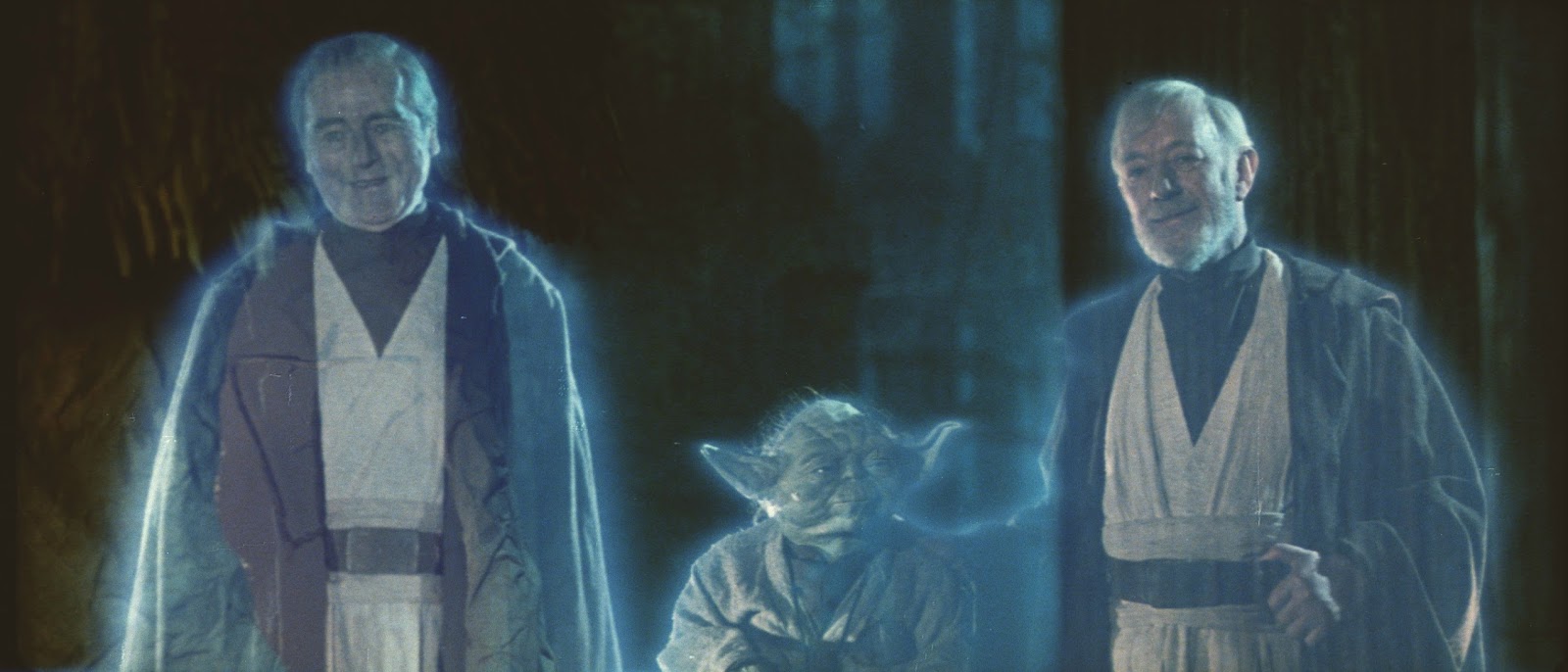
Later, on Endor, Luke mourns his father with a funeral pyre as everyone rejoices in the Rebel victory, even the ghostly images of Yoda, Obi-Wan and, yes, even Anakin Skywalker.


The spirits of Anakin, Yoda and Obi-Wan rejoice at the Rebel victory in Return of the Jedi.

The film was released on May 25, 1983. By now, and as we’ve learned from the subsequent prequel trilogy, the franchise is critic-proof. Reviews were mostly mixed, though some, notably Roger Ebert, loved the film. Domestically, the film made over $252 million. It would add another $165 million worldwide. Merchandising would not suffer, though I don’t have numbers, but from then on, it seems, there has been merchandising in some form or the other, in retail, book and toy stores ever since, even when there was no imminent release of a new film.

Like all of the previous films, Return would get the enhanced treatment with 1997’s Special Edition and the original would disappear, hopefully preserved in some film vault in canisters next to Star Wars and The Empire Strikes Back. But for the average filmgoer, you might as well consider the version we’re reviewing as “lost”.

That said, Return of the Jedi provides the best example of special effects needing enhancement. It is painfully obvious when green screens are used, even more so than in the first two installments. They come off looking fake rather than special. It is most noticeable on the chase scenes through the redwood forest on Endor.

Like in the previous films, the costuming is hit and miss, but here it is more miss than hit.

Outside of the iconic costumes already introduced, there is nothing really good. Whenever we’re introduced to a new “race” of creature, they look like they’re wearing costumes. There is no sense of a soul, for lack of a better word, behind any of the eyes on any of them. They come across as looking like something you’d see in a high school production rather than a multi-million dollar film. The Ewoks, as an example, might as well have had button eyes than what they had.


Not all the costumes were bad in Return of the Jedi.This outfit is particularly iconic.

The Ewoks are also an example of Lucas trying too hard, in this case, not to lose young viewers. It is no accident that they resemble teddy bears though they definitely have a native vibe, like pygmy's from a Tarzan movie.

Disappointing costumes and special effects aside, the acting is what really doesn’t congeal in this movie. It’s as if the man characters are going through the motions without emotion. Maybe familiarity has brought on a certain flatness, but I don’t feel like any of them (Hamill, Ford and Fisher) really put in their best efforts here. Even Alec Guiness, who again makes an appearance as Obi-Wan, comes across as flat in his delivery.

The plot point that is brought out in Return of the Jedi, the fact that Darth Vader doesn’t know he has a daughter, seems a little hard to believe. If this took place in a little backwoods village without any advanced technology, you might believe that a woman might be pregnant with twins and she and her husband might not know until she actually gives birth.

But even though this is long, long ago, these people have mastered inter-galactic travel. It’s hard to believe that a pregnant woman wouldn’t know there were multiples inside her. Add to that Anakin’s mastery of the Force and it’s hard to imagine he wouldn’t sense two “younglings” growing inside Padme. After Revenge of the Sith, I always assumed he knew and that they were trying to hide both children from him.

Watching The Empire Strikes Back and then Return of the Jedi was similar to watching Spider-Man 2 (2004) and then Spider-Man 3 (2007). When Spider-Man 2 ended, I couldn’t wait for 3, but after sitting through the final in the trilogy, I felt more like “phew that’s over.” Return of the Jedi is not as good as Spider-Man 3, but the disappointment is just as real.

You don’t watch Return of the Jedi because it’s a great movie; it’s not. You watch it because it completes a trilogy you’ve already given the first two parts of multiple viewings and hours of your life. But as disappointing as this might be, it is still heads and shoulders above the next three films, which we will not be reviewing.


The stage is set for Episode VII; who would have thought it would take 32 years to get there.

Saturday, December 13, 2014

Stubs – A Christmas Story


A Christmas Story (1983) Starring: Melinda Dillon, Darren McGavin, Peter Billingsley. Narrated by Jean Shepherd. Directed by Bob Clark. Screenplay by Jean Shepherd, Leigh Brown, Bob Clark. Based on the book In God We Trust, All Others Pay Cash by Jean Shepherd. Produced by Rene Dupont, Bob Clark. Run Time: 93 minutes. U.S. Color, Christmas, Comedy

Most of the time, when we think of Christmas movies, we’re talking about films like It’s A Wonderful Life (1946), The Bishop’s Wife (1947) or one of the many films based on Charles Dickens’ A Christmas Carol. But not all classic Christmas movies are that old or black and white. Case in point, A Christmas Story (1983), based on a book by Jean Shepherd, In God We Trust, All Others Pay Cash. Like It’s a Wonderful Life, which NBC shows every year in December and usually in a marathon at some point, A Christmas Story is shown every year by TBS often in a 24-hour marathon.

Jean Shepherd was an American story-teller as well as a radio and television personality, sort of his generation's David Sedaris. Like some of Sedaris’ work, Shepherd wrote humorous stories about growing up. Interestingly enough, both are perhaps most famous for stories about the Christmas season. In God We Trust, All Others Pay Cash was a series of short stories, first spoken by Shepherd on his radio show and published in Playboy magazine, before being published in book form in 1966.

The story takes place in Hohman, a fictionalized version of Hammond, Indiana, Shepherd’s hometown, during his youth, roughly the late 30’s/early 40’s (no actual year is given). The Parker family is a typical white family of the time, consisting of a housewife/mother (Melinda Dillon), a foul-mouthed father, aka The Old Man, (Darren McGavin) and two children, the nine-year-old Ralphie (Peter Billingsley) and his younger, more immature brother Randy (Ian Petrella).

Christmas is coming soon and after seeing it in the display window of a downtown department store all Ralphie wants is a Red Ryder Carbine Action 200-shot Range Model air rifle with a compass in the stock and “this thing which tells time.” But it’s a hard sell. His dilemma is how to bring in it up to his parents. He knows that he has to be delicate in his approach. He first tries to plant an ad for the rifle in his mother’s Look magazine.

Ralphie (Peter Billingsley), far left, sees what he wants for Christmas in a store window.

When sitting around the kitchen table, which is where the Parker family eats all their meals, he tries to be nonchalant about the need for such a gun, by mentioning a sighting of bears in town. Since that tact isn’t working, he tries to change the subject, but when his mom asks him what he wants for Christmas, he blurts out the Red Ryder BB gun. Of course, his mother retorts with “you’ll shoot your eye out” and Ralphie asks for tinker toys instead.

Ralphie continually blows his chances to drop a hint about what he really wants for Christmas.

Not everything about the movie is about the quest for the Red Ryder. The film tries to show the comings and goings of Ralphie, Randy, and their neighborhood friends, who attend the same school, Flick (Scott Schwarz) and Schwartz (R.D. Robb). One such incident revolves around a bet between Flick and Schwartz and whether or not your tongue would freeze against a cold flagpole. Flick doesn’t think it would and resists Schwartz's daring to prove it. But when Schwartz triple dog dares him, in front of the schoolyard, Flick has no choice; lo and behold it does stick. And when the bell rings, his classmates leave him stranded there until the teacher sees him and the fire and police departments are called.
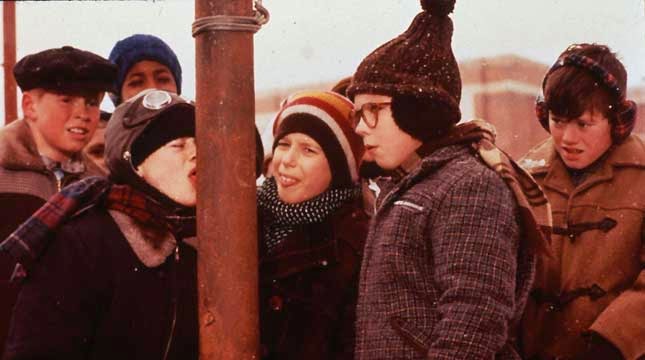
Flick (Scott Schwarz) gets triple dog dared by Schwartz (R.D. Robb) into sticking his tongue on a frozen pole.

The boys are also harassed by neighborhood bully Scut Farkus (Zack Ward) and his minion Grover Dill (Yano Anaya). Farkus doesn’t seem to be after money or goods, he just really enjoys terrorizing these smaller and younger kids.

Bully Scut Farkus (Zack Ward), right, and his minion, Grover Dill (Yano Anaya).

There are other touches from the era. Little Orphan Annie was a popular daily comic strip that ran from 1924 until 2010. Long before it got the Broadway musical treatment as Annie, it was serialized on the radio. Originally sponsored by Ovaltine, listeners, mostly children could redeem proofs of purchases for a secret decoder ring which would allow them to decode messages from the show. Ralphie, overjoyed by finally receiving his ring, is quickly disappointed when the first secret message he decodes is “Be sure to drink your Ovaltine.”

Father, who beyond being a furnace fighter and curse word connoisseur, is also a dedicated contest entrant. Finally, he receives notification that he's won a major prize. Anticipation runs high as to what’s in the box that gets delivered after dinner. Mother is visibly disappointed that it turns out to be a lamp made from a plastic replica of a woman’s leg in fishnet stockings and high heels. Father, happy to have finally won something, wants to proudly display it in the front window, much to Mother’s chagrin. Later, while Father is busy fighting the furnace, Mother “accidentally” knocks the lamp over, breaking it. Father tries unsuccessfully to glue it back, but it proves to be hopeless.

The Old Man (Darren McGavin) proudly shows off his
hideous prize. Mother (Melinda Dillon) is not as pleased. 

Next up is getting a Christmas tree, for which there doesn’t seem to be much selection, though they do haggle the price down a few dollars. But the big incident happens on the way home when the car has a flat. Thinking Ralphie is old enough to help, Mother sends him out to help their father with changing the tire. Father, who has always visioned himself working in the pits at a car race, is slowed down by Ralphie’s assistance. But things go from bad to worse when the hubcap Ralphie is holding gets knocked out of his hands and the lug nuts it contains go flying into the snowy night. Ralphie sums up the incident by using an expletive, aka the F-word, fudge.

Father rats him out to Mother and Ralphie is forced to have his mouth washed out with soap until he confesses who taught the bad word. He chooses a friend rather than blaming his ever cursing Father.

Ralphie gets his mouth washed out with soap for saying a bad word.

Back on his quest for the Red Ryder, Ralphie tries to go around his mother and hopes to use a theme paper they have to write for school to get his teacher, Miss Shield (Tedde Moore), on his side. In his paper, he pleads his case for the Red Ryder Carbine Action 200-shot Range Model air rifle with a compass in the stock and “this thing which tells time.” However, his hopes are dashed when his teacher echoes his mother’s sentiment, writing at the bottom of his C+-graded paper that he would probably shoot his eye out with the gun.

Disappointed beyond belief, Ralphie is in no mood for his daily dose of bullying from Farkus. Losing it, Ralphie fights back, knocking Farkus to the ground and wailing on him. The other kids watch in amazement until Randy goes to get their mother. Farkus is left bleeding on the sidewalk while Mom takes Ralphie home and tries to calm him down.

Ralphie wails on Farkus while his friends watch on in amazement.

Ralphie and Randy are both worried about their father’s reaction, but when he gets home, both are pleasantly surprised when Mother downplays the incident and tells Father that she’s taken care of everything.

Having failed to persuade his mother or his teacher, Ralphie hits upon Santa Claus, who, after all, has the final say about Christmas gifts. But the line to see Santa is long, the store is closing and lap time is at a premium..Once again Ralphie blows his chance and goes mute when asked what he wants. Shaking his head "yes" when Santa suggests a football, Ralphie is put on the slide down from Santa’s perch before finally coming to his senses. Scrambling back up the slide, he asks Santa for the Red Ryder Carbine Action 200-shot Range Model air rifle with a compass in the stock and “this thing which tells time.” Little Ralphie sells it with a smile, but is crestfallen when Santa, sounding like his mother, warns that he might shoot his eye out. Adding insult to injury, Santa uses his boot to push Ralphie down the slide. Feeling defeated, Ralphie goes home.

Ralphie proud of himself for finally asking Santa for the Red Ryder.

Christmas morning finally arrives and Ralphie and Randy dive into the pile of presents. One of the presents is a pink bunny suit hand sewn by an Aunt, which Ralphie is forced to put on. It looks ridiculous and the Father allows him to change out of it.

Worst gift ever. Ralphie receives a custom-made pink bunny outfit from one of his aunts.

After all the gifts are seemingly opened and Randy is passed out on the floor, The Old Man directs Ralphie to a box that is hidden between the desk and wall. When Ralphie pulls it out and unwraps it, he is surprised that it is the Red Ryder he’s been longing for. Father waves off Mother’s concerns about the gun and Ralphie anxiously runs out to play, again warned not to shoot his eye out.

Ralphie takes aim with his new Red Ryder.

No sooner is he outside and shooting at a target, the backfire from the gun knocks him down. With his glasses off and his cheek cut, Ralphie considers for a second if he has actually shot his eye out. When he realizes he’s okay, he tries to find his glasses, stepping on them, of course, and breaking them. Mustering up a few tears, Ralphie’s cries get Mother’s attention. He tells her that an icicle fell and cut his cheek and broke his glasses. When Mother believes him, Ralphie looks at the camera as if to say, “I can’t believe I got away with that.”

Ralphie convinces his mother that an icicle fell on his face.

With the outside door left open, the neighbor’s dogs invade the Parker house and devour the turkey that was being basted on the table when Ralphie had his accident. With no turkey to eat and few options, the Parker family end up being serenaded with Christmas songs in a Chinese restaurant.

For Ralphie, all’s well that ends well and he ends up sleeping that night with the Red Ryder in his clutches, the best Christmas gift he had ever gotten or would ever receive in his life, according to the narrator, Jean Shepherd.

Ralphie Parker stories would not end with that Christmas night. Though there were only supporting cast leftovers from A Christmas Story, there was a sequel made, My Summer Story (1994) and some TV movies featuring the Parker family, based on other Jean Shepherd stories, followed. An “official” sequel would be made: A Christmas Story 2: Official Sequel (2012). The direct-to-video feature was not based on the writings of Shepherd, just his characters, which is never a good sign.

Melinda Dillon, who plays Ralphie’s mother, began her acting debut on Broadway as Honey in the original production of Who’s Afraid of Virginia Woolf (1962) for which she was nominated for the Tony Award for Best Featured Actress in a Play. Her first film was The April Fools (1969). She has been nominated twice for Academy Awards for Best Supporting Actress for her roles in Close Encounters of the Third Kind (1977) and Absence of Malice (1981). She would also appear in several TV Movies including State of Emergency (1994), for which she was nominated for a CableACE Award for Best Supporting Actress in a Mini-Series or a Movie.

Darren McGavin would start his film career as a painter at Columbia Pictures in 1945. That same year he would win a bit part in A Song to Remember and from that an acting career was born. He would appear in such films as The Man With the Golden Arm (1955); Mrs. Pollifax – Spy (1971); Happy Mother’s Day, Love George (1973), which he would also direct and produce; Airport ’77 (1977) and the Martian Chronicles (1980) before appearing in A Christmas Story. He would also appear on many television shows starting with Crime Photographer (1951-52) and Mickey Spillane’s Mike Hammer (1958-60). McGavin, however, maybe best known for the TV movies The Night Stalker (1972) and The Night Strangler (1973) and the series that would come after them Kolchak: The Night Stalker (1974-75).

Like many child stars, Peter Billingsley started young, doing his first TV commercial at the age of 2. In all he would do about 120 commercials. He would make his first movie appearance in If I Ever See You Again (1978). After A Christmas Story, though, roles would slow down. He would make appearances on many sitcoms of the time, Punky Brewster, Who’s the Boss? and The Wonder Years, but roles would be harder to get. On an afternoon special for CBS: The Fourth Man (1990), he would meet and become friends with Vince Vaughn.

He would move behind the camera working with Vaughn and Jon Favreau, co-producing Made (2001), and Zathura: A Space Adventure (2005), and became Executive Producer on The Break-Up (2006), Iron Man (2008) and Four Christmases (2008). Billingsley currently is an Executive Producer on Sullivan & Son on TBS, which Vaughn is also involved in.

Jean Shepherd’s humor, much like Sedaris’, isn’t for everyone, and not everything either write is as funny or as fascinating as they may think. I have to imagine that the sense of humor reflected in A Christmas Story met with Shepherd’s approval. since he co-wrote the screenplay. And there are many very relatable and quotable sequences. I like the fact that the movie is pulling back the covers on the Norman Rockwell ideal holiday family without completely blowing it up.

Still, there are some bits I could do without. As an example, I have to turn my head away whenever Ralphie’s brother Randy is around food. Randy, like many children, has an aversion to eating. He plays with his food, especially mashed potatoes, which he sculpts, but nothing like Richard Dreyfuss does in Close Encounters of the Third Kind (1977). Mom gets Randy to eat by having him show her how pigs eat. Gross.

Gross out humor: Randy plays with his food rather than eat it.

I’m not sure how accurately the film actually reflects the time period. In the 30s/40s time frame, America was either recovering from the Great Depression or was involved in World War II; neither event is mentioned, though either would have undoubtedly effected their lives. And I’m not one of those who can tell a 1938 Plymouth from a 1943 Ford, so I can’t tell you if other things like clothes and cars are accurate or not. But nostalgia is about remembering the best of how things were supposed to be, rather than how they really were, so you forgive a film like this if it isn’t spot-on period accurate.

The film is really a series of vignettes, pulled from other Shepherd stories, with the Red Ryder for Christmas theme holding everything together. As such, there are some time-bending issues, like giving their teacher Christmas gifts, but school continuing afterward. I would have thought those would have happened concurrently.

It also seems a little incongruent, to me, that a boy who still believes in Santa Claus would have some of the vocabulary Ralphie has. Usually the first time you say the F-word is after you figure out the Santa Claus scam not while you still believe it. Otherwise, this wouldn’t be the first time he’d have had his mouth washed out with soap. But it probably makes for a good story, as does the salacious lamp The Old Man wins. What sort of contests was he entering anyway?

Still, I think the film does create an atmosphere that is, for the most part, believable, especially from a child’s point of view and an adult's remembrance. Ralphie’s schemes seem to make sense if you don’t know how the real world works. And his daydreams are worthy of Walter Mitty. Once he’s a glamorized cowboy holding off bad guys in the striped prison shirts, led by Black Bart the outlaw, using his Red Ryder. In another, his parents learn their lesson when he goes blind from soap poison. When he turns in his theme paper, he imagines a reception worthy of Babe Ruth winning the World Series with two out bases loaded in the bottom of the ninth.

While I would recommend the film, I would do so with the caveat that this is not meant for small children. The PG rating the film received at the time of release suggests that the audience was meant to skew a little older and would have already gone through this time in life, rather than going through it when they watch the movie.

A note about the Blu-ray of A Christmas Story. The copy I have is from 2008 (the copyright on the package) and the disc does not offer chapter breakdowns, so you can’t skip to your favorite part like you can with the DVD. Usually, Blu-rays will have more bells and whistles, not less, so imagine my surprise to find that in this case, it doesn’t. It seems like a simple thing to have added to the viewer's experience. I don't know if this error has been rectified in future releases.

Still, the story resonates beyond the media. There is a universality about Ralphie's story that continues to be a part of the season. It would not be the same Christmas season without A Christmas Story.

To read reviews of other Christmas films, please see our Christmas Review Hub.