Saturday, October 18, 2014

Kingdom Hearts: Birth by Sleep - An Important Stop


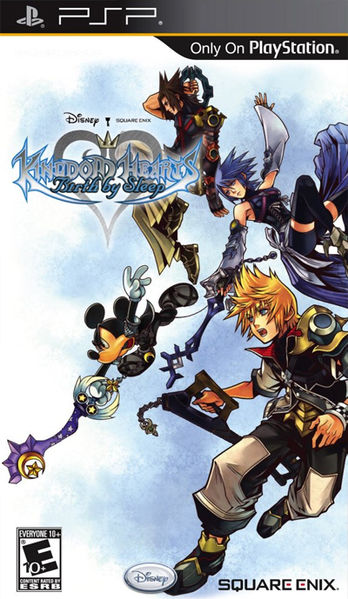
When I first played Kingdom Hearts about a decade ago, I was completely blown away. I was having a really fun time and when it ended, I was excited to learn of another game in the series. Since I didn’t have a Gameboy at the time however, I couldn’t really play Chain of Memories (and wouldn’t be able to until the PS2 remake, Re:Chain of Memories), so I ended up skipping to Kingdom Hearts II on PS2. I later learned that this was a bad idea, but since I’ve played Re:Chain of Memories, the story makes just a little more sense (at least as much sense as you can make out of Kingdom Hearts). As the years went on, more games came out, but on platforms that I had no access to, so I was bummed that my lack of a DS would prevent me from witnessing 358/2 Days (pronounced Three-Five-Eight-Days Over Two), though thankfully 1.5 HD Remix was able to fill me in on the details via redone cutscenes. Flash forward to the announcement of Kingdom Hearts: Birth by Sleep for the PSP handheld. The fact that I actually owned a PSP enticed me to play it, so much so that while walking to the bus during my first College semester, I went by the nearest GameStop and picked up a copy. I then proceeded to start playing as soon as I sat down and wouldn’t stop playing for a few weeks during the same semester. I would play during long wait times, particularly the hour or so before Astronomy class, and my sessions went on so long that I had to keep exchanging PSP batteries with my brother just so I could keep going. As I played Birth by Sleep for the first time (and wrote a terrible review of it on DeviantArt once I finished), it became my new favorite game in the series, overtaking Kingdom Hearts II. Having played it years later in anticipation of Kingdom Hearts 2.5 HD Remix, with greater knowledge of the inner workings of the game, I can say that this sentiment still rings true.

It began so simply...

In The Land of Departure, the Keyblade wielders Terra, Ventus and Aqua are all close friends. On the night before Terra and Aqua’s Mark of Mastery exam, which will determine who receives the title of Keyblade Master, Ventus decides to help the two practice and hone their skills. Afterwards, the three of them discuss their friendship, at which point Aqua decides to give everyone Wayfinders that she made to symbolize that their bonds of friendship are strong enough that they’ll be able to find each other no matter where they are. The next day, Master Eraqus, with Master Xehanort in attendance as a guest, begins the Mark of Mastery exam with Terra and Aqua, summoning orbs of light for them to destroy. However, something goes wrong and the orbs are imbued with darkness, causing their behavior to become erratic enough to pull Ventus into the fray. Once the crisis is over, Terra and Aqua have a one-on-one match to display their abilities. In the end, Aqua is declared the Keyblade Master by Master Eraqus because Terra let his inner darkness get to him at one point in the match. As Aqua goes to Eraqus to learn a valuable secret, Terra storms off and is confronted by Master Xehanort, who tells him about his inner darkness and convinces him that it isn’t something to be feared, but channeled and that going to different worlds will help him control it. Meanwhile, Ventus is in his room when he is suddenly confronted by a boy in a mask. The boy in the mask informs him that Terra is leaving, possibly forever, and that Ventus has one last chance to see him beforehand. Once the boy departs, Ventus runs off to where Terra is in an attempt to say something to him. However, Terra leaves in a hurry, causing Ventus to chase after him. Aqua, who has just arrived, tries to stop Ventus and tell him something, but she is too late. Once both Terra and Ventus are gone, Eraqus instructs Aqua to go after them, but keep an especially close eye on Terra, as he is worried about his darkness getting out of hand. Aqua complies, flying away from the Land of Departure in pursuit of Terra and Ventus.

Master Xehanort

It’s interesting to note that Birth by Sleep is a prequel of sorts, occurring ten years before the events of the original Kingdom Hearts. In this regard, it does its job well, establishing several key details that add some depth to the mythos and help explain how certain things came to be, including Sora and Riku’s connections with the Keyblade, the origins of Roxas and even the creation of Castle Oblivion. From a narrative standpoint, as in how it functions on its own, Birth by Sleep is written pretty well. It does a pretty good job handling its gimmick, which has you playing as three different characters, Terra, Ventus and Aqua, who travel to the same worlds, but not during the same points in time. Their independent plot threads do intertwine at times, which helps to establish connecting points to separate the story into distinct parts (ex. before and after the battle with Trinity Armor). As with the previous entries, there are some dark themes explored here and they go beyond the struggle between light and darkness in the heart. Because the three characters are effectively soldiers, darker themes are touched upon, including war, genocide, existential crises and feelings of trust and betrayal. These aren’t as explored as extensively as they would be in, say, Metal Gear, but the elements have enough of a presence that the overall narrative is very engaging and elicits good emotive reactions out of the player. Though admittedly the story can be a little confusing at times, what with the discussions of the Keyblade War and the χ-blade (pronounced Kye-blade) and whatnot, Birth by Sleep is an important milestone to hit to at least try and understand the story as it stands now.

Vanitas (left) is very important to the story.

While the story is very interesting to play through, the heroes do make plenty of mistakes. Terra, for the most part, is easily trusting of the people he meets, including Master Xehanort, and this comes back to bite him hard (though I won’t say how). Likewise, Aqua and Ventus’ stories also rely on them making one poor decision after another, which by the endgame seems to have only furthered Xehanort’s plans without them realizing it. Fortunately, they are able to reverse most of the damage that they cause, but it also comes at a great cost, which I will not reveal here for the sake of avoiding spoilers. In any case, I found it interesting how the Disney-inspired worlds were integrated into the plotline, even if the stories don’t quite match up with the source material (though one should expect creative liberties when putting a work from one medium into another, especially when fusing multiple continuities and independent stories together).

Gameplay-wise, Birth by Sleep is the best I’ve ever played in the series. As with Kingdom Hearts II, there is a further emphasis on action, but the twist here is that they’ve done away with the menu system entirely, instead going with a customizable command deck. The way the system works is that you are given a certain amount of slots (which increase over time to a maximum of eight) to insert commands representing certain physical or magical attacks as well as items. The d-pad scrolls through the commands and you press triangle to activate the one you want, after which there is a cool down period that must end before you can use it again. By using commands, a gauge above the list is filled up, which can lead to a unique finishing move or a new command style that enhances regular attacks and can lead to a more powerful finisher.

One of the most powerful styles: Ghost Drive.

These commands can also be melded together, similarly to Crisis Core: Final Fantasy VII’s Materia Fusion system, and combined with different crystals to attach various abilities which range from reducing cool down times to buffing or nerfing elemental damage. One of the most essential of these abilities, from my experience, is EXP Walker, which lets you gain 1 EXP for each step you take (for those who wish to know, the most reliable method to obtain it is to combine Blizzard and Aero in conjunction with an Abounding Crystal). In place of summons, the game introduces a D-Link system as well, which lets the player replace their command deck with that of another character that they have formed a bond with (ex. Terra, Ventus, Aqua, Snow White, Experiment 626, etc.). D-Links can be upgraded with a rare star drop that can attach different abilities to the character during usage, making them more powerful for the next activation; when the D-Link gauge isn’t full, it can be replenished with blue D-Link prizes.

The last system introduced is the Shotlock Command, which is activated by holding down L and R and then moving a target over enemies. Pressing X will trigger the Shotlock attack, though pressing the button when the targets are at maximum will not only fire off all the selected shots, but allow an additional barrage of the same attack as well. While these attacks are cool to pull off, the only problem is that the same buttons used to trigger them are also used to rotate the camera, which can be awkward if you’re really not careful.

One of the strongest Shotlock Commands: Ultima Cannon.

I realize that what I’ve written may sound a little confusing, but I think it’s the best system the series has had. Once you get into it it’s very easy and intuitive on top of being incredibly quick and responsive. By taking away a lot of the complexity of previous Kingdom Hearts games, including the already streamlined Kingdom Hearts II, it becomes much easier to manage the player character and figure out exactly what you want. Despite some of the minor flaws in the systems present, I hope that they not only keep the command deck in future Kingdom Hearts titles, but expand and improve on it as well for the best possible experience. It’s a natural evolution of the process and the only logical next step is to move forward with it.

Although Birth by Sleep was developed for the PSP, I’m genuinely impressed by its size and scale. There are several worlds to explore, each with a number of areas and secrets. Each area isn’t always available, in fact limited to how relevant they are to each character’s story, but this doesn’t change that the size of the game could easily rival its console brethren. Birth by Sleep feels as large, and as long, as any Kingdom Hearts game on the PS2 (and now PS3), a feat to be rightfully commended for. There is also a great attention to detail and a fittingly bright color palette with a lot of range. Every one of the Unversed enemies has a unique shape, save the ones that are merely palette swaps, and an easily identifiable color pattern that helps one to figure out exactly how to take them down. On the downside, the graphics aren’t the best, being on PSP and all, since the character models end up a little jagged in places and cloth textures don’t look particularly smooth. Despite this however, Birth by Sleep ends up being one of the best looking games on the handheld and can be seen as a technical marvel.

A Flood, one of the most common Unversed types.

The game also has plenty of challenge, especially on the higher difficulties (I played on Proud Mode), where the bosses can really knock you around like a piñata unless you go into battle fully prepared. No matter what difficulty you play on, you may find the Mandrake Unversed to be particularly annoying, as they attack by firing razor sharp leaves that always seem to match your elevation and they can fire them off in rapid succession to disrupt any combo you might have had going (which can further cause the meter on the Command Deck to start dwindling). The worst part is that not only can they inflict Poison and Confusion if you’re not careful, they don’t appear out of thin air like the other Unversed, rather they are already on the battlefield to begin with and can thus cause you as much pain and suffering as possible; I loathed Mandrakes every time I came across them.

Voice acting and music have always been a strong suit for Kingdom Hearts and this installment is no exception. Since I own the soundtrack, I believe that it contains some of Yoko Shimomura’s best compositions to date, with a grand mix of upbeat world themes and dark and foreboding battle pieces. Voice acting, however, is admittedly kind of a mixed bag. On one hand, we have phenomenal voice work by the recurring Disney characters, who mostly use the official Disney voice actors (for those characters whose voice actors are deceased, they have incredibly convincing sound-alikes). There are also surprise performances from Leonard Nimoy and Mark Hamill, each respectively voicing Master Xehanort and Master Eraqus. They both sound like they really put their heart into their work and their many years of experience have certainly paid off. On the other hand, we have the main trio; Terra, Ventus and Aqua. Terra, due to being voiced by Jason Dohring, sounds a little bored in his delivery, downplaying the emotions he should be feeling in certain scenes. However, when Richard Epcar takes over at some point during the plot (I won’t say how), his lines are overacted, which balances that out perfectly. Ventus is voiced by Jesse McCartney and actually gives a solid performance, mirroring his role as Roxas in Kingdom Hearts II. Lastly, we have Aqua, whose voice actress, Willa Holland, has nearly the same problem as Dohring, but not to the same degree. Should these characters return in the future, I hope that Dohring and Holland have picked up a thing or two to make their characters better rounded out.

Mark Hamill does a good job as Master Eraqus.

Before I end this review, I’d like to share some advice with prospective PSP players. You can play the three stories in any order you wish, but the best order is Terra, Ventus then Aqua. Playing in this specific order will lead to far less confusion than playing it any other way, plus it creates a smooth transition to the Final Story. I also highly recommend unlocking the secret video, Blank Points, as it is a good epilogue to cap off the events of the story. The easiest way to unlock it is to complete all of the campaigns on Proud or Critical mode (I would advise playing on Proud Mode, even if it’s your first time playing, since the difficulty will disappear after playing for a while). Finally, there are some settings that would be very beneficial to manipulate. There is the option to install the game to your memory card, which gives the advantage of reduced load times, and you have the option between 200, 400 or 624 MB, speeding up load times in an increasing number of areas for the game (combat, menus, moving between areas, etc.); I recommend doing a full install for best results. Also, there are two specific settings that you should immediately increase: Color Depth and CPU Speed. Upping the Color Depth to 32-bit will provide the best graphics, but sometimes causes slowdown as a result. Accelerating the CPU Speed prevents slowdown, counteracting the disadvantage of 32-bit Color Depth, but will cause the PSP battery to drain much quicker, so it is further recommended that you have an AC adaptor at all times (I call this combination “drain the battery mode” for a good reason). Follow all of these simple steps and you’ll have the best Birth by Sleep experience possible.

In the end, Kingdom Hearts: Birth by Sleep is what I would consider the best game in the franchise. The gameplay is streamlined and the controls are tight, all without sacrificing the spirit of earlier games or what made them good in the first place. Admittedly the story can be confusing at times, a given for this franchise, and the voice acting may not be perfect, but the game has a plotline that can, to some degree, operate independently of its brethren (though it does serve as the MGS4 of the group by explaining just about everything (for now…)). On top of that, the game is simply a well-crafted RPG that makes owning a PSP very worthwhile. If you haven’t played it yet, I see no reason to wait; it might also be a good excuse to buy a PSP and a play a good game that isn’t related to God of War.

Friday, October 17, 2014

[OLD] Skylanders #1 (Comic)


Quite recently, IDW Publishing has begun releasing a comic book series based on the ever-popular Skylanders property, having released an exclusive issue #0 at San Diego Comic-Con to build interest in both this venture and the then-upcoming Skylanders: Trap Team. Thankfully, this first issue is not just a reprint of the #0 comic, beginning to tell new stories in the Skylanders universe to flesh out its world. Though it is obviously meant as a way to further advertise the toys (see: Transformers), this first issue does manage to expand on the games’ characters, even if it is a little rough around the edges.

This issue features a main story, “Forgetting Flynn”, and a back-up story, “The Secret Origin of Trigger Happy”, both written by Ron Marz and David A. Rodriguez. “Forgetting Flynn”, drawn by Mike Bowden and colored by Fernando Peniche, follows Flynn as he tries to transport the Mini Skylanders to Skylanders Academy. On the way, Flynn sees Kaos has disguised himself as Weeruptor (one of the Mini Skylanders) to infiltrate the Academy. In response, Kaos casts an amnesia spell on Flynn and a Skylander, Chopper, tries to snap him out of it. I thought the story was written fairly decently, since it does good at highlighting Chopper and Flynn’s dialogue was written such that it sounded like things he would say, especially when delirious (and of course it’s hard to un-hear Kaos with his dialogue). However, the whole business about Kaos taking the form of Weeruptor goes unresolved, and on top of this the story just says “End” at the end. Looking at an ad in the comic for the Skylanders Micro Fun Packs (micro comics plus extra goodies), it appears the story will continue in the next issue and this is part of a 3+-issue arc, so the “End” was probably included due to it being released as a separate micro comic. However, it was a little confusing for me, since I’m used to seeing a “To Be Continued…” or some other variant when a comic has a running story (the Adventure Time comic from Boom’s Kaboom! imprint does this with bigger arcs and it usually also has a back-up story). As far as the writing goes, however, this was my only real hang-up about it; also, “enchilada” eventually becomes a weird word, but that’s beside the point.

Buy our toys!

Mike Bowden’s art works pretty well for the main story, as it did for the Comic-Con comic, bringing his own style to the Skylanders characters while still drawing them accurately and expressively. Fernando Peniche’s colors compliment this style, adding extra life to the characters and helping to match the tone of the situation. An interesting thing about the art is that, while the characters themselves and other important objects use definitive outlines, the backgrounds go without outlines, which I think gives the comic a certain feel to it and helps the characters not blend into their brightly-colored backgrounds.

“The Secret Origin of Trigger Happy”, drawn by David Baldeón and colored by Ander Zarate, sees the Skylanders Trigger Happy, Night Shift (a SWAP Force member) and Bouncer (a Giant) at Skylanders Academy training out of boredom while they wait for Blades to show up, and in this boredom Trigger Happy tries to relay his backstory. This story was an interesting read, as it gives some insight into what Skylanders do when not trying to stop any villains (of which the new game contains a plethora), and it was kind of funny to see references to some known Marvel and DC heroes as Trigger Happy explains his origin. The story ends up being kind of a big tease, but it was still nice to see the Skylanders in their off-hours; it makes you wonder what others do with their spare time. I liked David Baldeón’s art here, since it was very energetic and expressive, and Ander Zarate’s coloring work only adds to this energy (in addition to some rather impressive lighting work that really adds some depth to everything, as well as some glow effects on places where there would be on Bouncer’s toy). It would be very interesting to see more from this art team in the future.

The artwork for the back-up story is very energetic.
(Page shown without its dialogue.)

Also, as with the #0, this comic contains character bios at the back, so it can be assumed that this will be a running feature. I like to make a point of reading stuff like this, as it gives me more background on the characters and helps me to appreciate them more (and I’m sure the same can be said for any hardcore fan). In case anyone is wondering, the bios in this issue are for the Skylanders Spyro, Jet-Vac, Prism Break, and Food Fight.

Skylanders #1 is a decent start for the Skylanders comic, even if it does have a couple of rough patches. The writing isn’t terrible, the art is nice to look at (especially in the back-up story), and it does a good job of trying to flesh out the characters (which is a little more than I can say with the games themselves), which I hope to see more of in future issues. This is definitely a comic that any Skylanders fan should pick up, and anyone interested in playing the games but does not have the money or resources to do so can use this as a more cost-effective jump-on point to understanding the game’s world (the main story even offers a brief and concise summary of the overall backstory for newcomers). As someone who has not been able to play Skylanders: Trap Team yet, I’m glad to see that there aren’t any spoilers for that game anywhere, so anyone in a similar situation can pick up this comic without worry.

Stubs – Freaks


Freaks (1932) Starring: Wallace Ford, Leila Hyams, Olga Baclanova, Rosco Ates. Directed by Tod Browning. Screenplay by Willis Goldbeck and Leon Gordon. Based on the short story Spurs, by Tod Robbins. Produced by Tod Browning. Run Time: 65 minutes. U.S.  Black and White. Horror, Drama

To be honest with you, dear readers, Freaks is a film I had, for many years, avoided seeing. However, seeing as Halloween is approaching and we wanted to do a retrospective of classic horror films, I decided to man up and watch it. I may sound squeamish, but I have never been a fan of freak shows. These poor deformed people fall under a category Woody Allen described in Annie Hall (1977) as the horrible, people you don’t know how they get through life. I don’t find amusement in their deformities, nor do I relish watching them perform. But while these freaks might be the “stars” of the film, their deformities are not the real focus.

The film opens with patrons at a circus freak show. The barker (Murray Kinnell) leads them over to a horrifying display that makes women gasp. He explains to the crowd that the pitiful specimen inside this particular case was once a beautiful aerialist named Cleopatra (Olga Baclanova), who was known as the "Peacock of the Air." For most of the film, we hear her story as it is related to the gathered crowd.

Hans (Harry Earles), one of the carnival's dwarfs, is infatuated with the normal size Cleopatra's beauty, much to the dismay of his fiancée, Frieda (Daisy Earles), who is Hans' size. Cleopatra delights in toying with Hans' affections and making Frieda jealous, and she continually borrows large sums of money from Hans, who is only to happy to oblige. Despite his stature, Hans desperately wants to be taken seriously as a man and he apparently feels Cleopatra’s affections are proof of that.


Hans (Harry Earles) and his fiancee, Frieda (Daisy Earles). In real life they were brother and sister.

The freaks in the show are considered second class creatures by most of the other performers, who make fun of them to their faces. And this treatment is not limited to the circus itself. When one of the minders takes some of the freaks outside the circus grounds to let them run and play like children, they encounter Monsieur Duval (Albert Conti) and his caretaker, Jean (Michael Visaroff). Jean wants to run them removed from Duval’s land immediately, but the landowner takes pity and lets them stay.

One day, Hercules (Henry Victor), the strongman in the show, ends his relationship with Venus (Leila Hyams), one of the other "normal" members of the carnival. Venus turns to and is comforted by one of the clowns, Phroso (Wallace Ford), and her friends, the freaks. Roscoe (Rosco Ates), another of the circus clowns, is married to Daisy Hilton, one of the carnival's Siamese twins.


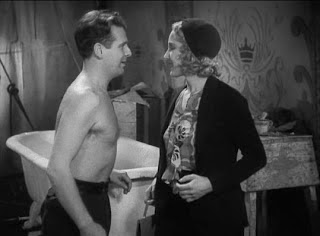
Venus (Leila Hyams) and Phroso (Wallace Ford), one of the clowns in the circus.

Hercules takes up almost immediately with Cleopatra, who shares with her his cruel attitude toward, and his disdain of, the freaks. Hercules sees nothing wrong with beating the Half Woman – Half Man (Josephine Joseph) when he thinks she’s eavesdropping on them.

Hans is increasingly ignoring Frieda to moon over Cleopatra. But Cleopatra is only interested in Hercules’ money. Venus, who doesn’t have a problem with the freaks, talks openly with Frieda about Hans’ fascination with Cleopatra. Venus tries to convince her that Cleopatra doesn’t love him. But that’s not what Frieda is worried about. She only wants Hans to be happy.

But Cleopatra doesn’t love Hans and even has him rub her shoulders to amuse other circus performers. Basically, everyone but Hans knows what’s going on with him and Cleopatra.


Cleopatra has Hans rub her shoulders for the amusement of the other performers.

Not all of the normals treat the freaks badly. Venus and Phroso don’t have problems with associating with them and are told when the Bearded Lady (Olga Roderick) gives birth to the Human Skeleton’s (Peter Robinson) daughter. Phroso even “flirts” with Schlitze, one of the so-called pinheads in the show, making her feel special by the attention.


Schlitze is one of the pinheads in the show. Despite the dress, Schlitze was a man.

Meanwhile, Venus and Phroso’s relationship continues to blossom. Love must be in the air as Violet Hilton, Daisy’s sister, also gets engaged to a Mr. Rogers (Demetrius Alexis). This promises to make for a very weird marriage for all. But not all love ends well.

Frieda goes to Hans to try and talk him out of his infatuation with Cleopatra. She tells him that the circus is laughing at him behind his back, but Hans doesn’t want to hear it and breaks off his engagement to Frieda.

Hans then gives Cleopatra an expensive platinum bracelet, causing Hercules to ask where the pollywog gets his money. Frieda goes to Cleopatra and begs her to cease leading Hans on. But Cleopatra laughs at her. Frieda then inadvertently tells Cleopatra about the fortune Hans has inherited, which only makes things worse as Cleopatra and Hercules plot to get his money. Cleopatra can marry him and then kill him.


Frieda goes to Cleopatra (Olga Baclanova) and asks her to leave Hans alone.

And indeed, Cleopatra marries Hans. At the wedding feast, she openly makes out with Hercules much to the disdain of Hans and the other freaks. Frieda, who can’t stand witnessing Hans' humiliation, leaves the table.

When the drunken freaks pass around a ceremonial cup, all take a drink from it and chant "Gooble-gobble, gooble-gobble. We accept her. One of us, one of us,” as they do. When the cup is presented to Cleopatra, as a sign her acceptance, she calls them freaks and tells them they make her want to puke. When Hans tells her that she makes him feel ashamed, she further humiliates Hans by carrying him around on her shoulders like he is a child, not a man.


Cleopatra doesn't want to be "One of  us, one of us."

Later that night, Cleopatra and Hercules reveal to Hans that the marriage is a joke. While they’re talking, Hans collapses from poison she’s given him. Cleopatra carries him back to his caravan. The next morning, a doctor (Hooper Atchley) determines that Hans has been poisoned, but that he will recover. Venus confronts Hercules, but he refuses to tell her what poison Cleopatra used.


After the wedding, Hercules and Cleopatra reveal to Hans that the marriage is a joke.

A week passes and Cleopatra has stayed by Hans’ bedside, but that night, she doctors Hans’ medicine. After she gives it to him, he secretly spits it out. When she leaves to see Hercules, Hans and the other freaks, who have been watching her closely, plot their revenge on Cleopatra and Hercules.

That night, a thunderstorm begins, and the caravan starts moving. Cleopatra tries to give Hans more medicine, but Hans, with other freaks around him, demands to see the bottle. There is an accident and some of the wagons are overturned. Cleopatra tries to run away, but some of the freaks chase after her. Others go to protect Venus, who has been attacked by Hercules. Phroso, who has come to Venus’ aid, is saved when one of the freaks throws a knife into Hercules. Cleopatra is chased into the rainy night by knife wielding freaks. We don’t see the attack, just the results.

The barker concludes his story and shows everyone what has become of Cleopatra; once a great beauty, she has been mysteriously transformed into a grotesque "duck woman" who is on display with the other freaks in the show.


Cleopatra is transformed into the "duck woman".

In an epilogue, years have passed and Hans, who has long since retired from the circus, is reintroduced to Frieda by Phroso and Venus. Hans has hidden himself away after that rainy night and Frieda tells Hans she still loves him.

This film seems like an odd choice for a studio like MGM, but at the time Tod Browning was a hot commodity, having just made Dracula (1931) the year before. While Dracula was a Universal picture, Browning’s career had really taken off while he was at MGM, working with Lon Chaney in such films as The Unholy Three (1925), The Blackbird (1926), The Road to Mandalay (1926) and London After Midnight (1927). It was during his tenure at MGM that Browning convinced Irving Thalberg to buy the short story Spurs, by Tod Robbins.

After making Dracula under a one picture deal, Browning returned to MGM. Thalberg offered him the opportunity to direct Arsene Lupin (1932), but Browning declined, preferring instead to develop Freaks. Being a studio picture, major stars were originally considered, including Victor McLaglen as Hercules, Myrna Loy as Cleopatra and Jean Harlow as Venus. Instead, Thalberg decided on a relative no-name cast.

Wallace Ford, at the time the picture was made, was a relative newcomer. Freaks was only his fourth feature length film. Ford would go on to appear in over 200 films, including a number of Westerns and B-pictures, including 13 films for director John Ford.

Leila Hyams made her first film in 1924, Sandra. She appeared in MGM’s first partial-talkie, Alias Johnny Valentine (1928), Buster Keaton’s Spite Marriage (1929), as Robert Montgomery’s sister in The Big House (1930) and with Jean Harlow in Red-Headed Woman (1932). She retired from filmmaking in 1936, after appearing in Yellow Dust, at the age of 31.

Cleopatra was played by Olga Baclanova. If you don’t remember her, you’re probably not alone. With the exception of Freaks, the Russian born actress made few sound films. A beautiful woman, she appeared in several silent features, including The Docks of New York (1928) and The Man Who Laughs (1928), but had a difficult transition to sound given her thick accent. Following Freaks, she only made three feature films, the last being Claudia (1943).

Rosco Ates, who plays the stuttering clown Roscoe, actually had a stutter, which he had overcome as a child. While he initially tried to be a violinist, he found success on the Vaudeville stage as a comedian with a stutter. Ates would have a long career as an actor in both features and shorts and on television.

But the strength of Freaks is not the direction of Browning or the acting of his “stars”, it comes from the real life circus freaks Browning used. Having worked in a travelling circus in his youth, Browning had a different view than most of these sideshow attractions. They are portrayed as honorable people, mistreated and misunderstood by the rest of the world.

Hans and Frieda were played by actual siblings, Harry Doll Earles and Daisy Doll Earles, from the Doll Family, a quartet of German-born dwarf siblings who performed in sideshows in the U.S. until the 1950’s. While Hans was a big role for Harry (no pun intended), he is probably best remembered as one of the members of The Lollipop Guild in The Wizard of Oz (1939).


Harry Doll Earles (r) is part of the Lollipop Guild in The Wizard of Oz.

But Hans and Frieda were simply miniatures. Many of the freaks in the movie had far worse deformities. For example, The Hilton sisters were real-life Siamese Twins; Johnny Eck, the legless Half Boy; Schlitze, a male pinhead; and Prince Randian, the armless, legless Living Torso all make powerful impressions. And while that impression is still strong today, it worked against the film when it was first released.


Daisy and Violet Hilton were real-life Siamese Twins.

Test screenings of the original 90 minute film would be considered disastrous. Extensive edits were made, removing what were considered over-the-top sequences like the freaks attacking Cleopatra and castrating Hercules were excised (thank you). So were some comedy routines and the first of the film’s epilogues. All the edited out sequences are now considered lost. The prologue with the circus barker was added, as was the happy ending reuniting Hans and Frieda. The resulting film was only 65 minutes.

But shorter length didn’t matter. The film received overall negative reviews and was outright banned in some countries, like the UK, where it wasn’t shown for 30 years. Let’s just say the world wasn’t ready for a strong dose of circus freaks and film did not do well at the box office.

Browning’s career apparently suffered too, derailed by the film’s response. He only directed four more films before retiring from the business. For him, Freaks had been a failure he couldn’t recover from.

The film itself would be resurrected from the ash heap of obscurity in the 1960’s and become a darling of the counterculture and be shown regularly as a midnight movie in the 1970’s and 80’s. In 1994, the National Film Registry included the film because it is considered “culturally, historically, or aesthetically significant" (All the films on the National Film Registry are).

While meant to be horrifying, the film is instead more of a curiosity than anything else. An infamous film about a world most of us don’t know and probably don’t want to know either. A lot of people think studio films from the 1930’s are safe, in that Hollywood was starting to develop a formula that would lead to its worldwide success. Freaks is an example of a major studio and a major director who didn’t play it safe.

Now I can report that I didn’t suffer any nightmares from watching it, but this is not a really enjoyable film to view. And it’s not the deformed actors that are to blame as this is simply not a very good movie. Some of this may have to do with the editing. You can’t subtract nearly a half hour of footage, a third of the film, without something suffering along the way. I wouldn’t go so far as to call this a flawed classic either, but simply a flawed film.


Instant.WarnerArchive.com

Friday, October 10, 2014

Stubs - Frankenstein


Frankenstein (1931) Starring: Colin Clive, Mae Clarke, John Boles, Boris Karloff, Edward Van Sloan. Directed by James Whale. Produced by Carl Laemmle, Jr. Screenplay by Garrett Fort and Francis Edwards Faragoh. Based on the novel Frankenstein; or, The Modern Prometheus by Mary Wollstonecraft Shelley (London, 1818), and the composition of John L. Balderston from the play Frankenstein by Peggy Webling (England, 1927). Run Time: 70 minutes. U.S.  Black and White, Horror.

Following the success of Dracula (1931), Universal released a film that would be even bigger, Frankenstein. Like Dracula, this film, too, was based on a play, this one by Peggy Webling, which was based on a book of the same name by Mary Shelley, first published anonymously in 1818. It was written as part of a competition between Mary; her future husband and poet Percy; and their friends Lord Byron, also a poet; and English writer and physician John Polidori. After thinking for days, Mary had a dream about a scientist who created life and was horrified by what he had made; her dream later evolved into the story within the novel.

And like Dracula, the novel was turned into a play. Hamilton Deane, who had found success with his play, Dracula, hired Peggy Webling, a British writer, to adapt Shelley’s novel. The play was first produced in Preston, Lancashire in 1927 and toured in repertory with Dracula for two years. Ms. Webling made some revisions before the play opened in London in 1930, where it played only 72 performances. Webling’s play was not reviewed well by the London press, The Times calling it as “flimsy as a bird cage.”

As the Shelley novel was in the public domain, Universal Pictures bought the rights to an unproduced American adaptation written by John L. Balderston, the same writer who had written the American Dracula play upon which that movie was based. Balderston apparently didn’t think much of Webling’s play, calling it “illiterate” and “inconceivably crude.” But Balderston apparently did like the $20,000 Universal paid him and the 1% of the gross earnings he was paid.

(Also like Dracula, Universal wasn’t the first company to make a film based on Frankenstein. That honor went to the Edison Company, which made a 16 minute adaptation of the story in 1910. An early horror film, Life Without Soul (1915), directed by Joseph W. Smiley, was also based on the Shelley story. There was also an Italian film called Il Mostro di Frakestein (1920) directed by Eugenio Testa.)

Coming on the heels of Dracula, Bela Lugosi was the first choice to play Dr. Frankenstein in the movie, but he was considered unsuitable for the role. After that he was demoted, as it were, to playing the Monster. The idea was to keep his now famous name on the billing block. Again, that didn’t work out either. Apparently the make-up tests were disastrous and Lugosi left the project. This is often thought to have been a bad decision on Lugosi’s part, but the monster part he was offered was very different from the role played by Boris Karloff.

In fact, he may have been kicked off the project when James Whale arrived at Universal and asked for the project. The Laemmles had given him free rein to choose his projects and he took over the movie. Out went original director, Robert Florey, best known at the time as the director of the Marx Brothers' The Cocoanuts (1929), and Lugosi with him. They would be given the project Murders in the Rue Morgue (1932) as a sort of consolation.

Whale, who had been a stage director, was best known for a play set during World War I, Journey’s End, starring a young Colin Clive in the lead role. It ran for two years at the Prince of Wales Theatre in London before being brought stateside where it played on Broadway for more than a year. The success of the play brought him to the attention of Hollywood. He was hired by Paramount to be the dialogue director on The Love Doctor (1929), after which his contract was allowed to expire. After that he directed dialogue scenes for Howard Hughes’ Hell’s Angels (1930), helping to transform the silent feature into a talkie.

He was signed to a five year contract by Universal and his first film was Waterloo Bridge (1931), which starred Mae Clarke as a prostitute in World War I London. After that he was given his choice of projects and took Frankenstein, partly because it wasn’t a war story. He rewrote the script and cast Clive as Dr. Henry Frankenstein, Clarke as his fiancée, Elizabeth and an unknown actor for the role of the monster, Boris Karloff.
The British-born Karloff had been in movies since the teens, but in small roles and often uncredited. He was often cast as a villain. He got his first bit of recognition for The Criminal Code (1931), in which he reprised a role he’d played on stage. And he played a key supporting role in Five Star Final (1931) as a reporter. The film would be nominated for Best Picture by the Academy, but appearing in Frankenstein would make him a star.

The script would go through a lot of hands and revisions. The original outline was written by Florey and Garrett Fort (who had penned the screenplay for Dracula), who worked on it from May 15 to June 20, 1931. When Whale was brought in, their script was revised by John Russell in July 1931. Russell is credited with introducing the plot device about normal and criminal brains. Francis Edwards Faragoh replaced Russell and completed his script by August 12, 1931. Faragoh is credited with giving speech to Fritz, softening the monster’s brutality and adding humor. Faragoh and Fort would receive screen credit for their work; Florey and Russell would not.

The Hays Office expressed concerns to Universal about "gruesome [scenes] that will certainly bring an audience reaction of horror,” in a letter dated August 18, 1931. Specifically, the Hays Office urged the studio to use care in handling certain scenes, both which involved depicting hangings.

The movie went into production on August 24 and shooting exceeded both schedule and budget predictions with a final cost of $291,129. The film wrapped on October 3rd and went into release on November 21, 1931. Remember, this is back when Hollywood studios put out a film a week.

In a prologue, an announcer (Edward Van Sloan) steps from behind a curtain. At the bequest of Carl Laemmle, he is there to warn the audience of the horrifying nature of the film they are about to see. If you don’t think you can take it, this is your chance to leave the theater.

The audience gets a warning about the contents of the
film they are about to watch from Edward Van Sloan.

Perhaps fitting for a movie about life and death, it opens with a funeral. Who is being buried is not important and we’re never told. Watching with great expectation are Fritz (Dwight Frye), a hunchback, and Henry Frankenstein (Colin Clive), a young scientist. As soon as the gravedigger (William Dyer) is finished with his task, they move in to dig up the freshly buried body. Henry is almost romantic about it claiming that the corpse is waiting for a new life.

Dr. Frankenstein (Colin Clive) and his assistant, Fritz (Dwight Frye), dig up a freshly buried corpse.

As they wheel the casket back to his makeshift lab, in an old watch tower, they come across a man from a gibbet. Fritz seems excited about the body still being there, but he’s not that excited about having to climb up and cut the body down. The corpse’s neck has been broken, so Henry announces that the brain is no good and that a new one must be found.

Fritz gets to climb up and cut down the hanged man.

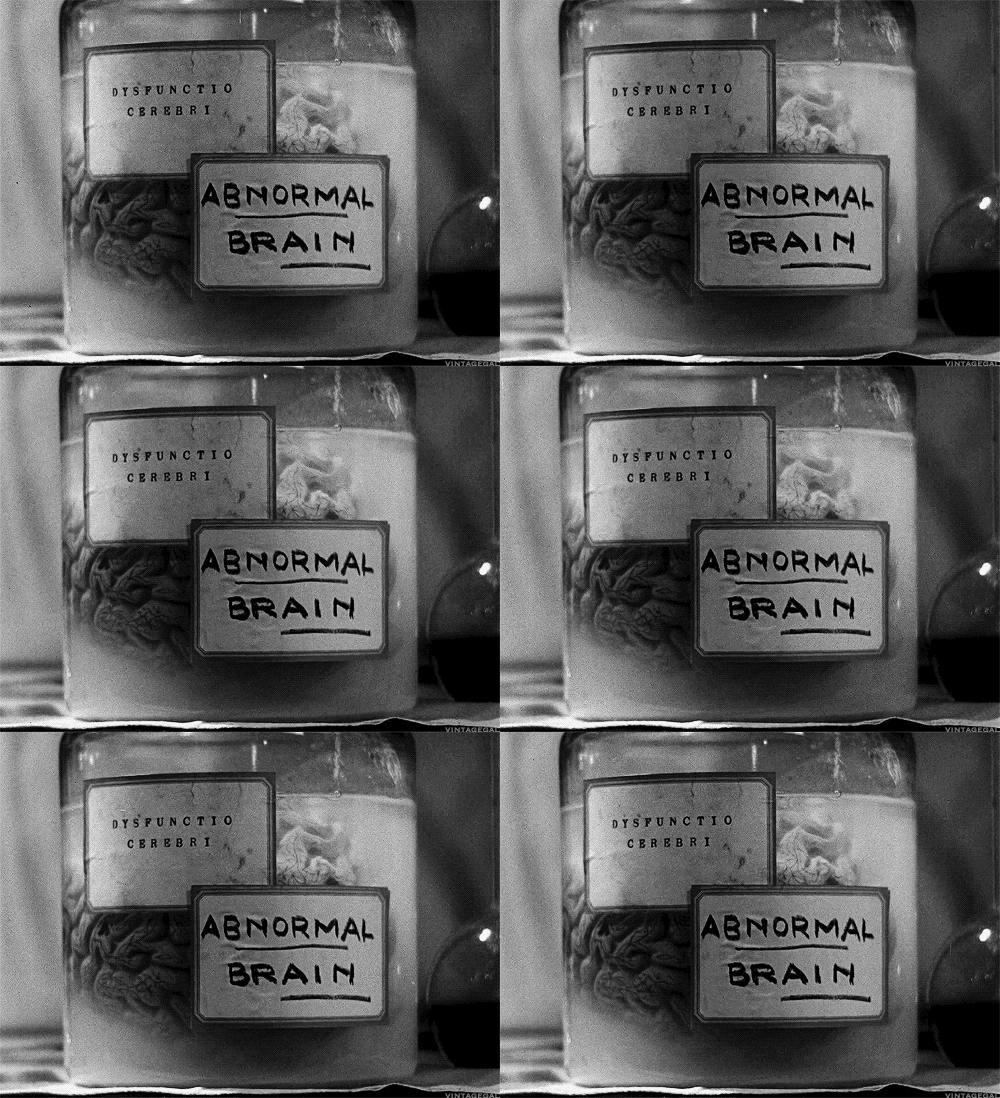
At Goldstadt Medical College, Doctor Waldman (Edward Van Sloan) is finishing up a lecture on, conveniently enough, the differences between a normal brain and an abnormal, dysfunctional, criminal brain. The two brains are clearly marked in jars for the students to look at, which apparently none do. After the room clears, Fritz sneaks in to steal the normal brain. But when he’s startled and drops the jar with the normal brain, he goes back and retrieves the dysfunctional one.

Clearly marked bad brain. Do not use.

Meanwhile, in Henry's nearby hometown, Victor Moritz (John Boles) visits Elizabeth (Mae Clark). Victor is Henry’s best friend, but is in love with Mae, who is engaged to Henry. She reads to Victor a strange note she’s received from Henry, who writes that his experiments preclude her from joining him.

The love triangle that never develops. Elizabeth (Mae Clark)
turns to Victor (John Boles), Henry's best friend, for advice.

Victor will do anything for Elizabeth and tells her he’ll go see Dr. Waldman, Henry’s former professor at the medical school. Elizabeth insists on going, too. Waldman explains to them that Henry had left the college to pursue a mad dream of destroying and recreating human life. Elizabeth asks Waldman to go to talk to Henry. While he initially refuses, he quickly capitulates. Together the three go to Henry's laboratory.

Before they arrive, Henry and Fritz are putting the final touches on their experiment, preparing to use the power of lightning, there is a fierce rainstorm raging, to charge their electrical mechanisms and give life to a body Henry had pieced together.

Getting ready to hoist the lifeless body up into the lightning.

Henry is upset when the three arrive and won’t let them in. But Elizabeth has a power to persuade men and he agrees to let them in. When Victor calls him mad, he lets them observe to prove he’s sane. He explains his scientific theories to Waldman, telling him that there is a light source that gives life and that he’ll use it to bring his creation to life.

They watch as Henry raises the table the body is on up to the top of the roof so it can be bombarded by the lightning. Henry cries “It’s alive” when the monster moves his fingers.

"It's alive." Frankenstein's experiment works.

Later, Victor and Elizabeth attempt to pacify Henry's doubting and doddering father, Baron Frankenstein (Frederick Kerr), who is only interested in his son's wedding, even though he’s not happy to entertain the Burgomaster (Lionel Belmore), the chief magistrate of the village, who comes to inquire of the date and to let him know the villagers are ready. (I’ve read somewhere that this part of the story takes place in Nyon, Switzerland. This is never made clear in the movie, though judging by the villagers’ costumes there is a definite Bavarian feel to the place.)

Henry's father, Baron Frankenstein (Frederick Kerr).

Back at the laboratory, Henry asks Waldman to give the monster a little more time; he is, after all, getting used to a new brain. Waldman informs Henry that the monster has a criminal’s brain. The Monster is tormented by Fritz who uses a whip to keep the Monster in line. Fritz seems to really enjoy the torturing. When he torments him with fire, the monster breaks his restraints and hangs Fritz.

Dr. Frankenstein  insists to Dr. Waldman (Sloan) that he give the Monster a little more time.

When Henry tries to retrieve his dead assistant’s body, the Monster won’t let him near it and Waldman and Henry barely escape the monster’s cell. Waldman and Henry manage to sedate the monster just as the Baron and Elizabeth approach the lab. They hide the Monster in his cell.


The Monster (Boris Karloff), who has been kept in the dark, reacts to seeing the sun for the first time.

Henry is exhausted and collapses when he sees Elizabeth. Henry is taken home to recover and Waldman promises to destroy the monster for him. Henry isn’t happy about the outcome, but understands it is what must be done.

Henry is tended to by family and friends.

Instead of just killing the monster outright, Waldman plans to dissect the monster to see what makes him tick. He thinks he’s injected the monster with enough to kill it, but he’s wrong. While he stands over the body, the monster reaches up and grabs him, killing him by strangulation.

The Monster plays with Little Maria (Marilyn Harris), but things quickly get out of hand.

As Henry recovers with Elizabeth by his side, neither knows that the Monster has been set loose. A girl, Little Maria (Marilyn Harris), is left alone by her father. She wants someone to play with her and when the Monster appears, she is not frightened, but rather excited to have a playmate. She shows him how to make daisies float like boats in the nearby lake. The Monster likes this and when the flowers run out, he looks for something else to throw in the water. Little Maria is close by and he throws her in and drowns her when she tries to fight back. The Monster seems genuinely frightened by the murder and runs off.

When they run out of flowers, the Monster throws Little Maria into the lake.

As the village dances and celebrates as a prelude to the wedding, the Monster invades the Frankenstein home. Trying to protect her, Henry locks Elizabeth in her room and she can’t escape when the Monster comes in through the window. What he does to her is left to the imagination, but it is clear that he molests her.
Meanwhile, Maria’s father Ludwig (Michael Mark) carries her lifeless body through the village to the doorstep of the Burgomaster. The village forms into an angry search party and, led by Henry, go looking for his creation. 

The Monster comes after Elizabeth on her wedding day.

They trap the Monster in an abandoned windmill. Henry and the monster engage in a struggle while the mob sets the mill on fire with their torches. The Monster throws Henry to the ground before being engulfed by the flames.

With the Monster trapped in the windmill, the villagers set it on fire.

The film ends with the baron celebrating the wedding of his recovered son and Elizabeth with a toast to a future grandchild.

When it was first released, Frankenstein was a big hit. By the June of next year, the film had earned a reported $1.4 million in rentals. In 1943, Universal reported it had earned a profit of $708,871. The film also received critical acclaim, being named on the New York Times “10 Best” films of 1931.

The film did meet with some censorship, as state censorship agencies made minor cuts from the film before they would allow it to be released. As an example, censors in Kansas cut a close-up shot of a hypodermic needle injection, when Waldman first subdues the Monster, and the scene in which Maria is carried in her father's arms. Quebec censors rejected the film in its entirety and petitioned Universal to either resubmit the film with a foreword or preface to indicate that the picture was a dream, or end the picture at the windmill scene and make a number of other cuts.

The film was also banned outright in Northern Ireland, Sweden and Italy in 1932 and in Czechoslovakia in 1935.

When Universal wanted to re-release the film in 1937, the Hays Office demanded certain edits, including the elimination of dialogue in which the name of "God" is used, the shortening of the scene in which "Fritz" torments the monster with a lighted torch and the cutting out of the scene in which the monster tosses Maria into the water. In 1986, three reportedly “lost” segments, including a shot of the monster drowning Maria, were discovered and added back for home video release by Universal. All the additional scenes only added about two minutes to the run time of the film.

Frankenstein is the best known work for its “leading” man, Colin Clive. Clive was an English-born actor, whose first film in Hollywood was James Whale’s Journey’s End. In the film he played an alcoholic, something that he suffered from in real life as well. Despite his marriage to actress Jeannie de Casalis, there were rumors that it was a lavender marriage; he was gay and Jeannie a lesbian. Whale’s longtime companion, David Lewis, flatly stated that Clive was not gay. Clive appeared in less than twenty films, none of which would be as famous as Frankenstein. He would die young from complications of tuberculosis in 1937 at the age of 37.

Colin Clive as Dr. Frankenstein.

Mae Clarke would have a much longer career. She had appeared in films since Big Time (1929) and was already famous, after a fashion, before she made Frankenstein. Clarke was the woman who had the grapefruit smashed in her face by Cagney in Public Enemy (1931) earlier in the year. That same year, she would also play Molly Malloy in the first film adaptation of The Front Page (1931) which was nominated for Best Picture. She also appeared in Waterloo Bridge (1931), Penthouse (1933) and Lady Killer (1933). She would continue to act into the 1950’s, but in smaller parts, appearing uncredited, for example, in Singin’ in the Rain (1952).

Mae Clark as Elizabeth.

John Boles, who plays Victor, is a Texas-born actor who appeared on the Broadway stage before appearing in a trio of silent films in 1924. He appeared in Gloria Swanson’s The Love of Sunya (1927), which was a big success at the time. Boles, who was a singer, went on to appear in sound films, including musicals for Warner Bros., The Desert Song (1929); RKO, Rio Rita (1929) and back at Warner Bros, The Song of the West (1930); The King of Jazz (1930); Captain of the Guard (1930) and One Heavenly Night (1931). After Frankenstein, Boles would star with Shirley Temple in Curly Top (1935) and with Barbara Stanwyck in Stella Dallas (1943).  He would retire from stage and screen in 1952 at the age of 57.

John Boles as Victor.

But the actor who would become a star because of the film was Boris Karloff, who became famous as the Monster, and had a long career appearing in horror films, including The Mummy (1932), The Black Cat (1934), The Bride of Frankenstein (1935), The Raven (1935) and Son of Frankenstein (1939) to name a few. In latter films, he is sometimes billed simply as KARLOFF. But he also had roles outside the genre, appearing in Scarface (1932) and in John Ford’s Lost Patrol (1934). He played James Lee Wong in a series of Mr. Wong mysteries and had a substantial role in The Secret Life of Walter Mitty (1947). He would also be known to several generations for his voice work in How the Grinch Stole Christmas (1966), the adaptation of a Dr. Seuss book.

Boris Karloff out of make up.

Frankenstein would prove to be so popular that Universal would produce a whole series of films, what they would now call a franchise. First up was The Bride of Frankenstein (1935), in which Elsa Lanchester plays the Bride. Like the original film, The Bride was also directed by James Whale and starred both Karloff as the monster and Colin Clive as Frankenstein. Clive’s death did not stop the sequels.

Son of Frankenstein (1939) followed, introducing the character of Ygor, an assistant to Baron Wolf von Frankenstein (Basil Rathbone). Ygor, who would appear in this film and in The Ghost of Frankenstein (1942), was played by Bela Lugosi of Dracula fame. In the later film, Lon Chaney, Jr. played the monster instead of Boris Karloff.

The cross-over sequel, Frankenstein Meets the Wolf Man (1943) presented a problem, since Lon Chaney, Jr. played the Wolf Man as well. Lugosi was cast as the monster. Karloff returned to the role of the monster in House of Frankenstein (1944) with Chaney, Jr. again appearing as the Wolf Man and John Carradine appearing as Dracula. The monster would appear again in House of Dracula (1945) with Glenn Strange in the role, Carradine as Dracula and Chaney, Jr., again as the Wolf Man.

Other versions of Shelley's novel include The Curse of Frankenstein (1957) produced in England in 1957 and directed by Terence Young; a 1973 made-for-television version, Frankenstein: The True Story, directed by Jack Smight; and Mel Brooks' 1974 spoof of the early Universal films, Young Frankenstein. The opening sequence of the 2004 Universal production Van Helsing, directed by Stephen Sommers and starring Hugh Jackman and Shuler Hensley as the monster, was a replication of a sequence in the 1931 film of Frankenstein bringing his monster to life.

There have been other attempts at telling the story, too many to mention here. Some notables: Andy Warhol’s Frankenstein (1973) and The Rocky Horror Picture Show (1975) both have elements of the Frankenstein myth, though they take them different places. Warhol’s scientist wants to rule the world and Dr. Frank N. Furter in Rocky Horror was his own needs the monster will satisfy.

I would be remiss in not mentioning the Gene Wilder-Mel Brook collaboration, Young Frankenstein (1974), which is sort of a sequel spoof of the 1931 classic. The film shows a respect for the original, using some of the same sets and props Whale used and was shot in black and white. Wilder plays a descendant of Dr. Frankenstein and Peter Boyle plays the Monster in this modern comedy classic.

One of the things I noticed about the film was the little bits of humor that are sprinkled through the beginning of the film. Dwight Frye’s Fritz is like a big kid at first and his bits of dialogue and reactions are childish and almost innocent. Later, Fritz turns cruel as he seems to really enjoy the control over the creature. Again, like a child not knowing how to handle authority. Of course, he pays the price for mistreating the Monster.

Boris Karloff brings a certain humanity to the Monster. The way he yearns for sunlight and how things can fascinate him, make him seem like a giant child in the beginning. When the Monster kills Maria, you get a real sense that it was accidental. The darker urges of the dysfunctional brain took over at the moment and play turned to murder. From then on, the Monster would no longer be an innocent, but would be a terror. Again, no one comes out and says it, but I get the sense he sexually assaults or tries to assault Elizabeth. There seems to be no other reason to seek her out; he doesn’t kill her or take her as a hostage.

There is a real sense of science for the sake of science in the film. The special effects: the electricity jumping between poles, the sparks and the real sense that everything is on the verge of catching fire, are good, but they don’t seem to have a real purpose other than looking cool. And I love the business of the film; we see Dr. Frankenstein putting on headphones to listen to the storm (?) and mixing chemicals together in a beaker which he puts down and walks away from. We never see it used; but that’s what scientists do, isn’t it?

Science for the sake of science: Dr. Frankenstein listening to the lightning?

The film also shows some influence of German Expressionism in Hollywood. Not only in subject matter, the expressionist movement seemed perfect for the horror genre: The Cabinet of Dr. Caligari (1919), The Golem (1920), Nosferatu (1922) and Phantom (1922), with its stylized backgrounds and use of shadows. You can see these replicated in the sets used for the Doctor's watchtower, with its asymmetrical winding stone staircase and especially in the layout of the cell where the Monster is kept.


Fritz torturing the Monster in his cell. Note the shape of the room,
the window in the background and the use of shadows.

I can see why this was big at the time. The film is well made, the acting is pretty good and the special effects were definitely unique and iconic. Frankenstein is less melodramatic than Dracula, but you get the real sense they are contemporary tales. The villagers in this film dress pretty, much like the villagers warning Renfield to turn back.

As far as frightening goes, Frankenstein has some moments, but I’m beginning to think horror, like comedy, might have an expiration date. Tastes change and I won’t be the first person to theorize we’ve become more desensitized thanks to television, films and the internet. It takes a lot to really scare someone these days. Back in its day there weren’t dozens of shows dealing with the dead and the undead and there was definitely a whole generation who had never seen anything like this on screen at the time.

Still, this is one of the iconic films of its time and in the history of cinema. Frankenstein’s Monster is the archetype for horror creatures. If on those terms alone, the film should be seen. Perhaps it will even horrify you as Sloan warns at the beginning, but Frankenstein deserves to be seen.