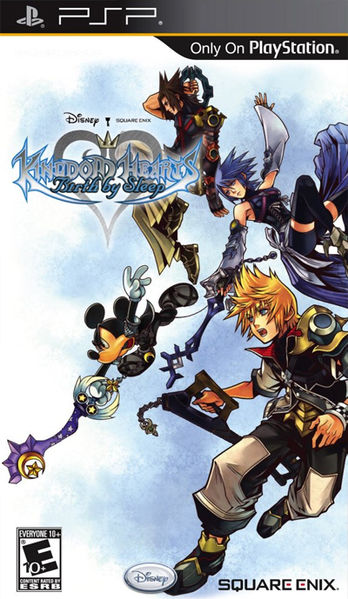
When I first played Kingdom Hearts about
a decade ago, I was completely blown away. I was having a really fun time and
when it ended, I was excited to learn of another game in the series. Since I
didn’t have a Gameboy at the time however, I couldn’t really play Chain of
Memories (and wouldn’t be able to until the PS2 remake, Re:Chain of Memories),
so I ended up skipping to Kingdom Hearts II on PS2. I later learned that this
was a bad idea, but since I’ve played Re:Chain of Memories, the story makes
just a little more sense (at least as much sense as you can make out of Kingdom
Hearts). As the years went on, more games came out, but on platforms that I had
no access to, so I was bummed that my lack of a DS would prevent me from
witnessing 358/2 Days (pronounced Three-Five-Eight-Days Over Two), though
thankfully 1.5 HD Remix was able to fill me in on the details via redone
cutscenes. Flash forward to the announcement of Kingdom Hearts: Birth by Sleep
for the PSP handheld. The fact that I actually owned a PSP enticed me to play
it, so much so that while walking to the bus during my first College semester,
I went by the nearest GameStop and picked up a copy. I then proceeded to start
playing as soon as I sat down and wouldn’t stop playing for a few weeks during
the same semester. I would play during long wait times, particularly the hour
or so before Astronomy class, and my sessions went on so long that I had to
keep exchanging PSP batteries with my brother just so I could keep going. As I
played Birth by Sleep for the first time (and wrote a terrible review of it on
DeviantArt once I finished), it became my new favorite game in the series,
overtaking Kingdom Hearts II. Having played it years later in anticipation of
Kingdom Hearts 2.5 HD Remix, with greater knowledge of the inner workings of
the game, I can say that this sentiment still rings true.
 |
| It began so simply... |
In The Land of Departure, the Keyblade
wielders Terra, Ventus and Aqua are all close friends. On the night before
Terra and Aqua’s Mark of Mastery exam, which will determine who receives the
title of Keyblade Master, Ventus decides to help the two practice and hone
their skills. Afterwards, the three of them discuss their friendship, at which
point Aqua decides to give everyone Wayfinders that she made to symbolize that
their bonds of friendship are strong enough that they’ll be able to find each
other no matter where they are. The next day, Master Eraqus, with Master
Xehanort in attendance as a guest, begins the Mark of Mastery exam with Terra
and Aqua, summoning orbs of light for them to destroy. However, something goes
wrong and the orbs are imbued with darkness, causing their behavior to become
erratic enough to pull Ventus into the fray. Once the crisis is over, Terra and
Aqua have a one-on-one match to display their abilities. In the end, Aqua is
declared the Keyblade Master by Master Eraqus because Terra let his inner
darkness get to him at one point in the match. As Aqua goes to Eraqus to learn
a valuable secret, Terra storms off and is confronted by Master Xehanort, who
tells him about his inner darkness and convinces him that it isn’t something to
be feared, but channeled and that going to different worlds will help him
control it. Meanwhile, Ventus is in his room when he is suddenly confronted by
a boy in a mask. The boy in the mask informs him that Terra is leaving,
possibly forever, and that Ventus has one last chance to see him beforehand.
Once the boy departs, Ventus runs off to where Terra is in an attempt to say
something to him. However, Terra leaves in a hurry, causing Ventus to chase
after him. Aqua, who has just arrived, tries to stop Ventus and tell him
something, but she is too late. Once both Terra and Ventus are gone, Eraqus
instructs Aqua to go after them, but keep an especially close eye on Terra, as
he is worried about his darkness getting out of hand. Aqua complies, flying
away from the Land of Departure in pursuit of Terra and Ventus.
 |
| Master Xehanort |
It’s interesting to note that Birth by
Sleep is a prequel of sorts, occurring ten years before the events of the
original Kingdom Hearts. In this regard, it does its job well, establishing
several key details that add some depth to the mythos and help explain how
certain things came to be, including Sora and Riku’s connections with the
Keyblade, the origins of Roxas and even the creation of Castle Oblivion. From a
narrative standpoint, as in how it functions on its own, Birth by Sleep is
written pretty well. It does a pretty good job handling its gimmick, which has
you playing as three different characters, Terra, Ventus and Aqua, who travel
to the same worlds, but not during the same points in time. Their independent
plot threads do intertwine at times, which helps to establish connecting points
to separate the story into distinct parts (ex. before and after the battle with
Trinity Armor). As with the previous entries, there are some dark themes
explored here and they go beyond the struggle between light and darkness in the
heart. Because the three characters are effectively soldiers, darker themes are
touched upon, including war, genocide, existential crises and feelings of trust
and betrayal. These aren’t as explored as extensively as they would be in, say,
Metal Gear, but the elements have enough of a presence that the overall
narrative is very engaging and elicits good emotive reactions out of the
player. Though admittedly the story can be a little confusing at times, what
with the discussions of the Keyblade War and the χ-blade (pronounced Kye-blade)
and whatnot, Birth by Sleep is an important milestone to hit to at least try
and understand the story as it stands now.
 |
| Vanitas (left) is very important to the story. |
While the story is very interesting to
play through, the heroes do make plenty of mistakes. Terra, for the most part,
is easily trusting of the people he meets, including Master Xehanort, and this
comes back to bite him hard (though I
won’t say how). Likewise, Aqua and Ventus’ stories also rely on them making one
poor decision after another, which by the endgame seems to have only furthered
Xehanort’s plans without them realizing it. Fortunately, they are able to
reverse most of the damage that they cause, but it also comes at a great cost,
which I will not reveal here for the sake of avoiding spoilers. In any case, I
found it interesting how the Disney-inspired worlds were integrated into the
plotline, even if the stories don’t quite match up with the source material
(though one should expect creative liberties when putting a work from one
medium into another, especially when fusing multiple continuities and
independent stories together).
Gameplay-wise, Birth by Sleep is the
best I’ve ever played in the series. As with Kingdom Hearts II, there is a
further emphasis on action, but the twist here is that they’ve done away with
the menu system entirely, instead going with a customizable command deck. The
way the system works is that you are given a certain amount of slots (which
increase over time to a maximum of eight) to insert commands representing
certain physical or magical attacks as well as items. The d-pad scrolls through
the commands and you press triangle to activate the one you want, after which
there is a cool down period that must end before you can use it again. By using
commands, a gauge above the list is filled up, which can lead to a unique
finishing move or a new command style that enhances regular attacks and can
lead to a more powerful finisher.
 |
| One of the most powerful styles: Ghost Drive. |
These commands can also be melded
together, similarly to Crisis Core: Final Fantasy VII’s Materia Fusion system,
and combined with different crystals to attach various abilities which range
from reducing cool down times to buffing or nerfing elemental damage. One of
the most essential of these abilities, from my experience, is EXP Walker, which
lets you gain 1 EXP for each step you take (for those who wish to know, the
most reliable method to obtain it is to combine Blizzard and Aero in conjunction
with an Abounding Crystal). In place of summons, the game introduces a D-Link
system as well, which lets the player replace their command deck with that of
another character that they have formed a bond with (ex. Terra, Ventus, Aqua,
Snow White, Experiment 626, etc.). D-Links can be upgraded with a rare star
drop that can attach different abilities to the character during usage, making
them more powerful for the next activation; when the D-Link gauge isn’t full,
it can be replenished with blue D-Link prizes.
The last system introduced is the
Shotlock Command, which is activated by holding down L and R and then moving a
target over enemies. Pressing X will trigger the Shotlock attack, though
pressing the button when the targets are at maximum will not only fire off all
the selected shots, but allow an additional barrage of the same attack as well.
While these attacks are cool to pull off, the only problem is that the same
buttons used to trigger them are also used to rotate the camera, which can be
awkward if you’re really not careful.
 |
| One of the strongest Shotlock Commands: Ultima Cannon. |
I realize that what I’ve written may
sound a little confusing, but I think it’s the best system the series has had.
Once you get into it it’s very easy and intuitive on top of being incredibly
quick and responsive. By taking away a lot of the complexity of previous
Kingdom Hearts games, including the already streamlined Kingdom Hearts II, it
becomes much easier to manage the player character and figure out exactly what
you want. Despite some of the minor flaws in the systems present, I hope that
they not only keep the command deck in future Kingdom Hearts titles, but expand
and improve on it as well for the best possible experience. It’s a natural
evolution of the process and the only logical next step is to move forward with
it.
Although Birth by Sleep was developed
for the PSP, I’m genuinely impressed by its size and scale. There are several
worlds to explore, each with a number of areas and secrets. Each area isn’t
always available, in fact limited to how relevant they are to each character’s
story, but this doesn’t change that the size of the game could easily rival its
console brethren. Birth by Sleep feels as large, and as long, as any Kingdom
Hearts game on the PS2 (and now PS3), a feat to be rightfully commended for.
There is also a great attention to detail and a fittingly bright color palette
with a lot of range. Every one of the Unversed enemies has a unique shape, save
the ones that are merely palette swaps, and an easily identifiable color
pattern that helps one to figure out exactly how to take them down. On the
downside, the graphics aren’t the best, being on PSP and all, since the
character models end up a little jagged in places and cloth textures don’t look
particularly smooth. Despite this however, Birth by Sleep ends up being one of
the best looking games on the handheld and can be seen as a technical marvel.
 |
| A Flood, one of the most common Unversed types. |
The game also has plenty of challenge,
especially on the higher difficulties (I played on Proud Mode), where the
bosses can really knock you around like a piñata unless you go into battle
fully prepared. No matter what difficulty you play on, you may find the
Mandrake Unversed to be particularly annoying, as they attack by firing razor
sharp leaves that always seem to match your elevation and they can fire them
off in rapid succession to disrupt any combo you might have had going (which
can further cause the meter on the Command Deck to start dwindling). The worst
part is that not only can they inflict Poison and Confusion if you’re not
careful, they don’t appear out of thin air like the other Unversed, rather they
are already on the battlefield to begin with and can thus cause you as much
pain and suffering as possible; I loathed Mandrakes every time I came across
them.
Voice acting and music have always been
a strong suit for Kingdom Hearts and this installment is no exception. Since I
own the soundtrack, I believe that it contains some of Yoko Shimomura’s best
compositions to date, with a grand mix of upbeat world themes and dark and
foreboding battle pieces. Voice acting, however, is admittedly kind of a mixed
bag. On one hand, we have phenomenal voice work by the recurring Disney
characters, who mostly use the official Disney voice actors (for those
characters whose voice actors are deceased, they have incredibly convincing
sound-alikes). There are also surprise performances from Leonard Nimoy and Mark
Hamill, each respectively voicing Master Xehanort and Master Eraqus. They both
sound like they really put their heart into their work and their many years of
experience have certainly paid off. On the other hand, we have the main trio;
Terra, Ventus and Aqua. Terra, due to being voiced by Jason Dohring, sounds a
little bored in his delivery, downplaying the emotions he should be feeling in
certain scenes. However, when Richard Epcar takes over at some point during the
plot (I won’t say how), his lines are overacted, which balances that out
perfectly. Ventus is voiced by Jesse McCartney and actually gives a solid
performance, mirroring his role as Roxas in Kingdom Hearts II. Lastly, we have
Aqua, whose voice actress, Willa Holland, has nearly the same problem as
Dohring, but not to the same degree. Should these characters return in the
future, I hope that Dohring and Holland have picked up a thing or two to make
their characters better rounded out.
 |
| Mark Hamill does a good job as Master Eraqus. |
Before I end this review, I’d like to
share some advice with prospective PSP players. You can play the three stories
in any order you wish, but the best order is Terra, Ventus then Aqua. Playing
in this specific order will lead to far less confusion than playing it any
other way, plus it creates a smooth transition to the Final Story. I also
highly recommend unlocking the secret video, Blank Points, as it is a good
epilogue to cap off the events of the story. The easiest way to unlock it is to
complete all of the campaigns on Proud or Critical mode (I would advise playing
on Proud Mode, even if it’s your first time playing, since the difficulty will
disappear after playing for a while). Finally, there are some settings that
would be very beneficial to manipulate. There is the option to install the game
to your memory card, which gives the advantage of reduced load times, and you
have the option between 200, 400 or 624 MB, speeding up load times in an
increasing number of areas for the game (combat, menus, moving between areas,
etc.); I recommend doing a full install for best results. Also, there are two
specific settings that you should immediately increase: Color Depth and CPU
Speed. Upping the Color Depth to 32-bit will provide the best graphics, but
sometimes causes slowdown as a result. Accelerating the CPU Speed prevents
slowdown, counteracting the disadvantage of 32-bit Color Depth, but will cause
the PSP battery to drain much quicker, so it is further recommended that you
have an AC adaptor at all times (I call this combination “drain the battery
mode” for a good reason). Follow all of these simple steps and you’ll have the
best Birth by Sleep experience possible.
In the end, Kingdom Hearts: Birth by
Sleep is what I would consider the best game in the franchise. The gameplay is
streamlined and the controls are tight, all without sacrificing the spirit of
earlier games or what made them good in the first place. Admittedly the story
can be confusing at times, a given for this franchise, and the voice acting may
not be perfect, but the game has a plotline that can, to some degree, operate
independently of its brethren (though it does serve as the MGS4 of the group by
explaining just about everything (for now…)). On top of that, the game is
simply a well-crafted RPG that makes owning a PSP very worthwhile. If you
haven’t played it yet, I see no reason to wait; it might also be a good excuse
to buy a PSP and a play a good game that isn’t related to God of War.


