Showing posts with label 1998. Show all posts

Saturday, May 3, 2025

Stubs - Blade


Blade (1998) starring Wesley Snipes, Stephen Dorff, Kris Kristofferson. Directed by Stephen Norrington. Screenplay by David S. Goyer. Based on characters created by Marv Wolfman and Gene Colan. Produced by Peter Frankfurt, Wesley Snipes, Robert Engelman. Run time: 120 minutes. Color. USA. Horror

Before there was the MCU and before the X-Men franchise got off the ground, there was Blade. Not the first Marvel adventure into films, there was a Captain America serial in 1944, and, of course, the misfortunate Howard the Duck (1978), but unlike that film, Blade showed there was money to be made from adapting comic books for the big screen.

There are other firsts for Blade that often attributed to other films. As an example, it was the first comic book film adaptation to feature a Black superhero, not Black Panther. And the first comic book adaptation to receive an R rating, not Deadpool.

Wednesday, December 11, 2024

Sonic Adventure (Dreamcast)


Since his debut on the Sega Genesis in 1991, Sonic the Hedgehog made a splash with speed-based platforming, almost matching Mario in mainstream appeal and popularity, and spawned a successful multimedia franchise that continues to this day. During the series’ infancy, it dabbled in other gameplay styles, including a 3D isometric view with Sonic 3D Blast in 1996, which would lead to the blue blur’s first full 3D game, Sonic Adventure (SA) developed by the one and only Sonic Team. SA would launch in Japan in 1998 as one of the earliest titles for the Sega Dreamcast, but notably came over to the US as a launch title for the system on 9/9/1999 to critical acclaim and would become the best-selling game for the system. Due to its success, with 2.5 million copies sold, and the direction the franchise would take afterwards, this makes SA one of the most significant games in the series.

As for my own history with this game, I had always wanted a Dreamcast as a child, but never got to own one until several years later when I had started collecting retro consoles and games back in a time when that was easier and more affordable. This included buying a copy of SA, though a number of newer and older titles distracted me from playing past the first stage (as I write this, I’m sensing a pattern with how I’ve played other series-defining releases). Despite that, I still found myself obsessed with Sonic the Hedgehog growing up, which included watching most of the cartoons (and the OVA) and playing a number of the games, plus I did see an adaptation of SA’s storyline through the 4Kids dub of Sonic X during its original US airing.

Fast forward to now and the upcoming Sonic the Hedgehog 3 film, which takes influence from Sonic Adventure 2, gave me the motivation to finally give SA an honest try on the original hardware, warts and all. I even went through the effort of buying a second copy (the “Not for Resale” version) when my original disc stopped functioning right before an early Stage. After going through all of that effort, I must say that although the game feels janky nowadays, especially when compared with more modern game design, I still felt like a kid again and enjoyed myself the whole time.

Saturday, August 17, 2024

Stubs - You've Got Mail


You’ve Got Mail (1998) starring Tom Hanks, Meg Ryan, Greg Kinnear, Parker Posey. Directed by Nora Ephron. Screenplay by Nora Ephron, Delia Ephron. Based on the film screenplay The Shop Around the Corner by Samson Raphaelson. Produced by Lauren Shuler Donner and Nora Ephron. Run time: 119 minutes. Color. USA. Romantic Comedy

Movie remakes can be like impersonation, the sincerest form of flattery and sometimes a story takes time to get it right, take The Maltese Falcon, which took three takes. But then there are the films that did work, like The Shop Around the Corner (1940), which don’t need to be remade but are. The first time was as a musical In the Good Old Summertime (1949) as a vehicle for Judy Garland. These were all based on the play Parfumerie by Miklós László, a romantic comedy taking place in a store around Christmas time.

The third take, driven by Nora Ephron, the writer/director behind such films as When Harry Met Sally... (1989), Sleepless in Seattle (1993), Michael (1996), and Julie & Julia (2009), came out in 1998 and re-teamed Tom Hanks and Meg Ryan, who had already worked together on such films as Joe vs. The Volcano (1990) and Sleepless in Seattle. This film is often cited in lists of drive-by Christmas films, even though Christmas, unlike the play or the first film, really doesn’t have much to do with the story or the setting.

Saturday, September 9, 2023

Stubs - Batman & Mr. Freeze: SubZero


Batman & Mr. Freeze: SubZero
(1998) Voices of Kevin Conroy, Michael Ansara, Loren Lester, Efrem Zimbalist Jr., George Dzundza, Robert Costanzo, Bob Hastings, Mary Kay Bergman, Marilu Henner, Dean Jones. Directed by Boyd Kirkland. Screenplay by Boyd Kirkland, Randy Rogel. Based on Batman by Bill Finger and Bob Kane Run time: 66 minutes. Color. USA Direct-to-video, Animated, Superhero

Following the relative success of Batman: Mask of the Phantasm (1993), a second film was ordered by Warner Bros. That film was Batman & Mr. Freeze: SubZero, which was made to tie-in with Joel Schumacher's Batman & Robin (1997), but delayed a year when that film received a poor reception. The last Batman direct-to-video film to use cel animation, SubZero was released on March 17, 1998.

Wednesday, March 2, 2022

Spyro the Dragon


Insomniac games may be best known for their Ratchet & Clank series and Marvel's Spider-Man right now, but their earliest success involved an early PlayStation mascot, a purple dragon named Spyro from their second ever video game, Spyro the Dragon. Spyro is far from obscure, but with Insomniac’s more recent successes, I thought it would be interesting to look back at their roots and see how well their first series held up today. Spyro the Dragon certainly feels like an experience only Insomniac could deliver, but time has only highlighted its flaws.

Wednesday, January 20, 2021

Devil Dice

As with any major console release, “homebrew” development exists to allow people to make their own games for a given system in an unofficial capacity. However, it’s not too often that any of said games get an official major release. Such is the case with Devil Dice (XI [sai] in Japan), a dice puzzle game from developer Shift of God Eater and Code Vein fame, originally developed for the Net Yaroze homebrew platform. After stumbling upon Devil Dice’s existence after having already owned its follow-up title, Bombastic, I managed to find it in a used game store on a trip to Texas, though I didn’t get around to playing it until recently. After getting the chance to play it, I found it to be a rather unique and enjoyable title in the puzzle game space.

Saturday, September 5, 2020

Mulan (1998)


Mulan, based on a Chinese ballad known as the Ballad of Mulan, was a film I had seen at least once when I was a kid, albeit on home video. Though it had been years since I had seen the 1998 movie, I remember liking it at the time, however I had sometimes considered re-watching it in order to pay more attention to the story and see if my opinion on it had changed. That opportunity came when a live-action remake of the movie was announced by Disney, though I would not actually jump on that chance until recently, in the wake of the remake’s release on Disney+ (for the low, low price of $30 on top of the regular subscription) in light of the ongoing COVID-19 pandemic. After viewing the 1998 Mulan again, I though it not only managed to hold up well after 22 years, it was a lot better than I remembered.

Saturday, July 13, 2019

A Bug's Life


Note: This review contains spoilers for A Bug’s Life.

Three years after the release of Toy Story (1995), Pixar released their second animated feature, A Bug’s Life (1998), which also happened to be the first film I had ever seen in a movie theater. Though critically acclaimed at the time, it seems to have generally fallen off the radar in recent years when the works of Pixar are discussed. The same rang true for us until we caught part of a recent Disney XD airing and decided to watch the movie in full through our DVD copy. Now that we’ve seen it all the way through again after several years, it seems to have held up surprisingly well, though it’s also a little rough around the edges.

Saturday, September 22, 2018

Scooby-Doo on Zombie Island


If you’ve been alive for the last 20 or so years, you’re no doubt familiar with Scooby-Doo, one of Hanna-Barbera’s most successful franchises, in some form or another. Since the original 1969 cartoon, Scooby-Doo, Where Are You!, the iconic group of meddling teenagers and their Great Dane spawned numerous spin-offs and TV movies into the present day, although production of Scooby-Doo material had stagnated over time, with the various series and specials relegated to re-runs. However, the 1998 home video release of Scooby-Doo on Zombie Island proved popular enough that it more or less revived the franchise, which lead to the production of further spin-offs and yearly direct-to-video features, with no signs of stopping anytime soon. We’ve decided to take a look at Scooby-Doo on Zombie Island in honor of its 20th anniversary to see how well it holds up today.

After solving cases for years, the Mystery, Inc. gang grow bored of mystery-solving and go their separate ways. Daphne (Mary Kay Bergman) and Fred (Frank Welker) have started a successful TV series, Velma (B.J. Ward) becomes the owner of a bookstore and Shaggy (Billy West) and Scooby-Doo (Scott Innes) are fired from an airport security job after consuming food designated as contraband. After Daphne expresses a desire to see everyone again, Fred gathers everyone together on her birthday to go on a roadtrip while filming her newest show, which involves finding locations that are actually haunted. Their search leads them to a remote home in New Orleans on Moonscar Island. While the gang is initially skeptical about how haunted the island is, they gradually discover that this time, the monsters are real.

(L-R): Fred (Frank Welker), Velma (B.J. Ward),
Shaggy (Billy West), Scooby-Doo (Scott Innes) and
Daphne (Mary Kay Bergman) reunite to film Daphne's new show.

Compared with most other versions of Scooby-Doo, Zombie Island has a more realistic atmosphere and more mature storytelling. The film explores what happens to Mystery, Inc. after they become adults and it’s interesting to see their lives with varying degrees of success before they regroup to relive their glory days. As part of this more mature direction, the story features actual deaths and the gang encounter real monsters, mainly the titular zombies. There is also more of an effort to give the characters depth, including a hint of romantic interest between Fred and Daphne that gets explored to some degree during the plot. This interpretation of the Scooby-Doo mythos is one of the more intriguing ones because the audience gets to see the gang reacting to a fairly rare situation and the story manages to successfully take the source material more seriously. There’s also a little humor to balance out the horror, mostly through subtle jokes about the franchise, such as a visual gag where Shaggy opens a suitcase to reveal multiple sets of his classic wardrobe.

While the story is able to stand the test of time, there are minor faults. For one, the character Snakebite Scruggs (Mark Hamill) doesn’t serve much of a purpose outside of saving Shaggy from a group of alligators and expressing bitterness towards the presence of “tourists” on his fishing grounds. Additionally, since Zombie Island came out in 1998, the setting features outdated technology, mainly a non-digital video camera, that would feel out of place in any other time period.

What helps the movie hold up today is the still-impressive traditional animation. The animation of Zombie Island is more fluid and detailed than most other Scooby-Doo productions before and since and features a darker color palette that fits in well with the atmosphere. Naturally being direct-to-video means that this movie would have a higher budget than a standard TV series, but even then, it seems to top many of the other direct-to-video Scooby-Doo films of recent years.

The detail helps the animation hold up today.

Zombie Island also stands out with its choice of music. Where previous versions of Scooby-Doo used pop music, this movie goes for a harder alternative sound with original tracks “The Ghost is Here” and “It’s Terror Time Again” performed by Skycycle, along with a cover of “Scooby-Doo, Where Are You!” by Third Eye Blind. The original tracks add to the mood of the scenes they’re used in and are also memorable tracks in their own right, especially “It’s Terror Time Again.” The voice acting is also done well, as even though not all of the original voice actors returned for this project, the featured line-up captures the feeling of their respective characters.

On the subject of the voice acting, Zombie Island holds the honor of having the first permanent recast of the voice actors used within the franchise. Following the death of Don Messick, to whom Zombie Island is dedicated, Scott Innes became the voice of Scooby-Doo; Casey Kasem declined to reprise his role as Shaggy unless the character would be depicted as a vegetarian, so Shaggy is instead voiced by Billy West in a one-off role; Mary Kay Bergman replaced Heather North in the role of Daphne and B.J. Ward replaced Nicole Jaffe as Velma. In contrast, Frank Welker was the only original cast member to return and still continues to voice Fred.

I can’t really end this without addressing an interesting bit of trivia regarding the origins of Zombie Island. The reason the plot unfolds the way it does is that apparently, the script borrows elements from an unfinished episode of SWAT Kats: The Radical Squadron called “The Curse of Kataluna”, also written by Glenn Leopold, who wrote Zombie Island.

Scooby-Doo on Zombie Island is easily one of the better examples of the Scooby-Doo franchise. The darker and more realistic atmosphere, consistent tone, incredible voice acting and mature writing all help this movie stand the test of time. While I would recommend this movie to anyone even remotely familiar with Scooby-Doo, as it’s still perfectly enjoyable for adults, I would advise parents to keep in mind that the subject matter could be genuinely frightening for small children.

Saturday, September 8, 2018

Stubs - Kiki's Delivery Service


Kiki’s Delivery Service (1989, version reviewed 1998) Starring: Kirsten Dunst, Phil Hartman, Tress MacNeille, Janeane Garofalo, Matthew Lawrence, Debbie Reynolds. Directed by Hayao Miyazaki. Screenplay by Hayao Miyazaki. Kiki's Delivery Service by Eiko Kadono. Produced by Hayao Miyazaki. Run Time: 102 minutes. Japan. Animation, Adventure.

Soon after the release of My Neighbor Totoro (1988), Hayao Miyazaki released his next film, Kiki’s Delivery Service, based on a novel by Eiko Kadono first published in 1985 as Majo no Takkyūbin. The first of a series of novels: Majo no Takkyūbin 2: Kiki to Atarashii Mahō (Witch's Express Home Delivery 2: Kiki and Her New Magic?) in 1993; Majo no Takkyūbin 3: Kiki to mō Hitori no Majo (Witch's Express Home Delivery 3: Kiki and the Other Witch?) in 2000; Majo no Takkyūbin 4: Kiki no Koi (Witch's Express Home Delivery 4: Kiki's Love?)  in 2004; Majo no Takkyūbin 5: Mahō no Tomarigi (Witch's Express Home Delivery 5: Perch of Magic?) in 2007 and Majo no Takkyūbin 6: Sorezore no Tabidachi Witch's Express Home Delivery 6: Each and Every Departure?) in 2009. It is no surprise that Hayao Miyazaki’s movie based on the first book plays like the first part of a longer series.

It was not Miyazaki’s intent to write and direct the film. He had chosen Sunao Katabuchi, someone he had worked with before, to direct the film. And Studio Ghibli hired Nobuyuki Isshiki to be the screenwriter. Since the book took place in a fictional European nation, Miyazaki and his creative team had gone to Stockholm, Sweden as well as the Swedish Island of Gotland to research settings and other elements for the project.

Upon their return, Miyazaki started to develop his own ideas. He had already been disappointed in the first script and his ideas would change the story from the book’s episodic approach to Kiki’s story and adding in elements not found in the book. Kadono was not happy with the changes and the whole project was on the verge of being shelved before the first frame was shot. But after she visited Ghibli at Miyazaki’s and Toshio Suzuki’s request, she decided to let the project move forward. Miyazaki ended up writing the screenplay and decided to direct the film itself.

Released in Japan in 1989, Kiki’s Delivery Service was a modest success in its home country, earning the equivalent of $18 million on a budget of a little less than $7 million. The first U.S. release came via Streamline Pictures, which used Lisa Michelson as Kiki, Kerrigan Mahan as Jiji, Alexandra Kenworthy as Osono and Edie Mirman as Ursula.

Like My Neighbor Totoro, when Disney got rights to the film, they redubbed the English version and actually made further changes to the film, which were approved by Miyazaki and Studio Ghibli. In place of Michelson, Kirsten Dunst was cast as Kiki. Phil Hartman, who would be making his final film appearance, was cast as her cat Jiji. Standup comic and actress Janeane Garofalo was cast as Ursula and Debbie Reynolds was cast in a smaller role as Madame.

Kiki (Kirsten Dunst) packs her things anticipating her leaving home.

The film opens on the verge of a full moon. Kiki (Dunst), who is thirteen, is anxious to get on with her trip. As a young witch, she is to leave home and spend a year studying somewhere else. Kiki’s mother, Kokiri (Kath Soucie), a practicing witch herself, seems unable to talk her young daughter from leaving. She explains to Miss Dora (Fay DeWitt), a family friend, that she has not had a chance to train her daughter at all, which makes her departure sound even more problematic.

Kiki’s father, Okino (Jeff Bennett), is unable to talk Kiki out of leaving.

Kiki’s father, Okino (Jeff Bennett), comes home from work and is also unable to talk Kiki out of leaving that night when there is to be a full moon. Kiki packs her belongings in a bag and plans to leave along with her black cat Jiji (Hartman) whom she communicates with. Jiji is not as anxious to leave as Kiki is, but he really has no choice in the matter.

Kiki's mother (Kath Soucie) insists Kiki take her broom.

At first, Kiki wants to use a broom that she herself has fashioned, but her mother insists that she take the broom she has been using instead. And with a group of friends there to wish her luck, Kiki and Jiji set off on their year-long adventure; destination unknown. The wind is strong and Kiki has to get Jiji to turn on her father’s transistor radio that she has attached to the broom handle. While they are flying they see another young witch, Senior Witch (Debi Derryberry), and a black cat also flying close by and try to engage her in conversation.

Kiki tries to make conversation with Senior Witch (Debi Derryberry), another witch she meets in flight.

This girl, who claims to be a fortune teller, is near the end of her training and is really not very encouraging to Kiki. As soon as she descends into her town, a major thunderstorm comes through, forcing Kiki out of the skies. She and Jiji take refuge in what they discover the next day is a cattle car on a moving train, making a bed in the hay that is suspended for the cow’s to eat in transit.

Tombo Kopoli (Matthew Lawrence) helps Kiki get away from a policeman.

The next morning, after the storm has passed, Kiki and Jiji get on their way and head towards Koriko, a fairly large city which is on the ocean, which appeals to her. Not really sure what to expect, Kiki descends into the city and gets caught up in the wind, nearly causing a major traffic accident. A policeman catches her and is about to book her when a boy, Tombo Kopoli (Matthew Lawrence), who is smitten with the girl, pretends to need the policeman’s help. This allows Kiki to escape. But when Tombo approaches her, she is not interested in speaking to him.

Osono (Tress MacNeille), a very pregnant baker, has a customer's forgotten pacifier which Kiki offers to return.

After trying to find a room for the night at a major hotel, Kiki catches a break. Standing outside a bakery run by a very pregnant Osono (Tress MacNeille) and her nearly mute husband, she overhears the store owner trying to get the attention of a customer who has recently left. The woman, who has a very young child, has left the baby’s pacifier. Osono is going to have to stop serving customers to take chase when Kiki offers to run the errand for her. Osono is surprised and amazed to find out that Kiki is a witch. When Kiki returns from the errand, Osono invites her in for hot chocolate and eventually offers the girl a room to live in and breakfast, as long as she’ll occasionally help in the shop. Kiki agrees to the terms.

Osono makes Kiki hot chocolate and offers her a job and a place to stay.

Because Kiki’s only talent is her ability to fly, she decides to go into the delivery business and Osono helps her there as well. In fact, she helps her get her first client, Maki (Julia Fletcher), who has a gift she needs to be delivered for her nephew’s birthday that she won’t be able to attend. The gift is a stuffed cat which looks just like Jiji in a cage. But the delivery does not go without incident.

Maki (Julia Fletcher) is Kiki's first delivery customer.

On the way, Kiki flies next to a flock of geese which Jiji is able to understand. He hears them warning about a big gust of wind which Kiki misses out on. As a result, she is blown off course and into the trees, falling next to a bird’s nest. She is called an egg thief by all the birds and she gets chased away. Only then do they realize that the stuffed animal has been lost in the fall.

Her first delivery isn't without issues.

Rather than go back and fight the birds, they go on to Ket’s (Julia Fletcher), the nephew’s house, with Jiji being used as a replacement for the doll. Under the cover of darkness, Kiki goes back to look for the doll. She does find it in the window of Ursula’s (Janeane Garofalo) cabin. Ursula, who is an artist, offers to give her back the doll, but they find out that the head has come off. Ursula offers to sew the head back on the doll in exchange for Kiki doing something for her. So while Ursula sews the doll back together, Kiki scrubs her floor. Even though Kiki isn’t done by the time Ursula is, she’s allowed to take the doll to rescue Jiji.

Ursula (Janeane Garofalo) helps Kiki out of a jam.

Meanwhile, JiJi has befriended the family’s Saint Bernard, who takes Jiji outside to where Kiki is waiting. The dog even takes the doll back inside.

Even though Kiki has given him the cold shoulder, Tombo hasn’t given up on her. He invites her to a gathering of his friends, who are all into flying. He doesn’t give her a chance to say no and promises to come to pick her up at 6. But Kiki gets another delivery job, this time to take a pie for Madame (Debbie Reynolds) to her granddaughter for her birthday. Madame has a friend, Barsa (Edie McClurg), who helps her around the house.

Kiki makes friends with Madame (Debbie Reynolds).

But the pie isn’t quite done, so Kiki helps the two load and ignite a firewood oven to cook the pie to completion. Madame and Barsa are both very impressed by the young girl.

This delivery doesn’t go any smoother than the first one, as a thunderstorm comes up and drenches Kiki and Jiji. When they do make it to the granddaughter’s (Sherry Lynn) house, she is nonplused, not liking her grandmother’s pies.

When Kiki gets back home, she has not only missed Tombo but she has also caught a cold. Osono tries her best to take care of Kiki, who does recover. Osono tells Kiki that Tombo has come by to see her, but that she had sent him away. Osono does have another delivery, though for Kiki to make. Turns out to be to Tombo.

Tombo shows Kiki his propeller-powered bicycle.

Given the chance, the two actually talk and seem to bond. He shows her the propeller-powered bicycle that the gathering was celebrating the night before. Tombo talks Kiki into going with him to see a dirigible that has landed on the beach. The two ride down there on his bike but they don’t make it all the way before Tombo loses control and the two are forced off the road. While they laugh about their incident, friends of Tombo come by on their way to see the dirigible. Even though he invites her to come along with them, Kiki turns down the offer and walks back to her home.

With his friends’ help, Tombo gets to ride on the dirigible. Kiki sees him from a distance and he waves to her, but she doesn’t reciprocate. Tombo even calls her to tell her about his experience, but she hangs up on him.

Kiki finds she's losing the ability to communicate with her cat Jiji (Phil Hartman).

Later, Kiki realizes that she is losing her ability to fly, the thing that she feels makes her a witch. She tries in vain to take flight, breaking her mother’s broom in the process. Further upsetting her is her inability to communicate with Jiji, who appears to have lost the power of speech while he pursues romantic interests with another cat. Depressed, Kiki stays in her room until one day when Ursula comes to town to do some shopping and to see her. She invites Kiki back to her cabin in the woods.

Ursula comes to town to visit with Kiki.

Ursula has been painting a mural about Kiki and needs the girl to pose for sketches so she can complete it. While they’re there, Ursula talks about the magic of art and how much she loves painting. She describes how one day she found that she couldn’t paint anymore and compares that situation to Kiki’s. She tells the younger girl that if she gives herself time away from worrying about it, she’ll get past the mental block. With that knowledge, Kiki returns home.

She gets another delivery job and is called back to Madame’s house. Barsa is pretty excited about the dirigible, which is on the television. There is a live report going on about the airship’s being buffeted by the wind that has once again begun to blow hard.

Madame bakes a special cake for Kiki.

The delivery is really more of a ruse, as Madame has baked a cake for Kiki, wanting to be friends with the girl. Kiki is happy and excited and the two plan to be friends.

Tombo gets carried away by a dirigible.

Meanwhile, things are getting worse with the dirigible. People on the ground are trying very hard to keep it moored, even going so far as to tie it to the bumper of a police car. Tombo is there, trying to help and unfortunately, he is the only one still holding the ropes when the dirigible is carried off the ground. He hangs on helplessly while the crew of the dirigible is helpless to help him. He slides down the rope and unfortunately dislodges the police car, sending it falling into a swimming pool below. When the dirigible is blown into the town’s clock tower, Tombo is left dangling.

Kiki takes it upon herself to rescue Tombo.

Kiki takes it upon herself to try and save him. Borrowing a street cleaner’s broom, Kiki manages to fly, but the rescue doesn’t go smoothly. Before she can get him, Tombo loses his grip and is sent falling to the ground. Kiki manages to fly down and save him before he hits. After saving him, Kiki is now renowned about town and is treated like a hero by the townspeople.

Kiki becomes a local hero as a result and even sees an imitator on the street.

The film ends with Kiki having sent a letter home to her parents, telling them that she’s settling in and feeling good about herself.

I have not read the original story, but I’m struck by the haphazardness of Kiki’s journey. One thinks of young witches studying with someone or someplace where they will be with others like them; Harry Potter had Hogwarts come to mind. Not sure what a young witch will learn going out on her own without guidance to a strange city or how making deliveries and working the counter at a bakery is going to sharpen her undeveloped skills. I know that’s not really the point of the movie really, but, as a parent, I had issues with the premise.

That doesn’t mean that I didn’t like the movie, I did, but I really am left wanting more. Kiki’s Delivery Service is more a slice of life and it leaves itself open for further stories. Rather than more films in the series, the story has since been remade as a live-action film, Kiki's Delivery Service (2014). While Miyazaki’s film is more universal in its appeal and perhaps truer to the original story, which is set in Europe, the live-action film is aimed more squarely at a Japanese audience.

The voice acting is good. I will admit that the only voice I recognized was Phil Hartman’s, who plays Jiji with more than just a hint of sarcasm. His is the most distinctive of the voices. Having watched this film since the passing of Debbie Reynolds, I didn’t recognize her as Madame. That doesn’t take away from the performances of the actors, which for the most part were very good and believable in their tone.

The look of the film is very much like My Neighbor Totoro, which used a very similar color palette and animation style. His research trip to Sweden really paid off as Koriko looks very European without being too specific to one city in particular. A grand background to place the story against. Unlike Totoro, Kiki’s world, save for the flying witches, is not populated with magical creatures, just humans. I really like how they capture the characters moving about, sometimes even stumbling, which makes it seem more real in a way.

A film should leave you wanting more and this film certainly did that. Not only do I want more stories about Kiki, but I’m looking forward to more movies by Hayao Miyazaki. I would highly recommend Kiki’s Delivery Service to anyone, though maybe not for very young children. While Disney may control the rights to the film, this is not a Disney film.

Saturday, April 8, 2017

Stubs – Shakespeare in Love


Shakespeare in Love (1998) Starring: Gwyneth Paltrow, Joseph Fiennes, Geoffrey Rush, Colin Firth, Ben Affleck, Judi Dench. Directed by John Madden. Screenplay by Marc Norman, Tom Stoppard. Produced by David Parfitt, Donna Gigliotti, Harvey Weinstein, Edward Zwick, Marc Norman. Run Time: 123 minutes. UK and US. Color. Romantic Comedy, Drama

Shakespeare’s plays have been used as source material for dozens of movies. But the Bard himself is also the subject of several films. Since there is very little actually known about the man himself, much is pure fiction. The idea of Shakespeare falling in love with an actress dates back to Alexandre Duval's "Shakespeare amoureux ou la Piece a l'Etude" (1804), in which Shakespeare falls in love with an actress who is playing Richard III. There is also a 1941 novel by Caryl Brahams and S.J. Simon, No Bed for Bacon, in which Shakespeare falls in love and finds inspiration for later plays.

Marc Norman independently developed his idea in the late 1980’s, when he pitched the idea to director Edward Zwick. Zwick, however, didn’t like Norman’s screenplay and hired Tom Stoppard, a playwright, best known for his own Shakespeare-inspired play, Rosencrantz and Guildenstern Are Dead, to improve it. A film version of the screenplay almost went into production in 1991 at Universal with Zwick as director and Julia Roberts set to play Viola. Even though sets were constructed, the part of Shakespeare had not been cast. Roberts insisted on having Daniel Day-Lewis play the part and when she couldn’t convince him to play it, she walked six weeks before production was to start.

Universal put the project into turnaround and that was the end of it for several years. Eventually though, Harvey Weinstein and Miramax would take up the production. But Zwick was replaced with John Madden, who had previously directed three films, Ethan Frome (1993), Golden Gate (1994) and Mrs. Brown (1997). The final film was the result of considerable reworking after test screenings. The ending was re-shot several times until Stoppard came up with a suitable conclusion.

When the film opens, William Shakespeare (Joseph Fiennes) is a sometime actor sometime playwright.

The story opens in 1593, William Shakespeare (Joseph Fiennes) is sometime actor sometime playwright working for Philip Henslowe (Geoffrey Rush), the owner of The Rose Theatre in London. Shakespeare is supposed to be working on a new play, a comedy called Romeo and Ethel, the Pirate’s Daughter. But he’s not writing, suffering from a bad case of writer’s block. Henslowe is in need of the play and a hit at his theatre because he owes money to Hugh Fennyman (Tom Wilkinson).

Philip Henslowe (Geoffrey Rush) owns The Rose Theatre in London and for
whom Shakespeare is supposedly writing a play for when the movie opens.

Fennyman decides to cut himself in on the production, figuring if it’s a hit, he’ll get back his money with the take. When Henslowe asks about the actors’ share of the profits, Fennyman, in Hollywood accounting traditions, informs him there is never a profit.

Henslowe needs a successful play since he's in debt to Hugh Fennyman (Tom Wilkinson).

Even though Shakespeare has only started writing the play, Henslowe has already begun auditioning actors. Ned Alleyn (Ben Affleck) and his fellow troupe of actors show up and are given parts. Alleyn, who is presented as having charisma to spare, is not given the Romeo part. Rather Shakespeare gives him the role of Mercutio, the one suggested earlier by Marlowe.

Ned Alleyn (Ben Affleck) is an actor being auditioned for a play Shakespeare has only begun to write.

In that day and age, all parts on stage were played by men. The role of Juliet is to be played by a young man whose voice has not yet changed, etc. But that doesn’t prevent Viola de Lesseps (Gwyneth Paltrow), the daughter of a wealthy merchant, who loves plays, from disguising herself and auditioning under the pseudonym Thomas Kent.

Viola de Lesseps (Gwyneth Paltrow) pretends to be Thomas Kent so she can audition for a play.

When Thomas suddenly leaves in a hurry, William follows Thomas back to her house. He leaves a note with Viola’s nurse (Imelda Staunton), asking Thomas to begin rehearsals at the Rose. Later that night, he slips into the house with the minstrels who are playing that night at the ball. Viola’s parents are arranging for her marriage to Lord Wessex (Colin Firth), an impoverished aristocrat with a plantation in the Virginia colony.

Viola's parents want her to marry Lord Wessex (Colin Firth), an impoverished aristocrat.

When Shakespeare sees Viola, he is love struck, but Wessex will have none of it and forcibly ejects Shakespeare, who tells him his name is Christopher Marlowe, from the ball. After that, Shakespeare uses Kent as a go-between, until Shakespeare discovers her true identity. After that, they begin a secret, but passionate affair. Having found his muse, Shakespeare begins writing. He gets a little help from his rival playwright, Christopher Marlowe (Rupert Everett), who helps him transform the play into Romeo and Juliet, even suggesting part of the plot and the name of one of the characters.

Shakespeare unwittingly falls in love with Viola, whom he knows as Thomas Kent.

But there are issues that seem to doom Shakespeare’s relationship with Viola. To begin with, Shakespeare reveals that he’s married to Anne Hathaway, who is back at Stratford-Upon-Avon with their children. While that might seem like a roadblock, it doesn’t compare with the fact that Viola is pledged to marry Wessex.

The affair between Shakespeare and Viola ends his writer’s block. Inspired by his muse, the play seems to flow out of him onto paper. Gone is Ethel, the pirates’ daughter, enter fair Juliet. And no longer a comedy, the play is transformed into the tragedy we know today. The lovers even act out some of the scenes that will find their way into the finished play, especially the post-wedding night of passion.

One way to break through writer's block.

Soon afterward, Marlowe is murdered while at a pub. Shakespeare figures Wessex had him killed and blames himself for having used his name. Wessex, upon hearing of Marlowe’s murder, thinks his rival for Viola’s heart is dead. Viola has only heard that a playwright has been killed and fears the worst. When she learns Shakespeare is still very much alive, she pledges her love for him.

Christopher Marlowe (Rupert Everett) is a rival playwright to Shakespeare.

When Viola is taken to Queen Elizabeth I’s (Judi Dench) court in Greenwich to get her approval for the wedding, Shakespeare goes along disguised as her female cousin. The Queen is presented as a bigger fan of the theatre than Viola. Her love of plays may be the reason theatres were allowed to stay open during her reign,

Queen Elizabeth I (Judi Dench) must approve Viola's marriage to Wessex.

While at the court, Shakespeare, dressed as the nurse, wages Wessex £50 that a play can capture the true nature of love. £50 happens to be the same amount Shakespeare needs to buy a share in Lord Chamberlain's Men, a troupe in which Shakespeare occasionally acts. The Queen, hearing the wager, declares that she will be the judge of the matter.

A woman actor was not only untraditional, it was against the law. When Shakespeare is spied kissing Viola, while she’s still dressed as Thomas, by an actor left out of the production, Edmund Tilney (Simon Callow), the Master of the Revels shuts the production down. The Master of the Revels was a  position within the Royal household, that, at the time, was responsible for overseeing royal festivities and for stage censorship.

With Viola’s true identity exposed, the play is now without a lead actor or a stage to perform it on. Shakespeare takes up the role of Romeo and Richard Burbage (Martin Clunes), the owner of the Curtain theatre, gives them a venue. The play is to premiere on the day of Viola’s wedding to Wessex and she can’t stay away and she runs away to the Curtain to watch. When the boy actor set to play Juliet cannot perform, Viola steps in.

Viola steps in when the boy to play Juliet cannot perform and Shakepeare plays Romeo.

The play is a great success, with the audience captivated by the performance, even though it turns out to be a tragedy at the end. But Viola’s presence on stage leads to Tilney’s return to arrest everyone involved. But the Queen is in attendance and pretends that Viola is her alter ego Kent and prevents Tilney from executing his orders.

But the Queen is also up front about Viola’s marriage to Wessex, which she is powerless to end. She orders Kent to fetch Viola, who is set to sail to the Virginia colony with her new husband, who has followed her to the Curtain. Seeing Wessex, she orders him to pay the £50 to Shakespeare as Romeo and Juliet proves a play can depict true love.

Even though Viola and Shakespeare have to say goodbye, he vows to immortalize her. The next play he writes, at least per the movie, is Twelfth Night and he imagines Viola as a castaway on a voyage to a strange land. In that play, one of the protagonists is named Viola and she is disguised as a boy.

The film received a positive reception when it was released and made $289 million at the box office against a budget of $25 million, making it a solid hit. The film was also well represented during awards season, winning seven Academy Awards, including Best Actress for Paltrow, Best Supporting Actress for Dench and Best Picture for the movie itself. The film also won three BAFTAs including Best Film and Supporting Actress (Dench); a Silver Bear at the Berlin International Film Festival; a DGA for John Madden; Golden Globes, SAG awards, and Writers Guild Awards. One of those rare films that combines commercial and critical success.

Obviously, the film itself is a work of fiction. As any fan of Shakespeare or any reader of our review will know, the Bard did not originate the story of Romeo and Juliet himself but rather adapted one that had been around for over a hundred years. But it is clear the intention of the filmmakers was not to tell a real story but to have fun with the lack of knowledge about the Shakespearean legend. The story is presented believably, though in its own universe which is full of historical inaccuracies.

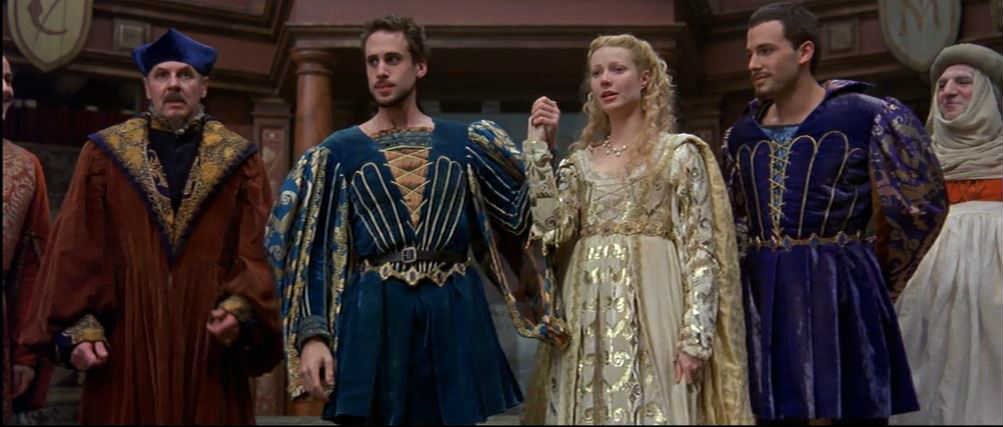
This is a very good film, from the inventiveness of the screenplay to the acting to the costume designs, which naturally won the Oscar for Best Costume Design, the way period films do.

Being a film that mostly takes place in London, there are almost as many British actors as in a Harry Potter film and all of them are very good. Joseph Fiennes, the young brother of Ralph, shows that good acting talent can be hereditary. He plays the Bard as a struggling playwright who is on the verge of failure before meeting his muse and becoming the legend we think we know today. He brings a real humanity and sense of humor, not to mention athleticism, to a role that has the potential for being quite stuffy.

Dame Judi Dench infuses Queen Elizabeth I with a personality one doubts many during her reign actually saw. Geoffrey Rush is actually an Australian, but he plays British subjects so often and so well that it’s hard to remember he’s from a different island nation. His Kings Speech co-star, Colin Firth, is also good as the self-absorbed loser, Lord Wessex. The list goes on and on, including Simon Callow, Tom Wilkinson, Rupert Everett, Jim Carter and Imelda Staunton, who are all good and believable in roles large and small.

Ben Affleck seems to be an odd choice to play Ned Alleyn. In retrospect, one doubts they ran out of British actors and had to draft an American to fill the part. But at the time, Affleck was in high demand, his previous film having been the Academy Award-winning Good Will Hunting (1997), in which he not only acted but won the Academy Award for Best Original Screenplay and Best Picture. In that context, he seems to be the perfect choice for Alleyn, who is presented as an actor on the top of his game, who gets a little bit of a comeuppance, when he isn’t cast as the lead in the new play. Affleck’s career has been a series of peaks and valleys since.

The star of the film, however, is another American actress, Gwyneth Paltrow. This is the pre-Goop, pre-self-absorbed Paltrow that we know today. She is good in the dual roles of Viola and Kent and I don’t have any argument with her winning the Academy Award, though I have not done an extensive look at her competition.

Gwyneth Paltrow stars in Shakespeare in Love.

After having watched several of Shakespeare’s plays made into films, I really enjoyed watching this film again. It is very delightful to reimagine a life and writing process so few know anything about. Given the unknown qualities of Shakespeare’s life, it is easy to have his character say or do anything the filmmakers wanted. There is gratefully nothing too embarrassing or outlandish Shakespeare is required to do. You can only imagine in lesser hands the crudeness that could be applied to his life.

While there is no real insight into the creative process, Shakespeare In Love is a fun period piece, an unlikely romantic comedy involving the world’s most famous writer. With the exception of some nudity, I would recommend this to anyone who is just learning about the Bard or had to endure studying one of his many plays in school and wants to see the mythical writer humanized in a fun way.