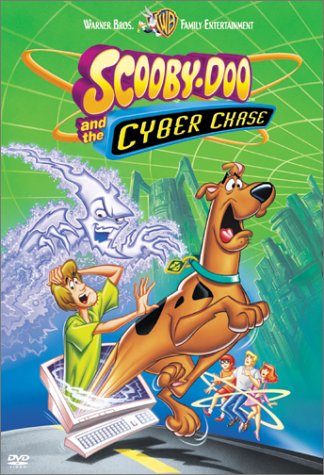
After we reviewed Scooby-Doo on Zombie Island, we’ve decided to review another
direct-to-video Scooby-Doo movie, not
only to celebrate its 17th anniversary, but also because we’ve actually owned a
copy on DVD since its original release. That particular movie is Scooby-Doo and the Cyber Chase, a movie which
represents many firsts and lasts for the Scooby-Doo
franchise. I remember liking this movie as a kid, even watching it a few times,
but looking back on it now as an adult, it’s more flawed than I had thought.
In a college computer lab run by
Professor Kaufman (Tom Kane), two of his students, Eric Staufer (Bob Bergen)
and Bill McLemore (Mikey Kelley), are working on gaming projects when a
creature, the Phantom Virus (Gary Sturgis), is beamed into the real world from
one of the games and tries to attack. The next day, the Mystery, Inc. gang visits
Eric to try out a game he made based on their previous adventures, only to find
out that the Phantom Virus is still roaming around the campus. The gang manages
to find the Phantom Virus, only to be mysteriously beamed into Eric’s video game
along with it. If they want to escape the game and figure out who created the
virus, they’ll have to confront the Phantom Virus while beating all ten of the
game’s levels.
At its core, Scooby-Doo and the Cyber Chase seems to take inspiration from Tron (1982), as both movies involve a
human, or group in this case, being beamed into a digital world and having to
fight their way back into the real world. Both also involve games in some form,
though the games in Tron were based
more on physical combat, which Flynn escapes before having to fight the Master Control
Program, while Cyber Chase involves Mystery,
Inc. overcoming various trials put forth by the various video game worlds they have
to complete. While this observation has no bearing on the quality of Cyber Chase, it was one I made during the
viewing for this review and I wanted to express it here.
 |
The title screen of the fictional game created by Eric Staufer (Bob Bergen),
featuring Mystery, Inc. in their "classic" attire. |
Apart from the Tron inspiration, Scooby-Doo
and the Cyber Chase actually has some interesting ideas, mainly Mystery, Inc.
having to fight a non-conventional digital monster that has the ability to
control electronics. Additionally, the idea of traveling through a video game
world apparently modeled after their previous adventures opens up some unique storytelling
possibilities.
Unfortunately, Cyber Chase suffers from some rather lackluster execution. Whenever
the Phantom Virus shows up during the game, his abilities aren’t fully taken
advantage of and he’s more of a pushover until the final level of the game. On
that note, his weakness, a super magnet, is also forgotten until it’s needed during
the final level and the movie’s internal rules of the magnet’s strength aren’t completely
clear. The Phantom Virus also seems to, for some reason, constantly leave clues
as to who his creator is. When we do find out, the villain also does nothing to
make themselves seem less guilty, which removes a lot of the tension from the
finale. As for the game itself, the movie shows the contents of the first three
levels, but then skips six of them in a glorified music video, only to more fully
explore the tenth level.
By virtue of its prominence in the
latter half, the tenth level of the in-universe game is one of the more
interesting, apart from the somewhat realistic aesthetic of the city. It’s here
that the more interesting ideas from the movie are more fully realized,
including the appearance of some of Mystery, Inc.’s past villains and a more
complete showcase of the Phantom Virus’ abilities. However, a majority of the
encounter against past villains is shown through a music montage involving
plenty of slapstick humor. Looking back on it, I feel the movie could have benefited from spreading out the appearances with previous villains across the
game’s levels in order to give them proper screen time.
 |
| The Phantom Virus (Gary Sturgis) had potential as a villain, but fell short. |
The post-credits sequence, which
features Mystery, Inc. talking about their favorite parts of the movie, doesn’t
really help with sorting out the internal logic of Cyber Chase, since this sequence not only implies that the characters
had somehow filmed the movie, but also includes moments that weren’t even in
the final product. I ran with it as a kid, but as an adult it felt more
confusing.
I’ll also mention at this point that Cyber Chase contains quite a bit of
slapstick humor by comparison with Zombie
Island, which had more subtle jokes incorporated into the dialogue. In
spite of this, there is a little bit of clever Scooby-Doo meta humor that addresses how Mystery, Inc. normally splits
up while looking for a monster.
While not free of errors, the animation of
Cyber Chase is smooth and holds up
pretty well. The darker color palette introduced in Zombie Island has all but disappeared, leaving a noticeably brighter
color palette against a world that’s still depicted pretty realistically. Considering
the visual differences between Cyber
Chase and later Scooby-Doo direct-to-video
movies, Cyber Chase could be viewed
as a transition between different interpretations of the franchise and
different animation styles.
Story aside, the voice acting of Cyber Chase is well-done, with each of
the actors lending the appropriate voices and energy to the characters. The soundtrack
is also solid, though lighter in comparison with Zombie Island, which lends further credence to the idea that Cyber Chase is a stylistic transition.
As is tradition, Cyber Chase features
a version of the main Scooby-Doo
theme, this time sung by three members of the B-52s, specifically Cindy Wilson,
Kate Pierson, and Fred Schneider. This is accompanied by two original songs, “Hello
Cyberdream,” written by Richard Lawrence Wolf and performed by David Nicoll and
Wes Quave, and “Double Double Joint,” an instrumental written and performed by
Richard Lawrence Wolf.
While both “Hello Cyberdream” and “Double
Double Joint” are catchy, the former isn’t completely listenable out of context
like “The Ghost is Here” and “It’s Terror Time Again” from Zombie Island. What doesn’t help is that the lyrics of “Hello Cyberdream”
seem to more or less describe what’s happening onscreen during the montage in
which it's used.
As with Zombie Island, Cyber Chase
represents many firsts and lasts for Scooby-Doo.
Cyber Chase is the final film in what’s
considered the “dark era” of Scooby-Doo
animation, which consists of the first four direct-to-video features and is marked
by a generally darker color palette, more realistic tone and real monsters. As
such, this is also the last film to have Mystery, Inc. in their attire from Zombie Island, returning to their “classic”
attire from then on.
 |
Scooby-Doo and the Cyber Chase features a brighter color palette
while keeping the more realistic appearances of Mystery, Inc.;
L-R: Scooby-Doo (Scott Innes), Shaggy (Scott Innes), Velma (B.J. Ward),
Daphne (Grey DeLisle) and Fred (Frank Welker). |
On the voice acting side, Cyber Chase is the last time that Scott
Innes voices both Scooby and Shaggy, though he has come back from time to time
for commercials and games, the final time that B.J. Ward voices Velma and the
first time that Grey DeLisle voices Daphne following the passing of Mary Kay
Bergman.
Perhaps most notably, Cyber Chase is considered the last
official Hanna-Barbera production, since afterwards, Warner Bros. would fully absorb
the studio following the passing of William Hanna, to which Cyber Chase is dedicated. This film is
also the first Scooby-Doo production animated
entirely digitally, as opposed to animation cels, and is also the last movie to
be animated by Japanese studio Mook DLE.
Appropriately enough, Cyber Chase is also the only Scooby-Doo film to receive a tie-in
video game, which released on the PlayStation and Gameboy Advance the same year,
2001. Although we have yet to play either version, I’ll note that our DVD copy
came with a handful of tips for playing through the game, although it’s
disappointingly pretty basic information. On a much less important note, our
DVD copy is also so old that it still has a 16-years expired coupon for Frigo
Cheese Heads String Cheese.
One more minor note about Cyber Chase regards the Creeper (Scott
Innes), a villain who appears during the final act and the only one actually from the
original cartoon, Scooby-Doo, Where Are
You! As with other Scooby-Doo
media, this film continues the misconception that the Creeper has no dialogue
apart from repeating his own name. However, in the original episode in which he
appears, Jeepers, It’s the Creeper,
he actually repeats the word “Paper” in reference to an incriminating photo of
his identity.
 |
| The Creeper (Scott Innes) as he appears in Scooby-Doo and the Cyber Chase. |
While Scooby-Doo and the Cyber Chase is very flawed on an objective
level, especially with regard to its storytelling and internal logic, it’s
still an enjoyable movie. I might personally attribute this to nostalgia, since
I loved watching it as a kid for being one of the few pieces of media to
represent video games in a more positive light, but I won’t really fault anyone
for enjoying this film unironically. I would recommend this more to Scooby-Doo fans looking to relive their
childhood or people who are going through a Scooby-Doo
kick and are willing to watch something flawed, yet entertaining.