Showing posts with label Japanese. Show all posts

Saturday, November 14, 2026

Stubs - Godzilla Minus Zero


Godzilla Minus Zero
(2026) starring Ryunosuke Kamiki, Minami Hamabe, Min Tanaka, Hidetaka Yoshioka, Masami Nagasawa, Yuki Yamada, Kuranosuke Sasaki, Jun Kunimura, Sakura Ando, Miou Tanaka. Directed by Takashi Yamazaki. Screenplay by Takashi Yamazaki. Produced by Kazuaki Kishida, Gō Abe, Keiichirō Moriya. Run time: 135 minutes. Color. Japanese, Epic Kaiju

While Godzilla Minus One may have snuck up on audiences in 2023, the same cannot be said for the sequel Godzilla Minus Zero, which opened on November 6 in the United States. Unlike sequels in Hollywood, the budget for this new film did not balloon and, once again, every yen spent seems to be on the screen and then some.

Wednesday, July 14, 2021

JoJo's Bizarre Adventure: Diamond is Unbreakable - Chapter I


Note: This review contains massive spoilers for JoJo’s Bizarre Adventure: Diamond is Unbreakable.

JoJo’s Bizarre Adventure, begun by mangaka Hirohiko Araki in 1987, tells the multi-generational story of the Joestar family and their continuing battle against the forces of evil. The series is split into currently eight Parts, each focusing on a different Joestar, with Part 3 introducing the concept of Stands, which are psychic powers reflecting the personality of the user. Part 4, Diamond is Unbreakable (1992-1995), tells the story of Josuke Higashikata and his misadventures in the fictional town of Morioh, solving mysteries about his hometown along the way.

I will admit that, while I had heard of JoJo’s Bizarre Adventure and was aware of its limited US import in my high school years, it didn’t really grab my attention until the series received a proper anime adaptation in 2012, and since then it has become one of my favorite anime/manga series in spite of whatever flaws it has. My curiosity was piqued when, at the height of the increased popularity of Diamond is Unbreakable following its anime adaptation, a live-action film based on the series, JoJo’s Bizarre Adventure: Diamond is Unbreakable – Chapter I (JP: JoJo no Kimyō na Bōken Daiyamondo wa Kudakenai Dai-Isshō), was announced in 2016 to be directed by prolific director Takashi Miike, though I held off on actually trying to watch the film until it had a proper release stateside. The opportunity finally presented itself when Viz Media brought it over in subtitled form on Blu-ray in 2020, though I did not end up actually watching it until some time later. As someone who has read the official English translation of Diamond is Unbreakable from Viz and watched the anime twice, once in subtitled form on Crunchyroll and once in English dubbed form through a Toonami broadcast, I thought it was a good movie overall, though it could have been improved in places.

Saturday, March 27, 2021

Godzilla, Mothra and King Ghidorah: Giant Monsters All-Out Attack


Following the debut of Godzilla (aka Gojira) in 1954, the film proved popular enough to spawn arguably the best-known series of kaiju films that continues in some form to this day, even spawning a recent American-produced series of films known as the MonsterVerse that includes a crossover with King Kong. In the spirit of things, I decided to take another look at a Godzilla movie from 2001 I happened to own, dubbed Godzilla, Mothra and King Ghidorah: Giant Monsters All-Out Attack (JP: Gojira, Mosura, Kingu Gidora: Daikaijū Sōkōgeki) (GMK). What I watched in particular was the US DVD release from 2003, which featured the original uncut Japanese version with English subtitles. Though the 25th installment in the series, produced during the Millenium Era, the film bills itself as a direct follow-up to the 1954 original, which worked out for me continuity-wise since I’m not the most knowledgeable in the Godzilla mythos. The movie itself holds up pretty decently, though I had some minor issues with it.

Saturday, September 8, 2018

Stubs - Kiki's Delivery Service


Kiki’s Delivery Service (1989, version reviewed 1998) Starring: Kirsten Dunst, Phil Hartman, Tress MacNeille, Janeane Garofalo, Matthew Lawrence, Debbie Reynolds. Directed by Hayao Miyazaki. Screenplay by Hayao Miyazaki. Kiki's Delivery Service by Eiko Kadono. Produced by Hayao Miyazaki. Run Time: 102 minutes. Japan. Animation, Adventure.

Soon after the release of My Neighbor Totoro (1988), Hayao Miyazaki released his next film, Kiki’s Delivery Service, based on a novel by Eiko Kadono first published in 1985 as Majo no Takkyūbin. The first of a series of novels: Majo no Takkyūbin 2: Kiki to Atarashii Mahō (Witch's Express Home Delivery 2: Kiki and Her New Magic?) in 1993; Majo no Takkyūbin 3: Kiki to mō Hitori no Majo (Witch's Express Home Delivery 3: Kiki and the Other Witch?) in 2000; Majo no Takkyūbin 4: Kiki no Koi (Witch's Express Home Delivery 4: Kiki's Love?)  in 2004; Majo no Takkyūbin 5: Mahō no Tomarigi (Witch's Express Home Delivery 5: Perch of Magic?) in 2007 and Majo no Takkyūbin 6: Sorezore no Tabidachi Witch's Express Home Delivery 6: Each and Every Departure?) in 2009. It is no surprise that Hayao Miyazaki’s movie based on the first book plays like the first part of a longer series.

It was not Miyazaki’s intent to write and direct the film. He had chosen Sunao Katabuchi, someone he had worked with before, to direct the film. And Studio Ghibli hired Nobuyuki Isshiki to be the screenwriter. Since the book took place in a fictional European nation, Miyazaki and his creative team had gone to Stockholm, Sweden as well as the Swedish Island of Gotland to research settings and other elements for the project.

Upon their return, Miyazaki started to develop his own ideas. He had already been disappointed in the first script and his ideas would change the story from the book’s episodic approach to Kiki’s story and adding in elements not found in the book. Kadono was not happy with the changes and the whole project was on the verge of being shelved before the first frame was shot. But after she visited Ghibli at Miyazaki’s and Toshio Suzuki’s request, she decided to let the project move forward. Miyazaki ended up writing the screenplay and decided to direct the film itself.

Released in Japan in 1989, Kiki’s Delivery Service was a modest success in its home country, earning the equivalent of $18 million on a budget of a little less than $7 million. The first U.S. release came via Streamline Pictures, which used Lisa Michelson as Kiki, Kerrigan Mahan as Jiji, Alexandra Kenworthy as Osono and Edie Mirman as Ursula.

Like My Neighbor Totoro, when Disney got rights to the film, they redubbed the English version and actually made further changes to the film, which were approved by Miyazaki and Studio Ghibli. In place of Michelson, Kirsten Dunst was cast as Kiki. Phil Hartman, who would be making his final film appearance, was cast as her cat Jiji. Standup comic and actress Janeane Garofalo was cast as Ursula and Debbie Reynolds was cast in a smaller role as Madame.

Kiki (Kirsten Dunst) packs her things anticipating her leaving home.

The film opens on the verge of a full moon. Kiki (Dunst), who is thirteen, is anxious to get on with her trip. As a young witch, she is to leave home and spend a year studying somewhere else. Kiki’s mother, Kokiri (Kath Soucie), a practicing witch herself, seems unable to talk her young daughter from leaving. She explains to Miss Dora (Fay DeWitt), a family friend, that she has not had a chance to train her daughter at all, which makes her departure sound even more problematic.

Kiki’s father, Okino (Jeff Bennett), is unable to talk Kiki out of leaving.

Kiki’s father, Okino (Jeff Bennett), comes home from work and is also unable to talk Kiki out of leaving that night when there is to be a full moon. Kiki packs her belongings in a bag and plans to leave along with her black cat Jiji (Hartman) whom she communicates with. Jiji is not as anxious to leave as Kiki is, but he really has no choice in the matter.

Kiki's mother (Kath Soucie) insists Kiki take her broom.

At first, Kiki wants to use a broom that she herself has fashioned, but her mother insists that she take the broom she has been using instead. And with a group of friends there to wish her luck, Kiki and Jiji set off on their year-long adventure; destination unknown. The wind is strong and Kiki has to get Jiji to turn on her father’s transistor radio that she has attached to the broom handle. While they are flying they see another young witch, Senior Witch (Debi Derryberry), and a black cat also flying close by and try to engage her in conversation.

Kiki tries to make conversation with Senior Witch (Debi Derryberry), another witch she meets in flight.

This girl, who claims to be a fortune teller, is near the end of her training and is really not very encouraging to Kiki. As soon as she descends into her town, a major thunderstorm comes through, forcing Kiki out of the skies. She and Jiji take refuge in what they discover the next day is a cattle car on a moving train, making a bed in the hay that is suspended for the cow’s to eat in transit.

Tombo Kopoli (Matthew Lawrence) helps Kiki get away from a policeman.

The next morning, after the storm has passed, Kiki and Jiji get on their way and head towards Koriko, a fairly large city which is on the ocean, which appeals to her. Not really sure what to expect, Kiki descends into the city and gets caught up in the wind, nearly causing a major traffic accident. A policeman catches her and is about to book her when a boy, Tombo Kopoli (Matthew Lawrence), who is smitten with the girl, pretends to need the policeman’s help. This allows Kiki to escape. But when Tombo approaches her, she is not interested in speaking to him.

Osono (Tress MacNeille), a very pregnant baker, has a customer's forgotten pacifier which Kiki offers to return.

After trying to find a room for the night at a major hotel, Kiki catches a break. Standing outside a bakery run by a very pregnant Osono (Tress MacNeille) and her nearly mute husband, she overhears the store owner trying to get the attention of a customer who has recently left. The woman, who has a very young child, has left the baby’s pacifier. Osono is going to have to stop serving customers to take chase when Kiki offers to run the errand for her. Osono is surprised and amazed to find out that Kiki is a witch. When Kiki returns from the errand, Osono invites her in for hot chocolate and eventually offers the girl a room to live in and breakfast, as long as she’ll occasionally help in the shop. Kiki agrees to the terms.

Osono makes Kiki hot chocolate and offers her a job and a place to stay.

Because Kiki’s only talent is her ability to fly, she decides to go into the delivery business and Osono helps her there as well. In fact, she helps her get her first client, Maki (Julia Fletcher), who has a gift she needs to be delivered for her nephew’s birthday that she won’t be able to attend. The gift is a stuffed cat which looks just like Jiji in a cage. But the delivery does not go without incident.

Maki (Julia Fletcher) is Kiki's first delivery customer.

On the way, Kiki flies next to a flock of geese which Jiji is able to understand. He hears them warning about a big gust of wind which Kiki misses out on. As a result, she is blown off course and into the trees, falling next to a bird’s nest. She is called an egg thief by all the birds and she gets chased away. Only then do they realize that the stuffed animal has been lost in the fall.

Her first delivery isn't without issues.

Rather than go back and fight the birds, they go on to Ket’s (Julia Fletcher), the nephew’s house, with Jiji being used as a replacement for the doll. Under the cover of darkness, Kiki goes back to look for the doll. She does find it in the window of Ursula’s (Janeane Garofalo) cabin. Ursula, who is an artist, offers to give her back the doll, but they find out that the head has come off. Ursula offers to sew the head back on the doll in exchange for Kiki doing something for her. So while Ursula sews the doll back together, Kiki scrubs her floor. Even though Kiki isn’t done by the time Ursula is, she’s allowed to take the doll to rescue Jiji.

Ursula (Janeane Garofalo) helps Kiki out of a jam.

Meanwhile, JiJi has befriended the family’s Saint Bernard, who takes Jiji outside to where Kiki is waiting. The dog even takes the doll back inside.

Even though Kiki has given him the cold shoulder, Tombo hasn’t given up on her. He invites her to a gathering of his friends, who are all into flying. He doesn’t give her a chance to say no and promises to come to pick her up at 6. But Kiki gets another delivery job, this time to take a pie for Madame (Debbie Reynolds) to her granddaughter for her birthday. Madame has a friend, Barsa (Edie McClurg), who helps her around the house.

Kiki makes friends with Madame (Debbie Reynolds).

But the pie isn’t quite done, so Kiki helps the two load and ignite a firewood oven to cook the pie to completion. Madame and Barsa are both very impressed by the young girl.

This delivery doesn’t go any smoother than the first one, as a thunderstorm comes up and drenches Kiki and Jiji. When they do make it to the granddaughter’s (Sherry Lynn) house, she is nonplused, not liking her grandmother’s pies.

When Kiki gets back home, she has not only missed Tombo but she has also caught a cold. Osono tries her best to take care of Kiki, who does recover. Osono tells Kiki that Tombo has come by to see her, but that she had sent him away. Osono does have another delivery, though for Kiki to make. Turns out to be to Tombo.

Tombo shows Kiki his propeller-powered bicycle.

Given the chance, the two actually talk and seem to bond. He shows her the propeller-powered bicycle that the gathering was celebrating the night before. Tombo talks Kiki into going with him to see a dirigible that has landed on the beach. The two ride down there on his bike but they don’t make it all the way before Tombo loses control and the two are forced off the road. While they laugh about their incident, friends of Tombo come by on their way to see the dirigible. Even though he invites her to come along with them, Kiki turns down the offer and walks back to her home.

With his friends’ help, Tombo gets to ride on the dirigible. Kiki sees him from a distance and he waves to her, but she doesn’t reciprocate. Tombo even calls her to tell her about his experience, but she hangs up on him.

Kiki finds she's losing the ability to communicate with her cat Jiji (Phil Hartman).

Later, Kiki realizes that she is losing her ability to fly, the thing that she feels makes her a witch. She tries in vain to take flight, breaking her mother’s broom in the process. Further upsetting her is her inability to communicate with Jiji, who appears to have lost the power of speech while he pursues romantic interests with another cat. Depressed, Kiki stays in her room until one day when Ursula comes to town to do some shopping and to see her. She invites Kiki back to her cabin in the woods.

Ursula comes to town to visit with Kiki.

Ursula has been painting a mural about Kiki and needs the girl to pose for sketches so she can complete it. While they’re there, Ursula talks about the magic of art and how much she loves painting. She describes how one day she found that she couldn’t paint anymore and compares that situation to Kiki’s. She tells the younger girl that if she gives herself time away from worrying about it, she’ll get past the mental block. With that knowledge, Kiki returns home.

She gets another delivery job and is called back to Madame’s house. Barsa is pretty excited about the dirigible, which is on the television. There is a live report going on about the airship’s being buffeted by the wind that has once again begun to blow hard.

Madame bakes a special cake for Kiki.

The delivery is really more of a ruse, as Madame has baked a cake for Kiki, wanting to be friends with the girl. Kiki is happy and excited and the two plan to be friends.

Tombo gets carried away by a dirigible.

Meanwhile, things are getting worse with the dirigible. People on the ground are trying very hard to keep it moored, even going so far as to tie it to the bumper of a police car. Tombo is there, trying to help and unfortunately, he is the only one still holding the ropes when the dirigible is carried off the ground. He hangs on helplessly while the crew of the dirigible is helpless to help him. He slides down the rope and unfortunately dislodges the police car, sending it falling into a swimming pool below. When the dirigible is blown into the town’s clock tower, Tombo is left dangling.

Kiki takes it upon herself to rescue Tombo.

Kiki takes it upon herself to try and save him. Borrowing a street cleaner’s broom, Kiki manages to fly, but the rescue doesn’t go smoothly. Before she can get him, Tombo loses his grip and is sent falling to the ground. Kiki manages to fly down and save him before he hits. After saving him, Kiki is now renowned about town and is treated like a hero by the townspeople.

Kiki becomes a local hero as a result and even sees an imitator on the street.

The film ends with Kiki having sent a letter home to her parents, telling them that she’s settling in and feeling good about herself.

I have not read the original story, but I’m struck by the haphazardness of Kiki’s journey. One thinks of young witches studying with someone or someplace where they will be with others like them; Harry Potter had Hogwarts come to mind. Not sure what a young witch will learn going out on her own without guidance to a strange city or how making deliveries and working the counter at a bakery is going to sharpen her undeveloped skills. I know that’s not really the point of the movie really, but, as a parent, I had issues with the premise.

That doesn’t mean that I didn’t like the movie, I did, but I really am left wanting more. Kiki’s Delivery Service is more a slice of life and it leaves itself open for further stories. Rather than more films in the series, the story has since been remade as a live-action film, Kiki's Delivery Service (2014). While Miyazaki’s film is more universal in its appeal and perhaps truer to the original story, which is set in Europe, the live-action film is aimed more squarely at a Japanese audience.

The voice acting is good. I will admit that the only voice I recognized was Phil Hartman’s, who plays Jiji with more than just a hint of sarcasm. His is the most distinctive of the voices. Having watched this film since the passing of Debbie Reynolds, I didn’t recognize her as Madame. That doesn’t take away from the performances of the actors, which for the most part were very good and believable in their tone.

The look of the film is very much like My Neighbor Totoro, which used a very similar color palette and animation style. His research trip to Sweden really paid off as Koriko looks very European without being too specific to one city in particular. A grand background to place the story against. Unlike Totoro, Kiki’s world, save for the flying witches, is not populated with magical creatures, just humans. I really like how they capture the characters moving about, sometimes even stumbling, which makes it seem more real in a way.

A film should leave you wanting more and this film certainly did that. Not only do I want more stories about Kiki, but I’m looking forward to more movies by Hayao Miyazaki. I would highly recommend Kiki’s Delivery Service to anyone, though maybe not for very young children. While Disney may control the rights to the film, this is not a Disney film.

Saturday, January 16, 2016

Stubs - Rashōmon


Rashōmon (1950) Starring: Toshiro Mifune, Masayuki Mori, Machiko Kyō, Takashi Shimura, Minoru Chiaki. Directed by Akira Kurosawa.  Screenplay by  Akira Kurosawa, Shinobu Hashimoto Based on: "Rashōmon" and "In a Grove" by Ryūnosuke Akutagawa Produced by: Minoru Jingo. Run Time: 88 minutes. Japanese, Black and White, Drama

Recently, Trophy Unlocked reviewed its first Japanese film, Gojira (1954). The choice was driven by the release of Godzilla (2014), a remake that was supposed to be true to the intent of the original. While the most famous thing about Gojira was the monster, such is not the case with our next film, Akira Kurosawa’s Rashōmon (1950). Kurosawa had been directing films since during World War II, his first film being Sanshiro Sugata (1943) But until the release of Rashōmon, his work was not widely known outside of Japan.

The 1950’s saw an influx of world cinema to the U.S., and while mainly relegated to art houses, these movies would nonetheless have an impact on Hollywood. Films by such diverse filmmakers as Ingmar Bergman, Federico Fellini and Jacques Tati revealed different ways of story-telling and pushed the envelope of acceptable subjects for moviegoers. This is also true of Rashōmon, the first Japanese film to receive a substantial release outside of that country.

Rashōmon is probably best known for its depiction of a story from four different points of view, something that was seen as revolutionary at the time. Based on two works by Ryūnosuke Akutagawa, Rashōmon and In the Grove, the film tells the story of the interaction between Tajōmaru, a bandit (Toshiro Mifune), a samurai, Takehiro Kanazawa (Masayuki Mori), and the samurai’s wife, Masako (Machiko Kyō). While travelling through the woods, the samurai and his wife pass by the bandit who is sleeping at the foot of a tree by the edge of the trail. It is a hot day and a cool breeze rustles Tajōmaru from his nap in time to catch sight of the samurai’s wife as she rides by on a horse. He instantly desires her and follows after the couple through the woods. His plan is to take the woman from the man without killing him. Let’s not mistake the bandit’s intentions, which are to have sex with the woman, consensual or not.

The bandit Tajomaru (Toshiro Mifune) wakes from his nap to see the Samurai and his wife go by.

From there the stories of what happen diverge.

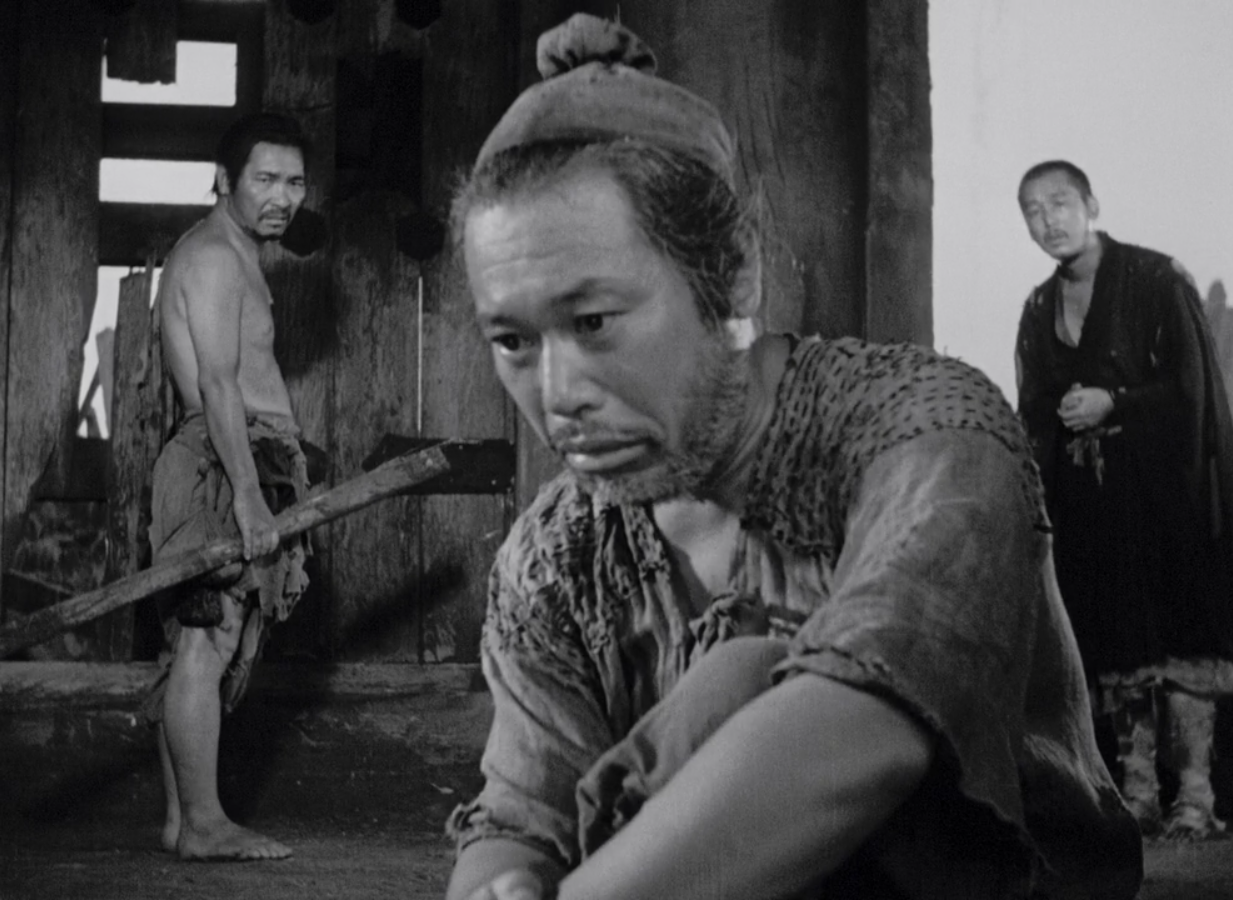
At Rashōmon, the city gates of Kyoto, a woodcutter Kikori (Takashi Shimura) and a priest (Minoru Chiaki) sit out an intense rainstorm. A third man, a commoner (Kichijiro Ueda), joins them. While they hint about a disturbing story they have to tell, it is the commoner who gets them to open up.

An intense rainstorm at the city gates of Kyoto traps a woodcutter, a priest and a commoner.

The woodcutter tells him that three days before, while searching for wood in the forest, he comes across a woman’s hat and veil stuck on a branch. Later, he finds a samurai’s cap just before discovering the samurai’s dead body. The discovery sends him running from the woods in a panic to tell the authorities. He had just that day given such testimony in a court looking into the murder. The priest had seen the couple only minutes before the murder as they made their way past him in the woods. After giving their testimony, the woodcutter and the priest are seen sitting in the background, in the sun, while other witnesses testify. I don’t know if this is supposed to be a realistic depiction of courts of the 11th century, when our story takes place, or if this is shown for symbolic reasons, so as to let the audience know the two heard the other stories they’re recanting.

The woodcutter, Kikori (Takashi Shimura), discovers the Samurai's dead body while searching for wood.

Like the woodcutter, we see the priest answering questions that we never hear being asked, as if they’re speaking to us, the audience, directly. There are three other witnesses brought before the court, each telling their story in the same manner, speaking directly to us as if we are the judge of their tale.

First up is Tajōmaru, who has been captured by a policeman (Daisuke Katô). The policeman had found the bandit by a lake, with the samurai’s possessions, including his horse and his bow and arrows, having apparently been thrown by the horse.

A policeman (Daisuke Kato) captures Tajomaru by a lake,

Tajōmaru, who is a renowned bandit and perhaps crazy, readily confesses to the crime.

The bandit confesses in court and readily admits to the crime.

He claims that he had no desire to hurt the man, only to have sex with the woman. He lured the samurai off the trail with the promise of a cache of swords he had discovered and buried. The samurai might be cautious about the tale, but he leaves his wife and horse and follows after the bandit. When they reach the grove, the bandit overpowers the samurai and ties him up. He then goes back to the wife and tells him that her husband has taken ill and has her follow him back to opening. It seems a bit perverse to want to have sex with her in front of her husband, but that seems to be the bandit’s plan. But the woman is not an easy target. She pulls out a dagger and tries to attack the bandit, who is too fast and too strong for her.


The bandit lures the Samurai (Takehiro Kanazawa) away from
 his wife with the promise of a cache of swords.

In a clinch, the bandit kisses the woman, who drops her dagger. We’re led to believe she’s been seduced. 

The bandit kisses the Samurai's wife, Masako (Machiko Kyo) and she drops her dagger.

Afterwards, this is the 50’s everywhere and sex was never shown, the woman is filled with shame. Not wanting to live with two men knowing of her guilt, she asks the bandit to duel with her husband and she would go with the winner.

Tajōmaru unties the samurai and they fight honorably, crossing swords more than twenty times, before the bandit kills the samurai. But when the fight is over, the woman runs away and escapes.

The bandit and the Samurai cross swords in battle over the wife. 

After telling his story, he is asked about the wife’s dagger, which has has a pearl inlay, which is supposedly left at the scene. He admits it was foolish of him to leave behind such a valuable object.

The wife testifies while the Priest and the Woodcutter look on.

Next to testify is the wife, who tells the court that Tajōmaru raped her and then left. But when she begged for her husband’s forgiveness, he simply stared at her with a glare she read as contempt. She then freed him from his bindings and asked for him to kill her so she wouldn’t have to live with the shame, but he only continued to stare at her. So disturbed, the woman fainted, the dagger still in her hand. But when she awakes, she finds that the dagger is in her husband’s chest. Not knowing what had happened, she tries to kill herself, but fails.

The Samurai testifies through a medium (Noriko Honma).

In what is no doubt a Japanese touch, the samurai testifies through a medium (Noriko Honma). Speaking on his behalf, she tells the story that after raping his wife, the bandit asks her to travel with him, a request she accepts. But she insists that Tajōmaru kill him so that she wouldn’t feel like she belongs to two men. Surprised and shocked by the request, he gives the samurai the choice of letting the woman go or killing her.

According to the Saumurai's story, his wife encourages the bandit to kill him.

The woman then tries to run away, but Tajōmaru fails to recapture her and she gets away. Tajōmaru then lets the samurai go free and leaves. The samurai then kills himself, using his wife’s dagger.

The Samurai kills himself with his wife's dagger.

But back at the gates, the woodcutter tells the commoner that the samurai’s story is a lie and that he had witnessed both the rape and the murder. When asked why he didn’t tell his side of the story in court, he says he didn’t want to get involved.

The woodcutter admits to the commoner (Kichijiro Ueda) and the priest
(Minoru Chiaki) that he didn't want to get involved.

According to the woodcutter’s testimony, after raping her, the bandit begged her to come away with him. Instead, the woman frees her husband, but he is unwilling to fight for a spoiled woman. But the woman then turns the table on both men, claiming that neither of them is a real man, since they refuse to fight for the woman’s love. After spurning the two men into a duel, she hides her face to avoid seeing the actual fight.

The climatic fight according to the woodcutter's point of view.

The fighting, according to the woodcutter, is not as honorable as Tajōmaru had depicted in his testimony. Not only is the swordplay sloppy, but neither man fights with any real gusto. But in the end the bandit wins by what some might say was a lucky turn of events and reluctantly kills the samurai, who begs for his life. The woman flees in horror. Unable to catch her, Tajōmaru takes the samurai’s sword and leaves the scene limping.

The films ends back at the Rashōmon gates, where further discussion about the woodcutter’s motives are interrupted by the sounds of a crying baby. The commoner swoops in and steals the kimono and an amulet that were left for the baby. The woodcutter tries to chastise him for his actions, but the commoner, thinking the woodcutter had taken the woman’s dagger from the murder scene, won’t have any of his consternation, saying in essence it takes a thief to know a thief. The commoner then leaves Rashōmon claiming all men are motivated by their own self-interest.

The priest’s faith in humanity is shaken by not only the trial, but also by the woodcutter’s refusal to bear witness at the trial. He is therefore reluctant to give the baby to the woodcutter, who reaches to take it from the priest’s arms. The woodcutter insists that one more child, he already has six, won’t be a problem for him. The priest, feeling that he has renewed reason to believe in humanity, lets the woodcutter take the baby. And as the woodcutter leaves, the rain has stopped and it is sunny for the first time.

The woodcutter leaves the gates taking the baby found there while the priest watches.

Weather always seems to play a part in Kurosawa’s films and when it rains, it pours. One of my more vivid memories of his Seven Samurai (1954) are the action scenes taking place in a drenching rainstorm. In this film, it is the rain that has drawn these three divergent men together and allows the woodcutter and priest to tell the commoner their stories. But symbolically, the rain hangs over all humanity, at least in the priest’s eyes. It is only when his faith has been restored do the clouds break.

A lot is also made of the cinematography not only of the scenes at the gates, but the scenes shot in the forest. Shot under the shade of tall trees gives the light, as Robert Altman put it in an introductory video on the Criterion Collection DVD, a “dappled” quality and thereby the story and the characters some “ambiguity”. Perhaps that explains how the various witnesses see the same story so differently.

An example of the "dappled" quality of the light.

What is not explained, however, is why the stories are so different. Why would the bandit confess to a murder that will no doubt lead to his execution? Was the wife trying to protect her new lover by leaving open the idea that she could have killed her husband? Was the dead samurai telling the court he committed suicide a way for him to save face even in the afterlife? We can’t even be certain the woodcutter, who doesn’t seem to have a dog in the fight, is telling the truth himself. While contradictory interpretations of the same event by different people is now referred to as the Rashōmon effect, it still makes for a unique and disturbing film with so many unanswered questions at the end.

It really comes down to motivation. Lust motivated Tajōmaru to desire the samurai’s wife and it seems honor motivates the samurai and his wife after the attacks. But does the samurai feel he’s been left with damaged goods, now that his wife has had sex with another man, regardless of consensuality, or is he ashamed that he was unable to prevent it? And did the woodcutter not speak up in court so as not to testify that he is the one who took the samurai wife’s dagger? The film leaves it up the viewer, who had been made the judge at the trial, to decide for themselves. As Altman also points out, some of the issues with a Western reading of the film is the unfamiliarity of the mythos. He points out that in the U.S. most of us grew up with the old-West mythos and therefore recognize characters and motivations for that genre right away. We are not familiar in the same immersed way with samurais, so some of what may seem familiar to a Japanese audience and understood right away is initially lost on us.

I am not the first person to notice this, but Rashōmon has a lot of the same qualities that late-era silent films do. The film depends on visuals to tell a good part of the story and dialogue, like title cards, are used only when there is no other way to communicate. A lover of silent films, Kurosawa tried to reconstruct that feel through a minimalist use of settings. Some of that may have had to do with its low budget.

Shooting on the film began on July 7, 1950 and wrapped on August 17th. The film premiered eight days later at the Imperial Theater in Tokyo, on the 25th, expanding nationwide the next day. But the film was met with lukewarm reviews.

Unbeknownst to Kurosawa, the film was entered into the Venice Film Festival at the behest of Giuliana Stramigioli, a Japan-based representative of an Italian film company, who had seen and admired the movie and convinced Daiei to submit it. On September 10, 1951, the film won the festival’s highest prize, the Golden Lion.

After Daiei showed a dubbed version of the film in Los Angeles, RKO bought the rights and released the film in the U.S. on December 26, 1951. While movie studios have classic divisions to handle such films, this was considered a real gamble for RKO at the time. Up until then the studio had only put one subtitled film on the market and the only other Japanese film to be released in the U.S. had been Mikio Naruse's comedy, Wife! Be Like a Rose, in 1937: a critical and box-office flop.

But Rashōmon was a game changer. With good reviews, the film made $35,000 in its first three weeks at a single New York theater, an almost unheard-of sum at the time. Its success paved the way for Japanese films in the U.S., which became the rage, replacing Italian Neorealist cinema as the foreign darling. At the next Academy Awards the film would win an Honorary Award as "the most outstanding foreign language film released in the United States during 1951" (This was in the days before a special awards category for foreign language films.)

With the film's success, Kurosawa returned to Toho studios, at which he would make his next 11 films, including Seven Samurai, Throne of Blood (1957), Yojimbo (1961) and Ran (1985).

Interestingly, Rashōmon, like Seven Samurai before it, would get the Hollywood treatment and be remade as a Western. [Seven Samurai would be made into The Magnificent Seven (1960)] The Outrage (1964) starring Paul Newman, Laurence Harvey, Claire Bloom, Edward G. Robinson and William Shatner, acknowledges the Rashōmon screenplay in the credits. Speaking of world cinema, an Indian film, Andha Naal (1954), directed by Sundaran Balachander, was supposedly inspired by Rashōmon as well, though in this case the film is considered the first film noir in Tamil cinema. (Tamil is a language spoken in the Indian state of Tamil.)

While I am not a big fan of samurai films, I did enjoy seeing Rashōmon again recently. It is curious to think that no one else thought about telling a story from different points of view before Kurosawa made this film. Other movies, such as Courage Under Fire (1996) and One Night at McCool’s (2001) use a similar technique to tell their story, as do countless episodes of TV sitcoms, but this one was the ground breaker.

For anyone who loves movies as an art form, Rashōmon is a must see. This film shows that a filmmaker doesn’t need a big budget to have a big influence. More than just story-telling technique, Rashōmon introduced the world to Akira Kurosawa and to the cinema of Japan.