Saturday, August 6, 2016

Stubs - Hard to Handle (1933)


Hard to Handle (1933) Starring James Cagney, Mary Brian, Ruth Donnelly, Allen Jenkins, Claire Dodd, Gavin Gordon. Directed by Mervyn LeRoy. Screenplay by Wilson Mizner, Robert Lord. Based on a story by Houston Branch. Produced by Robert Lord. Black and White, U.S. Comedy

By the middle of 1932, James Cagney was feeling like a star at Warner Bros., his home studio. In the two and half years since he’d come to Hollywood to star in Sinner’s Holiday (1930), he’d already made a name for himself and had become a star thanks to The Public Enemy (1931). But there was one thing that Cagney didn’t have and that was a star’s paycheck.

When he asked for a pay raise, studio head Jack Warner said no and put him on contract suspension for asking. Cagney wasn’t the kind to do nothing so he tried to get out of the contract all together, offering to do three films for free. Warner might be a lot of things, but he wasn’t stupid. He knew he had a star on his hands and refused.

This wasn’t the first time that Cagney had asked for a raise. After the success of The Public Enemy, Cagney had begun to compare his pay with his peers and found his lacking. He felt that his contract allowed for adjustments based on the success of his pictures. Warners disagreed, so Cagney walked.

His brother, Harry, acting on Cagney’s behalf, was able to get a raise for his brother to $1000 a week. Cagney came back, but it wasn’t too long before he wanted more, asking for $4000 a week, the same salary as Edward G. Robinson, Douglas Fairbanks Jr. and Kay Francis, with a raise to $4500 a week by 1935.

The Academy of Motion Picture Arts and Sciences asked Frank Capra to arbitrate and in the end Cagney got $3000 a week, but demanded that he only have to make four films a year and receive top-billing in all of them. By September 1932, the new deal was signed.

Prior to the contract dispute, Cagney had been scheduled to star in 20,000 Years in Sing-Sing (1933), but that film had already gone into production with Spencer Tracy in the lead opposite Bette Davis. For a new vehicle, Warners decided on Hard to Handle, an adaptation of a story by Houston Branch.

The production had already gone through various name changes including A Bad Boy, The Inside and Hard to Hold. The writer of the screenplay was Wilson Mizner, known around town as having a great wit, but considered by Jack Warner to be a lovable con man. While Mizner was always able to ad-lib for big laughs at writers conferences, he never seemed to produce much else. It should come as no surprise that Cagney was apparently very fond of the writer who was on the outs with the studio head.

Mizner’s story went into production in late October, 1932. In it, Cagney plays Myron C. “Lefty” Merrill, a California promoter. When the film opens, it is a marathon dance contest. There are only two couples left on the dance floor, including Ruth Walters (Mary Brian), with whom Lefty is in love.

Lefty (James Cagney) secretly encourages Ruth Walters (Mary Brian) during a marathon dance he's co-sponsoring.

We’re told this by a radio announcer at the dance (Allen Jenkins), who seems to delight in telling everyone what should have probably best been left private.

Allen Jenkins plays the announcer at the dance contest.

Ruth and her partner win when the other couple, Andy Heaney (Sterling Holloway) and his partner (Mary Doran), falls to the floor. But when Lefty goes back to the office to retrieve the $1000 prize money, he discovers that his partner Ed 'Mac' McGrath (John Sheehan) has absconded with all the money they’d made, leaving Lefty holding the bag, so to speak. Not only are the winners mad, but so is Ruth’s mother, Lil (Ruth Donnelly), and she manages to agitate the workers, who realize they won’t get paid either. Lefty manages to escape with his life.

Lil Walters (Ruth Donnelly), Ruth's mother, manages to
agitate the workers, much to Lefty's chagrin.

Meanwhile, Ruth has grown tired from the empty promises of California and longs to move away. No man they’ve found in Los Angeles is good enough for Lil’s daughter, especially the low down Lefty, who shows up unexpectedly looking for a place to stay and a friendly face. Thanks to Lil, he finds neither.

Determined to pay Ruth her share of the winnings (forget her dance partner), Lefty promotes a treasure hunt at a pier. But the owner, Col. H.D.X. Wells (Berton Churchill), has other plans. While he agrees to pay Lefty five hundred dollars for the scheme to bring hundreds to his pier, the prize money he hides is only $10. But the crowd, thinking there could be much more, tears the pier apart, causing much more damage. Lefty manages to escape before the mob gets out of control.

Lefty's get quick scheme goes awry as treasure seekers destroy the pier.

He shows up at the Walters’ apartment with the $500, but finds Lil sold the furniture to a second-hand furniture salesman, Abe Goldstein (Harry Strang) and used the money to move back to New York. The problem is that Lil didn’t own the furniture and once again Lefty has to hurry away before everyone tries to get the money from him.

Lefty follows the Walters to New York, where he discovers that Ruth is working as a model as well as dating the photographer John Hayden (Gavin Gordon). Lefty talks up a good game, but no matter how fast he talks, he knows he needs to make a quick score of money to win her back.

Lefty follows Ruth  and her mother to New York, but finds Ruth in a
 relationship with her photographer, John Hayden (Gavin Gordon), when he arrives.

His next get rich quick comes to him while he watches Ruth struggle with a thick and sticky face cream. The idea is to sell the cream as a reducing cream, since her efforts to spread it were surely burning calories. With the endorsement of Mrs. O.H.P. Weston-Parks (Louise Mackintosh), a socialite, he is extremely successful.

Lefty takes charge of the advertising campaign for his reducing cream.

Money makes him a good catch according to Lil, but Ruth wants to see how being rich affects him. 

Now Lefty is a promotional man in demand. When Bedford College comes to him to promote their school, the campaign is so successful that he is awarded an honorary doctorate.

Lefty receives an honorary doctorate after helping the school raise money.

He also draws the attention of pretty student Marlene Reeves (Claire Dodd) and her father, Charles (Robert McWade). Charles hires Lefty to promote his development in Florida, Grapefruit Acres. Lefty asks Ruth to accompany him down to Florida and to marry him there, but she insists on waiting until he gets back.

While Ruth doesn’t go, Marlene does and she makes a play for Lefty. But Ruth changes her mind and she and Lil decide to go to Florida to surprise Lefty. But the surprise is on them, when they enter Marlene’s hotel room and find the two of them having breakfast in their robes. (Ah, pre-code Hollywood.)

Marlene Reeves (Claire Dodd) follows Lefty to Florida.

Not only does he lose Ruth, but his campaign for Grapefruit Acres gets him in trouble. (Grapefruit is a call back to The Public Enemy with its infamous breakfast scene.) The promotions promise that the first harvest of grapefruits will more than pay for the house. But with the price of grapefruits at an all-time low, Lefty is thrown in jail for false advertising.

In jail, Lefty is reunited with Mac, his former partner in the marathon dance contest. He manages to get a little revenge by punching Mac, but he also learns that Mac had lost weight on a grapefruit diet.

In jail, Lefty is reunited with Mac (John Sheehan), from whom he takes out his revenge.

With that idea, Lefty invents the 18-day grapefruit diet. So successful is this promotion that the price of grapefruit spikes and suddenly his original claims are legitimate. The charges are dropped.

Lefty wants Ruth back, but Lil tells him that her daughter is going to marry Hayden. Not to be outdone, Lefty tricks Ruth into admitting that she still loves him.

Like most Cagney films from that era, this one was generally well-received by critics of the day. From the reviews I’ve read, Mordaunt Hall’s in The New York Times seems typical: “James Cagney's shadow burst into Warner's Strand [Theatre] last night as the dynamic publicity man in Hard to Handle, an adaptation of a story by Houston Branch. It is a violent, down-to-the-pavement, slangy affair which has many a mirthful moment...Mr. Cagney as Lefty Merrill leaps from the frying pan into the fire, from the fire into the frying pan and lastly from the pan to the kitchen floor...The episodes fly by like the wind, or as fast as Lefty Merrill runs in several of the episodes...And like virtually all Mr. Cagney's pictures, there is no time for pausing. The picture must go on, and on it goes." Variety commented “While his material isn’t up to average, Cagney’s playing is as usual and as effective in its way as always.”

Everything they said in those reviews back then is still true today. Hard to Handle seems to fit in well with Cagney’s early films at Warner Bros. The stories in these early films are usually very fast paced. And Lefty seems like a slightly more sophisticated cousin to Harry Delano, the penny arcade barker with bigger ambitions he played in his first film, Sinners’ Holiday (1930).

The supporting cast includes Mary Brian as Ruth, a role that would seem to have been a good fit for Joan Blondell. However, it was first offered to Carole Lombard, who was under contract to Paramount and turned it down. Mary Brian, also under contract to Paramount, was hired for the role. Brian, whom I don’t think I had seen before, does a good job in the part, but I still think Blondell would have been ideal for the role.

Mary Brian plays Ruth in Hard to Handle, a role for which Joan Blondell was a good fit.

Ruth Donnelly is a very good comedienne, but her character here is a little one note. A mother only wants what’s best for her child, so what’s the harm if some of that fortune rubs off on her or ends up in her pocket? She is good, though perhaps underused.

No matter who is in support, Hard to Handle belongs to Cagney and the enjoyment is in watching him. Don’t get me wrong, this is not a great film, but that doesn’t mean it’s not fun to watch.

Sunday, July 31, 2016

Star Trek Beyond (2016)


Star Trek Beyond (2016) Starring Chris Pine, Zachary Quinto, Karl Urban, Zoe Saldana, Simon Pegg, John Cho, Anton Yelchin, Idris Elba, Sofia Boutella. Directed by Justin Lin. Screenplay by Simon Pegg and Doug Jung. Based on Star Trek TV Series created by Gene Roddenberry. Produced by J. J. Abrams, Roberto Orci, Lindsey Weber Justin Lin, Color. Runtime 122 minuted. USA. Science Fiction, Action, Adventure, Fantasy

If it seems like it was just three years since the release of Star Trek Into Darkness, you'd be right. And if that feels like a little long between sequels, you'd be right there, too. One of the problems with this reboot of the franchise is the pacing of the releases. It's been seven years since the first film and we're only up to number three. In the meantime, we've lost two actors important to the series, the go-to cameo services of Leonard Nimoy and one of the main cast members, Anton Yelchin. That is the problem with dragging these films out, other things happen. Not sure what supposedly happened to Dr. Carol Marcus (Alice Eve), who was introduced three years ago as a new crew member, but apparently she fell off the ship somewhere in the intervening time and space.

Another thing that happened to the franchise is that J.J. Abrams, who still has his finger on the content, as a producer, has left the director's chair. While the FX guy responsible for lens flare might be upset, the franchise is finally getting somewhere in his absence. For the first time in this franchise, I don't get the feeling that I'm watching a revised original Star Trek (TV and films) storyline. Pardon me, but Star Trek the reboot is finally going where Gene Roddenberry hadn't taken it.

The story seemed fresh, perhaps thanks to having Simon Pegg, the man behind the Three Flavours Cornetto Trilogy: Shaun of the Dead, Hot Fuzz, and The World's End, moving from in front of the camera to behind the laptop as one of the writers on the screenplay. The story no longer feels constricted by Roddenberry's vision, with dialogue being more frank and realistic and even funny at times.

The downside of that is that Pegg and Doug Jung, his co-writer, have also chosen to emphasize things that were not in the original story. I don't think I'm telling tales out of school that Pegg was behind making Sulu (John Cho) gay in honor of the original actor, George Takei's sexual preference. Even when Takei asked that they not do this to Roddenberry's story, Pegg felt compelled to keep the reference in. Frankly, it seems to be a lot about nothing as the reference was so subtle that if you didn't know what you were supposed to be looking for, you might miss it. Sulu's sexual relations have nothing to do with the franchise or this story, so one wonders, why make the change in the first place?

While certainly not earth-shattering, I don't like the recent trend in movies and comics to make male characters female or straight characters gay or white characters minority. Diversity is a great idea, but why not create and market new and interesting characters rather than taking the relatively lazy creative step of changing well-established characters to fit the fickle tastes of the moment. I'm guessing we'll once again have this sort of debate when casting takes place for the next James Bond film.

But I digress.

Star Trek Beyond's main cast seem to be immensely comfortable with their roles and relationships, though I suspect there is a bit of riding on the backs of the original series for some of this. As an example, Spock (Zachary Quinto) and Dr. McCoy (Karl Urban) have not had enough screen time together for us to see them have an adversarial relationship which was established so solidly in the weekly series back in the 1960s. They talk more about it than show us.

The strength of the film is the cast, Dr. McCoy (Karl Urban), Mr. Spock
(Zachary Quinto) and Nyota Uhura (Zoe Saldana) among them.

The film fits into the overall arc so far created. Captain Kirk (Chris Pine) is still in charge with Mr. Spock and Dr. McCoy as his two right-hand men. Spock and Uhura (Zoe Saldana) are still an item, though Earth girls are harder to figure out than the Vulcan was prepared for.

The story is a little convoluted, but still very good as the crew of the Enterprise are captured by an evil villain, Krall (Idris Elba), bent on destroying the world (aren't they all). They are assisted in their fight by a new ally, Jaylah (Sofia Boutella). The situation is harrowing and somewhat scary, though, in the end, the crew, led by Captain Kirk (Chris Pine), triumphs and saves the day.

Captain Kirk (Chris Pine) leads his crew through a harrowing situation.

Pegg has given his Scotty character much more to do here than he had in previous films. A gifted engineer in previous films, his skills are ratcheted up here to perhaps less believable levels as he is an immediate master of any system he sees. While always a second-tier main character, Scotty is bumping here to make the trio into a quartet. Likewise, Uhura has a seemingly expanded role as well, one which Saldana is more than capable of handling.

The new addition of Jaylah is interesting, but I wouldn't count on seeing her again, remember Dr. Marcus. Idris Elba seems to show up more and more in films, especially fantasy films, but that is to be expected. He is a good actor and rarely, if ever, disappoints.

Jaylah (Sofia Boutella) saves Scotty (Simon Pegg), the latter of whom has a larger role in this installment.

The film relies on the usual bit of science mumbo jumbo when they have to explain things, but you sort of have to go with it. I am not a fantasy or sci-fi aficionado, so while I might disagree with some of the choices, I am an outsider to these worlds and will keep my opinions to myself.

Perhaps fitting the choice of directors, this time out there is a lot more action and fight scenes. I have never watched The Fast and the Furious 3 through 6 or other films Justin Lin might have directed, but I would assume that action over story is a hallmark of his films. My only complaint here is that some of the action is sometimes hard to follow, but that is my complaint with many films in this genre.

While I have my complaints, I was for the most part happy with the film and would definitely recommend it, especially to anyone who has invested their time in the first two films or in Star Trek lore in general. Now, I'd like to see Paramount and it's many co-production companies on this film (of which there are many) get their act together and put out another one, sooner rather than later. They're getting better, but three years, while better than four, is still too long between installments for this franchise to live up to its potential. Now that we've gotten Beyond, let's keep it going.

Saturday, July 30, 2016

Stubs - Big Night


Big Night (1996) Starring: Minnie Driver, Ian Holm, Isabella Rossellini, Tony Shalhoub and Stanley Tucci. Directed by Campbell Scott and Stanley Tucci. Screenplay by Joseph Tropiano and Stanley Tucci. Produced by David Kirkpatrick and Jonathan Filley Runtime 107 minutes. US. Color. Drama

Independent movies, like their studio counterparts, can be very hit and miss. Oftentimes, though, the goal is to make a good movie and not necessarily a lot of money. [My Big Fat Greek Wedding (2002) is an exception to the rule. Made on a budget of $5 million, that Canadian-American romantic comedy would go on to earn nearly $370 million at the box office.] While no one would turn down a wheelbarrow full of cash, it really is the quality of the work that will live on long after the money is spent. That’s why we celebrate classic Hollywood cinema, not because of the box office the film might have earned, but because when the work is good, we want to see it over and over again.

Such is the case with Big Night, a film co-written and co-directed by Stanley Tucci. Made on what had to be a, pardon the pun, spaghetti thin budget of $4.1 million, Big Night really seems to capture the mood of the time. Set on the New Jersey Shore in the 1950s, Big Night tells the story of two recent Italian immigrant brothers, Primo (Tony Shalhoub) and his younger brother, Secondo (Tucci). Together, they run a small Italian restaurant, Paradise. Primo is the chef and closely follows traditional cooking he learned back in Abruzzo. Primo openly dislikes American ideas of what makes an Italian dinner. We see him get enraged when a female customer wants a side dish of spaghetti and meatballs to go along with her order of seafood risotto. He can’t understand why she would want a starch to go with a starch. He wonders if he should make her mashed potatoes as well.

Secondo manages Paradise and he is concerned about the restaurant’s future. Unlike his brother, whose whole life seems to revolve around food, Secondo is interested in the possibilities and promise of their new home, America.

Primo is not sold on staying, contemplating an offer from their uncle to return to Rome and work in his restaurant. Secondo, no matter what, has no intentions of ever going back.

Despite the quality of the food, Paradise is failing. Their lone employee is a busboy named Cristiano (Marc Anthony). The restaurant is in direct competition with Pascal’s (Ian Holm) self-named much more successful one which is just across the street. There they serve Americanized Italian cuisine and have a full house every night because of it.

Secondo (Stanley Tucci) has trouble committing to his girlfriend, Phyllis (Minnie Driver).

Because he is struggling to keep his business going, the bank refuses to give the brothers more time to pay back their business loan, Secondo has trouble committing to his girlfriend, Phyllis (Minnie Driver). Further, she wants to remain chaste until they tie the knot. To that end, Secondo is sleeping with Pascal’s younger wife, Gabriella (Isabella Rossellini).

Rival Pascal (Ian Holm) offers to help Secondo and Primo (Tony Shalhoub), but he doesn't.

Secondo goes to Pascal looking for a loan, but while Pascal says he likes the brothers and wants them to come work with him, he can’t come up with the money they need. But instead of money, Pascal offers to persuade popular Italian-American singer Louis Prima to dine at Paradise when he is in town. The assumption is having a big name dine there will help revitalize the boy’s business. Primo hasn’t heard of Louis Prima, but Secondo knows what a potential publicity event this would be. He finally confesses to Primo the financial precipice the restaurant is teetering on and Primo steps up preparing a timpano for the occasion. (If you haven’t seen the film, a timpano is a complicated baked pasta dish, which you will definitely want after the movie.)

Secondo and Cristiano (Mark Anthony) admire Primo's Timpano.

The brothers spend nearly all of their life savings on the big night and Secondo invites anyone and everyone, including the produce deliveryman, Bob (Campbell Scott), a car dealer who tempted Secondo with a Cadillac and a newspaper reporter, not to mention Pascal, Gabriella, Phyllis and Ann (Allison Janney), a widow who runs the florist, on whom the shy Primo has an unexpressed crush.

Primo has a crush on Ann (Allison Janney), who also gets invited to the Big Night.

As they wait for Prima to arrive, the guests indulge in Primo’s exquisitely made dishes and a celebration starts. Eventually, it becomes apparent that Prima is not coming. Phyllis catches Secondo and Gabriella kissing and runs off to the beach. At Gabriella's insistence, Pascal finally admits that he never called Louis Prima, thus ending the party.

All the party is missing is the guest of honor Louis Prima.

Secondo follows Phyllis to the beach where they have a final quarrel. Primo and Secondo also argue, hashing out their differences. Pascal admits to Secondo that he had set up the brothers for failure; but not as revenge for Secondo's affair with Gabriella. He wanted to force the brothers to either return to Italy or come work for him. Secondo tells Pascal that the brothers will never work for him.

As dawn breaks, the brothers return to Paradise, where Secondo silently cooks an omelet. When done, he divides it among three plates, one for Cristiano, one for himself and one for Primo. The two brothers eat without speaking and lay their arms across one another's shoulders in a sign of family solidarity.
At the end of the Big Night, Secondo and Primo share breakfast and their future.

While their future looks bleak, it is clear that the two brothers will face it together. A lot is left unsettled, but that’s partly the point of the movie. We’re peeking into a day in the life of two brothers, both chasing unattainable dreams. Primo wants to be the best cook and change American expectations for Italian cuisine, while Secondo wants to live the good life of the American dream: beautiful women and luxury cars.

In many ways, this is a small film with small ambitions, just like Primo and Secondo. But unlike the Paradise, the film succeeds at all levels. The story stays true to itself. These are all flawed people in some ways. Secondo can’t commit to Phyllis, but has no qualms about sleeping with the wife of another man whom he turns to for help. Primo doesn’t have the right temperament to be a successful chef, he is unwilling to adapt to attract more clientele. And Pascal is perhaps the most flawed, ruining the livelihood of two men he pretends to like. He has already won the competition between the restaurants, but he is not happy until he has vanquished his rivals.

A labor of love for Scott and Tucci, who had been friends since high school, the film was a breakthrough of sorts for both actors. The film captures the right mood and look of the era in which it takes place. Big Night makes you long for homemade Italian food and for more films like this.

Tucci was still on TV in his role as Richard Cross on Murder One (1995-96) when this film opened theatrically. After this film, it is sad that Tucci has not done more directing. This was the first of only four films he helmed, including The Impostors (1998), Joe Gould’s Secret (2000) and Blind Date (2007), none of which has resonated the way Big Night has. Instead, he has concentrated on acting, appearing in mostly supporting roles in films like Deconstructing Harry (1997), Road to Perdition (2002), Maid in Manhattan (2002), The Devil Wears Prada (2006) and Julie & Julia (2009). A very versatile actor, it is sad in a way that modern audiences know him best as Caesar Flickerman, the over-the-top TV host in The Hunger Games (2012), The Hunger Games: Catching Fire (2013) and The Hunger Games: Mockingjay – Part 1 (2014) and Part 2 (2015).

Tucci and Scott co-directed Big Night.

Campbell Scott, the son of George C. Scott and Colleen Dewhurst has not been quite as busy as Tucci. While they both earned their equity cards by appearing in a Broadway play Dewhurst was co-starring in, their careers have taken divergent paths. Scott’s breakthrough performance came opposite Julia Roberts in Dying Young (1991). He had also appeared in Singles (1992) and as Peter Benchley in Mrs. Parker and the Vicious Circle (1994). Since Big Night, he has worked in both TV and film, most recently narrating the History Channel series The Men Who Built America (2012). He has also appeared in The Amazing Spider-Man (2012) and its sequel The Amazing Spider-Man 2 (2014). His role in Big Night is rather small, but his contribution to the overall film was in a more important role as co-director.

One other actor to comment on from this film is Tony Shalhoub. His first major role was in the TV series Wings (1991-97) in which he played mechanic Antonio Scarpacci. He would later find success as Monk in a series by the same name which ran on the USA network from 2002-2009. A very versatile actor, Shalhoub has appeared in such films as Barton Fink (1991), Honeymoon in Vegas (1992), IQ (1994), Men in Black (1997), Galaxy Quest (1999), Spy Kids (2001), Men in Black II (2002) and Cars (2006). His performance as Primo is one of the highlights of Big Night.

I could go on and on, but everyone deserves some mention for their acting prowess and the gravitas they bring to their roles in this film.

Instead, I would rather recommend Big Night to anyone who wants to see a good movie and who loves Italian food. Because afterward, you’ll want to see the movie again while eating a slice of timpano.

Tuesday, July 19, 2016

Stubs - Star Trek III: The Search for Spock


Star Trek III: The Search for Spock (1984) Starring: William Shatner, Leonard Nimoy, DeForrest Kelley, Dame Judith Anderson, Christopher Lloyd. Directed by Leonard Nimoy. Screenplay by Harve Bennett, Harvey F. Thew. Based on characters created by Gene Roddenberry Produced by Harve Bennett. Run Time: 105 minutes. U.S. Color. Adventure, Science Fiction

Following the success of Star Trek II: Wrath of Khan (1982), Paramount was eager for a sequel; so eager in fact that the studio commissioned Harve Bennett to write the follow up the day after its release. Bennett, who had been working in television, was the man studio heads Barry Diller and Michael Eisner and then owner Charles Bluhdorn turned to save the franchise after the disappointing Star Trek: The Motion Picture (1979).

Instead of turning back to the series, from which Bennett drew the plot of Wrath of Khan, he wrote a script that continued that film’s story. While it was no doubt a forgone conclusion that Spock would not stay dead, great effort was made to keep the story a secret.

When Leonard Nimoy was approached by the studio to resurrect, as it were, his role of Spock, they were somewhat surprised at his enthusiasm. Thinking that he had grown tired of the part, they certainly didn’t expect him to want to direct the film as well. While Nimoy had directed some television before, including his directorial debut with an episode of Night Gallery, "Death on a Barge" (1973), he had never directed a movie, let alone the key sequel in a franchise. (Nicholas Meyer, who had directed Wrath of Khan, did not want to return due to artistic differences with that film’s ending.)

Given the budget of only $16 million, the original had a budget of $46 million, shooting would have to take place in the soundstages at Paramount, notably Stage 15. Principal photography got underway on August 15, 1983. Security was tight to say the least, as the studio tried hard to keep wraps on the story. Leonard Nimoy’s name did not appear on call sheets, scripts were chemically treated so that copies could be traced back to the original and set designers were only given enough pages so that they could do their jobs.

While the Director of Photography, Charles Correll, wanted to shoot some scenes on location, namely Kuaui in Hawaii and the Red Rock Canyon in California, the budget would not allow it. The only location shooting were the stairs at Occidental College that were used to represent Vulcan. Even a fire at an adjacent soundstage did not prevent all but two days to be shot indoors.

Paramount worked with George Lucas’ Industrial Light and Magic for special effects as well as minatures used for the Enterprise and other ships from the Federation and the Klingon’s Bird of Prey. The biggest problem was the 400 miles that separated Paramount and ILM, but still the effects house provided 120 shots for the movie.

The film, with a score by James Horner, was released on June 1, 1984.

As mentioned before, the story takes place right after the events of Wrath of Khan and, in fact, opens with some scenes from that film, including Spock’s (Leonard Nimoy) mind meld with Dr. McCoy and his selfless act to save the Enterprise and its crew. After Spock dies, his casket is sent to the planet that is also getting the Genesis treatment.

When the ship returns to Spacedock over the Earth, McCoy starts to act oddly, even speaking in Spock’s voice and is placed in detention as a result. Meanwhile, Admiral Kirk (William Shatner) and crew are visited by Starfleet Admiral Morrow (Robert Hooks), who informs them that the Enterprise will not be repaired, but instead will be decommissioned after twenty years of service. The crew is further admonished not to mention the Genesis Project due to political fallout about the use of the device.

The only ship allowed to explore the Genesis Planet is the science ship, Grissom. On board is David Marcus (Merrick Butrick), who happens to be Kirk’s son, and the Vulcan Lieutenant Saavik (Robin Curtis). They discover an unexpected life form on the surface and transport to the planet’s surface to investigate. The life form turns out to be Spock as a baby and figure that he’s been resurrected by the Genesis device. But because of the instability of the device, Marcus admits to using unstable Proto-matter, the planet is self-destructing and Spock is rapidly aging. We see him progress from 9 (Carl Steven) to 13 (Vadia Potenza) to 17 (Stephen Manley) and to 25 (Joe W. Davis). When Spock reaches 17, the mating drive called pon farr overtakes the adolescent and we’re led to believe that Saavik participates in his rite of passage.

17 year-old Spock (Stephen Manley) goes through pon farr with Vulcan Lt. Saavik (Robin Curtis).

Meanwhile, the Klingons, led by Kruge (Christopher Lloyd), have intercepted information about the Genesis project, which they believe is a potential weapon. Kruge takes his cloaked ship, a Bird of Prey, to the Genesis planet, destroys the Grissom and captures Marcus, Saavik and Spock.

25 year-old Spock (Joe W. Davis), Kirk's son David Marcus (Merrick
Butrick) and Saavik are taken prisoner by the Klingons.

Back on Earth, Spock’s father, Sarek (Michael Leonard), visits Kirk about Spock’s death. Sarek wants Spock’s katra, or living spirit, returned to Vulcan. They discover, by viewing video shot onboard the Enterprise, that Spock had transferred his katra to McCoy, who will eventually die from carrying it. Disobeying orders, Kirk springs McCoy from detention and steals the Enterprise with the help of Scotty (James Doohan) and Sulu (George Takei). The Excelsior, led by Captain Styles (James Sikking), goes to take chase, but Scotty, who had been assigned to that ship has disabled their vaunted trans-warp drive. The Enterprise then heads to the Genesis planet to retrieve Spock’s body.

Spock's father, Sarek (Michael Leonard), visits Captain Kirk (William Shatner).

The Enterprise is disabled by the Klingon ship in battle. In the standoff that follows, Kruge demands that Kirk hand over the Enterprise and the secret of Genesis or he will kill one of the hostages on the planet. When a Klingon guard looks poised to kill Saavik, Marcus tries to stop him, but gets killed in the process. Kirk pretends to hand the Enterprise over to Kruge, but as the Klingons are about to transport order, Kirk, Scotty and Chekov (Walter Koenig) start the ships self-destruct sequence and transport down the planet’s surface. When Kruge’s crew boards the ship, they are already doomed and before they can do anything, the Enterprise blows up.

The Enterprise confronts the Klingon's Bird of Prey.

Kirk manages to lure Kruge down to the planet’s surface and, while the planet is disintegrating beneath them, the two get into hand to hand combat. Kirk wins, kicking Kruge into one of the lava flows that have developed. He tricks the Bird of Prey into beaming them aboard and then overwhelms the last member of the Klingon crew, taking the ship to Vulcan, where Sarek and Uhura (Nichelle Nicholls) are waiting.

Klingon leader Kruge (Christopher Lloyd) fights Kirk in hand-to-hand combat.

Spock’s katra ceremony goes forward overseen by T’Lar (Dame Judith Anderson), a Vulcan high priestess, and with Dr. McCoy’s cooperation, Spock’s spirit is reunited with his body and the Spock we’ve all come to love (Leonard Nimoy) is once again with us. His memories are somewhat fragmented, but Kirk helps him remember and Spock recognizes the rest of the crew that has gathered there as well. A happy ending and we’re told in advance that the journeys will continue, setting us up for Star Trek IV: The Journey Home, though no mention is made of that title.

At the end, Spock (Leonard Nimoy) recognizes Kirk as his friend, paving the way for more sequels.

The movie opened in theaters on June 1, 1984 into a market already crowded with Indiana Jones and the Temple of Doom, Gremlins, Ghostbusters and Top Secret!. As such it opened in second place with an opening weekend gross of about $16 million, despite a heavy marketing campaign. All in all, the film took in a rather disappointing $87 million worldwide. (Wrath of Khan had done $97 million and the Motion Picture had done $139 million, this was not a good trend.)

The film was not a critical success. While Nimoy’s direction is generally praised, cited for being the best of the three and for capturing the spirit of the television show, the film was generally considered everything from “b-a-a-a-d” (Susan Ferrier Mackay in Canada’s The Global and Mail) to “Good, but not great” (Roger Ebert The Chicago Sun-Times). Even Ronald Reagan, the former actor turned real-life President, screened the film and wrote “It 
wasn’t too good.”

I fall more in line with Ebert’s sentiments about the film. There is belief that the odd numbered Star Trek films are the bad ones. Star Trek: The Motion Picture certainly started that trend and while Search for Spock is better than the first one it is not as good as Wrath of Khan. Part of the problem may be that like Khan, Search for Spock is reminiscent of the TV show. That, in and of itself, is not a good thing.

While I understand the temptation to make a popular TV show into a movie, there is delicate balance that has to be struck. As an audience member, I want to see all the old familiar faces, but as a movie-goer I want to have a theatrical experience, not just see a TV show blown up to larger proportions. With the original Star Trek series of films, as I go in wanting to like it; wanting the film to boldly take me someplace I’ve never been before. The failure of Star Trek: The Motion Picture is that it made the mistake of not giving the characters we all know and love the screen time they deserved and instead spent too much time on new characters we didn’t care about and who we, thankfully, have never seen again.

The Search for Spock goes back to the series and picks up what has become the dominate villain in the canon, the Klingons [Romulans wouldn’t be revisited as a villain until Star Trek (2009)] and tries to right the wrong of Spock’s death, since the series could not continue without him. With friendship being one of the key themes of the movie, the triumvirate of Kirk, Spock and McCoy has to be maintained, though less seems to be made of McCoy and Kirk’s in this one.

The film manages to have special effects without having them dominate the way they did in The Motion Picture. Perhaps distancing itself further from the first film, the U.S.S. Enterprise, which I felt the first one doted on too much, is blown up. The fact that the series could continue without the original ship shows that the power is not in the models and VFX but with the relationships of the crew and especially the three main characters. The one problem with the special effects is that it starts to blur the line between Star Wars and Star Trek, which are competing mythologies to a certain extent. By making Star Trek look visually like its sci-fi rival, it seems to be capitulating to the other's dominance.

I’m sort of ambivalent about The Search for Spock, while I see it as necessary for the franchise to continue, as an audience member I’m frustrated that the movie series has taken so long to gel. I have a similar complaint about the rebooted series, which also acts like it has all the time in the world. By Search for Spock, the actors are really starting to show their age, nearly twenty years on, and the sooner we can move forward with something new for them to do the better. You want to see them take more than just a victory lap.

The story is somewhat ambitious in that it tries to tie up a lot of loose strings, including getting rid of Marcus as Kirk’s son. While I have nothing against the role or the actor playing it, he simply doesn’t belong in this version of the Star Trek universe. He’s one of those extra characters that the film’s producers want to add, perhaps in the hopes of bringing in younger fans, but it is really a misstep in retrospect.

And at the same time the story is over-plotted. There is no time as an example to worry about the crew of the Grissom, which is blown up or for Kirk to really mourn for the loss of Marcus, his only son. The film tries to cover a lot of ground and a lot of relationships and some things get left behind in its wake.

I look at The Search for Spock as a good, but not great addition to the Star Trek universe. It is a necessary evil to get the franchise out of dry dock, so to speak. If the franchise was to survive it would have to shed the television series to a certain extent. The cast would need to remain intact, that’s a given, but the adventures needed to differentiate themselves from those of the series.

Saturday, July 16, 2016

Stubs – Our Miss Brooks


Our Miss Brooks (1956) Starring Eve Arden, Gale Gordon, Don Porter, Robert Rockwell, Jane Morgan, Richard Crenna, Leonard Smith, Gloria MacMillan and Nick Adams. Directed by Al Lewis. Screenplay by Al Lewis and Joseph Quinlan. Based on the CBS Television Program Series: Our Miss Brooks. Produced by David Weisbrat. Black and White. USA. Comedy.

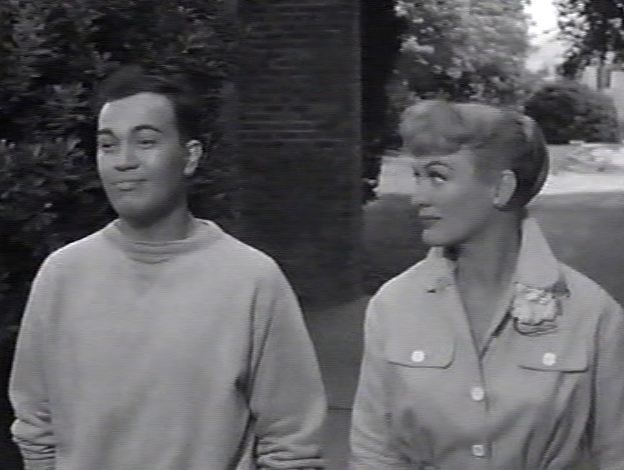
While Eve Arden is wonderful in Mildred Pierce (1945) as Ida Corwin, Mildred’s boss turned assistant, the role she will always be associated with is Connie Brooks, sarcastic and single English teacher at fictional Madison High School. This is a part she originated on radio back in 1948. Our Miss Brooks, the radio series, was a great success and ran for 190 episodes until 1957, outlasting the television show of the same name.

Still on radio, the show was also produced for television, by Desilu Productions, with mostly the same cast. The television show, which had a run of 130 episodes, was broadcast on CBS from 1952 to 1956. TV Our Miss Brooks utilized many of the scripts and ideas already done on the radio.

The same year as the television show was cancelled; Warner Brothers released Our Miss Brooks, the film. Warner Brothers had earlier released a film version of Jack Webb’s radio-television series, Dragnet (1954), and was willing to take a chance on Our Miss Brooks.

The film version is sort of like the origin story of Our Miss Brooks and you have to wonder if they were originally anticipating making more than just one of these films. There is no need to have heard the radio show or to have seen the television version to understand the story, since it starts at the very beginning of Miss Constance Brooks (Eve Arden) arriving in a fictional Midwest town as the new English teacher at Madison High School.

Constance Brooks (Eve Arden) arrives in town. (Thanks gettyimages.)

From the train station she walks to the address in an ad she’s circled, placed by Mrs. Margaret Davis (Jane Morgan), looking for a boarder. When Connie gets to the house she rings the bell, but instead of answering the door, Margaret picks up the phone. Connie hears her through the front door and the two have a conversation with Connie on the porch and Margaret on the phone in her foyer. When Connie tells her she wants to see the room, Margaret invites her over.

This time, Connie knocks on the door and Margaret answers, impressed by her promptness. She shows Connie the room after passing the test of getting along with Minerva, Mrs. Davis’ pet cat. As an afterthought, Mrs. Davis shows Connie the view, which is a “cottage” across the street. This starts Eve to imagining herself married and living there. The only problem is who will she marry?

Miss Brooks passes Margaret Davis' (Jane Morgan) test when her cat Minerva likes her.

The answer presents himself the next day at Madison High School. On her first day, Connie is being shown around by Fabian “Stretch” Snodgrass (Leonard Smith), a long-time student at Madison, when she sees a shirtless man exercising on the lawn. Excusing herself from Stretch’s tour, Connie introduces herself to Mr. Phil Boynton (Robert Rockwell). Phil is also new to Madison and a biology teacher. When she sees him, Connie fantasizes that he’s the man with the cottage.

"Stretch" (Leonard Smith) shows Miss Brooks around the campus.

Her flights of fancy are interrupted by the arrival of Principal Osgood Conklin (Gale Gordon). He reminds his two new teachers that he’s a stickler for the rule, which includes no on campus fraternization between teachers. A former military man, Conklin demands punctuality.

Osgood Conklin (Gale Gordon) is the principal at Madison High School.

It isn’t long before Connie and Phil are dating. She tells us that they regularly meet at the zoo. After eight months of that, Phil is finally willing to take her for a walk in public. When Connie makes a point of showing him a bride’s gown in a store display window, it isn’t long before they’re back to feeding the elephants. Phil even comments on how big one of them has grown since they started coming.

At school Connie is having trouble reaching one of her students, Gary Nolan (Nick Adams), who is failing her English class. She is summoned by Gary’s widowed father, Lawrence (Don Porter), who is the publisher of the city’s newspaper and a real stuffed shirt, to his house to explain why she’s failing his son. While the two get off to a rocky-start, Lawrence comes to understand that not all the blame is Connie’s fault. She agrees to tutor Gary, turning down money for the love of teaching.

Connie seems to reach all of her students, save one.

Meanwhile, Phil confesses his feelings for Connie to Mrs. Davis. He tells her that if can save some money and provide Connie with financial security, he will ask her to marry him. And Mrs. Davis promises to keep this a secret, which she does until Connie comes home. Using playing cards to read Connie’s future, she tells her everything Phil had told her.

Back at school, Mr. Stone (Joseph Kearns), the school superintendent, criticizes Conklin for his tight grip on the school. He tells Conklin that if he could, he would dismiss him, but apparently Conklin has his supporters on the school board. But he promises, if he’s elected to a new position, the coordinator of education, he will be sure to get Conklin ousted.

Seeing the writing on the wall, Conklin decides to run for the new position himself and asks/tells Connie that she will be his campaign manager. She tries to tell him that she’s too busy, since she’s tutoring the Nolan boy. When Conklin realizes the father is the newspaper publisher, he turns up the pressure on Connie, Conklin strongly hinting that if he gets elected he’ll be sure to make Phil the new principal at Madison. And further, the pay raise might make Phil feel like settling down. Explained that way, Connie agrees.

Connie manages to get the students to support Conklin by telling them they would be rid of him as a result. She unveils for them her campaign slogan, "Get Mr. Conklin into public office and out of Madison."

The tutoring is going better, as Gary starts to come around. Connie assigns him to write stories for the school paper and Lawrence encourages his son by reprinting some of the articles in his paper. Lawrence also starts to feel romantically about Connie. Lawrence decides to take Gary out on their yacht and invites Connie to go along. She declines, citing her plans with Phil as an excuse.

Pleased with her tutoring of his son, Gary (Nick Adams), and finding her attractive,
 Lawrence Nolan (Don Porter) asks Connie out on his yacht.

But Phil is feeling neglected and breaks off their date out of spite. With her schedule freed up, Connie takes up the Nolans on their offer. Mrs. Davis hurries to tell Phil that he might lose Connie if he doesn’t try to stop them. Borrowing Walter Denton’s (Richard Crenna) jalopy, Phil takes off. Despite a flat tire, Phil makes it to the shore. While he tries to take a motorboat, he ends up rowing out to the yacht.

Phil Boynton (Robert Rockwell) breaks his date with Connie out of spite.

Out on the boat, Gary swims while Lawrence makes his play for Connie. When Gary goes down below to take a nap, Lawrence makes his intentions known, but Connie does not commit. Phil shows up in the nick of time, rowing up alongside the boat. While trying to board the yacht, Phil falls into the water. Lawrence pulls him out of the water. Phil realizes that there is nothing going on, since Gary is also on board, and feels ridiculous for over-reacting. Lawrence sends him down below to change into dry clothes.

No sooner has Phil gone below deck, than Osgood rows up and also falls into the water. Osgood makes a play for Nolan’s help, promising that helping him would allow Lawrence to work with Connie. Lawrence eagerly agrees to help Osgood.

After driving Connie home, Phil admits to Connie that he has nothing to offer her in comparison with the wealthy Nolan. Phil is about to walk away, when Connie suggests, "the best defense is a good offense." It takes Phil a second to realize what’s she’s talking about and then he kisses her passionately.

Later, Mrs. Davis invites Phil to dinner, but he is called out of town. His mother is ailing, but there is nothing physically wrong with her. The doctor informs Phil that his mother, Mrs. Boynton, suffers from loneliness and he encourages Phil to try and make room for her.

Phil confesses to Mrs. Davis his true feelings for Connie.

Back in Madison, Phil sees the cottage near Mrs. Davis’ and calls to make an offer on it. At that moment, Connie is in the realtor’s office making a payment for Mrs. Davis. She overhears the conversation and overhears the realtor mention "Mrs. Boynton," and jumps to the conclusion that a marriage proposal is forthcoming.

Gary is actually working at the newspaper when Connie shows up to tell his father that she’s going to marry Phil. Lawrence takes the news very well and wishes her all the best. Out in the office, the new, young and pretty Miss Lonelyhearts (June Blair) is getting a lot of attention from the male writers on the paper.

Still thinking she will be moving into the cottage, Connie shows up with wallpaper swatches. In every room of the house, she fantasizes about her future life there with Phil. Her daydreaming is shattered when Phil actually shows up and informs her that he is buying the house so he can live with his mother. Heartbroken, Connie leaves in tears.

Mrs. Davis senses Connie’s pain and goes to visit Mrs. Boynton, whom she’d met before.

At school, Connie informs Conklin that she wants to resign. He wants her to think about it before doing something rash. While she’s in the office, Stone come in. With the help of the newspaper and some publicity stunts, Conklin is leading in the ratings. But he resigns from the race when Stone, who has a successful insurance business, informs him that the new position only pays $500 a year.

At the newspaper, Gary takes the story from Conklin and informs his father of his withdrawl from the race. Just then, Miss Lonelyhearts brings in her copy. Lawrence, with Gary’s encouragement, leaves to ask her out.

When Connie comes home from school, she learns that Mrs. Boynton is moving in with Mrs. Davis, who had used playing cards to show her how much her son was in love with Connie and Connie in love with Phil. Since Phil is shy, she knew little about their romance until Mrs. Davis told her.

Suddenly touched by Phil's kindness to his mother, Connie seeks him out at the zoo. This time it’s Phil’s turn to fantasize and he sees Connie standing in front of the cottage. They walk off arm in arm with marriage in the offing.

The proposed marriage at the end was a bit of a departure from the radio and television series, but serves to wrap up Miss Brook’s story with the happy ending the character had been wanting and waiting for. In today’s terminology, this is an alternative story in an Our Miss Brooks Multiverse.

Overall, Our Miss Brooks, the movie, has more meat on its bones than the usual radio or television show. (I’ve seen Our Miss Brooks in reruns and have heard the radio show before thanks to Radio Classics on Sirius radio.) Not only is the storytelling unencumbered by the normal two act sitcom with commercials writing style of the times, but they are get a little more in depth on what were most likely already familiar characters to the audience that went to see the film when it first ran. The filmic treatment works well, no doubt aided by a cast and creative staff that was already very familiar with the produce.

While it would be easy for everyone in the cast to go through the motions, having already played these characters 100s of times, no one seems to. Their performances seem fresh and enthusiastic.

Eve Arden first garnered attention thanks to her role in Stage Door (1937) as the fast-talking Eve, opposite the likes of Katharine Hepburn, Ginger Rogers and Lucille Ball. That role would be a template for many of her subsequent roles, including her part in Mildred Pierce. Along the way, Arden would also appear in the Marx Bros. film At the Circus (1939). It was her ability with comedy that got her onto the radio, appearing as a regular on Danny Kaye’s short-lived radio series in 1946. That role got her the part she would be forever associated with, Constance Brooks. Her career would continue on after Our Miss Brooks ended with a memorable role as James Stewart’s sarcastic secretary in Otto Preminger’s Anatomy of a Murder (1959) and the role as the school Principal in Grease (1978) and Grease 2 (1982). While Arden never played Miss Brooks again, she is quoted as saying she considered that role as Constance finally moving up in School Administration.

Gale Gordon is probably best known for his work with Lucille Ball on radio and television. He played her husband on My Favorite Husband, a Lucy radio show that would be a precursor to her megahit television show, I Love Lucy. Even though her real life husband, Desi Arnaz, would play her husband on TV, Gordon was the first choice to play Fred Mertz. But Gordon was already committed to Our Miss Brooks, so William Frawley landed the role. Gordon would appear in all three of Lucy’s post I Love Lucy TV sitcoms: The Lucy Show, Here’s Lucy and the short-lived 80’s sit com, Life with Lucy. Here he’s a strict disciplinarian played for laughs.

It seems to me that Richard Crenna’s role as Walter Denton is really reduced here. He, too, is a little old for the part. Crenna was about 30 when the film was made, playing a high school student. (No wonder teenagers in older movies seem to look so mature.) After Our Miss Brooks, he would star in The Real McCoys, a sitcom that ran from 1957 to 1963 on ABC and CBS. He would do a lot of TV work and would win an Emmy for his performance in The Rape of Richard Beck (1985). A whole new generation would know him as John Rambo’s commanding officer, Colonel Sam Trautman, in the first three Rambo films.

Walter Denton (Richard Crenna), a staple of the radio and TV series casts, 
has a reduced presence in the film version.

Nick Adams is probably best known for what he might have been. A struggling actor for most of his life, he worked with James Dean in Rebel Without a Cause (1955) and met Elvis Presley while the singer was filming Love Me Tender, striking up friendships with both men. His career never really took off. There were rumors about his sexuality that seemed to dog him. He would appear on other TV shows, including two years as Johnny Yuma on The Rebel (1959-1961) and make a few low budget films like Die, Monster Die! (1965). He would die at the age of 36 from a drug overdose.

The film is sort of like a theatrical version of a TV Movie. The fact that it retells the story of Connie Brooks’ arrival in town and her first day on the job shows that they were trying to ensure that it would be relevant to someone unfamiliar with the program. On its own, this is a nice programmer from the mid-1950s displaying an idealized version of America at that time. The humor is like that from the show, mild, but funny. Arden is arguably too old for the lead role. At 48, she doesn’t look like a chaste school teacher just starting out. But the viewer for the most part can overlook that, after all, no one else could be Our Miss Brooks.

Available on MOD through Warner Archive.

www.warnerarchive.com

Sunday, July 10, 2016

The Secret Life of Pets


The Secret Life of Pets (2016) Starring the voices of Louis C.K, Eric Stonestreet, Kevin Hart, Steve Coogan, Ellie Kemper, Bobby Moynihan. Directed by Chris Renaud. Screenplay by Brian Lynch, Cinco Paul and Ken Daurio. Produced by  hris Meledandri. Color. U.S. Run time: 90 minutes. Animation, Comedy.

What is like Toy Story and not like Toy Story? The answer: The Secret Life of Pets, the latest animated feature to be released in the summer of 2016. Every summer has their fair share of these, some good, some okay and some very disappointing. I'm putting Pets in the latter category.

How is it like Toy Story? Well, imagine Woody is a  Jack Russell Terrier named Max (Louis C.K.) and Buzz Lightyear is a larger long-haired Newfoundland named Duke (Eric Stonestreet) and Andy is replaced by Katie (Ellie Kemper) and you're just about half-way there with the story of this film. There are even scenes reminiscent of scenes in Toy Story, if you'll remember Woody saving Buzz at the end of that movie, and you wanted to see it with dogs, then you won't be disappointed.

How is it not like Toy Story? It's bad. Not that it doesn't look good, it does. The scenery and backgrounds of New York look very good. Perhaps not Zootopia good, but very state of the art nonetheless.

And the actors doing the voice work aren't flubbing lines or messing up accents. No, they're fine as well. There is quite a cast of known and unknowns doing the voices, including Albert Brooks, who was recently featured in Finding Dory. I always find voice acting hard to judge. Rather than actual voice-actors carrying the story, the voice-acting seems to be more like stunt casting rather than because the actors pursue their craft with their voices, at least not in the "star" roles.

It's that the story lacks the magic that Pixar captured in their first feature and is more like what Illumination, the animation house behind this film, did in Despicable Me (2010). In fact, it's sort of been downhill for Illumination ever since they burst on the scene. And I'm not talking money, their films make a ton at the box office, but more like imagination. The same creative team followed up their first success with a sequel to that success and then their third film made minor characters, Minions, from the first two, the stars. Cute in doses, they weren't ready to carry their own movie. Now they seem to be recycling storylines from other films; not really stepping it up.

Now, Illumination is moving into the world of pets and while it starts off cute and cuddly, their environment grows dark very quickly, when they fall under the spell of an animal revolutionary, Snowball (Kevin Hart), a little bunny, and his herd of forgotten pets (again think of Toy Story and the misfit toys that cower under the bed in Sid's room next door). I hope it's just me, but I sensed that these pets under Snowball's control seemed to consider their pet parents more like slave owners that had to be overthrown and killed. In fact, that was one of the requirements for Max and Duke to join his team was to recount how they killed their owner, which, of course, they hadn't.

Unlike Toy Story, in which you could almost believe toys acted a certain way when humans weren't around, here, as in Finding Dory, the animals do too many human-like things in broad daylight. It's not a secret life if you're doing it in public.

Don't want to give too much away, since the film only recently opened in theaters, but this is not a must-see movie. In fact, this is one of the few films that the more I saw the previews, and they've been playing for a long time, the less I wanted to actually see the film. My hopes that I was wrong were dashed and my doubts confirmed.

The film is accompanied by a short, Mower Minions, which once again stars those gibberish-speaking yellow twinkies. I hate to say it, but the Minions have overstayed their welcome.