Saturday, February 6, 2016

Stubs – Monkey Business (1931)


Monkey Business (1931) Starring: Groucho Marx, Chico Marx, Harpo Marx, Zeppo Marx, Rockcliffe Fellowes, Harry Woods, Thelma Todd. Directed by Norman Z. McLeod.  Screenplay by S.J. Perelman, Will J. Johnstone. Produced by Herman J. Mankiewicz (credited as Associate Producer) Run Time: 77 minutes. U.S. Black and White. Comedy.

Monkey Business marks a departure for the Marx Bros. After two successful films shot in New York at Paramount’s Astoria Studios, The Cocoanuts (1929) and Animal Crackers (1930), their third film would be shot in Hollywood. More than that, however, it was the first film not to be based on a previous stage production.

Between the features and following their move to Los Angeles, the Brothers had appeared in a short film, celebrating the studio's twentieth anniversary, The House That Shadows Built (1931), in which they adapted the opening scene from I’ll Say She Is, a 1924 stage revue written by Will J. Johnstone and his brother Tom Johnstone. The revue, which starred the Marx Brothers, also featured Lotta Miles, is attributed to have led to the Brothers' rise in Vaudeville and their eventual entry into films. In the short, the four Marx Brothers are seen auditioning for the same play by imitating Maurice Chevalier, another Paramount star, performing a song.

Much has been made about the screenplay for Monkey Business. While S.J. Perelman, a humorist and screenwriter, is credited along with Johnstone, there is some argument about how much Perelman actually wrote that makes it into the final film.

The Marx Brothers' relationship with Perelman dates back to their Broadway days, when Groucho read his book, Dawn Ginsbergh’s Revenge. After a complimentary letter from Groucho prompted a meeting backstage, Perelman was asked if he could write something for a proposed Marx Brothers’ radio show with W. B. Johnstone. The fact that Harpo didn’t speak caused the writers some issues. The one idea they came up with was presented to Groucho at a story conference – the Marx Brothers as stowaways on a luxury liner. Groucho liked the idea so much that he took the writers directly to Paramount’s New York offices, so they could be put under contract.

Perelman was warned by producer Herman Mankiewicz about working with the Marx Brothers, “They're mercurial, devious and ungrateful,” he is quoted as saying. “I hate to depress you, but you'll rue the day you ever took the assignment. This is an ordeal by fire. Make sure you wear asbestos pants." Perelman didn’t have to wait long for Mankiewicz’s warning came true. As soon as he read them the first draft, Groucho either said, depending on whom you listen to, “It stinks” or “I think we need a script." Neither of which would be considered encouraging.

It’s not certain who all contributed to the screenplay. Director Norman McLeod said that over the next five months, 12 different writers were involved. Even cartoonist J. Carver Pusey, who created the pantomime comic strip Benny, which ran in newspapers from 1929 to 1939, is listed in copyright paperwork. It is also said that when Eddie Cantor visited the set, he made contributions. But as McLeod, in his first time solo in the director’s chair, would soon learn, the Marx Brothers liked to ad lib and once he kept the camera running was able to capture some of that for the movie.

One more change for the brothers was their leading lady. In Cocoanuts and Animal Crackers, Margaret Dumont had been Groucho’s love interest/foil as it were. For their next two films, she was replaced by Thelma Todd, a blond beauty with a long comedic background. While she is perhaps best known for her work with the Marx Brothers, she also worked with Charley Chase, Buster Keaton and Laurel and Hardy. Todd also appeared in any early version of the Maltese Falcon, as Iva Archer, opposite Ricardo Cortez’s Sam Spade. Todd would appear in two Marx Brothers’ movies, this one and Horse Feathers (1932).

There isn’t really that much of a plot. Per the premise, the Brothers are stowaways on a luxury liner that is already out to sea. They are being searched for by the First Mate Gibson (Tom Kennedy), who is sure there are four in the cargo hold, since he’s heard the four-part harmony of Sweet Adeline. We’re even treated to a little snippet of them singing each in their own Kippered Herring barrel, the first time Harpo’s voice is heard on film.


The Marx Brothers (Harpo, Zeppo, Chico and Groucho) stowaway on board ship in barrels.

Even when the First Mate brings down a crew of sailors to search the hold, the Brothers manage to avoid detection until he orders the barrels taken topside to get them out of the way. The hoist lifts the barrels off the brothers, leaving each exposed. The Brothers scatter when they’re noticed, but they always manage to stay one step ahead of their pursuers, even hiding in plain sight pretending to be a four-piece band.


They hide in plain sight pretending to be a four-piece band.

Harpo is chased into a Punch and Judy show, where he becomes part of the show and torments the First Mate who followed him in. When the Captain (Ben Taggart) finds his First Mate is fighting with a puppet, he sends him to his room. Even after they discover their mistake, Harpo manages to elude them. At one point, Chico and Harpo take over the ship’s barbershop and “snoop” away an officer’s moustache.


The Captain (Ben Taggart) finds his First Mate Gibson (Tom
Kennedy) fighting with Harpo, whom he thinks is a puppet.

The Brothers are not through with the Captain, as Groucho and Chico follow him into his quarters and order up his lunch, even going so far as to share his lunch without his permission and then locking the Captain in a closet.


Groucho and Chico crash the Captain's lunch.

Zeppo avoids his pursuers by hooking up with a woman walking on deck. While she’s resistant at first, he charms her with his comment about the might pretty country around here, meaning the ocean. The girl, who turns out to be Mary Helton (Ruth Hall), is so enamored that she comments about the number of trees.

Meanwhile, Chico and Harpo get hired as henchmen for a gangster on board the ship, Joe Helton (Rockcliffe Fellowes), who turns out to be Mary’s father. Groucho and Zeppo are hired by Helton’s rival, “Alky” Briggs (Harry Woods), but only after Groucho’s made a pass at his wife, Lucille (Thelma Todd).


Joe Helton (Rockcliffe Fellowes) hires Chico and Harpo as henchmen.

Each pair of brothers follows their new boss around the decks of the ship. Harpo and Chico, who don’t pay close attention, end up following any man who passes by them, until they end up following an older man, who is not in disguise. Groucho, who is working for Briggs, approaches Helton to make nice.


Groucho is hired by "Alky" Briggs (Harry Woods), but only after he's
 already made a pass at Briggs' wife Lucille (Thelma Todd)

Once the ship reaches the docks, getting off the ship proves to be difficult without a passport. They try in vain to pickpocket one of the other passengers and fail, that is until Zeppo runs into Maurice Chevalier, an action that takes place off screen. But using Chevalier’s passport proves difficult, since none of the brothers really resemble the well-known French born actor and fellow Paramount star. Zeppo suggests that they sing a song to prove their identity and all four sing "You Brought a New Kind of Love to Me", which Chevalier sang in The Big Pond (1930). [Chevalier actually had a bonafide hit with another song from The Big Pond: "Livin' in the Sunlight, Lovin' in the Moonlight"]


Maurice Chevalier in The Big Pond (1930).

The Brothers manage to get off the boat when one of the passengers faints while departing. An ambulance is called and the boys stowaway on the passenger’s stretcher.

On dry land, the fun continues at a party Helton is throwing for his daughter’s coming out, something that used to be reserved for debutantes. The Brothers through hook or crook manage to be in attendance. Zeppo appears there at Mary’s invitation, Groucho at the father’s and Chico and Harpo out of the force of their nature.


Groucho enjoys attention hanging out at the party.

In what seems customary with any Marx Brothers film is a musical interlude. Chico leads an orchestra in a piano medley. While I don’t think anyone would mistake Chico for Van Cliburn, I doubt anyone had more fun and was more fun to watch playing. Harpo ends up accompanying Maxine Castle, a contralto, in her rendering of "O Sole Mio.", before playing solo. It is interesting to note that what he plays, a little under two minute ditty, “I’m Daffy Over You”, was written by brother Chico.

But “Alky” Briggs has other plans for the night; to kidnap Mary and use her as leverage over her father, no doubt to take control of his operation. He and Lucille are in attendance, which allows him to tell Groucho of his plans and for Groucho to make one more play for Lucille.
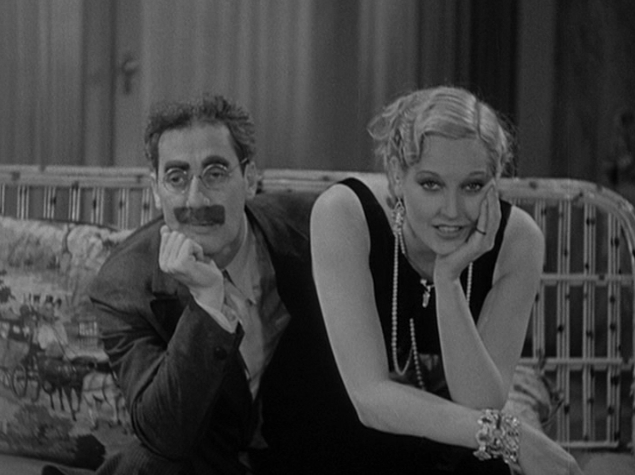

Groucho with Lucille at the party.

When the kidnapping occurs, Groucho knows where Mary is being taken, the “old Barn” and the Brothers take chase. The Brothers manage to fight and defeat Alky’s henchmen, Zeppo rescues Mary and knocks out Briggs just as Helton and his men arrive.

The film was a huge success for Paramount, for the writers involved and for the Marx Brothers, establishing them as major stars in Hollywood. There were even plans, according to Robert Osborne, for a sequel in keeping with the mafia themes from this film. However, those plans were scuttled when Charles Lindbergh’s son was kidnapped and killed by gang members. Instead, the next film Horse Feathers ended up being a re-working of sorts of a Marx Brothers’ stage show “Fun in Hi Skule”. [The Lindbergh kidnapping was such a big event that it had a definite impact on films from Hollywood. Another example was Three on a Match (1932), which also faced censorship because of its plot points involving kidnapping.]

Some of the themes and plot points in this film would be mined later. The concept of them as stowaways would be used in their eventual radio show, Flywheel, Shyster, and Flywheel, a situational comedy starring Groucho and Chico that ran for 26 episodes on NBC’s Blue Network from November 28, 1932 to May 22, 1933. And of course, would be recycled again in the three Marx Brother’s A Night at the Opera (1935), by which time the act had moved to MGM.

The Marx Brothers are a unique force of comedy, being able to successfully merge wordplay with slapstick in a way no one else seems to pull off. Throw in their musical talents and there has really been no act like them in the history of Hollywood. Perhaps it’s the numbers, there are four in this film, allowing each to concentrate on what they do best. Harpo is the king of pantomime in the sound era of film, but also the source of chaos, not to mention his harp playing. Chico is the conniving “immigrant” who doesn’t quite understand English or understands only what he wants to and plays a mean piano.

Groucho is unmatched in his verbal wordplay, oftentimes opposite Chico, and manages to pull off a grease pencil moustache better than anyone. Zeppo, the group’s straight man and love interest so to speak, even gets a few laughs and gets the girl. The four brothers make a complete package in this film.

This film is an example of the Marx Brothers’ style of anarchy, driven home by Harpo’s complete lack of respect for authority when they’re trying to get past the passport check point. He literally walks on the tables in a defiance of standing in line and when he makes it to the front he throws papers off the table for no real reason but to make a mess of the order. Everything, everyone and every location is simply a backdrop for the Marx's to react to, play off and make fun of; no one is immune. The higher up the social or authority ladder, the more of a come-uppance the Marx's try to provide. You have to know that this played well with a depression-era movie-going crowd.

Harpo creates havoc at the passport check point and shows his complete lack of respect for authority.

Monkey Business is one of the funniest of the Marx Brothers films, but that’s a little like asking a parent to pick their favorite twin child. [The proper answer is the one in the middle.] They are all, for the most part, fun to watch. This film illustrates how much the Marx Brothers can do with very little and that sometimes it’s best to sit back and let them do what they do, rather than try to reel them in.

Saturday, January 30, 2016

Stubs - Monkey Business (1952)


Monkey Business (1952) Starring: Cary Grant, Ginger Rogers, Charles Coburn, Marilyn Monroe, Hugh Marlowe Directed by Howard Hawks. Produced by Sol C. Siegel.  Screenplay by Ben Hecht, Charles Lederer and I.A.L. Diamond. Run Time: 97 minutes. U.S. Black and White. Screwball Comedy

Sometimes it seems that Hollywood becomes derivative, telling the same stories over and over again, rebooting, retelling and making sequels of the same story, whether it’s Spider-Man or Batman or the Fantastic Four or the Pirates of the Caribbean. The excuse is the cost of making big budget films. Studios are cautious, if unwilling, to spend large amounts of money on untried stories, rather hoping that the tried and true will bring audiences in for more of the same.

Of course, this retelling of stories is nothing really new. Hollywood has always been making films like other films that were popular. In the case of Hollywood during the 30’s, 40’s and 50’s, the assembly line approach sometimes did not allow for great innovation and originality. Sometimes filmmakers were forced to rely on their own works for inspiration. In the case of Monkey Business (1952), I would not be the first to recall Hawks' earlier film Bringing Up Baby (1938) to which this has more than a passing resemblance, including the male lead.

Howard Hawks is one of the true greats of the Hollywood studio era, so you can’t blame him for borrowing from himself. Originally called Darling, I’m Growing Younger, the film was not going to star Grant, with whom Hawks had already worked four times, but rather Danny Kaye and with Ava Gardner instead of Marilyn Monroe.

But casting weren’t the only changes. The original screenplay was rejected on February 6, 1952 by the Breen Office stating: "the reason for this unacceptability lies in the fact that the story of Dr. Fulton's youth formula amounts to a story of the invention of an aphrodisiac, which mainly exploits the lurid, or what might be called 'sexsational' aspects of such a drug."  Sex was a definite no-no under the Production Code, which was definitely being enforced at the time. Hawks and producer Sol C. Siegel met with the PCA and agreed to make changes, including changing formula name from “Cupidone" to a "pseudo-scientific type of vitamin," and toning down Oliver Oxly’s sexual interest in Lois Laurel.

The changes must have not been too severe, since the PCA approved the amended screenplay and production began on March 5 and continued until late April, 1952. The film would have its opening five months later on September 3, 1952.

The film begins with Cary Grant opening the front door of a house and being told by an off-screen Howard Hawks "Not yet, Cary” several times; an obvious breaking of the fourth wall, not common at that time.

After the sufficient credits have run and the film actually starts, Cary is now Barnaby Fulton, an absent-minded scientist who can’t help but think about his work. He is developing a formula he hopes will reverse the aging process. He is so lost in thought about it, that even after his wife, Edwina (Ginger Rogers), gives him exact directions on locking up the house, so they can leave, he still gets it wrong, ending up inside rather than out.


Barnaby Fulton (Cary Grant) would rather stay home and think
than go to a party with his wife Edwina (Ginger Rogers).

After more than one false start, Edwina gives up and decides that instead of going out to a party, they’ll stay at home so Barnaby can keep thinking. Edwina slips off her dress (off camera, of course), puts on a house coat and starts to make them eggs for dinner.

Hank Entwhistle (Hugh Marlowe), a family friend and lawyer, comes over to encourage them to go the party. He tells Edwina that if she had married him she wouldn’t have to stay home and cook. It is about then that Barnaby realizes Edwina’s backside, clothed in only undergarments, is visible. In the first scene that is reminiscent of Bringing Up Baby, Barnaby covers her up, the same way David (Grant) covers up Susan (Katherine Hepburn) when her dress gets torn. In this case, he puts an apron on her backwards. Hank takes some convincing, but he does finally leave.

When Edwina serves Barnaby soup, his mouth gets burned, which gives him an idea that he takes with him to the office the next day, using heat to encourage the absorption of the formula. He arrives at Oxly Chemical Factory, where he works, and is immediately summoned to President Oliver Oxly’s (Charles Coburn) office for an update on the formula Oxly is anxious to exploit, already having worked up an ad campaign for what he calls B-4.


Barnaby's boss at the plant is Oliver Oxly (Charles Coburn). His
secretary is the curvaceous Lois Laurel (Marilyn Monroe).

While Barnaby waits to see Oxly, Lois Laurel (Marilyn Monroe), Oxly’s curvaceous secretary, shows him the hosiery his acetate formula had led to and her leg on which they cover. Oxly is not amused when he walks in on the tableaux.

But Oxly is more interested in money and brings Barnaby into his office. But they are quickly called away to the lab, where one of the older monkeys they are experimenting the formula on, the 84-year-old equivalent Rudolph, is bounding around like a youngster. Everyone is fooled until Barnaby discovers that the monkey’s numbers have been accidentally switched and the much younger Esther is wearing Rudolph’s number.

Once the mistake has been noticed and Esther is back in her unlocked cage, Barnaby begins to work on his idea, but when he leaves the laboratory, Esther frees herself and, copying Barnaby’s actions, mixes a batch of the ingredients that he uses in his formula. Hearing him return, Esther pours her chemicals into the water cooler, after which Barnaby mixes his own batch.


Esther the monkey mimics Barnaby's actions and mixes up her own batch of chemicals.

Against the wishes of his assistant, Dr. Jerome Lenton (Henri Letondal), Barnaby swallows his version. The bitter taste forces him to get some water from the cooler, soon after which Barnaby notices that the bursitis he suffers from no longer hurts and he no longer needs his thick glasses to see.

Barnaby feels so good and youthful that he leaves the laboratory. Wanting a more youthful look, he gets a then popular crew cut. Next he changes his appearance by buying a loud sports coat. His last stop is a car dealership where he trades in his sedan for a sports car, a 1950 MG TD.

Miss Laurel has been sent to find him and shows up just as he is concluding the purchase of the car. He asks her if she wants to go for a ride. Miss Laurel, who has a crush on the older man, gladly accepts. While they race through the city, it is obvious that Miss Laurel is getting aroused by the speed, the danger they’re in and by him. But Barnaby gets distracted and can’t stop before he runs into a truck that blocks the street.


Barnaby and Laurel go for a drive in his new MG.

They take the car to the shop and are told it’ll be good as new by five o’clock. To kill time, the two go roller-skating and, after Barnaby falls, they go swimming. At the pool, Barnaby attempts a swan dive, but ends up doing a belly flop. But no one is watching him, but rather Miss Laurel in a one-piece.


She only have eyes for Barnaby, but everyone else has eyes on Lois in her one-piece.

After the car is fixed, Barnaby drives them back to Oxly. While they’re driving, she kisses him on the cheek, but pouts when she discovers that he’s married. Before they get back to the office, the formula starts to wear off. Barnaby’s eyesight starts to fade and he ultimately crashes the car into a chain-link fence.

When he returns to the lab, Barnaby falls asleep. By the time he awakens, Edwina, who has been called by a night watchman, has arrived. She’s not happy to hear about his haircut or by his antics, especially the lipstick on his cheek from Miss Laurel. Barnaby insists it was the formula and tries to reassure her that the kiss meant nothing to him.

Barnaby wants to retest the formula on himself, but Edwina has other plans, drinking the latest double strength batch, so her husband can observe her. Again she takes a glass of water after drinking the sour concoction. The formula starts to take effect when Oxly comes in to inquire about Barnaby’s progress. Edwina is overly playful, putting a goldfish down the side of Oxly’s pants.

Barnaby and Edwina get away and Edwina demands that they drive to the hotel where they spent their honeymoon. When they get to the hotel, Edwina wants to go dancing, eventually exhausting Barnaby. When they finally get back to the room, Edwina gets emotional, acting like a new bride and crying for her mother.


Their honeymoon reenactment doesn't come off as planned.

Barnaby tries to find out what’s going on with Edwina, but it quickly turns into a quarrel, in the middle of which Barnaby’s glasses fall off. When he pushes her gently away from them on the floor, she throws him out of the room. While the nearly blind Barnaby feels his way through the halls in his pajamas, missing the tie string, which has been caught in the room’s door, Edwina calls Hank. She tells him that Barnaby has brutalized her and she wants to file for divorce.

Meanwhile, Barnaby, who is looking for help, ends up going head first down the laundry chute and ends up in one of the large wheeled carts. The force of his entry sends the cart rolling straight into a wall on which poor Barnaby hits his head and passes out.

The next morning, Edwina has fully recovered from the formula and is checking out of the hotel, when Barnaby has been brought up from the laundry room by a couple of confused maids. He refuses to change, but rather just wants to go home.

When they arrive, they are set upon by a horde of reporters and Hank is inside waiting. Edwina realizes that she still very much loves Hank and wants to call off the divorce. But Barnaby, realizing the harm the formula does, and a little disheartened to have found out Edwina once kissed Hank, decides the best course of action is to destroy the formula.

Edwina goes with Barnaby to the lab and there, using the water from the cooler, she makes them a pot of coffee. After a couple of cups, both are acting like ten-year-olds.

Meanwhile, Oxly has heard about the success of the formula and has called an emergency meeting of the board to come up with an offer to Barnaby for the rights. When it’s pointed out that he made the formula while working for them, Oxly points out that there seems to be an ingredient or step missing as they can’t recreate it with the same results.

Barnaby is called in and enters with Edwina and a monkey between them. When they ask him how much he wants, he says a "zillion" dollars. When he lets slip his idea about adding heat, the board thinks they have the answer they need and Barnaby and Edwina escape.

The couple walks home, too young to drive, and while they do, Edwina starts to annoy the 10-year-old acting Barnaby, who is turning into a girl-hater. After getting into a fight and throwing paint on each other, he runs off to join real ten-year-olds, who are playing “Indian”. Edwina, meanwhile, goes home and calls Hank to complain again about Barnaby. She then takes a nap, which seems to be a side-effect of the formula.

As she sleeps, Barnaby puts on war paint and convinces his playmates to help him scalp Hank, whom he is still jealous about.

When Edwina awakens from her nap, she is once again her old self. But the neighbor’s baby, Johnny, has walked into their house and crawled in next to her. She mistakenly assumes the baby to be Barnaby on an overdose of the formula and dashes back to Oxly with the baby in her arms.


Edwina mistakes the neighbor's baby for Barnaby and rushes him back to Oxly.

Meanwhile, Barnaby and his friends succeed in capturing Hank, but instead of scalping him, cut his hair into a Mohawk.

Barnaby convinces the boys in the neighborhood to help his scalp Hank (Hugh Marlowe).

Back at Oxly, everyone thinks Johnny is Barnaby. Edwina puts the baby down on Barnaby’s couch, hoping that if he falls to sleep, the formula will wear off. Out in the lab, the men, including the Board of Directors, Oxly and Lenton, pace and when they’re thirsty, drink water from the cooler. Oxly orders the bitter-tasting water thrown out, but it’s too late to stop the formula from taking effect.


Still wearing warpaint, Barnaby returns to Oxly.

Barnaby shows up and climbs through the window of his office. When Edwina finds him, she realizes her mistake about Johnny. But when they go out to the outer laboratory, they find everyone, Oxly, the board members and the scientists acting like children. It is Lenton who finally deduces that Esther has concocted the formula. While Oxly is chasing Miss Laurel around the lab with a seltzer bottle, the Fultons leave.

Craziness ensues in the lab when everyone drinks the formula.

Three days later, there is a new Oxly contract ensuring Barnaby’s future with the firm. Barnaby tells Edwina that a person is old only when he forgets that he is young.

Hawks was somewhat disappointed by the film, thinking the premise was too unbelievable and that the film was not as funny as it could have been. Hawks was right, but the premise was
only the beginning of the problems. Monkey Business suffers from many ailments, one of which is a surprisingly lackluster screenplay given the talents of Ben Hecht and I.A.L. Diamond. Gags and characters seem to have been recycled from previous films, but what makes it all right at all is that Hawks is mostly stealing from himself.

The best line in the film is delivered about Monroe’s sex appeal. While it is best seen in context, I’ll try to set it up:

Early in the film, Barnaby and Oxly are in the latter’s office with Lois. There is a call waiting for Mr. Oxly and Lois is about to be dismissed.

Oliver Oxly: Oh, yes. Just a moment, Miss Laurel. Find someone to type this.

Lois Laurel: Oh, Mr. Oxly, can't I try again?

Oliver Oxly: No, it's very important. Better find somebody to type it for you.

Lois Laurel: Yes, sir.

As she walks to the door and closes it, both Barnaby and Oxly admire her swaying hips and backside.

As if to answer the unasked question of why he has her as his secretary, but won’t let her type his letters, Oxly turns to Barnaby and deadpans:

Oliver Oxly: Anybody can type a letter.

It’s too bad there’s not more laugh out loud lines like this one. Too much of the humor is based on adults acting like kids and mistaken identity. It doesn’t take much of either to get old.

I don’t know if I’ve ever seen a bad Grant film, that is to say a bad performance by the actor. Even in this film, he is good, but his best scenes are with Marilyn Monroe and not Ginger Rogers. As stated before, his Barnaby Fulton feels like a redo of his Bringing Up Baby David character, so it’s sort of like seeing a photocopy of the original; close, but not as good. It’s too bad that Monkey Business would be his last film with Grant, with whom he’d made Bringing Up Baby, Only Angels Have Wings (1939), His Girl Friday (1940) and I Was A Male War Bride (1949).

Ginger Rogers, whom I’ve already gone on record as loving, is not at her best here. In fact, I think she overacts the part. When she’s supposed to be twenty she comes off as being closer to ten. I sometimes think she’s trying too hard, which is bad when it shows. Like Grant, Rogers has played a similar character before, previously playing “young” in The Major and the Minor (1942) a decade earlier.

The film feels over long, especially with the back and forth between Barnaby and Edwina. While both Grant and Rogers are great movie stars, I don’t really get the sense that they have great chemistry together and the off again on again divorce seems a contrivance at best.

The best pairing in the film seems to be Grant with Monroe, but that looks more like a happy accident than the intent of the filmmakers. For all the star power of Cary Grant and Ginger Rogers, Monkey Business is often sold as one of Marilyn Monroe’s early films. In some ways, she steals the film, though her part is rather small, she is in a lot of scenes and is often the object of the attention of both Barnaby and Oxly, as well as any other men that might be around. It is the scenes with Grant that give a glimpse into Monroe’s comedic sensibilities mixed with her abundant sexuality.

So much has been written about Monroe that there is no point in getting too deep here. Simply put she is the iconic sex symbol. There have been many contemporary imitators, including Jayne Mansfield and Cleo Moore, but accept no substitute. Monroe was the sex kitten by which all others should be judged as inferior.
Marilyn Monroe is the iconic sex symbol.

While Grant and Rogers seem to be replaying character types from their long film careers, Monroe is at the beginning of hers and there is a real sense that she is bringing something new to the screen. While sex symbols were nothing new in Hollywood, there had never been one like Monroe since perhaps Jean Harlow in the 1930s.

If Monroe had lived longer, we might be looking at Monkey Business as a changing of the guard in Hollywood. However, Monroe would be dead in ten years, her last film being The Misfits (1961). Ginger Rogers’ last film would be Harlow (1965) and Grant’s would be Walk, Don’t Run (1966).

Still, Monroe is the real reason to watch this film, not the proven stars with top-billing. Not a great film, Monkey Business has its moments, but given the director, the writers and the actors involved in the project, it fails to deliver on all of its potential.

Saturday, January 23, 2016

Stubs - Galaxy Quest


Galaxy Quest (1999) Starring: Tim Allen, Sigourney Weaver, Alan Rickman, Tony Shalhoub, Sam Rockwell, Daryl Mitchell, Justin Long. Directed by Dean Parisot. Screenplay by David Howard and Robert Gordon. Produced by Mark Johnson, Charles Newirth. Color. 102 minutes. U.S. Comedy, Science Fiction

Galaxy Quest is to Star Trek as the Rutles are to the Beatles; a comedic spoof done with love and appreciation of the original. And like the Rutles, you don’t have to be familiar with the original product to enjoy it, though it certainly does help.

What started out as a spec script by David Howard found a home at Paramount Pictures, then the home of both the Star Trek TV series and the film franchise. While much of his original idea was thrown out by Robert Gordon, who was asked to do a re-write without reading Howard’s script, the concept remained. What happens when the actors of a sci-fi TV series are mistaken for their fictional characters?

It may come as a surprise to some, but in the days before cable, satellite and the internet, TV shows were actually broadcast through the air. They still are, but having an antenna was the only way to receive them. But broadcasting means that rather than pinpointing a receiver, the show went in all directions, including up and into outer space.

Galaxy Quest is a weekly TV space adventure show following the crew aboard the spaceship, the Protector, as they travel through space and interface with alien races and civilizations. Commander Peter Quincy Taggart (Jason Nesmith) is in charge, with a penchant for losing his shirt during their voyages. His first mate, Dr. Lazarus of Tev'Meck (Alexander Dane) is an alien species renowned for their intelligence. Communications are handled by Lt. Tawny Madison (Gwen DeMarco). The engine room is run by Tech Sgt. Chen (Fred Kwan). The master pilot of the Protector is a child prodigy, Lt. Laredo (Tommy Webber).

Actors get type-cast and TV shows get cancelled. But the show lives on in re-runs and Galaxy Quest becomes a cult-favorite, spawning conventions in which fans dress in their favorite hero and villain costumes. While Jason (Tim Allen) has remained popular, the others, for the most part, are drafting in his popularity. Oh, there are some devoted fans of Dr. Lazarus (Alan Rickman) who can’t wait to repeat to him the catchphrase he’s long grown tired of, "By Grabthar's hammer, by the suns of Warvan, you shall be avenged!".

The film opens at one such convention in Los Angeles. The cast is waiting in the green room to be introduced, all except Jason, who is, as usual, running late. Waiting to announce them is Guy Fleegman (Sam Rockwell), a part-time actor who actually appeared in one episode of the series. By the time Jason arrives, Dane has had second thoughts and doesn’t want to go through with it. A Shakespearean actor, he hates that he can’t shake his Dr. Lazarus alter-ego. But Jason talks him down and they all go out for their roll call and the signing that follows.

Jason Nesmith (Tim Allen) must convince Alexander Dane (Alan Rickman) that the show must go on.

As with any fan interactions, they ask the actors detailed questions about episodes, relationships and the Protector as if the show had been real. Dane especially shows his disdain for hearing his catchphrase repeated to him by a line of Dr. Lazarus-attired fans. Jason, however, uses the opportunity to hold court with his fans, indulging them until one, Brandon (Justin Long), a devotee with an encyclopedic knowledge, goes too deep with his questioning.

Brandon (Justin Long) is a fan with an encyclopedic knowledge of all things Galaxy Quest.

But there are no more devoted fans than the Thermians led by Mathesar (Enrico Colantoni). The Thermians are a race of octopoids who, using a device, can take human form. The Thermians have seen the Galaxy Quest TV show, but rather than enjoying the stories as fictions, believe them to be historical documents of the crew's real adventures. They have come to ask for Taggart’s help.

The Thermians are being victimized by a warlike humanoid insectoid-reptilian race led by Gen. Roth'h'ar Sarris (Robin Sachs) and have come to plead for Taggart to help negotiate with Sarris. Thinking it is another fan-made show, he agrees to come as long as they supply him with a limousine.

The Thermians pick up Taggart in a limo as promised. 

The next morning, Jason wakes up on his floor with the Thermians standing outside his house, knocking on the sliding glass doors to get his attention. Hungover, Jason barely remembers accepting their offer, but, thinking there is money involved, he puts on his pants and gets into the limo.

But rather than driving to some home-made set, the limo takes off into space. Jason passes out, but awakes to find himself onboard a Thermian-made version of the Protector, retro-fitted from what they had seen on the show. Not believing it’s all real and in a hurry for another engagement, Jason handles the negotiations in a flip-manner, instructing the Thermians to fire all the ship’s weapons at Sarris.

Taggart doesn't take Sarris (Robin Sachs) seriously and, instead of negotiating, fires all the ship's missiles at him.

It is not until he’s sent back to Earth, via a gelatin-like suit travelling through space, does the enormity of what had happened sink in.

The trip back to Earth is scarier than the ride up.

The rest of the Protector’s crew has had to go on without Taggart at a store-opening and signing. When he shows up late, as usual, but with a wild tale, none of the others believe him. But the Thermians return soon afterwards. They tell Jason that Sarris survived and is angrier than ever. Jason tries to get the others to go with him, but they’re tired of dealing with him. It is only when they think there might be a paying job involved do they insist on coming along. Even Fleegman wants to get in on the action this time.

The crew of the TV Protector arrive on the bridge of the actual ship. Guy (Sam Rockwell),
 Dr. Lazarus, Tawny (Sigourney Weaver) with Mathesar (Enrico Colantoni).

Like Jason, they can’t believe that they are actually in space. They are greeted like heroes by the Thermians, who have prepared the favorite dishes from the crewman’s fictional homelands. Dane finds that his might eat him back. They feel compelled by the trust the Thermians have in them to continue the pretense and pretend to be their fictional characters.

The Thermians reveal their true form without their device working.

But they are actors, not spacemen, and are incompetent at their jobs. As an example, Tommy Webber (Daryl Mitchell) has no idea how to actually fly the Protector and even scrapes the sides on the docking bay the ship is harbored in. Things get worse when they encounter Sarris, a trained tactician. They are forced to retreat into a minefield. But though they manage to temporarily escape Sarris, the beryllium sphere, which powers the ship, is damaged as a result.

Tommy Webber flies the Protector into the side of its space dock.

In order to get a new sphere, they take a space shuttle to a nearby planet. The miners seem like happy child-like creatures, but the crew sees their vicious side as they turn mercilessly on a fellow creature that gets injured. While most of the crew manages to escape via the shuttle, Jason is left behind. He is forced to fight an enormous rock creature to which he is powerless to defeat. His only hope is that Fred Kwan (Tony Shalhoub) can master the transportation beam. When his first attempt ends up with the subject turned inside out, he loses all of his nerve, but with the strength of the admiration of Laliari (Missi Pyle), one of the Thermians, he manages to regain his nerve just in time to save Jason from the rock creature and bring him back onboard.


The cute little miners on the planet turn on one of their own.

But even though the new beryllium sphere is in place, things go from bad to worse, as Sarris and his men board the Protector. In order to save Mathesar, Sarris questions Jason about the secret weapon he believes is onboard, the Omega 13. This forces Jason to come clean and admit that he doesn’t know what it is and that he is only an actor. Sarris makes him explain this to Mathesar, who doesn’t seem to quite understand.

Sarris decides to have the actors thrown out into space, but on the way, Jason and Dane re-enact one of the scenes from the show and manage to overpower the guards, who get ejected into space. Sarris orders the Protector destroyed and has his men set off the self-destruct sequence. He also has the 
Thermians locked in an airtight room, where they will slowly suffocate from lack of air.

Jason assumes command and gives out orders. Guy, Fred and Laliari will try to reverse the airflow to the Thermians, Dane will try to free them, and Webber will practice flying the ship while he and Gwen will try to override the self-destruct.

Guy, Fred and Laliari find the controls for the air vent are in the same room as several of Sarris’ armed guards. Rather than take them on directly, Fred gets the idea to transport the rock monster onboard into the room with the guards.

While they’re doing that, Dane gets help from one of the Thermians, Quellek (Patrick Breen), who has avoided capture. Together, they manage to pry open the door to the chamber. But it takes Fred opening the oxygen valve to save the Thermians inside. Even when Dane enters the room, the inhabitants cheer for Commander Taggart delivering their salvation.


Dr. Lazarus frees the Thermians, who chant their thanks to Commander Taggart instead.

Meanwhile, Tommy watches the historical documents to learn how to fly the ship, mimicking his own hand movements from nearly 20 years before.

Tommy Webber (Daryl Mitchell) learns to fly from watching historical documents of his younger self.

When Sarris learns that the cast has managed to escape, he sends his men back onboard the ship and they attack the Thermians, mortally wounding Quellek. As if to grant his last request, Dane repeats his catchphrase about avenging his death to Quellek and then goes about doing it, attacking the beast that shot Quellek with his bare hands and subduing him.

Quellek (Patrick Breen) dies knowing that "By Grabthat's hammer, by the suns of Warvan, you shall be avenged!"

To help him and Gwen maneuver through the ship, Jason contacts Brandon using an intergalactic communication device he accidentally swapped with him at the convention. Brandon initially apologizes for being over anxious with his questions until Jason informs him that it is all real.


Brandon rallies his friends, via the internet, to help Cmndr. Taggart.

Using the combined knowledge of his friends on the internet, Brandon, when he’s not having to take out the trash, guides Jason and Gwen through the bowels of the ship, which includes, as all such scenes require, them to crawl through air vents. Stuck in a universe based on the series, Jason and Gwen find themselves dealing with the shortcomings of the show’s writing. To start with there is the Omega 13, which even Brandon and his friends don’t know for sure what it does, as it was never really pinned down in the show. He says some people think the device is a bomb what will destroy all matter in 13 seconds, while others think it might allow time travel into the past for 13 seconds. Towards the end of their trek, Brandon leads them into something call the Chompers, a nonsensical room with horizontal and vertical smashers which they have to maneuver through. After that there is a burst of fire which they’ll have to leap over.

The Chompers, a bad writer's idea.

Gwen sums up her thoughts when she sees the obstacles when she mutters, "Well, screw that!" which is obviously dubbed from its original line. Once they make it through, she exclaims, “Whoever wrote this episode should die!”

Gwen expresses her feelings after running the gauntlet and jumping over fire.

Turning off the self-destruct mechanism is as simple as pushing a button, but when they do, Jason and Gwen watch in horror as the countdown clock continues. Jason and Gwen almost admit to each other their real feelings, but in television tradition, the clock finally stops with 1 second on the countdown.

In a final showdown with Sarris, Jason has Tommy go back through the minefield and then head directly for Sarris’ ship. Sarris thinks he’s daft until he learns, too late, that the Protector is dragging behind it enough mines to blow up Sarris’ ship.

Thinking they are rid of their nemesis, Jason directs Tommy to set a course for Earth, when Fred comes up to the command deck. But it turns out not to be Fred, but rather Sarris in disguise who starts shooting, killing several crew members before Jason has Mathesar set off the Omega 13, still not sure what it will do. Luckily, the theory that it enables time travel proves correct. This allows 
Jason to stop Sarris’ attack.

With the ship hurtling towards Earth, the command deck with the Galaxy Quest crew and Laliari, who has fallen in love with Fred, onboard, Brandon and his friends try their best to help guide the ship down, but they can’t prevent it from crashing into the convention center where the event is in its final day. Despite the damage they do, the crew is still cheered as they come off the ship. But Sarris is not dead and he gets off the ship as well. Jason moves and shoots him, disintegrating the villain in front of the cheering crowd.

Fast forward and Galaxy Quest, the series, is back on the air, with the original cast and two additional cast members, Guy and Laliari, who is credited as Jane Doe. Everyone seems to be happy now with their roles.


The show returns to the air with a new crew member played by
Jane Doe (Missi Pyle) working closely with Kwan (Tony Shaloub).

Comparisons to Star Trek are unavoidable. There are some elements which actually seem to play out like an episode of that show. Taggart’s battle with the rock monster feels a lot like Kirk fighting the Gorn in the 1967 episode, Arena. To drive the point home, Guy even asks the Commander if there is anything down on the planet that he can use to make a weapon, as Kirk did in that episode.

If you’re a big fan of Star Trek and are worried that Galaxy Quest is poking fun at your favorite franchise, fear not. Galaxy Quest is a spoof which is laughing along with Star Trek and not at it. No one or nothing is held up for too much ridicule. Even William Shatner’s overacting is not overdone by Tim Allen as the Commander. In effect, Galaxy Quest is sort of an alternative universe to Star Trek, trotting much of the same ground, but not exactly in its footsteps.

Tim Allen has an uneven track record as a film actor, for every Toy Story (1995) and Santa Clause (1994), there is a Jungle 2 Jungle (1997), but he certainly makes for a good Commander Taggart. Being the leader of a star ship crew takes a certain amount of ego and vanity, just like being an actor in a leading role in a movie or on TV. But there is also Nesmith’s own realization that he is living on past glories and that he is not happy with himself. But he rises to the occasion when called upon and leads his ragtag band of actors as if he is the real Taggart.

Like Allen, all of the characters seem perfectly cast. Alan Rickman comes into the film with enough gravitas as a serious actor that you certainly believe his bemoaning Dane about being typecast as an alien sidekick. Even though he obviously hates this character, he never takes off the headdress he’s wearing. He is obviously channeling Leonard Nimoy, who had a love/hate relationship with Spock.

Sigourney Weaver is surprisingly sexy as Gwen, an actress with more on the ball than the character she plays on the series. She is a composite of several characters from Star Trek, from Nichelle Nichols’ Uhura, the communications officer in the original series, to the babe-of-the-week that Kirk seemed to bed.

Tony Shaloub’s Kwan is the only character that doesn’t seem to have an equivalent in the Star Trek universe. Scotty was no womanizer nor as laid back as Kwan, but it’s better that there is not a one-to-one correlation between the movie and the show.

The young pilot Tommy Webber seems more like a spoof of the juvenile genius Wesley Crusher (Will Wheaton) from Gene Roddenberry’s follow up series, Star Trek: The Next Generation. Still, it works.

Sam Rockwell’s Guy is every red-shirt in the show that was killed off right away. Having been on the show already, Guy is always aware that it is his expected fate. It’s not until Kwan tells him he could be comedic relief, does he change his tune.

But this goes beyond the characters and some set pieces previously used on Star Trek, the film throws its rope lovingly over Trekkers as well; fans who know more than any cast member, but who still have to ask detailed questions of anyone related to the show they might meet. While actors merely play a role, these fans live the show and invest their time in understanding everything about it. But few are as fortunate as Brandon and friends, to actually get an opportunity to use that knowledge in the real world.

Galaxy Quest was a fairly successful film when it was released on Christmas Day, 1999, earning a little less than $72 million in the U.S. and about $91 million worldwide. Ratings have a lot to do with box-office as a film rated R will most likely not do as well as one rated PG-13 and Galaxy Quest was nearly rated R, due to one line Gwen says in the film. When she and Taggart first come to the Chompers, she says, “Well, screw that!". Originally her line contained, and if you look closely you can see her still mouth it, an expletive that starts with an “F”. Small changes like that no doubt allowed Galaxy Quest to be seen by a wider age range and thus helped its box-office.

You might hear "Well, screw that!" but you see she actually says something else.

Now, the question is should you see it? If you like your sci-fi with humor, then you should see Galaxy Quest. If you’re a fan of Star Trek, then you should see it. If you like to laugh, you should see it. And the list goes on and on. In short, Galaxy Quest is definitely a film you should see.