Sunday, January 1, 2012

[OLD] Skylanders: Spyro's Adventure - This Game Literally Sells Itself


This game has been re-reviewed. Read it here: https://trophyunlocked.blogspot.com/2021/10/second-look-skylanders-spyros-adventure.html

Spyro, a well-known cute purple dragon, began life in an acclaimed trilogy of games created by Insomniac for the PS1, before the developer left the character to create Ratchet & Clank. Since then, Spyro was relaunched by the hands of Vivendi Universal Games, who made several games for the character with mixed results. Now under the control of Activision, the dragon has been revitalized in a new relaunch title, made to appeal to a younger audience, which this review shall cover. Skylanders: Spyro's Adventure proves to be a rather interesting title with a unique concept, but you'd better make sure you don't burn a hole in your wallet too quickly.

The story, written by Toy Story veterans Joel Cohen and Alek Sokolow, begins in the mystical realm of Skylands, inhabited by the protective Skylanders as peace reigns under the Core of Light, created by Portal Master Eon. However an evil Portal Master under the name Kaos destroys the Core of Light through the power of darkness, ejecting the Skylanders along with it. When a Skylander reappears later, it is up to you, a new Portal Master, to use the Skylanders in order to rebuild the Core of Light and defeat Kaos. Though simple, this is effective and coherent enough to to string together the game's events.

The graphics of this game are bright and colorful, which actually works really well in the game's favor. Aside from being good visual appeal to its target audience, everything stands out perfectly well and makes things very easy to spot. The soundtrack is a delight to listen to, including some instances of very catchy and equally epic battle music during boss fights. The voice acting is done rather well for a children's game, including the voice of the villain Kaos, performed by Richard Steven Horvitz, perhaps well-known for his role as the titular character of Invader Zim. His performance is in fact very similar to Zim's, which I found made him a more entertaining bad guy to say the least.

What makes this game unique, however, is the main gimmick: Your Skylanders are represented by physical toys, which you can transport into the game through the Portal of Power. This new peripheral is a light-up base that wirelessly connects to your console, giving you the role of Portal Master within the actual game. The fascinating thing about these toys is that everything that happens to their avatars in the game (money, levels, upgrades, and experiences) is saved onto the toy itself, so you never have to worry about losing that precious data from your console. However, this is also part of an ingenious way for developer Toys for Bob and publisher Activision to continuously print money.

For starters, there are, as advertised, over 30 Skylanders figures to collect, reducing the titular Spyro to a bit player despite his name being in the title, which is appealing to someone like me who is easily attracted to gimmicks. The game itself comes with three of these toys (Spyro, Gill Grunt, and Trigger Happy); I managed to complete the game and whatever I could access using only these three toys, though I had to bring my brother in for the drop-in drop-out co-op in order to win the final boss fight. You actually need several Skylanders, at least one from each of the eight different Elements, in order to access everything the game has to offer since some sections only allow access to specific types. To put into perspective my earlier comment about burning holes in wallets: A single Skylander costs $8; a pack of three Skylanders costs $20; and an Adventure Pack, containing an extra setpiece, a Skylander, and two item figures, also costs $20 (I have nothing to say about the Adventure Packs because I don't have them at this point). This means that in addition to paying $70 for the base package, you need to spend at least $40 extra at retail in order to get the best experience, which can sound ridiculous to any older player.

On top of this, as I've stated in the title, this game takes many an opportunity to advertise these toys. For starters, part of the actual story, explained by Eon, dictates that once the Skylanders were scattered from Skylands, they shrunk in size and landed on Earth for you to find (read: spend your money on) them. To add to this, an off-hand comment made by a fairy (who unfortunately looks slightly like Chucky from Child's Play) refers to the current Skylander leaving their world and turning back into a statue (read: removing the toy from the Portal of Power to replace with another). There are even advertisements in the actual game, although these are more subtle. At points when you collect Soul Gems, which represent powers for another character, you are given the option of previewing the character its associated with (including Spyro), which is only missing a voice-over and some children to become a more blatant commercial. Adding to my previous statements on spending money, this means you have to buy the advertised character in order to actually use that power.

While spending money this way can be problematic for some people, this is actually not among my major complaints with this game. For example, although this isn't a platforming title, it seems like the type of game that would have a jump button, which it doesn't have. This often leaves some items nigh impossible to reach in higher places unless, in some cases, you give your Skylander the ability to fly. Even worse is the fact that the Portal peripheral is a tad temperamental at times. At least a few times I've had it where I was asked to place a Skylander on the Portal of Power, only for it to immediately follow up with the summoning animation, all while a figure was still placed on the Portal of Power (I've even once seen the animation flash through the symbol for every Element before coming to the correct one). These I learned to deal with as I went forward, as I eventually accepted the lack of jumping as normal.

This is more of an observation, but while I played the PS3 version of this game, it appears to have been designed with the Wii in mind. Menus are laid out as if one would have to point with the Wiimote, some commands are replacements for shaking the controller (in fact one tip against a particular enemy is "shake to escape"), and quite possibly the aforementioned lack of a jump button. Again, this isn't a complaint so much as mere observation.

Skylanders: Spyro's Adventure is a unique approach to the Spyro franchise and to gaming in general. Save for the Portal of Power at some points, everything is solidly constructed and gives a worthwhile experience to its demographic in addition to existing fans of the series. This game is a perfect gift for any child since they will quite easily have the most fun with this title. Although paying for the physical DLC can be a problem for some, I actually enjoy the unique aspect of this gimmick and I plan to invest in more figures in the future so I may complete my experience.

I apologize for this review being late, as I received it as a Christmas present.

Saturday, December 31, 2011

2011 - The Highlights (EHeroFlareNeos)

With 2012 upon us, it's time to look forward to what we can enjoy in the new year. However, this is also the perfect time to look back at what releases made 2011 so great, as well as others that didn't quite hold up. Below is my list of the top movies, games and disappointments of the year (in no particular order), along with links to the reviews of each title on this blog for further reading.

Top Movies of 2011

Captain America: The First Avenger
Among Marvel Studio's run of contributions to comic book movies, Captain America is easily one of the best. With a great cast and a greater emphasis on the title hero's original time period, this film provides a great balance of action, comedy, and drama to stand as one which all Superhero movies should aspire to be. If other studios took notes from this, then the comic book movie would definitely blossom into a much more widespread and competent genre than it is now.

Harry Potter and the Deathly Hallows Part 2
If you're like me and have read the Harry Potter series of books since you were a child, then you were no doubt looking forward to seeing this movie for years. As an adaptation and continuation, it sticks very closely to the book and yet manages to make the final fight against the powerful Voldemort even more of a spectacle worthy of cinema. It served as a fitting conclusion to the franchise, save for perhaps the epilogue, and I'm very happy to be able to say my final goodbye to the boy who lived.


Kung Fu Panda 2
As one of the few movies from Dreamworks Animation that feels worthy of being called a movie, Kung Fu Panda 2 shows just what the studio is capable of creating without stuffing a film with dated pop cultural references. In addition it stands as a great modern martial arts flick, with plenty of over the top action and lore to keep the action fan in you satisfied, combined with a great blend of humor and character development to leave you wanting more.


The Artist
As a black & white silent film, The Artist sticks out among every other movie released in the past few decades. When viewing it as a movie in general, it is a masterpiece of cinema that lets the audience learn not only what life was like for stars during the transition from silent films to talkies in the earlier days of Hollywood, but also that sometimes a movie doesn't need to be filled to the brim with special effects and sound to be enjoyable. It is one of the few films I have ever cried at as much as I did during one especially emotional scene and also one of the few that gave me time to actually care about what happened to the characters onscreen. I would encourage anyone interested in this era of film making to watch this masterful throwback to a time where less was more.

Top Video Games of 2011

Batman: Arkham City
For a studio with only two other games under their belt, it is very clear how passionate Rocksteady is about Batman. With an absolutely powerful script penned by Paul Dini, fantastic performances by Mark Hamill and Kevin Conroy, improved combat, and plenty of incentive to explore the titular city, Batman: Arkham City is a game that literally no one with a gaming system should pass up. For me personally, it stands as a great contender for the best video game I have ever played, though it is safe to say I feel that way regarding Superhero games in general.


Dead Space 2
While Dead Space 2 may reside in a genre I would normally avoid, it managed to build up the right atmosphere and tension to get me sucked into the action onscreen. Having to retrain yourself to shoot the limbs instead of the head also brings out the player's more tactical side in a great effort to stay alive in space. If more games like this and Bulletstorm existed to help introduce more variety in this fashion, then there would probably be more worthy single player campaigns out there for the FPS genre today.

Portal 2
While the original Portal was a very short game, it also provided plenty of entertainment to make repeat trips into Aperture Science enjoyable every single time. For the sequel, Valve Software managed not only to retain what made the first one fun, they made the overall experience even better. From expert integration of Cross-console Co-op to wildly fun new game mechanics, there is hardly anything this game gets wrong.

Uncharted 3: Drake's Deception
As action games continue to set the bar in video games, the Uncharted franchise will continue to vault over it. Drake's Deception not only defines what is possible to display on PS3, but also sets a new limit on how many setpiece moments you can put in a game without taking away from an outstanding plot and characters. While at least one mechanic hiccups despite improvements to combat, there is a lot to like about Uncharted 3 for PS3 owners, even if the series is just starting to feel a little formulaic at its core.

Top Disappointments of 2011

Cars 2
Right off the heels of Toy Story 3, Cars 2 is a perfect example of what happens when you make a sequel with the sole purpose of selling more merchandise. This movie is not only a drastic drop in quality from most of Pixar's earlier works, it takes a swan dive through every spy movie cliche imaginable and heads straight toward the number in the title. Hopefully their next project, Brave, will restore faith in Pixar enough to help audiences pretend this one never existed.

Green Lantern
While I hadn't been looking forward to this film as much as I did the ones coming out from Marvel Studios, I at least wanted to see if Warner Bros. could help satiate my interest in Superhero movies in between releases. Unfortunately, the overemphasis on loud visuals and constant exposition seemed to really make this the blackest night for its genre in 2011.

Assassin's Creed: Revelations
I wanted to like Assassin's Creed: Revelations after my buildup of playing every other game, really I did. But when you take the increased emphasis on Multiplayer, abysmally incorporated Den Defense, and zero incentive to take advantage of bomb crafting into account, it creates a game that, while more enjoyable than Brotherhood, almost looks like a mess when you look at the big picture. With 2012 comes a new protagonist to the Assassin's Creed franchise, and hopefully one whose story isn't nearly forgotten in the pursuit of attracting the multiplayer crowd.

2011 – The Highlights (lionsroar)

Best Films of 2011

In no particular order:

THE ARTIST
While this is in some ways a novelty: a modern black and white silent film shot in the 1.33 aspect, this is really a very good movie. Set in Hollywood at the time silent films gave way to sound, it tells the story of two stars whose paths cross, as one goes to the top of the heap and the other falls into obscurity.

HUGO
Based on an award winning book, the film tells the story of an orphaned boy left on his own in a major Parisian railway station, who is obsessed with fixing an automaton that his father had found in a museum. His quest for parts puts him into contact with an old man who owns a toy shop in the station, who happens to be the great French silent film director, George Méliés. A departure from most of the films Martin Scorsese has made, this is a film that both entertains and inspires.


MIDNIGHT IN PARIS
Woody Allen continues his tour of European capitals and this may be one his better efforts of late. In typical Allen fashion, the film has many stars, but none of them outshine the script or the direction. This is a fantasy film like few others and shows that the writer/director still has some magic left.

CAPTAIN AMERICA: THE FIRST AVENGER
While I am normally dismissive of summer blockbusters, this is perhaps one of the best comic book based movies ever and certainly the best one since SPIDER-MAN 2. After the mini-disaster of THOR, this film points the way to what should be an exciting series of AVENGER films.

RANGO
An interesting and beautifully rendered take on the animated film, RANGO is a modern western, starring the voice of Johnny Depp. Clever and funny, the film manages to rise above the normal animated films and aims at a more mature audience than expect from Nickelodeon.


Biggest Film Disappointments of 2011

In no particular order:

THOR
It wasn’t so much the film as it was the presentation. This is was the nadir of my 3-D film experiences and was almost a cure. There are a lot of industry insiders that think viewers are idiots for complaining about 3-D, after all we see in 3-D and don’t get headaches. But they never have to sit through too dark to comprehend presentations, either.

SUPER 8 and THE ADVENTURES OF TINTIN
I guess we’re supposed to be overly impressed whenever Steven Spielberg works with another director. However, the sum is oftentimes much smaller than the parts. That was true of these two films. SUPER 8 presented yet another can’t kill space alien from J.J. Abrams and TINTIN, Spielberg's teaming with Peter Jackson, makes one wonder why this thin story was made and why it was made as motion capture. What’s the old saying about too many cooks?

CARS 2
This is what you get for blindly supporting Pixar. The little studio that never seems to miss is way off target with this little abomination, designed solely it seems to sell toys. For the first time I’m worried that maybe John Lasseter and his folks have gotten a little too big for their creative britches. They seem to be fully engulfed by Disney consumerism, which of late has been merchandising over storytelling.

FOOTLOOSE
While not a bad film per say, one wonders why it was made at all. This is an example of lazy filmmaking. It is sad when Hollywood can’t be more original than making remakes and sequels. Sometimes there is something wrong with the original film that a remake corrects, see last year’s TRUE GRIT. But that wasn’t the case here. At the end of this year there are reports that film attendance was down. Maybe if Hollywood was more original, then the audience would be more willing to come back to the theaters.

2011 - The Highlights (Tetris_King)

2012 is just around the corner, so this is a perfect time to reflect on some of the best and worst releases of 2011. Included is a list of what I liked and didn't like out of my experiences this year, with some added links to the full reviews elsewhere on the blog. Keep in mind that what I list is not in any set order.

Top Movies of 2011

It feels sort of obligatory for me to include this, but I really enjoyed this movie as a Transformers fan. The special effects are better than ever, the 3D was spectacular, and there was some nice pacing to the action that eats up about half the movie. It still wasn't my favorite movie this year, but I definitely felt it was exciting, unlike Revenge of the Fallen from two years ago.

As an adaptation of a book, this movie does a fantastic job, enough to let it stand on its own. Its theme of older movies is handled quite nicely, mainly in the way it revolves around the life and works of Georges Méliès, and it also gives a nice emotional story that is very unforgettable. The 3D adds a sense of depth to the environments, as well as some of the scenes themselves, and sometimes it's really cool to see very intricately placed automaton parts work in motion.

In an era where every movie has sound and most have some sort of special effects, The Artist is unique in that it is a black and white silent movie much like those from the early days of the medium. There is plenty of time to get to know and feel for the characters in this movie, and some scenes can even make you cry because you are given time to care. Though most modern film-goers probably wouldn't be caught dead watching this film, it is one that you have to see if you appreciate the era that this pays homage to.

Top Games of 2011

The original Portal is a very interesting, not to mention fun, puzzle game, and the sequel truly ups the ante. More complex puzzles, new gameplay elements, humorous characters, fantastic music, and the ability to play together with someone else across systems really add to the experience and make it one of the best games this year. This is especially a must for puzzle gamers to witness for themselves.

The God of War games have been consistently good thus far, and this collection of two PSP games is no exception. Even though the only major differences are shinier graphics and a more dedicated dodge command, it feels nice to play them with a controller in hand on a bigger screen.

Top Disappointments of 2011

This game was disappointing, if only due to some flaws. Ledges cannot be grasped, mid-air attacks are impossible, and some of the horror aspect becomes a little generic as the game progresses. Still, while it does not hold up to its predecessor, this sequel provides a solid, worthwhile experience.

The movie itself isn't too bad, just the awful 3D that bogged down my theater experience. It was difficult to see exactly what was going on in several scenes, particularly when there was any fighting on another world. Hopefully I'll have a better experience once I watch it again on Blu-ray.

This is quite possibly the worst movie I've seen from this year. The plot is made of nearly every spy movie on the planet, it's filled with national stereotypes, and the character we hear for most of the movie is practically unbearable. What's made even worse is that this abomination to cinema was made by Pixar, a very highly respected animation studio with an impressive track record up to this point. It seems rather obvious that this movie was made just to sell toys, which is rather sad, though unlike Transformers 3 which had a similar intent, this one is severely lacking in thrills.

Honorable Mentions of 2011 (Things I Did Not Review, But Deserve Mention)

Yu-Gi-Oh! 3D: Bonds Beyond Time
As a Yu-Gi-Oh! fan, I really enjoyed this movie. Sure, there are some logical fallacies here and there, but it was still amazing to watch the 3D make all the monsters pop right out at you. Even if you see this movie and don't like it, it's at least a vast improvement over 2004's Yu-Gi-Oh!: The Movie.

Tetris (PS3)
Tetris is a game that is pretty much expected to appear on any gaming platform nowadays, and this recent addition to the series doesn't disappoint. I have yet to dip into the multiplayer aspect of this version, but I can say that while it isn't too much different than its PSP counterpart, this game can easily provide hours upon hours of addictive fun.

Thursday, December 29, 2011

The Artist - One of The Year's Best Films


THE ARTIST (2011) Starring: Jean Dujardin, Bérénice Bejo, John Goodman, James Cromwell, Missi Pyle, Penelope Ann Miller, Malcolm McDowell. Directed by Michel Hazanavicius. Written by Michel Hazanavicius. Produced by Thomas Langman. Run Time: 100 minutes. Black and White. France. Silent, Romantic, Comedy, Drama.

The silent era of filmmaking has been the subject of two extraordinary films in 2011: HUGO and THE ARTIST. Both deal with how the change in public tastes and expectations affect early filmmakers and stars. HUGO poignantly touches on the real life story of George Méliés. THE ARTIST on the other hand, tells a story reminiscent of WHAT PRICE HOLLYWOOD? (1932). In that film, Constance Bennett stars as Mary Evans, an aspiring actress who meets, falls in love with and who’s career eventually eclipses that of director Maximillan Carey (Lowell Sherman).

In Michel Hazanavicius’s brilliant film, set at the end of the silent movie era, aspiring actress Peppy Miller (Bérénice Bejo) turns a chance encounter with swashbuckling actor George Valentin (Jean Dujardin) into a career path. Valentin has just premiered his latest Kinograph film, The Russian Affair, to an excited audience. A mixture of Douglas Fairbanks and Gene Kelly, Valentin has an ego that is as big as the silver screen. The word ham comes to mind as he milks the applause of the audience for all its worth by dancing for them and playing with his dog co-star, before finally bringing out, and then quickly leading off, his female lead Constance (Missi Pyle). Outside the theater, the news photographers, what we now call paparazzi, take photo after photo of the star, when out of the crowd accidentally tumbles Peppy Miller. Swept up in the hoopla, she poses and preens for the camera, even landing a kiss on the always smiling actor’s cheek. The photo lands on the front page of Variety under the headline asking Who’s That Girl?

The photo and the story rub both Valentin’s wife Doris (Penelope Ann Miller) and his boss, Al Zimmer (John Goodman) the wrong way. Doris, who really never has much to do in this film other than be dissatisfied, doesn’t like seeing her husband kissing another woman and Zimmer doesn’t like the fact that the story pushed publicity for The Russian Affair off the front page. Meanwhile, Peppy is just happy to see her photo in print. She even brags to another one of the extras waiting to be cast (Malcolm McDowell) about it. And though she is cast, Zimmer recognizes her and fires her off the set, only to be overruled by Valentin who wants Peppy to stay. Rather than lose face, Zimmer leaves the set.

During a lull in filming, Peppy goes to Valentin’s dressing room and there is a bit of business with his trademark tux jacket that would be worthy of any silent comedy. When Valentin returns, he catches her in mid self-caress. Playing the part of mentor, Valentin suggests she use a drawn on beauty mark as a way of distinguishing herself from the other actresses. The beauty mark will not only become her trademark, but will also be the name of one of her first starring films, reminiscent of The It Girl for Clara Bow and Platinum Blonde for Jean Harlow. There is a smoldering attraction between the two, which gets derailed when Clifton (James Cromwell), Valentin’s faithful chauffer and manservant returns from a shopping trip to buy something for Valentin to give Doris.

Over the next two years, we see Peppy’s career ascend as she moves up the billing block, while Valentin stays a star making The German Affair. It is interesting that every time we see Valentin walking he is usually headed downstairs and Miller is always shown going up on the same set. Then, in 1929, everything changes in Hollywood with the coming of the talkies. As was the case for many silent stars, most notably John Gilbert, sound meant the end of their career. Valentin, who refuses to even attempt a talkie, is fired by Kinograph and ventures into forming his own production company, making and paying for his own jungle adventure film, Tears of Love. Meanwhile Peppy is one of the rising young stars at the studio and in Hollywood. Tears of Love are slated to open opposite Beauty Spot on October 25th. Only days before the release of his film, Valentin is also hit hard by the collapse of Wall Street. He is wiped out unless Tears of Love is a success. No one is surprised when it isn’t. Adding insult to injury, Doris decides to kick Valentin out that same night, giving him two weeks to move out his memorabilia.

Broke and down on his luck, Valentin becomes a drunk, pawning whatever he can to buy another bottle. Even though he hasn’t paid Clifton for over a year, the chauffer stands by his down on his luck boss, having to be fired before he leaves. Totally broke, Valentin sells everything he has, save his films, at auction. Everything is purchased by a mysterious man, who we quickly learn works for Peppy. By 1932, Valentin sits alone watching his old movies while he drinks himself into greater depression. Suddenly, feeling sorry for himself, he goes on a rant and decides in a whimsy to burn all his old films. Valentin is only saved when his dog runs for a policeman, in a scene out of every TV episode of Lassie. Before passing out from the smoke, Valentin grabs one reel of film back from the flames.

When Peppy learns of his plight, she rushes to his hospital bed, the canister of film that had to be pried from his hands nearby. When she looks at it, she sees it is from the first film she had made with him. Touched, she takes him home to convalesce. Trying to help him, she blackmails Zimmer into bringing Valentin back for another film with her. Clifton, who is now working for Miller, delivers the script to Valentin’s bed. But rather than take the hand out, the actor’s pride is too great. Discovering that Miller has all of his memorabilia stored in her house, he leaves with his dog back to his small apartment. He is intent on committing suicide. Again, this is reminiscent of the situation in What Price Hollywood? But in this case, Miller arrives in time. Driving like a mad woman through the streets of Hollywood, she has many near misses, but ultimately hits the tree in front of his apartment. The Bang the car makes stops Valentin who literally has the gun in his mouth at the time. Reunited with Miller, Valentin suddenly has a resurgence of vigor.

Having gone to the edge he lets Peppy pull him back from the precipice. But still he refuses to talk in films. Instead, she hits upon the idea of his dancing in the film, something she has seen him do on his own many times. In the last scene we see Zimmer watching them go through their routine. Valentin is back and Miller is by his side.

In much the same way The Wizard of Oz used color to distinguish Kansas from Oz, Hazanavicius uses sound. It is subtle throughout most of the movie. When Valentin dreams about not being able to talk at all, we hear the sounds of a drop of water, the laughter of extras, even a floating feather makes a whump when it finally lands. Everything makes noise, except Valentin. At the end of the film, we finally hear everyone talking, even Valentin. Like its star, the film finally moves into the realm of sound and we know there is no going back.

There are few things not to like about THE ARTIST. The casting for the most part is superb. Bejo especially looks like she could have been a flapper girl and early sound star. She is right for the era they are trying to pay homage to. I’m never surprised when John Goodman ends up in some offbeat film and his turn as movie mogul Zimmer seems to be based on cutthroat moguls like Louis B. Mayer. Goodman’s best scene is when he lets Valentin go as the studio gears up to make only sound films. Zimmer tells his star that the two of them belong to a different time, but as it turns out only one of them is going to stay.

I was surprised to see how many actors and actresses were willing to take such small parts in a small film. James Cromwell as Clifton and Penelope Ann Miller as Doris have little to do, though both characters they play are important to the plot. Malcolm McDowell has perhaps the skimpiest of parts. I’m not sure if he even warranted a title card when his unnamed character and Peppy interacted. Bit actors, like Joel Murray (best known as TV actor) and Bill Fagerbakke (perhaps best known as the voice of Patrick on Spongebob) both play policemen. My hat is off to all of the actors who participated in the film because they added to its atmosphere.

Speaking of bit parts, I would be remiss not to mention the Dog played by Uggie. This mutt can certainly do it all. Not only is he loyal to his down on his luck owner, but he is great for comic relief and is used for that throughout the film.

Despite this being a French film, it was shot in Los Angeles and locales, such as the Bradbury Building and the Orpheum Theater, are used to give THE ARTIST an appropriate period feel. Sad to say it took a French filmmaker to show interest in this fascinating time in Hollywood history, but perhaps because he was an outsider, Hazanavicius tried hard to get it right and he succeeded. I fear that a Hollywood film company might have shot the L.A. scenes somewhere else to save money.

There are few things that Hazanavicius uses as a convenience. For example, when Miller examines the reel that Valentin saved from the fire by holding it up to the light, it happens to be the outtakes of their first scene together. And while I’m no expert on the history of Variety, I don’t think it was ever such a gossip rag as to let a sidewalk kiss dominate the entire front page, the way it does in the movies. And I’m pretty sure that movie stars rarely actually owned the animals they used in the movies. But this is truly quibbling on my part and I know it.

THE ARTIST is the right film if you love Hollywood history, love films about films or just love a good story well told. As we come to the end of the year and to the official start of Awards season in tinsel town, THE ARTIST should be in the running for every award possible and should be at or near the top of everyone’s list of best films of the year.

Friday, December 23, 2011

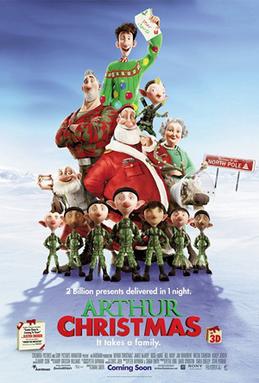
Arthur Christmas - Naughty or Nice?


Aardman Animations, Ltd., is a highly respected animation studio known especially for their stop-motion work. Their most well-known IP has got to be Wallace & Gromit, having spawned a series of short films, a spin-off television series (surprisingly with it's own spin-off), and a theatrical movie released a few years back. Recently the company has entered the realm of computer animation, their first venture being Flushed Away in 2006, which I didn't like very well. Their latest film and the subject of this review, Arthur Christmas, is also made in computer generation, but is also a holiday film and a pretty decent one at that.

After a spectacularly awful Justin Bieber music video (explaining exactly why would turn this review into a rant), we are treated to a visual explanation as to how Santa Claus is able to traverse the entire world in a single night: elves travel down from a giant, high-tech, sleigh-shaped ship and do practically everything that Santa is known to do on Christmas night. They are led by the current Santa's son, Steve (Hugh Laurie), who keeps everything running efficiently to ensure everything goes off without a hitch. Meanwhile his brother, Arthur (James McAvoy), is tasked with answering every letter addressed to the man in the red suit, enthusiastically stating that he (Santa) will definitely be on his way. By the end of the mission, all seems well until it's discovered later that one child in England was accidentally skipped. Upon learning this, Arthur, who is always filled with Christmas spirit, sets on a mission himself to deliver the present with only two hours until morning.

What's interesting about this movie is the approach it takes to interpret how the legend of Santa Claus works. Here it's explained that the jolly Christmas icon has been around forever because it's a family by the last name Claus and every so often one of them retires to pass the torch unto a new Santa, treated more as a title than a name, which is actually pretty clever. The roles of the elves, especially the ones that perform in the field, are similar to how it's shown in Disney's Prep and Landing, but on a much grander scale, and there is also an acceptable explanation as to how reindeer can fly: magic dust.

The characters of this movie are interesting to watch, especially in the ways their personalities bounce off each other and how the family of Santas doesn't get along that well, particularly between the current Santa (Jim Broadbent); Steve, who is to be the next Santa; and Grandsanta (Bill Nighy), the previous Santa who brags about how he got things done without modern technology. One elf of note is Bryony (Ashley Jensen), who can wrap any gift very quickly with very minimal tape (and still have time for a bow). The family tension leads to some drama during the course of the movie, though some of Bryony and Grandsanta's dialogue provide a few laughs to prevent the movie from becoming too serious.

The animation of this movie is simply stunning, especially in terms of the hair on each character. Everything is very fluid and helps to display an array of body language that enhances the emotions each character feels. Comparing the animation to Flushed Away, since it was also done in CG, the look and fluidity are both greatly improved here, since they didn't try to make it appear to be stop-motion when it wasn't. The music, Bieber aside, really helps to set the atmosphere and tone of the story and make it feel even more like an enjoyable Christmas flick.

Arthur Christmas is a movie I would recommend, especially to fans of whatever Aardman puts out or anyone looking for a good Christmas story this holiday, since it hits all the right points. However, if you are not a fan of Justin Bieber, whose song sandwiches the story, this may scare you away from seeing it again right away. Regardless, it's definitely worth a look.

To read reviews of other Christmas films, please see our Christmas Review Hub.

Thursday, December 22, 2011

[OLD] Ratchet & Clank: Up Your Arsenal


After the success of Going Commando, Ratchet & Clank continued the following year in 2004 with a third game, Up Your Arsenal (you've probably noticed the double entendres in these titles). This game offers a few enhancements to the series' gameplay style, as well as the addition of a new Multiplayer function, which would continue to be featured in later games of the franchise.

It's been a while since the events of Going Commando, as the titular Ratchet and Clank are seen playing a game to pass the time, that is until Clank tunes into his new television show, Secret Agent Clank. Disinterested, Ratchet changes the channel to a news broadcast, where it is reported that his home planet Veldin is under attack by an alien race known as the Thyrranoids. It is also reported that the culprit behind the attack is a robot that goes by the name of Dr. Nefarious. A native of Veldin himself, the Lombax (Ratchet) decides to take action, getting himself into something much more than meets the eye.

Along with returning characters from the first installments, the game introduces a handful of new and interesting characters, helped by the great voice cast, among them the aforementioned Dr. Nefarious. I found this new villain to be much more interesting to watch than the previous two, especially with his high-pitched voice, a quirk where he freezes and picks up radio broadcasts of a soap opera whenever he gets excited, and the conversations he has with his assistant Lawrence. The quirkiness of this character has given me a few laughs and he is so far my favorite Ratchet & Clank villain.

The gun play of the previous title returns here, but now comes with a nice improvement. Your Quick Select can now hold double the guns and gadgets, totaling 16 instead of 8, and you can switch between two rings of your arsenal by holding R1. This helps in that it becomes less time consuming to figure out what items go into either of these wheels, though you may still end up changing around your inventory a few times. As with the last game, if an old Save of the last adventure is detected when you visit a Gadgetron Vendor, you can recover some of your old weapons for free, so you can save your bolts for something else and increase the range of items to pick from in either wheel. The upgrade system also returns, except now you can boost your weapons by up to five levels rather than two, this time including the ones you previously owned. Another change is the Health display, in that it's represented by numbers rather than in segments, which makes calculating damage you take from an attack a little easier.

On the topic of variety, a series of mini-games is introduced in the form of Qwark Vid-comics, which tell the story of how Captain Qwark previously went up against Dr. Nefarious. These comics not only have amazing art and break up the gun play a little, but they also provide a few laughs as well as add more depth to the overall story. These mini-games are actually quite fun to play, and the music provided for each of them is very catchy and quirky in itself, providing an atmosphere unique from the rest of the game.

While I enjoyed my time with this older game, there was one thing I didn't like in particular, namely the ways Bolts can be spent. The previous game had special flying segments where you can use Raritanium (introduced in the first Ratchet & Clank) to change the design and capabilities of your ship. Here, you can instead use your regular Bolts, but they are instead used for cosmetic purposes, which led me to wonder why the option was even included in the first place. Then there's Titanium Bolts; while I admittedly could not figure out how they were supposed to be used previously, when they were called Platinum Bolts, I did manage to find how they could be spent here: Skins, which serve no gameplay purpose other than to make yourself look different. Like with customizing the ship, I couldn't help but wonder what exactly the point of this is, unless you really, really want to play through the game as a snowman. This also isn't very much of a complaint, but traveling around planets is more linear here than in the last two games, since in those there was more incentive to not only go around each planet but also revisit older ones for special rewards. However this is minor and doesn't impact the experience at all.

A notable aspect of this game is that it is the first in the series to incorporate Multiplayer, including an Online option. However, since this is a PS2 game from 2004, I will not be covering the Online portion of this option, but rather the Local aspect of it. There are three different gameplay modes, two of which appear on every map: Seige, Capture the Flag, and Deathmatch. Today these are standard for many games with Online Multiplayer, but they still provide a challenge in Local, though I would recommend playing with more than two people, since it can get a little boring if you don't have enough friends to play with nearby.

Ratchet & Clank: Up Your Arsenal is a must-have for Ratchet & Clank fans, and a game one should definitely have in their PS2 library. It's a fun and quirky title that keeps you invested until the very end. If you have any friends with you and want to play something old-school, give the Local Multiplayer in this title a shot; you may end up having a good time.