Tuesday, December 6, 2011

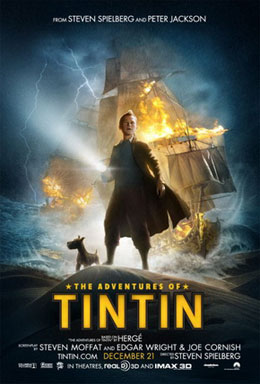
The Adventures of Tintin - A Little Thinthin

THE ADVENTURES OF TINTIN (2011) Starring: Daniel Craig, Jaime Bell, Simon Pegg, Andy Serkis Directed by Steven Spielberg. Written by Steven Moffat and Edgar Wright & Joe Cornish. Produced by Steven Spielberg, Kathleen Kennedy and Peter Jackson. Based on comic book series by Hergé. Music by John Williams. Run Time: 107 minutes. Color. US/New Zealand, Animated, Action, Adventure, 3-D

Just to set the record straight, I’m reviewing this film without having ever really read Hergé’s comic book series, so I’m not coming at this as a fan boy. Nor am I necessarily overly enamored with Peter Jackson or Steven Spielberg. Both have been involved in as many bad movies as good over the duration of their careers, despite what their reputations might suggest. Since I’ve never read any Tintin, I won’t be commenting on how accurate the film portrays the characters or plots in the comic book. There are those more knowledgeable on that subject and I will leave it to them to discuss it on those merits.

I want this review to be about the movie itself, not how does it stand up as an adaptation but as a film.
One of the reasons I was interested in seeing this in the first place has to do with wanting to keep up. It’s a little like reading a book you’d rather not just because everyone is talking about it. Given the stature of Spielberg and Jackson, I’m guessing this is a film people will be talking about. It’s basically the same reason I went to see AVATAR (2009). Going in I’m hoping that TINTIN has more going for it than Cameron’s SMURFS meets DANCES WITH WOLVES film of two years ago. At least I’m not already familiar with the plot points of TINTIN, which is a plus and a chance for surprise.

My one concern before I saw a frame of film was the possibility that I would experience the uncanny valley, wherein the animation looks too human for its own good. I can honestly say that once the film started the uncanny valley wasn’t so much an issue as was why they shot this movie the way they did. Using motion capture, the actors played their parts, only to be animated over. This has been done many times before and while TINTIN is far superior to THE POLAR EXPRESS, as a viewer I wondered why they didn’t either animate it from the start or do a live action version of the story? What they ended up with is a hybrid that is sort of like watching cartoon characters walking about in the real world. I would have been happy if the entire film was animated in the same style as the opening credits. It wasn’t shot this way to save money, as it reportedly cost $200 million. It comes off as stunt filmmaking, as in we can do it this way, so why not, rather than is this the best way to tell the story. Except for a few prosthetic noses, it’s hard to know what about TINTIN couldn’t have been done as a live action film.

I won’t go in to the plot of TINTIN, since it has not yet been in theaters, but it’s somewhat convoluted plot has to do with lost treasure, cryptic clues and family feuds. And it is heavy on action, almost to the point of distraction. Spielberg doesn’t seem to be satisfied with being the most commercially successful director of all time; he must also want to be known as the director with the most action per minute of film. This film almost makes the Indiana Jones franchise look like a walk in the park. There is one action sequence that frankly goes on so long your mind can start to wander. This is not to say that TINTIN is all bad. Just that it could have been better.

There are things that the film does well. Spielberg obviously knows his craft. The choice of shots and the way the humor is set up are good. But as with some of his films, story takes a backseat to the visual. And like AVATAR, this is a very visual film. Sometimes, though, the film seems to be an extended cutscene from one of the UNCHARTED video games.

The film comes dangerously close to assuming you’re familiar with TINTIN and that it doesn’t need to set up the characters at all. Saved from the possibility of an exhaustive exposition sequence, the viewer is given no backstory for Tintin, save for a few visual clues. Again, having never read the comic, I don’t know if Hergé never bothered to explain his past or that the filmmakers decided the viewers who didn’t already know would want to research it on their own after seeing the movie. As an example, our only clue that Tintin is a boy is that everyone refers to him as such in the film. Otherwise, he could be a young-looking thirty for all we know.

And this brings up a point about the marketing for this film. As consumers of pop culture we have become accustomed to long build ups for films, TV shows and video games and so I am somewhat surprised that there was not more of a push to get TINTIN out into the public consciousness before releasing this very costly movie in America. Whether or not this will effect box office remains to be seen.

It is also really hard to figure out how they chose the cast for this film. Since no one had to necessarily look like their parts why, as an example, cast Daniel Craig at all, when the characters he plays don’t look like or even really sound like Daniel Craig? I have nothing against Craig as an actor, but it is hard to know what he brings to the role that others couldn’t, since he literally disappears on screen.

I’m not surprised that Andy Serkis is prominently used. After all Peter Jackson is involved, so Serkis can’t be far behind. It is a somewhat similar relationship as Tim Burton and Johnny Depp or Tim Burton and Helena Bonham Carter. If you see Jackson’s name as producer or director I look for Serkis in the billing block. I know that there has been a ground swell about what a great actor Serkis is ever since he was Gollum in the Lord of the Rings trilogy, but what we’re really left with is him as a voice actor. While motion capture can follow movements, it’s hard to know where the actor ends and the CGI takes over. This is not to take away from Serkis’s talent, but it would be nice to see him act as an actor rather than a fancy prop.

Now TINTIN has already been a big success overseas, but it’s hard to know if that will transfer into big domestic box office as well. For moviegoers who would go to any Spielberg film, then this is your holiday as he has a second film, WAR HORSE, opening just four days after this one. Based on the ads I’ve seen for the latter, I would venture that TINTIN would be the bigger of the two releases. But it is rare to see a director be his own competition. Usually they try to avoid that situation.

After having seen TINTIN at a holiday screening at Paramount, I can honestly say that I would not put down good money to see it. But I’m sure I am in the minority of holiday filmgoers. THE ADVENTURES OF TINTIN will be a big success. After all, they’ve already set up the sequel. Literally.

Saturday, December 3, 2011

Hulk Vs - Twice The Carnage, But Not Twice The Fun


Before I start, I should mention that I'm not very well versed in the Marvel universe, but I've always been very curious about it. Thanks to some crossover events, the Marvel Cinematic Universe, and word of mouth however, I have been able to learn about it to the point where I can at least understand what happened in the character's early years and part of what's going on with them now. Because of this, I became curious about Hulk Vs and decided to watch it. Released in 2009 by Lionsgate around the time Marvel Animation began making animated series, Hulk Vs turned out to be an entertaining duo of shorts revolving around the Hulk battling Wolverine and Thor. While they do manage to show how much the creators knew about the respective universes, there are some major differences between the two that cause them to stand out with mixed results.

To begin, Hulk Vs Wolverine shows the two of them first meeting, with Wolverine tasked to stop the Hulk's rampage through Canada. Logan tracks him down by using his toxic scent, having a run-in with Banner that causes their fight to begin. This part provides some great thrills and displays just how competent both are in a  fight, as well as a realistic underwater brawl. With the inclusion of a Weapon X plot, there still isn't any shortage of action as the two of them take on Sabretooth, Omega Red, Deathstrike, and Deadpool (who I must say is absolutely hilarious).

The carnage throughout the short, though bloody, is made interesting by using an art style inspired by anime and a suitably dark color palette. It's also notably fast paced, which helped to keep me invested until even after the credits. The flashback to Wolverine's backstory proved interesting and helped to establish what Weapon X is, but felt slightly out of place in the grand scheme of things. In the end, it was a lot of fun to watch and made me want to watch more of it.

However, the same cannot be said of its cousin, Hulk Vs Thor. Here, the Norse God Loki has managed to abduct Bruce Banner. With the aid of the Enchantress, Amora, he is able to separate Bruce Banner from the Hulk so that he may use its raw power to take over Asgard during the Odinsleep. At first he succeeds, but the arrival of Thor serves to throw a wrench in his plans as he tries to stop the Hulk from destroying the land of the gods. Unfortunately, the ensuing struggle quickly becomes boring due to the one-sided nature of the fight. The Hulk is able to dispatch of everything, god or otherwise, in its way with incredible ease, taking away a lot of the tension that made Vs Wolverine fun to watch. This isn't helped by the fact that the plot is more focused on Banner than the title characters.

While I do like the look of the noticeably cleaner style and brighter color palette, it doesn't take away from the fact that the story would only make sense to those who know about every character in the Thor universe. The ones that do show up are hardly explained save for name and relation, and the deeper character relationships present are more confusing than anything. Even though some of the scenes are impressive to watch, the slow pacing makes the short less enjoyable and gave me less of an incentive to re-watch it.

At this point, I'd like to point out that both parts of the DVD have some great qualities shared between them. The voice acting is top notch, especially Steve Blum as Wolverine and Nolan North as Deadpool. In addition, the music manages to fit the tone of each story perfectly and the distinctive styles at least offer more of a variety for the senses.

In the end, Hulk Vs proves itself to be a good offering, even if it feels like a mixed bag. While I did enjoy the Wolverine short a bit more, I'm sure there are people who would enjoy the Thor half as well. This is a DVD that I would recommend any Marvel fan to own, even those who want it only for a single character appearance.

Sunday, November 27, 2011

Hugo - A Fully Functional Machine

File:Hugo Poster.jpg

In early 2007, a book was released titled The Invention of Hugo Cabret, by Brian Selznik. It's a rather interesting book in that while some of the story is told through written word, some of it is also told through gorgeously detailed drawings that help carry the narrative. This is one of the best books I have read in recent years, and if you find it anywhere I would highly recommend picking it up. Recently, this same book was adapted into a movie, simply called Hugo, directed by Martin Scorsese. Having enjoyed the book, I was curious to see how a book like that would translate to film; I was not disappointed one bit with the final result.

In a 1930 Paris train station, a young boy named Hugo (Asa Butterfield) is keeping the clocks running behind the scenes after his uncle disappears. After he gets caught trying to steal a wind-up toy from a toy shop, he is forced to relinquish a notebook to the shopkeeper. After failing to get it back, Hugo retreats to his living space within the walls of the station, where it is discovered that he is working on repairing an old automaton, which he requires the notebook to accomplish. He later meets a girl named Isabelle (Chloë Grace Moretz), a relative of the shopkeeper, as he discovers the secret behind the automaton.

The movie does a very good job of adapting the book, even if it takes a few creative liberties (saying which ones would likely ruin the story for you). It's amazing how much attention to detail is put into the setting, especially the intricacies of moving mechanical parts. A particular favorite of mine is when the automaton begins to move because it's fun to see all the small parts interact to achieve the end result.

On the subject of interaction, the acting is rather impressive, even the performances coming from the supporting cast. This really helps the dialogue flow naturally and you really get a sense of what the characters are feeling. At times when special effects are used, they are simply stunning and help bring certain scenes to life, particularly within Hugo's dream sequences.

One of the themes of Hugo is the history of older films, and the usage of such footage is used to its full advantage. Several clips can be seen from the works of Charlie Chaplin, Buster Keaton, Harold Lloyd (particularly Safety Last), and especially from the many films of Georges Méliès. It's a little better to be aware of some of the older films featured going in, but it's still really nice to see how it helps tell the story.

Hugo is a simply wonderful movie that one shouldn't miss, especially for fans of the book on which it's based. The attention to detail is astounding, to where even the little things are amazing to watch. You also might want to have some tissues on hand, because it can get really emotional at times.

Wednesday, November 23, 2011

[OLD] Assassin's Creed: Revelations - An Assassin With A Broken Blade


At last the wait is over. After finally playing through all of the Assassin's Creed franchise, I really wasn't sure what to expect based on the twist ending of Assassin's Creed: Brotherhood as well as the various previews I had read of the gameplay systems. With this next entry, released only a year after Brotherhood, I had expected something that would at least be an enjoyable improvement. Since completing the campaign however, I find myself liking it and yet feeling like it could have done better.

While the campaign does shed some light on the protagonists Desmond and Altair, Ezio is still the big star. After the events of Brotherhood, he undergoes a pilgrimage to Masyaf in an attempt to leave his Assassin life behind him, only to be sucked into another adventure that leads him to the city of Constantinople. When he gets there, two plots emerge. In one, he becomes involved in a power struggle between the Ottoman Empire and the Byzantines, while in the other he comes across a beautiful woman who helps him locate important artifacts once belonging to Altair. I enjoyed watching both paths unravel, while introducing some interesting new characters, and then later intersect to help conclude the well-written narrative in a pounding cliffhanger. The story missions themselves are very balanced and offer good variety without being overly frustrating, along with some more engaging cutscenes.

Like with the other games, a number of side missions can be played to help break up the action, including the return of the economic system built in Brotherhood. Thankfully, the shop quests that I also found an annoyance have been scrapped, in favor of just simply allowing the player to buy the item they need. As with before, Ezio can also raise an army of Assassins to assist him around the city as well as send on missions around the Mediterranean. This feature felt improved and more fun, with Assassins now upgrading much easier and offering more content with each level up. They can also now be assigned to Assassin Dens and be put on special missions from there to increase their strength and skill.

New additions are made to the game outside of general tweaks, such as a new Hookblade in Ezio's arsenal. This allows for more combat options such as flipping enemies over, as well as navigation abilities like going across zip lines or grabbing ledges that would normally be out of reach. I found this to be fun and useful, though it wasn't as big a difference as the introduction of bomb crafting. While this feature is unique and interesting, with the game pushing you to use the system by handing out parts at every opportunity or even whole bombs in chests, I didn't really feel any incentive to indulge in this feature. I ended up just doing missions how I had always approached them before using the tools on hand.

But what is perhaps the most disappointing addition is the new Den Defense game, which you may regularly be called upon to play. While it tries to add even more variety to the game by adding an element of Tower Defense, the execution of the idea fails horribly. The controls are sloppy and sometimes hard to wrestle with, since trying to place units with an analog stick requires incredible precision that the controller simply can't provide. It seems designed more with a computer mouse in mind, although I'm not quite sure how much more enjoyment PC users would get out of it thanks to the very awkward camera angle. To top it all off, the whole idea seems a little absurd when compared to the Assassin philosophy of staying hidden and fighting a secret war with the Templars. Lowering your level of suspicion will decrease the likelihood of encountering this game, which is what I ended up doing to avoid it most of the time, but it definitely could have been easily scrapped without negatively impacting the overall product.

While Ezio may play a big role in the game, there is still opportunity to interact with the other two characters. Throughout the story, Ezio will recover Masyaf Keys that allow him to look at the memories of Altair spanning the rest of his life. This allows players to not only find out what happens to him at the end of the original Assassin's Creed, but also control him one last time. The missions may be short in this department and take place exclusively in one location, but they are also fun and memorable and let players feel more emotion for the character.

As for Desmond, the game also gives some follow-up since the events of the previous game while he tries to restore his shattered memory. Collecting Animus Data Fragments in the main game allows for a playable side quest that explores his own past and delivers more depth into his character. While I did find the stories intriguing, the gameplay felt a little iffy. His memories are rendered in First-person platforming levels, which can be a little difficult given the limitations of that gameplay mechanic.

Overall, Assassin's Creed: Revelations feels like a mixed bag. I had more fun than I did with Brotherhood, but some of the new gameplay additions I either ignored or got frustrated with in the long run. However, the story is very much worth it and serves to help lead fantasticaly into the upcoming Assassin's Creed III due next year. I would not recommend newer players to start with this game due to the attempts at variety. However, getting the PS3 version of the game also allows access to the original Assassin's Creed for free, which is a great incentive for purchase and should offer those players a proper place to begin.

Monday, November 21, 2011

Stubs - The Matrix


THE MATRIX (1999) Starring: Keanu Reeves, Laurence Fishburne, Carrie-Anne Moss, Hugo Weaving and Joe Pantoliano. Directed by Andy Wachowski, Larry Wachowski. Written by Andy Wachowski, Larry Wachowski. Produced by Joel Silver. Music by Don Davis. Run Time: 136 minutes. Color. Australia/U.S., Science Fiction

One of the most visually interesting films to come out in the 1990’s, THE MATRIX is one of those special effects films that your parents warned you about. It does not always make sense, and can drag a little in places, but the film is best known for its action sequences and something known as bullet time, a special and visual effect that alters time, space and point of view.

There are two alternate realities at work in THE MATRIX, and neither of them is good if you’re a human being. There is the simulated reality, fed by Artificial Intelligence machines to keep the human population subdued. This is a dream state in which people think they are living their lives. This is the reality we all know. We sleep, go to work, go to school, hack computer systems and eat.

Then there is the real reality, in which humans are nothing more than an energy supply for the A.I. machines that have taken over the world. This is their revenge for mankind permanently darkening the sky, in our last ditch effort to stop the machines by cutting off their primary energy source, the sun. In this reality, humans are treated like cattle; fed and used. When a human dies, it is turned into food for other humans. If this starts to sound like THE TERMINATOR meets SOYLENT GREEN, you’re not too far off.

But humans are not completely defeated. There is Zion, the last human city. And there is a band of people who are trying their best to disrupt the simulated reality. This group is led by Morpheus (Laurence Fishburne). Morpheus, for some never explained reason, has latched on to a hacker called Neo (Keanu Reeves) as the last great hope for mankind. During the day, in his simulated reality, Neo, aka Thomas Anderson, is a computer programmer. He knows, through his hacking, that there is something called THE MATRIX, but he doesn’t know what it is or what it means. Enter Trinity (Carrie-Anne Moss), another hacker, who tells Neo that Morpheus has the answers to his questions.

Neo is then arrested by Agent Smith (Hugo Weaving) and other men in black, who warn him to stay away from Morpheus. But Neo doesn’t listen and meets with Morpheus anyway. At the meeting he is given the choice between the red pill and the blue pill. The blue pill basically takes Neo back to sleep and he awakes in the morning and will remember nothing. The red pill will provide him with the truth. Naturally, Neo takes the red pill or we have no story. After taking it, Neo wakes up in his pod, connected to wires and tubes. These connections are severed and Morpheus rescues Neo and takes him aboard the Nebuchadnezzar, his ship.

There Neo is repaired, given the low down and uploaded with handy to know things like Martial Arts. “I know Kung Fu.”. (This learn through uploads would be the premise for TV’s Chuck series, but instead of the Matrix it is the Intersect.) Morpheus gives Neo the back story on what happened to humans. He tells Neo that he is the One who the Oracle has prophesized will end the war through his control of the Matrix. Morpheus and crew go around unplugging other humans and having them join their rebellion, but not everyone on board the Nebuchadnezzar is happy about it. Cypher (Joe Pantoliano) seems to regret not taking the blue pill when he had the choice.

Everyone though is amazed at how quickly Neo learns and adapts to his new environment. Like all of Morpheus’s crew, Neo can bend the simulated laws of physics. Morpheus is convinced that Neo will have no trouble dealing with the Agents, who are computer generated programs who are designed to stop any threats to the simulated world.

Morpheus takes Neo to meet the Oracle (Gloria Foster), but she tells Neo that he’s not The One, which is a little confusing, since he is. She also tells him that Morpheus believes in him so much that he would sacrifice himself for Neo. When the group tries to get back aboard ship, they are surrounded by Agent Smith and other security. Morpheus stays behind so that the Trinity and Neo can escape back through the hacked telephone lines to the ship. Once on board they find out that Cypher has killed most of the crew by unplugging them from THE MATRIX and made a deal with the machines to return to his dream pod in exchange for giving them Morpheus.

But not everyone on board is dead. Dozer (Anthony Ray Parker), the ship’s pilot and a native of Zion, is only wounded and he kills Cypher before he can kill Trinity and Neo. Meanwhile, Morpheus is being interrogated in a government building by Agent Smith and others. What they want from him are the access codes to the mainframe for Zion. Neo and Trinity, armed to the max, storm the building. Here Neo is able to put into practice all that he has learned. He is able to twist around the bullets being fired at him. The Agents can’t stop him and Neo and Trinity save Morpheus. On the way back to the ship, Neo is ambushed by more Agents while Morpheus and Trinity escape.

Neo, though is not able to bend his way out of trouble and a barrage of bullets “kills” him in the simulated world and in the real one. But Trinity won’t let him die. The Oracle had told her that she would fall in love with The One and Neo is The One. Like Harry Potter, love saves Neo and he revives in the real world and in the simulated one as well. Now he is able to see THE MATRIX and he destroys Agent Smith. He vows to save everyone imprisoned by THE MATRIX and then he flies off, presumably to the two sequels spawned from the original.

Keanu Reeves seems to be born to play Neo. His range as an actor is almost non-existent, but that works well in this film. Rather than wooden, he comes across as machine-like in THE MATRIX.

For the most part, all the characters are pretty one dimensional. There isn’t a lot of growth or change for them throughout the film. Trinity’s love for Neo seems a little tacked on, as if the writers were looking for something, anything, to bring him back from the dead. (There were those sequels that needed to be made.) The only character that goes through any change is Cypher and he goes from being a disgruntled rebel to spy for the machines, but even that is telegraphed long before it happens.

But THE MATRIX isn’t about things like character development. It is all about the visual effects and in this category it excels. Whether it is the bullet time effect or it is the time slice, with completely frozen characters and objects or spinning cameras THE MATRIX set a new standard in action scene choreography. For many, the lobby scene, when Neo and Trinity are on their way to save Morpheus, is among the greatest action scenes ever.

Throughout the film, there are references made to Alice in Wonderland. At times, the viewer feels that he has fallen down the rabbit hole with Neo. But in the end, THE MATRIX is able to keep its rather convoluted plot moving forward, even if not everything gets explained in the process.

The Matrix is available on the WB Shop:

Free Shipping on All Orders Over $50!

Wednesday, November 16, 2011

[OLD] Ratchet & Clank: Going Commando

File:Ratchet and clank gc image.jpg

In 2002, Ratchet & Clank started off with a decent game. It wasn't perfectly constructed, but it was still enjoyable nonetheless. Ratchet & Clank: Going Commando, released in 2003, is not only an improvement over the original, it also racks up the difficulty for those seeking a challenge.

Months after the defeat of Chairman Drek, Ratchet and Clank reside back on Planet Veldin, having remained inactive in the intervening time. It is then that they are teleported to another galaxy by Ambercrombie Fizzwidget, head of Megacorp, and tasked to retrieve a stolen experiment. What follows is a story deeper than the last one, with a few nice surprises thrown in.

The game still has some likable characters, including the main duo and Mr. Fizzwidget, backed up by some great voice acting. Also in terms of sound, the background music is still very catchy, some of which you will never get tired of listening to. The graphics are still good for the time of its release, using much clearer cutscenes and a nice mix of light and dark palettes while having everything still easily stand out.

As with the original Ratchet & Clank, there is a large variety of weapons to pick from, which can be helpful in different situations. In fact, the weapon variety is even bigger than last time since you can recover weapons from the last game to assist you (you can get these without spending bolts if you have a Ratchet & Clank save on your PS2 Memory Card). This adds even more to the gameplay as you can more carefully decide what you need to use at a given moment. Another addition to the gameplay is the ability to upgrade weapons, sans the older ones, with more frequent use, which sometimes comes in handy when up against a large wave of enemies, and in a New Game +, you can actually upgrade your weapons a second time for even more power. It is also now possible to have the game pause while using Quick Select, which helps to change weapons more easily without taking damage.

On the aforementioned difficulty, This game is a little more challenging than the last. A few times when playing through certain areas, I got frustrated at how difficult it was, since enemies can now dish out what feels like an unfair amount of damage, even when some of these enemies aren't wearing any armor. Despite this, I actually had a feeling of satisfaction once I got past these stages, preparing not to go through them again. Though the Save system remains generally the same as the last game, it at least tells you this time when there's a checkpoint so you don't have to go through any frustration trying to figure it out.

Ratchet & Clank: Going Commando is overall a nice improvement on its predecessor. While the higher difficulty may turn off some players of the original, it's still an enjoyable experience and provides an interesting challenge. Fans of the original will enjoy this one, though I recommend newcomers to play the original game first, if only to help the story.

Saturday, November 12, 2011

Stubs - The Big Lebowski

THE BIG LEBOWSKI (1998) Starring: Jeff Bridges, John Goodman, Steve Buscemi, Julianne Moore, John Turturo. Directed by Joel Coen. Written by Ethan Coen and Joel Coen Produced by Ethan Coen. Music by Carter Burwell. Run Time: 119 minutes. Color. U.S., Comedy

This is one of those films whose legacy seems to grow year after year. While it would not be considered a box office success when it was first released, it has become a cultural icon, even to the point of being referenced in a recent My Little Pony: Friendship is Magic episode. When Jeff Bridges is mocked on Saturday Night Live, it is The Dude character from this film that gets used. It is one of those films that has flourished in home entertainment release.

THE BIG LEBOWSKI, which Wikipedia states as being loosely based on Raymond Chandler’s The Big Sleep, is perhaps as confusing as that book’s best known adaptation, Warner Bros. 1946 version starring Humphrey Bogart. While the film is funny in places, it is overstuffed with characters and plot points.

Jeff Lebowski, aka The Dude, is mistaken for another man with the same name by two thugs who come to collect money that his wife, Bunny, owes a man named Jackie Treehorn. The Dude is intimidated to the point of having his rug urinated on, but he finally convinces them that they have the wrong guy. But The Dude is still short one rug and he turns to his bowling partners, Walter Sobchak (John Goodman) and Donny Kerabatsos (Steve Buscemi) for advice. They come to the conclusion that the other Jeff Lebowski aka The Big Lebowski (David Huddleston) owes The Dude a new rug.

To hear The Big Lebowski talk, he is a self-made man who has overcome losing the use of his legs to become a titan of industry. He does not see that he owes The Dude anything and kicks him up. But The Dude manages to take a replacement rug on his way out. Also on his way out, The Dude meets Bunny (Tara Reid), The Big Lebowski’s much younger trophy wife.

It is not too long before The Dude hears back from The Big Lebowski. Bunny has been kidnapped and he wants The Dude to handle the million dollar ransom payment for him. The logic is that The Dude will be able to identify if the kidnappers are the same thugs who ruined his rug. However, it is not long before a different set of thugs break in to The Dude’s apartment, knock him unconscious and steal his new rug. When he is contacted by the kidnappers, who are identified as German nihilists, The Dude brings along Walter. 

Walter has his own idea and tries to convince The Dude to swap the ransom money for a briefcase of his dirty laundry. Over The Dude’s protests, the kidnappers take the ringer and leave The Dude and Walter with the million dollars. They don’t get to do anything with the money, because The Dude’s car is stolen that night from the bowling alley parking lot. Maude Lebowski (Julianne Moore) the Big Lebowski’s daughter, contacts The Dude and he goes to her art studio. She tells The Dude that she stole back the rug The Dude had stolen, because it belonged to her mother. 

She tells The Dude that Bunny is a porn star who has worked for Jackie Treehorn. And Maude confirms The Dude’s suspicion that Bunny kidnapped herself to get the money she owes. Maude wants The Dude to get back the million dollars, because her father has embezzled it from a family charity to pay the ransom.

The Big Lebowski is not happy with The Dude over failing to deliver the ransom. The kidnappers have sent a toe that is supposed to be Bunny’s. When he gets home, The Dude has a message that his car has been found, but before he can retrieve it, three people invade his house, claiming to be the kidnappers and demanding their money or else they will hurt him. The Dude returns to Maude, who tells him that the kidnappers are not only Bunny’s friends, but also a failed German electronic band, a la Kraftwerk.

When The Dude picks up his car, the money is gone and the police are no help. The Dude finds a test paper from the perpetrator of the theft, a teenager named Larry Sellers. When The Dude and Walter go to Larry’s house, the teenager says nothing, even though there is a new car parked in front of his house. Walter tries to intimate the kid, by taking a crowbar to his car. But the car ends up belonging to a neighbor, who takes revenge on The Dude’s car.

But Jackie Treehorn (Ben Gazarra) is not through with The Dude. His thugs bring The Dude to Jackie’s Malibu home. Jackie still wants his money and offers The Dude a cut if he gets it for him. For some reason, Jackie drugs The Dude’s drink, which leads to one of the movie’s most surreal passages. In his drugged out state, The Dude has a dream that is laced with references to bowling, the Persian Gulf War and Maude’s art. The Dude wakes up while running down the street, which naturally gets the attention of the Malibu police. After being assaulted by the police chief, The Dude is kicked out of his taxi home when he complains that the driver is playing the Eagles.

When he finally gets home, he finds that his apartment has been gone through by Jackie’s thugs and that Maude is waiting for him. She seduces him so that she can get pregnant by him; though she tells him she wants him to have no part in raising the child. In their post-coitus conversation, she reveals that her father, despite his appearances, has no money. Her late mother was the rich one and she left everything to the family charity. In an epiphany, The Dude realizes that The Big Lebowski never gave him the million dollars in the first place and would have been happy to have the kidnappers kill Bunny, whom he had grown tired of having around and to pin the theft of the money on The Dude.

When The Dude and Walter go to The Big Lebowski’s house to confront him, they find that Bunny has returned on her unannounced get away. Thinking things are finally over, the boys go bowling. But the kidnappers, who had used Bunny’s trip as a ruse for the ransom, still want their money. When they say they’ll settle for what the boys have on them, Walter still fights them. While the German nihilists are vanquished, Donny has a heart attack and dies.

The movie ends, where else, at the bowling alley, where The Dude and Walter go after spreading Donny’s ashes. All is apparently resolved, so the narrator/The Stranger (Sam Elliott) tells us.

Even a detailed synopsis doesn’t cover everything going on in this movie. The film is character driven as opposed to plot. Chief among them is The Dude, around which the film revolves. The Dude is sleepwalking through life high on a combination of pot and White Russians. He is almost never without a White Russian in his hands, even if he has to make it with non-dairy coffee creamer rather than half and half. The Dude, though, remains unchanged by the events of the movie, as do all the main characters, save Donny who dies.

Walter is perhaps the most complex character of the film. A rather stupid hot head, he can’t get over the Vietnam war. He shows great reverence to two sets of rules: those of bowling and Judaism, even though, in the case of the latter, he was born a Catholic. Walter is really the one that gets The Dude in trouble and keeps him there throughout the movie. He tries to settle arguments by pulling a gun or crowbar.

Perhaps the problem I have with the movie can be best summed up in John Turturo’s Jesus character, or as he refers to himself The Jesus. He is part of a team that The Dude’s team will meet in the bowling league’s tournament. But like his character, Seymour Simmons, in the three recent Transformers movies, Jesus is superfilous to the film and really gets in the way more than anything else.

And this film is filled with interesting but unnecessary characters, which only take away from the plot, not add to it. Bowling partner Donny; the Big Lebowski’s assistant, Brandt (Philip Seymour Hoffman); Video artist Knox Harrington (David Thewlis); Private Detective Da Fine (Jon Polito); and apartment manager wannabe dancer Marty (Jack Kehler) are all interesting, but not needed. It is as if the Coen Brothers tried to make a part for actors they admired or knew, but didn’t really have anything for them to do. There is a lot of talent that seems to get wasted on bit parts in THE BIG LEBOWSKI.

It comes down to what I would consider to be problems with the script. An overly complicated plot with too many characters with the results that nothing really changed, except Donny’s dead and The Dude is down a rug and a car. This was a story that while interesting doesn’t really say anything or have a purpose. While BIG LEBOWSKI’s narrator tells us that all the loose ends have been wrapped up, much of it is not. Perhaps this film is best viewed not with a bag of popcorn and a coke, but with a joint and a White Russian. Maybe then it would all make sense.