Saturday, January 16, 2016

Stubs - Rashōmon


Rashōmon (1950) Starring: Toshiro Mifune, Masayuki Mori, Machiko Kyō, Takashi Shimura, Minoru Chiaki. Directed by Akira Kurosawa.  Screenplay by  Akira Kurosawa, Shinobu Hashimoto Based on: "Rashōmon" and "In a Grove" by Ryūnosuke Akutagawa Produced by: Minoru Jingo. Run Time: 88 minutes. Japanese, Black and White, Drama

Recently, Trophy Unlocked reviewed its first Japanese film, Gojira (1954). The choice was driven by the release of Godzilla (2014), a remake that was supposed to be true to the intent of the original. While the most famous thing about Gojira was the monster, such is not the case with our next film, Akira Kurosawa’s Rashōmon (1950). Kurosawa had been directing films since during World War II, his first film being Sanshiro Sugata (1943) But until the release of Rashōmon, his work was not widely known outside of Japan.

The 1950’s saw an influx of world cinema to the U.S., and while mainly relegated to art houses, these movies would nonetheless have an impact on Hollywood. Films by such diverse filmmakers as Ingmar Bergman, Federico Fellini and Jacques Tati revealed different ways of story-telling and pushed the envelope of acceptable subjects for moviegoers. This is also true of Rashōmon, the first Japanese film to receive a substantial release outside of that country.

Rashōmon is probably best known for its depiction of a story from four different points of view, something that was seen as revolutionary at the time. Based on two works by Ryūnosuke Akutagawa, Rashōmon and In the Grove, the film tells the story of the interaction between Tajōmaru, a bandit (Toshiro Mifune), a samurai, Takehiro Kanazawa (Masayuki Mori), and the samurai’s wife, Masako (Machiko Kyō). While travelling through the woods, the samurai and his wife pass by the bandit who is sleeping at the foot of a tree by the edge of the trail. It is a hot day and a cool breeze rustles Tajōmaru from his nap in time to catch sight of the samurai’s wife as she rides by on a horse. He instantly desires her and follows after the couple through the woods. His plan is to take the woman from the man without killing him. Let’s not mistake the bandit’s intentions, which are to have sex with the woman, consensual or not.

The bandit Tajomaru (Toshiro Mifune) wakes from his nap to see the Samurai and his wife go by.

From there the stories of what happen diverge.

At Rashōmon, the city gates of Kyoto, a woodcutter Kikori (Takashi Shimura) and a priest (Minoru Chiaki) sit out an intense rainstorm. A third man, a commoner (Kichijiro Ueda), joins them. While they hint about a disturbing story they have to tell, it is the commoner who gets them to open up.

An intense rainstorm at the city gates of Kyoto traps a woodcutter, a priest and a commoner.

The woodcutter tells him that three days before, while searching for wood in the forest, he comes across a woman’s hat and veil stuck on a branch. Later, he finds a samurai’s cap just before discovering the samurai’s dead body. The discovery sends him running from the woods in a panic to tell the authorities. He had just that day given such testimony in a court looking into the murder. The priest had seen the couple only minutes before the murder as they made their way past him in the woods. After giving their testimony, the woodcutter and the priest are seen sitting in the background, in the sun, while other witnesses testify. I don’t know if this is supposed to be a realistic depiction of courts of the 11th century, when our story takes place, or if this is shown for symbolic reasons, so as to let the audience know the two heard the other stories they’re recanting.

The woodcutter, Kikori (Takashi Shimura), discovers the Samurai's dead body while searching for wood.

Like the woodcutter, we see the priest answering questions that we never hear being asked, as if they’re speaking to us, the audience, directly. There are three other witnesses brought before the court, each telling their story in the same manner, speaking directly to us as if we are the judge of their tale.

First up is Tajōmaru, who has been captured by a policeman (Daisuke Katô). The policeman had found the bandit by a lake, with the samurai’s possessions, including his horse and his bow and arrows, having apparently been thrown by the horse.

A policeman (Daisuke Kato) captures Tajomaru by a lake,

Tajōmaru, who is a renowned bandit and perhaps crazy, readily confesses to the crime.

The bandit confesses in court and readily admits to the crime.

He claims that he had no desire to hurt the man, only to have sex with the woman. He lured the samurai off the trail with the promise of a cache of swords he had discovered and buried. The samurai might be cautious about the tale, but he leaves his wife and horse and follows after the bandit. When they reach the grove, the bandit overpowers the samurai and ties him up. He then goes back to the wife and tells him that her husband has taken ill and has her follow him back to opening. It seems a bit perverse to want to have sex with her in front of her husband, but that seems to be the bandit’s plan. But the woman is not an easy target. She pulls out a dagger and tries to attack the bandit, who is too fast and too strong for her.


The bandit lures the Samurai (Takehiro Kanazawa) away from
 his wife with the promise of a cache of swords.

In a clinch, the bandit kisses the woman, who drops her dagger. We’re led to believe she’s been seduced. 

The bandit kisses the Samurai's wife, Masako (Machiko Kyo) and she drops her dagger.

Afterwards, this is the 50’s everywhere and sex was never shown, the woman is filled with shame. Not wanting to live with two men knowing of her guilt, she asks the bandit to duel with her husband and she would go with the winner.

Tajōmaru unties the samurai and they fight honorably, crossing swords more than twenty times, before the bandit kills the samurai. But when the fight is over, the woman runs away and escapes.

The bandit and the Samurai cross swords in battle over the wife. 

After telling his story, he is asked about the wife’s dagger, which has has a pearl inlay, which is supposedly left at the scene. He admits it was foolish of him to leave behind such a valuable object.

The wife testifies while the Priest and the Woodcutter look on.

Next to testify is the wife, who tells the court that Tajōmaru raped her and then left. But when she begged for her husband’s forgiveness, he simply stared at her with a glare she read as contempt. She then freed him from his bindings and asked for him to kill her so she wouldn’t have to live with the shame, but he only continued to stare at her. So disturbed, the woman fainted, the dagger still in her hand. But when she awakes, she finds that the dagger is in her husband’s chest. Not knowing what had happened, she tries to kill herself, but fails.

The Samurai testifies through a medium (Noriko Honma).

In what is no doubt a Japanese touch, the samurai testifies through a medium (Noriko Honma). Speaking on his behalf, she tells the story that after raping his wife, the bandit asks her to travel with him, a request she accepts. But she insists that Tajōmaru kill him so that she wouldn’t feel like she belongs to two men. Surprised and shocked by the request, he gives the samurai the choice of letting the woman go or killing her.

According to the Saumurai's story, his wife encourages the bandit to kill him.

The woman then tries to run away, but Tajōmaru fails to recapture her and she gets away. Tajōmaru then lets the samurai go free and leaves. The samurai then kills himself, using his wife’s dagger.

The Samurai kills himself with his wife's dagger.

But back at the gates, the woodcutter tells the commoner that the samurai’s story is a lie and that he had witnessed both the rape and the murder. When asked why he didn’t tell his side of the story in court, he says he didn’t want to get involved.
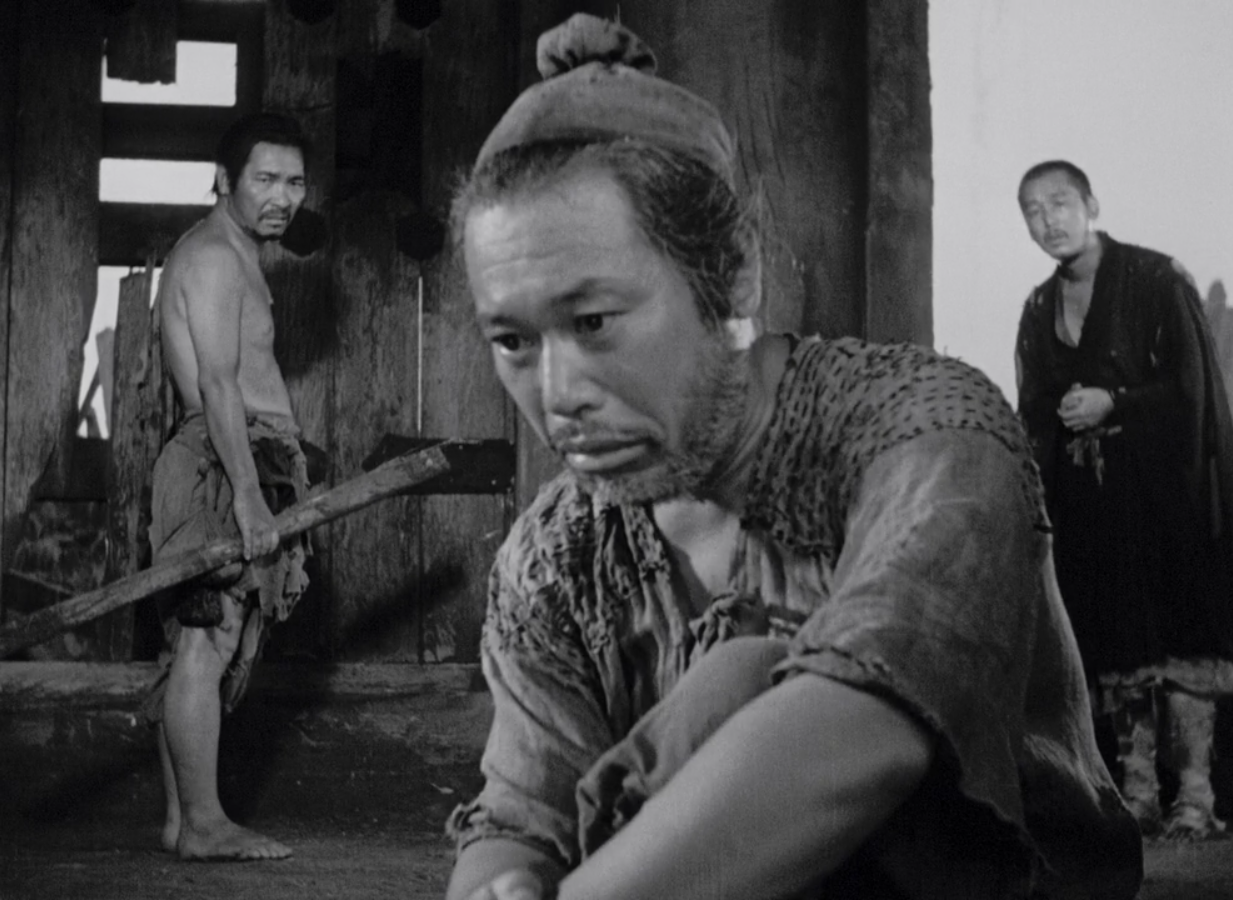
The woodcutter admits to the commoner (Kichijiro Ueda) and the priest
(Minoru Chiaki) that he didn't want to get involved.

According to the woodcutter’s testimony, after raping her, the bandit begged her to come away with him. Instead, the woman frees her husband, but he is unwilling to fight for a spoiled woman. But the woman then turns the table on both men, claiming that neither of them is a real man, since they refuse to fight for the woman’s love. After spurning the two men into a duel, she hides her face to avoid seeing the actual fight.

The climatic fight according to the woodcutter's point of view.

The fighting, according to the woodcutter, is not as honorable as Tajōmaru had depicted in his testimony. Not only is the swordplay sloppy, but neither man fights with any real gusto. But in the end the bandit wins by what some might say was a lucky turn of events and reluctantly kills the samurai, who begs for his life. The woman flees in horror. Unable to catch her, Tajōmaru takes the samurai’s sword and leaves the scene limping.

The films ends back at the Rashōmon gates, where further discussion about the woodcutter’s motives are interrupted by the sounds of a crying baby. The commoner swoops in and steals the kimono and an amulet that were left for the baby. The woodcutter tries to chastise him for his actions, but the commoner, thinking the woodcutter had taken the woman’s dagger from the murder scene, won’t have any of his consternation, saying in essence it takes a thief to know a thief. The commoner then leaves Rashōmon claiming all men are motivated by their own self-interest.

The priest’s faith in humanity is shaken by not only the trial, but also by the woodcutter’s refusal to bear witness at the trial. He is therefore reluctant to give the baby to the woodcutter, who reaches to take it from the priest’s arms. The woodcutter insists that one more child, he already has six, won’t be a problem for him. The priest, feeling that he has renewed reason to believe in humanity, lets the woodcutter take the baby. And as the woodcutter leaves, the rain has stopped and it is sunny for the first time.

The woodcutter leaves the gates taking the baby found there while the priest watches.

Weather always seems to play a part in Kurosawa’s films and when it rains, it pours. One of my more vivid memories of his Seven Samurai (1954) are the action scenes taking place in a drenching rainstorm. In this film, it is the rain that has drawn these three divergent men together and allows the woodcutter and priest to tell the commoner their stories. But symbolically, the rain hangs over all humanity, at least in the priest’s eyes. It is only when his faith has been restored do the clouds break.

A lot is also made of the cinematography not only of the scenes at the gates, but the scenes shot in the forest. Shot under the shade of tall trees gives the light, as Robert Altman put it in an introductory video on the Criterion Collection DVD, a “dappled” quality and thereby the story and the characters some “ambiguity”. Perhaps that explains how the various witnesses see the same story so differently.

An example of the "dappled" quality of the light.

What is not explained, however, is why the stories are so different. Why would the bandit confess to a murder that will no doubt lead to his execution? Was the wife trying to protect her new lover by leaving open the idea that she could have killed her husband? Was the dead samurai telling the court he committed suicide a way for him to save face even in the afterlife? We can’t even be certain the woodcutter, who doesn’t seem to have a dog in the fight, is telling the truth himself. While contradictory interpretations of the same event by different people is now referred to as the Rashōmon effect, it still makes for a unique and disturbing film with so many unanswered questions at the end.

It really comes down to motivation. Lust motivated Tajōmaru to desire the samurai’s wife and it seems honor motivates the samurai and his wife after the attacks. But does the samurai feel he’s been left with damaged goods, now that his wife has had sex with another man, regardless of consensuality, or is he ashamed that he was unable to prevent it? And did the woodcutter not speak up in court so as not to testify that he is the one who took the samurai wife’s dagger? The film leaves it up the viewer, who had been made the judge at the trial, to decide for themselves. As Altman also points out, some of the issues with a Western reading of the film is the unfamiliarity of the mythos. He points out that in the U.S. most of us grew up with the old-West mythos and therefore recognize characters and motivations for that genre right away. We are not familiar in the same immersed way with samurais, so some of what may seem familiar to a Japanese audience and understood right away is initially lost on us.

I am not the first person to notice this, but Rashōmon has a lot of the same qualities that late-era silent films do. The film depends on visuals to tell a good part of the story and dialogue, like title cards, are used only when there is no other way to communicate. A lover of silent films, Kurosawa tried to reconstruct that feel through a minimalist use of settings. Some of that may have had to do with its low budget.

Shooting on the film began on July 7, 1950 and wrapped on August 17th. The film premiered eight days later at the Imperial Theater in Tokyo, on the 25th, expanding nationwide the next day. But the film was met with lukewarm reviews.

Unbeknownst to Kurosawa, the film was entered into the Venice Film Festival at the behest of Giuliana Stramigioli, a Japan-based representative of an Italian film company, who had seen and admired the movie and convinced Daiei to submit it. On September 10, 1951, the film won the festival’s highest prize, the Golden Lion.

After Daiei showed a dubbed version of the film in Los Angeles, RKO bought the rights and released the film in the U.S. on December 26, 1951. While movie studios have classic divisions to handle such films, this was considered a real gamble for RKO at the time. Up until then the studio had only put one subtitled film on the market and the only other Japanese film to be released in the U.S. had been Mikio Naruse's comedy, Wife! Be Like a Rose, in 1937: a critical and box-office flop.

But Rashōmon was a game changer. With good reviews, the film made $35,000 in its first three weeks at a single New York theater, an almost unheard-of sum at the time. Its success paved the way for Japanese films in the U.S., which became the rage, replacing Italian Neorealist cinema as the foreign darling. At the next Academy Awards the film would win an Honorary Award as "the most outstanding foreign language film released in the United States during 1951" (This was in the days before a special awards category for foreign language films.)

With the film's success, Kurosawa returned to Toho studios, at which he would make his next 11 films, including Seven Samurai, Throne of Blood (1957), Yojimbo (1961) and Ran (1985).

Interestingly, Rashōmon, like Seven Samurai before it, would get the Hollywood treatment and be remade as a Western. [Seven Samurai would be made into The Magnificent Seven (1960)] The Outrage (1964) starring Paul Newman, Laurence Harvey, Claire Bloom, Edward G. Robinson and William Shatner, acknowledges the Rashōmon screenplay in the credits. Speaking of world cinema, an Indian film, Andha Naal (1954), directed by Sundaran Balachander, was supposedly inspired by Rashōmon as well, though in this case the film is considered the first film noir in Tamil cinema. (Tamil is a language spoken in the Indian state of Tamil.)

While I am not a big fan of samurai films, I did enjoy seeing Rashōmon again recently. It is curious to think that no one else thought about telling a story from different points of view before Kurosawa made this film. Other movies, such as Courage Under Fire (1996) and One Night at McCool’s (2001) use a similar technique to tell their story, as do countless episodes of TV sitcoms, but this one was the ground breaker.

For anyone who loves movies as an art form, Rashōmon is a must see. This film shows that a filmmaker doesn’t need a big budget to have a big influence. More than just story-telling technique, Rashōmon introduced the world to Akira Kurosawa and to the cinema of Japan.

Saturday, January 9, 2016

Stubs – Dave (1993)


Dave (1993) Starring: Kevin Kline, Sigourney Weaver, Frank Langella, Kevin Dunn, Ving Rhames, Ben Kingsley, Tom Dugan, Charles Grodin. Directed by Ivan Reitman. Produced by Ivan Reitman, Lauren Shuler Donner. Screenplay by Gary Ross.  Run Time: 110 minutes. U.S. Color, Political Comedy

Politics has been the subject of movies for quite some time. While Mr. Smith Goes To Washington (1939) may be one of the most famous, it is far from the only one. And as in Mr. Smith, politicians aren’t shown in a very good light.

Gary Ross may be most famous for his work on the first Hunger Games (2012) film, but he had been working as a writer in Hollywood since Big (1988), starring Tom Hanks and directed by Penny Marshall. It was Ross who had the idea for Dave and presented it to his good friend producer Lauren Shuler Donner in 1988. She tried to place the film at Columbia Pictures, but they turned it down. Warner Bros. bought it, but it sat on the shelf until Shuler could get out of her contract and Ivan Reitman, the director of the film, was available.

Dave Kovic (Kevin Kline) supplements his income from running a temporary employment agency in the Georgetown section of Washington, D.C. by impersonating the current President, Bill Jefferson Mitchell (Kevin Kline), for whom he is a dead ringer. One day after placing his umpteenth employee at his friend’s Murray Blum’s (Charles Grodin) accounting agency, Dave goes home.


Dave Kovic (Kevin Kline) runs a temp agency and supplements his income impersonating the Preisdent.

Waiting for him are two Secret Service Agents; one, Duane Stevensen (Ving Rhames), informs Dave that his country needs him as a decoy for the President after an appearance at a downtown hotel that night. Dave assumes that it is a matter of national security and agrees. In reality, it’s a rouse to cover up an extramarital affair Mitchell is having with one of his White House secretaries, Randi (Laura Linney).

It is during his tryst that things go wrong. Mitchell suffers a severe and debilitating stroke, which leaves him alive, but in a vegetative state. Now, of course, this is when the Vice President would step in to run the country. But White House Chief of Staff Bob Alexander (Frank Langella) and Communications Director Alan Reed (Kevin Dunn) have other ideas. Not wanting the honest VP to ruin their good thing, they convince Dave that VP Gary Nance (Ben Kingsley) is mentally incompetent and he would be helping the country until Mitchell can recover.
Dave, who admires Mitchell, is a novice when it comes to politics and doesn’t realize that Mitchell and his wife, 
First Lady Ellen Mitchell (Sigourney Weaver), essentially lead separate lives.


Not wanting to change their politics, Communications Director Alan Reed
(Kevin Dunn) and Chief of Staff Bob Alexander (Frank Langella) convince Dave
to pretend to be President, for the good of the country,after a stroke debilitates him.

With Dave on board and with some coaching from Alexander and Reed, the nation is notified that Mitchell had suffered a “minor circulatory problem of the head” and should make a full recovery. Once Dave, as Mitchell, is given a clean bill of health and returns to public display, Nance is sent on a 12-nation goodwill tour of Africa. Alexander and Reed use his absence to set him up as a participant in a Savings and Loan fraud, which Mitchell had actually been involved with.

Alexander plans to force Nance to resign his office, have the fake Mitchell appoint him as Vice President and then assume office when Mitchell publicly suffers a more serious stroke.

Ironically, Dave's enthusiasm for public service revives Mitchell's poll numbers. We see commentary about the new Mitchell from political round tables, like the McLaughlin Report, CNN’s Crossfire and even Jay Leno’s Tonight Show monologue. To capitalize on his newfound popularity, Reed arranges for him to spend the day with the First Lady when she goes to visit a homeless shelter for children. Dave is touched by their plight and actually, to the First Lady’s and the media’s notice, connects with a little boy at the shelter.


A fully recovered Mitchell jokes around with the real Arnold
 Schwarzenegger, at the time a harmless spokesperson for fitness.

But just when Ellen is starting to feel differently about her husband, Alexander, forging the President’s signature, vetoes the spending bill that included the $650 million of funding for that and like homeless shelters to run. Outraged, Ellen confronts Dave while he’s in the shower about the veto.

Not sure what to do, Dave has Duane call back Alexander and Reed to the White House. Mad about being disturbed by the stand-in, Alexander does tell him that if he can find $650 million in the budget to cut he can have his shelters. And Dave goes about doing just that. Calling in Marvin to help him go over the Federal Budget, Dave uses the next press-covered cabinet meeting to find ways of freeing up the money, much to the anger of Alexander.


Dave calls in his best friend and accountant Murray
 Blum (Charles Grodin) to help him trim the budget.

Ellen, however, suspects that Dave is not her husband and tricks him into revealing himself. She wants to see her husband and Duane takes them down to a secret room under the White House where Mitchell is being cared for by doctors and nurses that Alexander and Reed have paid off.

That night, both Ellen and Dave decide it’s time to leave the White House. Duane arranges for them to have a car, but their getaway is short-lived. Dave makes an illegal left turn and is pulled over by Washington D.C. police. Dave does some fast thinking and convinces the officer (Charles Hallahan) that they are both impersonators returning from a party. Ellen even pretends to be an imposter for herself and the officer believes them, though he pulls Dave aside and tells him that Ellen needs work.

Deciding there is still good work that they can do, Dave and Ellen return to the White House. Dave fires Alexander and then goes to a press conference to announce a jobs bill for every American who wants to work. Meanwhile, Nance returns from Africa and confronts Dave about his administrations smear campaign against him. Dave promises to take care of things.

Dave confides in Ellen about wanting to turn things over to Nance and she goes along, even though she’s fallen in love with Dave and doesn’t want to lose him. Alexander, meanwhile, goes to the press and reveals Mitchell’s involvement in the Savings and Loan fraud he’d earlier implicated Nance in.

Speaking before a joint session of Congress to address the allegations, Dave acknowledges wrong-doing and even brings a bulging briefcase of evidence that implicates himself and Alexander in the fraud. But he also publicly apologizes to Nance, just before falling to the floor, the victim of yet another stroke.


In a speech before a Joint Session of Congress, Dave exonerates the Vice President Nance (Ben
Kingsley) and puts the blame on himself and Alexander, before dropping dead from another stroke.

On the way to the hospital, Dave switches places with President Mitchell, whose body is wheeled into the emergency room. Dave makes his escape, dressed like a paramedic from the Washington D.C. Fire Department.

Fast forward to several months in the future; Nance has become Acting President and when Mitchell finally succumbs to his stroke, President of the U.S. Meanwhile, Alexander and others in the Mitchell administration are indicted for their involvement with the S&L fraud; and Mitchell’s jobs bill, which Nance has supported, becomes law.

Back at his temp agency, Kovic has decided to get politically involved and is running for city council on a shoe-string budget, with Murray as his campaign manager. One day, Ellen appears at the office to volunteer. Dave takes her back to his office, where they kiss. Realizing that everyone is watching them, Dave turns the blinds. For extra security, Duane, now wearing a Kovic campaign button, steps forward to guard the door.

Once you get past the coup d’état plot twist and our right as Americans to expect our elected officials to be real is violated, the movie is really rather funny. I mean, who but the most naïve would expect their accountant friend to be able to make heads or tails out of the federal budget? And what’s more, make headway.

Kevin Kline is a very versatile actor, proving here he can play two roles, though honestly his time as the real President Mitchell is very brief. But Kline is a man who can play comedy, winning the Best Supporting Actor Oscar for A Fish Called Wanda (1988); drama, Sophie’s Choice (1982); and musicals, The Pirates of Penzance (1983), based on the musical he also starred in on Broadway.

Prior to Dave, Kline had also appeared in The Big Chill (1983), and Grand Canyon (1991) both written and directed by Lawrence Kasdan, as well as the biopic Chaplin (1992), in which he appeared as Douglas Fairbanks.

While he has done voice work for a series of animated films, including The Hunchback of Notre Dame (1996), The Road to El Dorado (2000), The Hunchback of Notre Dame II (2002), and the more recent The Tale of Despereaux (2008), his live action films since have been somewhat hit or miss. Wild Wild West (1999) which co-starred him with Will Smith, was a big budget film that underperformed at the box-office. De-Lovely (2004), a biopic in which Kline plays Cole Porter received mixed reviews and did not, despite its low budget, make much money. On the other hand, he received second billing to Steve Martin in The Pink Panther (2006), which was successful enough to spawn a sequel. Kline can currently be heard doing voice work on Fox’s animated series Bob’s Burgers.

Sigourney Weaver, who usually gives a solid performance, is good as Ellen Mitchell. You get a real sense that she’s been through a lot of grief in her marriage, what with his affairs, that she’s not really that upset to see him lying as a virtual vegetable after his stroke. The fact that she could fall in love with his doppelganger is a little strange, but if you believe you fall in love with the same type of person, then it’s quite plausible.

Frank Langella, who made a big splash as the title character in Dracula (1979), plays the power-mad White House Chief of Staff Bob Alexander, perhaps a foreshadowing of his Academy nominated depiction of Richard Nixon in Frost/Nixon (2008). While Mitchell is tangentially shown to be a Republican, Alexander is more obviously depicted as one, especially by the association shown with Nixon’s and Ford’s speechwriter Ben Stein played by himself.

Still bad, but less evil is Kevin Dunn as White House Communications Director Alan Reed. The Republican with a decent heart, who helps Dave right the wrongs Mitchell’s administration had created. Dunn has appeared in a variety of roles on both television and film, bouncing between dramas like Mississippi Burning (1988), Nixon (1995), All the King’s Men (2006), Lions for Lambs (2007) and True Detective (2014); and comedies Ghostbusters II (1989), Hot Shots! (1991), Vicky Cristina Barcelona (2008) and Veep (2013).

Ving Rhames, in the year before he played Marsellus Wallace in Pulp Fiction (1994), shows his comedic side here as a Secret Service Agent, a small, but important role. Ben Kingsley plays an even smaller role as Vice President Gary Nance. Quite a come down from Gandhi (1982) and Betrayal (1983), but Kingsley is one of those actors that uses his considerable talents in roles both big and small.

There are a couple of notable actresses who have small roles in the film. Laura Linney appears in only her second film as Randi, President Mitchell’s lover, and Bonnie Hunt appears as a White House Tour Guide in only her third film appearance. Both would go on to bigger and better roles, but still have a screen presence in this one.

One of the interesting aspects of the film is seeing the political pundits playing themselves, including John McLaughlin, Eleanor Clift, Chris Matthews, Freddy "the Beadle" Barnes, Larry King, Nina Totenberg, Sander Vanocur and Michael Kinsley. Their presence lends a certain realism to the proceedings without distracting from the humor of Dave. In fact, seeing them debate the changes in President Mitchell is part of the joke, so to speak.

Let yourself believe the premise and you’re in for a fun time. While politics is at the basis of the movie, there is not so much of it that you really have to understand too much to enjoy Dave. Funny with just enough romance sprinkled in; this is a movie I would definitely recommend.

Saturday, January 2, 2016

Stubs - Roadblock (1951)


Roadblock (1951) Starring: Charles McGraw, Joan Dixon, Lowell Gilmore, Louis Jean Heydt, Milburn Stone, Joseph Crehan. Directed by Harold Daniels. Screenplay by Steve Fisher, George Bricker. Produced by  Lewis J. Rachmil. Run Time: 74 minutes. U.S. Black and White Film Noir, Drama, Crime, Christmas

Shot on the streets of Los Angeles, a popular locale for  many film noirs, Roadblock was one of the first to utilize the cemented Los Angeles riverbed as a locale.  While this usually bone-dry canal would subsequently be used in such film as Them! (1954), Chinatown (1974) and Transformers (2007), at the time it was considered an inspired choice, but most likely was chosen out of budgetary considerations.

The film starts in Cincinnati with a bit of misdirection, a murder. Joe Peters (Charles McGraw) poses as a murderer, shooting his partner Harry Miller (Louis Jean Heydt) in front of a bank robber played by Peter Brocco. As the lone witness to the murder, Joe takes him hostage. Trying to show that he’s on the run, too, and won’t talk, the robber takes Joe to where he’s buried $100,000 he stole, his uncle’s crypt. There is, of course, a gun on top of the strong box, so the robber doesn’t go down without a fight. Joe though is too powerful and when Harry arrives, the ruse is exposed and the robber taken into custody. Turns out Harry and Joe aren’t cops, but insurance investigators.

Harry flies back to LA ahead of Joe, who happens to pick up a wife along the way. Fellow passenger Diane Morley (Joan Dixon) uses Joe, without his knowledge, to take advantage of the airline’s (TWA for those that remember that far back) cheaper husband-wife-first-of –the-week fares (now I know this is fiction). Joe doesn’t know until she sits down next to him on the plane and gives the stewardess the name Mrs. Joe Peters when she checks off the passenger list. (I guess they used to do that.)

Diane Morley (Joan Dixon) poses as Joe Peter's (Charled McGraw) wife to qualify for a lower fare.
While Joe is mad that she’s using him to cheat the airlines, calling her a “chiseler” he’s attracted to her enough not to turn her in. But things get dicey when bad weather forces the plane down in Kansas and the airline puts the couple up in a hotel room together until the weather clears. Forced to share a one-bedroom suite, Joe and Diane flip for the bed; Joe wins and flip for the lone blanket, Diane wins.  Joe doesn’t trust her and sleeps with his gun and his wallet under his pillow.

The unmarried couple share a room, but not a bed. Diane loses the coin flup and sleeps on the couch.
The next morning, over breakfast, Diane tells Joe that things would never work out between them, because she wants what Joe can’t afford on his insurance investigator’s salary, $350 a month. She wants furs and jewelry and a man who can give her those things. Joe makes one attempt to win her over with a passionate kiss, which she rejects, telling him it takes two.

Back in Los Angeles, Joe and Harry are given a week’s vacation to spend at the cabin they own together, their boss Thompson (Joseph Crehan) rescinds the offer when there is a burglary at a furrier’s the company insures. They quickly suspect Kendall Webb (Lowell Gilmore), a well-known racketeer who happens to own the building the fur company is located in. As part of their investigation, Joe follows Kendall to his usual watering hole, Larry’s, and while he’s staking him out, he sees Diane with him, of course, wearing fur.

Joe doesn't expect to see Diane with Kendall Webb.
She makes a point of coming over to speak with Joe and insists that she’s earned the fur. Joe is skeptical and starts to walk away, when Diane kisses him. This time he rejects her with the same line, “it takes two.”

Thinking they might be on to something, Joe and Larry go to Kendall’s apartment, where they interrupt his early Christmas celebration for two. Once again, Diane is there and she’s wearing another new fur. Joe’s suspicions that it’s from the robbery are thwarted by the sales receipt she has in the pocket. Even though they leave empty-handed, Joe’s mind is full of thoughts of her.

Joe and his partner Harry Miller (Louis Jean Heydt) go to Kendall's
apartment, but Joe can't stop thinking about Diane who was also there.
He even goes to her apartment and puts up a Christmas tree for her. When she finds him there, she tells him that she has feeling for him, but insists that he can’t afford her.

Joe goes to Diane's apartment and puts up a Christmas tree for her.
This plants in Joe’s mind an idea how to get a lot of money fast. When he reads about an upcoming $1.25 million cash transfer that his company is insuring, he goes to Kendall with a plan. Joe wants a third of the take and Kendall agrees to the plan.

Joe goes to Kendall Webb (Lowell Gilmore) with a plan to get some money.
Christmas is a time for family and Kendall has a wife back in Las Vegas that he returns to, leaving Diane alone. Feeling unloved by Kendall, she suddenly decides to take the love of a good man over his and turns to Joe. This time love wins out over money and Diane wants to marry Joe.

Thinking he no longer needs the money, Joe goes to Kendall, who has returned after the holidays, to call off the heist. Kendall’s been keeping tabs on the investigator and knows about Diane and their impending nuptials. He warns Joe that in four months, Diane will want something Joe can’t afford and she’ll leave him. Joe relents and the two work out the details of the plan. Once the heist is over, Kendall is supposed to send Joe his cut in care of the mountain cabin, in a hollowed-out fire extinguisher.

While they are on their honeymoon at the cabin, Joe seems to be nervous and when Diane asks him why, he admits to her about the heist with Kendall.  When the heist happens, Joe hears about it on news reports on the radio. The next day, Joe is called back to duty, to investigate the train robbery. In town, the fire extinguisher has already arrived and Joe takes it back to the cabin for safe-keeping before the couple heads back to Los Angeles.

Joe listens to news reports about the train robbery on the radio.
Back in the office, Harry and Ray Egan (Milburn Stone) inform Joe that because the robbers knew exactly which mail bags to take, they suspect an inside job, Joe included as a suspect. His whereabouts, however, clear him as his itinerary for the past few days has already been investigated, down to the delivery of the fire extinguisher, something Harry takes notices of. Ray tells him that they suspect the robbers got away on a particular model of amphibious airplane, which they go looking for, which can carry four to six passengers. Joe notes that’s just big enough for the pilot and the five robbers.

Ray Egan (Milburn Stone) consults with Joe and Harry about the train robbery.
Partos (Richard Irving) is a pilot of such a plane and when grass identical to the field the escape instigated from, he is taken in for questioning. He claims not to know what was going on, only that he needed the money he was offered. When they make him go through mug shots, he finally recognizes one of the men, De Vita (Steve Roberts), a known associate of Kendall’s.

Pilot Partos (Richard Irving) is interrogated about what he knew and when he knew it.
When De Vita is brought in for questioning, Joe calls Kendall to let him know, Kendall insists that De Vita won’t talk, especially if he’s roughed up. Joe is in a unique spot to insure that De Vita gets roughed up; punching him several times before the other investigators pull him off and send him home. The other investigators are surprised by Joe’s sudden violent outburst, especially Harry, who notes that he’s only been that way since the marriage.

De Vita (Steve Roberts) is a known associate of Kendall's.
Harry goes to Joe’s apartment to investigate, walking in like he owns the place, while Diane is busy packing. Harry tells her that since De Vita is an associate of Kendall’s, they suspect that her ex- is behind the heist. When Joe arrives, Harry makes a quick exit.

Nervous that Harry will figure everything out, Joe calls Kendall, who is already feeling the heat as well. Kendall is packing his bags to leave town, but agrees to meet Joe on a lonely stretch of Mulholland Drive, when Joe insists he has a fool proof plan to get them off the hook.  Suspecting something is up, Kendall tries to pull a gun on Joe and the two wrestle on the highway. Joe manages to knock Kendall out. He then puts him back in his car and pushes the car over the edge, but not before taking out some of the money Kendall has with him. The car, as they all do in films from this era, explodes and catches fire, burning Kendall’s body and a lot of the money.

Joe, as Kendall, sends a telegram to Kendall’s wife in Las Vegas that he sending her a parcel and she’s to put it in the safety deposit box. Soon after, when investigators go to pay her a visit, she’s caught red-handed and arrested.

Talking things over with their boss, they estimate that between the money burned in Kendall’s car, the money he sent to his wife and the pay to the other criminals, only two-thirds of the loot has been recovered. Thompson isn’t satisfied until they’ve found it all. Harry thinks he knows where it might be and Thompson charges him with finding it.

Over an uncharacteristic day-time drink, Harry tells Joe that he knows he’s involved. Joe’s knowledge of the number of men involved, before he was told, and the purchase of a second fire extinguisher for the cabin, when the one he’d purchased a few months earlier was working perfectly, has made him suspect his best friend. He asks Joe to come along peacefully, but Joe has other ideas.

Harry takes Joe out for a farewell drink before he tries to place him under arrest.
After knocking Harry out with an empty bottle of beer, he heads for a pay phone. He instructs Diane to call a cab and grab only the money, which they’ve since retrieved from the cabin, and to meet him at a lumber yard. No sooner does she arrive than Joe picks her up and he heads for Mexico.

Meanwhile, the now conscious Harry and Ray Egan, hurry to Joe’s apartment. An APB is put out on him and roadblocks are put up all around town. Trapped, Joe tries driving down on the Los Angeles river bed to make his escape. But there are only four entrances from the street to the canal and the police have them blocked.

Joe tries to escape by driving down on the dry canal of the Los Angeles River.
Pushing Diane out of the car to protect, Joe tries desperately to make his escape. Abandoning his car in the canal, he tries to run up the steep embankment. Harry arrives but Joe won’t go peacefully. A policeman with an angle shoots Joe and he slides down the cement to the riverbed. Diane runs up and Joe dies in her arms. While the investigators talk about the incident, Diane gets up and walks away to her own uncertain future.

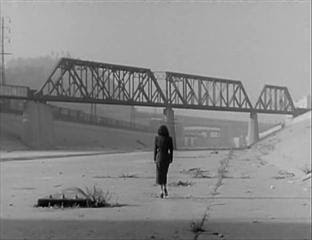
Diane walks off towards her own uncertain future.
The film is definitely a taught 74 minutes, skillfully mixing exposition with action and character relationships with plot. While the love between Joe and Diane seems to come out of nowhere, it is not atypical of movies from this time period. There is no time for courtship and it is always deep love at first sight with these movies.

The acting is pretty good. As noted in our review of The Threat, Charles McGraw was adept at playing men on both sides of the law. Here he gets to play a character that does both, going from law abiding investigator to the murderous brains of a major train robbery. All for the love of a woman.

In Roadblock, Charles McGraw plays an honest man who turns to crime to make money fast.
Joan Dixon was a Howard Hughes protégé when he owned a controlling interest in RKO, which explains her second-billing. Hughes tried and failed to make her a star in the vein of Jane Russell. Pretty, but not much of an actress, Dixon appeared mostly in Westerns opposite Tim Holt in her brief career. Diane in Roadblock is her best known role.

Lowell Gilmore plays the suave Kendall Webb. A Broadway actor in the 1930’s and early 40’s, Gilmore came to Hollywood in 1944, making his debut in Jacques Tourneur's war drama Days of Glory (1944) with Gregory Peck. He would next play the painter of The Picture of Dorian Gray (1945) in what had the promises of a very promising career. Gilmore’s Kendall Webb is a restrained, yet believable portrayal of an underworld figure.

Lowell Gilmore plays Kendall Webb in Roadblock.
Louis Jean Heydt, Harry, came to Hollywood in the 1930’s and appeared in over 100 films, most notably on this blog as the rather hapless Joe Brody in The Big Sleep (1946). A good actor, he’s sort of background in this film, even though he is the one who figures out the plot.

Want also to mention Milburn Stone who plays Ray Egan. Again, a minor role in the film, but it was interesting to see Stone play something/anything besides the Doc Adams character on television’s long-running western Gunsmoke, a role he played throughout the series TV run from 1955 to 1975.

Roadblock shares many of the film noir characteristics of Double Indemnity(1944), an insurance man gets corrupted by a woman and turned into a criminal, and this film does so without the same amount of flare that Billy Wilder brought to the project. The dialogue is noted as being hard edged, existential and cynical, the example always that’s used to illustrate this point is:

Joe - "What makes you the way you are?"
Diane - "What makes anybody the way they are?"
Joe - "You tell me."
Diane - "Where they got started maybe. I had a lot of jobs - modeling, clerking, secretarial work. I tried hard but it was no go."
Joe - "Does that make a chiseler out of you? Must have been something else."
Diane - "Whenever I got a job there was always a man who wasn't interested in my working ability."
Joe - "I understand that."
Diane - "Really? Coming from you that's a compliment."

I prefer the double entendre of Wilder and Raymond Chandler’s script:

Phyllis: Mr. Neff, why don't you drop by tomorrow evening about eight-thirty. He'll be in then.
Walter Neff: Who?
Phyllis: My husband. You were anxious to talk to him weren't you?
Walter Neff: Yeah, I was, but I'm sort of getting over the idea, if you know what I mean.
Phyllis: There's a speed limit in this state, Mr. Neff. Forty-five miles an hour.
Walter Neff: How fast was I going, officer?
Phyllis: I'd say around ninety.
Walter Neff: Suppose you get down off your motorcycle and give me a ticket.
Phyllis: Suppose I let you off with a warning this time.
Walter Neff: Suppose it doesn't take.
Phyllis: Suppose I have to whack you over the knuckles.
Walter Neff: Suppose I bust out crying and put my head on your shoulder.
Phyllis: Suppose you try putting it on my husband's shoulder.
Walter Neff: That tears it.

But writing pedigree aside, Roadblock was never meant to be a great movie. This was a typical low-budget programmer from RKO which has been elevated because of the acting and directing and ascending along with the nostalgia for the film noir genre. Well worth watching if you ever have the chance.

To read reviews of other Christmas films, please see our Christmas Review Hub.