Sunday, April 9, 2017

Your Name.


After its original release in Japan, Your Name., written and directed by Makoto Shinkai, proved itself a cultural phenomenon, breaking Japanese box office records and becoming the highest grossing anime film of all time. It released to critical and audience acclaim in its home country, which led to a US release by Funimation, both in English dubbed and subtitled formats, starting with a limited theatrical run. The success of the film intrigued me to where I watched it in the nearest location screening the dubbed version (I’m aware some locations only screened the subbed version). After my viewing, I can honestly say that the acclaim for Your Name. is well-deserved.

Mitsuha Miyamizu (Stephanie Sheh), a girl who lives in the country, and Taki Tachibana (Michael Sinterniklaas), a boy who lives in Tokyo, begin to have strange dreams about each other’s lives. These dreams are frequent enough that they eventually realize they are repeatedly swapping bodies, and lives, with each other. As the body swapping continues, they begin to leave more of an impact on each other’s lives while the true nature of their situation slowly comes together.

Though the story has elements seen in other films, including The Lake House and Freaky Friday, Your Name. manages to use these elements in an effective way. As the plot gradually ramps up, it’s easy to root for the main characters and want them to find each other and finally get together. The story manages to combine humor, drama and romance in an emotionally engaging and poignant combination, while also presenting its supernatural elements within a world that is itself presented as surprisingly realistic.

The realism of the film’s world is captured in simply phenomenal animation. Every single detail, down to the body language of the characters and appearance of anything from buildings to smoke, feels about as real as you can possibly get with traditional animation. This helps draw the viewer into the world and helps certain actions come off more realistically. What also helps is the expert use of lighting and a bright, life-like color palette.

In addition, the English voice acting is excellent in carrying the dialogue and allowing the viewer to become emotionally invested in the characters. Notably, the movie features a rather minimal use of music, as well as the occasional moment of complete silence, which increases the impact when music is an element in a scene and allows the original music by Radwimps to stand out, such as during a montage or the animated opening sequence.

Put simply, Your Name. is a must-see. While some plot elements have been seen in other movies, this film manages to combine them in an emotionally engaging way. The realistic setting is also an effective backdrop for the more supernatural elements, aided by some of the best traditional animation to date. With an anime film like this, it’s a shame that not a whole lot of people seem to be interested (if my screening was anything to go by). If you have the chance to see it during its theatrical run, do it as soon as you can. If you can’t, watch it on the inevitable home video release.

Saturday, April 8, 2017

Stubs – Shakespeare in Love


Shakespeare in Love (1998) Starring: Gwyneth Paltrow, Joseph Fiennes, Geoffrey Rush, Colin Firth, Ben Affleck, Judi Dench. Directed by John Madden. Screenplay by Marc Norman, Tom Stoppard. Produced by David Parfitt, Donna Gigliotti, Harvey Weinstein, Edward Zwick, Marc Norman. Run Time: 123 minutes. UK and US. Color. Romantic Comedy, Drama

Shakespeare’s plays have been used as source material for dozens of movies. But the Bard himself is also the subject of several films. Since there is very little actually known about the man himself, much is pure fiction. The idea of Shakespeare falling in love with an actress dates back to Alexandre Duval's "Shakespeare amoureux ou la Piece a l'Etude" (1804), in which Shakespeare falls in love with an actress who is playing Richard III. There is also a 1941 novel by Caryl Brahams and S.J. Simon, No Bed for Bacon, in which Shakespeare falls in love and finds inspiration for later plays.

Marc Norman independently developed his idea in the late 1980’s, when he pitched the idea to director Edward Zwick. Zwick, however, didn’t like Norman’s screenplay and hired Tom Stoppard, a playwright, best known for his own Shakespeare-inspired play, Rosencrantz and Guildenstern Are Dead, to improve it. A film version of the screenplay almost went into production in 1991 at Universal with Zwick as director and Julia Roberts set to play Viola. Even though sets were constructed, the part of Shakespeare had not been cast. Roberts insisted on having Daniel Day-Lewis play the part and when she couldn’t convince him to play it, she walked six weeks before production was to start.

Universal put the project into turnaround and that was the end of it for several years. Eventually though, Harvey Weinstein and Miramax would take up the production. But Zwick was replaced with John Madden, who had previously directed three films, Ethan Frome (1993), Golden Gate (1994) and Mrs. Brown (1997). The final film was the result of considerable reworking after test screenings. The ending was re-shot several times until Stoppard came up with a suitable conclusion.

When the film opens, William Shakespeare (Joseph Fiennes) is a sometime actor sometime playwright.

The story opens in 1593, William Shakespeare (Joseph Fiennes) is sometime actor sometime playwright working for Philip Henslowe (Geoffrey Rush), the owner of The Rose Theatre in London. Shakespeare is supposed to be working on a new play, a comedy called Romeo and Ethel, the Pirate’s Daughter. But he’s not writing, suffering from a bad case of writer’s block. Henslowe is in need of the play and a hit at his theatre because he owes money to Hugh Fennyman (Tom Wilkinson).

Philip Henslowe (Geoffrey Rush) owns The Rose Theatre in London and for
whom Shakespeare is supposedly writing a play for when the movie opens.

Fennyman decides to cut himself in on the production, figuring if it’s a hit, he’ll get back his money with the take. When Henslowe asks about the actors’ share of the profits, Fennyman, in Hollywood accounting traditions, informs him there is never a profit.

Henslowe needs a successful play since he's in debt to Hugh Fennyman (Tom Wilkinson).

Even though Shakespeare has only started writing the play, Henslowe has already begun auditioning actors. Ned Alleyn (Ben Affleck) and his fellow troupe of actors show up and are given parts. Alleyn, who is presented as having charisma to spare, is not given the Romeo part. Rather Shakespeare gives him the role of Mercutio, the one suggested earlier by Marlowe.

Ned Alleyn (Ben Affleck) is an actor being auditioned for a play Shakespeare has only begun to write.

In that day and age, all parts on stage were played by men. The role of Juliet is to be played by a young man whose voice has not yet changed, etc. But that doesn’t prevent Viola de Lesseps (Gwyneth Paltrow), the daughter of a wealthy merchant, who loves plays, from disguising herself and auditioning under the pseudonym Thomas Kent.

Viola de Lesseps (Gwyneth Paltrow) pretends to be Thomas Kent so she can audition for a play.

When Thomas suddenly leaves in a hurry, William follows Thomas back to her house. He leaves a note with Viola’s nurse (Imelda Staunton), asking Thomas to begin rehearsals at the Rose. Later that night, he slips into the house with the minstrels who are playing that night at the ball. Viola’s parents are arranging for her marriage to Lord Wessex (Colin Firth), an impoverished aristocrat with a plantation in the Virginia colony.

Viola's parents want her to marry Lord Wessex (Colin Firth), an impoverished aristocrat.

When Shakespeare sees Viola, he is love struck, but Wessex will have none of it and forcibly ejects Shakespeare, who tells him his name is Christopher Marlowe, from the ball. After that, Shakespeare uses Kent as a go-between, until Shakespeare discovers her true identity. After that, they begin a secret, but passionate affair. Having found his muse, Shakespeare begins writing. He gets a little help from his rival playwright, Christopher Marlowe (Rupert Everett), who helps him transform the play into Romeo and Juliet, even suggesting part of the plot and the name of one of the characters.

Shakespeare unwittingly falls in love with Viola, whom he knows as Thomas Kent.

But there are issues that seem to doom Shakespeare’s relationship with Viola. To begin with, Shakespeare reveals that he’s married to Anne Hathaway, who is back at Stratford-Upon-Avon with their children. While that might seem like a roadblock, it doesn’t compare with the fact that Viola is pledged to marry Wessex.

The affair between Shakespeare and Viola ends his writer’s block. Inspired by his muse, the play seems to flow out of him onto paper. Gone is Ethel, the pirates’ daughter, enter fair Juliet. And no longer a comedy, the play is transformed into the tragedy we know today. The lovers even act out some of the scenes that will find their way into the finished play, especially the post-wedding night of passion.

One way to break through writer's block.

Soon afterward, Marlowe is murdered while at a pub. Shakespeare figures Wessex had him killed and blames himself for having used his name. Wessex, upon hearing of Marlowe’s murder, thinks his rival for Viola’s heart is dead. Viola has only heard that a playwright has been killed and fears the worst. When she learns Shakespeare is still very much alive, she pledges her love for him.

Christopher Marlowe (Rupert Everett) is a rival playwright to Shakespeare.

When Viola is taken to Queen Elizabeth I’s (Judi Dench) court in Greenwich to get her approval for the wedding, Shakespeare goes along disguised as her female cousin. The Queen is presented as a bigger fan of the theatre than Viola. Her love of plays may be the reason theatres were allowed to stay open during her reign,

Queen Elizabeth I (Judi Dench) must approve Viola's marriage to Wessex.

While at the court, Shakespeare, dressed as the nurse, wages Wessex £50 that a play can capture the true nature of love. £50 happens to be the same amount Shakespeare needs to buy a share in Lord Chamberlain's Men, a troupe in which Shakespeare occasionally acts. The Queen, hearing the wager, declares that she will be the judge of the matter.

A woman actor was not only untraditional, it was against the law. When Shakespeare is spied kissing Viola, while she’s still dressed as Thomas, by an actor left out of the production, Edmund Tilney (Simon Callow), the Master of the Revels shuts the production down. The Master of the Revels was a  position within the Royal household, that, at the time, was responsible for overseeing royal festivities and for stage censorship.

With Viola’s true identity exposed, the play is now without a lead actor or a stage to perform it on. Shakespeare takes up the role of Romeo and Richard Burbage (Martin Clunes), the owner of the Curtain theatre, gives them a venue. The play is to premiere on the day of Viola’s wedding to Wessex and she can’t stay away and she runs away to the Curtain to watch. When the boy actor set to play Juliet cannot perform, Viola steps in.

Viola steps in when the boy to play Juliet cannot perform and Shakepeare plays Romeo.

The play is a great success, with the audience captivated by the performance, even though it turns out to be a tragedy at the end. But Viola’s presence on stage leads to Tilney’s return to arrest everyone involved. But the Queen is in attendance and pretends that Viola is her alter ego Kent and prevents Tilney from executing his orders.

But the Queen is also up front about Viola’s marriage to Wessex, which she is powerless to end. She orders Kent to fetch Viola, who is set to sail to the Virginia colony with her new husband, who has followed her to the Curtain. Seeing Wessex, she orders him to pay the £50 to Shakespeare as Romeo and Juliet proves a play can depict true love.

Even though Viola and Shakespeare have to say goodbye, he vows to immortalize her. The next play he writes, at least per the movie, is Twelfth Night and he imagines Viola as a castaway on a voyage to a strange land. In that play, one of the protagonists is named Viola and she is disguised as a boy.

The film received a positive reception when it was released and made $289 million at the box office against a budget of $25 million, making it a solid hit. The film was also well represented during awards season, winning seven Academy Awards, including Best Actress for Paltrow, Best Supporting Actress for Dench and Best Picture for the movie itself. The film also won three BAFTAs including Best Film and Supporting Actress (Dench); a Silver Bear at the Berlin International Film Festival; a DGA for John Madden; Golden Globes, SAG awards, and Writers Guild Awards. One of those rare films that combines commercial and critical success.

Obviously, the film itself is a work of fiction. As any fan of Shakespeare or any reader of our review will know, the Bard did not originate the story of Romeo and Juliet himself but rather adapted one that had been around for over a hundred years. But it is clear the intention of the filmmakers was not to tell a real story but to have fun with the lack of knowledge about the Shakespearean legend. The story is presented believably, though in its own universe which is full of historical inaccuracies.

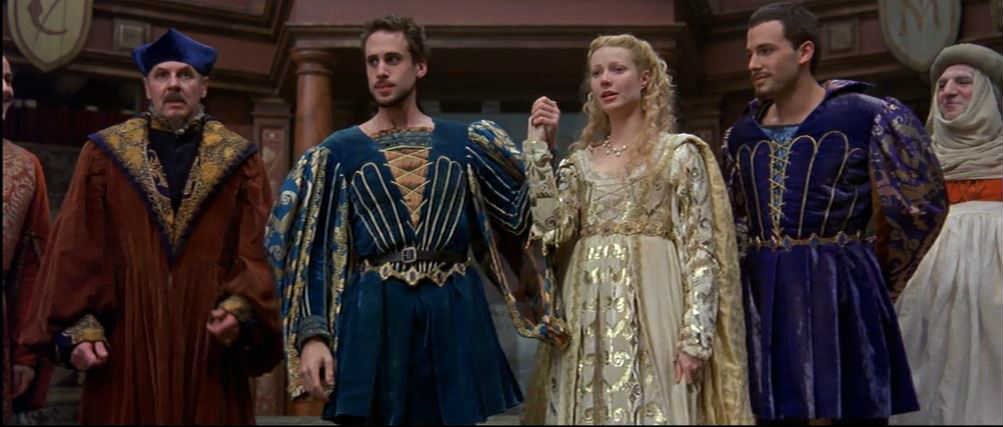
This is a very good film, from the inventiveness of the screenplay to the acting to the costume designs, which naturally won the Oscar for Best Costume Design, the way period films do.

Being a film that mostly takes place in London, there are almost as many British actors as in a Harry Potter film and all of them are very good. Joseph Fiennes, the young brother of Ralph, shows that good acting talent can be hereditary. He plays the Bard as a struggling playwright who is on the verge of failure before meeting his muse and becoming the legend we think we know today. He brings a real humanity and sense of humor, not to mention athleticism, to a role that has the potential for being quite stuffy.

Dame Judi Dench infuses Queen Elizabeth I with a personality one doubts many during her reign actually saw. Geoffrey Rush is actually an Australian, but he plays British subjects so often and so well that it’s hard to remember he’s from a different island nation. His Kings Speech co-star, Colin Firth, is also good as the self-absorbed loser, Lord Wessex. The list goes on and on, including Simon Callow, Tom Wilkinson, Rupert Everett, Jim Carter and Imelda Staunton, who are all good and believable in roles large and small.

Ben Affleck seems to be an odd choice to play Ned Alleyn. In retrospect, one doubts they ran out of British actors and had to draft an American to fill the part. But at the time, Affleck was in high demand, his previous film having been the Academy Award-winning Good Will Hunting (1997), in which he not only acted but won the Academy Award for Best Original Screenplay and Best Picture. In that context, he seems to be the perfect choice for Alleyn, who is presented as an actor on the top of his game, who gets a little bit of a comeuppance, when he isn’t cast as the lead in the new play. Affleck’s career has been a series of peaks and valleys since.

The star of the film, however, is another American actress, Gwyneth Paltrow. This is the pre-Goop, pre-self-absorbed Paltrow that we know today. She is good in the dual roles of Viola and Kent and I don’t have any argument with her winning the Academy Award, though I have not done an extensive look at her competition.

Gwyneth Paltrow stars in Shakespeare in Love.

After having watched several of Shakespeare’s plays made into films, I really enjoyed watching this film again. It is very delightful to reimagine a life and writing process so few know anything about. Given the unknown qualities of Shakespeare’s life, it is easy to have his character say or do anything the filmmakers wanted. There is gratefully nothing too embarrassing or outlandish Shakespeare is required to do. You can only imagine in lesser hands the crudeness that could be applied to his life.

While there is no real insight into the creative process, Shakespeare In Love is a fun period piece, an unlikely romantic comedy involving the world’s most famous writer. With the exception of some nudity, I would recommend this to anyone who is just learning about the Bard or had to endure studying one of his many plays in school and wants to see the mythical writer humanized in a fun way.

Saturday, April 1, 2017

Wall Street Kid HD


The original Wall Street Kid, released in 1990 on the NES, has become an interesting cultural item in the US. It is not a fondly remembered game in comparison to other famous NES titles like Tetris or Super Mario Bros., but it is still talked about if only to mention the odd notion of basing an entire game around the idea of playing the stock market. Despite this odd premise, which has roots in the Japanese series The Money Game, the second of which Wall Street Kid is the localization of, the game seems to have garnered enough interest to create a brand-new entry nearly 30 years later. This new installment, Wall Street Kid HD, continues its focus on the concept of the stock market, but puts a new twist on the Tycoon genre by adding open world elements.

As with the original Wall Street Kid, the player is to inherit $600 Billion from the wealthy Benedict family. Before they can receive the inheritance, however, they must prove themselves by taking a $500,000 loan and grow it into $1,000,000 using only the stock market. Along the way, they will also need to have enough money before certain dates to purchase key items including a boat, a house and a castle. At the same time, the player must pay attention to both their significant other and their physical health, improved by activities such as exercising and swimming.

The first twist Wall Street Kid HD places on the formula is the existence of not one, but two stock markets to invest in. One is influenced by the actions made within the game itself while the other is tied to the habits of everyone else playing Wall Street Kid HD, provided they have an internet connection. This twist provides the player with an incredible wealth of options for investment, which both provides more variety and presents a potential issue with the player-controlled stock. Due to the volatile nature of the secondary stock option, some players may be more hesitant to invest, especially with the possibility of players crashing the stock market either intentionally through a coordinated effort or unintentionally by independently making the same decisions. This concern, however, only really comes into play with the addition of open world elements to the Tycoon genre, though I’ll go into more detail later.

The more stable game-controlled stock, which
the player can actively manipulate.

The more unstable online-controlled stock.

Another twist on the Wall Street Kid formula is the need to control not one, but three stock portfolios, as there are two additional characters added to the game, each with their own storyline. Each character has their own reason for investing in the stock market and making it big and are surprisingly well fleshed out. However, instead of choosing one character’s story to play through, the player has to balance all three of them at the same time, forcing them to pay close attention to the timing of stock in their individual portfolios. Thankfully, it is possible to have them all invest in the same stock at the same time for a more reliable result, though the player should keep in mind that they all have different amounts of seed money at the beginning and all have different monetary goals even though the major dates are all the same.

In an odd twist for the Tycoon genre, the game also features open world elements that are accessed through the game’s mission system. If the stock market isn’t moving fast enough for you, you can partake in different missions which become available over time. These missions include, but are limited to, destruction of a competitor’s property or assassination of CEOs. Should you accept a mission using one of the three characters, you’ll be tasked with driving around the world to make the appropriate preparations for each mission before formally taking it on. Occasionally, the player will be tasked with having different combinations of each playable character work together, which can be mutually beneficial to each storyline, as well as reveal more about each character through the way they interact with each other. While this system is a very interesting leap forward for the genre, it does come with the drawback that missions still use time on the clock, time which also needs to be used buying and selling valuable stock. In other words, this mechanic can offer a potentially bigger payout through direct manipulation, but runs the risk of taking away valuable time to complete other tasks the player must balance.

In addition to stock market manipulation, the player must also make sure that each character has a healthy personal and social life. These include tasks such as working out and swimming or showering your significant other with gifts and attention. Like the missions, these segments are also completely playable, but the timer for these tasks operates a little differently. Rather than actively eat away at your time like the missions, the tasks take off a set amount of time like in the original Wall Street Kid, so no matter how long you take to play through each of these segments, it will still use up the same amount of time. This is certainly an odd choice, one that is only somewhat mitigated by the ability to toggle the playability of tasks.

The new Tennis activity.

As an upside, the game features phenomenal graphics which are leaps and bounds ahead of the NES version. Likewise, the sound design and voice acting are top notch, as is the original score by Celldweller, which uses elements from the original Wall Street Kid soundtrack while updating it for the modern day. The controls are also very functional during missions, although the driving can be a bit sensitive at times. This may be due in part to the sudden transition to 3D and HD after such a long period of time, but the grand level of polish this game has can only hide so much.

Overall, Wall Street Kid HD is a huge step forward for the series and shows a willingness to take risks with the Tycoon genre. A refined stock market system as well as a larger wealth of content make it surprisingly fun to play for hours on end, though as time goes on its blemishes begin to show. This includes the balance of time between playing the stock market or going on missions, which could have been improved upon to remove the rather large gamble enforced with the latter. Considering the length of an average playthrough with all of the interactive elements, it may be difficult to justify repeat runs with the campaign. Then again, some may be turned off by the feeling that they essentially reversed the formula of Grand Theft Auto V.

Happy April Fool’s Day!

Stubs - From Here to Eternity


From Here to Eternity (1953) Starring: Burt Lancaster, Montgomery Clift, Deborah Kerr, Donna Reed, Frank Sinatra. Directed by Fred Zinnemann. Produced by Buddy Adler. Screenplay by Daniel Tardoch. Based on the novel From Here to Eternity by James Jones. Run Time: 115 minutes. U.S.  Black and White. Drama, War, Romance

Just because there was a production code in effect in the 1950’s didn’t mean that movies didn’t take on controversial topics or adapt sensational literature. Case in point: James Jones’ debut novel, From Here to Eternity was published by Scribner’s in 1951. The novel, based on Jones’ own experience in the Army on the eve of World War II, shocked readers in its day with its frank language and sexual preoccupations of the characters. It is no surprise that it has been reported that prior to publication, every major studio turned down the opportunity to buy the explicit novel. However, a week after it hit the shelves, Columbia Pictures bought the rights for $85,000. Initially, the studio intended to star Broderick Crawford, Glenn Ford and John Derek in its adaptation. While the novel had to be reduced from 800 pages to a 150 page script, and much of its explicit sex had to be toned down, the resulting film would go on to win eight Academy Awards, including Best Picture.

Private Robert E. Lee Prewitt (Montgomery Clift) arrives at Schofield Barracks.

The movie starts in 1941, on the island of Oahu, Hawaii. Pvt. Robert E. Lee "Prew" Prewitt (Montgomery Clift) arrives at Schofield Barracks, to which he has voluntarily transferred after quitting the Bugle Corp stateside after being replaced as First Bugler. Prewitt reunites with his good friend, Pvt. Angelo Maggio (Frank Sinatra), before meeting with the by-the-books, but still fair, adjutant Sgt. Milton Warden (Burt Lancaster). Warden runs G Company for commander and Regimental boxing head, Capt. Dana Holmes (Philip Ober). Holmes makes a brief appearance in the office before “heading to town”, which seems to be code word for drink and carouse. He meets with Prewitt, the same as he says he does with all his new men. Holmes is aware of Prewitt's success as an Army boxer and pressures him to join the company boxing club, but Prewitt steadfastly refuses, for reasons he doesn’t elaborate on.

Deborah Kerr plays Holmes' wife Karen in From Here to Eternity.

Warden cautions Prewitt against opposing Holmes, but Prewitt stubbornly declines to box. Later, Warden sees Holmes's attractive wife, Karen (Deborah Kerr), visiting the post and learns of her "reputation" from another non-commissioned officer. Upon discovering that Prewitt refuses to box, the other soldiers in the boxing club harass him relentlessly with Holmes' approval. Prewitt is made an example of by the various drill sergeants he comes into contact with during drills. Maggio protests, only to be disciplined as well, as the two of them are forced to run laps holding their weapons high.
One afternoon, while Captain Holmes is off the base again, Warden visits Holmes' cottage on a pretext of Army business. Warden finds Karen beautiful and doesn’t like to see her, as he says pointedly, go to waste. Karen claims not to be what she seems, but when Warden starts to leave, she stops him. She gives into his advances and they kiss.

Warden receives several warnings from other non-coms, such as Sgt. Maylon Stock (George Reeves), about Karen’s looseness, but he goes through and meets with her. She tries to pick a fight with Warden, but he won’t have any of it.

At the New Congress Club, Prewitt meets Lorene (Donna Reed).

On pay day, Maggio takes Prewitt to the New Congress Club, where Prewitt meets a club hostess, Lorene (Donna Reed), aka the Princess. Prewitt is immediately taken by her beauty. A drunken Maggio riles "Fatso" Judson (Ernest Borgnine), sergeant of the stockade, who is playing the piano when Maggio starts the jukebox. Prewitt prevents a fist fight between them, but loses Lorene’s attention to another soldier, Bill.

Prewitt gets in between Fatso (Ernest Borgnine) and Maggio.

Meanwhile, Warden and Karen continue their date. Both are wearing swimsuits under their clothes and they go to a secluded beach for a nighttime dip in the ocean. After their dip, we’re treated to the movie’s iconic shot of Karen and Warden making out on the beach as the waves crash over their bodies. Karen admits to Warden that there have been a lot of other men in her life.

Warden (Burt Lancaster) and Karen share a kiss and one of the most iconic scenes in all of film history.

He reminds her of her past relationships with men and with Sgt. Stock in particular. Hurt, she tells him that after two years of marriage to Holmes and pregnant with his child, she learns of his infidelity and through his drunken negligence she miscarries and can no longer have children. She’s been going out with other men looking for someone to really love her.

Prewitt has fallen in love with Lorene and can't stay away from her.

Back at the New Congress Club, it is obvious Prewitt has fallen for Lorene, but she is attracted to him as well. She tells him about her past and how she came to the New Congress Club. She tells him that she doesn’t really like the work and is just doing it for the money. But it’s obvious, even to a drunken Maggio, that there is something between the two of them. Prewitt confides in Lorene that he refuses to box because he once blinded a friend while sparring.

Prewitt gets punished for his refusal to box.

Prewitt steadfastly refuses to box, even though the sergeants of the company ratchet up the harassment. His refusal to fight infuriates Holmes, who views having a winning boxing team as important to his advancement in the Army. He punishes Prewitt with an extra long march in full pack thinking it will make him capitulate. But it doesn’t work, so Prewitt is sent again. Holmes tells Warden to go so far as to prepare orders to have Prewitt court-martialed. Instead, Warden convinces Holmes to apply "the treatment," using grueling physical punishment and extra duty to break him.

Prewitt shows off his skills with a bugle for Maggio (Frank Sinatra).

Warden tries to convince Prewitt and the two develop a certain respect for one another when even after a month Prewitt doesn’t break. One evening at Choy's bar, other soldiers try to convince Prewitt to complain, but he doesn’t want to give them the satisfaction. Prewitt surprises the men by demonstrating his skill with the bugle, which he makes sound like a trumpet.

Warden breaks up a fight between Fatso and Maggio.

Fatso arrives and makes a point of taunting Maggio, who is too stupid not to take the bait. Warden breaks up the fight before it gets going. When Fatso is slow to comply, Warden offers to take him on. Fatso backs down. But Fatso can’t resist threatening Maggio should he ever end up in the stockade.
Warden knows Prewitt has gone “dippy” for Lorene and arranges for a weekend pass so he can go visit her. But before Maggio can join him on the bus, he gets dragged into guard duty, despite the fact he has a pass.

Prewitt wants to see Lorene, but she has her job to do and can’t get away. Mrs. Kipfer (Barbara Morrison) makes a point that Lorene, who’s real name is Alma, is needed inside. Still, Lorene leaves work to meet Prewitt at another bar. She can’t understand Prewitt's putting up with the treatment.
While they’re talking, Maggio shows up at the bar. He has gone AWOL from guard duty. Prewitt tries to get Maggio to go back to base, but Maggio gets arrested by MPs. Maggio gets court-martialed and sentenced to the stockade for six months. Fatso is only too happy to see Maggio walk through the door.

Prewitt and Lorene continue to see each other. She gives him the key to the cottage she’s rented with a roommate, Georgette (Kristine Miller), and tells him he can use it even if she’s not there.

Meanwhile, Karen continues to see Warden. They are obviously now very much in love, but when other men from the camp show up, Warden ushers her out of the bar. Karen tells Warden that they can’t go on much longer. They try to figure out what they can do. She encourages Warden to apply for promotion, explaining that as an officer, he can be shipped stateside where they could marry after she divorces Holmes.  Warden, who hates officers, still tentatively agrees to her plan.

Prewitt proposes to Lorene, but she scoffs at his idea. She thinks marrying him will ruin things. He wants to be a sergeant and the only way is to fight. Still Lorene is not convinced. She tells them that they love each other now but may not back in the states. She tells him honestly that she can’t marry him because she doesn’t want to be the wife of a soldier. She has other goals in life and wants to meet and marry a proper man and raise a proper family. But Lorene still needs Prewitt, because she’s lonely.

Meanwhile, Holmes has discovered that Karen is having an affair, but doesn’t know who and she won’t say. He’s still convinced that it’s a civilian.

A soldier who had been in the stockade with Maggio tells Prewitt about his treatment at the hands of Fatso. While they’re still talking, Sgt. Ike Galovitch (John Dennis), head of the boxing team, forces Prewitt into fighting one afternoon, quickly drawing a crowd who cheer Prewitt on. Prewitt does fight back, but refuses to hit him in the face. Holmes watches the fight, but doesn’t break it up until Prewitt starts to hit Galovitch in the face and win. Holmes’s inaction is noticed by his superiors on the base.

Holmes tries to punish Prewitt until the other sergeants put the blame squarely on Galovitch. In that case, Holmes wants to just forget about the incident. Prewitt still refuses to join the boxing team.
That night, both Prewitt and Warden get drunk and end up sitting together on a camp road sharing a bottle. Warden admires Prewitt, but warns him they’re going to get him sooner or later. It is obvious by now they’ve developed respect for one another. They confess their problems with women to each other.

A severely beaten Maggio stumbles out of the woods and collapses into Prewitt's arms. He tells Prewitt about Fatso's brutal abuse and that he had to get out, he had to escape. He warns Prewitt to be aware of Fatso and then he dies from his injuries.

Maggio tells Prewitt about the punishment he's received at Fatso's hand.

While Prewitt plays taps for his fallen friend, it seems the rest of the company reflects about themselves.

On his next free day, Prewitt waits for Fatso outside the New Congress Club. Fatso doesn’t know what Prewitt wants to talk to him about, but he’s unremorseful about having contributed to Maggio’s death. They each have knives and even though Fatso is bigger, Prewitt is a more skilled fighter. Using his boxing skills, Prewitt knocks Fatso down and knifes him to death in an alley behind the club.

Seriously wounded himself, Prewitt staggers to Lorene's for help and remains there for several days.

Warden carries Prewitt on the active list for as long as possible, even when asked about it by Prewitt’s Sgt., Baldy Dohm (Claude Akins). The camp commander, Gen. Slater (Fay Roope), who has investigated the fight between Prewitt and Galovitch, accuses Holmes of applying illegal measures against Prewitt and informs him he must either resign from the Army or be court-martialed. The new commander, Capt. Ross (John Bryant), stops the boxing and busts Galovitch to private.

Karen tells Warden that Holmes has asked her to return stateside with him and inquires about Warden's commission. He admits he has not submitted the request because he doesn’t want to and can’t be an officer. He tells Karen that he loves her, but she breaks off their relationship and returns to her husband.

Meanwhile, Prewitt remains AWOL at Lorene’s.

But the next morning, December 7, 1941, the Japanese attack Pearl Harbor and Schofield base doesn’t escape bombardment. Warden organizes his company, fearing the Japanese will invade by land, too. He and the other sergeants go up on the roof and fire at the Japanese planes as they go fly by, downing one of the swarm.

On the rooftop, Warden  and company fire at the Japanese airplanes.

Prewitt, still weak, hears of the attack over the radio and the possibility of an invasion. He is determined to rejoin the army despite Lorene's hysterical protests. She even offers to marry him if that’ll keep him from going back. But he feels a duty as a soldier to fight. Moving under the cover of night, he tries to slip back into camp, but is shot by a guard on patrol.

Karen and Lorene meet onboard a ship heading back to the states.

A few days later, sailing on one of the first evacuation ships, Karen meets Lorene on deck as they watch Hawaii disappear in the distance. Lorene tells Karen her fiancé was a bomber pilot, who died bravely during the attack. But Karen recognizes the name Robert E. Lee Prewitt, from Warden having spoken about him.

The acting by the entire cast is good in From Here to Eternity, starting with Burt Lancaster.

Do you know who is good in this movie? Everyone. You can start with Burt Lancaster and work your way down the credits. All the actors, even the former singer, put in really good performances and create unforgettable characters. All of the leads, Lancaster, Kerr and Clift, received Academy nominations and the two main supporting actors, Reed and Sinatra, won in their categories. But a case can be made for Ernest Borgnine, who we all remember as either the jolly fat man from McHale’s Navy or the moody Marty. Here he plays the short-tempered bigoted Sgt. “Fatso” Judson and is very convincing in the part.

Ernest Borgnine plays Fatso the opposite of the jolly fat man he played on McHale's Navy.

This is one of those Hollywood films that we studied at USC in Cinema Studies, not for the aesthetics, but to read it from the confines of the New Discourse. It’s about as much fun as it sounds. I remember a lot being made about the fact Deborah Kerr is on top of Burt Lancaster during part of that iconic kiss. Something like the dominant male role being subverted or some other nonsense that gets in the way of enjoying the film. But I do remember volunteering to look into the career of Fred Zinnemann, the director And this was before such useful internet tools like IMDb or Wikipedia or the entire internet for that matter.

Thankfully, those days are over and information is readily available. Zinnemann was born in Vienna, Austria-Hungary. While studying to be a lawyer, Zinnemann was drawn to films, eventually becoming a cameraman and working with the likes of Billy Wilder and Richard Siodmak on People on Sunday (1929). Soon afterwards, he came to America to study film. He worked with documentarian Robert Flaherty and was drawn to realism and authenticity as a filmmaker, traits Flaherty didn’t always show in his documentaries.

Zinnemann settled into making short films at MGM from 1937 until 1942. Several of his shorts, including Mothers Might Live (1938) and Forbidden Passage (1941), would receive nominations and win Academy Awards for short subjects. In 1942, he graduated, so to speak, to B-Movies with Kid Glove Killer starring Van Heflin and Eyes In the Night, starring Edward Arnold, Ann Harding and Donna Reed. In 1944, he made The Seventh Cross, for which supporting actor Hume Cronyn would be nominated for his performance, the first of some 65 Academy nominations Zinnemann films would receive, 19 for acting. Other big films Zinnemann would helm in his career included The Search (1948), High Noon (1952), Oklahoma! (1955), The Nun’s Story (1959), The Sundowners (1960), A Man for All Seasons (1966), The Day of the Jackal (1973) and Julia (1977). His last film would be Five Days One Summer (1982).

I’m a little surprised at just how much I love From Here to Eternity. All the characters seem to be well rounded, but they’re all broken people looking for someone else to fill the void in their lives. There is a real sense that war is coming and everything we know will be forever changed. It’s almost as if the characters in the film are trying to get in as much living as they can before the whole world changes on them.

I would definitely recommend From Here to Eternity to anyone that likes a good movie. This is definitely one of the best to come out of Hollywood in the early 1950’s.

Saturday, March 25, 2017

Stubs - Blazing Saddles


Blazing Saddles (1974) Starring: Cleavon Little, Gene Wilder, Harvey Korman, Madeline Kahn, Slim Pickens, Dom DeLuise, Mel Brooks. Directed by Mel Brooks. Screenplay by Mel Brooks, Andrew Bergman, Richard Pryor, Norman Steinberg, and Al Uger. Produced by Michael Hertzberg. Color. U.S.A. Run Time: 92 minutes. Comedy, Western.

With the passing of Gene Wilder, one of the films that kept being mentioned was Blazing Saddles. To be honest, when I think of Blazing Saddles, which is hardly ever, I think more of Cleavon Little, but Wilder is very prominent in the film. It had been several years since I had seen the film and it’s one of those films that gets referenced quite a bit, so I thought it was time to watch it again.

There were many things that I had forgotten about the film and others that are hard to forget  (I’m thinking about the infamous campfire scene.) Originally considered as a parody of the Western and perhaps the death knell of that genre, the film was quite a big success, earning $119.6 million on a budget of $2.6 million.

One of the major themes that the film drives home with typical Brooks-ian overstatement is racism and not against the American Indian, but against Blacks and other minorities in the Old West, but mostly Blacks. As anyone who took American History in high school knows, Chinese workers were imported to help build the intercontinental railroad. According to this film, working next to them, if not downright outnumbering them, were recently freed Blacks. And of course, those in charge not only didn’t appreciate them, they freely used the N-word when talking to and about them.

The "N' word flies freely in Blazing Saddles.

It's 1874 when the movie opens and the construction of the railroad has hit a snag. Its planned path, it appears, will take it into a patch of quicksand. Taggart (Slim Pickens) has two of his black workers confirm this, Charlie (Charles McGregor) and Bart (Cleavon Little), being sure to fish out the handcart when it gets stuck, which is deemed more valuable than Bart. In retaliation for the sentiment, Bart knocks Taggart out with a shovel. Such an offense is deemed punishable by death and Bart is taken into custody.

Taggart, with his head still wrapped in a bandage, meets with the corrupt Hedley Lamarr (Harvey Korman) the State’s Attorney General, who also happens to have a financial interest in the railroad. Taggart explains to him that the best alternative route would take the railway into Rock Ridge, a small white township. In order to get them off the land, Lamarr sends Taggart and his crew into the town where they loot the stores, destroy the crops and murder the sheriff.

Taggart (Slim Pickens) and Hedley Lamarr (Harvey Korman) go to visit the governor.

The townspeople meet in the church to discuss what to do next, with the Reverend Johnson (Liam Dunn) encouraging everyone to pick up stakes and flee. But Gabby Johnson (Claude Ennis Starrett Jr.), a wizen old man, gives an impassioned and mumbled speech, Olson Johnson (David Huddleston) praises as “authentic frontier gibberish,” which causes everyone to change their mind. Instead of fleeing, the town demands Hedley Lamarr send them a new sheriff.

Gabby Johnson (Claude Ennis Starrett Jr) gives an impassioned gibberish-filled speech.

But Lamarr gets the idea to send a new sheriff that will surely force the town to back down; a black sheriff, saving Bart from the gallows. With the approval of Governor Lepetomane (Mel Brooks), Bart is sent to Rock Ridge.

Bart (Cleavon Little) is the new sheriff in town, much to the chagrin of the town.

The town has thrown out all the stops in their welcome ceremony for the new Sheriff and is in total dismay when Bart rides up with his Gucci saddlebag. More N-words fly freely and the town seems intent on killing him, that is until Bart turns his gun on himself. Fearing that the sheriff is in real danger, the townspeople back down, laying down their weapons, allowing Bart to escape into his office.

Bart has to pull a gun on himself to get out of this mess.

It is in the jail that Bart finds Jim (Gene Wilder), whom he learns was formerly known as the Waco Kid, a quick-draw gunfighter. The next morning, Bart tries again to win over the townsfolk, but retreats back to the jail when an elderly woman shouts racial epithets at him.

Jim (Gene Wilder) is a quick-draw gunfighter who befriends Bart. 

Later, while enjoying a dinner of beans around the campfire, Taggart gets the idea to send in Mongo (Alex Karras), a near-Neanderthal, into Ridge Rock to kill Bart. But Bart manages to both subdue and befriend Mongo. Likewise, German seductress-for-hire Lili von Shtupp (Madeline Kahn) falls for Bart as well.

Mongo (Alex Karras) is sent into town by Taggart, but ends up an ally of Bart's.

Lamarr, now really mad that all his plans are foiled, hatches an even larger plan including the usual roughnecks supplemented by common criminals, members of the Ku Klux Klan, and if that wasn’t anachronistic enough, Nazi soldiers from the future.

But Bart is not to be outsmarted. With the help of the Black and Chinese railroad workers, who help in exchange for acceptance by the whites in the town, build a fake Rock Ridge three miles east of the real town. To give the townspeople enough time to construct replicas of themselves, Bart, Jim, and Mongo put up the “William J. Le Pétomane Memorial Thruway", which delays the raiding party as they search for dimes for the toll.

Once past the tollbooth, the marauders descend on fake Rock Ridge and wreak havoc. But the dummies are booby-trapped with bombs, which Jim, using his sharpshooting skills, detonates. Following the explosions, the townsfolks descend on Taggart’s gang.

Gunfights in the Old West were never like this.

The ensuing brawl literally breaks the fourth wall, as the fight spills over into neighboring sets, including one in which director Buddy Bizarre (Dom DeLuise) is directing a Busby Berkley-type musical number, of course, not of a subject Berkley would have handled. The fight flows out into the street outside of Warner Brothers’ Burbank studios. Lamarr hails a cab and tells the driver to "get me out of this picture."

Dom DeLuise makes a cameo as a Buddy Bizarre, a choreographer.

Next stop is Grauman’s Chinese Theater, which happens to be playing the premiere of Blazing Saddles. But as soon as Lamarr settles down in his seat, Bart arrives outside the theater on horseback. He confronts Lamarr and, in a spoof of the classic Western gunfight, shoots Lamarr in the groin.

Bart and Jim then go into the theater and watch the movie, in which Bart is telling the townspeople that his work there is done and that he’s moving on. Riding out of town, Bart finds Jim still eating the popcorn from the theater and invites him to accompany him to “nowhere special.” The two ride into the sunset in the back of a black stretch limousine, which drives them off.

Like most of Brooks’ work, post The Producers, Blazing Saddles is filled with verbal and sight gags in a throw-the-spaghetti-at-the-wall-to-see-if-it-is-ready approach to humor; how funny it is depends on how much you think sticks to the wall. Some consider the film to be very funny, in fact. The film ranked No. 6 on the American Film Institute's 100 Years...100 Laughs list. Everyone is entitled to their opinions.

An early example of a mainstream film with gross-out humor, a trend I’m afraid has only grown geometrically, Blazing Saddles doesn’t have the shock value it once may have had. Passing gas on film has come to be standard fare even for so-called children’s films. It was an easy gag for Brooks to use; the low hanging fruit of comedy. Given his writing background on television and film, I would have expected something a little more highbrow. 

The humor is a sort of Catskills meets Burlesque mix here with farting, women’s breasts, a man caught in mid-coitus running around with his pants down, a man punching a horse and racial epithets carrying the load. So much for raising the bar on the discourse.

Mel Brooks plays Governor Lepetomane in this "raunchy" comedy.

While there were five writers, including the late stand-up comedian Richard Pryor, credited on the film, as director, Brooks made the final decisions on what to include. Brooks got his start as a writer on television, perhaps best known for his work on Sid Caesar’s Your Show of Shows, which also featured Carl Reiner and Neil Simon on its staff. Reiner and Brooks also partnered for their now famous 2000-Year-Old Man act on The Steve Allen Show and on record, the latter which sold a million copies in 1961. In 1965, Brooks would team with Buck Henry to create The Man From U.N.C.L.E. spoof, Get Smart, which starred Don Adams.

Following the success of his first film, The Producers (1968), Brooks made The Twelve Chairs (1970). Loosely based on a Russian 1928 novel The Twelve Chairs by Ilf and Petrov, the film was not a critical or financial success. Brooks found no takers for his next script, another adaptation, this time of Oliver Goldsmith's She Stoops to Conquer.

Brooks, with the help of agent David Begelman, set up a deal with Warner Brothers. Brooks was hired along with Pryor, Andrew Bergman, Norman Steinberg, and Al Uger as script doctors for an unproduced script, Tex-X (a play on Black Muslim leader, Malcolm X), written by Bergman. Brooks posted a sign in the writer’s room, "Please do not write a polite script". (He apparently got his wish). Pryor, who was Brooks’ first choice to play Bart, left the writing process after the first draft. The film title changed, finally settling on the title, “Blazing Saddles.”

When it came time to cast the roles, the studio, citing his public issues with drugs, refused to approve financing if Pryor was the star. Other casting issues included the role of Hedley Lamarr, which was turned down by both Johnny Carson and Gene Wilder. His luck changed with his ad looking for a Frankie Laine type to sing the opening song and Laine offered his services.

But Brooks’ troubles with the studio over the picture continued. Warner Bros. objected to the constant use of the word “nigger,” the scene of Lili von Shtupp seducing Bart in the dark, the flatulent campfire scene and Mongo’s punching out of a horse, amongst other issues. But Brooks had approval over final content and refused to make many of the changes the studio wanted. Actress Heddy Lamarr would later sue Warner Bros., claiming the running gag on her name infringed on her right to privacy. She settled out of court for a small sum and an apology.

The film features a large cast of movie, television and even music stars. Count Basie and his orchestra play “April in Paris” out in the desert, when Bart is on his way to Rock Ridge the first time, one of the several anachronisms that populate the film.

Harvey Korman, perhaps best known for his role as sidekick to comedienne Carol Burnett on her long-running TV variety show, plays the lead villain here. I don’t think this film shows Korman at his best. I don’t think anyone really comes off at their best. I found myself feeling a little sorry for Slim Pickens, especially in those scenes where he has to grovel to Korman’s Hedley character.

While this film was often cited in Gene Wilder’s obituaries, again one of the reasons for us watching the film in the first place, his character is really almost superfluous to the story. His blue eyes and bright demeanor are not really enough to justify his presence in the film. Oh, his character’s supposed skills with a gun comes in handy at the very end, but it wouldn’t have taken much to have given Bart those skills.

Madeleine Kahn was apparently a little weary of Brooks in the beginning, balking at his request during the casting session to show her legs. But she would not only appear in Blazing Saddles, but also in Young Frankenstein (1974), High Anxiety (1977) and History of the World, Part 1 (1981). In this film, she’s playing a character based on Marlene Dietrich’s Frenchy character in Destry Rides Again (1939). While Kahn would receive a second consecutive Academy Awards nomination for Supporting Actress for the role, she does play it over the top, something that she would continue to do while she worked with Brooks.

Madeleine Kahn plays a Marlene Dietrich inspired role in Blazing Saddles.

The film’s star, Cleavon Little, seemed like a choice a little out of left field when he was cast as a replacement for Richard Pryor. Little, who had appeared on Broadway and on television, had never appeared in a film prior to Blazing Saddles. While he would receive a BAFTA Awards nomination for the most promising newcomer as a result, Blazing Saddles would be the most successful film he would ever star in. While Little does an okay job in a slightly awkward role, one can only imagine what Pryor might have done with the role. It may not have been enough to save the film; it might have made it more memorable. If Pryor had made the film, it would have been the first pairing with Wilder; the two would make four movies together, starting with Silver Streak (1976).

When the film was released it got mixed reviews. Some like Vincent Canby wrote that Brooks “With his talent he should do much better than that.” On the other hand, critic Roger Ebert gave the film four stars, calling it an audience picture.” It has a 90% rating on Rotten Tomatoes for anyone who cares about such things.

This was the second viewing for me and I honestly can’t remember how I felt about it the first time I saw it. However, my subsequent viewing did not make me a fan. While I like good slapstick, I draw the line at gross-out humor. They are truly the cheap laughs that are guaranteed to tickle funny bones, except now they seem to be the preeminent form of comedy. Why try to be witty when you can just cut to a bunch of cowpokes farting around a fire or have a man punch out a horse? I guess I prefer my humor with a little more thought and finesse, two things Blazing Saddles is sorely lacking.

Also working against it is that the bits aren't new anymore. No doubt there was a shock value when the film was released. I’m sure no one thought that Brooks would have stooped so low, but I don’t believe anyone has such illusions anymore. While he is a very funny man, Brooks will also do or say anything that he thinks will get a laugh. Again, I go back to my throw spaghetti on the wall; some sticks, some doesn’t. On a second viewing, I found that most of the gags didn’t land.