Saturday, December 13, 2014

Stubs – A Christmas Story


A Christmas Story (1983) Starring: Melinda Dillon, Darren McGavin, Peter Billingsley. Narrated by Jean Shepherd. Directed by Bob Clark. Screenplay by Jean Shepherd, Leigh Brown, Bob Clark. Based on the book In God We Trust, All Others Pay Cash by Jean Shepherd. Produced by Rene Dupont, Bob Clark. Run Time: 93 minutes. U.S. Color, Christmas, Comedy

Most of the time, when we think of Christmas movies, we’re talking about films like It’s A Wonderful Life (1946), The Bishop’s Wife (1947) or one of the many films based on Charles Dickens’ A Christmas Carol. But not all classic Christmas movies are that old or black and white. Case in point, A Christmas Story (1983), based on a book by Jean Shepherd, In God We Trust, All Others Pay Cash. Like It’s a Wonderful Life, which NBC shows every year in December and usually in a marathon at some point, A Christmas Story is shown every year by TBS often in a 24-hour marathon.

Jean Shepherd was an American story-teller as well as a radio and television personality, sort of his generation's David Sedaris. Like some of Sedaris’ work, Shepherd wrote humorous stories about growing up. Interestingly enough, both are perhaps most famous for stories about the Christmas season. In God We Trust, All Others Pay Cash was a series of short stories, first spoken by Shepherd on his radio show and published in Playboy magazine, before being published in book form in 1966.

The story takes place in Hohman, a fictionalized version of Hammond, Indiana, Shepherd’s hometown, during his youth, roughly the late 30’s/early 40’s (no actual year is given). The Parker family is a typical white family of the time, consisting of a housewife/mother (Melinda Dillon), a foul-mouthed father, aka The Old Man, (Darren McGavin) and two children, the nine-year-old Ralphie (Peter Billingsley) and his younger, more immature brother Randy (Ian Petrella).

Christmas is coming soon and after seeing it in the display window of a downtown department store all Ralphie wants is a Red Ryder Carbine Action 200-shot Range Model air rifle with a compass in the stock and “this thing which tells time.” But it’s a hard sell. His dilemma is how to bring in it up to his parents. He knows that he has to be delicate in his approach. He first tries to plant an ad for the rifle in his mother’s Look magazine.

Ralphie (Peter Billingsley), far left, sees what he wants for Christmas in a store window.

When sitting around the kitchen table, which is where the Parker family eats all their meals, he tries to be nonchalant about the need for such a gun, by mentioning a sighting of bears in town. Since that tact isn’t working, he tries to change the subject, but when his mom asks him what he wants for Christmas, he blurts out the Red Ryder BB gun. Of course, his mother retorts with “you’ll shoot your eye out” and Ralphie asks for tinker toys instead.

Ralphie continually blows his chances to drop a hint about what he really wants for Christmas.

Not everything about the movie is about the quest for the Red Ryder. The film tries to show the comings and goings of Ralphie, Randy, and their neighborhood friends, who attend the same school, Flick (Scott Schwarz) and Schwartz (R.D. Robb). One such incident revolves around a bet between Flick and Schwartz and whether or not your tongue would freeze against a cold flagpole. Flick doesn’t think it would and resists Schwartz's daring to prove it. But when Schwartz triple dog dares him, in front of the schoolyard, Flick has no choice; lo and behold it does stick. And when the bell rings, his classmates leave him stranded there until the teacher sees him and the fire and police departments are called.
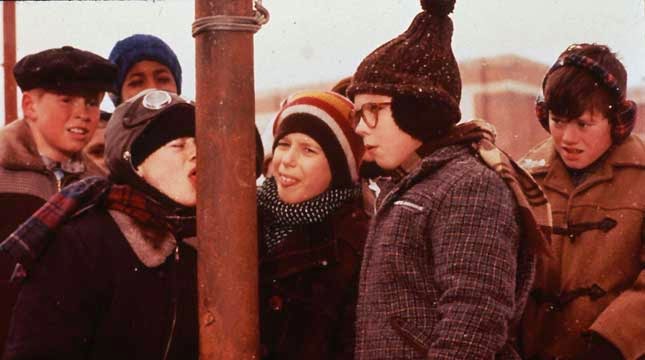
Flick (Scott Schwarz) gets triple dog dared by Schwartz (R.D. Robb) into sticking his tongue on a frozen pole.

The boys are also harassed by neighborhood bully Scut Farkus (Zack Ward) and his minion Grover Dill (Yano Anaya). Farkus doesn’t seem to be after money or goods, he just really enjoys terrorizing these smaller and younger kids.

Bully Scut Farkus (Zack Ward), right, and his minion, Grover Dill (Yano Anaya).

There are other touches from the era. Little Orphan Annie was a popular daily comic strip that ran from 1924 until 2010. Long before it got the Broadway musical treatment as Annie, it was serialized on the radio. Originally sponsored by Ovaltine, listeners, mostly children could redeem proofs of purchases for a secret decoder ring which would allow them to decode messages from the show. Ralphie, overjoyed by finally receiving his ring, is quickly disappointed when the first secret message he decodes is “Be sure to drink your Ovaltine.”

Father, who beyond being a furnace fighter and curse word connoisseur, is also a dedicated contest entrant. Finally, he receives notification that he's won a major prize. Anticipation runs high as to what’s in the box that gets delivered after dinner. Mother is visibly disappointed that it turns out to be a lamp made from a plastic replica of a woman’s leg in fishnet stockings and high heels. Father, happy to have finally won something, wants to proudly display it in the front window, much to Mother’s chagrin. Later, while Father is busy fighting the furnace, Mother “accidentally” knocks the lamp over, breaking it. Father tries unsuccessfully to glue it back, but it proves to be hopeless.

The Old Man (Darren McGavin) proudly shows off his
hideous prize. Mother (Melinda Dillon) is not as pleased. 

Next up is getting a Christmas tree, for which there doesn’t seem to be much selection, though they do haggle the price down a few dollars. But the big incident happens on the way home when the car has a flat. Thinking Ralphie is old enough to help, Mother sends him out to help their father with changing the tire. Father, who has always visioned himself working in the pits at a car race, is slowed down by Ralphie’s assistance. But things go from bad to worse when the hubcap Ralphie is holding gets knocked out of his hands and the lug nuts it contains go flying into the snowy night. Ralphie sums up the incident by using an expletive, aka the F-word, fudge.

Father rats him out to Mother and Ralphie is forced to have his mouth washed out with soap until he confesses who taught the bad word. He chooses a friend rather than blaming his ever cursing Father.

Ralphie gets his mouth washed out with soap for saying a bad word.

Back on his quest for the Red Ryder, Ralphie tries to go around his mother and hopes to use a theme paper they have to write for school to get his teacher, Miss Shield (Tedde Moore), on his side. In his paper, he pleads his case for the Red Ryder Carbine Action 200-shot Range Model air rifle with a compass in the stock and “this thing which tells time.” However, his hopes are dashed when his teacher echoes his mother’s sentiment, writing at the bottom of his C+-graded paper that he would probably shoot his eye out with the gun.

Disappointed beyond belief, Ralphie is in no mood for his daily dose of bullying from Farkus. Losing it, Ralphie fights back, knocking Farkus to the ground and wailing on him. The other kids watch in amazement until Randy goes to get their mother. Farkus is left bleeding on the sidewalk while Mom takes Ralphie home and tries to calm him down.

Ralphie wails on Farkus while his friends watch on in amazement.

Ralphie and Randy are both worried about their father’s reaction, but when he gets home, both are pleasantly surprised when Mother downplays the incident and tells Father that she’s taken care of everything.

Having failed to persuade his mother or his teacher, Ralphie hits upon Santa Claus, who, after all, has the final say about Christmas gifts. But the line to see Santa is long, the store is closing and lap time is at a premium..Once again Ralphie blows his chance and goes mute when asked what he wants. Shaking his head "yes" when Santa suggests a football, Ralphie is put on the slide down from Santa’s perch before finally coming to his senses. Scrambling back up the slide, he asks Santa for the Red Ryder Carbine Action 200-shot Range Model air rifle with a compass in the stock and “this thing which tells time.” Little Ralphie sells it with a smile, but is crestfallen when Santa, sounding like his mother, warns that he might shoot his eye out. Adding insult to injury, Santa uses his boot to push Ralphie down the slide. Feeling defeated, Ralphie goes home.

Ralphie proud of himself for finally asking Santa for the Red Ryder.

Christmas morning finally arrives and Ralphie and Randy dive into the pile of presents. One of the presents is a pink bunny suit hand sewn by an Aunt, which Ralphie is forced to put on. It looks ridiculous and the Father allows him to change out of it.

Worst gift ever. Ralphie receives a custom-made pink bunny outfit from one of his aunts.

After all the gifts are seemingly opened and Randy is passed out on the floor, The Old Man directs Ralphie to a box that is hidden between the desk and wall. When Ralphie pulls it out and unwraps it, he is surprised that it is the Red Ryder he’s been longing for. Father waves off Mother’s concerns about the gun and Ralphie anxiously runs out to play, again warned not to shoot his eye out.

Ralphie takes aim with his new Red Ryder.

No sooner is he outside and shooting at a target, the backfire from the gun knocks him down. With his glasses off and his cheek cut, Ralphie considers for a second if he has actually shot his eye out. When he realizes he’s okay, he tries to find his glasses, stepping on them, of course, and breaking them. Mustering up a few tears, Ralphie’s cries get Mother’s attention. He tells her that an icicle fell and cut his cheek and broke his glasses. When Mother believes him, Ralphie looks at the camera as if to say, “I can’t believe I got away with that.”

Ralphie convinces his mother that an icicle fell on his face.

With the outside door left open, the neighbor’s dogs invade the Parker house and devour the turkey that was being basted on the table when Ralphie had his accident. With no turkey to eat and few options, the Parker family end up being serenaded with Christmas songs in a Chinese restaurant.

For Ralphie, all’s well that ends well and he ends up sleeping that night with the Red Ryder in his clutches, the best Christmas gift he had ever gotten or would ever receive in his life, according to the narrator, Jean Shepherd.

Ralphie Parker stories would not end with that Christmas night. Though there were only supporting cast leftovers from A Christmas Story, there was a sequel made, My Summer Story (1994) and some TV movies featuring the Parker family, based on other Jean Shepherd stories, followed. An “official” sequel would be made: A Christmas Story 2: Official Sequel (2012). The direct-to-video feature was not based on the writings of Shepherd, just his characters, which is never a good sign.

Melinda Dillon, who plays Ralphie’s mother, began her acting debut on Broadway as Honey in the original production of Who’s Afraid of Virginia Woolf (1962) for which she was nominated for the Tony Award for Best Featured Actress in a Play. Her first film was The April Fools (1969). She has been nominated twice for Academy Awards for Best Supporting Actress for her roles in Close Encounters of the Third Kind (1977) and Absence of Malice (1981). She would also appear in several TV Movies including State of Emergency (1994), for which she was nominated for a CableACE Award for Best Supporting Actress in a Mini-Series or a Movie.

Darren McGavin would start his film career as a painter at Columbia Pictures in 1945. That same year he would win a bit part in A Song to Remember and from that an acting career was born. He would appear in such films as The Man With the Golden Arm (1955); Mrs. Pollifax – Spy (1971); Happy Mother’s Day, Love George (1973), which he would also direct and produce; Airport ’77 (1977) and the Martian Chronicles (1980) before appearing in A Christmas Story. He would also appear on many television shows starting with Crime Photographer (1951-52) and Mickey Spillane’s Mike Hammer (1958-60). McGavin, however, maybe best known for the TV movies The Night Stalker (1972) and The Night Strangler (1973) and the series that would come after them Kolchak: The Night Stalker (1974-75).

Like many child stars, Peter Billingsley started young, doing his first TV commercial at the age of 2. In all he would do about 120 commercials. He would make his first movie appearance in If I Ever See You Again (1978). After A Christmas Story, though, roles would slow down. He would make appearances on many sitcoms of the time, Punky Brewster, Who’s the Boss? and The Wonder Years, but roles would be harder to get. On an afternoon special for CBS: The Fourth Man (1990), he would meet and become friends with Vince Vaughn.

He would move behind the camera working with Vaughn and Jon Favreau, co-producing Made (2001), and Zathura: A Space Adventure (2005), and became Executive Producer on The Break-Up (2006), Iron Man (2008) and Four Christmases (2008). Billingsley currently is an Executive Producer on Sullivan & Son on TBS, which Vaughn is also involved in.

Jean Shepherd’s humor, much like Sedaris’, isn’t for everyone, and not everything either write is as funny or as fascinating as they may think. I have to imagine that the sense of humor reflected in A Christmas Story met with Shepherd’s approval. since he co-wrote the screenplay. And there are many very relatable and quotable sequences. I like the fact that the movie is pulling back the covers on the Norman Rockwell ideal holiday family without completely blowing it up.

Still, there are some bits I could do without. As an example, I have to turn my head away whenever Ralphie’s brother Randy is around food. Randy, like many children, has an aversion to eating. He plays with his food, especially mashed potatoes, which he sculpts, but nothing like Richard Dreyfuss does in Close Encounters of the Third Kind (1977). Mom gets Randy to eat by having him show her how pigs eat. Gross.

Gross out humor: Randy plays with his food rather than eat it.

I’m not sure how accurately the film actually reflects the time period. In the 30s/40s time frame, America was either recovering from the Great Depression or was involved in World War II; neither event is mentioned, though either would have undoubtedly effected their lives. And I’m not one of those who can tell a 1938 Plymouth from a 1943 Ford, so I can’t tell you if other things like clothes and cars are accurate or not. But nostalgia is about remembering the best of how things were supposed to be, rather than how they really were, so you forgive a film like this if it isn’t spot-on period accurate.

The film is really a series of vignettes, pulled from other Shepherd stories, with the Red Ryder for Christmas theme holding everything together. As such, there are some time-bending issues, like giving their teacher Christmas gifts, but school continuing afterward. I would have thought those would have happened concurrently.

It also seems a little incongruent, to me, that a boy who still believes in Santa Claus would have some of the vocabulary Ralphie has. Usually the first time you say the F-word is after you figure out the Santa Claus scam not while you still believe it. Otherwise, this wouldn’t be the first time he’d have had his mouth washed out with soap. But it probably makes for a good story, as does the salacious lamp The Old Man wins. What sort of contests was he entering anyway?

Still, I think the film does create an atmosphere that is, for the most part, believable, especially from a child’s point of view and an adult's remembrance. Ralphie’s schemes seem to make sense if you don’t know how the real world works. And his daydreams are worthy of Walter Mitty. Once he’s a glamorized cowboy holding off bad guys in the striped prison shirts, led by Black Bart the outlaw, using his Red Ryder. In another, his parents learn their lesson when he goes blind from soap poison. When he turns in his theme paper, he imagines a reception worthy of Babe Ruth winning the World Series with two out bases loaded in the bottom of the ninth.

While I would recommend the film, I would do so with the caveat that this is not meant for small children. The PG rating the film received at the time of release suggests that the audience was meant to skew a little older and would have already gone through this time in life, rather than going through it when they watch the movie.

A note about the Blu-ray of A Christmas Story. The copy I have is from 2008 (the copyright on the package) and the disc does not offer chapter breakdowns, so you can’t skip to your favorite part like you can with the DVD. Usually, Blu-rays will have more bells and whistles, not less, so imagine my surprise to find that in this case, it doesn’t. It seems like a simple thing to have added to the viewer's experience. I don't know if this error has been rectified in future releases.

Still, the story resonates beyond the media. There is a universality about Ralphie's story that continues to be a part of the season. It would not be the same Christmas season without A Christmas Story.

To read reviews of other Christmas films, please see our Christmas Review Hub.

Sunday, December 7, 2014

Report from the Front: Kingdom Hearts HD 2.5 Remix Launch Showcase


As I waited in anticipation for Kingdom Hearts HD 2.5 Remix, I was made aware that an event, “Inside the Kingdom, with Heart,” would be hosted on the Walt Disney Studios Lot where lucky fans would be able to see exclusive footage related to the game as well as meet a few special guests. This felt like something I couldn’t really pass up on, so I followed the instructions and waited on the official Kingdom Hearts Facebook page for a link to the free tickets. After three attempts, my brother and I both managed to score tickets to the later 6:30 time (because school) and, come December 1st, we were ready to go.

Our trip took us between 30 and 45 minutes due to traffic and because we happen to live in relative proximity to the Lot. Once we got inside, we parked and walked past a few sound stages to get to the event; as a side note, if you’ve ever been on a studio lot for any reason, then you have an idea of what the Walt Disney Studios Lot is like. Signs were posted every few feet in mainly a straight line to direct us to the right spot, marked by a large photo showcasing a lot of the major characters in the series. Before we could partake in anything related to the event, we had to go through the process of signing in, doubling as a waiver for filming (if we were filmed, they would be allowed to use our likeness). We were then given an orange bracelet to wear and merchandise sheets for the room next door.

The first sight of the event (the Notice of Filming is to the left).

The next place we went was the merchandise room, aka the Hyperion room, where attendees could buy various merch related to Kingdom Hearts. Our options included Play Arts Kai figures, keychains, a soundtrack bundle and versions of Kingdom Hearts HD 2.5 Remix for PlayStation 3 (in other words, it was possible to buy the game one day early); I skipped on the last option because I had already pre-ordered the game through Amazon weeks prior. One item we actually wanted, a Meow-Wow plush, was marked as Sold Out almost immediately after we entered, so I ended up purchasing the soundtrack bundle for HD 1.5 and HD 2.5 Remix instead.

After leaving the Hyperion room, we both went into the Disney store to have a look around. Disney evidently sold a lot of merch in such a small space, including a small selection of movies, some ornaments and a section dedicated to Disney Inifnity, aka “Disney Skylanders.” Admittedly the figures for Groot and Rocket Raccoon were tempting, but we ended up not buying anything because we were at the lot for Kingdom Hearts and nothing else.

There was a lot of merch in the Hyperion room (pictured: one of four display cases).

With not much else to do, we walked around for a few minutes before getting to the event proper, though we had to stand outside of the theater and wait. Since we still had time to kill, I participated in the photo booth. We then ended up standing around until the show started, snapping a few pics where allowed.

About 20 minutes before 6:30 P.M., the large crowd in front of the theater was allowed inside, where we waited for the show to start. I overheard conversations regarding the Nintendo DS or Kingdom Hearts, but without any real form of entertainment, I was only able to wait patiently, which I found very difficult to do.

Background options at the photobooth (vertical
photo for clarity).

A little before 6:30, the event finally began, indicated by the lights dimming and the theater curtains opening to reveal the movie screen. Before any actual Kingdom Hearts stuff, everyone had to watch three trailers for other Disney projects: Into the Woods, Cinderella (2015) and The Avengers: Age of Ultron. Since I had to sit through these, I suppose I might as well share my brief opinions, or rather first impressions. Into the Woods is based on a Steven Sondheim musical from Broadway which, based on what I saw in the trailer, is kind of a mash-up of several of Grimm’s Fairy Tales. The trailer made it out to be The Brothers Grimm but better and seems rather interesting although I’m not sure I’m going to see it. Cinderella (2015) looks like Disney basically took their Cinderella animated film from 1950 (read: 64 years ago) and gave it the live-action treatment while adding in some filler scenes and making the tone appear darker, as well as throwing in the uncanny valley for good measure. On top of that, if you look at the trailer, it seems to serve as an effective plot summary. I’m not planning on seeing it anyway, but I have a feeling that it’ll show that sometimes fantasy is better done in animation. As for The Avengers: Age of Ultron, we had already planned on seeing it anyway, if only because we’ve been following the Marvel Cinematic Universe up to now, but what appeared to be new footage was an added bonus.

After the three movie trailers, the ball finally got rolling once trailers for Kingdom Hearts HD 2.5 Remix were projected onto the screen. I remembered seeing the second one beforehand, but the first one seemed new and the crowd was clapping and cheering when certain characters showed up. Once the trailers finished, Drew Hayashida from Disney introduced Shinji Hashimoto, the Executive Producer for the Kingdom Hearts games, and Emiko Yamamoto, Executive Producer at Disney Interactive Japan for the franchise. The three of them talked about how they liked being able to see the fans at the event and Yamamoto mentioned that Square Enix and Disney have a very strong working relationship.

A video was then displayed of Kingdom Hearts fans talking about their favorite music from the series. This led into a performance by the pianist Livan from Video Game Orchestra. As he played a couple of pieces, I could see his fingers flowing across the keys as though it were easy. He is certainly very talented and was able to play very gracefully and accurately (if memory serves). After this performance, another video was projected, this one being series composer Yoko Shimomura talking about her experience with the Kingdom Hearts franchise. She specifically mentioned how it was her first series and how she always does her best to make each score better than the last one. One particular piece that she discussed was the battle theme of Traverse Town, with the working title of “Town Battle,” from the original game, which she imagined as being more upbeat than what the staff intended. The end result was a compromise, with a somber beginning and upbeat second half; this was pointed out as a rare occurrence in video game scores.

The video served as a lead-in to further performances by Livan, who showed off his incredible talent with a few more songs (there was also a humorous event where an assistant had to tape the sheet music down so Livan wouldn’t have to keep propping it back up). When he finished, Drew Hayashida pointed out that there were two pianos in the front and introduced Yoko Shimomura herself. The audience erupted with joy when it was revealed that she and Livan, who attended at the former’s insistence, were to perform a duet. As they played together for a couple of songs, I really enjoyed hearing them work together to do justice to the beautiful score of the series.

After the performances on piano, Drew Hayashida introduced a panel-like Q&A session with Shinji Hashimoto hosted by Kaori Takasue, the North American Kingdom Hearts Brand Manager. There were three chairs set up, which the audience assumed was for Hashimoto, Takasue and the translator. However, Takasue mentioned that she’d need a fourth chair and revealed the appearance of a surprise guest, the Director of the Kingdom Hearts franchise, Tetsuya Nomura himself.

After the excitement of the audience, including myself, died down, a few questions were fielded to both Tetsuya Nomura and Shinji Hashimoto. Out of the questions asked, the answers I can recall are:

1) The urban legend of Shinji Hashimoto meeting Emiko Yamamoto in an elevator is true. Hashimoto needed approval from Disney to get the idea of Kingdom Hearts off the ground, so his chance meeting with Yamamoto allowed the necessary relationship to form and develop a strong bond between Disney and Square Enix.

2) The reason the Kingdom Hearts series has such a confusing timeline is because, according to Tetsuya Nomura, when players complete a traditional RPG, the ending completely wraps up the story and they are able to reflect back on the adventure they took, but are likely to forget it within a week. During development, a spark of inspiration will come and he’ll have ideas for the next one or two Kingdom Hearts games (for instance, he came up with ideas for Chain of Memories and Kingdom Hearts II during development of the original Kingdom Hearts). As such, he tries to counter the problem of players forgetting the story by inserting a teaser for his next idea. This way, players will continue to talk about Kingdom Hearts by discussing how they feel about what they just saw or coming up with ideas as to what the teaser could mean and what’s in store next.

3) As an extension of the story ideas, when Nomura envisions the next one or two games, he’ll actually come up with more or less the main plot points, but not really the minutia. Instead, he allows the finer details to spin around these main plot points as multiple writers go through the scriptwriting process.

4) Nomura acknowledged that the reactions of the fanbase differ greatly between Japan and the US. In Japan, the fans react to announcements in a more reserved and less emotional way. By contrast, the US fans are more openly passionate about reveals and express their feelings more deeply. In fact, he loves seeing the reactions of the US fanbase and it keeps the development team’s morale high.


5) For Nomura, inspiration can come from anywhere. Even something as simple as an object with a shape that he likes can turn into a game concept later on. All ideas are considered and he keeps an open mind for this reason.

6) In his private life, Nomura is more of a homebody. He’ll get on his computer for a while or do some grocery shopping when he has to. At home, he’s also taking care of two cats, specifically Scottish Folds. This is partly to help him recover from exhaustion over the last year, which saw intense development work.

7) Nomura is one of the few people in the world who is officially allowed to draw Disney characters. He considers this an honor, as it allows him to design characters the way he wishes, but he also feels pressure to uphold the image of the Disney brand. He’s also become very comfortable with drawing the characters.

8) The reason the poster for Kingdom Hearts HD 2.5 Remix is designed the way it is has an interesting explanation. Kingdom Hearts right now is going through what Nomura calls the “Dark Seeker Saga” with Master Xehanort as the main antagonist. Nomura wanted to highlight Xehanort’s importance to the story by putting him front and center, but he also wanted to highlight the importance of Sora to the story as the main protagonist. When conceptualizing this idea, he also inserted the other characters around Sora to show their importance to the narrative as the “warriors of light.”

This suddenly made more sense.

Nomura also discussed his favorite scenes from the games depicted in HD 2.5 Remix.

1) His favorite scene from Kingdom Hearts II comes from the end credits sequence, specifically the footage where Sora discovers what Kairi added to the cave drawing in the first game. Everything in this scene, from camera angles to Sora’s actions, is a reaction to the moment with Kairi and furthers the connection between the two characters.

2) From Birth By Sleep, Nomura selected the moment where Terra is taken over by Xehanort, becoming Terranort, and Terra’s spirit brings his armor to life to fight this new combination. He chose this scene because in Kingdom Hearts II Final Mix, which wasn’t ported to the US until HD 2.5 Remix, there is a secret boss fight with the Lingering Will, which is a sentient form of Terra’s armor from Birth by Sleep. This boss fight was conceived before the scene form Birth by Sleep, so he wanted to create the scene in a way that would add more emotional impact to the Lingering Will fight and help the player understand why Terra feels the way he does about Xehanort.

3) As for Re:coded, Nomura picked the scene where Sora and Roxas have a lengthy discussion. He said that there were scenes that the team wanted to animate in the game, but couldn’t due to the limitations of the platform. When working on it more recently, he was able to finally see this scene in animation, but also explained that the conversation between these two characters specifically is a rather rare occurrence within the franchise. Not only do these two characters talk for as long as they do about themselves, but there’s also a lot of raw emotion going on that would only have worked within the final scene.

Once the Q&A ended, the audience was shown an exclusive first look at a trailer called “Inside the Kingdom, with Heart” showcasing audience reactions to the Kingdom Hearts brand and what it means to them. I was able to feel the clear passion from the video, including parts showing the development team’s reaction to the fan reactions, and it was hard to not join in on cheering for it.


Afterwards, a raffle took place with prizes including signed Play Arts Kai figures, signed copies of the HD 1.5 and 2.5 Remix Soundtrack Bundle and copies of HD 2.5 Remix, as well as posters for The Avengers: Age of Ultron (because Disney). My brother and I both lost the raffle, but the audience did manage to make a couple jokes when people were handed the prizes by Nomura himself.

When the raffle was over, the audience saw a trailer with hilarious outtakes from the previous trailer, which proved to be quite entertaining. After the guests said their goodbyes however, the audience was given a special treat courtesy of Tetsuya Nomura: a taste of what to expect from Kingdom Hearts III. What we witnessed were animations of Sora using new weapons, concepts of Heartless, and a room in which Sora approached a window. More specific information is out there about what the teaser contained, but what I can say is that the graphics are going to be the best yet, matching or even exceeding the beautiful FMW sequences, and the game looks like it’ll be very exciting (I already planned on buying it anyway, but still).

After the event concluded, I left the theater with a sense of genuine happiness due to the passion of other fans and the inherent positivity that the franchise contains. Being in such close proximity to this positivity did wonders for me and I came out with knowledge that I can do more in my life to make myself happier than I’ve been during school (school being the reason this post is late). In any case, I’m very excited for the future of the Kingdom Hearts franchise and continue to anticipate the long-awaited Kingdom Hearts III.

Now to wait until 2015 for more info (the suspense is killing me).

Saturday, December 6, 2014

Stubs – Remember The Night


Remember The Night (1940) Starring: Barbara Stanwyck, Fred MacMurray, Beulah Bondi, Elizabeth Patterson. Directed by Mitchell Leisen. Screenplay by Preston Sturges Produced by Mitchell Leisen Run Time: 86 minutes. U.S. Black and White. Comedy, Drama, Romance, Christmas

With Christmas approaching like a bullet train, Trophy Unlocked wanted to go down the snowy holiday lane again and take a look at some new-to-the-blog Christmas films. We start the new survey with Remember The Night (1940), released in January of that year. Back then, there wasn’t an emphasis on releasing holiday related films during the holiday season, as few of the classic films we associate with the holiday season actually came out in theaters at Christmastime. The film may take place during the winter, but production took place mostly during August 1939.

It’s Christmas in New York and Lee Leander (Barbara Stanwyck) shoplifts an expensive bracelet from a Manhattan jewelry store. When she discovers no one is following her, she heads into a pawn shop, but the owner detains her and she’s arrested.

Trying a woman, and at Christmas, takes a certain touch and the District Attorney (Paul Guifoyle) chooses Assistant District Attorney John Sargeant (Fred MacMurray) to prosecute. Lee is represented by Francis X. O'Leary (Willard Robertson), a verbose defense attorney who spins a wild story for the jury, claiming that Lee was hypnotized by the sparkly jewels and weaving a story about how Lee was only trying to hawk the jewels in order to raise train fare to apologize to the owner of the jewelry store for taking them.

Even Lee (Barbara Stanwyck) doesn't believe what her lawyer is saying.

Fearing that the jury is thinking more about shopping than Lee’s guilt, John seizes on the hypnosis angle saying that would require the testimony of an expert, who is currently on holiday vacation. He asks and the Judge (Charles Waldron) grants a postponement until after New Year’s. Everyone can go home, except for Lee, who is held on $5,000 bail.

Feeling bad about her treatment, John arranges with bail bondsman Fat Mike (Tom Kennedy) to post her bail. Thinking he’s doing John a favor, Fat Mike does it for free and goes so far as to deliver Lee to John’s apartment. John’s servant, Rufus (Fred “Snowflake” Toones), can’t stop Mike from leaving Lee.

Lee, who comes with bags packed, thinks she’s there to “pay back” John for bailing her out. (Though it isn’t explicitly stated, the idea is that she would be providing sexual favors.) Nothing is further from John’s thoughts. He is about to leave town for the holidays and takes her out to dinner to discuss what to do with her.

John (Fred MacMurray) doesn't know why Lee is at his apartment.

It is at dinner, which is at a nightclub no less, that the Judge walks by with his wife. He not only recognizes John, but also Lee as the defendant from his court. Hurrying away, without introducing the women, the Judge leaves the two alone. At the end of the meal John asks for orchestra to play My Indiana Home. Lee learns John is a Hoosier like herself. When they realize they grew up within 50 miles of one another, John offers to take her home on his way. Lee agrees and that night, they leave.

Over dinner, John and Lee discover that they're both Hoosiers.

In the days before the Interstates, the highways were winding, going through every little town and hamlet, and with WPA (Works Progress Administration) detours not always clearly marked, John drives his car through a farmer’s fence and they spend the night in the pasture, after dining on Rufus’ sandwiches.

On the trip, they get lost thanks to the detours for construction.

A cow peeking its head through the window of the car awakes them the next morning. Hungry, John tries to milk the cow while it munches on Lee’s good hat. But the cow proves unwieldy and the farmer, Hank (John Wray), puts them under citizen’s arrest for breaking his fence, trespassing on his property and trying to steal his cow’s milk. Riding in the rumbleseat, he directs John to the Justice of the Peace’s house. Clyde Emory (Thomas W. Ross) is eating breakfast when his wife (Virginia Brissac) notices Hank bringing them up. She assumes it’s a shotgun wedding, but Clyde knows it’s another trespassing claim based on the new detours.

Publicity still of farmer Hank (John Wray) making a citizen's arrest.

Following Lee’s instructions, the two give false names and occupations, Lee claims to be Mary Smith, bubble dancer, and John to be Henry Wadsworth Longfellow, steam fitter. John pretends to know a little about the law, but Clyde is not amused, when John tries to pay his way out of trouble. Clyde is threatening to hand the couple over to the county for lock up when Lee starts a fire in Clyde’s wastebasket. In the confusion, Lee grabs John and the two manage to escape.

Lee creates a distraction by setting a fire in the Justice of the Peace's (Thomas W. Ross) wastebasket.

John drives Lee to her hometown of Eltonville and to her childhood home. Lee had run away many years ago and isn’t even sure if her mother still lives where she used to. A strange man (John Beck) answers the door and tells Lee that she’s looking for his wife. Lee’s mother (Georgia Caine) invites them in, but she is not happy to have her only child returning home. Apparently Lee had been forced to leave town when her mother publicly accused her of taking her egg money. Lee had wanted to pay her back, but no one in town would hire her, so she had to leave. The mother is not in the mood, even on Christmas Eve, to let bygones be bygones.

John makes the excuse that they have to keep going and Lee is thankful to be out of the house. She expects John to put her in a hotel or something, but instead, he takes her home with him, to his mother’s farm. John’s mother (Beulah Bondi) lives with his never married aunt Emma (Elizabeth Patterson) and cousin Willie (Sterling Holloway), who does the chores around the farm for room and board. Lee is received warmly by the family and while his mother thinks they’re a couple, John is honest with her about Lee’s past. Mother, to her credit, doesn’t treat her any differently and she doesn’t tell Emma or Willie.

Lee plays piano while Willie (Sterling Holloway) sings.

On Christmas morning, the family exchanges presents while Lee watches, but there are also presents for her, even one from John, which is a regift of a bottle of perfume he’d bought for his mother that she’d never opened.

The rest of the visit in Indiana includes a rummage sale, in which Lee helps sell an item to the richest man in the area (Spencer Charters) before he knows what’s hit him. There are other planned events for during their stay, like a taffy-pull, which we never see. The culmination of the trip is a barn dance on New Year’s Eve. Aunt Emma senses there is love in bloom and gives Lee an old dress of hers to wear, along with the corset and the other undergarments that go with it.

There are presents under the tree for everyone, including, from left to right, Lee,
John's Mother (Beulah Bondi), John, Willie and Aunt Emma (Elizabeth Patterson).

During the party, John’s mother doesn’t want to hear talk about their romance from Emma and is not happy to see the couple kiss lovingly after midnight. Back at the house, after everyone has gone to bed, John invites Lee over to his room to have a cigarette in front of the fire. Lee agrees to join him after she’s changed, but before she can, John’s mother comes to see her. She tells Lee about how hard John worked to get where he is and how important his job is. And even though Lee admits to loving him, she agrees not to do anything that would harm his position in the DA’s office and to give him up.

John's mother has a heart to heart talk with Lee about not hurting John's position with the DA's office.

They leave early on New Year’s Day and go back to New York via Canada to avoid Pennsylvania. On the border crossing, John admits with a smile that he’s a fugitive from justice, but they wave him through the check point anyway. Once they’re in, John tells Lee that she doesn’t have to go back, especially since he has no authority in another country. That night, at Niagara Falls, they talk about their relationship and Lee is adamant about going back to stand trial.

John and Lee talk about love at Niagara Falls.

The next morning, they even share a cab ride on the way to the courthouse, but Lee gets out before John so as to avoid being seen together.

The couple takes a taxi together to court.

Meanwhile, the Judge has called in the DA, worried that John might do something to throw the case. The DA agrees to listen in on the proceedings. John cross-examines her after her lawyer has questioned her about hypnosis. John is harsh with her, which everyone knows is not the right tactic to take with a woman on trial.

Lee senses that John is trying to throw the case and stops him, telling the Judge that she would like to plead guilty to the crime. Both her attorney and John protest, but the Judge agrees to accept her plea and remands her until a sentencing hearing can be set. She is taken to the holding cells and John follows. He proposes, wanting to marry her right then and there, but she doesn’t think that’s such a good idea for him. She promises to marry him, though, if he still wants to after she’s served her sentence.

John follows Lee into the holding cell and asks her to marry him.
Jail matron (Kate Drain Lawson) looks on.

The movie is tender with some of the dialogue being laugh out funny. Screenwriter Preston Sturges was well-known in Hollywood by the time this film was made. He had been writing for films since supplying dialogue for The Big Pond (1930). His first original screenplay to be made into a movie was The Power and the Glory (1933), a drama starring Spencer Tracy and Colleen Moore. He also contributed, though didn’t receive credit on, such films as The Invisible Man (1933) and Twentieth Century (1934). After Remember the Night, Sturges would become famous as a screenwriter/director starting with The Great McGinty (1940). Sturges would go on to write and direct such classics as Christmas in July (1940); The Lady Eve (1941); Sullivan’s Travels (1941); The Palm Beach Story (1942); The Miracle of Morgan’s Creek (1944); Hail the Conquering Hero (1944); The Sin of Harold Diddlebock (1947), starring Harold Lloyd; and the wonderfully dark Unfaithfully Yours (1948).

Part of the reason Sturges turned to directing his scripts was the treatment he received on this film. What Sturges objected to was that director Mitchell Leisen, whom he had previously with worked on Easy Living (1937), cut down his script. To avoid this in future, Sturges took his place in the director’s chair as well as behind the typewriter.

Mitchell Leisen began his career in movies in the art and costume departments. One of his earliest credits is as the costume designer for Cecil B. DeMille’s Don’t Change Your Husband (1919), a comedy starring Gloria Swanson. He would also serve as Art Director on DeMille’s remake of The Squaw Man (1931) and, though uncredited, on The Sign of the Cross (1932), before getting his chance to direct with the Cradle Song (1933).

Director Mitchell Leisen.

Known for melodramas and screwball comedies, Leisen would direct Death Takes a Holiday (1934) and the musical mystery Murder at the Vanities (1934). Leisen would also direct two Billy Wilder screenplays: Midnight (1939), starring Claudette Colbert and Don Ameche; and Hold Back the Dawn (1941), starring Charles Boyer, Olivia de Havilland and Paulette Goddard. Hold Back the Dawn was nominated for a Best Picture Academy Award, though he was not nominated as Best Director. Leisen would also direct The Big Broadcast of 1937 (1936) and The Big Broadcast of 1938 (1938). While Leisen would continue to direct through the 1940’s and 50’s, he would also do some costume design work for his own films as well.

Leisen would also direct television, beginning with episodes of Shirley Temple’s Storybook (1958) and including The Twilight Zone (1959-60), Wagon Train (1961) and The Girl From U.N.C.L.E. (1966-67). His last film was as co-director of Spree (1967), a documentary about the Las Vegas nightlife.

Fred MacMurray and Barbara Stanwyck are best known for their work together in Double Indemnity (1944), the classic film noir directed by Billy Wilder. But Remember The Night was their first pairing.

Originally, a vocalist, MacMurray would appear on Broadway before beginning a career in films with Girls Gone Wild (1929), which though lost was probably nothing like the 1990s video series of the same name. While he’s best remembered as Steve Douglas, the patriarch on My Three Sons which ran from 1960 to 1972, MacMurray was a popular film actor in the 30’s and 40’s, at one time becoming the highest paid actor in Hollywood, making $420,000 in 1943.

MacMurray would work with several of Hollywood’s leading men and women, but most often with Claudette Colbert. They would be paired in seven films, including The Egg and I (1947), a comedy best known for introducing the Ma and Pa Kettle characters. He also starred opposite Katherine Hepburn in Alice Adams (1935), Joan Crawford in Above Suspicion (1943), Carole Lombard in four films and Humphrey Bogart in The Caine Mutiny (1954). He would also play Jeff Sheldrake in Billy Wilder’s The Apartment (1960).

Barbara Stanwyck had been a Ziegfeld Girl before she began acting in films with her appearance as fan dancer in Broadway Nights (1927), a now lost film. She would appear in 82 films, almost always as the lead or one of the leads and in 1944, she was the highest paid woman in the U.S.

Stanwyck would appear in such diverse films as Illicit (1931), Night Nurse (1931), Baby Face (1933), Annie Oakley (1935), Stella Dallas (1937), Golden Boy (1939), The Lady Eve (1941), Meet John Doe (1941), Ball of Fire (1941), Christmas in Connecticut (1945), The Strange Love of Martha Ivers (1946), Sorry, Wrong Number (1948), Clash by Night (1952), Titanic (1953), Witness to Murder (1954) and Crime of Passion (1957). She would receive four Academy nominations for Best Actress, but was always a bridesmaid.

Stanwyck would end her career on television, appearing in episodes of The Jack Benny Program (1952) and The Untouchables (1962-63) before landing The Big Valley (1965-69), in which she played matriarch Victoria Barkley. She would also star in the miniseries The Thorn Birds (1983) and The Dynasty spin-off, The Colbys (1985-87).

Beulah Bondi may have started acting on stage at the age of seven, but she is best remembered for playing mothers on film, perhaps most famously as Jimmy Stewart’s in Vivacious Lady (1938),  Mr. Smith Goes to Washington (1939) and It’s a Wonderful Life (1946). Here she is on familiar ground playing MacMurray’s mother.

Actress Beulah Bondi.

Typically sweet and loving on film, Bondi never married and never had children. Bondi would also appear in Rain (1932), Watch on the Rhine (1943) and The Snake Pit (1948) in an acting career that would last until the 70s.  Bondi was twice nominated for an Academy Award for Best Supporting Actress. In fact, she was one of the first five women to be nominated when the category was created. Her nominations were for The Gorgeous Hussy (1936) and for Of Human Hearts (1938). She would also act on television, making her final appearance on The Waltons in 1976, in the episode The Pony Cart. For that performance she would receive an Emmy Award for Outstanding Lead Actress for a Single Appearance in a Drama or Comedy Series.

Elizabeth Patterson, Aunt Emma, is perhaps best known as Mrs. Mathilda Trumbull, the ever ready baby-sitting neighbor on the I Love Lucy show. Patterson had a love of the theater and appeared on Broadway in 1913 in the play Everyman. She did not appear in movies until 1926, at the age of 51, in the film The Boy Friend, a silent romantic comedy from MGM starring Marceline Day and John Harron. A character actress, Patterson would appear in such films as Dinner At Eight (1933) and Pal Joey (1957).

Elizabeth Patterson plays Aunt Emma.

Another character actor featured in the film was Sterling Holloway, who began his career in the silent Casey at the Bat (1927) and appeared in sixteen films in 1933 alone, including Wild Boys of the Road, Picture Snatcher, Gold Diggers of 1933 and a live-action version of Alice in Wonderland. He worked regularly throughout the rest of the 30's and early 40’s, appearing in Meet John Doe (1941). That same year he began a relationship with Walt Disney Studios that would see him become a regular in many of their animated features. Holloway would voice Mr. Stork in Dumbo (1941), the Adult Flower in Bambi (1942), narrate one of the segments of The Three Caballeros (1944), Cheshire Cat in Alice in Wonderland (1951), Kaa in The Jungle Book (1967), Roquefort the Mouse in The Aritsocats (1970) and Winnie The Pooh in The Many Adventures of Winnie The Pooh (1977).

Willie (Sterling Holloway) got a new hat for Christmas.

Credited as Snowflake on the film, Fred Toones was a veteran actor appearing in over 200 films, most without receiving credit, from 1928 until 1951. The only black actor in the film, Toones plays his usual character, a middle-aged man with a high-pitched voice and a childlike demeanor. Neither his character nor his treatment in the film would win any NAACP awards, but his type of servant is seen throughout Hollywood films of that era. Snowflake would appear as a porter in over 50 films, and played a variety of service-oriented parts such as bootblack, elevator operator, valet, butler and bellhops. As an actor, he is cited as an example of racial and social stereo-typing in Hollywood films. Notable films he appeared in include Way Out West (1937), 20th Century (1934), Christmas in July (1940) and The Palm Beach Story (1942).

Credited as Snowflake, Fred Toones plays John's servant, Rufus.

Remember The Night sort of disappeared from view, one of the many films that time had forgotten. Working together with the Library of Congress, Universal Pictures and Turner Classic Movies preserved and restored the film, making it available on the TCM channel and on DVD in 2010.

The film presents a conventional view of families at Christmas, with the prodigal son returning to the loving embrace of mother, hearth and home. At the same time, the Sargeant family opens up their home and hearts to a stranger so she won’t be alone during the holidays. Lee is someone who, with a little love and understanding, can be saved, so to speak, from a life of petty crime. Not a religious film, it’s themes of love, forgiveness and inclusion resonate at the holidays.

Both MacMurray and Stanwyck show their versatility as actors with their roles, especially when you look at their next pairing in Double Indemnity. Here they are decent Mid-Westerners, heart of the country, backbone of the nation types. Oh maybe she's had a few bad breaks and her life hasn't turned out they way she intended, but they are both, down inside decent people. When next we see them, they are cold-blooded killers, pretty much 180 degrees from who they are in Remember the Night. To their credit, they are both believable in either role.

The supporting cast fills in precisely where and when they should. Bondi, Patterson and Holloway make for a good ensemble presenting just enough quirk to distinguish themselves without distracting away from our leads. Rufus is sadly not much more than a stereo-type, but that's not Toones' fault. Sometimes performances reflect their times and Snowflake's (sadly) does.  

The writing is good, also showing Sturges' depth as a writer. The story mixes criminal law with a road picture with a romance with a comedy. We get laughs and pathos, which is not usually done so well as it is here. I don't know what changes Leisen made or deleted, but the Sturges magic with dialogue and characters still shines through.

I sometimes find it hard to judge a director's work. If he/she does their job right, you're really not aware of their work, the way a good dancer makes it seem natural that they're dancing in roller skates. From that standpoint, I think Leisen does a good job with the story and with the cast.


Maybe it’s not ready to take its place alongside It’s a Wonderful Life (1946) as the holiday classic, but Remember the Night is still an engaging and funny movie about two people thrown together by circumstance who realize they are in love. Somewhat typical Hollywood-fare storyline, but the screenplay by Preston Sturges, the direction of Mitchel Leisen and  the acting of Barbara Stanwyck and Fred MacMurray make it one that you shouldn’t miss when you have the opportunity to see it.

Walter Neff and Phyllis Dietrichson wish you a Merry Christmas.

To read reviews of other Christmas films, please see our Christmas Review Hub.

Thursday, December 4, 2014

Stubs Goes Blu(-ray) – Yankee Doodle Dandy

Stubs Goes Blu(-Ray) is an occasional series wherein we reexamine a favorite classic that receives an enhanced presentation. We thought we'd kick it off with a little holiday swap. Having earlier posted a Christmas Review Hub in July, why not look at a film associated with July in December?


Yankee Doodle Dandy (1942) Starring James Cagney, Joan Leslie, Walter Huston, Richard Worf. Directed by Michael Curtiz. Produced by: Hal B. Wallis, Jack Warner. Screenplay by: Robert Buckner, Edmund Joseph. Songs by George M. Cohan. Run Time: 126 Black & White U.S. Musical Biography

In 2013, we reviewed Yankee Doodle Dandy (1942) for the Fourth of July. A somewhat loose adaptation of Broadway song and dance man George M. Cohan’s life, Yankee Doodle Dandy provided the flag waving patriotism a country at war so desperately needed. The movie also provided James Cagney with a part that showcased his own singing and dancing talents and won him an Academy Award for Best Actor in a Leading Role.

It is impossible to watch the film and not come away singing at least a few of the songs featured in the film: Harrigan, The Yankee Doodle Boy, You’re a Grand Old Flag, Over There to name a few. The film is perfect for watching on the 4th, no matter what the month. The film has been made more perfect with its release this past October on Blu-ray by the Warner Archive, who provided us with a review copy.

Everything about the film and extras seem to be the same as provided in the DVD packaging. However, both the sound and picture are greatly improved. The soundtrack is still in mono and while I can't tell you what encoding in lossless DTS-HD MA 2.0 does, I can only tell you that the sound is fuller when listened to under the same conditions. This is particularly important for the many musical numbers in the movie.

I've often thought black and white films really pop in Hi-Def and Yankee Doodle Dandy is no exception. The visuals on the Blu-ray are much sharper and crisper than their DVD counterparts. If you were to compare images, you can see the difference. (Sorry, but side to side doesn't work with the format of the blog.)

Near the beginning of the film, George M. Cohan (James Cagney) shakes hands with FDR (Capt. Jack Young). The top image is from  the DVD version, the bottom one from the Blu-ray (Blu-ray screencap courtesy of Blu-ray.com)


The contrast is more pronounced in the musical scenes. As you can see in the screencaps below, the images are crisper on the Blu-ray than on the DVD. Cohan wears his patriotism on his sleeve with the production number for the song "You're a Grand Old Flag." (Blu-ray screeencap courtesy of Blu-ray.com)


While there is nothing like seeing a fully restored film in a theater, the way it was intended, this Blu-ray release provides the best sound and picture quality available in the home. Once again, if you haven't seen Yankee Doodle Dandy, there is no excuse not to.

If you would like to purchase the Blu-ray of Yankee Doodle Dandy, it is available through the Warner Archive:


www.warnerarchive.com