Showing posts with label EA. Show all posts

Saturday, August 29, 2015

Galidor: Defenders of the Outer Dimension (GBA)


In the year 2002, a live-action sci-fi series aired on Fox Kids (called Vortexx at the time I began writing this review before it went extinct) called Galidor: Defenders of the Outer Dimension. The show involved a boy named Nicholas “Nick” Bluetooth (Matthew Ewald) and his friend Allegra Zane (Marie-Marguerite Sabongui) becoming involved in a battle against the evil Gorm (Derrick Damon Reeve and Steven P. Park; voiced by Ian Finlay) in order to save another dimension (despite what you may think, Nick’s last name, Bluetooth, does not refer to Bluetooth technology, which was on the rise at the time, but rather the Danish King Harald “Bluetooth” Blaatand, which the technology is also named after). One major aspect of the show was a power known as “Glinching”, in which two parties can swap body parts with each other by making physical contact (ex. touching heads or left arms to swap them), usually done for one party to gain an ability another has that they don’t (ex. swapping legs can give one super speed). However, Nick is special in that he can Glinch without having to make contact, so one minute he can have a normal arm, the next it’s briefly a telescopic arm or a piledriver and so forth. Usually, Nick used this power to gain the upper hand, although there were also moments where this power would backfire on him. The show even had its own line of LEGO toys, which were made such that each figure had swappable body parts, allowing one to swap parts between toys to recreate the Glinching power seen in the show.

The main cast of the TV series (from left): Euripides, Allegra, Nick, Jens, Nepol

Growing up, I was a major Galidor fan, as was my brother and also my parents to a certain degree, and even now I have some memories of it, even if they are mostly vague (it’s been a while since I last watched the show). Similarly to Bionicle (which has received a reboot since I began writing this), it reached the point where I not only obtained every figure in the LEGO line, including one that actually interacted with the show, but I also got every one of the McDonald’s toys that were made as a tie-in, all of which also featured the Glinching gimmick and could thus interact with the main-line toys.

Gorm, the main antagonist of the series (in lieu of an actual screenshot).

I share my thoughts on this (now obscure) series because on a trip (the same one where I found Sphinx and the Cursed Mummy) I stumbled upon the tie-in video game released for the Game Boy Advance (GBA), also called Galidor: Defenders of the Outer Dimension. Since I then-recently acquired a Game Boy Advance SP, I decided to give the game a go, since I remembered liking the show and wanted a chance to experience something else Galidor related after being away from it for over a decade. While the game itself did allow me to touch base with a show I enjoyed so much and did nothing to hamper it, it does prove itself to be a bit of a challenge for all the wrong reasons.

After landing on the planet Arbo, Nick Bluetooth’s friends are kidnapped and taken to other worlds, forcing him to go rescue them. There isn’t much to the story beyond this, aside from Nick having to face Gorm at the end. However, I wouldn’t entirely call this just an excuse to get the game going, since whenever you rescue a friend they tell you where you need to go next, so I would consider the story loose at best.

The title screen, featuring the main cast in 32-bit glory.

Each world you travel to, of which there are 5, is split up into 4 levels, at least for the first 4 worlds; they usually consist of two platforming sections, followed by a 3D section before switching back to platforming, culminating in a boss fight. The fifth world, Gorm’s Lair, is entirely a boss fight, but I will get into more detail on that later. At the end of each level, you need to find a Keyfrag, which in the show are pieces of the egg-shaped key to opening the dimension Galidor, before you can advance; additionally, you must also enter the TDNM (Trans-Dimensional Navigation Module), aka the Egg (due to its shape), at the end of the platforming and boss sections.


The TDNM, for reference.

Throughout each level, you can pick up one of six different Glinches, ranging from a laser arm to a super jump, all of which are needed to more quickly advance through the area in which they appear. These Glinches also only last for a short period of time, though sometimes another copy of a Glinch you are using will show up within the same level to refill the timer (this can come in really handy during particularly difficult sections). You can also hold up to two Glinches at a time (grabbing a third will override one of the two you have), which can be (de-)activated at will by using the L and R buttons on the handheld. Each of these Glinches has a special power that is usually activated by pressing the A or B button, depending on which power it is. (During swimming sections, press B to accelerate; do this while facing up if you want to jump out of the water. If you plan on playing this game, I just saved you some frustration right there.)

One of several Glinches you can obtain during gameplay.

The platforming sections of the game actually have a good amount of enemy variety, and if you’re not careful, you can take damage before you land a hit (your normal attack is a sort of slide kick, though some Glinches can do the job more effectively). However, I played on Easy mainly so I could get through the game quicker, so I can definitely say that most of the game’s difficulty comes from the level design in the platforming segments. If you’re going through a level for the first time, you will end up running into a lot of blind jumps and more than likely die a lot in the stage, so to get through the level you pretty much have to go through it enough times to memorize it, particularly in the later stages of the game. I will give points for each level being unique from each other, but even some of the harder stages are a little more difficult than others (especially when you need the grappling hook Glinch, which requires very precise timing to swing across ceilings, to get through). Fortunately, each platforming level has a number of checkpoints to ease the struggle, though there are points where it almost seems like there aren’t enough of them. Due to this frustration with some stages, I employed a strategy that helped me get through the game at a somewhat respectable pace: When I got to a particularly difficult section, I took a break and kept my SP on (with backlight off) and constantly plugged in while in this state when able, that way I could continue without having to start the level over again (which you will have to do if you at any point turn the system off).

Another point of frustration is the boss fights, of which there are 5, including Gorm (aka the entirety of the Gorm’s Lair world). For a couple of them, I was able to figure out on my own how to beat them, though with the others I tried looking up strategies on how to beat them after failing to figure it out (they can be kind of cryptic). However, as it is nigh impossible to find a whole lot of information on Galidor online, especially when it comes to the GBA game, the only real guide I could find was a Let’s Play on YouTube, which I only ever used for the aforementioned boss fights. Gorm is especially tough to beat, given that the fight is in three stages that you must go through on a single life bar. With some aid from the Let’s Play on the first two sections, I was able to eventually get through the fight, though it did take me a little bit to figure out exactly how to get past the second part (Tip: using the D-Pad creates momentum after you jump out of the water). However, with some perseverance, I was able to make it through, which gave me an adrenaline rush the closer I got to beating Gorm, which lasted until I finally beat the game.

A sample of gameplay (planet Arbo pictured).

Across each level, excluding boss battles but including the 3D levels, you can also pick up canisters of Qorium, used to power the Egg in the series, of which there are 100. Picking up all 100 in a level nets you a Qorium Bonus; while this does create some replay value, every time you retry a level, the amount of Qorium you find in each level resets, forcing you to search all over for all the Qorium. As I only got all the Qorium in the first level after a couple of tries, I quickly stopped trying to do so after a few levels for the sake of getting through the game faster, so I’m not quite sure what the Qorium Bonus is supposed to be. (As a side note, you can also get a bonus for getting through the level fast enough, but for all the non-3D levels I could never get a time that wasn’t “Way Too Slow”.)

There are also four interactions with the Kek Powerizer toy (Intruder Alert, Shields, Tracking, Road Rocket) that you can obtain over the course of the game in one way or another, usually by finding them in a level or completing a world, the last of which I got for defeating Gorm (getting these interactions eventually became one of my main motivations for completing the game, along with the satisfaction of beating Gorm). The interactions are meant to work by having the GBA next to the toy, which also extends to interactivity occurring during regular gameplay. Unfortunately, even after unearthing the Kek Powerizer sometime after completing the game, I wasn’t quite able to get it to work, but it seems like the four particular interactions may have been to unlock games on the toy, which had already been unlocked (possibly via interaction with the TV series).

This is the Kek Powerizer, in case you were wondering,
which also has swappable parts.

While I don’t have much experience playing on a Game Boy Advance, I would say that the graphics are pretty good for what they are. There’s enough detail that you can tell what everything is supposed to be, and the game has a bright color palette that works in its favor, allowing you to see everything pretty clearly so you can more easily navigate the level. The sound design, for what it’s worth, is decent. There isn’t any voice acting, but there are a few music tracks that play during levels and menus. I got used to the music after a while, and admittedly it stays with you a little while after you beat the game, but it’s generally not really anything to write home about.

Overall, Galidor: Defenders of the Outer Dimension is a decent game. It has interesting gameplay with the Glinching mechanic and there is some variety and replay value, though the music, while somewhat of an acquired taste, isn’t entirely praise-worthy. The level design can get really aggravating after a while, so I suggest keeping the game on at all times while getting through a tough stage, but admittedly being able to beat it on your own skill is mildly satisfying (however, it is extremely satisfying to be able to defeat Gorm on said skill, though I would say it’s okay to get a little bit of assistance). Even though I couldn’t get it to work for me, it’s interesting that the game was made to interact with the Kek Powerizer in the first place, and (now that I think about it) by modern standards is kind of like a reverse-Skylanders (a game adding features to a toy rather than vice-versa).

If, after reading this review, you are interested in seeing what Galidor is like, there unfortunately isn’t a DVD release of any kind, but you might have some luck finding episodes online. If you are someone who remembers this show, this may be the only way for you to be able to become acquainted once again with Galidor aside from the LEGO toys, though I would suggest weighing whether you want to play this game or not if you haven’t played it already. If you are a newcomer to Galidor, I would still consider weighing your options, but in either case the game is worth trying at least once to form your own opinion. If you own the Kek Powerizer from the toy line and you can get the interactivity to kick in, this game is perfect for getting more mileage out of it. For what it’s worth, I’m still glad I got to play the game, since it may be the only chance I get to reconnect with Galidor for a long while without having to dig out the toys.

Saturday, October 25, 2014

Plants vs. Zombies: Timepocalypse (Halloween ComicFest Comic) - It's About Time


For those who don’t know, Free Comic Book Day is an annual event where, on the first Saturday of each May, participating comic shops are given special comics by participating publishers to give away for free (this can also extend to figures for the popular Heroclix tabletop game); these comics are mostly reprints of a company’s older comic, but can also feature original material (IDW has used the event twice recently to kickstart a Transformers-related series). Each year, there is also a (lesser-known) follow-up event on the last Saturday in October called Halloween ComicFest, which is essentially Free Comic Book Day Part 2, but usually features different free comics for distribution, often featuring Halloween-themed books in the line-up (this is also a mixture of reprints and original material). Today was one such Halloween ComicFest, and one of the comics up for grabs was a mini-comic from publisher Dark Horse, a print preview of a digital series called Plants vs. Zombies: Timepocalypse (in a similar fashion to the SDCC version of Plants vs. Zombies: Lawnmageddon). Aside from having a funny subtitle, this series is meant to tie in with the mobile game Plants vs. Zombies 2: It’s About Time. Though this is only the beginning of a larger story, I decided to review it anyway to see how well this comic does with interesting the reader in wanting to read more. Having read it, I can say wholeheartedly that this does the job well.

Following the events of Plants vs. Zombies: Lawnmageddon, Dr. Edgar Zomboss builds a Sun Vaccum that will, as the name implies, absorb all sunlight so that zombies can feast on brains unimpeded. However, when he tells a zombie to make some Pop Smarts (Strawberry flavor), the zombie puts them in the Sun Vaccum instead of the toaster, causing it to explode and open a portal, scattering the Sun Vaccum’s pieces throughout time. Zomboss then orders the zombies to go through and retrieve the scattered parts.

Paul Tobin returns as the writer for this comic, which he revealed to me when I got Lawnmageddon signed at Comic-Con, and he does as amazing a job as ever. There’s plenty of humor abound in this snippet of Timepocalypse, and I enjoyed every moment of it, since it’s the kind that fits within the Plants vs. Zombies universe. We also get to see how Nate, Patrice, and Crazy Dave are doing in this, as they are the main human characters, and so far the story does well with fleshing them out from the previous story. Ron Chan also returns as artist (and presumably Matthew J. Rainwater as colorist; the credits are listed in an ad for the digital release), and they again prove to be a great compliment to Tobin’s style of writing and add greatly to the humor value of the story, in addition to making the characters very lively and accurate to the source.

The Halloween ComicFest version of Plants vs. Zombies: Timepocalypse is a great way to get fans of the Plants vs. Zombies comic a reason to come back and make them want to see what happens next. The creative team from Lawnmageddon returns for this series, which is good as I think they did a wonderful job with the previous story and it seems the two will share a similar tonality and enjoyment level as a result. As a preview, I think it managed to hook me once again and I would recommend Plants vs. Zombies fans check this out via its digital release or the inevitable physical hardback; I personally am going to wait for the latter before I review the full comic in the future, mainly because I prefer physical releases. In any case, if you haven’t already and are interested (especially as a fan of the games), I would also recommend checking out the Lawnmageddon comic, as it, while not entirely required, provides some background on the events of Timepocalypse.

Sunday, August 3, 2014

Plants vs. Zombies: Lawnmageddon (Full Comic)


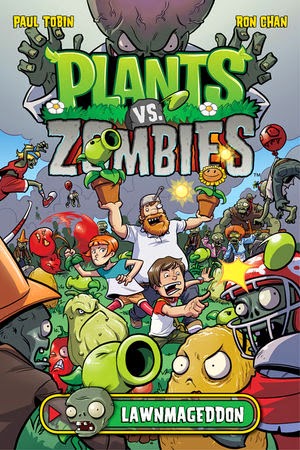
I have previously covered the comic Plants vs. Zombies: Lawnmageddon, based on the popular PopCap game, on this blog, although it was a print preview from SDCC of the digital comic that was coming out at the time. I am covering that same comic again, only this time it’s the full package after reading it from a hardcover collection. I have also mentioned a desire to play a couple of Plants vs. Zombies-related games that were then coming out, Plants vs. Zombies: Garden Warfare and Plants vs. Zombies 2: It’s About Time; my interest on those games has since waned, with a complete disinterest in the former due to lack of an offline multiplayer function and being unsure about the latter (despite the fact that I now have a smartphone) due to it being a free-to-play game with micro-transactions (I was somehow lead to believe it would also come to PC, my preferred platform for using plants to kill zombies). I recently acquired the hardcover collection of Lawnmageddon at the last San Diego Comic-Con, even getting it signed by writer Paul Tobin (I wasn’t really aware of when he was signing stuff, I just happened by his signing on the same day I got the hardcover). After having waited to read the comic until it came to print (my preferred way to read about using plants to kill zombies), I would say the investment was totally worth it.

In the city of Neighborville, a large horde of zombies has risen from the sewers in search of brains to devour. Meanwhile, a boy named Nate Timely arrives home and goes up to his treehouse, unaware of the approaching zombies. In his treehouse, Nate hears a noise and, mistaking it for a threat, attacks. However, he receives a counterattack and it turns out to be a girl named Patrice Blazing. The two quickly become friends, but soon afterwards the zombies begin to invade the treehouse. As the two flee from the zombies, they are saved by attacks from sentient plants while Patrice leads Nate to the home of her uncle, known to everyone else as Crazy Dave.

Nate and Patrice's first encounter.

Paul Tobin’s writing definitely captures the spirit of Plants vs. Zombies, working in the various plants and zombies of the game while still managing to tell an interesting and humorous story. While the story can be somewhat serious, its setting allows it a sense of humor that lets it not take itself too seriously. This works in the comic’s favor, since the game itself never really took itself that seriously to begin with. What helps sell the tone of the comic is not only the personalities and interactions between the central characters, but also the occasional gag involving some of Neighborville’s residents, which are always good for a chuckle.

Ron Chan’s artwork does an amazing job replicating the general art style of Plants vs. Zombies, with any new characters drawn such that they seem to fit in with everything else from the game. While everything is represented from the games really well, there is a great range of emotion in many of the plants, allowing you to feel bad for them when something goes wrong while fending off waves of zombies. This is helped by the coloring by Matthew J. Rainwater, who gives the comic a suitably brighter color palette to match the look of the game and give the art more life than it already has.

Crazy Dave is crazy.

Plants vs. Zombies: Lawnmageddon is a comic I would highly recommend to any Plants vs. Zombies fan. The writing has a good amount of humor to it without detracting from the story and the art accurately represents the game while still being fun to look at on its own. If you are interested in reading this comic, I would suggest picking up the physical hardcover collection since you can have the entire comic in one spot. Those that read the comic when released digitally might also want to consider the hardcover if they desire having a physical copy. Though I would recommend this to fans of the series, the comic does a good job of holding up on its own, so those looking for a good laugh may also want to consider checking this one out.

Tuesday, July 23, 2013

Plants vs. Zombies: Lawnmageddon (SDCC Comic) - The Seeds Have Been Planted


If you've ever been to San Diego Comic-Con or read our post on it, you know that the convention can be like hell if you let it. One of the good things about it, though, is getting exclusives that you couldn't get anywhere else, be it a special edition of a toy or a comic book among many, many other things. Today, I am going to cover something from the latter, a comic called Plants vs. Zombies: Lawnmageddon. For those unaware, Plants vs. Zombies is a game series developed by PopCap, the same company responsible for the popular and successful Bejeweled puzzle franchise. The gameplay involves planting plants in a garden as you try to protect your house (and your brains) from waves of zombies. I've played some of the game before and I enjoyed what I've played of it, and I plan to play the upcoming sequel titles, Plants vs. Zombies 2: It's About Time and Plants vs. Zombies: Garden Warfare (the latter when it comes to Xbox 360, since I have absolutely zero interest in owning an Xbox One). Getting back on track, Lawnmageddon was an exclusive $2 comic at Comic-Con, via the Dark Horse booth, and with the help of my parents, my brother and I managed to secure a couple of autographed copies right when they were running out for the convention (on Preview Night no less) and I thank them for their effort. I actually got to reading the comic last night, and I can say that I liked what I read...so far.

The story of Lawnmageddon, written by Paul Tobin, follows two kids, a boy named Nate Timely and a girl named Patrice Blazing, as they deal with an invasion of zombies that emerge from the depths of the sewers. The comic itself is only 12 pages long, so I don't think I can say much about the story, but I do think it's an interesting set-up. The introduction of these kids to the world of Plants vs. Zombies may seem odd since there was maybe only one important character in the original game, Crazy Dave, but I do think they're good at their purpose of moving the plot along, since I'm not sure how else you can create a coherent comic out of a game like that (plus, there is actually an interesting way Crazy Dave is worked into the story). Either way, I think Paul Tobin did a good job with the writing from what I have seen.

Then there's the art by Ron Chan, with colors by Matthew J. Rainwater. I think Ron Chan does an amazing job capturing the art style of the game, particularly with the designs of the titular plants and zombies, enhanced further by Rainwater's colors. The new child characters, along with the other humans you see in the comic, also look like they fit right in with whatever shows up from the game. There is no doubt here that Chan and Rainwater did an amazing job in the art department.

Quick, buy it before they run out!
Now the reason I said "so far" and "from what I have seen" is because, when I finished reading the comic, I found out exactly why it was an exclusive: at the back of the comic, on the inside cover, there is an advertisement for Lawnmageddon being a digital comic, which from the ad appears to be a six-issue deal. I decided to review this comic anyway because of the way it was packaged as a one-shot book, but I do plan to revisit this comic later once it finishes its run.

The Comic-Con version of Plants vs. Zombies: Lawnmageddon serves as a good first look at the digital series and gives those that bought the exclusive a good taste of what's to come. For those interested in checking it out, especially if you are already a Plants vs. Zombies fan, I would suggest doing so, either as it is released or, for those who prefer print material (like me), by holding out for the eventual hardcover collection, which can be pre-ordered on the Dark Horse website. I think the print comic that I read is enjoyable so far, but as for the overall quality of the finished product, we shall have to wait and see.

Saturday, September 22, 2012

Mirror's Edge - Goes Everywhere and Nowhere


Since I am currently a college student, this blog will be updated with less frequency than before and there is less time now to play video games of any substantial length (although there are a couple of upcoming games that will be reviewed no matter what). With this in mind, I figured it would be best to focus on shorter video games and get more licensed video game comic reviews up; basically whatever takes less time. As soon as we agreed to this measure, I thought of finally playing Mirror's Edge, a game that I had in my library for a couple years but never really got around to playing past the first chapter. I was surprised to learn that this game has a cult following, which would explain the planned sequel, and while I now understand why it does, it definitely needed some work for its initial release.

The game takes place in an unnamed dystopian city that does its hardest to forget its violent past. While most people are happy and have even forgotten what the "bad" old days were like, people like Faith Connors have not. While her family was involved in a campaign to stop the city from succumbing to totalitarianism, a tragic turn of events forced her to run away and start a new life. Four years later, she has found freedom as a Runner, a special breed of courier that delivers packages containing sensitive information that would normally be snuffed if handled through legitimate channels. Now Faith runs along the mirror's edge, always one step from death, existing everywhere and nowhere and the one thing that makes her feel truly alive and above the city's rule. However, that's about to change, since she's gotten involved in a conspiracy that involves her sister being unjustly imprisoned.

As the story unfolds, I found that the developers were able to craft a pretty solid story with the right turns and properly develop the main character. The problem however lies in the explanation. By that, I mean that the story is never properly explained that well within the game itself. You get more of an explanation of the background from the manual, where most of the previous paragraph came from, than you do in the actual game. While I feel that some more world building could have been done, the plot still manages to do a good job of making Faith a strong female protagonist. I liked that she was willing to save her sister no matter what it took, yet realizes the costs of her reckless actions when they finally catch up with her; she's human and willing to accept and make up for her mistakes. Other characters are developed as needed to fill an archetype, such as Mercury being Faith's mentor, but I think I should mention that I found the main antagonist to be rather disappointing. He just comes off as cocky and the buildup to the reveal isn't fully developed, which makes the story seem a bit thin the more I think about it.

Then of course is the gameplay, which is divided between parkour-style platforming and combat. The platforming is executed brilliantly, with levels designed specifically to take full advantage of the many things the player can potentially do. Among the many times I've had to vault, wall run and other maneuvers, I felt a sense of freedom and flow that I haven't from other platformers. The acrobatics that can be performed, especially when you're quickly changing directions, are unique and the sections that utilize the easy-to-use game mechanics are easily my favorite part of the experience.

Combat, on the other hand, falls flat. There's a sort of secondary "fight or flight" mentality to enemy encounters, in which running away from enemies is actually a viable option. Sometimes that doesn't pan out however and you are forced to fight past the blues (cops) or security guards to get to the objective. Faith can defend herself pretty well thanks to her hand-to-hand combat training, but even knowing the proper timing to disarm some of the tougher enemies' guns won't get you very far if you're attempting to get a specific achievement/trophy. While I tried to get the trophy, the sheer difficulty of trying to knock out guards and get away from some swarms forced me to learn to use the guns for survival. As far as I'm concerned the guns work perfectly well and can serve to make the levels go by much quicker, but there's no safe way to tell how much ammo is remaining and the sniper rifle could be difficult to aim with at times. Either way, I didn't have fun fighting off groups of enemies and simply wanted to get back to the splendid parkour.

You may not get to enjoy these sections for very long however, considering that the game is pretty short. The levels go by surprisingly quickly and since there's only nine total levels, you'll find yourself searching for motivation to keep playing. Thankfully, you can squeeze out more play time with the Time Trial mode, which basically has you playing through different level sections minus the guards, so long as you meet the requirements to unlock the various courses. I had some fun here, but it's good to keep in mind that the routes they make you follow are specific to the story, so don't be surprised if you quit in frustration at least once.

Technically speaking, I absolutely loved the graphics. The bright colors help the player find their way through the levels and have enough variety to make the scenery great to look at, though the daytime portions show off the lighting to the point where it takes a moment to make the whites easy to see. Conversely, I thought the flash animated cutscenes were decent, though it did simplify some details like Faith's tattoos. The music in each level is done well enough to aid the player's emotions, but isn't really memorable outside of gameplay.

For an experimental idea, DICE managed to craft a solid game based around first-person platforming. While I can't say I would play it all the time, I am definitely interested in a sequel, as it could end up like Portal 2 where the next installment really stretches everyone's creativity. I would tell you to give this game a try, especially at a low price, but know that Mirror's Edge runs the same line as the Runners: everywhere and nowhere.

Sunday, February 27, 2011

Bulletstorm: FPS On Steroids


In the world of the crowded FPS Genre, it gets difficult to stay on top. Every time a new concept comes along, various clones show up to try and cash in on the idea. However, one key concept always remains in an FPS: using the environment as a weapon. These usually come in the form of red barrels or some other form of explosive object in the background. The concept of realism also stands, attempting to combine the two into masterpiece crafts of the genre. If a game like Uncharted 2 is like a cinematic masterpiece and Call of Duty is a realistic war scenario, then Bulletstorm is a melodic blood symphony that makes the most out of its concept/tagline; Kill With Skill.

Looking first at the story, I wasn't really sure what to expect from it. Usually, a game with a concept as unique as that of Bulletstorm would just have a razor thin excuse plot designed solely to let you run wild. Instead, the story for this game has a surprising amount of depth to it. We start with a very intriguing and potty mouthed opening, which sets the stage for the story. Grayson Hunt finally encounters a ship that General Serrano is on and proceeds to attack it dead on. His ship crashes into Serrano's and both end up landing on the planet Stygia. After having surgery performed on his partner Ishi Sato, Grayson locks onto the location of Serrano and they both proceed to locate him.

It wouldn't really be right to talk about the plot of the game any further, as it is full of twists and unforeseen circumstances. But it would be right to say that it is full of truly spectacular moments and feats of scale never before seen in a shooter. For example, there is one section where Grayson gleefully attacks his enemies with a giant remote controlled robotic dinosaur, and another where Grayson and Ishi have to shoot enemies on an oncoming train while avoiding and attempting to take out a humongous wheel weaving towards them. The story was well-written in my opinion, assisted by top-notch voice acting and hilarious, if very potty mouthed, dialogue. Seriously, the amount of language in this game is enough to rival most games out on the market today. Even so, I was laughing all the way through the campaign.

The biggest part of Bulletstorm is the premise: Kill With Skill. Kills in the game are called Skillshots. In essence, there is a name for just about any kind of kill you can pull off short of just outright mowing an enemy down, each with a point value assigned to it. These points are then used as currency for the various dropkits scattered in the game, so the better you are the more weapons, upgrade, and ammo you can purchase for your guns. These skillshots come from skillfully combining your guns, leash, and standing and sliding kicks to pull off increasingly elaborate shots. Some also involve the environment, such as setting off an explosive near the enemy for the Enviro-Mental skillshot, which is one of the simplest skill shots to perform. If you want to start getting complex, you can use the energy leash's alt-fire, Thumper, to launch enemies into the air and kill them for Trap Shooting. And if you want to really get intricate, you can leash an enemy to your position, wrap a flail shot around them, and then kick them back toward a group and detonate the flail for the Homie Missile and Gang Bang skillshots. There are so many skillshots that I still haven't found all of them. There is a real thrill out of finding new skillshots and weapon combinations to use, which will guarantee more play out of the game in the near future.

The weapons are perhaps the most fun thing about Bulletstorm. Aside from the energy leash, kick, and trusty Peacemaker Carbine (PMC), you have a wide array of guns, each with their own powerful alt-fire modes. The alt-fire allows you to charge up your shots for equally ridiculous effects. For example, charging the Screamer turns it into a flare gun and charging the Head Hunter, a sniper rifle, allows you to detonate the sniper round midair for explosive results. Weapons also include the Penetrator, a drill gun; Flail Gun; Bouncer, a grenade launcher with bouncing orb shots; and Boneduster, a quadruple-barreled shotgun. While using them is always exciting, it helps that the controls are very tight and responsive, letting you feel more like a killing machine than ever thought possible. You can carry two other guns besides the PMC, and some are situational, but it's exciting to find that a combination was very effective even if it wasn't the "correct" one.

As far as visuals go, they were very detailed and fluid. The backgrounds are also very lush and colorful and the architecture is beautifully detailed, which gives you something nice to look at while you paint the walls with the blood and guts of your enemies. It was great to see a game like this use a large color palette, making for more inviting scenery and architecture than something like Fallout 3 or Bioshock 2. The game is also very linear, which minimizes backtracking to just going back to a strategically placed dropkit for a different load out or more ammo. What I knew going in was that the enemies in the game were more randomized to avoid being simply cookie cutter clusters, which I liked when I noticed some of the subtlety in the generated enemies.

Aside from the enjoyable Single Player campaign, there are also the Echoes and multiplayer Anarchy modes. Echoes mode has you replaying specific enemy encounters to compete against your friends by racking up points and finding more skillshots. While I enjoyed this mode for hours, I believe that leaderboard nuts will get full enjoyment out of this mode, compared to someone like me who prefers to play it to squeeze more fun out of the game. Sadly, I am unable to review the Anarchy mode due to unknown circumstances. I can't tell if it was the weather at the time or if it was a bad server connection or if it was my PS3 acting up, but I was unable to play a single map and at best stared at an infinite loading screen for about 30 minutes before giving up. As such, I am not one to say whether or not the online cooperative multiplayer is good or not; you may have to find out from someone else.

So, besides being unable to personally play the multiplayer and an okay ending to the story, Bulletstorm exceeded all of my expectations and then some. Never before has an FPS game make you think so quickly about various kills to the point where it becomes an instinctive reaction. I can definitely recommend this game to absolutely anyone who has played an FPS in their life and is willing to experience something that will expand their creative thinking. As for those who are still on the fence, think about it this way: in this game, you can fire a scoped sniper round at an enemy and redirect it midflight to make sure it hits your target, then control the enemy you just shot midair to another close by and remotely detonate the round.