Showing posts with label 1959. Show all posts

Saturday, November 8, 2025

Stubs - Odds Against Tomorrow


Odds Against Tomorrow (1959) Starring Harry Belafonte, Robert Ryan, Shelley Winters, Ed Begley, Gloria Grahame. Directed by Robert Wise. Screenplay by Abraham Polonsky and Nelson Gidding (credited to John O. Killens, Nelson Gidding) Based on the novel Odds Against Tomorrow by William P. McGivern (New York, 1957). Produced by Robert Wise Run time: 96 minutes. Black and White USA Drama, Film Noir

Harry Belafonte was perhaps best known as a singer aka King of Calypso, but he was more than that. A vocal and visible supporter of civil rights, he was also an actor, and in the case of Odds Against Tomorrow, also a producer, having founded his own production company, HarBel, which was behind the film.

Saturday, October 27, 2018

Stubs - The Mummy (1959)


The Mummy (1959) Starring Peter Cushing, Christopher Lee, Yvonne Furneaux. Directed by Terence Fisher. Screenplay by Jimmy Sangster. Produced by Michael Carreras. Runtime: 88 minutes. UK Color Horror.

Hammer Film Productions is probably best remembered for a series of horror films that it produced between 1959 and 1974, including such films as The Quatermass Experiment (1955), The Curse of Frankenstein (1957), Dracula (1958) and The Mummy (1959). These films would be popular in the United Kingdom as well as the US and would inspire such filmmakers as Roger Corman and American International Pictures, that would also produce their own horror films based on the writings of Edgar Allen Poe.

The studio, however, had gotten its start as the home studio for comedian William Hinds, who founded the company using his stage name Will Hammer as the inspiration. Its first film was indeed a comedy, The Public Life of Henry the Ninth (1935). The studio fell on hard times and went bankrupt in 1937. However, the distribution company Hinds had formed with Enrique Carreras, a former cinema owner and émigré from Spain, survived.

Hammer Film Productions made a comeback in 1947 with the British crime film Death in High Heels. In 1951, Hammer and Exclusive signed a four-year production and distribution deal with American film producer Robert Lippert. The two companies would distribute each other’s films as a result.

In 1955, Hammer began filming The Quatermass Experiment, the studio’s first venture into the horror genre. The film was so popular that a sequel was begun. But The Quatermass 2 ended up becoming the film The Curse of Frankenstein, based on a screenplay by American screenwriters  Max J. Rosenberg and Milton Subotsky. While it adhered closely to Universal’s Son of Frankenstein (1939), additions and edits managed to get past copyright issues. The film brought together director Terence Fisher with actors Peter Cushing and Christopher Lee, a trio who would drive much of Hammer’s success in the horror genre.

Hammer decided to take on another monster icon, Dracula, but copyright issues were harder to avoid with Universal. A legal agreement between Hammer and Universal was not completed until March 31, 1958 – after the film had been shot. The agreement, however, allowed Hammer to remake other Universal horror films, which lead to The Mummy (1959).

Principal photography on the film began on February 23, 1959, and ended on April 16, 1959. The film was originally released on September 25, 1959, in the UK receiving general release on October 23, 1959. The film, made on a budget of £125,000, was released in the US in December of that year.  While the title suggests the 1932 film, the story is more an amalgamation of plot and characters from Universal’s The Mummy's Hand (1940) and The Mummy's Tomb (1942), with the climax borrowed directly from The Mummy's Ghost (1944), all sequels to the original film.

The film opens in Egypt in 1895 where archaeologists John Banning (Peter Cushing), his father Stephen (Felix Aylmer) and his uncle Joseph Whemple (Raymond Huntley) are searching for the tomb of Princess Ananka, the high priestess of the god Karnak.

Stephen Banning (Felix Aylmer) and Joseph Whemple (Raymond Huntley) are archaeologists.

Sometime prior, John has a broken leg and is laid up. He refuses to get it set properly and will forever after walk with a limp. Because of his injury, he cannot accompany his father and uncle when they open the tomb.

John Banning (Peter Cushing) is also an archaeologist, but a broken leg keeps him from the dig.

But before they enter, an Egyptian named Mehemet Bey (George Pastell) warns them not to go in, lest they face the fatal curse against desecrators. Of course, Stephen and Joseph ignore him and discover within the sarcophagus of Ananka. Joseph leaves to tell John the good news, leaving Stephen alone inside the vault. While rummaging around, Stephen finds the Scroll of Life and naturally reads aloud from it as he translates it. Outside, members of the archaeological team hear his screams and Joseph rushes back into the tomb only to find Stephen in a catatonic state.

Before the entourage returns to England, the entrance to the tomb is dynamited. Bey stays behind to discover the body of Kharis (Christopher Lee), the mummy that Stephen had brought back to life by his readings.

Three years later, back in England, Stephen is being cared for at the Engerfield Nursing Home for the Mentally Disordered. The doctors figure he’d had a stroke and would never recover. However, he does and sends for his son. When John goes to visit him, Stephen tells him that when he read from the Scroll of Life, he unintentionally brought back to life Kharis, the mummified high priest of Karnak.

Meanwhile, Bey, a devoted worshiper of Karnak, comes to Engerfield under the alias of Mehemet Akir with the intention to wreak vengeance on the Bannings for their desecration of Ananka’s tomb. He hires a pair of drunken carters, Pat (Harold Goodwin) and Mike (Denis Shaw), to bring a crate of artifacts to his rented house. Inside the crate, however, is the slumbering Kharis.

But the two men's driving causes the crate to fall off the wagon and sink into a nearby bog. Bey, surprisingly, isn’t upset. Later, Bey returns and, using the Scroll of Life, exhorts Kharis to rise from the mud. He then sends him to murder Stephen Banning. Like a bloodhound, Kharis knows where to find Stephen.

Mehemet Bey (George Pastell) uses the Scroll of Life
to bring Kharis (Christopher Lee) back from the grave.

Meanwhile, Stephen is put into a padded room and told that no one can hear him. If he needs anything, he has to ring the bell in the room. No sooner is he left alone than Kharis breaks into his room, through an outside window. Rather than ring the bell, Stephen tries the door, which is locked. Too late he decides to try the bell, but before he can ring it, Kharis wrings his neck instead.

Kharis uses the Scroll of Life to try and bring Ananka (Yvonne Furneaux) back from the dead.

The next night, John reads the legend of Ananka to his uncle. The legend tells of the high princess, Ananka (Yvonne Furneaux), who dies while traveling. Rather than taking her back home for burial, Kharis has her body prepped and a chamber built where they are. There is an elaborate and lengthy process at the end of which her tomb is sealed. But Kharis, who is love with the princess, reads from The Scroll of Life in an effort to bring her back from the dead.

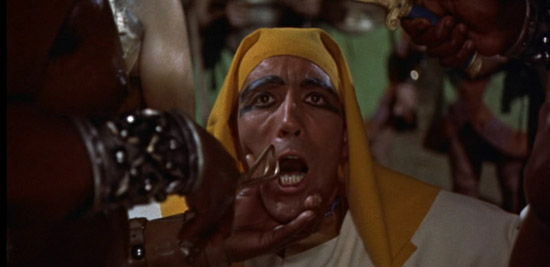
As punishment, Kharis' tongue is cut out of his mouth and ...

However, his desecration is discovered and his punishment includes having his tongue cut out and being buried alive near the princess’s sarcophagus.

Kharis is mummified alive and left to stand guard by Ananka's tomb.

Soon after reading him the legend, which Joseph dismisses, he is killed by Kharis. John tries to stop the murder and manages to shoot Kharis at close range, but it is too little too late. Joseph is dead and Kharis escapes.

Police Inspector Mulrooney (Eddie Byrne) is assigned to solve the murders, but he is skeptical about the details John tells him. Mulrooney deals only in "cold, hard facts” and does not believe John's incredible story about a killer mummy, even when John tells him that he is likely to be Kharis' third victim.

As Mulrooney investigates, John notices that his wife Isobel (Yvonne Furneaux) bears an uncanny resemblance to Princess Ananka. Gathering testimonial evidence from other individuals in the community, Mulrooney slowly begins to wonder if the mummy is real.

Bey sends Kharis out to kill John Banning.

Later, Bey sends the mummy to the Bannings' home to kill John. However, when Isobel rushes to her husband's aid, Kharis sees her, releases John, and leaves. When Kharis returns, Bey mistakenly believes John is dead and prepares to return to Egypt.

Police Inspector Mulrooney (Eddie Byrne) finally believes John's story.

Mulrooney tells John that the mysterious man who had hired the drivers to deliver the lost crate lives nearby and is thought by villagers to be an Egyptian. Despite Mulrooney’s advice to the contrary, John goes to pay him a visit. Bey is obviously surprised to learn that John is alive. Their conversation turns to religion and Bey condemns John for archeology’s desecration of Egypt’s holy places.

After John leaves, Bey leads Kharis in a second attempt on John's life. Mulrooney is trying to protect John, but the mummy knocks him out. Meanwhile, Bey takes out another man guarding the house. Kharis enters the house and finds John in his study. John tries to fight back, but Kharis starts to choke him.

Kharis notices how much Isobel (Yvonne Furneaux) resembles Ananka.

When Isobel hears John’s screams, she runs into the house. Kharis at first doesn’t recognize her but at John’s urging she lets down her hair. Seeing her as his beloved Ananka, Kharis lets John go. Bey orders the mummy to kill her, but he refuses. When Bey takes it into his own hands to kill her, Kharis kills him.

Isobel swoons and the mummy picks her up and carries her back to the swamp with John, Mulrooney and other police in pursuit. John yells to Isobel to tell Kharis to put her down. After he reluctantly puts her down, the police open fire, causing Kharis to sink into the swamp, taking the Scroll of Life with him.

Christopher Lee plays Kharis, a role in which he never speaks.

If you’re looking for heart-stopping terror, this Hammer Gothic Horror doesn’t have that quality. Rather it is about the atmosphere and the interactions between the characters. The latter is helped by the acting, which for the most part is pretty good. While Christopher Lee is one of the co-stars, he has the unenviable role of the Mummy, meaning for most of the film he never speaks and is covered head to toe by bandages. Even when he is allowed to be in character, Kharis the high priest, he still is shown silently with narration over his acting.

Peter Cushing plays John Banning in The Mummy.

Peter Cushing plays a British aristocrat pretty well. Though I doubt this was a really challenging role for him, he does make me want to see more of his work. Cushing started out on television and acted in a significant number of Hammer films, horror as well as other genres. He is, however, perhaps, best remembered by modern audiences for his role as Grand Moff Tarkin in the original Star Wars (1977).

French actress Yvonne Furneaux plays Isobel and Princess Ananka (above) in Hammer's The Mummy.

Yvonne Furneaux has a pretty one-dimensional character to play. There’s not much to Isobel except that she resembles Ananka. It’s hard to tell from this role if she’s a good actress or not. She would go onto a significant role in Federico Fellini’s La Dolce Vita (1960) the following year.

My favorite actor in the film is Eddie Byrne as Police Inspector Mulrooney. There is something so British about his portrayal. He gets to be a by-the-books sort of policeman but still comes around to believe the very odd story that John tells. It’s a small role, but he brings a lot of life to it.

One of my biggest complaints is a lack of logic that seems to propel the story forward and to its conclusion. If everyone related to the incident with Ananka dies before reaching civilization, how is there such a well-documented legend? How does Kharis know where to find his victims? I can understand the revenge, but he has never seen Joseph nor John but he apparently knows them on sight.

He also seems to be oblivious to manmade weapons, surviving multiple gunshots and a spear run through him but, in the end, he apparently succumbs to a volley from the police in the swamp. If bullets don’t harm him, how do they kill him?

Why is he taking Isobel back to the swamp in the first place? That makes no sense unless he’s trying to kill her? And where does he get the Scroll of Life that he takes with him to his watery grave? The scroll appears in his hand right at the very end, did he have it in his pocket? Does a mummy have pockets?

The Hammer version of the Mummy isn’t bad but it is an example of the old adage, don't remake good films. The original The Mummy (1932), starring Boris Karloff, may have its own flaws, but by comparison, it is a much better film than this. If you have to watch a Mummy film this Halloween season, stick with the original Universal version. The Hammer one only makes you realize how good the original is.

Saturday, October 15, 2016

Stubs - The Angry Red Planet


The Angry Red Planet (1959) Starring: Gerald Mohr, Naura Hayden, Jack Kruschen, Les Tremayne. Director: Ib Melchior. Screenplay by Sidney W. Pink, Ib Melchior. Produced by Sidney W. Pink, Norman Maurer. Color. USA Run Time 83 minutes Science Fiction, Horror

Science Fiction and horror are two genres that often get mixed together. In the case of The Angry Red Planet, a trip to Mars is filled with horrific space monsters that endanger the lives of the four astronauts sent there to explore. Originally called Invasion of Mars, the film was given a low budget of $200,000 and a short shooting schedule, 10 days. To compensate, the film is the first to use a technique called CineMagic, but more on that later.

Space was not a new subject when this film was made. Films about traveling in outer space are as old as filmmaking, including Le Voyage Dans la Lun (A Trip to the Moon) Georges Méliès’ 1902 fantasy about what it would take to get to the moon and what it would be like once they were there. But there was a real sense of urgency in the late 1950s after the Russians launched Sputnik in 1957 and the U.S. found itself in a Space Race that would culminate with man landing on the moon in 1969.

The Angry Red Planet skips ahead to a still future time when man lands on the moon, but still retains its 1950s sensibilities. When the film opens, an experimental rocket ship MR-1, thought to have crashed on Mars moons before, is suddenly sending signals back to Earth. No one is sure if any of the four-person crew is still alive or not, but a special meeting is held in Washington, including Maj. Gen. George Treegar (Paul Hahn) to devise a plan to retrieve the ship, which includes flying to Nevada, the origination and landing point of the MR-1.

Maj. General George Treegar (Paul Hahn) is briefed about the MR-1.

Using remote control, a ground crew brings the ship back for a landing. After checking for radiation, the ground crew finds two survivors on board, Dr. Iris Ryan (Naura Hayden), who opens the hatch, and a gravely ill Col. Thomas “Tom” O’Bannion (Gerald Mohr) is removed on a stretcher.

The command center for the MR-1 mission wouldn't give Mission Control a run for its money.

Iris, exhausted and in shock, is taken to the Norwood Air Force Hospital where doctors are flummoxed by a green growth on Tom’s arm. When doctors go to her for an explanation, Iris is at first unable to remember anything. But Dr. Frank Gordon (Tom Daly), who fears the growth might prove not only fatal for Tom, but could present a danger to life on Earth, needs her help and helps her relive the mission.

Aboard the MR-1 are Iris, a scientist; Tom, the ship’s commander; Prof. Theodore Gettell (Les Tremayne), who designed the ship; and Chief Warrant Officer Sam Jacobs (Jack Kruschen), who is in charge of communications with mission control and recordings related to the mission. The first few days go easily. As the only woman on board, Iris gets attention from both Jacobs and Tom. While Jacobs is more caveman in his approach and easily turned down, there is a smarmy aspect to Tom, who often walks around with his shirt unbuttoned and acts like God’s gift to women.

The crew aboard the MR-1, from left to right, Chief Warrant Officer Sam Jacobs (Jack Kruschen),
Professor Theodore Gettell (Les Tremayne), Dr. Iris Ryan (Naura Hayden) and Col. Thomas O'Bannion (Gerald Mohr).

When Iris goes to get food for the crew, yes even in space a woman’s place is still apparently in the kitchen, Tom follows and asks for a rain-check to take her out when they arrive back on Earth. She accepts.

Provisions already seem to be running low only a few days out.

On the 47th day of the mission, the MR-1 finally lands on Mars and when it does, the crew is anxious for the next part of the voyage. But when they look out the ship’s portal, they don’t see any movement. That is until Iris sees a creature looking back and screams.

Iris screams and then faints after seeing the Martian looking in through the portal.

That recollection brings Iris back to the present of the story and she is so bothered by it that she can’t continue.

While she’s sleeping, Treeger informs Gordon that they have recovered the tape recordings made aboard the MR-1 but, so far, they appear to be blank. As the two ponder over whether Iris is recalling the events or only her fears, she awakens and asks Gordon to give her something to force her to remember what happened.

Back in the MR-1, Iris describes the horrible creature she’s seen and no one believes her, at least not at first. Tom decides they should go outside and the crew dons their protective clothing before the disembark. Tom has a sidearm and Sam grabs a freeze ray as they go out. Once outside on the very red planet, Tom orders everyone to stay within his sight as they venture further away from the ship.

The crew ventures out onto the surface of Mars.

Curious about a strange vine, Iris follows it to find the source and is suddenly grabbed by the octopus-like creature Martian Venus flytrap. The three men rush to her aide, and with machetes and Sam's ray gun, kill the creature.

Iris gets attached by a giant Martian Venus Flytrap-like creature.

Iris and Dr. Gettell conclude that the creature was a carnivore, beyond normal plant life, with a neuromuscular formation. The next morning, after studying samples from their previous walk, the group again leaves MR-1. When Iris cuts off a sample from one plant, it reveals itself to be a huge rat-like bat creature on stilt-like legs. But this time Sam's ray gun has little effect, until Tom tells Sam to aim at its eyes, thus immobilizing it, allowing Gettell, who has been trapped between boulders, to escape.

The most hideous creature they encounter on the planet,

Before returning to the ship, the group sees a large lake but decides to wait until the following day before exploring it. Back inside the ship, after discussing the great dangers they have encountered, Tom and Gettell agree that they have to abort the mission immediately. But while the rocket engines ignite, the ship cannot lift off. Tom orders the MR-1’s engines cut to save fuel and determines a powerful source is holding it down and preventing them from going back to Earth.

They decide to wait until the next day to explore the lake.

Tom calms the fears of the crew and wonders what “they” want. Later, the four return to the lake and start paddling across. In the distance, they see a huge, industrial city and as they contemplate the curious sight, a giant monster arises from the sea and comes towards them. The four paddle furiously to get away.

Paddling across the lake, their view is blocked by a huge monster rising out of the water.

The creature chases after them onto the shore and as they rush back to the ship. But just before they can close the hatch, Sam is enveloped by the amoeba-like beast and swallowed whole. The other three watch in horror as Sam is digested. Once they’re inside, they realize that Tom has been wounded and it begins to worsen.

The creature follows them back on shore.

Iris recalls from her previous experiments on Amoeba cells how electricity is the only thing that can stop the amoeba’s growth. At Tom’s request, Gettell figures out a way to electrify the outer skin of the rocket ship while not endangering their own lives. After rewiring the ship, the plan works, causing the creature to shrivel away. Just then the ship’s radio broadcasts a voice saying, “Red alert…we of the planet Mars give you this warning.”

Back on the ship, Iris is repulsed by the infection on Tom's arm.

A short time after liftoff, the stress and exertion cause Gettell’s heart to give out and on the flight back, he dies. With Sam and Gettell dead and Tom unconscious, Iris tries to determine what Gettell would have done with the ship’s wiring. When she looks out the window, she sees Mars in the rear getting smaller.

Gettell's heart gives out after launch from Mars.

Iris again awakens in her bed and cries. After saying she can’t remember any more of the Martian warning, she faints. But Dr. Gordon has gleamed enough from Iris’ story to figure out that Tom is suffering from an enzymatic infection.

A little later, Treeger asks Iris if there is anything in her previous research that might be helpful in treating Tom. They give her access to a lab and she gets to work. She knows that electricity must be the key and surmises that it can be used to shock the amoeba on his arm to a non-human host. The experiment, of course, works and while Tom is recovering, Iris comes to his bedside wanting to cash the raincheck for their overdue date.

While most of the tapes from the MR-1 were found to be blank, Treeger informs Tom and Iris that they were able to recover the entire Martian warning, which concludes with “Do not return to Mars. We can and will destroy you if you do not heed our warning.”

No doubt the intent of the film was to terrify its audience with the horrible creatures imagined to reside on the planet Mars. Sadly, they are either cringe worthy or laughable. For the most part the creatures look like Dali rejects or they’re cardboard cut outs. The CineMagic effect, which gives all of the Martian landscape a red overcoat, perhaps was an attempt to mask the poor special effects. The effect was achieved with a black and white film negative processed with solarization (a process that partially reverses the negative making some areas appear positive). The film was then tainted red and a film positive was not required. Using black and white film, which was less expensive to process and not having to make a film positive, also helped keep the costs of the production down. The cheapness shows on the screen, that is unless you're color-blind to red and then I don't know what you'd see.

The CineMagic effect baths everything Martian in a blood red tint.

Space travel was depicted sort of like it had been since Victorian times. The rooms are spacious and there appear to be no issues with the lack of gravity. While the set does attempt to be “computerized” for the time, occupants are free to walk around; nearly shirtless if your Tom. Professor Gettell even smokes a pipe on board, so relaxed are the circumstances.

No cramped quarters for the crew aboard the MR-1.

The protective suits worn on the planet would probably be good in a rainstorm, but useless on another planet. I’m not sure if it was a cost-effective measure or one that the actors wanted, but there are no protective shields over the faces of the actors.

Who needs protective masks to breathe while on Mars?

All films reflect the time they were made in and Angry Red Planet is no exception. While its viewpoints on space travel seem backward, so do its views on women. Even though Iris would have to be an accomplished scientist to be included on an interplanetary space trip, she seems very much stuck in stereotypes of women in the late 50s. Not only is she part sex object, but she is also expected to cook, as it were, for the rest of the crew. We’re not shown her making the beds or doing the laundry, but no doubt they would be a part of her duties aboard the MR-1.

The thin protective suits can't protect Iris from Tom's busy hands.
Low budgets usually accompany plot holes and Angry Red Planet does not tempt to upset the applecart here. When the film opens, MR-1 was thought lost for months. But the amoeba that is taking over Tom’s body never seems to progress past his arm in all that time. One plot device, the time since Earth had lost contact with the ship, doesn’t line up with the urgency to cure the enzymatic infection.

Also, Professor Gettell’s death seems more like a plot convenience than set up by the story. Yes, he’s older than the other actors, but his life seems superfluous. He was needed for the part of the story about getting and landing on Mars, but three’s a crowd when they get back to Earth, so he has to die on the way home.

The acting is somewhat along similar stereotype lines. Sam Jacobs would have worn a red-shirt if this had been Star Trek. Slower both physically and mentally, he reads comic books after all, it is no wonder that Sam is the first to bite it. Jack Kruschen, who the following year would play Dr. Dreyfus in Billy Wilder’s The Apartment, seems right for the role, even though I’m sure he was not the low wattage bulb in real life as the character he plays here.

Sam Jacobs (Jack Kruschen), communications officer/comic book reader.

Les Tremayne plays Professor Gettell, who we’re supposed to believe is super smart and refined, hence the pipe. What’s missing are patches on the elbow of his protective suit. Tremayne is one of those actors that you see in a lot of movies, but usually in small roles, like the Auctioneer in North by Northwest, also released in 1959. For whatever reason, Tremayne’s filmography includes a lot of Sci-Fi films. For every Mutiny on the Bounty (1962) and The Fortune Cookie (1966), there is The War of the Worlds (1953) and Forbidden Planet (1956). He’s good here, but there isn’t really that much for him to do but react and look smart.

Gerald Mohr as Tom O'Bannion and Les Tremayne as Professor Gettell.

Gerald Mohr, who plays Tom O’Bannion, began his career on stage working with Orson Welles’ Mercury Theatre. He then appeared more than 500 times during the 30s, 40s and 50s on various shows from playing Phillip Marlowe from 1949 to 1951, to appearances on The Whistler, Our Miss Brooks and The Lone Ranger. He would later move into television, appearing in a number of Westerns, including Bonanza and The Rifleman, as well as comedies from Burns & Allen to the Smothers Brothers. Here he plays the equivalent to Hugh Hefner in space, all that he’s missing is his walking around in pajamas and a robe.

Iris (Naura Hayden) is both scientist and sex-object aboard the MR-1.

The object of Mohr’s stares is Naura Hayden, who was a model before she became an actress. Mostly known for her work in commercials, Hayden has the acting chops of a model to go along with the looks. Too bad there is more to good acting than screaming, which are the high points of her performance.

The Angry Red Planet is one of the best known films that Ib Melchior directed, which probably speaks volumes about his career. Melchior is known as a low-budget filmmaker, many of which were released through American International Pictures, a cinematic haven for bad sci-fi. He makes his reputation, what there is of it, with this film. He would later re-visit Mars with the screenplay, co-written by John C. Higgins, for Robinson Crusoe on Mars (1964).

While Halloween presents the opportunity to view a variety of films to get your horror fix, sadly The Angry Red Planet doesn’t quite get you there. Rather it seems to be ready fodder for the MST3K treatment. Try as it might, the film isn’t really all that scary, even though it wants us to think it is; no doubt hindered by a weak story and a small budget.

Be sure to check out other Horror films in our Horror Films Review Hub.

Saturday, February 27, 2016

Stubs - The Mouse That Roared


The Mouse That Roared (1959) Starring: Peter Sellers, Jean Seberg, William Hartnell Directed by Jack Arnold.  Screenplay by Roger MacDougall, Stanley Mann. Based on the novel, “The Mouse That Roared” by Leonard Wibberley. Produced by Walter Shenson. Run Time: 83 minutes. United Kingdom Color. Comedy

Inspiration comes from many sources. The inspiration for the book The Mouse That Roared came from the treaty between the United States and Japan that ended World War II. Several years later, Los Angeles Times editorial writer Leonard Wibberley wrote a satirical editorial about the treaty in which he mused that Japan was awarded so much aid for losing the war that perhaps it was better for them to lose than win.

Not wanting to let a good idea go to waste, Wibberley expanded his into a serialized novel about the tiny Duchy of Grand Fenwick declaring war on the U.S. in order to lose and reap the benefits. The story appeared in six issues of the Saturday Evening Post from December 25, 1954 to January 29, 1955 under the title “The Day New York Was Invaded”. In February, 1955, it was published as a novel as The Mouse That Roared. The book was later published in the UK under the title The Wrath of Grapes, a takeoff on John Steinbeck’s novel The Grapes of Wrath.

Walter Shenson was working as Columbia Picture’s head of publicity in the UK in the late 1950’s. Actor Tyrone Power gave Shenson a copy of the book and he was so impressed that he bought the film rights, quit his job and became a film producer.

Peter Sellers was not a household name in the US when he was cast in the film. Well known in England, Sellers had been on the Goon Shows radio programme for most of the 1950s. He had also been appearing in movies since 1950’s The Black Rose, in which he dubbed the voice of Lu Chung. The best known of his early films may be The Ladykillers (1955) opposite Alec Guiness and Herbert Lom.

The film was shot at the Shepperton Studios in London between October 27 and December 22, 1958. The World premiere was in Geneva, Switzerland on May 23, 1959, but the film didn’t open in London until July 17, 1959 and in New York until October 26, 1959. It was released through Columbia Pictures, Shenson’s former studio.

The Mouse That Roared begins with the opening credits. Miss Columbia, the studio’s trademark, is chased off her pedestal, frightened by a mouse that is under her gown.


Miss Columbia flees the opening credits.

We are informed through narration about the smallest country in the world, the Duchy of Grand Fenwick, the only English-speaking country on the European continent. Ruled by the popular Duchess Gloriana XII (Peter Sellers), a descendent of the founder of the country, the main source of money is the export of a particular wine to the U.S. We are introduced to Count Rupert Mountjoy (Peter Seller), the country’s Prime Minister and to Tully Bascome (Peter Sellers) leading the country’s Army through drills with a bow and arrow. The narrator acknowledges the resemblance making reference to the fact that the founding father of Fenwick was truly the father of his country.


But the country is about to go bankrupt when a California winery markets a similar tasting and similarly named wine of their own. The country’s protests to the U.S. have gone ignored. Facing insolvency, the country’s Prime Minister, Count Rupert Mountjoy, has a rather desperate sounding plan, declare war on the United States, then recognized as the most powerful nation on earth.


The Duchess Gloriana (Peter Sellers) watches as Prime Minister Rupert Mountjoy (Peter Sellers)
announces his idea to save the Duchy of Grand Fenwick by declaring war on the United States. 

While Mountjoy doesn’t mention it, his idea is based on how the U.S. treated Japan after World War II. He figures that as soon as the U.S. defeats the Duchy, they will pour money into the country. With the support of opposition leader Benter (Leo McKern) and the Duchess, Mountjoy sends a declaration of war to the U.S., but once again it is ignored.


Tully Bascome (Peter Sellers) reluctantly accepts his appointment to lead the Army.

He then appoints Tully Bascome, the country’s forest ranger as well as field marshal, to lead 20 volunteers from the country’s army, which still utilizes the long bow as its primary weapon to invade. Tully is not thrilled by the appointment, rather wanting to stay behind in the forest. But with the help of Sergeant Will Buckley (William Hartnell), who had real experience in the British Army, Tully manages to recruit twenty reluctant soldiers and they board a dilapidated freighter in Marseilles bound for New York City.


Tully drills his troops aboard the ship on the way to invade New York City.

When they land in the harbor and dressed in the chain mail, the troops invade, but find the city deserted due to a city-wide air raid drill. Unopposed, the troops move through the city. Tully picks up a paper and reads about the drill, which was called as a reaction to the impending development by Dr. Alfred Kokintz (David Kossoff) of the most deadly weapon known to man, the Q bomb.

Dr. Alfred Kokintz (David Kossoff) and his daughter Helen
(Jean Seberg) decline to hide when the air raid sirens go off.

On his way to surrender, Tully takes a wrong turn and ends up at the New York Institute of Physics, where Kokintz and his daughter Helen (Jean Seberg) are putting the finishing touches on the football-shaped bomb. Despite their protests, Tully has the doctor, his daughter and the bomb taken hostage.

Reports circulate that New York is under attack from Martians, so General Snippet (MacDonald Parke) accompanied by New York City police officers are sent out by the U.S. Secretary of Defense (Austin Willis) to investigate. When the jeep they are travelling in is attacked by arrows and the men are taken prisoner. As quickly as they came, the invaders leave and set sail back to Marseilles.


General Snippet (MacDonald Parke) surrenders to Tully's men in New York City.

Back in Fenwick, the government is preparing to welcome their American conquerors.


Meanwhile, the Duchy prepares to greet their American conquerors.

Back in Washington, the Secretary of Defense is only then becoming aware of Fenwick’s Declaration of War and aware that the Q bomb is missing. After consulting with the Army, the decision is made to declare defeat and he is sent to Fenwick, the Secretary of State is apparently busy elsewhere, to negotiate surrender.

When Tully arrives back in country, his own country is not overjoyed by his apparent victory. As word spreads, nations from all over the world, including England, France, China and the USSR offer their support of Fenwick.

Mountjoy and Benter are not happy with the outcome and suggest that they return the bomb to the U.S. But the Duchess has other ideas and order the bomb held in the dungeon. Mountjoy and Benter resign their posts and Tully is appointed Prime Minister.

Still determined to return the bomb and lose the war, Mountjoy visits Helen and tells her he wants to send her and the bomb back and offers to facilitate her escape. Her father, Dr. Kokintz, has caught the eye of the Duchess and she is busy serenading him on her harpsicord. Mountjoy and the now freed Snippet retrieve the bomb from the dungeon.


Montjoy, with the leader of the leader of the opposition (Leo
McKern) offer to facilitate the Americans' escape.

While she’s waiting for Mountjoy to return, Helen decides to take a shower. That is when Tully decides to visit her and the two get into a heated argument and which time he realizes he’s fallen in love with her. But when he returns to testify his love, Helen and Mountjoy escape out the back window and to the Duchess’ antique roadster where Snippet and the police officers are already waiting.

Before escaping, Helen decides to take a shower.

As they drive off with the bomb, the story is interrupted by footage of a nuclear explosion. The narrator explains that this is not the end of the film, but that the footage was included to "put audiences in the mood." The action then continues as "Tully" runs after the car on foot.

Meanwhile, the diplomats, stuck at the border, are playing a Monopoly-like board game called Diplomacy.

When the Duchess’ car sputters up the hill, Snippet, who is carrying the Q bomb, orders everyone else out to push. But after they get it over the hill, there is no one left to steer the car and it crashes into a haystack. There is a scramble for the Q bomb, which Snippet punts when it starts to emit warning noises. Tully ends up with it after it’s tossed around between the diplomats.

Now with the bomb firmly in Fenwick’s hands, Tully is ready to negotiate the U.S. surrender. In addition to the million dollar demand, which the U.S. raises to a billion, Fenwick demands the removal of the Enwick wine from the U.S. market. But the sticking point is the Q bomb, which Fenwick does not plan on returning. They plan to use their leverage with the bomb to force a worldwide disarmament. The U.S. acquiesces allowing Fenwick to keep the bomb.


On behalf of the U.S., the Secretary of Defense (Austin Willis) surrenders to Fenwick.

Dr. Kokintz, who plans to stay in Fenwick to develop a new chewing gum, accompanies Tully and Helen, who are now engaged to be married, down to the dungeon to disarm the bomb. It is only when Kokintz sneezes and drops the bomb that they discover it is a dud. The three agree to keep the secret to themselves.


The Q Bomb turns out to be a dud.

The film ends with the written proclamation: "The end. We Hope” after which Miss Columbia then climbs back onto her pedestal. 

The movie, like the book, makes a political statement, not about how the U.S. treats enemies of war, but about the then current state of the world politics post World War II. The U.S. and the U.S.S.R. were involved in the infamous Cold War. While everyone talked disarmament, both sides increased their nuclear stockpiles and invented new and more powerful bombs. Perhaps it would have taken a third-party with the world’s most destructive weapon to bring both sides to the table. The message is a little heavy-handed, but it is timely given the context in which the film was released. The film's message may explain why the premiere took place in Geneva Switzerland for a group of diplomats.

There are a few changes made from the book to the film. Because Peter Sellers plays three parts, some accommodations had to be made. The Duchess in the book is more a young Queen Elizabeth, but Sellers plays her more as an older Queen Victoria. There are supposedly two ingenues in the book, but only one in the film. And finally, only Dr. Kokintz finds out the bomb is a dud in the novel, in the film he is with Tully and his daughter Helen.

Jean Seberg doesn’t really have that much to do in the film. She is supposed to be the pretty daughter of Dr. Kokintz and she is definitely that. But her other characteristics, her scientific smarts and her loyalty to country take a backseat to the improbable love that develops between her and Tully, a man she spends most of the film hating.


Jean Seberg plays Dr. Kokintz's daughter Helen in The Mouse That Roared.

Peter Sellers is no doubt the star of the film, as he plays three characters. This was not the first time he would play multiple characters, nor would it be the last. He was a very talented, though troubled, actor and while he doesn’t really disappear into character, he does infuse each with a unique personality.


It is clear that Peter Sellers is the star of The Mouse That Roared.

But despite Sellers' presence, and even though he was hailed in a Life magazine review of the film as "the funniest actor England has sent to America since Alec Guinness” (and that statement may give some of you pause), the movie is not really all that funny to watch now. There are no really laugh out loud moments here, no really quotable lines nor remember when moments to recall. This is a comedy that does not deliver on that front.

That is not to say the film wasn’t successful enough when it was released to spawn a sequel, based on another one of Wibberley’s novels, The Mouse on the Moon (1963). (Irish by birth, Wibberley would publish over 100 books.) While Sellers would not return, he did recommend director Richard Lester to producer Walter Shenson. Sellers and Lester had previously worked together, most famously on the short The Running Jumping & Standing Still Film (1960). Lester and Shenson’s next two films together starred another British import to America, The Beatles; A HardDay’s Night (1964) and Help! (1965).

The question is should you watch this movie? I’d have to give The Mouse That Roared only a tepid recommendation. If you’re a Peter Sellers fan, which is the reason I wanted to watch it, then you may enjoy seeing it because of him. But he is really not at his funniest or most memorable here. If you’re looking for something truly funny from Sellers’ early oeuvre, I’d recommend The Pink Panther (1963). And If you like Sellers’ comedy to come with a strong anti-war anti-nuke message, then you would be better off with Dr. Strangelove or: How I Learned to Stop Worrying and Love the Bomb (1964).