Showing posts with label Jack Arnold. Show all posts

Saturday, August 31, 2024

Stubs - High School Confidential!

High School Confidential! (1958) Starring Russ Tamblyn, Jan Sterling, John Drew Barrymore, Mamie Van Doren, Diane Jergens, Jerry Lee Lewis. Directed by Jack Arnold. Screenplay by Lewis Meltzer, Robert Blees. Produced by Albert Zugsmith. Run time: 86 minutes. Black and White. USA. Drama

Following the death of Jerry Lee Lewis, "The Killer", on October 28th 2022, it was time to finally watch his appearance in High School Confidential!, an MGM film released while Lee was still a big rock and roll star.

Jerry Lee Lewis sings the title song.

Sadly, he is not the star of the film and only makes an appearance during the credits. Sitting in the Jerry Lee Lewis Music Truck, he is driven through the town singing the title song “High School Confidential” on the first day of school. I don’t know about you, but that never happened when I went to school.

Saturday, October 31, 2020

Stubs - Revenge of the Creature


Revenge of the Creature (1955) Starring: John Agar, Lori Nelson, John Bromfield Directed by Jack Arnold Screenplay by Martin Berkeley, William Alland. Produced by William Alland. Black and White Run time: 82 minutes USA Horror, Science Fiction, 3-D

As with any successful film, Hollywood is only too happy to make a sequel. Given that The Creature from the Black Lagoon made a whopping $1.3 million at the box office, Universal was willing to make another two, as it turns out. (Given the times, the genre and the original budget $1.3 million was a lot of money.)

Saturday, February 27, 2016

Stubs - The Mouse That Roared


The Mouse That Roared (1959) Starring: Peter Sellers, Jean Seberg, William Hartnell Directed by Jack Arnold.  Screenplay by Roger MacDougall, Stanley Mann. Based on the novel, “The Mouse That Roared” by Leonard Wibberley. Produced by Walter Shenson. Run Time: 83 minutes. United Kingdom Color. Comedy

Inspiration comes from many sources. The inspiration for the book The Mouse That Roared came from the treaty between the United States and Japan that ended World War II. Several years later, Los Angeles Times editorial writer Leonard Wibberley wrote a satirical editorial about the treaty in which he mused that Japan was awarded so much aid for losing the war that perhaps it was better for them to lose than win.

Not wanting to let a good idea go to waste, Wibberley expanded his into a serialized novel about the tiny Duchy of Grand Fenwick declaring war on the U.S. in order to lose and reap the benefits. The story appeared in six issues of the Saturday Evening Post from December 25, 1954 to January 29, 1955 under the title “The Day New York Was Invaded”. In February, 1955, it was published as a novel as The Mouse That Roared. The book was later published in the UK under the title The Wrath of Grapes, a takeoff on John Steinbeck’s novel The Grapes of Wrath.

Walter Shenson was working as Columbia Picture’s head of publicity in the UK in the late 1950’s. Actor Tyrone Power gave Shenson a copy of the book and he was so impressed that he bought the film rights, quit his job and became a film producer.

Peter Sellers was not a household name in the US when he was cast in the film. Well known in England, Sellers had been on the Goon Shows radio programme for most of the 1950s. He had also been appearing in movies since 1950’s The Black Rose, in which he dubbed the voice of Lu Chung. The best known of his early films may be The Ladykillers (1955) opposite Alec Guiness and Herbert Lom.

The film was shot at the Shepperton Studios in London between October 27 and December 22, 1958. The World premiere was in Geneva, Switzerland on May 23, 1959, but the film didn’t open in London until July 17, 1959 and in New York until October 26, 1959. It was released through Columbia Pictures, Shenson’s former studio.

The Mouse That Roared begins with the opening credits. Miss Columbia, the studio’s trademark, is chased off her pedestal, frightened by a mouse that is under her gown.


Miss Columbia flees the opening credits.

We are informed through narration about the smallest country in the world, the Duchy of Grand Fenwick, the only English-speaking country on the European continent. Ruled by the popular Duchess Gloriana XII (Peter Sellers), a descendent of the founder of the country, the main source of money is the export of a particular wine to the U.S. We are introduced to Count Rupert Mountjoy (Peter Seller), the country’s Prime Minister and to Tully Bascome (Peter Sellers) leading the country’s Army through drills with a bow and arrow. The narrator acknowledges the resemblance making reference to the fact that the founding father of Fenwick was truly the father of his country.


But the country is about to go bankrupt when a California winery markets a similar tasting and similarly named wine of their own. The country’s protests to the U.S. have gone ignored. Facing insolvency, the country’s Prime Minister, Count Rupert Mountjoy, has a rather desperate sounding plan, declare war on the United States, then recognized as the most powerful nation on earth.


The Duchess Gloriana (Peter Sellers) watches as Prime Minister Rupert Mountjoy (Peter Sellers)
announces his idea to save the Duchy of Grand Fenwick by declaring war on the United States. 

While Mountjoy doesn’t mention it, his idea is based on how the U.S. treated Japan after World War II. He figures that as soon as the U.S. defeats the Duchy, they will pour money into the country. With the support of opposition leader Benter (Leo McKern) and the Duchess, Mountjoy sends a declaration of war to the U.S., but once again it is ignored.


Tully Bascome (Peter Sellers) reluctantly accepts his appointment to lead the Army.

He then appoints Tully Bascome, the country’s forest ranger as well as field marshal, to lead 20 volunteers from the country’s army, which still utilizes the long bow as its primary weapon to invade. Tully is not thrilled by the appointment, rather wanting to stay behind in the forest. But with the help of Sergeant Will Buckley (William Hartnell), who had real experience in the British Army, Tully manages to recruit twenty reluctant soldiers and they board a dilapidated freighter in Marseilles bound for New York City.


Tully drills his troops aboard the ship on the way to invade New York City.

When they land in the harbor and dressed in the chain mail, the troops invade, but find the city deserted due to a city-wide air raid drill. Unopposed, the troops move through the city. Tully picks up a paper and reads about the drill, which was called as a reaction to the impending development by Dr. Alfred Kokintz (David Kossoff) of the most deadly weapon known to man, the Q bomb.

Dr. Alfred Kokintz (David Kossoff) and his daughter Helen
(Jean Seberg) decline to hide when the air raid sirens go off.

On his way to surrender, Tully takes a wrong turn and ends up at the New York Institute of Physics, where Kokintz and his daughter Helen (Jean Seberg) are putting the finishing touches on the football-shaped bomb. Despite their protests, Tully has the doctor, his daughter and the bomb taken hostage.

Reports circulate that New York is under attack from Martians, so General Snippet (MacDonald Parke) accompanied by New York City police officers are sent out by the U.S. Secretary of Defense (Austin Willis) to investigate. When the jeep they are travelling in is attacked by arrows and the men are taken prisoner. As quickly as they came, the invaders leave and set sail back to Marseilles.


General Snippet (MacDonald Parke) surrenders to Tully's men in New York City.

Back in Fenwick, the government is preparing to welcome their American conquerors.


Meanwhile, the Duchy prepares to greet their American conquerors.

Back in Washington, the Secretary of Defense is only then becoming aware of Fenwick’s Declaration of War and aware that the Q bomb is missing. After consulting with the Army, the decision is made to declare defeat and he is sent to Fenwick, the Secretary of State is apparently busy elsewhere, to negotiate surrender.

When Tully arrives back in country, his own country is not overjoyed by his apparent victory. As word spreads, nations from all over the world, including England, France, China and the USSR offer their support of Fenwick.

Mountjoy and Benter are not happy with the outcome and suggest that they return the bomb to the U.S. But the Duchess has other ideas and order the bomb held in the dungeon. Mountjoy and Benter resign their posts and Tully is appointed Prime Minister.

Still determined to return the bomb and lose the war, Mountjoy visits Helen and tells her he wants to send her and the bomb back and offers to facilitate her escape. Her father, Dr. Kokintz, has caught the eye of the Duchess and she is busy serenading him on her harpsicord. Mountjoy and the now freed Snippet retrieve the bomb from the dungeon.


Montjoy, with the leader of the leader of the opposition (Leo
McKern) offer to facilitate the Americans' escape.

While she’s waiting for Mountjoy to return, Helen decides to take a shower. That is when Tully decides to visit her and the two get into a heated argument and which time he realizes he’s fallen in love with her. But when he returns to testify his love, Helen and Mountjoy escape out the back window and to the Duchess’ antique roadster where Snippet and the police officers are already waiting.

Before escaping, Helen decides to take a shower.

As they drive off with the bomb, the story is interrupted by footage of a nuclear explosion. The narrator explains that this is not the end of the film, but that the footage was included to "put audiences in the mood." The action then continues as "Tully" runs after the car on foot.

Meanwhile, the diplomats, stuck at the border, are playing a Monopoly-like board game called Diplomacy.

When the Duchess’ car sputters up the hill, Snippet, who is carrying the Q bomb, orders everyone else out to push. But after they get it over the hill, there is no one left to steer the car and it crashes into a haystack. There is a scramble for the Q bomb, which Snippet punts when it starts to emit warning noises. Tully ends up with it after it’s tossed around between the diplomats.

Now with the bomb firmly in Fenwick’s hands, Tully is ready to negotiate the U.S. surrender. In addition to the million dollar demand, which the U.S. raises to a billion, Fenwick demands the removal of the Enwick wine from the U.S. market. But the sticking point is the Q bomb, which Fenwick does not plan on returning. They plan to use their leverage with the bomb to force a worldwide disarmament. The U.S. acquiesces allowing Fenwick to keep the bomb.


On behalf of the U.S., the Secretary of Defense (Austin Willis) surrenders to Fenwick.

Dr. Kokintz, who plans to stay in Fenwick to develop a new chewing gum, accompanies Tully and Helen, who are now engaged to be married, down to the dungeon to disarm the bomb. It is only when Kokintz sneezes and drops the bomb that they discover it is a dud. The three agree to keep the secret to themselves.


The Q Bomb turns out to be a dud.

The film ends with the written proclamation: "The end. We Hope” after which Miss Columbia then climbs back onto her pedestal. 

The movie, like the book, makes a political statement, not about how the U.S. treats enemies of war, but about the then current state of the world politics post World War II. The U.S. and the U.S.S.R. were involved in the infamous Cold War. While everyone talked disarmament, both sides increased their nuclear stockpiles and invented new and more powerful bombs. Perhaps it would have taken a third-party with the world’s most destructive weapon to bring both sides to the table. The message is a little heavy-handed, but it is timely given the context in which the film was released. The film's message may explain why the premiere took place in Geneva Switzerland for a group of diplomats.

There are a few changes made from the book to the film. Because Peter Sellers plays three parts, some accommodations had to be made. The Duchess in the book is more a young Queen Elizabeth, but Sellers plays her more as an older Queen Victoria. There are supposedly two ingenues in the book, but only one in the film. And finally, only Dr. Kokintz finds out the bomb is a dud in the novel, in the film he is with Tully and his daughter Helen.

Jean Seberg doesn’t really have that much to do in the film. She is supposed to be the pretty daughter of Dr. Kokintz and she is definitely that. But her other characteristics, her scientific smarts and her loyalty to country take a backseat to the improbable love that develops between her and Tully, a man she spends most of the film hating.


Jean Seberg plays Dr. Kokintz's daughter Helen in The Mouse That Roared.

Peter Sellers is no doubt the star of the film, as he plays three characters. This was not the first time he would play multiple characters, nor would it be the last. He was a very talented, though troubled, actor and while he doesn’t really disappear into character, he does infuse each with a unique personality.


It is clear that Peter Sellers is the star of The Mouse That Roared.

But despite Sellers' presence, and even though he was hailed in a Life magazine review of the film as "the funniest actor England has sent to America since Alec Guinness” (and that statement may give some of you pause), the movie is not really all that funny to watch now. There are no really laugh out loud moments here, no really quotable lines nor remember when moments to recall. This is a comedy that does not deliver on that front.

That is not to say the film wasn’t successful enough when it was released to spawn a sequel, based on another one of Wibberley’s novels, The Mouse on the Moon (1963). (Irish by birth, Wibberley would publish over 100 books.) While Sellers would not return, he did recommend director Richard Lester to producer Walter Shenson. Sellers and Lester had previously worked together, most famously on the short The Running Jumping & Standing Still Film (1960). Lester and Shenson’s next two films together starred another British import to America, The Beatles; A HardDay’s Night (1964) and Help! (1965).

The question is should you watch this movie? I’d have to give The Mouse That Roared only a tepid recommendation. If you’re a Peter Sellers fan, which is the reason I wanted to watch it, then you may enjoy seeing it because of him. But he is really not at his funniest or most memorable here. If you’re looking for something truly funny from Sellers’ early oeuvre, I’d recommend The Pink Panther (1963). And If you like Sellers’ comedy to come with a strong anti-war anti-nuke message, then you would be better off with Dr. Strangelove or: How I Learned to Stop Worrying and Love the Bomb (1964).

Saturday, October 10, 2015

Stubs - Creature From the Black Lagoon


Creature From the Black Lagoon (1954) Starring: Richard Carlson, Julia Adams, Richard Denning, Antonio Moreno, Nester Paiva, Whit Bissell Directed by Jack Arnold. Screenplay by Harry Essex, Arthur Ross. Story by: Maurice Zimm. Produced by William Alland. Run Time: 80 minutes. U.S. Black and White, Science Fiction, Horror, 3-D.

Following the success of It Came From Outer Space (1953), the first 3-D science fiction movie, producer William Alland, director Jack Arnold, screenwriter Harry Essex and star Richard Carlson reassembled the following year to make a film, Creature From the Black Lagoon, what would turn out to be the last great Universal monster, the Gill Man.

But the idea goes back more than a decade, to a dinner producer William Alland, then an actor working on Citizen Kane (1941), attended. There he spoke with Gabrial Figueroa, a Mexican cinematographer, who told him about the legend of a half-fish, half-man creature that lived in the Amazon. Inspired by the legend and the story of Beauty and the Beast, Alland wrote notes called “The Sea Monster” a decade later. In December 1952, Maurice Zimm wrote a story based on Alland’s notes and subsequently, Harry Essex and Arthur Ross were hired to turn the story into a screenplay.

The film begins with narration over images of the Earth coming into existence, cooling and the development of life as we know it on this planet.

Fast forward to an archaeological dig on the upper branch of the Amazon in Brazil. Dr. Carl Maia (Antonio Moreno) and his team, Luis (Rodd Redwing), Zee (Bernie Gozier) and Chico (Henry Escalante), discover the fossil of a webbed claw sticking out from a wall of limestone.

Not knowing what he’s found or its significance, Dr. Maia rushes the claw to the Instituto de Biologia Maritima in the hopes of getting the right crew to excavate the rest of the fossil. He leaves Luis in charge of the camp. But even before Dr. Maia’s left camp though, we see a living version of the claw reach out from the river and scratch at the bank.

Out at sea, Kay (Julia Adams) drives Dr. Maia out to the diving platform to retrieve her boyfriend, Dr. David Reed (Richard Carlson), who is diving. David, an ichthyologist (fish scientist), works at an aquarium in California and has been a guest of the marine biology institute in Brazil for over a month. Dr. Maia shows David a photo of his find and the three head back to the Instituto to see it. Not only are David and Kay amazed at the find, so is their boss, Dr. Mark Williams (Richard Denning), and Dr. Edwin Thompson (Whit Bissell). Dr. Williams agrees to fund the expedition and they all leave the next day to head back to camp. Kay, who works as an assistant to Mark, is invited along as well.


Back at the Institute, the team Dr. David Reed (Richard Carlson), Kay (Julia Adams),
Dr. Mark Williams (Richard Denning) and Dr. Edwin Thompson (Whit Bissell) examine the talon.

But back at camp, the creature (Ben Chapman) has come on land and is wrecking havoc, killing all those left behind.

The scientists hire a tramp steamer, the Rita, captained by a man named Lucas (Nestor Paiva), to take them back to the camp. When they arrive they find everything torn to pieces. Lucas suggests it was done by a  jaguar, but the others are not so sure. The real culprit, the creature, is not far away and, already fascinated by Kay, reaches out for her, missing only because she walks away to join the others.

Over the next eight days, the group digs through the limestone, but finds nothing. Mark, who is interested in the publicity, worries about wasting time and funds. But David comes up with a theory that perhaps the rest of the fossil might have been washed down the river. Lucas confirms that the river dumps into the Black Lagoon, where legend has it a half-man half-fish creature dwells. It is on board the boat that Mark sees Kay kissing David and is obviously jealous.


The Rita arrives in the Black Lagoon.

When they reach the lagoon, Gill Man (Ricou Browning) watches as David and Mark dive down looking for rocks to test. While Dr. Maia is testing the rocks, discovering they have the same make up as the limestone deposit back up river, Kays goes for a swim in the lagoon. Gill Man is fascinated by her and swims close to her (and even though the water is really clear, she does not see him.) Kay does notice when the creature reaches out and touches her foot. But by that time, Lucas has noticed she’s too far away and started the boat up to get closer.

So close. The Gill Man narrowly misses snagging Kay when she goes for a swim.

The Gill Man follows after her and gets caught up in the boat’s net, which is in the water. The creature struggles to free himself, while the men onboard try to raise the net. The hoist breaks and the creature cuts his way out. When they do get the net on deck, they find one of the creature’s talons.


They find one of the Gill Man's talons on the Rita.

Mark, to David’s dismay, wants to hunt and kill the creature. David urges him to preserve the creature and the two go back into the water; Mark armed with a harpoon gun and David with his camera. The Gill Man attacks them and while David tries to get a photo, Mark shoots the creature in the back with a harpoon. Back on ship, David develops his photograph and finds he only has a picture of seaweed. Mark doesn’t think anyone will believe them if they come back with only a story.

While they argue about how to proceed, the Creature, which no one ever hears come out of the water, attacks Chico and drags him over the bed to his death.

The next day, Mark and David use a drug Lucas has onboard that should sedate the fish, but the Gill Man avoids the drugged waters, despite a second dosage of the drug. Later that night, the Gill Man climbs on board in an effort to grab Kay. Her screams scare the creature back into the still drugged waters. David concerned the Gill Man will suffocate goes in after him and follows him into a grotto. The others follow in a row boat. The Gill Man, meanwhile, circles back and tries to make another grab for Kay. Tomas tries to stop it and is killed. But finally the drugs get to him and the Gill Man collapses.


The Gill Man is relentless in his pursuit of Kay.

Rather than killing him, as Mark wants to do, David convinces him to lock the creature in a water tank on the boat, using rope and bamboo to keep the creature imprisoned. Mark wants to leave the lagoon immediately, but once again he and David disagree. David wants to stay and do more research of the grotto and the water.

While Mark and David are off the boat, Dr. Thompson is left to stand guard over the creature. Through the bamboo the creature waits, biding his time. Dr. Thompson naturally falls asleep, but when you’d expect the creature to attack, it waits. Kay comes deckside and talks with Dr. Thompson, who knows about her love for David. While they are talking, they don’t notice or hear the creature try the bamboo and it escapes. The Gill Man slashes Thompson’s face and is only chased back into the water when Kay throws a lantern at the creature and catches him on fire. Dr. Thompson is bandaged and left to recover below deck.


No bamboo prison is going to hold the Creature for long.

David wants to leave now, saying they cannot risk any more attacks. Always the contrarian, Mark insists that they stay and kill the Gill Man. But Lucas sides with David and even pulls a knife on Mark to show who is in charge. But on their way out of the Lagoon, they find that their way has been blocked with a huge log the Gill Man has planted.

When they can’t pull the log out of the water, and the Creature does its best to stop them, David dives under the boat, followed by Mark, who still wants to kill the creature. The creature attacks and Mark shoots it with a harpoon, but only wounds it. Before David can scare the creature away it has already killed Mark.

Back on the boat, David devises a plan to shoot the rest of the drug directly at the creature, hoping to disable it long enough to allow him to clear the log. Diving back into the water, he surrounds the Gill Man with the drug, but the creature climbs on board and grabs Kay before diving back into the water with her.


David follows after them and the still-groggy creature attacks him. Dr. Maia and Lucas, who have followed in the rowboat, arrive in time to shoot the creature several times with bullets. David stops them, letting the creature escape back into the water, where it bleeds to death and sinks out of sight.


David rescues Kay from the Gill Man's grotto.

Shot in 3-D, the film did not receive a nationwide release as we often associate with major Hollywood films. Instead, it was distributed regionally, opening around the country at different times throughout 1954. By this time, 3-D was already falling out of favor. A lot of factors attributed to its decline including cost to project and exhibit, which led to cheap knockoff technologies. Since two projectors were required, there were issues with keeping them synchronized, which would lead to a dissatisfied audience. When Creature was released, it was primarily seen in smaller towns in flat 2D presentation and in 3-D only at the major theaters, which at the time were usually downtown in major cities.

The film, however, was still a financial success, leading to two sequels, Revenge of the Creature (1955) and The Creature Walks Among Us (1956), both produced by William Alland. Revenge of the Creature was shot in 3-D with hopes of reviving the dying format and, having failed, The Creature Walks Among Us was shot in 2D.

The Gill Man, designed by Disney animator Millicent Patrick, was partially based on the Academy Awards’  Oscar statue, though makeup artist Bud Westmore would take sole credit for its design. The character was portrayed by two actors, one when the creature was on land, Ben Chapman, and another when the creature was in the water, Ricou Browning. Ricou would appear as the Creature in the two sequels, again only in the water, while another actor would play the Creature on land.

Ricou Browning played the Gill Man in the water.

While there have been sequels, so far the film has avoided being rebooted, though there has been a lot of talk about doing so. As far back as 1982, John Landis was interested in having Jack Arnold direct a remake and making it in 3-D, but Universal dropped the idea in favor of Jaws 3-D (1983).

In 2001, Gary Ross, the son of screenwriter Arthur Ross, was hired to write and produce the remake. In 2002, Guillermo del Toro was signed to direct, but other commitments caused him to drop out and, for a time, Tedi Sarafian was hired to write the script in 2003.

Ross was still attached to the project and talked in 2007 about changing the Gill Man’s origin story to being the result of pharmaceutical pollution in the Amazon. Since then other directors have been attached including Breck Eisner and Carl Erik Rinsch, but so far nothing has come of the effort. Universal even announced a reboot in 2012 to be released in 2014, but that project, like the others, was cancelled. However a reboot/remake is probably inevitable. Universal has already begun rebooting their classic Monster films, starting with Dracula Untold (2014).

The original film's producer William Alland as mentioned before, began his career as an actor. A part of Orson Welles’ Mercury Playhouse, he appeared on radio in the infamous The War of the Worlds broadcast on October 30, 1938. His first screen appearance was as the investigative reporter Jerry Thompson in Citizen Kane (1941). He would also serve as the voice of “News on the March” in the same movie. He would also appear in Welles’ The Lady From Shanghai (1947), again as a reporter.

In 1953, Alland would produce It Came From Outer Space. In addition to the trilogy of Creature films, he would also produce the sci-fi classic This Island Earth (1955), which would be skewered in Mystery Science Theater 3000: The Movie (1996).

You didn't go to sci-fi films in the 1950s for the acting and Creature does not disappoint in that regard. Ricou Bowning, as the Gill Man, may have done the best work, which isn't saying much, as he only swims and you never quite forget you're watching a guy in a rubber suit. The land-loving male leads, Richard Carlson and Richard Denning, could have switched roles for all they really mattered.

Julia Adams, a former Miss Little Rock (Arkansas), stands out because she's the only woman and was the eye candy that every male in the movie was after, including doctors Reed and Williams and the Creature. She actually appeared on television before she appeared in films, in Your Show Time (1949), the first network dramatic show shot on film rather than aired live or on kinescope. That same year she would also make her first film appearance in Red, Hot and Blue. She would continue to act on both television and on film, making appearances on episodes of everything from Studio One (1956) to The Andy Griffith Show (1962) to The Big Valley (1967) to The Mod Squad (1973) to The Incredible Hulk (1978) to Beverly Hills, 90210 (1993) to Lost (2006) to CSI New York (2010). Her last appearance, which was as a voice only, was in Roman Polanski’s Carnage (2011). But again, her part in Creature could have been played by any sexy starlet of the time.

Julie Adams is the eye candy in the film.

Like Adams, director Jack Arnold worked in both film and television. He learned filmmaking from Robert Flaherty, the documentary filmmaker when he was assigned to the Signal Corps during World War II. He began making documentary shorts like The Valley of Shadow (1947) and The Chicken of Tomorrow (1948). He didn’t direct his first fiction film until Girls in the Night (1953), a crime drama for Universal. He would direct several of the 1950’s best known science fiction films including It Came From Outer Space, This Island Earth and The Incredible Shrinking Man (1957). In 1959, he directed The Mouse That Roared for Columbia Pictures, a British film starring Peter Sellers and Jean Seberg.

After that he would work almost exclusively in television with only the occasional film. He would direct episodes of Peter Gunn (1959-60), Dr. Kildare (1963), Gilligan’s Island (1964-66), It’s About Time (1966), Love, American Style (1971-72), The Brady Bunch (1970-74) and Love Boat (1977-1984).

The 3-D in the film is really well done almost to the point of distraction. While the film does use 3-D to shoot things off the screen, the technique is used effectively to draw the audience inward, adding layers on the screen rather than outside its confines. It is really quite an effective use of the process.

There were moments that were pretty scary in the movie and they do a pretty good job of building tension, though sometimes it seems like the Creature must have been trained as a ninja, since no one on the boat ever hears him. Over all, I liked The Creature In the Black Lagoon enough to recommend it to anyone who likes classic science fiction. For any director looking for a better way to use 3-D, Creature of the Black Lagoon should be required viewing.

Be sure to check out our other Horror film reviews here.

Saturday, October 19, 2013

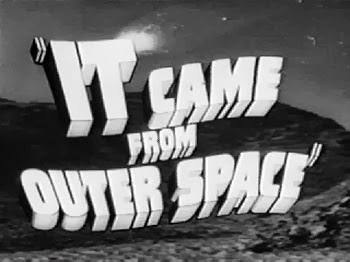
Stubs – It Came From Outer Space


It Came From Outer Space (1953) Starring: Richard Carlson, Barbara Rush, Charles Drake, Joe Sawyer, Russell Johnson. Directed by Jack Arnold. Screenplay by Harry Essex. Based on The Meteor, a story by Ray Bradbury. Produced by Wiliam Alland. Run Time: 81 minutes. U.S.  Black and White. Science Fiction, Horror
There is an old expression that everything old is new again. That’s true for two things that are popular staples in theaters today, science fiction films and 3D technology. These were also quite popular back in the 1950’s, when our film, It Came From Outer Space, was released.
Some have declared the 1950’s as the classic period of science fiction films. However, much of the science fiction films from this decade were low budget affairs. (Note: Practically every film made in the 1950’s was made on a shoe-string budget when compared to the $200 million productions of today.) Major studios were often involved, if not in a production capacity, then definitely as distributors.
In my review of Earth vs. The Flying Saucers, I wrote that fifties’ sci-fi and flying saucers go together like milk and cookies. And this is certainly true. Post World War II and pre-Apollo moon landing, there seemed to be an obsession with space and especially visitation from other worlds. While Mars was a popular choice, it was certainly not the only origin point for aliens. That fascination has never died and is carried on today fueled by films like Cloverfield (2008) and Super 8 (2011) to name a few (JJ Abrams) films.
Film studios, which were not the media companies we know today, were finding themselves in a pitch battle with this thing called television. One way they could differentiate themselves from the little box in the living room was to offer a bigger, more spectacular experience. Large formats, color, stereo sound and, of course, 3D, were all designed to separate the movie experience from the stay at home one. (Even today with large screens capable of showing 3D in Dolby 7.1 surround sound, the experience is not the same. Cheaper maybe once you buy all the equipment, but not the same.)


3D makes it better, doesn't it?
3D was a gimmick then and it is still a gimmick today, despite what the majors may say. They want you to pay extra to see something that might be passable in 2D, but is supposed to be awesome in 3D. And even more if it is in IMAX. Face facts that if the story is good the dimensions don’t matter. 3D, as long as it is projected correctly, can certainly enhance the storytelling and the visuals, but it can’t make up for a lousy script or bad acting.
Considered the Golden age for 3D, the early 1950’s saw several of the major studios release their first films in this new format. The first color stereoscopic film was Bwana Devil (1952) produced, directed and written by Arch Oboler, famous for his ego and for writing the radio series Lights Out. Columbia Pictures and Warner Bros. took stabs at 3D with Man in the Dark and House of Wax respectively, both released in 1953. House of Wax is notable as well for its use of stereo sound.
The craze would die down starting in the summer of 1953, when 3D was viewed as hard on the eyes (sound familiar?). When the two strips of film got out of synch or the projectionist was careless, the resulting viewing experience would cause headaches and eyestrains. When the craze kicked up again a few years ago, there were the same complaints. But rather than withdraw the format, the studios have gone so far as taking beloved classics, like The Wizard of Oz (1939) and transformed them to 3D. Nothing is sacred these days.
But before the craze started to die, Universal-International (“Doesn't the fact that it's universal make it international?” apologies to MST3K the Movie) got into the act, releasing It Came From Outer Space, its first 3D film and accompanied with “Amazing Directional Stereophonic Sound”.
Time to put on your 3D glasses.
It Came From Outer Space tells the story of writer and amateur astronomer John Putnam (Richard Carlson) who has recently moved from the city to the small town of Sand Rock, Arizona. (In fact his character starts narrating the film, but this device is quickly dropped.) Still considered an outsider, John has won the heart of schoolteacher Ellen Fields (Barbara Rush). Early one morning, after midnight, while John and Ellen are about to kiss (hey it was the 50’s and kissing was all that you could do on film) there is a flash of light streaking across the sky. John searches through an enormous telescope he has set up outside (not Mount Wilson big, but big for an amateur) for the meteorite crash site, nearby in the desert, near the abandoned Excelsior mine.
Sometimes a telescope is a telescope, other times it's a phallic symbol.
Waking up Pete Davis (Dave Willock), a pilot with a topless helicopter, John and Ellen visit the crash site. John, against better judgment, goes down into the crater created by the object and he follows a glittery trail that leads him to the spaceship which has caused the damage. In the open hatch is an alien, which only looks like a glowing eye. Before you can say “Danger Will Robinson”, the alien causes an avalanche by closing the hatch and the craft is buried.
This just looks dangerous.
John narrowly escapes being buried, too and by the time he’s made it out of the crater the local newspaperman, Dave Loring (Alan Dexter) and the Sheriff Matt Warren (Charles Drake) have arrived. But when John tells them what he’s seen they think maybe he suffered a blow to the head in the avalanche. The fact that Matt has a thing from Ellen doesn’t help matters either.
Just before the avalanche, John (or a model replica) gets close the spaceship in the crater.
After a helicopter ride back to the airport, John takes Ellen home. On the way, he explains that even though the townspeople may deride him, he must pursue his discovery. Ellen agrees to help him. Then in the desert, they glimpse a nebulous image that crosses in front of the car. Sure they have hit whatever it is, John stops the car, but there is nothing they can see. The two do not realize that the alien is watching them.
Ellen (Barbara Rush) and John (Richard Carlson) look for an alien lifeform.
The next day, activity at the crash site has increased. There is a phalanx of reporters, print and television, including Dugan (Robert Carson) as well as law enforcement and the army. When John arrives with Ellen, he is happy to see his old friend, Dr. Snell (George Eldridge), and his assistant, Bob (Brad Jackson), are already at the site, taking samples and readings. But the good doctor is unwilling to commit the resources necessary to dig up whatever caused the hole. He doesn’t seem to appreciate what John had been through the night before.
The press, Dugan (Robert Carson), hounds John for details about his supposed find.
After Matt warns John that he’s ruining Ellen’s career as a school teacher by keeping her out of the classroom, John and Ellen leave. On the way back to Sand Rock, they encounter their friends, phone engineers Frank Daylon (Joseph Sawyer) and George (Russell Johnson). They’re investigating an eerie whistling over the phone lines and Frank asks John and Ellen to check one area of the lines while he and George check another. John and Ellen find nothing and return to report to Frank and George. But they discover their telephone truck abandoned on the road with a blood stain on the door. John follows glittery tracks into the desert, where he encounters a glassy-eyed, robotic-sounding George, who assures John and Ellen that nothing is wrong. (Yeah, right.)
Frank (Joseph Sawyer) invites John to listen to the whistling noise on the telephone lines.
But John spies Frank's body on the ground behind a rock. He grabs Ellen and the two race back to town to enlist the sheriff's help. As soon as they leave, the real Frank and George wake up from having been knocked out and see before them their robotic replicas. Alien Frank and George explain to the real Frank and George they are aliens and have taken on the men's appearances. The aliens reassure Frank and George that they are peaceful and will merely detain the men at their ship until the aliens are ready to leave Earth.
Naturally, Matt does not believe John's story. Reluctantly, he accompanies them back to the desert; he leaves when they find no trace of Frank or George or their truck. All three return to town, where Matt watches as John spots alien Frank and George and chases them down the street. Hidden in a dark alleyway, the aliens, who sense that John understands them, inform him that if they are left alone to repair their ship, they will remain peaceful. They wish to harm no one, especially John.
Alien Frank and George tell John they just want to be left alone to finish their repairs.
That night, as John frets over whether he is doing the right thing by not attacking the aliens, he is called to Matt's office. The sheriff, concerned about that day's disappearance of Frank and George, as reported by Mrs. Daylon (Virginia Mullen) and George’s girlfriend, June (Kathleen Hughes). According to them the “men”, who had been acting strange, left on a special assignment for a couple of days and took clothes with them. The sheriff promises to let the women know what he finds and asks Ellen to drive them home.


June (Kathleen Hughes) is George's girlfriend. She certainly makes an impression in her one brief scene.
After they’ve gone, Matt tells John about the other people who’ve disappeared, including Dr. Snell and Bob, and about electrical equipment stolen from a local hardware store. Matt is finally beginning to believe John. 
Meanwhile, the alien Frank abducts Ellen and brings her to the mine.
Ellen being abducted by Alien Frank.
There is a mysterious phone call, after which John knows the two men need to visit the mine and that the aliens have Ellen. They hope the mine will lead to the buried spacecraft and its occupants. When John and Matt arrive, Matt reluctantly agrees to wait in the car while John explores outside, which seems to have been arranged in the call.
But within minutes, an alien uses Ellen's form to lure John into the mine. There, an obscured alien instructs John that its race is an advanced one, but they are good and have souls and want nothing more than to repair their ship and leave. While they desire contact with earthlings, humans are not developed enough to accept the aliens' frightening appearance. The alien tells him that he must keep the other humans away or they will have to destroy them.

John refuses to agree until the alien shows itself, but he then turns away in horror from the huge, one-eyed, bulbous jellyfish-like being. Back at the car, Matt is waiting anxiously. John reveals to Matt what he has seen and that he’s learned Ellen is okay as long as they don’t interfere. The aliens are afraid humans kill what they don’t understand. Matt reluctantly agrees to wait and the two return to town, where John finds that the aliens have visited his house, leaving their tell-tale glittery path. He discovers that his clothes are also missing.

John couldn't handle seeing the alien in his true form.
Meanwhile, the sheriff and his deputy, Reed (William Pullen), discuss what to do. The sheriff wants Reed to evacuate the area, but Reed thinks they should attack the aliens and questions Matt’s manhood for listening to John. So when John informs Matt that the aliens have taken some of his clothes, Matt decides that maybe the aliens have been lying to him.


Deputy Reed (William Pullen) challenges the Sheriff's decisions.
The nervous sheriff changes his mind about waiting things out. John has to restrain Matt from interfering with alien Frank who is in town getting supplies. But as soon as the truck has gotten safely away, Matt rounds up a posse to stop Frank. They set up a roadblock and shoot the alien, forcing his truck off the road and into a boulder causing it to explode.

Sheriff Matt Warren (Charles Drake) puts together a posse.
Alone, John takes the sheriff’s car and drives back to the mine to warn the aliens of the pending attack. He encounters alien Ellen, who first tries to lure him into a pit. She then tells him that the aliens no longer trust him and they must resort to violence. She tries to shoot him with a laser like device, but he shoots back with a handgun, killing alien Ellen, who transforms back into her alien form before falling into the pit and dissolving in the water.
When the aliens stop trusting John, alien Ellen tries to kill him.
Meanwhile, the sheriff and other armed men arrive at the mine ready for a fight.

John follows the sound of electric motors and finds the aliens, in their human forms (?), working on the engine they’ve been developing for over a thousand years. The head alien, who now looks like John, knows there is a mob after them and informs real John that the aliens have no choice but to use their deadly laser weapon if they are prevented from leaving.


Alien John tells real John once again they just want to leave earth.
John counters, proposing that the aliens release the earthlings as a show of faith. Then the men outside will cease their attack. Reluctantly, the aliens agree, and the unharmed humans are freed. They exit through the mine shaft. John sets off dynamite to seal the abandoned mine and to protect the aliens from the posse. Given the time to complete their repairs, the aliens leave while the townspeople stand together to watch.


John leads Ellen and the other townspeople to safety.
When Ellen asks if they are gone for good, John explains that they will return only when humans are ready for them to meet and they’ll be back.

While the 1950’s was the golden age for 3D sci-fi, that only meant there were a lot of them, that doesn’t mean they were necessarily good or made huge box office. It Came From Outer Space grossed only about $1.8 million in the U.S. and Canada, making it the 75th biggest film of the year, which is really nothing to brag about. Reviews at the time were lackluster. The New York Times wrote that it was “mildly diverting” which isn’t fodder for the movie poster.

The film is viewed now as one of those iconic 50’s sci-fi alien films, even earning mention in The Rocky Horror Show’s opening theme “Science Fiction/Double Feature” in the line: Then at a deadly pace it came from outer space.

The low budget film is not without its charm. As an example, the alien ship and their form are actually done pretty well and both seem original, at least to the casual viewer of 50’s sci-fi. One thing that adds to the film is its use of the Theremin in the score. The Theremin is an early electronic instrument controlled without physical contact and invented by Leon Theremin in 1928. The instrument is known for the eerie sounds that it creates and was already a staple of Sci-Fi and Horror soundtracks, having been used in Rocketship X-M (1950), The Thing From Another World (1951) and The Day The Earth Stood Still (1951). Before that the instrument had been used as far back as 1936 on The Green Hornet Radio show and in films as such as Spellbound (1945) and The Lost Weekend (1945) and The Spiral Staircase (1946). The soundtrack for It Came From Outer Space was written fairly equally by Herman Stein, Henry Mancini and Irving Gertz. The Theremin itself is played by Dr. Samuel Hoffman, who apparently was the go-to man for Theremin play.


The alien spaceship in flight from the beginning of the movie. This probably looked awesome in 3D.
There is also an originality to the story. The aliens really don’t want to do us harm nor take over planet Earth or tell us how to run things (as they do in say The Day The Earth Stood Still). Instead, they just crashed here on their way somewhere else and all they want to do is be on their way; the equivalent of an intergalactic flat tire. While that is a refreshing sentiment and sets the movie apart from most of the alien sci-fi fare, the story is still full of holes. To name a few: Why did the aliens pick John as someone to trust? Why would alien Frank and George know their way around the small town and manage to lead John into a trap of sorts? Who calls John at the Sheriff’s office to tell him the aliens have Ellen? Why do the aliens need human clothes? Why are they working on their ship in their human forms, rather than their true forms?

Much of the action consists of travelling to and from the crash site by helicopter, car and truck. And while the pace is slow, the story never really stands still.

The acting is all right though nothing spectacular. The lead actor, Richard Carlson, had been working in films as an actor since 1938’s The Young in Heart. While he would go on to appear in Creature From the Black Lagoon (1954), his film career would slow down after It Came From Outer Space. Carlson did work in television, where he would appear as Herbert Philbrick in I Led Three Wives (1953-1956). He would continue to act as well as direct and write until 1975.

The lovely Barbara Rush, who will apparently scream at the drop of a hat or at least the sighting of a Joshua Tree, had been acting since 1951, appearing in such films as When Worlds Collide. She received a lot of attention from this film, winning the Golden Globe for most promising female newcomer for her role as Ellen Fields. She would go on to appear in Magnificent Obsession (1954) and Robin and the 7 Hoods (1964) but never really obtained stardom. She also acted on television, appearing for example, in 68 episodes of Peyton Place (1968-69).

I would be want if I didn’t mention Russell Johnson, who plays George, Frank’s assistant. While Johnson appeared on television as far back as 1950 on a series called Fireside Theatre, and in films in 1952’s For Men Only, he is best known for the role of The Professor aka Roy Hinkley, Jr. (or as part of … and the rest, depending on which version of the theme song) on Gilligan’s Island (1964-1967). He appeared in This Island Earth (1955) along with numerous sci-fi and western films and had guest spots on such television series as Adventures of Superman (1953), The Lone Ranger (1955), Alfred Hitchcock Presents (1957), Twilight Zone (1960-61), Route 66 (1962) and on and on. But every time he appears on screen in any movie, you’re attempted to say, “Hey, it’s the Professor” and possibly make some bad Gilligan-related joke. Such is the power of television than an entire career can be overshadowed by one role.


Watch out Professor, I mean George.
Interestingly, Kathleen Hughes, who played June, George’s girlfriend, got fairly big billing for a pretty small role. She certainly stands out in the one scene she’s in, but it’s more her look than her acting that is noticed. While I’m not familiar with her career, which included about twenty films, It Came From Outer Space seems to have been the biggest one she appeared in, or at least the most memorable. She had been in films for about four years prior to this film, so I wonder if she was a bigger star than I realize or were people expecting more from her in the future? Hughes, like everyone else from the cast, would go on to act in episodic television, making guest appearances in everything from Alfred Hitchcock Presents (1956-57) through Perry Mason (1962). I Dream of Jeannie (1967) to Quincy M.E. (1980).

Overall, I would say that It Came From Outer Space is not a bad film, however the pacing is a bit slow. While I am not an aficionado of 50’s sci-fi, I do like watching the “classics” from time to time and I would consider this film to fall into that category. Fairly entertaining, this is very much worth viewing.