Saturday, November 14, 2015

Stubs – Fatty and Mabel Adrift


Fatty and Mabel Adrift (1916) Starring: Roscoe Arbuckle, Mabel Normand, Al St. John. Directed by Roscoe Arbuckle. Screenplay by Roscoe Arbuckle. Produced by Mack Sennett. Run Time: 34 minutes U.S. Black and White, Silent, Comedy.

Before there was United Artists, the studio owned by the stars, there was the Triangle Film Corporation. Founded by two brothers, Harry and Roy Aitken, in 1915, Triangle relied on three of cinema’s major producers: D.W. Griffith, Thomas Ince and Mack Sennett. The studio once stood where Sony Pictures Entertainment now stands, which is also the historic home of Metro-Goldwyn-Mayer.

The studio was short-lived, ceasing operations in 1919 after Adolph Zucker had taken control and after both Ince and Sennett had left. However, in those four years, films starring the likes of Fatty Arbuckle, Mabel Normand, Gloria Swanson, William Desmond and Douglas Fairbanks were distributed by the studio, not to mention D.W.Griffith’s silent epic Intolerance: Love’s Struggle Through the Ages (1916).

One of the approximately 240 films produced by Triangle was Fatty and Mabel Adrift (1916), a comedy short produced by Sennett, starring two of silent comedy's heavyweights, Roscoe “Fatty” Arbuckle and Mabel Normand. Like many of Sennett’s stars, Charlie Chaplin and Normand, Arbuckle not only starred in front of the camera, but also wrote and directed his own material. Arbuckle had been directing since Barnyard Flirtations (1914), a comedy short.

Mabel Normand and Roscoe "Fatty" Arbuckle.

The films opens with heavy-handed allegory for love, as we see Fatty (Roscoe Arbuckle) and Mabel (Mabel Normand) outlined in cut out heart shapes being united by Cupid.

The Cupid who brings them together.

Fatty is a farm hand working for Mabel’s parents (Frank Hayes and May Wells). While Fatty and Mabel are in love, there is a rival for her affections, Hiram Perkins’ son (Al St. John); and yes, that is the character’s only given name in the film.

Fatty is a farm hand working for Mabel's parents.
One day, I. Landem’s (Glen Cavender) car has a flat tire in front of the farm. While Fatty goes to help Landem’s chauffer (Joe Bordeaux) change the tire, Mabel’s parents decide to purchase a house from Landem, a seaside realtor, for Fatty and Mabel as a wedding present.

I. Landem (Glen Cavender) sells a seaside house to Mabel's father (Frank Hayes).
After their marriage, Mabel and Fatty move into their new home along with their dog, Luke. But Hiram Perkins’ son isn’t going to give up without a fight.

Mabel makes dinner for Fatty while he’s out fishing. Her biscuits are so hard that they break plates if they fall on them. At dinner, Luke takes his place at the table, even getting a napkin from Fatty. Fatty tries to cut the biscuits with a knife, but they are too hard. Mabel pretends not to notice until Fatty makes fun of how hard they are. When she cries, he does his best to pretend he likes them.

Mabel bakes Fatty some rock hard biscuits.
Meanwhile, Hiram Perkins’ son lurks outside their home. When Fatty catches him, they fight, with Fatty, who is much stronger, prevailing.

Fatty finds Hiram Perkins' son (Al St. John) lurking outside the house.
That night, the two newlyweds go to sleep in different beds in different rooms. While Mabel kisses Fatty good night, only Luke the dog is invited to share her bed. Fatty doesn’t seem to mind, even going so far as to shadow kiss her while she’s in bed.

Outside, it is starting to rain and Hiram Perkins’ son is taken by two henchmen (Bordeaux and Jimmy Bryant) to meet their boss, Brutus Bombastic (Wayland Trask). Bombastic is so tough that he is shown eating dynamite and drinking gasoline. He uses a gun to light his cigar. Hiram Perkin’s son Is happy to make Bombastic’s acquaintance and hires him to help get revenge on Fatty and Mabel. Bombastic dispatches his two henchmen to help him.

Hiram Perkins' son is taken by Bombastic's henchmen to meet their boss.
The storm rages outside the cabin, which keeps Fatty up. He wakes up Mabel to show her the storm, which is so severe that rain is coming down horizontal. When Fatty opens the window it is like a firehose hits him and Mabel. Both soaked, they go back to their separate beds.

The water fills the house and sets Mabel and Fatty's beds adrift.
The henchmen help to dislodge the house from its foundation and the agitated waves pull it out to sea.

Bombastic's henchmen dislodge the house off its foundation.
When Hiram Perkins’ son goes to pay the henchmen off, they notice he has a wad of cash. They naturally think they can win it from him in cards and challenge him to a game of poker.

By the next morning, the house is out to sea and even though the water is at least a foot deep inside, it is still afloat. Mabel’s bed floats into Fatty’s and it’s not too long before they’re both in the water. Finding a pencil, Fatty writes a note, attaches it to Luke’s collar and sends him out to get her parents’ help.

Fatty and Mabel set adrift.
Meanwhile, Hiram Perkins’ son is luckier at cards than at love and has the winning hand.

Mabel's parents come to the rescue, riding bikes in the storm, still wearing their night clothes.
When Mabel’s parents get the note, they call for help and also follow Luke back to the seaside on a bicycle built for two, though they are still dressed in their night clothes. The police, with little to go on, rush in boats to the house to rescue the couple. Mabel’s parents are in such a hurry that they ride their bike off the deck into the water, where they run into Landem, who takes them in his boat out to where the cottage is adrift.

Fatty and Mabel are rescued by Landem in his boat.
Back at Bombastic’s cave headquarters, while his henchmen may have lost their money, they try to take all of his for themselves. Even Bombastic gets in on the action and takes the wad of cash for himself. But he is careless when discarding his cigar and sets off an explosion, knocking everyone out. But Hiram Perkins’ son is the first to regain consciousness and takes the money back, only to have a loose rock fall and knock him out again.

Brutus Bombastic (Wayland Trask) eats dynamite and drinks gasoline.
Meanwhile, Fatty and Mabel are rescued and love wins out. The film ends with Fatty and Mabel in a single cut out heart shape; a bookend to the allegory that opened the film.

Mabel and Fatty united in love.
Released on January 9, 1916, the short received good reviews and Fatty and Mabel Adrift is considered to be one of Arbuckle’s better films as a director.

We’ve already discussed Mabel Normand’s career in our review of Tillie’s Punctured Romance (1914), one of her earlier successes co-starring with Marie Dressler and a new up and comer named Charlie Chaplin.

Her co-star in this film, Roscoe “Fatty” Arbuckle, like Mabel, would have a shorter career than he should have had as a movie star. For a silent movie comedian, Arbuckle got his start as a singer. After returning from an overseas tour with the Morosco Burbank Stock vaudeville company, Arbuckle began his film career at the Selig Polyscope Company in July 1909. His first film appearance was in Ben’s Kid (1909) and he continued to appear in one-reelers for Selig until 1913. After briefly working at Universal Pictures, Arbuckle found success at Mack Sennett’s Keystone studios.

Called Fatty, because of his weight of over 300 pounds, Arbuckle didn’t want to use his heft for laughs, refusing, as an example, to get cheap laughs by getting stuck in a chair or a doorway.

Arbuckle was so popular that in 1916, Joseph Schenck offered Roscoe $1,000 a day, 25% of the profits and complete creative control of his films. Together, they founded Comique. It was Arbuckle who brought the then 21-year old Buster Keaton into films.

In 1920, Arbuckle signed with Paramount Pictures at $1 million a year, giving control of Comique to Keaton. At Paramount, Arbuckle lost creative control and Adolph Zukor, the studio’s head, worked his new star hard, producing 9 features in the space of 18 months. Exhausted after 18 months of work, Arbuckle took a three-day vacation in San Francisco in September 1921 and the rest is sadly history.

At a party Arbuckle was throwing, Virginia Rappe fell ill with stomach pain and died four days later from what doctors called peritonitis. Arbuckle was arrested on September 11th on the charge of manslaughter. While the evidence was flimsy at best, newspapers, led by William Randolph Hearts’ papers, smeared the comedian, claiming that he had raped Rappe and used a foreign object on her as well.

Arbuckle had to stand trial three times, twice the juries were hung and the third one acquitted him. Still, the damage was done and Arbuckle’s career took a nosedive afterward. Arbuckle would be blacklisted for 11 years by Hollywood and as a scapegoat who thought Hollywood needed to be brought under moral control.

While he could no longer star in front of a camera, Arbuckle did go back to directing at Paramount under the pseudonym of William Goodrich. With the passage of time, Arbuckle was seemingly forgiven by the public and signed by Warner Bros. in 1932 to make six two-reelers for the studio. They were such a success that on June 28, 1933, Warners signed him to a long term contract. But after a night of celebration, Arbuckle died of a heart attack on June 29, 1933.

Al St. John, Arbuckle’s nephew, would appear in over 350 films beginning in 1913. In addition to appearing in films at Keystone and Comique, he would also work with Keaton and direct his own comedies as well for Sunshine Comedies. With the coming of sound, St. John would develop a Western character, Fuzzy Q. Jones, and appear in 80 films as Jones until the end of his career in 1952.

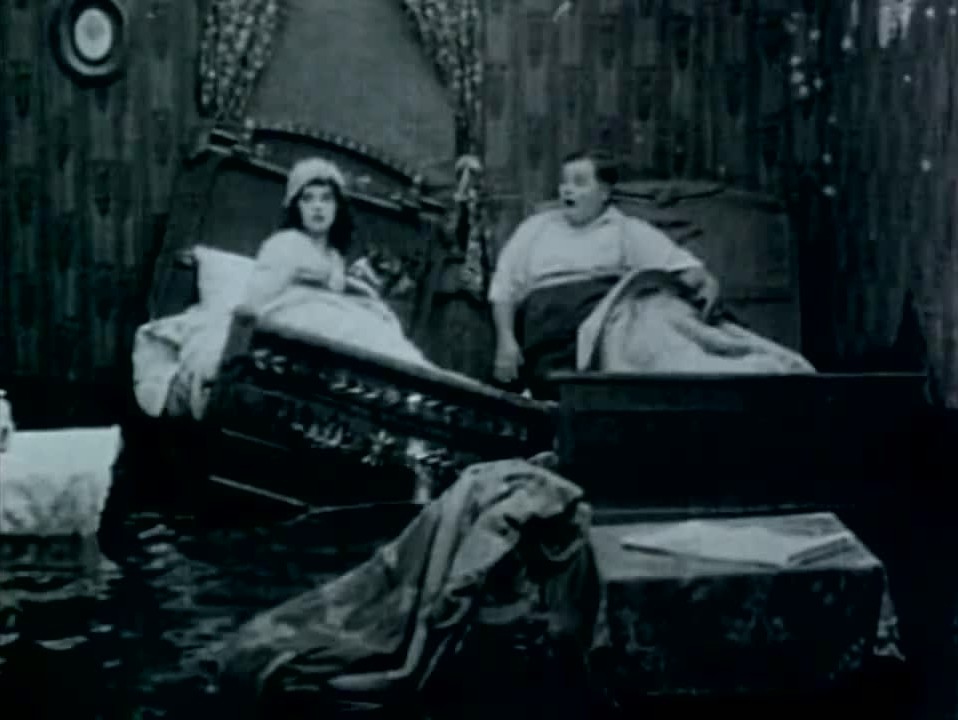
One of the reasons I wanted to see this film was the iconic photo of Arbuckle and Normand on the water-soaked stage. And there is indeed water in the film. However, slapstick, which Arbuckle and Sennett were best known for, is kept to a minimum here. I’ll let you judge if that is a positive or a detriment to the film.

The film uses tints to differentiate shots, so the film is far from strictly black and white. As an example, a blue tint is used for exterior night shots and a yellow gold tint is used for interiors supposedly lit by candlelight. There are both photographic and physical special effects utilized. The photographic, used for the light from a lighthouse, is a little clunky. The other special effects, such as the rain and water, are fairly well done.

The iconic image of Fatty and Mabel up to their waists in flood water.
The story is both pretty straightforward but at the same time a little hard to follow. I’m not sure if it’s the print I saw or how it was originally released, but there is a definite lack of title cards. You can get the gist of what is going on, but there are no subtleties. This is true of “dialogue” as well as the acting. Arbuckle is always bigger than life and aside from the gesture of having his shadow kiss his newlywed bride good night, there is nothing small in Arbuckle’s acting. He is always presented as muscular, whether it is lifting the car at the beginning to change the tire to throwing Hiram Perkins’ son around like a ragdoll. And despite Mabel Normand’s presence, it is up to Arbuckle to carry the movie.

I came to the film wanting to like it, but I’m afraid that even though I think the film is well-made, I didn’t find it all that funny. There may be other factors that attribute to this. Perhaps I’ve already seen some of the sight gags used in other later films. Perhaps there is much missing from the print I saw. But maybe this film hasn’t aged as well as it could have. The theme of the jilted lover getting revenge on the newlywed couple, by ruining their honeymoon cottage, is handled better and to funnier end by Buster Keaton in his short One Week (1920), four years later.

I’m open to watching other Arbuckle films and would definitely say that he is someone who cannot and should not be ignored in film and comedic history. I just didn’t find Fatty and Mabel Adrift to be all that it was cracked up to be or at least all I hoped it would be.

For other silent films, check out our Review Hub for Silent Cinema: Here.

Thursday, November 12, 2015

Spectre - Not Spectacular


Spectre (2015) Starring Daniel Craig, Christoph Waltz, Léa Seydoux, Ben Whishaw, Naomie Harris, Dave Bautista, Monica Bellucci, Ralph Fiennes. Directed by Sam Mendes. Written by John Logan, Neal Purvis, Robert Wade and Jez Butterworth. Based on characters developed by Ian Fleming. Produced by Michael G. Wilson, Barbara Broccoli.  Color United Kingdom/United States. Run time: 148 minutes. Action, Adventure, Espionage.

There seems to be a trend in television and film storytelling to try to blame all the world’s ills on some secret multi-national organization with unlimited resources that functions to help its own cause to, dare I say it, “rule the world.” Anyone familiar with TV’s Blacklist has heard of the Cabal. Even the recent installment of Mission: Impossible, Rogue Nation, had the Syndicate. It’ll probably come to no one’s surprise that Ian Fleming’s James Bond novels also had such an organization: Spectre. The only book that Spectre is really a significant threat is Thunderball, published in 1961.

While prominent in early Bond films, if you're new to the James Bond Cinematic Universe and Spectre doesn’t sound familiar, it’s because it hasn’t appeared in a movie since For Your Eyes Only (1981) and then only as a cameo for its leader Ernst Stavro Blofeld.

Well, everything old is new again and Spectre is back and the organization is sort of plastered over the top of all the Daniel Craig Bond films in an attempt to tie them all together. Once again, Blofeld strides the top of the organization with Quentin Tarantino favorite Christoph Waltz in the role. Understated evil wears well on Waltz.

Christoph Waltz is Ernst Stavro Blofeld, the main villain in Spectre.

Like the best villains, Blofeld has a secret fortress, this one in the middle of the Algerian desert, filled with loyal and heavily armed minions who seem to be there only to ramp up the body count. Not only does Blofeld take responsibility for all the pain in Bond’s life, killing every woman Bond has cared about (forget what you thought you knew from the other films), but he also has another connection to Bond that I will leave for the film to reveal, though it's not one Ian Fleming had thought of.

Every time there is a new Bond film, the comparisons between the current Bond and past Bonds are inevitable. Daniel Craig is definitely not your father’s or your grandfather’s Bond for that matter. He is not suave like Sean Connery or Pierce Brosnan, but that’s okay. He’s more of an enforcer type and that works well in the new world order. You don’t mind if he beds a woman now and then, but you want him to fight rather than negotiate.

Daniel Craig returns for the fourth time as James Bond.

Monica Bellucci may seem like an interesting choice for a Bond girl. An accomplished actress, she is also over 50, making her, I believe the oldest Bond girl, or should I say woman. Still a beautiful woman, the real shame is that there is so little for her to do.

Monica Bellucci is under used as a Bond girl in Spectre.

Bond’s main love interest in this film is Dr. Madeleine Swann (Léa Seydoux), the beautiful daughter of one of Bond’s more recent foes, Mr. White (Jesper Christensen), last seen in Quantum of Solace (2008). (It’s okay if you don’t immediately remember him after seven years.) When last seen, he was a major player in Quantum, a secret organization in its own right, but we now know was simply a subsidiary of a much larger one. The last film I saw her in was Woody Allen’s Midnight in Paris (2011). Even in the relatively small role of Gabrielle in that film, she made an impression and she does here again. Not an award-worthy performance, but still very good.

Lea Seydoux plays Dr. Madeleine Swann, Bond's love interest.

While Daniel Craig is the star of the film, the minor characters have a lot more to do than they have in previous films, at least the ones in the Craig franchise. While I’ve never been a big fan of Ralph Fiennes, I must say that he makes a good M. And while there will never be a Q like Desmond Llewelyn, Ben Whishaw, now in his second appearance in the role, is definitely growing on me. Bill Kinnear as Bill Tanner, the MI6 Chief of Staff, is also showing staying power. Rounding out the usual supporting cast, Naomie Harris is also back as Moneypenny, the former agent now M’s assistant.  This is really turning out to be a good supporting crew for whoever the star might be.

Spectre, the film, delivers on your Bond check list. There is an elaborate opening sequence, there are the multitude of International and exotic locales, the martini shaken but not stirred, the Aston Martin DB5, “Bond, James Bond”, the theme music, the beautiful woman with whom Bond has a tryst and of course, product placements, the new staple of the franchise. While Heineken beer gets a screen credit, I can’t imagine they’re happy that it was used to pour down a mouse hole.

Bond films have a standard of their own, but I sometimes felt that this one was stretching the rules of good writing. I know that there are passages that no one but a Bond screenwriter could get away with and only because he’s writing a Bond film. There are, in fact, four writers for this film, which is rarely a good sign. At times the rubber band of congruity is stretched to the breaking point.

While the film has its share of pyrotechnics, there are definitely some slow stretches and the film is a little too long. I think there’s a rule that Bond films should not be boring. Like the theme song “Writing's on the Wall", sung by Sam Smith, this Bond film is just okay. Not that that will equate to lower box-office, but maybe it’s time to shake up the creative team, as they may have to, once again, reboot the franchise.

We are told that James Bond will return, but that future may or may not include Daniel Craig as Bond. His status is somewhat up in the air as of this writing. I’m not sure if he has one more film on his contract or not; and the film leaves the future ambiguous. If this is Craig’s last go round, no one could blame him for wanting to get out. The man has literally lost teeth and fingertips for the role. While I wouldn’t mind him coming back, he might want to get out while he’s still in one piece.

Saturday, November 7, 2015

Review Hub - Silent Cinema


With our November salute to Silent films, we thought it would be a good time to create a Review Hub to showcase all the silent films we've reviewed thus far on Trophy Unlocked. 

The era of silent films (1894-1929) is one rich with some of the greatest films ever produced. While we, at Trophy Unlocked tend towards the comedies and the work of Charlie Chaplin, Buster Keaton and Harold Lloyd, some great dramatic works were also made during this time, including Sunrise and Wings. This is an era of birth, in which cinema was learning to tell stories and ideas were passed through pantomime and title cards. And while the era of silent films came to an end in 1929, with the release of The Jazz Singer, silent films were still made beyond that time, most notably by Chaplin, who continued making silent films well into the 30's. The fairly recent French film, The Artist (2011) demonstrates that you don't always need words to entertain.  

Just like there are many great black and white Academy ratio films made before you were born, there are also some really great silent films which we encourage you to seek out as well. Here are the ones we've reviewed so far and we'll keep adding to the list as time goes by:


City Lights


Sherlock, Jr.  


Sunrise


The Artist (2011)

Wings (1927)


Nosferatu (1922) 

Safety Last (1923)


Modern Times (1936)


The Phantom of the Opera (1925)


The Squaw Man (1914)


Kid Auto Races at Venice (1914)
Show People (1928)


Tillie's Punctured Romance


Steamboat Bill, Jr. 


Shoulder Arms (1918)


The Birth of a Nation (1915)


London After Midnight


The Cabinet of Dr. Caligari


A Submarine Pirate

Fatty and Mabel Adrift (1916)

The Immigrant (1917)
One Week


Intolerance (1916)

The Adventurer 


Beggars of Life


A Dog's Life


Seven Chances (1925)


The Balloonatic (1923)

Stubs – A Submarine Pirate (1915)


A Submarine Pirate (1915) Starring: Sydney Chaplin, Glen Cavender, Wesley Ruggles, Phyllis Allen. Directed by Charles Avery and Sydney Chaplin Screenplay: Mack Sennett (uncredited). Produced by Mack Sennett. Run Time: 25 minutes U.S.  Black and White. Silent, Comedy

While Charlie Chaplin was just emerging as one of the world’s biggest film stars, he wasn’t the only Chaplin making movies. His half-brother Sydney, whom Charlie had convinced Sennett to hire, was still making movies for Keystone Films even after Charlie had decided to leave for greener pastures at Essanay.

Just as Charlie had a recurring character, the little Tramp, Syd also had one at Keystone, Gussie. Starting with Gussie, the Golfer (1914), Syd would make about ten films as Gussie in 1914 and 1915. But in what would turn out to be his last film for Keystone, he would shed the Gussie character name in A Submarine Pirate (1915). Being unfamiliar with the Gussie series, I don’t know if he also shed the persona of that character.

Shot in San Diego, with the cooperation of the U.S. Navy, the film crew was able to use a real submarine. According to an article in the New York Times, dated November 15, 1915, the Navy claimed they planned to use the film to promote recruitment.

Released on December 26, 1915, A Submarine Pirate starts with a witless waiter (Sydney Chaplin) who is eating the leftovers from the guest trays in an unnamed hotel. He doesn’t seem to notice, until it’s too late, that he’s about to eat a real plate.

The hapless Waiter (Sydney Chaplin) eats not only the leftovers, but the plate they're on.

He’s no better at walking, as he falls down the stairs, while carrying a tray. His boss, hotel manager (Harold J. Binney), is not happy about the mess and starts to kick the waiter around the lobby. The mess is still there when one of the hotel’s guests with a bandaged leg (Frank Alexander) slips and falls. While the hotel manager continues to punish his waiter, the man returns, firing a gun into the lobby.


Hotel guest makes his displeasure known by firing a gun in the lobby.

All the commotion causes one guest (Phyllis Allen) to pass out. When she comes to, she blames Syd. Her retribution is interrupted by the appearance of a Peach (Cecile Arnold), with whom the waiter immediately starts to flirt. Ditching his duties, he accompanies her up to her room and kisses her at the door. Downstairs, the angry female guest is waiting for him. When he sticks his head out of the elevator door, he narrowly misses her ambush. He goes back upstairs and another guest of the hotel, a mysterious inventor (Glen Cavender), gets on in his place. When the inventor gets off the elevator, he is smacked in the head by the woman with her parasol.

The Waiter makes a play for Peach (Cecile Arnold).

The inventor is taken to the hotel’s restaurant, where his accomplice (Wesley Ruggles) is waiting for him. The waiter, of course, waits on him. He listens as the inventor tells his accomplice his plans for stealing gold being shipped on a passenger ship. When he’s discovered eavesdropping, he uses a telephone covered in flowers as a listening device.

The waiter not so subtly eavesdrops on the conversation between mysterious
inventor (Glen Cavender) (l) and his accomplice (Wesley Ruggles) (r).

While he’s in the kitchen, one of the cook’s is supposedly an uncredited young actor who would later become one of the big three silent comedy stars, Harold Lloyd.

Harold Lloyd is one of the cooks in the kitchen.

Swapping the inventor's satchel with another guest's look-a-like purse, the waiter takes the accomplice’s place and goes to make the rendezvous with the inventor’s submarine. Stopping at a surplus shop run by its Owner (Josef Swickard), he buys a captain’s uniform.

The Waiter buys a second-hand uniform.

Once on board, the waiter causes the submarine to submerge before the submarine is actually ready. The crew gets even by submerging the sub while he’s on deck. He manages to hold on to the periscope and is spotted, so the Sub Officer (Wesley Ruggles) lets him back on.

When the passenger ship with the gold is spotted, the Waiter once again is topside using a megaphone to tell the ship to surrender. Taking a boarding party with him, he commandeers the Ship’s Captain (Glen Cavender) to take him to the gold and a vault is opened.

The Waiter demands that the passenger ship surrender.

But the Captain manages to sneak away and has the telegraph officer send a distress message. A nearby gunship receives the message and comes to the rescue. But before they can, the waiter discovers their plot. At the same time, the Captain’s men, armed, take positions outside the wire room. But the now wily Waiter manages to bull his way through and, along with his crew, jumps ship.

Here’s where some of the action gets a little odd. With the gunship to the rescue, the passenger ship is to be evacuated and there seems to be a mad dash for the lifeboats. Not sure what is behind that move.

Meanwhile, back on board the sub, the waiter uses the submerging key to knock some sense into his first mate. Of course, without the key, the sub can’t go down below the surface. The waiter then goes into the torpedo room to “help”. It’s unclear what they’re shooting at, but the waiter manages to be holding on to the torpedo when it’s launched. He does eventually let go and swims back to the sub. Nothing seems to have been hit by the torpedo.

The Waiter holds on to the torpedo and gets fired into the water.

Having lost the submerging key in the melee, the sub has no choice but to fight it out with the gunship. Using some sort of submarine gun, the waiter manages to bombard the surface ship, but after a while, the gunship, with its superior fire power, manages to breach the hull of the sub and it goes down. The waiter manages to find a porthole to swim through, but is swimming into the path of a sharp-toothed fish when the story ends.


The Waiter gets attached by a fish when he tries to escape the sub.

When doing research for our review of Tillie’s Punctured Romance (1914), I found references to A Submarine Pirate being Sennett’s second most financially successful film, which, given the output of Keystone, is really saying something.

A Submarine Pirate moves at a fairly hectic pace. Based on the age of the film, some of the action is missing from the two current prints that I’ve seen. There is a very short scene which seems to indicate that the pirates were taking the gold off the passenger ship, but it's really not clear what happens to it. Not sure if this plotline was abandoned during the filming process, edited out prior to release or has simply been lost to time.

While these early silent comedies are sometimes big on pratfalls and short on plotlines, one doesn’t want to put too much on the thin story that is supposed to hold all the action together. Still, this seems like the pirate plot was “pasted” over other footage of a witless waiter causing havoc in the hotel where he works.

It becomes obvious that the hectic pace at the beginning of the film needs something to slow it down a little. The action I describe up the arrival of the Peach at the hotel takes place within the first two and a half minutes. The celluloid would certainly catch fire in the projector if that pace was kept up throughout. So after exhausting all they could do with the hotel lobby, kitchen and dining room bits, they tacked on the idea of a pirate sub hijacking a luxury liner; at least that how it looks 100 years later.

Charles Avery, Chaplin’s co-director had previously worked with him on several of his Gussie films. One of the original seven Keystone Kops, Avery later helm thirty-one of Fatty Arbuckle’s films at the studio. Frankly, it’s difficult to tell what part of A Submarine Pirate Avery directed versus what Chaplin did or if they directed together.

It’s hard to judge the acting capabilities of the actors in the supporting cast, as so much attention is paid to Syd Chaplin. Wesley Ruggles, who appears as the Inventor’s Accomplice and as the Officer on the Sub, was the younger brother of Charles Ruggles. Like the Chaplins, Wesley got his start in acting with Sennett. He appeared in several of Syd’s Gussie films. Wesley would go on to produce and direct films as well. For most of the film he sits and talks to the Inventor with a big moustache and beard blocking most of his face.

Glen Cavender, the mysterious Inventor and the passenger ship’s captain was another actor from the Keystone stable. He would make over 259 films between 1914 and 1949, including films with Mabel Normand and Roscoe “Fatty” Arbuckle, both together and separately. He appeared in Fatty and Mabel Adrift (1916).


Glen Cavender, who plays the mysterious inventor, made over 259 films during his 35 year career.

Phyllis Allen, the angry hotel guest who takes a dislike to Syd, is only in the first part of the film. She would appear in 74 films in the decade between 1913 and 1923, appearing in such Charlie Chaplin films as The Adventurer (1917), Pay Day (1922) and The Pilgrim (1923). While we know she can wield an umbrella, there isn’t much that can be gleamed from her acting besides she looks somewhat like Marie Dressler.

Another young comedian, Harold Lloyd, was also in the cast, though his appearance is not credited. Having started as an extra in the Edison production of The Old Monk’s Tale (1913), he had already been in a few Sennett shorts before appearing as a cook in A Submarine Pirate. He would soon become popular as Lonesome Luke in films we would make for Hal Roach, but find immortality as the “Glass” Character in such films as Safety Last (1923), The Freshman (1925) and The Kid Brother (1927).

Ultimately, this is Syd Chaplin’s film. While he is a talented comedian, we’re shown he can do pratfalls, juggle and other acrobatics, he comes across as a pale version of his younger brother. And while the little Tramp is endearing, the witless waiter turned wily sea pirate is really not. And he goes from hapless to brainy and back whenever the plot requires it.

Syd Chaplin in A Submarine Pirate.

The problem I have with connecting to the Waiter character I think comes down to his motivation in the movie. The character isn’t trying to thwart the piracy or get the money for some higher cause (ex. keeping a widow from losing her house, saving the hotel from bankruptcy, etc.), rather he hijacks the plot for what appears to be simple greed. He’s not a sympathetic character as a result.

Despite the film’s success, Syd would stop acting long enough to manage Charlie’s career, negotiating his lucrative contracts with Mutual and later with First National. He would appear in some of Charlie’s films, including Shoulder Arms (1918), and continue to act on his own throughout the 1920s.

A Submarine Pirate doesn’t quite congeal the way I had hoped before watching it. I know that comedic tastes have changed, but it’s not the slapstick that bothers me, so much as feeling the story was slapped together. In the hands of other silent comedians, such as Buster Keaton, who made several comedies revolving around boats and ships: The Boat (1921), The Navigator (1924) and Steamboat Bill Jr. (1928), there is a lot of humor to be found at sea.

I don’t want to use maritime lingo to describe how I feel about the movie, but let’s just say that this isn’t the comedy adventure I had hoped for and I would say that you can miss A Submarine Pirate.

For other silent films, check out our Review Hub for Silent Cinema: Here.