You Nazty Spy! (1940) Starring: Moe Howard, Larry Fine, Curly Howard, Lorna Gray, Dick Curtis, Don Beddoe. Directed by Jules White. Screenplay by Felix Adler and Clyde Bruckman. Produced by Jules White. Run Time: 18 minutes. U.S.A. Black and White. Comedy, Satire, Slapstick
If you’re of a certain age, the Three Stooges was something you watched after school on television. For me, they were the feature on a show called Slam Bang Theatre, hosted by Icky Twerp (Bill Camfield) with his two sidekicks in ape masks, Ajax and Delphinium. They were not something that my parents really wanted me to watch, thinking these old slapstick shorts would be a bad influence on me and my brother. They never out and out stopped us from watching, just looked disappointed when we talked about it.
Long before the Three Stooges became mid-60s syndication figures, they had appeared on vaudeville starting as support players for Ted Healy. Larry Fine, a vaudeville violinist, met Shemp Howard and Ted Healy when they were performing in the Shubert Brothers' A Night in Spain. Since Shemp was leaving the play, Fine was asked if he wanted to replace him, a replacement stooge. At the time, Healy’s other two stooges were Bobby Pinkus and Sam 'Moody' Braun.
Later, in 1929, Healy signed a contract to perform in a new Shubert Brothers revue, A Night in Venice and brought with him Fine, Shemp and Moe Howard. Moe had previously worked with Healy as well, back in 1921 in vaudeville. A Night in Venice ran until March 1930. That spring and summer, they toured as "Ted Healy & His Racketeers" before heading to Hollywood for Fox Studio’s Soup to Nuts (1930).
The Stooges broke away from Healy after that, as "Howard, Fine and Howard: Three Lost Soles" until the Summer of 1932. In July, Fine, Moe and Moe’s brother Curly joined back up with Healy; Shemp had broken off to pursue a solo career.
MGM signed Healy and his Stooges to a contract in 1933 and they appeared in several feature films and short subjects. Their final film together was Hollywood Party (1934). After that, the stooges parted company. The Stooges would sign a contract with Columbia Pictures to make two-reel comedies. They would go on to make 190 shorts at Columbia between 1934 and 1958, though there would be changes in the group, with Curly replacing Shemp in 1932, Shemp coming back to replace Curly in 1946 and Joe Besser replacing Shemp in 1956. Curly Joe DeRita would replace Besser in 1958 until 1970.
Their humor was considered low-brow slapstick. Moe was basically the ringleader and used physical abuse to keep the others in line and to do his bidding. I can understand why my parents were wary of me watching them and over time I feel like I’ve outgrown their humor, though it’s been a long time since I’ve watched any of their shorts.
What is of interest here is You Nazty Spy! the groups’ 44th short. The subject matter is something that Hollywood had tried to ignore up until now, Adolf Hitler and Nazi Germany. While Charlie Chaplin would get a lot of credit for parodying Hitler in his film The Great Dictator (1940), the Stooges beat him to the punch by about 9 months.
At the time of the film’s release, the U.S. was trying to avoid taking sides in what was becoming a European War. So worried was the U.S. government about taking sides, in 1941, isolationist senators were investigating suspected anti-Nazi propaganda by Hollywood. The committee had gone as far as making a list of films with an anti-Nazi bent. (These hearings are little known because they were canceled on the morning of Monday, Dec. 8, 1941, and the findings were never reported.)
The Hays office and the production code discouraged or prohibited many types of political and satirical messages in films, requiring that the history and prominent people of other countries must be portrayed "fairly". Short films, though, like those starring the Stooges, were given less attention than features and apparently didn’t stop them from making the film.
Filmed between December 5 and 9, 1939, the film was released on January 19, 1940. Written by Felix Adler and Clyde Bruckman, the latter of whom had worked with Buster Keaton and W.C. Fields. The director was Jules White, head of Columbia Pictures' short-subject division. In the 1930’s, while other suppliers of comedy shorts Hal Roach, Educational Pictures and Universal Pictures were scaling back, Columbia was just ramping up. White was used to physical humor, which fit in well with The Three Stooges act. Rather than the physical humor of say, the Marx Brothers, The Three Stooges were much rougher. Rather than cutting a deck of cars with an ax, as Harpo does in Horse Feathers (1932), Moe is more likely to hit Larry over the head with one.
 |
| You Nazty Spy! featured a new title sequence including the Columbia logo's torch-bearing woman on the left-hand corner, standing on a pedestal where each step has printed out "Columbia," "Short Subject" and "Presentation." |
The short begins with a title card disclaimer that reads: "Any resemblance between the characters in this picture and any persons, living or dead, is a miracle."
The story takes place in the fictional country of Moronika, where three munition manufacturers, Ixnay (Richard Fiske), Onay (Dick Curtis), and Amscray (Don Beddoe), are sitting around complaining about the lack of money they’re making. They blame their king, Herman the Sixth and Seven-Eights, and his policy of peace over war. Their solution is to instigate an overthrow of the King and install a dictatorship in his place. But who in the kingdom would be stupid enough to be a figurehead they could control?
 |
| Ixnay (Richard Fiske), Onay (Dick Curtis), and Amscray (Don Beddoe) meet with Moe Hailstone (Moe Howard), Curly Gallstone (Curly Howard) and Larry Pebble (Larry Fine) to discuss setting up a dictatorship. |
Ixnay suggests they use one of the paper hangers working in his living room. They go in and we meet Moe Hailstone (Moe Howard), Curly Gallstone (Curly Howard), and Larry Pebble (Larry Fine). It is decided that Moe shall be the dictator, Curly his Field Marshal and Larry as Minister of Propaganda, send-ups of Adolph Hitler, Hermann Göring, and Joseph Goebbels respectively.
 |
| Moe, Curly and Larry accept the offer and give their own version of the Nazi salute. |
They are told instigate a Beer Hall Putsch; to buy beer for a crowd and then lead them against the King. This apparently happens off camera, as next, we see the flag of Moronika features two snakes in the shape of a swastika and the phrase "Moronika for Morons".
 |
| Moe gives a parody of a Hitler speech flanked by his Field Marshal and Minister of Propaganda. |
Next, we see the Stooges, Moe is making a speech on a balcony flanked by Curly and Larry. As Moe speaks about helping Moronika helping its neighbors and then helping themselves to their neighbors, Larry holds up signs directing the masses on how to respond. The signs read "CHEERS", "APPLAUSE", and, accidentally, "HISS".
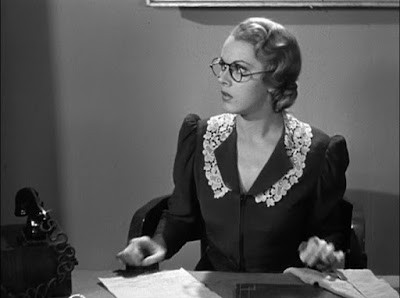 |
| The king's daughter (Lorna Gray) disguised as Moe's secretary. |
Afterwards, Moe’s secretary, or stenographer as Curly calls her, is the king’s daughter (Lorna Gray). She announces to Moe that Mattie Herring (a spoof of World War I spy Mata Hari) is there to see him and then changes out of her secretary disguise. As Mattie, she comes to read Moe his future. Rather than a crystal ball, she uses an 8 ball, which she instructs Moe to sit behind. When the 8-ball gets busted in two, a note inside gives her away as the daughter of the King.
 |
| As Mattie Herring, she plays fortune teller with an 8-ball. |
Suspecting her of being a spy, she is sentenced to death and Curly is supposed to execute her. But when he offers her a blindfold, she says “yes” and then puts it over Curly’s eyes. Curly, even though he can’t see anything, still tries to go through with the execution, but she takes the opportunity to make her escape.
Moe wants to have a round-meeting with neighboring countries, and when Larry points out that it is a square table, Moe gives him a saw to round it off with.
 |
| The map showing Moronika and the surrounding countries. |
Then for some reason, a ballerina enters, dancing of course, and informs Moe that the delegates for the meeting have arrived. Moe tells those assembled that Moronika demands concessions from its neighbors, leading the delegates to start arguing with him. Curly quells them by knocking them out with golf balls.
But their triumph is short-lived. After the meeting, a large mob, led by the King and Mattie Herring, advance on the palace. The trio immediately abdicates and try to find a place to hide. They inadvertently run into a lion’s den and are eaten. The film ends with the lions wearing articles of the trio’s clothing. And if it’s not clear what took place, one of the lions burps.
The short was surprisingly successful, even playing at major theaters that had previously not shown their work. A sequel followed, I'll Never Heil Again, in 1941, the first in the Stooges film canon. By then, everyone was getting onboard the anti-Nazi bandwagon.
The short is in many ways typical fare from the Stooges; eyes are poked, heads are slapped and mayhem. It shows a limit to the Stooges repertoire, and parts of the act that would be used in pretty much every short they made. Theirs is a different type of physical humor that one sees in Charlie Chaplin and Marx Brothers movies.
There are some cultural references that many today may not get. An example is that while the Stooges are waiting for their fortune, they tell each other to shush, which turns into mimicking the sound of a train going down the track until stops. A conductor comes out of nowhere and announces All out for Syracuse!" Hearing that, Larry gets up and announces that it's his stop. Moe explains to a confused Mattie, that "The boy's from Syracuse" - a reference to the musical The Boys from Syracuse which premiered on Broadway in 1938.
The Stooges were all Ashkenazi Jews and would work in Yiddish into their dialogue. In Moe's imitation of a Hitler speech, he says "in pupik gehabt haben" (the semi-obscene "I've had it in the bellybutton" in Yiddish). The irony of hearing Hitler speaking Yiddish was not lost on the Yiddish-speaking Jews in the audience.
But the main aim of the film is to parody Hitler and Nazi Germany. The phrase on the flag "Moronika for Morons" is a direct play on the Nazi slogan "Deutschland den Deutschen" (Germany for Germans). Hitler’s failed attempt to take power in 1923, leading a Beer Hall Putsch in Munich, is also parodied. The reference to Hitler as a paper hanger refers to a 1937 speech by Cardinal George Mundelein of Chicago, who called Hitler an "Austrian paperhanger", perhaps because he was a failed artist. The nickname stuck, even though there is no evidence that Hitler actually ever made a living doing that.
Hitler’s rise to power in 1933 was as a figurehead of sorts. The Post World I German Weimar government was run by a coalition of fascists, communists, and socialists. All of the parties were pulling for power and when they had to elect a new Chancellor of Germany, none had enough votes to win the position. They decided to elect Hitler, as a puppet figurehead, because he seemed harmless enough.
In 1933, Hitler was elected by a democratic process to the position of Chancellor of Germany. Less than one month later, a fire broke out in the Reichstag building, similar to our Congress, known as the Reichstag Fire. Hitler seized on the moment and claimed the fire was really a coup attempt by the communists. The S.S. destroyed documents and framed the communists, the leaders of which were arrested and sent to Dachau -- the beginning of the concentration camps. As Chancellor of Germany, Hitler declared a state of emergency, taking away all personal rights and freedoms. The accidental fire allowed Hitler the opportunity to become Dictator.
The Three Stooges might not be to everyone’s taste, but you have to applaud them for being the first in mainstream Hollywood to satirize the Nazis and the Third Reich. There is a certain amount of bravery involved by not only the Stooges, but also the director and writers, not to mention Columbia Pictures, for going against the isolationist grain that was predominant at the time in the U.S. So, while you might not laugh out loud at the short, you have to appreciate the Stooges for taking a stand when no one else was willing to.


