Showing posts with label Lord Miller Productions. Show all posts

Sunday, June 4, 2023

Spider-Man: Across the Spider-Verse

Note: This review contains spoilers for Spider-Man: Into the Spider-Verse

Of the more well-known superheroes from Marvel and DC, Marvel’s Spider-Man is one that’s no stranger to adaptations across TV and film. Some have had a lasting ripple effect, like Japanese Spider-Man inspiring the giant robots in Super Sentai (aka Power Rangers) or how the original Sam Raimi Spider-Man (2002) movie helped make superhero films more viable at the box office. Recently, 2018’s Spider-Man: Into the Spider-Verse made a huge splash in the world of animation thanks to its well-written story and its unique art style that perfectly replicated a living comic book and demonstrated that a CG film with such an approach could succeed at the box office. Into the Spider-Verse’s success has inspired experimentation in other animated productions, as seen in Sony Animation’s The Mitchells vs. the Machines and DreamWorks Animation’s The Bad Guys and Puss in Boots: The Last Wish, as well the upcoming Teenage Mutant Ninja Turtles: Mutant Mayhem, to name a few.

While time will tell how well other films inspired by Into the Spider-Verse will age, the film itself has remained enjoyable every time we’ve seen it, thanks in part to the continued discovery of new details in both the animation and story. Naturally, we immediately had an interest in the sequel, Across the Spider-Verse, from the millisecond we saw the original trailer (the one that initially labeled it “Part One” before that style of release fell out of favor), leading us to do what we normally haven’t since COVID-19 and watch a film on its opening weekend. Fortunately, Across the Spider-Verse proved itself worthy of its pre-release hype, though its nature as half a full story does affect the experience.

Saturday, March 12, 2022

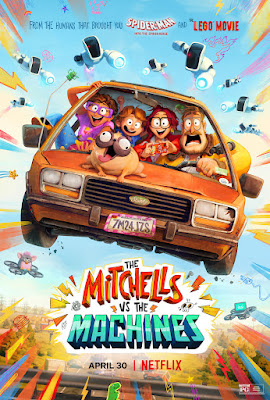
The Mitchells vs. the Machines


There’s no denying that Sony Pictures Animation productions are very hit and miss. However, some of their recent films have shown that with the right people on board, they can actually advance CG animation in bold new directions. Such is the case with The Mitchells vs. the Machines, written and directed by Mike Rianda. Originally scheduled for a 2020 theatrical run, the COVID-19 pandemic forced a change in plans that led it to a 2021 release on Netflix. Now that the film has made its way to home video and other streaming platforms, however, more people have the opportunity to experience one of the more innovative CG films in recent memory.

Sunday, February 10, 2019

The LEGO Movie 2: The Second Part - Everything Is NOT Awesome!!!


When The LEGO Movie first dropped in 2014, the movie turned out to be surprisingly good in spite of its early previews. Though a sequel was inevitable, two spin-offs had been released in the interim in 2017, The LEGO Batman Movie and The LEGO Ninjago Movie, the former of which I also enjoyed and the latter I skipped and turned out to not do too well with audiences. Upon the release of The LEGO Movie 2: The Second Part, the box office returns opening day didn’t give me high hopes for the overall quality of it, however I did at least expect it to be an enjoyable film, if not closer to the original in entertainment value. Upon actually getting to see the movie, it unfortunately wasn’t that hard to see why it was failing.

After the end of the original movie, Emmet (Chris Pratt) makes a peace offering with the DUPLO aliens, however this offering ends up getting destroyed. Five years later, Bricksburg has become Apocalypseburg, where everyone tries to avoid building cool things lest they attract the attention of the DUPLO aliens. Emmet, who somehow manages to remain optimistic in the post-apocalypse, builds a house anyway. This attracts the attention of General Mayhem (Stephanie Beatriz), who destroys the house and takes away Wyldstyle, Unikitty, Benny, Batman and Metalbeard. Emmet then rebuilds the destroyed house so that it can fly and chases after General Mayhem, along the way trying to figure out to toughen up because of something Wyldstyle (Elizabeth Banks) said.

The animation is still impressive as it was in the first LEGO Movie, evoking the feel of stop-motion as well as exploiting the potential play patterns of LEGO for all they’re worth. That said, much like The LEGO Batman Movie, a number of special effects that the original cleverly recreated in LEGO are instead rendered in particle effects, which seems to stray a bit from the whole point of the LEGO aesthetic, though I suspect this may have been done solely to save time on rendering. I was, however, impressed by the animation of the character Queen Watevra Wa'Nabi, as she constantly and seamlessly changes her appearance while still retaining the same color pool of LEGO bricks.

Aside from the voice acting, this is about the highest praise I can give the movie. To clarify, the story wasn’t too bad and it has some really good messages, however the execution was a little lackluster; out of a group of myself and three other family members, I was the only one who managed to successfully resist the temptation to fall asleep. The humor is well-paced and there are some chuckle-worthy moments, however compared to the first one, the humor was a bit more on-the-nose, as were a number of forced cameos and references, and overall it felt like the sequel was trying too hard in capturing lightning in a bottle a second time. The film also features an attempt at having its own “Everything Is Awesome!!!”, the appropriately named “Catchy Song”, as a plot point; while the song is, indeed, catchy, it didn’t stay in my head the same way “Everything Is Awesome!!!” did.

The LEGO Movie 2: The Second Part isn’t a terrible movie, however you should not go into this expecting the same magic as the original. The animation is spectacular, especially concerning one of the more important characters, however the story was bogged down by a number of things that made it more boring than it should’ve been. If you do, however, still wish to see this film, you are free to do so, so long as you watch The LEGO Movie first. Also, some throwaway dialogue confirms The LEGO Batman Movie as canon, meaning we now know where The LEGO Ninjago Movie stands in the franchise.

Friday, December 28, 2018

Spider-Man: Into the Spider-Verse


When I first saw a trailer for Spider-Man: Into the Spider-Verse, in spite of several recent blunders from Sony’s live-action and animation departments (some of which I only know through negative word-of-mouth), I was a little surprised that I actually wanted to see it, as it looked like a genuinely fun Spider-Man movie with some interesting art direction. With the reveal that the film would also feature a crossover between no less than six versions of the Spider-Man character, I was curious how this would be balanced, though the trailers kept my hopes up. While I could not see this film opening weekend, my recent viewing of it did not disappoint in the least.

Miles Morales (Shameik Moore) has been going through some issues, such as having trouble adjusting to a new school (to the point of trying to get expelled), and he silently rebels against his father (a police officer) by placing custom stickers around New York and spraying graffiti in secret locations. While placing one of his pieces up with his uncle Aaron (Mahershala Ali), Miles gets bitten by a radioactive spider, soon having to deal with newfound abilities. Following a battle between Spider-Man and Kingpin, that he ends up getting involved in, Miles ends up running into Peter B. Parker (Jake Johnson), a Peter Parker from another universe, whose help he needs to control his powers and stop Kingpin’s device that creates wormholes to alternate dimensions. It isn’t long, however, before the two discover they aren’t the only Spider-Men running around.

In spite of the number of Spider-Men and the general amount of characters present, the movie is actually pretty easy to follow and balances its cast surprisingly well. When a new Spider-Man is introduced, it goes through a quick recap of their backstory such that it’s very casual and playfully assumes you already know, which allows the movie to more quickly get back into the action and inform you of the multiverse at the same time. The movie also features a sizeable number of villains from Spider-Man lore (most of which are spoilers), however, unlike films such as Spider-Man 3 and The Amazing Spider-Man 2, it somehow never feels like there’s too many; Kingpin, the most prominent villain, actually has an interesting backstory that gives a good motivation for wanting to risk tearing up the multiverse, while at the same time making it clear he needs to be stopped because of said risk.

The six Spider-Men trying (and failing) to avoid detection in Miles' dorm room.
From left: Gwen Stacy/Spider-Gwen (Hailee Syeinfeld), Peni Parker/SP//dr
(Kimiko Glenn), Miles Morales (Shameik Moore), Peter B. Parker/Spider-Man
(Jake Johnson), Peter Parker/Spider-Man Noir (Nicholas Cage),
Peter Porker/Spider-Ham (John Mulaney)

The animation and art direction are both phenomenal. Similarly to Scott Pilgrim vs. The World, Into the Spider-Verse feels like a living comic book, while taking full adventage of the animation medium to explore this concept to its fullest potential. Three of the six Spider-Men, Peni Parker aka SP//dr (Kimiko Glenn), Peter Parker aka Spider-Man Noir (Nicholas Cage) and Peter Porker aka Spider-Ham (John Mulaney), each also feature their own animation styles, which the movie manages to blend really well with its own “comic book” style nature while taking opportunities to embellish the characters’ own styles when necessary. Spider-Ham in particular has a style more akin to a Looney Tunes cartoon, which is taken advantage of for very well-timed comedy.

Though brief, the late Stan Lee also makes an animated cameo in this film, as his lines were recorded sometime prior to his passing. Similarly to Once Upon a Deadpool, the movie also features a tribute to Stan Lee in a mid-credits scene, during which it properly credits him alongside the late Steve Ditko as co-creators of Spider-Man.

Spider-Man: Into the Spider-Verse is one of the best cinematic interpretations of Spider-Man. The animation is amazing (pun intended) and takes full of advantage of the comic book aesthetic, backed by great writing and characterization. It’s clear a lot of passion was put into this film, as it’s essentially a love letter to the character that fans can appreciate while allowing itself to be more open for newer fans as well. It should be noted that some of the different Spider-Men (all of which aside from Peter B. Parker are pre-existing characters) are more obscure than others, so some research may be required for anyone that doesn’t know them. It is also worth staying after the credits for a very special scene.

For a list of links to additional Spider-Man reviews, visit our Spider-Man Review Hub.

Monday, February 13, 2017

The LEGO Batman Movie


After the success of The LEGO Movie in 2014, an inevitable sequel was announced, and with it a pair of spin-offs based on Batman (as depicted in the movie) and LEGO’s popular Ninjago theme. Upon hearing about The LEGO Batman Movie, given Batman’s humorous portrayal in The LEGO Movie, I did have some reservations at first on whether his shtick would be able to carry an entire movie. A trailer paired with the disastrous Batman v Superman gave me a glimpse as to what such a movie would be like, and further trailers towards the actual release helped to assuage any doubts I may have had. In the end, I can say I enjoyed the movie much more than I thought I would initially.

After foiling a plan by The Joker (Zach Galifianakis) to blow up Gotham City, Batman/Bruce Wayne (Will Arnett) goes home to his large and empty mansion, eating microwaved lobster thermidor and watching movies alone in his theater. As Batman looks at an old family photo, his butler Alfred (Ralph Fiennes) suggests to him that he not only fears having a family of his own, he should also consider the possibility of raising a child. At an event commemorating Barbara Gordon (Rosario Dawson) as the new Commissioner of Gotham, this comes to a head when Bruce Wayne unknowingly adopts Richard “Dick” Grayson (Michael Cera), an orphan. Meanwhile, The Joker is upset about Batman not paying him any attention despite being a major villain, and so concocts a new scheme to earn that attention after watching a TV interview with Superman (Channing Tatum) involving the Phantom Zone.

The Joker (Zach Galifianakis) just wants some attention from Batman (Will Arnett).

Though this movie is a spin-off of The LEGO Movie, it generally presented itself as a stand-alone story, the only major connections being the existence of a swirling abyss at the edge of reality and Batman’s abilities as a Master Builder (allowing him to construct whatever he wants using LEGO bricks from the environment). Aside from that, the story was actually rather easy to follow and had some solid writing amidst a slew of largely-clever humor (among them a number of Michael Jackson references). In general, the movie can be viewed as both a celebration and parody of Batman as a whole, since there are a number of references/jokes to previous Batman media (up to Batman v Superman at the time of the movie’s release), many of them to the 1966 Adam West series. The movie also notably features the film debut of a great number of Batman villains (including Z-list characters such as Clock King, Polka-Dot Man, Calendar Man and Condiment King), as well as the first time the entirety of the Justice League has been seen on-screen together (beating out the upcoming Justice League movie by nine months at the time of this writing).

Yes, Condiment King is a real Batman villain.
(Pictured: His appearance as he debuted in
Batman: The Animated Series.)

As with The LEGO Movie, the animation is very well-done, mimicking the stop-motion style rather well. I did notice, however, that more liberties seemed to be taken in regards to character animation, such as minifigure arms and legs, while retaining static positions, moving more free-form around the body to achieve certain poses, as well as there being more ambiguity as to whether the minifigure characters have a static “neck.” Batman’s cowl is also noticeably more animated compared to it remaining static in The LEGO Movie, however the end result maintains the stop-motion illusion by appearing as though multiple cowl molds were swapped out between frames. There is also some minor cheating in that some realistic smoke and water effects are used at times rather than having said elements be made of LEGO bricks, as in The LEGO Movie, though the animators still did a good job overall in maintaining the illusion of being a high-budget stop-motion production.

The voice acting is actually pretty good, with Will Arnett returning to voice his version of Batman and being able to run with it while still delivering a good range of emotion when needed. I honestly did not recognize Michael Cera playing Dick Grayson/Robin, mainly because I’m used to seeing him perform characters along the lines of Scott Pilgrim, which to me proved that he actually has some range as an actor and makes me wonder if he will ever get an opportunity like that again in any future role he is given. Zach Galifianakis delivers a rather interesting take on The Joker, who is portrayed here as being a serious villain while at the same time edging on being one of the sillier Jokers, as he goes out of his way just to get Batman to recognize him as a threat in a way comparable to unrequited love. While Galifianakis is not Mark Hamill, he certainly makes his Joker memorable, which is unfortunately more than I can say about Jared Leto’s Joker as seen in last year’s Suicide Squad. The other voice actors in the movie do a good job in playing the roles in which they are cast, a number of which seem to be played for laughs, such as editor Matt Villa delivering a higher-pitched voice in a brief moment of Killer Croc speaking and The Big Bang Theory’s Kate Micucci voicing Clayface.

The main score is provided by Lorne Balfe, whose resume includes the main entries in the Skylanders video game franchise among other things, in collaboration with drummer Chad Smith from Red Hot Chili Peppers. While his score might not be as memorable as Mark Mothersbaugh’s score in The LEGO Movie, he does a good job in giving The LEGO Batman Movie its own identity separate from its predecessor. A well-composed lounge music cover of the song “Everything Is Awesome” is performed by Richard Cheese & Lounge Against The Machine, however its use is more subtle here than in The LEGO Movie.

The LEGO Batman Movie is a movie for fans of all things LEGO, Batman, and LEGO Batman. While not as good as The LEGO Movie, it keeps the same spirit of its predecessor while having its own identity as a fun action-comedy. It’s especially fun if you are a Batman fan, since, as I said earlier, the movie is essentially a simultaneous celebration and parody of the caped crusader’s 75+ years of history, many of it stemming from the Dark Knight Trilogy and the Adam West series from the 1960s. Attached to the main feature is a trailer for The LEGO Ninjago Movie; while I am not well-versed in the Ninjago theme, I remain cautiously optimistic that the movie will convince me to go see it in a similar fashion to how The LEGO Batman Movie managed to convince me.