Showing posts with label George Stevens. Show all posts

Saturday, March 11, 2017

Stubs - Shane


Shane (1953) Starring: Alan Ladd, Jean Arthur, Van Heflin, Brandon de Wilde, Walter Jack Palance. Directed by George Stevens. Produced by George Stevens. Screenplay by A. B. Guthrie Jr. Based on the novel Shane by Jack Schaefer (Boston, 1949). Run Time: 118 minutes. U.S.  Color, Western.

As we’ve discussed here before, Westerns were at one time very popular and every major actor seemed to appear in at least one. Add Alan Ladd to that list. After a decade in films, appearing in uncredited roles in such films as The Goldwyn Follies (1938) and Citizen Kane (1941), Ladd would finally become a star by playing a gangster, Raven, in This Gun For Hire (1942). Ladd became known for gangster and film noirs like The Glass Key (1942), Lucky Jordan (1942), Blue Dahlia (1946) and Appointment with Danger (1951). While he would also star in such films as The Great Gatsby (1949), he would find Westerns later in his career.

He would star in such westerns as Branded (1950), Red Mountain (1951), The Iron Mistress (1952), Saskatchewan (1954) and Drum Beat (1954), though none would be bigger than Shane (1953). But despite his stature, Ladd was not the first choice for the role of Shane. Montgomery Clift was director George Stevens’ first choice. But Clift and Steven’s other choice for parts, William Holden for Joe Starrett and Katharine Hepburn for the part of Marian Starrett were not available. The film was nearly abandoned, but Stevens asked Paramount Pictures studio head Y. Frank Freeman for a list of actors under contract and chose Ladd, Van Heflin and Jean Arthur for the parts.

Jean Arthur had retired from films when her contract with Columbia Pictures expired in 1944. She had only made one film since, A Foreign Affair (1948), directed by Billy Wilder. Even though she was 50 at the time Shane went into production in 1951, she agreed to make the film as a favor to Stevens. They had worked together twice before, The Talk of the Town (1942) and The More the Merrier (1943). Stevens considered her "one of the greatest comediennes the screen has ever seen"; perhaps not a ringing endorsement for casting her in a serious western, like Shane.

In the film, Arthur plays Marian, who along with her husband Joe (Van Heflin) are homesteaders in Wyoming. Their son, Joey (Brandon de Wilde), is outside playing when he sees a lone rider dressed in buckskin approaching, Shane (Alan Ladd). He tells Joe that he’s just heading north. When Joey cocks the rifle he’s been playing with, Shane draws his gun with the speed of a gunfighter, which disturbs Joe. He sends Shane on his way.

Just then, a group of armed men rides up led by Rufus Ryker (Emile Meyer), a cattle baron who accuses Joe of squatting on his grazing land and orders him off. When Joe refuses, Ryker’s men start to intimidate Joe until Shane reappears at Joe’s side. The men leave, but nothing has been settled.

Shane (Alan Ladd), right, stands by Joe (Van Heflin), Marian (Jean Arthur)
and Joey (Brandon de Wilde) against Ryker's intimidation.

Marian who has been observing everything from inside the cabin, urges Joe to invite Shane for dinner. Joey is excited to have Shane stay for dinner. Shane doesn’t want to talk about his past, but after eating, goes out to chop wood for the family as a way of paying back their kindness. Joe joins in and the two men seem to bond.

Shane chops wood for the family.

Shane spends the night outside and is awakened by Joey playing nearby. Joey tells Shane that his parents want him to stay and mentions his father’s concern about Ryker’s threats. Shane decides to stay and goes into town to buy some work clothes at Sam Grafton’s General Store.

Soon after Shane leaves, another homesteader, Ernie Wright (Leonard Strong), arrives to inform Joe that Ryker had his men destroy his wheat, so he and his family have decided to pull up stakes and leave. But Joe convinces Ernie to stay long enough for the other homesteaders to meet that night.

Back in town, Shane purchases his clothes and then goes next door to the adjoining saloon to buy Joey a bottle of soda pop. Ryker and his men, including Chris Calloway (Ben Johnson), are hanging out in the saloon and they try to intimidate Shane, calling him a sodbuster and tossing whiskey on his new shirt. But Shane doesn’t bite and walks out.

Chris Calloway (Ben Johnson), one of Ryker's men, tosses
whiskey on Shane, while Ryker (Emile Meyer) watches.

At the homesteaders’ meeting, Fred Lewis (Edgar Buchanan), who was in the saloon, tells the group about Shane not standing up to Calloway. Joey, whoever hears this, thinks Shane is a coward. Marian reassures Joey that Shane isn’t a coward, but tells her son not to become too attached to him.

The homesteaders decide to hang together and as a group, they go into town to shop for their Fourth of July celebration. Back at Grafton’s, Galloway again confronts Shane in the saloon, but this time Shane fights back. After a long fistfight, Shane knocks Galloway out. Ryker, who is there, offers Shane a drink and a job, but he turns him down. Next, Ryker accuses Shane of lusting after Marian. Despite Joey’s pleas, Shane gets into a fight with all of Ryker’s men in the saloon. Joe goes in and fights next to Shane, until Grafton, who owns the saloon, demands a halt to the action.

Joe and Shane fight back to back in the saloon against Ryker's men.

But Ryker isn’t through and sends for a notorious gunslinger from Cheyenne, Jack Wilson (Walter Jack Palance).

Back at the farm, Joey gushes about Shane to his mother, who is having her own romantic feelings for him as well.

The next day, Joey admits to Shane that he took a peek at his gun. Shane gives the boy some pointers on shooting. Marian, who is impressed by Shane’s marksmanship, doesn’t want Shane encouraging Joey’s fascination with guns.

Shane demonstrates for Joey his marksmanship.

Ernie complains to one of his fellow homesteaders, Frank “Stonewall” Torrey (Elisha Cook, Jr.), that because Ryker killed his livestock, he’s leaving. Stonewall then goes into town and criticizes Ryker for running Ernie off. Jack Wilson is already there.

Frank "Stonewall" Torrey (Elisha Cook Jr.) plays a homesteader who decides to stand up to Ryker.

At the Fourth of July party, which coincides with Joe and Marian’s 10th anniversary, Marian shares a dance with Shane. Stonewall arrives and tells everyone that Ryker has hired a gunslinger. From the description, Shane figures out it’s Wilson.

Later, back the house, Ryker’s brother Morgan (John Dierkes), accompanied by Wilson, confronts Joe. Claiming that his brother wants to seem reasonable, he offers to buy Joe out. Joe rejects the offer, pointing out that the government already recognizes the homesteader’s’ claims. Morgan points out that because Ryker fought the Indians and worked hard to make the land livable that he is entitled to a fence-free range, after which he and Wilson depart.

Back in town, Ryker tells Wilson to do whatever it takes to beat Joe. To start that process, Wilson provokes Stonewall, who has accompanied another homesteader into town. When Stonewall half-heartedly reaches for his gun, Wilson shoots him down in cold blood, killing him instantly while making it look like self-defense.

In town, Torrey confronts Wilson and is quickly in over his head.

Hired gun Jack Wilson (Walter Jack Palance) kills Torrey in "self-defense".

At Stonewall’s funeral, the Lewis family announces that they are leaving, but when a fire is spotted at the Lewis place, they decide to go back to their homestead and the others offer to help him rebuild.

The Lewis family announces they're leaving at Stonewall Torrey's funeral.

That night, Ryker sends for Joe, who is anxious to bring this to a conclusion, despite Marian’s pleas not to risk his life. Meanwhile, Calloway, who is leaving Ryker, informs Shane that Joe is being set up. Shane trades in his work clothes for his buckskins and puts on his gun. But Joe is determined to go and fights Shane for the privilege. The only way for Shane to stop Joe is to knock him over the head with the butt of his gun. When Joey sees this, he yells hateful things at Shane, but Marian is relieved Joe won’t die. She is obviously sad to see Shane leave. Knowing she’ll never see him again, she shakes his hand goodbye when she really wants to kiss him.

She may have romantic feelings for Shane, but it's a handshake instead of a kiss good-bye. 

When Shane rides off, Joey trails after him. He arrives at the saloon in time to watch Shane confront Ryker and Wilson. Shane manages to get Wilson to draw first and then kills him. He then shoots Ryker when he draws his gun. Morgan draws a bead on Shane with a rifle, but Joey sees it and shouts to warn Shane. Shots are fired and Morgan, too, is killed.

Shane outguns Wilson, killing him before killing Ryker.

Outside the saloon, Joey apologizes to Shane for his angry words and asks him to come back to the homestead. But Shane tells him that he can’t stop being the man he is and can’t go back. Joey notices that Shane is bleeding, but Shane insists he’s okay. Shane rides off into the night while Joey yells after him to come back, even proclaiming that his mother wants him to come back.

Shane says good-bye to Joey before riding off.

Shane would mark Stevens' first Western since Annie Oakley (1935) and would prove to be his last. It was shot on location in Jackson Hole, Wyoming against the backdrop of the Grand Teton Mountains. An entire Western street was built as well as a cemetery. Stevens also worked with artist Joe DeYoung (credited as DeYong) to create authentic costumes and decors. The two apparently traveled together and conducted research in order to achieve the most realistic look they could.

Shane was in production between June and October 1951 but was not released until 1953 due to Stevens' extensive editing. With a budget of over $3 million, Paramount wasn’t convinced the film would make back their investment. They considered selling the film, prior to release, to Howard Hughes for his RKO studio to release. While the deal fell through, Hughes’ enthusiasm for the film is said to have convinced Paramount to treat this film as more than just another Western. Despite Paramount’s initial misgivings, the film would also prove to be a financial success as well with a reputed box-office of $20 million.

While Shane was shot in the Academy ratio of 1.37:1, it was presented in Paramount’s new 1.66 widescreen format in an attempt to give moviegoers something they couldn’t then get on television.  Paramount’s decision to choose Shane was based on the fact that the film was made up mostly of long and medium shots it would not be compromised by the cropping of putting a newly cut aperture plate in front of the projector.

The film was well received by critics when it was released, some considering it one of the best Westerns ever made. The film was nominated for several Academy Awards for Best Picture, Best Director, Best Writing (Screenplay), Best Supporting Actor for both Palance and de Wilde, winning for Best Cinematography (Color). Stevens would be awarded the Irving J. Thalberg Memorial Award for “high quality of production for the current award year and preceding years.”

So beloved, the film was one chosen by President Dwight D. Eisenhower to Soviet Premier Nikita Khrushchev when he visited Camp David in 1959. The film was also one of five pictures chosen to tour China after that country lifted a boycott on American films.

While Alan Ladd was the star of the film, perhaps the actor who made the biggest impression was Jack Palance, credited as Walter Jack Palance. He is long, lean and dressed in black as the depiction of evil in the film. He seems to enjoy talking Stonewall into a gunfight, egging him on verbally while slipping on a glove on his shooting hand prior to gunning him down in cold blood. Palance got his first break in acting, as Marlon Brando’s understudy on Broadway in A Streetcar Named Desire, eventually replacing him on stage.

Palance’s first film role was in the film noir, Panic in the Streets (1950). He would thrice be nominated for an Academy Award for Best Actor in a Supporting Role for Sudden Fear (1952), Shane and City Slickers (1991), winning for his portrayal of Curly Washburn in the latter. He would also achieve some fame for hosting the TV Series Ripley’s Believe It Or Not (1982-86).

Brandon de Wilde would also be nominated for an Academy Award for Best Actor in a Supporting Role for Joey Starrett. Mostly known as a TV actor, Shane was only his second film. He was about nine when they were shooting the film. He had been acting since he was seven, winning a lot of attention for his role on Broadway in The Member of the Wedding and eventually playing the same role in the film version in 1952.

While de Wilde was acclaimed for his performance, I frankly find him to be a distraction when watching the movie. The frequent close-ups are so tight they seem to make him look cross-eyed. I know we’re supposed to see this story through his eyes, but I think Stevens hits us over the head with this a little too much.

Is it just me or does de Wilde almost look cross-eyed?

Like many child actors, de Wilde had trouble transitioning to adult lead roles, but unlike others, de Wilde wanted to get out anyway. Music had become his new interest and he tried to put together a record with the help of his friend Gram Parsons, then with the Byrds. According to those in the know, de Wilde and Parsons harmonized very well and even Parsons wrote a song with Emmylou Harris, “My Hour of Darkness” which refers to de Wilde’s death at 30 in a motorcycle accident.

Van Heflin, the other male lead, is remembered mostly as a character actor. A Broadway actor, he made his film debut for RKO in A Woman Rebels (1936), a film starring Katharine Hepburn. Heflin made Westerns almost from the start, appearing in The Outcasts of Poker Flat (1937) and Santa Fe Trail (1940). He also appeared in crime dramas such as the film noir Johnny Eager (1941), for which Van Heflin would win the Academy Award for Best Supporting Actor. He would star in Kid Glove Killer (1942), the feature-length directorial debut of Fred Zimmerman.

Adept at a variety of roles across different genres, Heflin appeared in such films as: the comedy/mystery Grand Central Murder (1942), the film noir The Strange Love of Martha Ivers (1946), the historical drama Green Dolphin Street (1947) and the Western, 3:10 to Yuma (1957). His last film was Airport (1970), in which he plays D. O. Guerrero, the man who brings the bomb aboard the airplane. (For everyone who has only flown in a post-9/11 world, this was possible at the time.) He would die of a heart attack in 1971.

I think I’ve seen Shane three times now. The first was in a college class and despite the professor’s claim that we would love the film, I don’t think I was the only one turned off by the prominent placement of de Wilde throughout the story. I remember the professor making the point that even though there were sexual sparks between Marian and Shane, she gives him a hearty handshake because of the production code.

In the intervening years, my opinion of de Wilde’s performance sadly hasn’t changed and I still find it annoying. However, I am now able to see past his character and appreciate the film as a whole more now. Still, I don’t hold it in the same high regard as say Woody Allen who is quoted as saying Shane, "...is a great movie and can hold its own with any film, whether it's a western or not."

I do see that it is a pretty good Western and tells a pretty interesting story about the struggles of homesteaders against the cattle ranchers that was a major part of settling Wyoming. If you’re a fan of Westerns, then you will no doubt like this film.

Saturday, August 9, 2014

Stubs – Gunga Din


Gunga Din (1939) Starring: Cary Grant, Victor McLaglen, Douglas Fairbanks, Jr., Sam Jaffe, Eduardo Ciannelli, Joan Fontaine. Directed by George Stevens. Screenplay by Joel Sayre, Fred Guiol. Story by Ben Hecht, Charles MacArthur. Inspired by the poem "Gunga Din" in Barrack Room Ballads by Rudyard Kipling (London, 1892). Produced by George Stevens. Run Time: 117 minutes. U.S.  Black and White Drama, Action, Adventure, Comedy

With 2014 being the 75th Anniversary of the Golden Year in Hollywood, 1939, Trophy Unlocked thought it would be interesting to take a look back at some films from that year. So many great films came out in one year that it is worth remembering films were once the main form of entertainment for most Americans, whether they were escaping the summer heat in an air-conditioned theater or they just wanted to be taken to some place exotic.

Such was the setting for RKO’s 1939 feature, Gunga Din. At the time, India was a far away and mysterious place, then still under British rule. Most Americans had never met an Indian or traveled there and probably never would. What better place to set an action adventure film than a strange land with strange customs?

Our story opens circa 1880, on the Northwest Frontier of India, one of the far reaches of the British Empire. But the presence of troops is not appreciated by everyone. There are Thugges, a fanatic religious order that worships the goddess Kali, which believes in killing with strangulation and has sworn to annihilate the British in India. Members are trying to cut down the telegraph wires when a British Army patrol comes by. Pretending to be scared civilians on their way home, they tag along with the troops, but massacre them in their sleep that night.

They continue to raise havoc, raiding a British outpost at Tantrapur and killing the British telegraph operator while he is in the midst of messaging the Army. Alarmed, Colonel Weed (Montagu Love) dispatches a detachment of British Indian Army troops led by three sergeants of the Royal Engineers, 'Mac' MacChesney (Victor McLaglen), Archibald Cutter (Cary Grant), and Thomas 'Tommy' Ballantine (Douglas Fairbanks, Jr.) to investigate. MacChesney, Cutter and Ballantine are long-time friends and veterans of the campaigns in the sub-continent.

The three, as we quickly learn, are also drunkards and disciplinary problems, who are out looking for quick riches. When they are located, they’ve been drinking and are in the middle of a fist fight with what appear to be other Army regulars. Cutter had bought a phony treasure map and this fight is somehow related, though the real purpose is to show us how rough and tumble they really are.

Sgt. MacChesney (Victor McLaglen) and Sgt. Cutter (Cary Grant) receive their orders from Colonel Weed.

Although they are a disciplinary headache for Weed, they are the right men for this dangerous mission. Accompanying the detail are six Indian camp workers, including regimental water boy Gunga Din (Sam Jaffe). Din, we will learn, longs to become a soldier of the Queen.

When the troops arrive, they find Tantrapur deserted. They find the food in the mess is cold and stale. With the Indian regulars doing all the heavy lifting, they set about repairing the telegraph. However, they are soon surrounded by hostile Thugges, led by Chota (Abner Biberman). The troops are outnumbered, but fight their way out of the city, eventually leaping off the cliffs behind the outpost and escaping via the river that runs nearby.

Swords drawn, Cutter and MacChesney, flanked by  Ballantine (Douglas Fairbanks, Jr.),
try to hold off the Thugges, but are eventually forced to abandoned Tantrapur.

Colonel Weed and Major Mitchell (Lumsden Hare) identify an enemy weapon brought back as belonging to the Thugges, a murderous cult that thought to have been wiped out years before. Weed wants to send out parties to search and kill off these radicals before it’s too late. But one of our three heroes is dismissed from duty.

Ballantine is due to leave the army in a few days to wed Emmy Stebbins (Joan Fontaine) and go into the tea business, and Weed wants to replace him in the field with Sgt. Bertie Higginbotham (Robert Coote). Neither MacChesney nor Cutter like Higginbotham and the thought of seeing Ballantine settle down seems to be a fate worse than death. The pair tries to disrupt Ballantine’s plans by spiking the punch at a wedding dance thrown by Emmy’s father (Cecil Kellaway), with Elephant Elixir. When Weed and Mitchell try to partake, MacChesney sticks his hand in the punchbowl to stop them.

Sgt. Bertie Higginbotham (Robert Coote) is not an acceptable replacement for Ballantine.

When Higginbotham shows up, Cutter makes sure to have him sample the concoction. When he becomes ill as a result, Ballantine is called back into service, though he promises Emmy he will only serve until his stint is over in a few days.

Meanwhile, Din has told Cutter of a temple made of gold and Cutter is determined to make his fortune. But MacChesney won’t let him go and Cutter tries to fight with him, but MacChesney is too big. After knocking Cutter out, he has him thrown into the stockade to prevent his desertion.

On his way to the stockade, the rarely sober Cutter grabs the bottle he's been drinking from.
But that night, with the help of Din and an Annie the elephant, Cutter escapes. Din leads him to the temple but they unfortunately find that it belongs to the Thugges. They return for an initiation of new members and a speech from their Guru (Eduardo Ciannelli). Knowing that the Colonel needs to know, Cutter creates a distraction and allows himself to be captured so Din can escape.


Gunga Din (Sam Jaffe) and Sgt. Cutter listen to the Guru encourage his Thugges.

But when Din arrives in camp, MacChesney at first wants to shoot him as a deserter. But Din persists and tells him that Cutter is being held hostage at the temple. MacChesney decides to go to the rescue, but Ballantine wants to go too. MacChesney points out that he cannot, as he is now officially a civilian. But if Ballantine re-enlists, on the understanding that the enlistment paper will be torn up after the rescue, he can go. Ballantine doesn’t tell Emmy, who tries to dissuade him from going, but he refuses to desert his friend in need.

Due to miscommunication between Din and MacChesney, the trio foolishly enter the temple by themselves and are easily captured. They find that Cutter has been tied up and whipped, but has refused to give them information about troop movements. The guru has them try the same on MacChesney, but he withstands the torture. Next, the guru threatens to throw him into a snake pit (more about that later). But the three manage to free themselves and take the guru hostage.


MacChesney discovers that Cutter has been whipped by the Thugges.
But the Thugges won’t give up and they are forced up to the roof with Din and Guru and a stand-off ensues. In the distance, the bagpipes of a British regiment coming to the rescue can be heard and the Guru boasts that they are marching into his trap he has set, with the three sergeants as bait.

He orders his men to take positions, but they are unwilling to leave him in enemy hands who are threatening to kill him if they move. In order to get things going, he takes his own life leaping into the snake pit.

Meanwhile, Thugges have climbed to the top of the temple and overwhelmed the soldiers. Din, who takes the lead, is bayoneted, as is Cutter. But Din manages, with the last of his strength, to climb to the top of the temple and sound the alarm with a bugle taken from a dead Thug.

Gunga Din blows a bugle to warn the British troops of the Thugges' ambush.
He is shot dead by a Thug, but the British force, led by Weed and now accompanied by a journalist, Rudyard Kipling (Reginald Sheffield), are alerted to the danger and win the ensuing battle.

After the battle, Ballantine officially submits his re-enlistment papers to Weed; the marriage and Emmy apparently all but forgotten. Weed formally inducts Din as a British corporal and reads the last lines of a poem Kipling had just written about the battle and the man, ending with the famous “You're a better man than I am, Gunga Din!” The film ends with a final superimposed image of Gunga Din's spirit standing proudly in a British uniform.


Heroic Gunga Din shown at the end of the film.
Reliance Pictures, formed in 1932 by Edward Small and Harry M. Goetz, financed by a division of United Artists in a deal brokered by Joseph Schenck, purchased the rights to the poem in 1936 for £4,700. RKO acquired the rights when Small left Reliance to become an associate producer at the studio which bought out Reliance. Howard Hawks was originally signed to direct the film, but after the disappointment of Bringing Up Baby (1938), he was fired by Pandro S. Berman, the head of production at RKO, and replaced by George Stevens.

The adapted screenplay by Charles MacArthur seemed to emphasis the barracks and this wasn’t considered right for the action movie this was to become. Apparently several writers made attempts at writing treatments and screenplays, including William Faulkner, Lester Cohen, John Colton, Vincent Lawrence, Dudley Nichols and Anthony Veiller. When Stevens came onboard to direct, so did Joel Sayre and Fred Guiol, but the script wasn’t finished before the production went on location, with 600 extras/actors in tow, to Lone Pine, California, which substituted for the Khyber Pass, for six weeks of shooting. The production cost about two million dollars; Gunga Din was one of the most expensive films that RKO had made up to that time. It got so bad that Berman had to visit Stevens on the set to encourage him to finish the film as quickly as possible.

While the film was popular at the time of release, its high production costs resulted in it actually losing money, about $193,000.

Cary Grant was originally cast to play the role of Ballantine and Fairbanks Jr. was cast as Cutter. Depending on whose story you hear, either Berman capitulated to Grant’s request to switch parts or Stevens had Grant and Fairbanks flip a coin. While I am a big fan of Grant’s and rarely think he misfires on film, Gunga Din is the exception to the rule. This is far from his best performance, in my opinion. As Sgt. Cutter, he tries his best to be funny, but his performance just seems off. Even the British-born actor’s accent is inconsistent.


Cary Grant as Sgt. Cutter. Not his best performance.

Given his pedigree, Douglas Fairbanks, Jr. had little choice but to be an actor. Born to his famous father and his first wife, Anna Beth Sully, Jr., he was signed to an acting contract by Paramount Pictures at the age of 14. When his films proved unsuccessful, he turned to the stage and there he impressed his father, his step-mother, Mary Pickford, and his father’s close friend, Charlie Chaplin. All encouraged the actor not to give up on acting.


Douglas Fairbanks, Jr. as Sgt. Ballantine.

When he was 19, Fairbanks married Joan Crawford, but the marriage only lasted a few years. By then, Crawford had already begun her affair with Clark Gable. Fairbanks would marry twice more, to Mary Lee Epping until her death in 1988 and lastly to Vera Shelton until his death in 2000 at the age of 90.

Fairbanks did appear in a lot of films, but he never came close to the superstardom his father enjoyed in silent films. He is best remembered for his role in this film and for being Rico’s (Edward G. Robinson) friend in Little Caesar (1931), one of the quintessential gangster films.

Victor McLaglen was a former English boxer and World War I veteran who found stardom in Hollywood in the 1920’s. He made his first film, The Call of the Road, in 1920. He successfully transitioned from silent to sound films and won the Academy Award for Best Actor for his role as Gypo Nolan in The Informer (1935). The barrel-chested actor seemed like a natural for the part of MacChesney. Still, he seems to be trying too hard in the role. There is a scene in which he talks baby-talk to a favorite elephant, the same one Din would use to free Cutter from jail, who takes ill. No doubt a chance to show the softer side of his character, but it comes off as embarrassing to watch.

Victor McLaglen plays Sgt. MacChesney.

Joan Fontaine has the unenviable part of Emmy. This is a very one-dimensional character. We really learn nothing more about her than she’s Ballantine’s fiancée, she has a father and that Ballantine would rather spend his time with MacChesney and Cutter than be settled down with her. We last see her being lied to by Ballantine as he rides off on the noble quest to save his friend, but her story is wrapped up off screen.


Joan Fontaine has little to do as Ballantine's fiancee Emmy.

Fontaine, Olivia de Havilland’s kid-sister, started acting in 1935, appearing in a West Coast stage production and being signed by RKO that same year. She must have inherited her acting genes, because she would be nominated for an Academy Award for Best Actress for her performance in Rebecca (1940) the very next year, win one for Suspicion (1941) and be nominated again for The Constant Nymph (1943). Her role in Gunga Dun does not really tap into her acting talents.

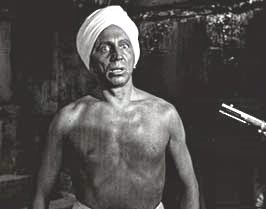
For the titular character of the Indian water-bearer or "Bhishti", Hollywood cast Sam Jaffe, a Russian Jewish actor who was 47 at the time. It seems like an odd choice. He wears so much make-up that at first you might not recognize him. The role, despite the title drop, is really quite small and he really doesn’t come to prominence until the third act, when suddenly he becomes the bravest fighter and ends up being the hero for the British and perhaps a traitor to his own people. His story seems tacked on, which isn’t the actor’s fault, as the film is really about MacChesney, Cutter and Ballantine. The film only has a passing relationship to the poem that inspired it.

Sam Jaffe might seem an odd choice to play Gunga Din.

Jaffe, who was a longtime friend of John Huston, would go on to star in The Asphalt Jungle (1950), one of my favorite film noirs. Blacklisted as part of Hollywood’s witch hunt for communist sympathizers, he would still be hired by Robert Wise to appear in The Day The Earth Stood Still (1951) and by William Wyler for Ben-Hur (1959). He would later co-star in the television series Ben Casey as Dr. Zorba from 1961 to 1965.

George Stevens, Gunga Din’s director, got his start in films as a cameraman for Laurel and Hardy films, including Night Owls (1930). He would go on to direct films in all sorts of genres, including romantic films: Alice Adams (1935), Quality Street (1937) and Vivacious Lady (1938); biographies: Annie Oakley (1935); musicals: Swing Time (1936) and A Damsel in Distress (1937); dramas: A Place in the Sun (1951), Giant (1956) and The Diary of Anne Frank (1959); comedy/dramas: Woman of the Year (1942) and Talk of the Town (1942) and westerns: Shane (1953). Quite a career.

There is something about setting a film in India, and I’m not talking about the 700 plus films made by that country’s industry every year, that requires the story be given a certain treatment by Hollywood. Gandhi (1982) is a good example, as is A Passage to India (1984). Anytime we’re outdoors, which is quite often, the landscape has to be presented in massive scale, even wide screen isn’t big enough to capture it all. And the story has to move slowly as if being weighed down by the heat.


An example of the Indian landscape used as backdrop for the stobe ry.
It's actually Lone Pine, California.
These elements are present in Gunga Din, one of the early big screen films to feature India as a backdrop. Even though we’re limited by the Academy ratio, the landscape, which is actually California, is shown as dwarfing everyone and sadly the film moves at a snail’s pace. There are action sequences, but to get to them you have to go through long sequences of British Army maneuvers, marching and drilling. Since the film brought in no less than five technical advisors, I’m sure they got all of that right, but it doesn’t make for a lot of exciting action.

Now I know that a film can’t just be battle after battle, with apologies to Lord of the Rings: Return of the King (2003), but there could easily be less marching and still get the same point across. That is unless the point was to show hundreds of men marching slowly against the larger than life backdrops of the Khyber Pass. In that case, mission accomplished.

While I don’t usually like to pick on a film’s special effects, there is a particular sequence in this film that sadly looks like nobody really cared. When Guru is trying to make MacChesney reveal secrets about Army maneuvers he threatens to drop him into a pit of snakes. You don’t have to look too closely to see the strings manipulating the rubbery stand-ins. I’m sure this was preferable to working with a pit of real vipers and cobras, but they look more comical than menacing. I have to give the actors credit for keeping straight faces, but I would love to see the outtakes from this bit.

Look closely and you can see the strings. The snakes look less menacing
 and more like the work of a drunk puppeteer.
Gunga Din is a film that most fans of older films have seen or will want to see. While I don’t think this is the great film I’d heard it was, I do see how it influenced such diverse films as the Indiana Jones series of adventures and even The Beatles’ Help! (1965). The film has all the elements: great actors, a great director and a bigger than life story, but they don’t quite come together. This film has not aged as well as others from that era. While I would suggest you see it, I would tell you to go in with lowered expectations.

Gunga Din is available at the WB Shop:

Free Shipping on All Orders Over $50!

Wednesday, August 15, 2012

Stubs – Vivacious Lady


VIVACIOUS LADY (1938) Starring: Ginger Rogers, James Stewart, James Ellison, Beulah Bondi, Charles Coburn, Frances Mercer. Directed by George Stevens. Screenplay by P.J. Wolfson, Ernest Pagano. Story by I.A.R. Wylie Produced by George Stevens. Run Time: 90. Black and White. U.S. Screwball Comedy, Romantic Comedy.

While I am a big fan of the Turner Classic Movies channel, I don’t always love some of their block programming. In fact, they are somewhat predictable with some of it. Every February we’re saddled with 30 days of Oscar, in which TCM shows films nominated for Academy Awards. And every August, they have Summer Under the Stars, in which every day of the month is dedicated to a single actor or actress. This is sometimes a hit and miss month for me. It all depends on who they are featuring and the movies they’ve scheduled. In some cases, an entire day with some actors can almost cure you of liking them. Such is not the case of with Ginger Rogers, one day this August was dedicated to her films, and I was able to see some that I had not had a chance to see before.

Best known for the films she made with Fred Astaire for RKO from 1933 to 1939, Ginger Rogers was more than Astaire’s dance partner. She was a gifted comedienne and actress and won an Academy Award for her performance in Kitty Foyle (1940). One of the benefits of spending a day with Ginger Rogers’s films is that you get to see her do more than dance.

One such film I was able to see for the first time was Vivacious Lady, a film she made with James Stewart. Rogers plays Francey Brent, a nightclub singer and dancer and the love interest of Keith Morgan (James Ellison), a professor at Old Sharon University. Keith’s cousin and fellow professor at Old Sharon, Peter Morgan (James Stewart) is sent to New York to bring him home. But once Peter finds Keith (with the help of a waiter played by Jack Carson), he also finds Francey. And it is love at first sight between the two.

After spending the night talking and eating corn on the cob, the two decide to get married. Their honeymoon night is spent on the train back to Old Sharon. While they intend to consummate the marriage on the ride, they are thwarted by the fact the compartment is double booked and already occupied by an older couple. And Keith is in no condition to give up his compartment either.

Waiting for them at the station the next morning are Peter Sr. (Charles Coburn) and Peter’s fiancée Helen (Frances Mercer). Because Peter is afraid to tell his parents about Francey it is decided that Keith will escort her off the train. Peter Sr., an overbearing man, is also the President of Old Sharon. Peter Sr., Keith tells Francey, is even behind Peter’s relationship with Helen.

Keith is almost too willing to help Peter and Francey, taking Francey back to his apartment while Peter gets up the nerve to tell his parents. When Peter Sr. and Helen see Francey with Keith, they both assume that she’s just another of his flings. Back home, Peter tries to talk to his father about Francey, but when he does, his father shuts him down and his mother Martha (Beulah Bondi) takes to bed. It is well known that she suffers from a weak heart.

There is a school prom that night and Peter tells Keith to bring Francey, but in order to get her in, they have to pass her off as a new student at the school. But Helen shows up and whisks Peter away to dance. In the woman’s lounge, Francey meets Martha for the first time and there seems to be an instant liking between them. But Martha thinks Keith cuts in and Peter escapes with Francey out onto a patio off the dance floor. Determined this is the right time and place, Peter leaves Francey and goes to get his parents. But Francey isn’t alone for long. Helen comes out to confront her.

After some witty banter, Helen slaps Francey, who naturally slaps back. Before Peter can round up his parents, Helen and Francey have each other in wrestling holds. But things get worse and before she’s through, Francey misses Helen and punches Peter Sr. in the mouth.

Francey moves out of Keith’s apartment into a woman’s only apartment house near campus. Franklin Pangborn plays the manager, whose job is to keep men from making it upstairs after 6 pm.

Peter finally does tell his father, blurting out the news just before Peter Sr. is about to make a speech. And because of his mother’s heart problems, Peter agrees to his father’s demand not to tell her. But Martha finds out when she goes to visit Francey on her own. Thinking she already knows, Francey calls Martha mom for the first time. But Martha didn’t know and when Francey is concerned she might have caused a heart flare up, Martha makes her own confession.

Her heart problems are just a device she uses to keep her husband in line. Keith arrives to take Francey to school and after learning the secret is out, he coaxes Francey into dancing. Martha joins in and the three are having a grand time dancing around the room when Peter Sr. arrives. He is not happy about the marriage and tells Francey that if she doesn’t leave, he will fire Peter from the university. Francey agrees to leave and Keith returns to the university to tell Peter what has happened. But Martha has thirty years of rage built up inside her. Tired of having to compromise herself for the good of Old Sharon, she decides to leave Peter Sr.

Francey tells Peter that she will leave unless he can change his father’s mind before the train leaves for New York. To disgrace his father, Peter gets drunk and then teaches his next class while drunk and with inspectors in attendance. Peter tells off his father and then resigns, but passes out before he can make it to the train.

After losing his wife and son, Peter Sr. comes around and taking Peter goes after the train. Meanwhile, Francey is about to sit down for a good cry when she realizes Martha is in the next compartment. The two try to cheer up the other when the train comes to a sudden stop. Peter Sr., in order to get the train to stop has parked his car on the rails. Peter Sr. swallows his pride to win his wife back and Peter and Francey finally get to have their honeymoon. Both marriages saved, the movie ends.

There is an old saying, and one I’m sure I’ve already quoted in this blog, that they don’t make them like they used to. Vivacious Lady is one example of this. While the plot would be a hard sell today, it fits with the time it was made. Marriage was an important and expected step in everyone’s life, not so today. The movie belongs back in a time when the movies tried to promote a certain way of life as outlined by the Motion Picture Production Code. I’m not saying studios were doing anything out of the kindness of their hearts or because of some sense of civic duty. They were forced to make movies using certain language and to deal with situations in a certain way.

While that might seem like a terrible bind to put yourself in, it did force movies and their audiences to put two and two together, rather than straight out show you the number four. The more clever the moviemakers, the better they handled the restrictions.

But the main reason for watching the movie in 1938, as well as today, is the performance of Ginger Rogers. While this is not a breakthrough performance by any means, it is solid. This is one film in a long career and it is interesting to see her in films where she is not dancing. She has good comedic timing as well as being cute as heck.

Rogers got into show biz when she was still a teenager. Her mother, Lela, had become a theater critic for the Fort Worth Record and Ginger would often attend the shows with her. One night when Eddie Foy came to Fort Worth, they needed a stand-in and Ginger was hired. She subsequently entered and won a Charleston dance contest which took her on tour for six months. At seventeen, she married Jack Pepper and the two of them had a short lived marriage and vaudeville act, called Ginger and Pepper.

After a few months the marriage broke up and Rogers continued to tour. When it got to New York City, she stayed to try to get work on Broadway. Shortly after her debut in something called Top Speed, she was hired as the lead in George and Ira Gershwin’s new musical, Girl Crazy. Now this must have been quite a show. In addition to making a star out of Rogers, it also made one out of the legendary Ethel Merman. Fred Astaire, an old friend of George’s, was brought in to help with the dancing and the pit orchestra included the likes of Benny Goodman, Glenn Miller, Gene Krupa and Tommy Dorsey, all big names in Swing music.

After success in Girl Crazy, Rogers was signed by Paramount Pictures. After a few unmemorable films, she got out of her contract and moved to Hollywood, where she worked at Warner Bros., Monogram and Fox. Her breakthrough role as “Anytime Annie” came in 1933 in the movie musical about putting on a musical, 42nd Street. She had a more prominent role in Gold Diggers of 1933 and was paired for the first time with Fred Astaire that same year in RKO’s Flying Down to Rio.

In addition to the films with Fred, Rogers was a major star for RKO throughout the 1930’s and 40’s. appearing in such films as Rafter Romance (1933), Stage Door (1937), Bachelor Mother (1939), Roxie Hart (1942), The Major and the Minor (1942) (Billy Wilder’s debut as a director), The Barkleys of Broadway (1949) which reunited her with Fred Astaire. Her career slowed significantly in the 50’s. Her most significant film of that decade was Monkey Business (1952), a screwball comedy directed by Howard Hawks and co-starring Cary Grant, Charles Coburn and a still up and coming Marilyn Monroe. Rogers’s last film was the low budget Harlow (1965) starring Carol Lynley.

Rogers would continue to act on Broadway and television. She appeared as Dolly Levi in Hello, Dolly! on Broadway in 1965 and as Mame in 1969. Her last television appearance would be in an episode of Hotel in 1987. Rogers would die from a heart attack in Rancho Mirage in 1995, at the age of 83.

While not a stand out in her career, Vivacious Lady is still a showcase of her talent. It also showcased her influence at RKO. In 1938, Jimmy Stewart was not yet a star, but Rogers, who had briefly dated Stewart a few years earlier, fought to get him the role. Prior to this, his biggest role had been as David Graham in 1936’s After The Thin Man. Stewart would go on to a huge career both before and after World War II. What is interesting about Stewart’s performance is that he seems to be a natural in a leading man role. In Vivacious Lady, we get to see a young Stewart who already seems to be a master of his craft.

While many remember director George Stevens for dramas like A Place In the Sun (1951), Giant (1956); the western Shane (1953) or the biblical epic The Greatest Story Ever Told (1965), it shouldn’t come as a surprise to anyone that he was able to direct this genre of film. While not his best remembered or even his best film, Vivacious Lady is a very well made, fast-paced comedy.

Stevens, after all, got his start directing comedies at the Hal Roach Studios in 1930. In 1932 and 33, Stevens worked at Universal, but it was at RKO that his career took off. There he directed such films as Alice Adams (1935) with Katherine Hepburn, Annie Oakley (1935) with Barbara Stanwyck and Swing Time (1936) with Fred and Ginger; moving easily from comedies, to biographical films to musicals along the way. In 1939, Stevens would direct Gunga Din, an adventure film with Cary Grant and Victor McLaglen. In the 40’s he would direct Penny Serenade (1941), The Talk of the Town (1942), The More The Merrier (1943) for Columbia and the Hepburn-Tracy rom-com Woman of the Year (1942) for MGM. Stevens’ last film would be The Only Game In Town (1970) with Elizabeth Taylor and Warren Beatty. Stevens would win Best Director twice for A Place In The Sun and Giant.

When Vivacious Lady was made, studios like RKO were making as many as 50 films in a year, in order to keep new films in their theater chains. What we may consider a classic movie today was only one of several new releases that week vying for the attention of the movie-going public. Sometimes, these films are forgettable filler and other times, when everything comes together, you have a solid piece of entertainment that allows you to escape the troubles of the day. Such is the case with Vivacious Lady.


www.warnerarchive.com