Showing posts with label 1995. Show all posts

Saturday, August 8, 2026

Mortal Kombat (1995)


When the fighting game Mortal Kombat debuted in arcades in 1992, its success led to a sequel, Mortal Kombat II, in 1993. As Mortal Kombat 3 (MK3) was being developed for a 1995 release, the games were expanded into a multimedia franchise, including a PG-13 live-action film, Mortal Kombat (MK95), released months after MK3. While I was aware of the franchise for the longest time before being formally introduced to it through the 2011 game, I became curious about MK95 film after seeing the 2021 reboot, but didn’t follow through on it until recently when I saw Mortal Kombat II (2026) in a theater. While I found it to be enjoyable in places, I found it to have a flawed execution and some missed opportunities.

Wednesday, June 3, 2026

I Have No Mouth, and I Must Scream (PC)


Back in 1995, developers Cyberdreams and The Dreamers Guild released a video game adaptation of one of Harlan Ellison’s most famous short stories, I Have No Mouth, and I Must Scream (IHNMAIMS), cited as one of the ten most reprinted stories in the English language. This adaptation, written and designed in collaboration with Ellison himself, would receive positive reviews and develop enough of a cult following over time that Nightdive Studios would later remaster the game for modern systems in 2013, followed by a console port in 2025. Admittedly, although I had known about the short story for the longest time, I finally checked it out after learning that a series that I like, The Amazing Digital Circus, took inspiration from it. Naturally, this also led me to playing the video game, which, for the sake of this review, I’ll mention was through the Nightdive release on Steam with all patches up to this point applied. There is some jank in the game’s design, especially one originally intended to have no win state, but it’s still worth checking out for how well it builds on the original story.

Saturday, May 30, 2026

Second Opinion - Toy Story


Note: This review contains spoilers for Toy Story.

Back in 1995, years before the studio tied the knot with Disney, Pixar made history with Toy Story, the first ever completely CGI animated film. Its impact on the animation industry, for better or worse, cannot be understated, as it revolutionized the medium and opened up more of its potential. The most impressive thing about the film, however, isn’t that it spawned an ongoing multimedia franchise or made a lasting mark on pop culture through iconic characters and moments, but that even over 30 years later, despite the animation showing its age, it still holds up as one of the studio’s best films and among the best that the medium has to offer.

Saturday, September 4, 2021

Batman Forever


Note: This review contains spoilers for Batman Forever.

Following Tim Burton’s acclaimed Batman (1989) and Batman Returns, Joel Schumacher was given the directorial reins for two follow-up films, Batman Forever and Batman & Robin, the latter of which is particularly infamous among Batman fans and general moviegoers alike. After having seen the other three films in the Burton/Schumacher tetralogy under different circumstances, I thought it only appropriate to complete the experience by watching Batman Forever, via HBO Max, starring Val Kilmer under the cowl and featuring Jim Carrey and Tommy Lee Jones as the Riddler and Two-Face respectively. Considering the two Tim Burton films are highly regarded and the latter Schumacher film popular to pick apart, Batman Forever was surprisingly more lukewarm than I expected.

Saturday, January 23, 2021

A Goofy Movie


Note: This review contains spoilers for A Goofy Movie.

While there are many motivations to watch a film, as we’ve discussed before on this blog, sometimes you’ve seen a film during childhood, but either didn’t pay attention or memories of it faded until you’re reminded of its existence years later. This was the case with A Goofy Movie, an animated Disney film based on Goof Troop that turned 25 this year. While looking for something short to watch, I remembered wanting to watch A Goofy Movie while actually paying attention to the plot, which led to buying a cheap DVD copy. At the next opportunity, I finally gave it a watch and realized I had just seen an underrated Disney classic.

Saturday, April 14, 2018

Clueless (1995)


Clueless (1995) Starring: Alicia Silverstone, Paul Rudd, Stacey Dash, Brittany Murphy, Breckin Meyer, Donald Faison, Dan Hedaya Directed by Amy Heckerling. Screenplay by Amy Heckerling. Based on Emma by Jane Austen (published in 1815). Produced by Scott Rudin, Robert Lawrence. Runtime: 97 minutes USA Romantic Comedy

Like William Shakespeare, the work of Jane Austen has been made into several movies. Every novel she’d written has been made into either a movie or a TV Miniseries save Sanditon (1817), her unfinished novel. Some of her books have been adapted many times, like Pride and Prejudice (1813) which has been adapted 13 times for film and television with looser adaptations from an episode of Red Dwarf to The Lizzie Bennet Diaries (2012–2013), an Emmy winning YouTube adaption.

Her book Emma was first adapted as a feature film in 1948 and again in 1996, starring Gwyneth Paltrow, and in between were two television miniseries, first in 1960 and then again in 1972. There was also a TV movie starring Kate Beckinsale, also released in 1996 and then again as a miniseries in 2009. But not all adaptations follow her books so closely. Case in point, Clueless (1995), in which the story is transplanted to Beverly Hills and given a then modern update by Amy Heckerling.

Heckerling, whose career includes another teenage comedy, Fast Times at Ridgemont High (1982), her first feature, was known for her comedies. These include Johnny Dangerously (1984), National Lampoon’s European Vacation (1985), Look Who’s Talking (1989) and Look Who’s Talking Too (1990). In order to prepare for this film, Heckerling studied real High School students to get the lingo and culture for teenagers in the 1990’s.

In this version, Austen’s Emma Woodhouse is reborn as Cheryl "Cher" Horowitz (Alicia Silverstone), a cute, sweet but deeply spoiled daughter of attorney Melvin "Mel" Horowitz (Dan Hedaya), a $500 an hour litigator. Cher’s mother died in a freak liposuction accident when Cher was only a baby.  Cher is one of the popular girls at high school, riding the crest of the social wave along with her best friend, Dionne Davenport (Stacey Dash). Dionne is based on the character Isabella Knightley (née Woodhouse), Emma’s sister.
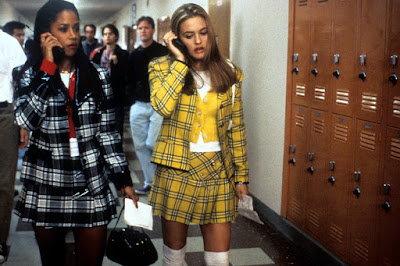
Dionne (Stacey Dash) and Cher (Alicia Silverstone) are best friends at school.

Cher is 15 years-old but drives a tricked-out Jeep that her father bought her. A good fashion sense, she has her outfits programmed into her computer so that she is never mismatched. A good student, Cher doesn’t apply herself to anything until she receives lower than expected. In order to help raise her grades, she negotiates with some of her teachers, who raise her grades. However, her debate teacher, Wendell Hall (Wallace Shawn), doesn’t budge. But she does manage to weaken his resolve by playing matchmaker, setting him up with another hard-grading teacher, Miss Geist (Twink Caplan), the latter of whom she gave a makeover to help attract Mr. Hall’s attention.

In an effort to get a better grade, Cher set up her debate teacher
 Wendell Hall (Wallace Shawn) with another lonely teacher.

After finding success with that effort, Cher turns her attention to a new student, Tai Frasier (Brittany Murphy). Tai is a bit of an ugly duckling by comparison with Cher and Dionne. Tai, though, catches the eye of skateboarder and drug user, Travis Birkenstock (Breckin Meyer), whom Cher feels is below her. Instead, she tries to fix up the new and improved Tai with Elton Tiscia (Jeremy Sisto).

Cher takes new student Tai (Brittany Murphy) under her wing and gives her a makeover.

She tries to match them up at a party in the Valley. But things don’t go as planned and Cher ends up with Elton. On the way home, Elton stops the car to make his play for Cher. However, when she rebuffs his advances, he leaves her on the side of the road. Cher is promptly mugged with her cell phone and purse stolen. Desperate, she calls her former stepbrother, Josh Lucas (Paul Rudd), who lives in L.A. going to college. Even though he’s on a date, he still comes to her rescue.

Cher tries to set Tai up with Elton (Jeremy Sisto), but he's only interested in Cher.

Cher then falls for another new student, Christian Stovitz (Justin Walker). The child of a divorced couple, Christian’s parents have joint custody and he spends one semester in Chicago and one in Beverly Hills. Good-looking with his own somewhat dated sense of fashion, he dresses like a member of the Rat Pack, Cher falls hard for him.

Cher falls for Christian (Justin Walker), another new student at her school.

On their first date, Christian takes Cher to a party. Concerned about him, Josh, who is helping his former step-father with some research for a case, begs off helping to follow them. Mel, who seems to know what’s going on, lets him go. At the party, Josh ends up dancing with Tai, who otherwise is a wallflower at the affair. Cher notices and appreciates his actions. What she doesn’t seem to notice is that Christian is more comfortable with the boys at the party, even staying behind with Josh taking her home.

Cher is willing to give her viriginity to Christian, but he's not interested.

Cher, who we learn is still a virgin and is waiting for someone she loves, decides that Christian is the one. She invites him over to her house when her father is out but when the time would be right, he goes home. It takes Dionne’s boyfriend, Murray Duvall (Donald Faison), to point out to her that Christian is gay.

Despite her miscalculation, Cher still likes Christian because he’s smart, likes art and has a good fashion sense. On a shopping spree with him, Tai, who is also at the mall, is flirting with some boys while sitting on the second-floor railing. She jokes about falling over and the boys she’s with decide to take it a step further and dangle her over the railing. Christian comes to her rescue but her near-death experience has a profound effect on her popularity at school.

Tai usurps Cher as the center of attention at school.

But things don’t get better, as Cher fails her driving test and try as she might, she can’t renegotiate the results. When she gets home, Tai is there with Josh and later Tai confides to Cher that she has a crush on Josh and asks Cher to help her get him. But Cher, instead, tells Tai that Josh’s not right for her. A verbal altercation follows, ending with Tai calling Cher a "virgin who can't drive".

Now, Cher is left feeling totally clueless, which causes her to reflect on the important things in her life. With Tai being the social queen, Cher gets involved in charity work, which she finds rewarding. Cher even leads her school’s Pismo Beach disaster relief effort, a made up and undefined disaster. She also lowers her guard, allowing Travis to invite her to an amateur skateboarding contest he’s participating in.

Cher starts to realize she's attracted to her former stepbrother, Josh (Paul Rudd).

Cher’s soul-searching leads her to the epiphany that she, in fact, loves Josh. But she can’t seem to bring this up to him. The situation presents itself, however, for Josh to show how he feels about her. When one of her father’s associates scolds her for taking files apart, Josh defends her. This allows them to finally confess their feelings for each other.

The film ends at the wedding of Hall and Geist.

The film ends with the wedding of Hall and Geist. The various couples are there, including Tai and Travis, Dionne and Murray and, of course, Cher and Josh. Cher even wins a $200 bet by being the woman who catches the Geist’s wedding bouquet. She and Josh embrace and kiss and the film ends.

Clueless ends with a kiss between Josh and Cher.

Clueless was a bit of a surprise hit. On a budget of $12 million, the film made $56.6 million. While not a blockbuster by the standards of the day, the film made the virtually unknown Silverstone a star and led her to getting a $10 million contract at Columbia Pictures. The film also received generally positive reviews from critics and moviegoers alike.

The film doesn’t really seem to have the usual three-act structure that we have become accustomed to. There are three acts, but the first act seems to go on for a long time. We are treated to a luxurious look at Cher’s lifestyle, which is pretty sweet. She seems to have money, freedom and zero responsibilities for most of the film. You have to give her some credit for still being a virgin but that is about as virtuous as she gets until near the very end. It is only after she loses her place on top of the social order that she takes a look at herself and changes.

I do find it hard to believe that a lawyer father would let his daughter drive without a license, knowing what sort of liability that would be. While I’m sure that this happens more than I’d care to think, it just doesn’t seem like something her father would knowingly let her do.

And I don’t really buy her situation at school, either. I know that the depiction of school life is supposed to be exaggerated for comedy but Elton is very handsy throughout, grabbing Cher at every turn, even when the moment doesn’t quite feel like it would be appropriate. Maybe I’ve been ruined by an ever-litigious America, but it’s hard to imagine a school would allow that sort of behavior. I know this is pre-PC and the #metoo movement, but it still seems very brazen, even for the setting.

Cher is not really a likable character through much of the film. While you might envy her lifestyle, she is a self-centered drama queen. Unless she was a friend of yours you wouldn’t really like her as a person. I know you’re saying but she does good deeds, doesn’t she? Well, the first good deed we see her do, matching Hall and Geist together, is really a selfish gesture because she hopes it will lead to better grades. She takes pity on Tai, but she never really seems to have that girl’s best interest at heart.

It might also seem a little odd that she ends up with her ex-stepbrother in the end. Not the usual way a romantic comedy ends, but they are a cute couple nevertheless. While Josh is based on Emma’s George Knightley, their relationship in the book is not so familial, though they are familiar, life-long friends.

One of the fun parts of the film is watching a couple of really good character actors. Wallace Shawn, perhaps best known for films like My Dinner with Andre (1981) and The Princess Bride (1987), doesn’t disappoint here in what is a small, though important role. Neither does Dan Heyada, who plays Cher’s father. Heyada first came to be known as Carla’s ne’er-do-well husband in the long-running TV Series Cheers. He would also appear in such films as Nixon (1995) and later play Nixon in Dick (1999).

Several of the stars of Clueless would go on to long careers in film. Silverstone, despite her large contract with Sony, never really took off as a major star. There would be some big roles, like Batgirl in Batman & Robin (1997) and while she continues to act to this day, Silverstone is known as much for her activism as her acting. A devoted vegan, she is also a supporter of PETA.

Stacey Dash, who would reprise her role in the Clueless TV show that followed from 1996 to 1999, also appeared in several films and TV Series. Somewhere along the way, the Democratic Dash would end up a Republican and on Fox News as a commentator during the latter half of the Obama administration. She has since filed to run in California's 44th congressional district in the 2018 Congressional Election as a Republican.

Donald Faison would have a more conventional acting career. After also appearing on the Clueless TV series, Faison would also appear on the long-running Scrubs (2001-2010) followed by The Exes (2011-2015).

Jeremy Sisto, who played Elton, would go on to appear in such films as Waitress (2007) as well as star on the TV series Law and Order (2008–2010), and Suburgatory (2011-2014). He would also play Jesus in a TV Movie of the same name in 1999. Here he’s all hands; not his best role.

Brittany Murphy, who played Tai, maybe best remembered for voicing Luanne Platter for the entire run of the animated series King of the Hill (1997-2009) also got her big break in this film.  She would also appear in such films as Girl, Interrupted (1999), 8 Mile (2002), Just Married (2003) and Happy Feet (2006), the latter in which she voiced the character of Gloria. Plagued by rumors of drug use, Brittany's career slowed in the late 2000s and she would, unfortunately, die of pneumonia in December 2009. 

Perhaps of all the actors, Paul Rudd may have had the most prolific career. Clueless was his first film, though he had been on the TV series Sisters before that. He would go on to appear in 18 episodes of the very popular Friends series. A favorite of director Judd Apatow, Rudd would appear in several of his films, The 40-Year-Old Virgin (2005), Knocked Up (2007), and This Is 40 (2012). He also appeared in Anchorman: The Legend of Ron Burgundy (2004) and Anchorman 2: The Legend Continues (2013), both directed by Adam McKay. He also found new fans with his successful appearance as the titular character in Ant-Man (2015), Captain America: Civil War (2016) and will soon appear in Avengers: Infinity War (2018), Ant-Man and the Wasp (2018) and in the yet untitled Avengers: Infinity War sequel. At this point of his career, Rudd’s best attribute was that he was cute.

Clueless is not so bad as it is somewhat forgettable. The film hasn’t aged-well, especially in light of the more recent Occupy Movement and attention to economic inequalities. The story is okay, though Cher really doesn’t change all that much. It’s not like she goes for someone like Travis. Instead, she ends up with someone in her same socio-economic class. Perhaps it's telling that Josh is also involved with Murray, who may be to blame for how the two of them came out. And what’s there to say about a film whose most memorable line of dialogue is “as if”.

Saturday, February 24, 2018

Stubs - Runaway Brain


Runaway Brain (1995) Starring the voices of: Wayne Allwine, Russi Taylor, Kelsey Grammer, Jim Cummings, Bill Farmer Directed by Chris Bailey. Story by Tim Hauser. Produced by Ron Tippe. Runtime: 7 minutes. U.S. Color. Animated, Comedy, Horror.

Mickey Mouse is the face of the Walt Disney Company, and prominent at attractions like Disneyland, but he hasn’t been so prominent in Disney animated works. In 2013, he appeared in Get A Horse, a 3D animated short that recalled his past glories on the silver screen. But prior to that, he hadn’t appeared in a theatrical animated short since Runaway Brain (1995), a period of 18 years.

Mickey made his debut in Steamboat Willie (1928), a Disney homage of sorts to Buster Keaton’s Steamboat Bill, Jr. (1928). He would go on to be featured in 130 films including Plane Crazy (1929), The Band Concert (1935), and Fantasia (1940). But things came to a stop after The Simple Things (1953). For whatever reason, it would be thirty years before his next animated short, Mickey’s Christmas Carol (1983). The Prince and the Pauper (1990) would follow and it would be 5 more years before Runaway Brain.

It’s not that Mickey needs any sort of introduction, despite his time away from theaters. He is iconic in that way.

The film opens on a rainy night. Mickey (Wayne Allwine), with his dog Pluto (Bill Farmer) by his side, is doing what a lot of guys might be doing, playing a video game. This one appears to be based on Snow White and the Seven Dwarfs (1937), with the wicked witch throwing apples on the Dwarfs. His gameplay is interrupted when Minnie (Russi Taylor) comes home.

Mickey (Wayne Allwine) is shown to be a video game addict.

She figures, correctly as it turns out, that Mickey has forgotten the anniversary of their first date. Pretending he hasn’t, he shows her a newspaper ad for Miniature Golf, but Minnie only sees the ad below that one, a trip to Hawaii. Happy to know he has planned something special, Minnie leaves. It is only then that Mickey realizes that the trip will cost $999.99, which is obviously more than he has.

Minnie (Russi Taylor) is disappointed that Mickey has forgotten the anniversary of their first date.

Pluto comes to the rescue by finding a want ad that promises to pay $999.99 for one day’s mindless work. Thinking he’s hit a home run, Mickey goes to apply. But when he arrives at the address at 1313 Lobotomy Lane, he falls through a trap door and into a science lab where he is strapped down in a chair, unable to move.

Pluto (Bill Farmer) shows Mickey a help wanted ad that promises the money he needs.

He is interviewed by the primate-like Dr. Frankenollie (Kelsey Grammer) who decides Mickey will do and introduces him to his co-worker, Julius (Jim Cummings), a twenty-foot tall creature. Dr. Frankenollie wants Mickey’s brain, which we see extends into his ears, for Julius. So in what has become a cliché of sorts, he throws a switch to move Mickey’s thoughts and memories into Julius.

Dr. Frankenollie (Kelsey Grammer) decides Mickey is perfect for his needs.

There is an explosion, which we find out burns the doctor into a crisp. Mickey discovers this when now in Julius’ body he tells the doctor to change him back and the doctor’s body falls away like so much ash on the end of a cigarette.

The doctor sets off the transference with a click of a button.

With Julius’ brain in it, Mickey’s body turns feral. When Mickey tries to explain that he needs to change back, he tries to get Julius to look at the photos in Mickey’s wallet, one of which is him as Steamboat Willie. But when Julius sees Minnie’s photo, he is smitten by her. Seeing her on the street entering a bikini shop, he runs down to get her. Minnie, of course, doesn’t see any difference in Mickey and hides the scanty bikini to save it for their vacation. But when Mickey in Julius’ body tries to save her, she thinks he is the monster.

With Julius' brain in his body, Mickey turns feral and even scares himself.

Quickly, however, she realizes that he is her Mickey. In a King Kong-like move, he places her on a tall building where she will be safe and goes back to battle Julius. For a moment, Julius outsmarts Mickey and the two of them are sent falling towards the ground, but they land on electrical lines and the resulting charge sends their brains back to the right bodies.

Julius, back in his own body, clutches Mickey and Minnie even though they're sticking through a billboard.

But the bounce back up from the wires sends them to the top of the building and thrusts all three through a large billboard advertising Hawaii. Mickey realizes he’s back into his own body, but he’s in Julius’ grasp. Minnie is in the other hand. Mickey manages to escape and tries to fight Julius with window cleaner gear before rescuing Minnie when she is dropped by Julius by swinging on a rope to catch her. Mickey uses the same rope to tie Julius to the hand of the hula dancer on the billboard. Julius is trapped like a yo-yo.

Minnie falls before Mickey rescues her.

In the final scene, Mickey and Minnie are together on their way to Hawaii on a raft being pulled through the ocean by Julius with a photo of Minnie being used as the carrot on the stick to keep him swimming.

Mickey does manage to take Minnie to Hawaii aboard a raft.

Produced by Walt Disney Animation France, the film was originally released in North America on August 11, 1995, accompanying A Kid In King Arthur’s Court, a live-action family-friendly retelling of Mark Twain’s A Connecticut Yankee in King Arthur’s Court and a remake of Disney’s own Unidentified Flying Oddball (1978).

After having been off the screen for five years, Mickey’s appearance in Runaway Brain didn’t meet with universal praise. Many otherwise Disney fans were turned off by the macabre nature of the short, especially when compared to the light tone of his previous shorts.

The short was re-released with 101 Dalmatians (1996), their live-action remake of the animated classic. But Disney asked theater owners to cut the short off all film prints and replace it with trailers for then-upcoming Disney films. Runaway Brain would later be released attached to George of the Jungle (1997), yet another live-action remake. The short would be nominated for the Academy Award for Best Animated Short at the 68th Academy Awards, ending up losing to A Close Shave (1995) from Aardman Animations and director Nick Park.

Watching the short, I wasn’t really bothered by its horror film undertones. I will admit that it is not something you’d expect from a Mickey Mouse animated short. But there is nothing in this short that you haven’t seen in other animated films, even when Dr. Frankenollie turning to ash is nothing new.

While most of the early animated shorts from the studios, including Disney, were never rated, they did include violence that feature films couldn’t have gotten away with because of the interpretation of the Production Code by the Hays Office.

The film’s use of imagery from movies like Frankenstein (1931) and King Kong (1933) seems to presume that its audience is already aware of these films. They’re a visual short-hand for science fiction and horror that allow the filmmakers, who only have seven minutes, to sort of cheat on their storytelling.

However, the film overall feels sort of disjointed to me. A derivative of other films, there is nothing really unique about it, that is there is nothing you haven’t seen before, with the possible difference seeing Mickey Mouse in this sort of film.

Kelsey Grammer, who was in the middle of his 20-year plus run playing Dr. Fraiser Crane on TV shows Cheers and Fraiser, has a rather small role considering his celebrity at the time. Dr. Frankenollie may instigate the action, but he disappears rather quickly in the story. You wonder why the stunt casting if the role was so small.

The other actors, while perhaps not as well-known to mainstream audiences, are still gifted voice actors. Wayne Allwine had played Mickey Mouse for 32 years and his wife Russi Taylor has voiced Minnie since 1986, not to mention Martin Prince, Sherri and Terri, and Üter on the animated series The Simpsons. Jim Cummings, whose voice has appeared in over 400 films, is perhaps known for another Disney project he worked on, the title role in the TV series Darkwing Duck. Bill Farmer has been playing another Disney dog, Goofy, since 1987, as well as voicing Pluto. If you ever have a chance to attend a panel for voice actors at a comic-convention, I would recommend you attend as they are very entertaining to watch and listen to.

It is the fact that Disney has made the film sort of hard to find that makes it compelling to watch. What are they trying to hide? We’re disc people at my house, and proud of it, but this short was not available on disc, rather it was a digital extra for the digital version of Walt Disney Short Film Collection from 2015. The character of Julius, however, would make one more appearance as an optional secret boss in Kingdom Hearts 3D: Dream Drop Distance in Traverse Town.

For the die-hard Mickey Mouse fan, this is worth seeking out. If you’re a casual fan of Disney animation, then Runaway Brain is sort of fun to watch and makes for a pleasant diversion.

Saturday, February 4, 2017

Stubs - Toy Story


Toy Story (1995) Starring the voices of Tom Hanks, Tim Allen, Don Rickles, Jim Varney, Wallace Shawn, John Ratzenberger, Annie Potts. Directed by John Lasseter. Screenplay by Joss Whedon, Andrew Stanton, Joel Cohen, Alec Sokolow. Produced by Bonnie Arnold, Ralph Guggenheim. Run Time: 81 minutes. U.S.A. Color. Animated, Adventure

Ever wonder what it’s like to be a toy? Well, you need to look no further than Tin Toy (1988), a CGI short directed by John Lasseter to show off the Pixar Image Computer's capabilities. Despite why the film was originally made, it would go on to win the 1988 Academy Award for Best Animated Short Film.

The short Tin Toy (1988) was the precursor to Toy Story.

Tin Toy got the attention of the Walt Disney company, known for its traditional hand-drawn animated classics like Snow White and the Seven Dwarfs and Alice in Wonderland. Under the regime led by Michael Eisner, Jeffrey Katzenberg tried to seduce Lasseter, a former mouse house animator, back into the fold. But Lasseter felt loyal to Steve Jobs, then owner of Pixar, and decided to stay and make history with Pixar.

Undeterred, Katzenberg set in motion plans for a production deal with Pixar. Disney had made all their films in-house up until Tim Burton’s The Nightmare Before Christmas (1993). But negotiations were not easy between the two companies. Disney had a bad reputation for how they treated their animators, something those at Pixar already knew, some like Lasseter knew that first hand. The other problem was Katzenberg himself, who had a well-established reputation as a micro-managing tyrant, something he himself copped to in a meeting between the studios. But things between the two studios worked out.

Originally conceived as a Christmas TV Special, A Tin Toy Christmas, as a way to gain experience before making a feature film, that gave way, in 1991 to a Tin Toy movie with the working title Toy Story. Disney would own the property with an option to do Pixar’s next two films and to make sequels with or without Pixar involvement using the characters in the film. Pixar would receive 12.5 percent of the ticket revenues in return.

It was in the writing of the film that the story began to take shape. Originally, under Katzenberg’s supervision, the character of Woody was the main villain and Tinny, the musical toy from Tin Story, was paired with a ventriloquist dummy and the two set out on an Odyssey together. When Disney relinquished creative control to Pixar, the story began to more resemble what we know now.

Tinny, which Lasseter felt was not antiquated, went through a transformation ultimately becoming a space ranger named Lunar Larry on his way to becoming Buzz Lightyear. Woody also went through his own makeover as it were, starting out as a ventriloquist dummy and ending up as a pull-string toy. The name Woody was supposedly in homage to Woody Strode, a black football player turned actor who appeared in several John Ford westerns, including Sergeant Rutledge (1960) and The Man Who Shot Liberty Valance (1962).


Woody (Tom Hanks) holds court with the other toys, advising them to get a buddy for the pending move.

Inside six-year-old Andy Davis’(John Morris) room, his toys live in a world of their own when he’s not around. Their leader, and Andy’s favorite toy, is Sheriff Woody (Tom Hanks), an old-fashioned pull-string Cowboy doll. Woody, as he’s called, organizes the other toys, including Mr. Potato Head (Don Rickles); Slinky Dog (Jim Varney); Rex (Wallace Shawn), a cowardly dinosaur; Hamm (John Ratzenberger), a piggy bank; and Bo Peep (Annie Potts), a porcelain doll who is in love with Woody.

The toys paying attention to Woody's announcement include Rex (Wallace Shawn), Mr. Potato
Head (Don Rickles), Slinky Dog  (Jim Varney), Hamm (John Ratzenberger) and Bo Peep (Annie Potts).

Andy’s family, which includes his single mom (Laurie Metcalf) and a younger sister, are getting ready to move and Woody wants all the toys to find a moving buddy. During the session, Woody also announces that today is Andy’s birthday party, which causes anxiety amongst the toys. With the exception of Woody, they are all worried about being replaced. In order to keep an eye on the gifts,


The Army soldiers under Sarge's (R. Lee Ermey) command deploy to eavesdrop on Andy's Birthday party.

Woody sends a platoon of green Army men, led by Sarge (R. Lee Ermey), downstairs. Using a baby monitor, Sarge reports back to the other toys the presents as Andy opens them. When there is nothing to worry about, Sarge signs off, but quickly tries to get back online when Andy’s mom brings out a surprise gift. Again, the toys are anxious, causing Rex to knock the baby monitor to the floor, causing the batteries to fall out. While they are struggling to get them back in, Andy and his friends come running upstairs to his room. The toys become inanimate and fall to the floor; Woody takes his place on top of Andy’s bed.


Woody tries to figure out what to do after Buzz Lightyear (Tim Allen) lands on Andy's bed.

In the commotion, Woody slips off the bed as when the new present lands on the bed. When the boys run out of the room for cake and ice cream, the toys come back to life and wonder who has replaced Woody. It turns out to be an unaware Buzz Lightyear (Tim Allen), who doesn’t know that he’s only a toy. He thinks he’s on a space mission and is trying to make friends with the indigenous species while he attempts to make repairs to his spaceship, the box he came in.


Buzz "proves" to the other toys that he can really fly.

The other toys are impressed by all of Buzz’s features and even think that he can fly once he demonstrates his prowess. Woody is unimpressed, saying that Buzz is merely "falling with style!" Andy is also impressed and begins to favor him over Woody. Even though the family is days away from moving, we see Andy’s room transform into a shrine to Buzz with new sheets on the bed.

Woody can’t help but notice his diminished role in Andy’s life. When the family is planning a trip to Pizza Planet, Woody tries to trap Buzz behind the desk, to keep him from being picked, but he accidentally knocks Buzz out the window. The other toys gang up against Woody, accusing him of killing Buzz out of jealousy. But before they can punish Woody, Andy takes him as a second choice.


Woody convinces Buzz that the Pizza Planet delivery truck is taking them to a spaceport.

Down in the car, Woody finds that Buzz has also found his way into the car. When they’re left alone, when the mother stops for gas, the two get into a fight and fall out and find themselves left behind when the mother drives away without them. Seeing a delivery truck for Pizza Planet, Woody convinces Buzz that it is a spaceship that will take them to Andy. When Woody climbs into the back, Buzz carefully takes his place in the front seat with seat belts on.

Once they get to Pizza Planet they sneak in as trash. Woody starts looking for Andy’s family, but Buzz starts to look for a rocket ship, thinking Pizza Planet is a spaceport. At about the time Woody spies the family, Buzz has discovered a rocket-shaped crane game and crawls in. The game is populated, these are sentient toys after all, by little green squeeze alien toys (Jeff Pidgeon and Debi Derryberry), who treat the game as a sort of purgatory. Being pulled up by the crane is the same as salvation.


Woody becomes the hero to the little green squeeze toys (Jeff Pidgeon and
 Debi Derryberry) who are waiting inside the crane game.

Woody climbs into the game hoping to pull Buzz out, but they both get trapped when Sid Phillips (Erik von Detten), a ten-year-old bully and Andy’s next door neighbor, grabs Buzz with the crane and starts to pull him out. In his attempt to pull Buzz free, Woody gets caught up and Sid thinks he’s hit the jackpot. But Sid isn’t like Andy, he doesn’t play nice with his toys.


Sid Phillips (Erik von Detten) doesn't play nicely with his toys.

When Woody and Buzz are left alone, they discover that Sid’s room is occupied by a bizarre group of mutant toys created by combining parts from unlike toys together. Woody is shocked and scared by what he sees. He is surprised to see them help repair Buzz rather than consume him like toy cannibals.


Sid's toys are mutant creations.

Sid’s plan is to strap Buzz on a rocket that has just arrived in the mail. But the launch is delayed by a thunderstorm. Woody tries to make an escape, but they get separated and Buzz ends up in a room with a TV blaring a commercial, narrated by Penn Jillette, about the toy Buzz Lightyear and all the wonderful things it can do. Hearing that, Buzz for the first time realizes that he, too, is a toy. This news sort of bums him out. He tries to escape by flying, but he can’t and falls to the floor, where he is found by Sid’s sister Hannah (Sarah Freeman), who takes him as compensation for the myriad of toys her brother has ruined of hers.

Despondent, Buzz, who had one of his arms pop out in the fall, is dressed up as a member of her tea party. Woody, who had been hiding in a closet to get away from the Phillips’ family dog rescues Buzz from the tea party. Back in Sid’s room, Woody finally convinces Buzz that as a toy, he can make Andy happy. The mutant toys fix Buzz and then help Woody work out an elaborate scheme to rescue Buzz when Sid straps him to the rocket and takes him outside to launch him. Before Sid can light the rocket that he’s strapped to Buzz’s back, Woody and the other toys come to life in front of Sid, scaring him into no longer abusing toys and allowing Buzz and Woody to make their escape.


Before he's stopped, Sid plans to light the rocket strapped to Buzz's back.

But they just miss the family car, because Buzz has gotten caught up in the fence. Buzz and Woody chase after the moving truck, but Sid’s dog, Scud, gives chase, capturing Buzz. Woody tries to save him using Andy’s remote controlled car, RC, but the other toys turn on him. Still believing he has eliminated Buzz, the others, led by Mr. Potato Head, throw Woody off the end, but not before Woody has grabbed RC.

Buzz and Woody are "falling with style," but together.

They succeed in rescuing Buzz and while the other toys see them together, there is nothing they can do as RC’s batteries begin to run out. Woody tries to use the match that Sid didn’t to light the rocket, but the wind from a passing car blows it out.  Using Buzz's helmet shield as a magnifying glass, Woody ignites the rocket with the sun's rays and the three of them take flight. They manage to throw RC, now missing his remote, into the back of the truck as they soar by. Then Buzz uses his wings to free himself from the rocket just before it explodes. Buzz and Woody then glide and drop through the open sunroof into the mother’s car and land in a box right next to an excited Andy.


In the end, Andy (John Morris) gets Buzz and Woody back.

Flash forward to Christmas Day and Sarge and his men are on another reconnaissance mission while the toys in his room listen keenly for what presents Andy receives. Just as Woody is joking with Buzz that there is nothing Andy could receive that would be worse than Buzz, they hear over the intercom that Andy’s new gift is a puppy.

Released after dual premieres by Disney in LA and Pixar in San Francisco, the film was released on November 22, 1995, and would go on to gross $350 million worldwide on a budget of $30 million. Toy Story would also go on to be nominated for three Academy Awards Best Music—Original Song, for "You've Got a Friend in Me", and Best Music—Original Musical or Comedy Score both for Randy Newman and Best Original Screenplay for Joel Cohen, Pete Docter, John Lasseter, Joe Ranft, Alec Sokolow, Andrew Stanton and Joss Whedon, the first animated film to be so nominated.

Unlike say a DreamWorks Animation film, there are no hip cultural references that will quickly age the film. The writing is solid, managing to engage both young and old without speaking down to kids or up to adults. A buddy film with toys had never been done before and really hasn’t been done better, despite the sequels.

While CGI pioneered by Pixar has come a long way in the twenty-plus years since its release, the film for the most part still holds up. What was bad about the film then was its depiction of humans. While Pixar excelled at everything else, human characters appeared to elude them. They have gotten much better over the years with that, as well as other innovations that have made Pixar the premiere animation house, even though it is now a wholly-owned subsidiary of Disney. What was once cutting-edge animation now looks a little below the standards Pixar keeps setting.

Besides the Easter eggs that first appear in this film, like the ball with the star on it, there are other things that this film demonstrates Pixar does very well. One of them is to get the most out of their voice actors. While Tom Hanks and Tim Allen were both new to voice work, it is not really amazing that they were good at their parts. What is surprising is that Pixar could take someone like Jim Varney, who I would normally move across the street to avoid, into a likable character actor. They would do the same thing in such films like Cars and Cars 2, where they made Larry the Cable Guy a mainstream star.

In fact, Pixar has excelled over the years with ensembles made up of actors from a variety of backgrounds including film actors, TV actors and stand-up comics; accomplished and unaccomplished alike. Somehow they have always managed to make them work. Some of the selections like Don Rickles as Mr. Potato Head and Wallace Shawn as Rex are perfect.

The film was also the debut of John Ratzenberger in a Pixar film. Best known for his portrayal of the annoying Cliff Clavin on the long-running TV series Cheers, Ratzenberger would go on to appear in all of Pixar’s films to date. With him as a good luck charm, Pixar would have a very successful run of hit films, marred by only a few misfires.

Toy Story made Randy Newman, best known for his politically charged and satirical songs, into a more mainstream songwriter. While no stranger to writing film scores, his first was Ragtime (1981), it was songs like “You’ve Got a Friend in Me” that seemed to be a different offering for the accomplished songwriter. I don’t think he had many children fans before this film was released. Now the singer who was once known for such songs as “Short People” and “I Love L.A.” is also remembered for his song about friendship.

There is much to like about Toy Story. For a production company new to feature films, there is a certain feeling of magic surrounding their initial offering. The studio would certainly prove that it was no fluke with their next film, A Bug’s Life (1998).

Innovative, Toy Story is an interesting blend of talents from the producing, the writing, the voice acting and of course the animation and rendering. It was the first of its kind and the heralding in a change of animation from hand-drawn, which had been the tradition since film animation was first done. It also passed the baton, as it were, from Disney to Pixar as the premier animation house.

Toy Story is fun for children; it does not speak down to them. At the same time, the film is fun for adults as well and might even be a little nostalgic for some. Who didn’t have a favorite toy growing up that, at least when you were around, interacted with you like a real person? This film takes that a step further and tells they not only interacted with you, but with each other when you weren’t around. This is a film you can see several times, I have, and never grow tired of.

Saturday, September 19, 2015

Stubs – Othello


Othello (1995) Starring: Laurence Fishburne, Kenneth Branagh, Irène Jacob, Nathaniel Parker, Michael Maloney. Directed by Oliver Parker. Screenplay by Oliver Parker Based on the play Othello by William Shakespeare (London, ca. 1604, published 1622). Produced by David Barron, Luc Roeg.  Run Time: 125 minutes. U.K. U.S. Color Drama, Tragedy

In our continuing study of movies based on the plays of William Shakespeare, next up is the 1995 version of Othello, based on the play of the same name, also known as The Tragedy of Othello, the Moor of Venice. The play was written around 1603-04 and based on the short story Un Capitano Moro ("A Moorish Captain") by Cinthio, first published in 1565. The first known performance of Othello was November 1, 1604 at Whitehall Palace in London.

The play is somewhat unique in the canon of Shakespeare’s plays in that the eponymous character is a non-white, Moor. Moors were medieval Muslim inhabitants of the Iberian Peninsula (Spain and Portugal), Sicily and Malta. The Moors arrived on the Iberian Peninsula in 711 from North African Morrocco and remained until they were expelled in 1492, the same year Christopher Columbus sailed for the New World under the Spanish kingdom’s flag.

The term Moors was a derogatory term for Muslims and was applied in Europe to Arabs and Sub-Saharan Africans. While Shakespeare left Othello’s race ambiguous, he is often portrayed as a black African.

Othello has inspired two operas, both called Otello and both in Italian. The first has a libretto by Francesco Maria Berio di Salsi and music by Gioachino Rossini. This Otello was first performed on December 4, 1816. Seventy-one years later, Giuseppe Verdi and librettist Arrigo Boito wrote a second adaptation. This one was first performed in Milan on February 5, 1887.

Films have been made using both the plays and the operas as a basis since 1909, though oftentimes Othello was played by a white actor. Emil Jannings, the great German silent actor, played the role in 1922; Orson Welles in his own version in 1952; and Laurence Olivier played Othello on film in 1965. Our Othello marked the first major film production to cast a black actor, Laurence Fishburne, as Othello.

The film marks Oliver Parker’s directorial debut. While the film follows the play’s plot very closely, lines are cut and some scenes are added. This is to be expected as every screenwriter/director wants to put his own mark on the project and not merely film the play. Live-theater and film are similar, but very different ways of telling a story and Parker cannot be faulted for using the aspects of the media that were not available to Shakespeare when he wrote this play.

The film, like the play, opens in Venice. Desdemona (Irène Jacob) is hurrying to her secret marriage ceremony to Othello (Laurence Fishbourne), a Moorish general in the Army. Roderigo (Michael Maloney), who is in love with Desdemona, complains about this to his friend, Iago (Kenneth Branagh), an ensign under Othello, who hates him because he believes Othello slept with his wife, Emilia (Anna Patrick). For money, he promises Roderigo that he’ll split up the marriage, so he can have his chance with Desdemona.

The two go to wake Brabantio (Pierre Vaneck), Desdemona’s father, to tell him of his daughter’s elopement. Brabantio is enraged at the news and gathers the family to go after Othello. Afterwards, Iago finds Othello and warns him that Brabatino is coming after him.

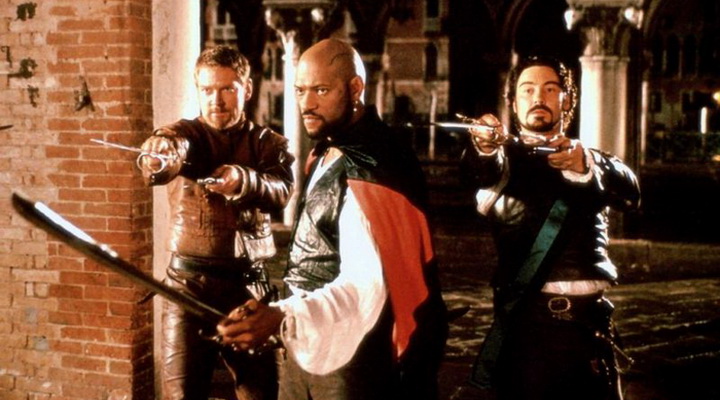
Brabantio and his family confront Othello and his men, but while there is some sword-play, they are called to the Duke of Venice’s (Gabriele Ferzetti) residence. News has arrived in Venice that the Turks are going to attack Cyprus and Othello has been summoned.


Othello (Laurence Fishbourne) confronts his father-in-law. Iago (Kenneth Branagh) is to the left.

In front of the Duke, Brabantio accuses Othello of seducing Desdemona by witchcraft. To clear the air, Dedemona is summoned to the residence. Desdemona confirms that she loves Othello, which satisifies the senate and the Duke, but Brabantio is still not overjoyed.


Brabantio (Pierre Vaneck) is not happy about Desdemona's (Irene Jacobs) marriage to Othello.

The real business before the Duke is gotten to and Othello is sent to Cyprus to command the Venetian Army against the Turks. Othello leaves, accompanied by his new wife, Cassio (Nathaniel Parker), a new lieutenant, Iago, and Emilia, who is also Desdemona’s attendant.

The Turks flee Cyrus and Othello orders a general celebration. While Othello is spending private time with Desdemona, Iago schemes to ruin Cassio. After admitting to Iago that he can’t hold his liquor, Iago gets him drunk and then persuades Rodrigo to draw him out into a fight. When Othello learns of the fight, he blames Cassio and strips him of his rank.

Desdemona joins Othello on Cyprus after the Turks flee.

Iago, always the mixer, convinces Cassio to use Desdemona as a go-between to help rehabilitate his reputation with Othello. Iago then persuades Othello to be suspicious of Cassio and Desdemona.

When Desdemona uses a handkerchief with strawberries on it, a family heirloom of sorts for Othello and his first gift to her, to help bind Othello’s headache, she accidentally drops it on the bed. Emilia, who has watched this, scoops it up and delivers it to Iago, but has no idea why he wants it. Iago then plants the handkerchief in Cassio’s residence.

Still trying to convince Othello of Desdemona’s affair, Iago has Othello watch as he speaks with Cassio about the handkerchief. Instead of the handkerchief, Iago speaks to Cassio about his affair with Bianca (Indra Ové), a local woman with whom Cassio has been spending a lot of time with lately. While they are speaking, Bianca confronts Cassio about the handkerchief and chastises him for giving her a gift he received from a prior lover. Cassio pleads with her that that is not the case and follows after her.


Iago talks with Cassio (Nathaniel Parker) under false pretenses to prove a point to Othello.

Othello, having seen this exchange, is convinced by Iago that Cassio had received the handkerchief from Desdemona, despite the great significance Othello placed on it in the context of their relationship. Othello is enraged at his wife’s betrayal and resolves to kill her. He then asks Iago to kill Cassio.

From then on, Othello is rather cruel to Desdemona, even striking her in front of visiting Venetian nobles, including Lodovico (Michael Sheen).


 Lodovico (Michael Sheen) is one of the visiting Venetian nobles.

Meanwhile, Roderigo is not happy with the lack of progress Iago has made and wants his money back. Iago convinces him to kill Cassio; Iago hides while Roderigo attacks Cassio on the street, but in the swordfight, Roderigo is wounded by Cassio, even though Iago creeps up from behind Cassio and badly cuts his leg during the skirmish.

Cassio cries for help and Iago, along with the Venetian nobles, comes to help. While the others attend to Cassio, Iago pretends to help Roderigo, whom he quietly stabs to prevent him from revealing the plot. Later we see Cassio and Roderigo being attended to in an infirmary. Roderigo is not quite dead when he arrives, but dies while Iago watches.

Later that night, Othello confronts Desdemona and refuses to believe her pleas that she has been faithful to him. He then smothers her with a pillow. She is not quite dead when Emilia arrives to tell Othello about Roderigo’s death. When Desdemona dies, Emilia screams for help. Lodovico, Iago and others arrive.


Othello can't be convinced of Desdemona's fidelity.

Still in the bedroom, Desdemona’s body still where she was killed, Othello admits to the murder. Emilia begins to explain the situation, implicating her husband when Othello mentions the handkerchief as proof of Desdemona’s betrayal. Iago then stabs Emilia in front of everyone. She asks to be laid down next to her mistress to die.

Realizing Desdemona’s innocence, Othello stabs Iago, but not fatally, saying that he would rather have Iago live the rest of his life in pain. For his part, Iago refuses to explain his motives, vowing to remain silent from that moment on. Othello commits suicide with a dagger he has hidden and dies on the bed next to Desdemona. Cassio is made Governor of the island by Lodovico and Iago is sent away to be punished.


Iago gets what's coming to him when Othello stabs him.

Unlike the play, the movie ends with a burial at sea for the bodies, presumably of Othello and Desdemona. Othello, like The Merchant of Venice (2004) and Romeo and Juliet (1968), was shot on location, with some scenes shot in Venice. Like Merchant, the authentic backdrops add to the realism of the story.

The acting for the most part is very good. Laurence Fishbourne was an established actor by this point in his career, having starred in such films as Boyz In the Hood (1991) and having appeared on stage. Up until then, he was not an actor one associated with Shakespeare. However, he is very good in the role and brings out all sides of Othello’s character.


Laurence Fishbourne as Othello.
He is teamed with Kenneth Branagh, an actor who is very much associated with the works of Shakespeare, having appeared in several stage productions and writing, directing and starring in the films Henry V (1989) and Much Ado About Nothing (1993). Branagh is excellent at the conniving, scheming and generally evil Iago. The character has so much screentime and carries the plot that he could be considered to be the lead, though not the hero of the piece.


Kenneth Branagh plays Iago.

Other fine performances are turned in by Indra Ové as the beautiful Desdemona, Nathaniel Parker as Cassio and Anna Patrick as Emilia. Of these, I think Parker’s Cassio is the best and certainly the meatiest of the roles. Just for reference sake, the Parkers, director and actor, are brothers and Anna Patrick is also Nathaniel’s wife. Sometimes nepotism pays off, as they are both very fine actors.

For a first time director, I think Oliver Patrick did a good job of keeping the story moving forward. I’ve seen that some adaptations can take up to three plus hours to tell the story. The shorter running time means that a lot of the play was excised In order to keep things moving. While that might be seen as a disservice to the Bard, it is not out of line with the writer’s own work. Even though we may see Shakespeare as a lofty writer of tragedies and comedies, he was in reality writing for the enjoyment of the common man, which made up the audience at the Globe Theatre where much of his work premiered. This Othello, with its shorter run time, is perhaps better suited for today’s audience, with shorter attention spans, than a full out and out adaptation of the entire play.

The film received over all positive reviews, with Branagh called out for his Iago. He was even nominated for the Screen Actors Guild’s Outstanding Performance by a Male Actor in a Supporting Role. Fishburne would receive an Image Award nomination for Outstanding Lead Actor in a Motion Picture and the film would be nominated for Outstanding Motion Picture. However, despite the good reviews, this production was far from a success. Budgeted at $11 million, this Othello brought in less than $3 million in the U.S.

For me, this was my first exposure to Othello. This recent immersion in Shakespearean films has exposed me to a lot of stories that I had either avoided or neglected, depending on your point of view. For some reason Othello always seemed sort of intimidating to me. This production made this story much more accessible for me.

However, even though the acting was good, I still found myself getting lost sometimes in the meter of Shakespeare’s dialogue. Despite that, the film was not really hard to follow on a high level, but some subtleties with story and dialogue sort of washed over me and I’m sure I’ve missed out on some based on my own lack of knowledge of Shakespeare.

If you’re new to Shakespearean films like I am, then I would certainly recommend this film to you. Again, the acting and directing are very good and the pace of the film keeps things moving. However, I’m not sure if the more knowledgeable of the Bard you are the less you may forgive the cuts or the additions that were made. If for no other reason, the film should be seen for Fishburne’s and Branagh’s performances.