A bit of an oddball in the Godzilla and King Kong franchises, the 1962 film King Kong vs. Godzilla was the third outing for both series and the first crossover between the two, with two different cuts of the film produced for Japanese and American audiences. While this would be a weird one-off crossover between two legendary monsters, it wouldn’t be until Legendary Pictures' MonsterVerse that the two titans would have their rematch in the 2021 film Godzilla vs. Kong. In preparation for this, I decided to see how their first battle played out for comparison, opting for a Blu-ray release of the American cut from 1963. While this cut is interesting to see, it proved to be enjoyable in more of a “so bad it’s good” sort of way.
Showing posts with label 1962. Show all posts
Thursday, April 1, 2021
Saturday, October 28, 2017
Stubs - What Ever Happened to Baby Jane?
What Ever Happened to Baby Jane? (1962) Starring: Bette Davis, Joan Crawford. Directed by Robert Aldrich. Screenplay by Lukas Heller Based on the book: What Ever Happened to Baby Jane? by Henry Farrell. Produced by Robert Aldrich. Runtime: 133 minutes. U.S. Black and White. Drama. Horror. Psychological Thriller.
Hollywood has never been kind to women as they age, no matter how big a star they might have been at one time. Even if you’ve won Academy Awards for your acting, like Bette Davis and Joan Crawford. Major stars in the studio systems of the 1930s and 40s by the early 60s, their careers were on the wane.
Rivals for headlines: Joan Crawford’s divorce from first husband Douglas Fairbanks Jr., grabbed attention away from Warner Bros.’ publicity campaign for Bette’s first major starring role in Ex-Lady (1933); men: Bette was in love with Franchot Tone, but Joan Crawford married him in 1935; and roles: Bette turned down the starring role in Mildred Pierce for which Joan won the Oscar for Best Actress. There were even rumors about Joan’s sexual attraction to Bette and to make matters worse, Bette played a thinly-veiled character based on Crawford in The Star (1952), which was unflattering, to say the least.
These two women might seem like odd bed-fellows to mount a comeback bid, but they were thrown together in What Ever Happened to Baby Jane? It was Crawford who persuaded Davis to appear in the film and Bette did, but on two conditions: first, she played the starring role of Jane in the film and that Aldrich assure her that he was not sleeping with Crawford. The concern wasn’t about their private lives, but that Davis wanted to be sure Crawford didn’t receive any more close-ups than she did.
The actresses did not put aside their rivalry even then. Crawford, who thanks to her late husband, Alan Steele, was on the board of Pepsi-Cola. Davis, knowing this, had a Coke machine installed in her dressing room. And it didn’t stop even during filming. During a scene in which Davis was to have to pull Crawford across the floor, Crawford knew that Davis had a bad back and purposefully made herself heavy. Depending on whose story you believe, she either put rocks in her pocket, wore a weightlifter’s belt or just made herself into dead weight, causing Davis agony and takes to be ruined as a result.
![]() |
| Daddy (Dave Willock) watches Baby Jane, while his wife (Anne Barton) and other daughter Blanche (Gina Gillespie) watch him. |
The film opens in 1917 when Baby Jane Hudson (Julie Allred, singing voice by Debbie Burton) is the toast of vaudeville and the apple of Daddy’s (Dave Willock) eye. Baby Jane’s signature song is even "I've Written a Letter to Daddy" (words and music by Frank DeVol).
![]() |
| The apple of Daddy's eye, Baby Jane Hudson (Julie Allred). |
Jane’s long-suffering mother (Anne Barton) and sister, Blanche (Gina Gillespie), are forced to play second fiddle to Jane’s talent and to her whims. Mother tries to comfort Blanche by telling her that when her turn comes, as it were inevitable, she will have to be better to Jane than Jane treats her now.
![]() |
| Mother tells Blanche that when her turn comes, she should treat Jane better than Jane treats her. |
That prophecy appears to come true when in 1935, Blanche (Joan Crawford) is a big star and Baby Jane (Bette Davis) is considered an also-ran, only have a contract because of Blanche’s clout at the box-office. We see the stars in footage from their films, Davis in Parachute Jumper (1933) and Ex-Lady (1933) and Crawford in Sadie McKee (1934). Studio execs find Jane’s acting atrocious and would love Blanche to let them dump her. But as they point out, Blanche is loyal to Jane.
But is that loyalty a two-way street. We’re shown the girls coming home to their mansion, the former home of Rudolph Valentino we’re told, drunk after a long night out. When one of the sisters gets out to open the gates, the other puts the car in gear and drives forward. We’re not told who is who, but when the story resumes in 1962, Blanche is a wheelchair bound invalid being cared for by Jane, who is not happy about waiting on her sister hand and foot.
![]() |
| Neighbors, Mrs. Bates (Anna Lee) and her daughter Liza (B.D. Merrill), talk about Blanche and Jane. |
Blanche is rarely seen outside of her second-floor bedroom, something the neighbors Mrs. Bates (Anna Lee) and her daughter Liza (B.D. Merrill) discuss. They don’t seem to remember that Jane also had a career at one time, her movies apparently not even good enough for the afternoon movies on television. Every time Mrs. Bates makes overtures for Blanche, bringing her flowers from her garden, as an example, she is met with Jane’s coldness.
![]() |
| Blanche's (Joan Crawford) link to the outside world is her cleaning woman Elvira (Maidie Norman). |
Blanche’s only outside contact is her cleaning woman Elvira (Maidie Norman), who fears Jane is displaying all the signs of mental illness. But when she tells Blanche her concerns, Blanche sticks up for Jane.
But Jane torments Blanche at every turn. She takes away Blanche’s parakeet under the guise of cleaning out the cage but then informs her that the bird flew away. The bird does reappear soon afterward as the lunch Jane serves her. Later, Jane complains to Blanche about rats in the house before serving her one for a meal. Jane gets a big laugh out of Blanche’s shock and horror at the dish.
![]() |
| Blanche about to find out what Jane has made for her lunch. |
An alcoholic, Jane is cut off by Blanche at the local liquor store. But Jane gets around that by pretending to be her sister and rescinds the hold and enabling herself to buy more.
When she suspects that Blanche is plotting against her and trying to sell the house, she rips out the phone (in the days before modular connections), essentially cutting her off from the outside world.
Blanche can do little to fight back, but when Jane leaves her alone in the house to put an advertisement in the newspaper, she tries to get Mrs. Bate’s attention by throwing a note to her pleading for help and not to show the note to Jane. But Blanche’s throw ends up short and Jane, who seems to make lightning-fast errands around Los Angeles, returns before Mrs. Bates notices the note.
When Jane picks it up, you know there will be hell to pay by Blanche.
The next time Elvira comes to work, Jane gives her the day off, but when she returns later in the day, Jane fires Elvira and sends her away.
![]() |
| Jane (Bette Davis) gives Elvira the day off before she outright fires her. |
Meanwhile, Jane’s ad for a piano player gets attention from Edwin Flagg (Victor Buono), a would-be musician hungry for money. Jane wants to restart her career by going back to her early success on the Vaudeville stage. She even regales Edwin with a new rendition of "I've Written a Letter to Daddy”, who was probably the last person to believe in her. As a way of winning him over, Jane gives Edwin one of the leftover Baby Jane dolls that her father would hawk to patrons.
![]() |
| Jane revives her signature song while Edwin Flagg (Victor Buono) accompanies her. |
When she takes Edwin home, Blanche, who is starving, goes looking for food and finds chocolates in Jane’s room, along with checks that she has forged. While she’s out, Blanche makes her way downstairs to the only phone in the house. She calls Dr. Shelby (Robert Cornthwaite) for help with Jane, but the delay in getting past his nurse and his own reluctance to act provides Jane with the time to return and catch Blanche in the midst of the call. She knocks her sister unconscious and then calls back and imitates Blanche telling the doctor not to come after all.
![]() |
| Blanche realizes that Jane has been forging her name on documents. |
But Elvira does come back. Jane is again out of the house picking up the costumes for her new act and Elvira lets herself in with the key she told Jane she didn’t have. Elvira uses a hammer to take the pins out of the door hinges and finds Blanche tied up and gagged. But she makes a fatal mistake, leaving the hammer out where Jane finds it after she once again runs her errand quickly. Blanche tries to warn Elvira, but she’s unable to help as Jane takes the hammer to Elvira. Later that night, Jane disposes of Elvira’s body.
About a week later, Elvira has been reported as missing by her cousin and the police come to the Hudson house to investigate. Jane starts to panic and prepares to take Blanche away. But before they can, Edwin shows up drunk and uninvited. Jane tries to keep him outside, but he hears noises and goes to investigate, finding Blanche. Frightened, Edwin runs away and tries to call for help.
Meanwhile, Jane takes Blanche out to the beach just ahead of the announcement in the paper that Elvira’s body has been found. While she’s lying helpless on the beach, Blanche confesses to Jane that it was her who was driving the car that night and that she had tried to kill Jane, as payback for how she’d been treated, but instead got injured in the accident herself. Jane, who was already drunk, ran and blamed herself and Blanche never corrected her.
![]() |
| Blanche begs Jane to get help. |
The police, who are out looking for Jane and Blanche, see a woman who looks like Jane getting ice cream from the café. They follow her back to the beach, but when they confront her, Jane doesn’t say anything but rather dances like a child for the assembled beachgoers. At the very end, they see Blanche and hurry to save her.
![]() |
| As the cops close in, Jane starts to dance around like a child. |
When the film was released it was a surprise hit, earning $9.5 million on a budget of only $1 million. The film also received five Academy nominations, including one for Best Actor in a Supporting Role for Victor Buono and one for Best Actress in a Leading Role for Bette Davis. It was the latter that brought back the rivalry. While Davis would accuse Crawford of campaigning against her in the Awards vote, Crawford did offer her services to any nominated Actress who couldn’t make it to the ceremony. Anne Bancroft was one of those who accepted Crawford’s offer and actually won the Award, so it was actually Crawford on the Oscar stage that night rather than Davis.
The film is not scary the way films are now. There is no gore as an example, the worst is when Jane serves Blanche a rat for lunch; pretty mild by today’s standards. Elvira’s brutal murder is not shown, but rather simply hinted at, but that’s the way it was back in the days of the Production Code. If you’re going in looking for an early version of Saw, then you should keep looking.
Both actresses give good performances, but of the two there is more meat on the bone with Davis’ Jane. She has more to work with and the Oscars love women who act crazy. Crawford had to give a more restrained performance as Blanche and while this is really a two-person acting performance, if you have to give a nod to one over the other then it would have to be Davis over Crawford. No doubt she better channeled her hatred of Crawford.
It must have been too much for Crawford to handle. Not only did she back out of the promotional tour for the film, but she pulled out of what was supposed to be a sequel of sorts, Hush… Hush, Sweet Charlotte (1964). Crawford, as she had done before, feigned illness as a way of getting out of the production. She would be replaced after other actresses turned down the role by Olivia de Havilland.
The fact that Victor Buono received a nomination is more of a head-scratcher. His character is almost superfluous to the story. He really doesn’t do much more than play a prop to Jane’s ambition and while they give him the cover of a schemer’s backstory, he has drilled a dry well by getting involved with Baby Jane. While he makes for an interesting character, I’m not sure there is enough of Buono to warrant the nomination.
It is interesting to note, that B.D. Merrill, who plays another superfluous character, the neighbor’s daughter Liza, is Bette Davis’ own daughter by William Grant Sherry, but was adopted by fourth husband Gary Merrill. While her role in the film is somewhat minor, she still plays a part in the feud between her mother and Crawford. Joan apparently asked Bette to keep B.D. away from her adopted daughter, Christina, because Joan thought she would be a bad influence on her. Just what every mother wants to hear about her daughter. While B.D., like Christina, would go on to write an unflattering book about her mother and be disowned as a result, the potential bad influence is now the head of her own ministry and church in Charlottesville, Virginia.
This is one of those films that is serviced by its black and white cinematography. Not only do we have what we initially think is good and evil, but Davis’ makeup looks better this way too. She supposedly did it herself, thinking her character was someone who didn’t wash her face, but rather simply applied more makeup. I don’t think this would have had the same effect if the film had been in color.
While the film was interesting for its historic value, I found the story filled with too many characters that went nowhere and too many holes. Why were we introduced to the Bates living next door? They never really did anything of importance to the story except aggravate Jane. Would nobody ever really look in on Blanche? Why couldn’t Blanche just call out the window to Mrs. Bates while Jane was out of the house? It seems to me that there were too many also-rans when one character, Elvira, would have been enough. She actually tries to do something while the Bates and Flagg do nothing.
Once again, I haven’t read the book the movie is based on, but from what I can tell there is more focus on the Elvira character and less on these other side characters. Too bad Maidie Norman’s performance was overlooked in favor of Buono’s as Flagg.
What Ever Happened to Baby Jane is at once dated and a good reflection of the time it was made. The Hollywood legends of the studio system were being forgotten, hence Davis and Crawford trying to make a comeback in a psychological thriller horror film. The performances by the leads are good, but one would have hoped they would have been better served in a different genre.
Be sure to check out other Horror films in our Horror Films Review Hub.
Saturday, December 17, 2016
Stubs - Mr. Magoo's Christmas Carol (1962)
Mr. Magoo’s Christmas Carol (1962) Starring the voices of Jim Backus, Morey Amsterdam, Jack Cassidy, Royal Dano, Paul Frees, Joan Gardner, John Hart, Jane Kean, Marie Matthews, Laura Olsher, Les Tremayne. Directed by Abe Levitow. Freely Adapted from Charles Dickens, by Barbara Chain. Based on A Christmas Carol by Charles Dickens. Produced by Lee Orgel. Songs by Jule Styne and Bob Merrill. Run Time: 53 minutes. USA Animated, Christmas, Musical, Drama
While normally, Trophy Unlocked does not review TV movies, we do occasionally make exceptions. In this season of good will and joy to the world, we are again making that exception as we look at Mr. Magoo’s Christmas Carol, which first aired on TV on December 18, 1962. Produced by United Productions of America, better known as UPA, the TV special was the first animated holiday special made specifically for television. Originally commissioned and sponsored by the Timex watch company, Mr. Magoo’s Christmas Carol is now considered a holiday classic by many.
Founded on June 19, 1943, UPA was never one of the major animation studios, like Disney or Warner Bros., however that doesn’t mean they didn’t have an impact on the field. They pioneered a technique known as limited animation. Characterized by its stylized design, limited animation creates an image with abstract art, symbolism and fewer drawings than studios like Walt Disney’s used. Originally a stylistic choice, limited animation came into wide use in the 1960s and 1970s as a cost-cutting measure.
Originally called Industrial Film and Poster Service, the company found success with government contracts during World War II as well as work for the United Auto Workers (UAW). But after the war, with the Red Scare, the government severed ties with Hollywood. To continue, UPA contracted with Columbia Pictures to produce animated theatrical shorts, including Gerald McBoing Boing (1951), which would win the Academy Award for best animated short, as well as shorts featuring another character, Quincy Magoo. also known as Mr. Magoo, voiced by Jim Backus.
Mr. Magoo’s Christmas Carol takes a very different approach to the story than do the Christmas Carols we’ve previously seen and reviewed. Not only is this one animated, but there is also a bookend story, that this is a Broadway musical production, starring Mr. Magoo as Ebenezer Scrooge. Not necessarily a new device, that was the basic story structure of The Jack Benny Show on radio and television, but it is new to the adaptations. And, given that this is supposed to be a musical, there are songs with words by Bill Merrill and music by Jule Styne.
![]() |
| Mr. Magoo (Jim Backus) sings "It's Great to Be Back on Broadway" as he drives himself to the theatre. |
It is one of those musical numbers which opens our show, "It's Great To Be Back On Broadway", which introduces us to Quincy Magoo (Jim Backus) on his way to the theater for opening night. Of course, seeing how this is the nearsighted Magoo, a character audiences already knew, he not only crashes but rather than going in through the stage door entrance, he enters a restaurant next to the theater and is ushered by waiters to the theater.
![]() |
| In typical fashion, Magoo crashes his car but still walks away. |
He is, of course, late and is informed of this by a frantic Director (Paul Frees) that they’ve held the curtain for half an hour. On his way to his dressing room, Magoo stumbles into a rolling office chair with his name on it and rolls the rest of the way. Just as Magoo is not bothered by such things as time, signage on doors means nothing to him, as he rolls into a women’s changing room before the Director guides him into his own. When Magoo goes out on stage, he manages to set in motion one of the scenery counterbalance weights to fall down on the Director, another typical Magoo occurrence; he manages to remain unscathed even if others around him get hurt.
Out on the stage, the curtain rises on a wintery London town. Carolers are out singing “Joy to the World” and everyone is the holiday mood. Everyone that is except Ebenezer Scrooge (played by Magoo), who is happily singing the wonders of money, "Ringle, Ringle," rather than the wonders of the season. When two businessmen (Paul Frees is the only one to speak) come in looking for handouts for the poor, the obviously wealthy Scrooge has them leave empty-handed, once again talking up the benefits of prisons and workhouses for those less fortunate. Staying close to the book, Scrooge exclaims that if the poor would rather die than seek out institutions set up to handle them, they should hurry up and relieve the excess population.
![]() |
| Bob Cratchit (Jack Cassidy) suffers in the cold with only one lump of coal in the stove. |
Scrooge’s lone employee, Bob Cratchit (Jack Cassidy), labors on at his ledger. Cold, he tries to sneak another piece of coal for the fire, but is stopped by the tight-fisted Scrooge. As Scrooge goes back to his money counting and his happy song, “Ringle, Ringle,” Bob sings a counterpart "it's cold, it's frightfully cold" and begs Scrooge for "just one piece of coal".
![]() |
| Scrooge's happy song, "Ringle Ringle," about the joys of money. |
Grudgingly, Scrooge gives Cratchit the whole day of Christmas off before going home. On the door knocker, he sees the image of his seven-year dead partner, Marley, on the door knocker. Thinking it is a smudge he tries to clean it off his handkerchief. But upstairs while eating his sour gruel, Marley’s Ghost (Royal Dano) is back from the dead to warn Scrooge about what fate awaits him in the afterlife if he doesn’t quickly change his ways. He warns the frightened Scrooge that he will be
visited by three spirits starting at 1 o’clock, but is careful not to say whom will be visiting him first.
![]() |
| Marley's Ghost (Royal Dano) tries to warn Scrooge to change his ways. |
Very different from the book, the first to visit is the Ghost of Christmas Present (Les Tremayne), who takes Scrooge to view the Cratchit family’s Christmas meal. Bob and his wife and family seem to be happier than their lot in life would indicate as they sing "The Lord's Bright Blessing." Tiny Tim (here played by another well-known UPA character, Gerald McBoing-Boing and voiced by Joan Gardner, sings of "razzleberry dressing" and "woofle jelly cake." While these foodstuffs sound like ingredients from Dr. Seuss’ cookbook, that’s probably not really that far-fetched. Gerald McBoing-Boing’s first appearance in a short, in 1950, is based on a story written by Dr. Seuss, aka Theodor Seuss Geisel.
![]() |
| The Ghost of Christmas Present (Les Tremayne) appears first. |
After asking about Tiny Tim, Scrooge is informed by the Ghost that unless things change, there will be an empty seat and a well-preserved cane, but no Tim by next Christmas.
![]() |
| Scrooge is informed that Tiny Tim (Joan Gardner) might not live until next Christmas. |
Since this is supposed to be a Broadway production, visitations are treated as acts in a play. While this was a convenient way to place commercials, no doubt originally promoting the toughness of Timex watches, “Takes a licking and keeps on ticking,” it also brings us back to our bookend storyline.
![]() |
| Since this is supposed to be a Broadway musical, there is an audience shown between acts. |
In the next Act, Scrooge wakes up in his own bed, still not sure if he believes what has happened. But he doesn’t have long to wait before he is visited by the Ghost of Christmas Past (Joan Gardner).
![]() |
| The Ghost of Christmas Past (Joan Gardner) beckons Scrooge to come with him. |
This spirit, who has a constant flame just above their head, takes Scrooge back to his school days, where Ebenezer sees a younger version of himself (voiced by Marie Matthews). Left at school over the holidays, young Ebenezer sings “Alone in the World” before being joined by his sympathetic older self as he sings:
A hand for each hand was planned for the world
Why don't my fingers reach?
Millions of grains of sand in the world
Why such a lonely beach?
![]() |
| Young Scrooge (Marie Matthews) sings about his loneliness while his elder self sympathizes. |
Next, Scrooge is taken to see his first boss, Fezziwig (Paul Frees), who seems to have the spirit of the holiday. He has his apprentices, Ebenezer and Dick Wilkins (Jack Cassidy), clear the warehouse so they can throw an elaborate Christmas party. We watch during the party as Belle (Jane Kean) is pursued by various suitors, but only has eyes for the young Ebenezer.
![]() |
| Fezziwig (Paul Frees) dances at his company's Christmas party. |
With the Ghost of Christmas Past’s time growing short, he takes Ebenezer to Belle breaking up with him. She feels she simply can’t and won’t compete with Scrooge’s other love, money. She sings a rather slow and forgettable song: “Winter Was Warm” about lost love. (Note: this song is often times cut when the show is broadcast, even though it’s musical theme still permeates the production as bridge music.)
![]() |
| Belle (Jane Kean) breaks up with Scrooge and later sings "Winter Was Warm". |
After that show stopper, Scrooge is left by the Christmas Past and given over to the Ghost of Christmas Future, a hooded silent and menacing presence. He leads Scrooge to three businessmen, Billings (John Hart), Brady (Morey Amsterdam) and James (Morey Amsterdam), who are standing on a street corner discussing the recent death of an acquaintance. While none of them seem sad to hear the news, they grudgingly agree to go to the funeral as long as a meal is served.
![]() |
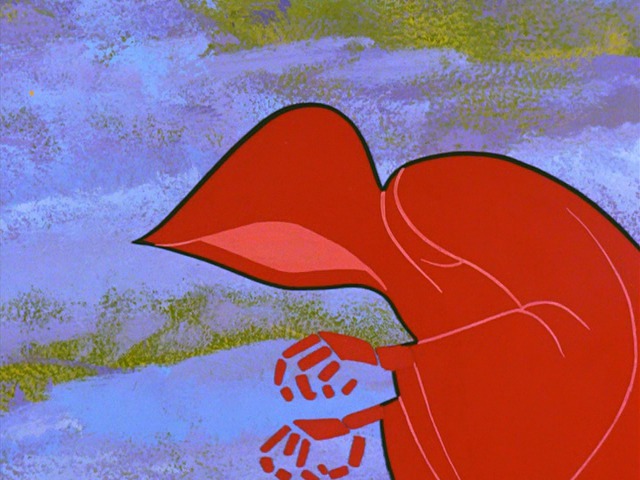
| The Ghost of Christmas Future. |
Scrooge is perplexed about whom the men are discussing and what effect they would have on his future. But the Ghost doesn’t say a word, instead leading him through the fog to a junk shop, Old Joe’s (Paul Frees), where a charwoman (Joan Gardner), a laundress (Laura Olsher) and an undertaker (Paul Frees) are there with items they’ve purloined from the recent deceased, including the curtain that hangs around his bed. They sing "We're Despicable (Plunderer's March)" about their dirty deeds.
![]() |
| The Undertaker (Paul Frees), the Charwoman (Joan Gardner), the laundress (Laurs Olsher) and Old Joe the junk store owner (Paul Frees) sing "We're Despicable (Plunderer's March)" |
Scrooge asks to be shown some tenderness connected with a death and he’s taken to the Cratchit’s, as Bob is returning home from visiting Tiny Tim’s gravesite. Scrooge is disturbed by Tiny Tim’s death. He asks if there was something he could have done to have saved Tiny Tim and asks to be taken to where he is now. That answer is a cemetery, where the Ghost of Christmas Future takes him to his own grave.
The Ghost melts away, leaving Scrooge alone. He reprises “Alone in the World,” ending the Act.
The next morning, Scrooge awakes in his own bed after pleading again for the Ghost to give him answers. Realizing he’s still alive, he promises himself that he will not let the future end as predicted.
![]() |
| Scrooge greets the Christmas morning full of love. |
He thanks Marley for showing him the way. He dances about the bedroom before lighting to the window, not sure how long he’s been with the spirits or even what day it is. He sees a boy (Laura Olsher) down on the street who tells him that it’s Christmas. He beckons the boy to go buy the large turkey, bigger than the boy, that hangs in a nearby butcher’s shop window.
Dressing in a top hat, but still in his night clothes, Scrooge goes outside and meets the butcher, paying him to deliver it to the Cratchits, but not tell them who sent it, and paying the boy for running the errand. Later, fully dressed, Scrooge walks the streets of London spreading the good word of Christmas. When he comes across the charity solicitors on the streets, he gives them a healthy donation for their cause.
Meanwhile, the Cratchits are sitting down to their Christmas meal. Bob offers a toast to Mr. Scrooge, which his wife (Laura Olsher) only sarcastically agrees to. She seems upset, even though there is a large turkey on their table. Bob is only beginning to carve it when there is a knock on the door. Scrooge is at the door and initially berates Cratchit for not being at work. Fearing the worst, Cratchit is surprised when Scrooge offers him a raise instead of discipline. Scrooge wishes him and his family a Merry Christmas.
![]() |
| Scrooge lavishes the Cratchits with gifts and gives Tiny Tim his attention. |
Scrooge reprises “Ringle Ringle,” but the lyrics are now skewed towards the joys of giving away money. He showers the family with money and gifts, including the “razzleberry dressing" and "woofle jelly cake” that Tiny Tim so loves. The musical ends with a reprisal of "The Lord's Bright Blessing," but the show is not quite done.
![]() |
| The cast sings together at the end of the musical. |
While the cast takes bows to the applause of the audience, Magoo gets turned around, but straightens himself out. He goes to get the Director so that he can get applause for his work. Already in bandages, the Director is reluctant about going out front, but Magoo insists. On the way to the front of the stage, Magoo gets his foot caught in a rope that when he pulls it brings down all the scenery falling on top of the poor Director. Magoo acknowledges that he has once again brought down the house.
The special was so much of a success that it led to a Mr. Magoo TV Series, The Famous Adventures of Mr. Magoo (1964), which UPA had a hard time making. Quality suffered and the series only ran for one season. In order to keep the struggling studio afloat, its owner, Henry G. Saperstein, abandoned animation and contracted with Japan’s Toho studio to distribute that studio’s giant monster movies in the U.S.
In 2000, after Saperstein’s death, his family sold the studio and what was left of its library, Columbia retained the theatrical shorts, to Classic Media, which in turn was bought by DreamWorks Animation in 2012. That studio was acquired by NBCUniversal in 2016.
Many consider this to be their definitive version of A Christmas Carol, but in reality, the show diverts from the book. Not only are the Ghosts presented out of order, but many of the book’s characters are jettisoned as well. There is no sister Fan and thus no nephew Fred to worry about. While the screenplay retains much of the original language of the novella, how the characters speak, it changes the ending. In the book, Scrooge waits until the next morning to give Cratchit his overdue raise. In this version, Scrooge not only drops in on the Cratchits on Christmas, but offers him the raise that same day.
The "Freely adapted" credit is well-earned. Some of the changes are most likely due to production costs, even limited animation costs money, and to fit the story into the hour-long time slot. The differences between book and show don't really take away from this telling, but they are interesting to note.
And there are the songs which are sort of uneven. There is the sometimes whimsical "The Lord's Bright Blessing" with its razzleberry dressing and woofle jelly cake, the memorable “We're Despicable (Plunderer's March)," the sentimental “Alone in the World” and the forgettable “Winter Was Warm.” So unmemorable is the last one, is that even though this wasn't our first time to watch this, none of us remembered the song and only grew restless hearing it for what had to be the fourth or fifth time.
The voice acting is pretty much dominated by Jim Backus, who is better known to a generation as Thurston Howell the third on the television show “Gilligan’s Island.” While not Shakespeare, the part gave Backus the chance to ham it up and bring home a steady paycheck. Backus also makes a cameo in the star-studded It’s a Mad, Mad, Mad, Mad World (1963).
While there has been much speculation that talented voice actress June Foray appears in the special, she has denied it and was in fact not in the cast. Several women voice actresses were in the production, perhaps most notably Joan Gardner and Laura Olsher, both of which play multiple roles. No doubt their talents helped keep the production costs down. Other actors, like Paul Frees, play multiple characters, while others like Morey Amsterdam receive higher billing than their limited work would suggest. For the most part, all the characters sound different.
Even though this was made for television, rebroadcasts have not been kind to the story. As mentioned before, the bookend stories are often edited out for more commercials and there is a sequence that appeared in the original broadcast that has not made it to subsequent airings or even to its DVD release. That scene involves the Ghost of Christmas Past taking Scrooge to a large country home, where he sees Belle with her husband and children. While she has a happy family life, when her husband mentions seeing Scrooge in town and how unhappy he looked, it brings back fond memories to Belle. "Winter Was Warm" is reprised, underscoring the happiness Scrooge has missed out on and the feeling of loss Belle still feels when it comes to her love of Scrooge.
There were other scenes that were discussed and even sketched, but not produced. One involves the death of Tiny Tim, which one can only imagine might have been a strong image for family animated show in the early 1960s.
To read reviews of other Christmas films, please see our Christmas Review Hub.
Sunday, October 7, 2012
Stubs – Dr. No
DR. NO (1962)
Starring: Sean Connery, Joseph Wiseman, Ursula Andress, Jack Lord, John
Kitzmiller. Directed by Terence Young. Screenplay by Richard Malbaum, Johanna
Harwood, Berkeley Mather. Based on Ian Fleming’s novel Dr. No. Produced by Harry Saltzman, Albert R.
Broccoli. Run Time: 110. Color. UK. Action, Espionage
Fifty years ago on October 5, 1962, two monumental events
occurred in British culture that have resonated across the globe. On this date,
The Beatles released their first single on Parlophone records, Love Me Do b/w
P.S. I Love You. The single did well, climbing to number 17 on the British
charts, thanks in large part to orders from NEMS record store in Liverpool.
Brian Epstein, the Beatles manager also happened to run NEMS. The Beatles next
single Please Please Me in 1963, would do much better climbing to Number 1 and
the next seven years the group would not only dominate the British pop charts,
but also everywhere else in the world. They are still to this day the standard by which other rock and pop musical artists are judged. (See reviews of their films by clicking here.)
Also on that date, the first James Bond film, Dr. No,
opened, based on the popular novel by Ian Fleming. In the intervening 50 years,
there have been 24 Bond films, with the 25th, Skyfall, opening next
month. The film series now the second highest grossing just behind the eight
Harry Potter films, has gone through several changes, including seven different
actors playing the title role of the spy with a license to kill.
(On a side note, October 5, 1969 saw the first Monty
Python’s Flying Circus episode on the BBC, but that’s an entry for another
blog.)
Watching the first Bond film, especially against more
current incarnations, you can see the elements of the franchise being formed. Dr. No is in many ways a primer for the rest of the series. To begin with, the opening title sequence to future films seem to use this one
as a model. They will get more polished and the production values will get
better, but the targeting of the Bond character and his subsequent shooting of
the sniper started here.
We get a peek into the infrastructure of M16, the British
organization that employs Bond and gives him double 0 status, which allows him
to kill when necessary. His boss in this film and in every subsequent Bond film
is M. Here it is played by Bernard Lee.
Then there is the Bond theme, that quintessential piece of
music that has played in every Eon-produced Bond film since. It is much like
hearing a fanfare from one of the Star Wars films. The experience is not
complete without it. Connery also delivers the “Bond. James Bond” line for the
first time as well as drinks his vodka martini shaken not stirred.
Bond is a womanizer, sleeping with three women in this film.
But there is no nudity and the sex is always off screen. That is also a
characteristic of the franchise which alludes to the sex, but avoids the down
and dirty. We have the first Bond Girl, Ursula Andress (aka Ursula Undress for
subsequent roles and Playboy photo spreads), as Honey Ryder. And we also have
Miss Moneypenny (here played by Lois Maxwell), whom Bond flirts with before and
after his meeting with M.
And of course, we have a well-funded villain, Dr. Julius No
(Joseph Wiseman), a millionaire Chinese businessman, who is part of an
organization called SPECTRE (Special Executive for Counter-intelligence,
Terrorism, Revenge, and Extortion), with a vague mission of taking over the
world. [Ever wonder where the TV show, the Man from U.N.C.L.E. (United Network
Command for Law Enforcement) got THRUSH, or Get Smart got CONTROL and KAOS?
Acronyms were all the rage in the 60’s.]
But this is not the high tech heavy product placement show
that Bond films have become. There are really no gadgets, so no Q. The only
thing Bond gets is a new gun. I don’t believe he even drives an Astin Martin in
the film, a car that would be synonymous with Bond.
The story starts with the assassination of the British
Intelligence Station Chief in Jamaica, John Strangways (Timothy Moxon) and his
secretary by three assassins, introduced to the tune of Three Blind Mice. M
(Bernard Lee) sends James Bond (Connery) to investigate and to see if it is
connected to Strangways work with the CIA on radio interference effecting
launches from Cape Canaveral.
Upon his departure from the plane, a female photographer
tries to take Bond’s photo and he is greeted by a driver who tells him he’s
from Government House. A quick phone call to Pleydell-Smith (Louis Blaazer) at
Government House determines that no such car was sent, but Bond gets in anyway.
They are followed by two men in a convertible, but they manage to pull off the
road and the convertible passes by. When Bond interrogates the driver about who
sent him, the driver takes a bite out of a cyanide laced cigarette and commits
suicide rather than talk.
Bond continues with his investigation, going to Strangways’ house.
There he finds a receipt for work done by Professor R.J. Dent (Anthony Dawson)
and locates a photo of Strangways with a boatman that he later finds out is
named Quarrel (John Kitzmiller), whom Bond recognizes as the driver of the
chase car from the airport. At first, Quarrel is uncooperative, but Bond
follows him to a local bar where he promises to talk in private. But Quarrel,
with the help of the owner of the bar, tries to beat up Bond. However, Bond is
able to turn the tables on them and is only stopped when the second man in the
chase car shows up. He turns out to be CIA agent, Felix Leiter (Jack Lord),
whom Bond had been told would help him.
Leiter reveals that the CIA had determined that the radio
interference was coming from the vicinity of Jamaica, but that aerial
photography could not reveal the source. Quarrel tells them that he had taken
Strangways around to the various islands, where Strangways would take samples.
However, there was one island that they had to sneak onto, Crab Key, which is
owned by a mysterious Dr. No. On the island is a bauxite mine, which Dr. No
protects with armed security and radar.
Bond takes the receipt to Professor Dent, who tells him that
Strangways had brought him rock samples, which Dent determined were worthless
and discarded. Dent, though is alarmed and takes a boat out to Crab Key to see
Dr. No, who is displeased that Dent has been unable to kill Bond. He gives Dent
a tarantula to put into Bond’s bedroom.
When he catches Playdell-Smith’s secretary, Miss Taro (Zena
Marshall), listening at the door, he doesn’t turn her in, but rather invites
her to show him the island. She reluctantly agrees.
When Bond tests Quarrel’s boat, where Strangways samples
were stored, with a Geiger counter that he picked up at Government House, he
find that it is still radioactive. He shares what he finds out with Leiter and
together they convince a reluctant Quarrel to return to Crab Key. Quarrel is
nervous because legend has it that there is a dragon on the island, but Leiter
tries to convince him that it is a rumor circulated by Dr. No.
Miss Taro calls James to change their meeting from his hotel
to her apartment, which happens to be located up some deserted road off a
cement factory. It is of course a ruse and Bond is nearly run off the rugged
mountain road. But instead, and as always, he turns the tables and the car
chasing him is the one that goes over the railings to a fiery death.
Miss Taro is surprised that James has shown up at her door
and calls into her boss for instructions. She is told to keep him occupied for
a couple of hours. What better to way then to have sex? But Bond must sense
this is a set up. He calls for a cab under the guise that his car is won’t
start, but the cab turns out to be the police, who take Miss Taro into custody.
Then Bond goes back into the apartment to wait for his assassin to arrive. That
turns out to be Professor Dent, who empties his gun into a pillow Bond has
arranged on the bed. When Dent’s gun is empty, Bond reveals himself. But Dent
tries to escape and Bond cold-bloodedly kills him.
Later that night, Leiter, Quarrel and Bond head out to Crab
Key. Leiter returns to the harbor with the motor boat, leaving Bond and Quarrel
to row into shore. They manage to evade radar, hide the boat and get some
sleep. The next morning, Bond meets Honey Ryder (Andress), a local girl who
collects conch shells and looks really hot in her iconic white bikini.
While Honey doesn’t trust Bond at first, she leads Quarrel
and him to her secret hiding place. But on the way, they are overrun by island
security, but manage to escape capture. But their freedom is short-lived. That
night, the three are besieged by the island’s legendary “dragon” which is an
armored vehicle with a flamethrower attachment. In the brief fire fight,
Quarrel is burned to death and Bond and Honey taken prisoner.
After being decontaminated, Bond and Honey are taken to a
prison which more resembles a luxury hotel suite. But the two of them drink
coffee that is drugged and they pass out. Later at dinner, Bond finally meets
Dr. No (Wiseman), who reveals SPECTRE’s plan to disrupt the next American space
launch with his atomic-powered radio beam. Honey is taken away by security and
Bond is beaten by the guards and thrown into a real prison cell.
But Bond manages to escape through a vent and, dressed like
a worker, manages to get into the control room, with an atomic reactor set in
the floor, all overseen by Dr. No. Bond manages to slip past guards and
overloads the nuclear reactor, just as the American spacecraft launches. Bond
and Dr. No get into hand-to-hand combat, which results in the good-doctor being
boiled alive in the nuclear reactor’s cooling vat.
On his way out, Bond rescues Honey from being drowned and
the two escape in a motor boat, just as the island’s reactor explodes. Their
boat runs out of fuel, but they are rescued by Leiter who has a bigger boat.
Viewing this film in hind-sight, which is the only way to
look at it 50 years later, Dr. No seems quainter than subsequent films in this
series. There is judo, but no parkour. The special effects are kept to a
minimum. And this is somewhat more of a detective story than espionage film. Also,
the pacing is slow by today’s standards, but that’s true with many films made
before television dissected our attention span into five minute segments.
One reason to watch Dr. No is to see Sean Connery play James
Bond. He seems born to play this part and watching subsequent actors play the
part is sort of like watching someone else play Harry Potter other than Daniel
Radcliffe or someone other than Yul Brenner in the King and I. Others could
play the part, but they only pale by comparison.
If you’re a fan of Bond films, especially the ones with
Daniel Craig or Pierce Brosnan, you owe it to yourself to see how the franchise
started. Overall, this is a very solid film. And while the films may get better
production values, the stories don’t always get bigger and better than this.
Subscribe to:
Posts (Atom)